
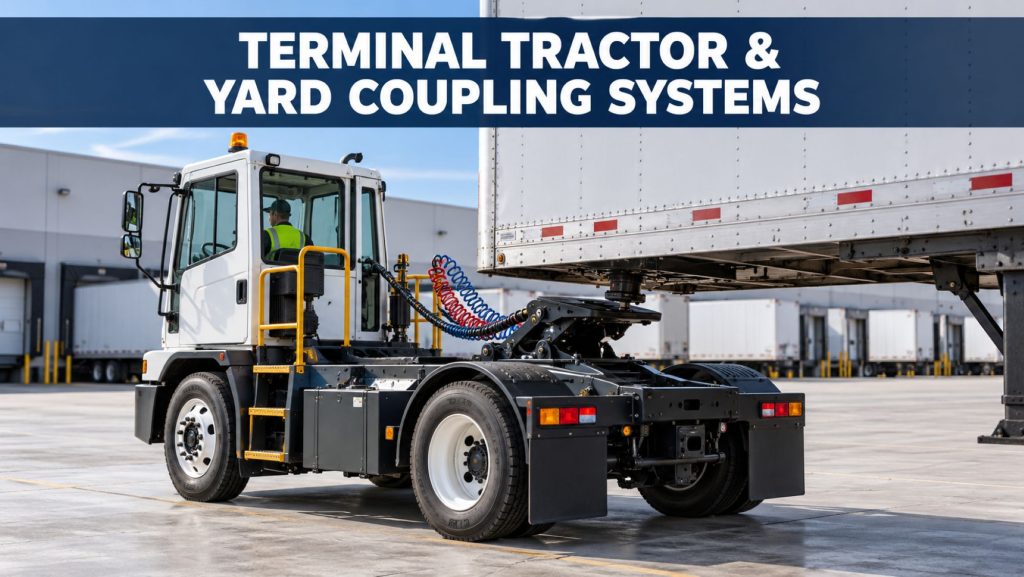
Terminal tractor and yard coupling systems are designed for the frequent movement of semitrailers within distribution centers, freight terminals, ports, warehouses, manufacturing facilities, intermodal yards, and other controlled operating areas.
Unlike conventional highway tractors, terminal tractors commonly use hydraulically lifting fifth wheels that allow operators to raise a trailer without fully retracting its landing gear. This design can reduce the time required to couple, move, and reposition trailers during repetitive yard operations.
This section of Truck Equipment Atlas covers terminal-tractor fifth wheels, hydraulic lifting systems, automatic coupling technology, yard-tractor equipment, trailer-connection components, and related safety systems.
Terminal Tractor and Yard Coupling Products on Truck Equipment Atlas
Dedicated terminal-tractor vehicle profiles are not yet available. The overview below explains yard coupling systems and their applications.
How Terminal Tractor Coupling Systems Work
A terminal tractor couples to a semitrailer through a fifth wheel and kingpin in a manner similar to a highway tractor. The operator backs beneath the trailer until the kingpin enters the fifth-wheel throat and engages the locking mechanism.
The major difference is the addition of a hydraulic lifting structure beneath the fifth wheel. After coupling, hydraulic cylinders raise the fifth wheel and the front of the trailer high enough to move it without requiring the operator to fully retract the landing gear.
The operator connects the trailer air lines and electrical cable when the trailer’s brakes, lights, or other systems are needed during the move. After the trailer reaches its assigned location, the lifting system lowers it onto its landing gear before the fifth wheel is released.
Major System Components
A terminal tractor and yard coupling system may include the following components:
- Fifth-wheel top plate
- Kingpin locking mechanism
- Release handle or in-cab release control
- Hydraulic lifting frame
- Hydraulic lift cylinders
- Hydraulic pump and reservoir
- Hydraulic hoses and control valves
- Pivot pins and bushings
- Fifth-wheel mounting brackets
- Trailer air-line connections
- Electrical cable and trailer connector
- Coupling cameras or proximity sensors
- Kingpin lock sensors
- Trailer-presence sensors
- Automatic coupling equipment where installed
Hydraulic Fifth-Wheel Lifting Systems
The hydraulic lifting fifth wheel is one of the defining features of a purpose-built terminal tractor. The lifting structure raises the trailer’s front end while the landing gear remains extended near the ground.
This system can substantially reduce the number of times an operator must enter and exit the cab to crank landing gear during short yard moves. The landing gear must still provide adequate ground clearance and remain structurally capable of supporting the trailer when it is lowered.
Lift capacity, lift height, fifth-wheel height, hydraulic pressure, and operating range vary by tractor model and application. Operators should never use the hydraulic lift to exceed the ratings of the tractor, fifth wheel, trailer, landing gear, or coupling structure.
Fifth-Wheel Locking and Release Systems
The fifth-wheel locking mechanism closes around the trailer kingpin during coupling. Depending on the equipment, the lock may be released using an external handle, an in-cab pneumatic control, a hydraulic control, or an electronically managed system.
An in-cab release system can reduce the need for the operator to leave the cab during repetitive trailer moves. However, the system must include safeguards that prevent unintended release while the tractor and trailer are under load or moving.
Operators should follow the manufacturer’s coupling procedure and verify that the lock is fully engaged before moving the trailer.
Automatic Trailer Coupling Systems
Automatic coupling systems can combine fifth-wheel locking, air connections, electrical connections, sensors, and operator controls into a coordinated trailer-connection process.
Depending on the system, automatic coupling equipment may provide:
- Automatic kingpin lock confirmation
- Remote fifth-wheel release
- Automatic air-line connection
- Automatic electrical connection
- Trailer-presence detection
- Coupling-status indicators
- Incorrect-coupling warnings
- Integration with yard-management software
- Support for automated terminal tractors
Compatibility depends on the tractor, trailer fleet, fifth wheel, kingpin, pneumatic connections, electrical connections, and facility operating system.
Trailer Air and Electrical Connections
Terminal tractors may use standard gladhand air connections and commercial trailer electrical connectors. The exact connections required depend on whether the trailer must have operational brakes, lights, antilock braking, or other electrical systems during the yard move.
Frequent coupling cycles can accelerate wear on air hoses, gladhands, seals, cables, plugs, and mounting brackets. Connections should be positioned where operators can reach them safely without creating excessive stretching, dragging, or interference during turns.
Coupling Cameras and Sensors
Rear-facing cameras can help operators align the fifth wheel with the trailer kingpin. Additional sensors may monitor kingpin position, fifth-wheel lock status, trailer presence, hydraulic lift position, or connection status.
These systems can improve visibility and provide useful warnings, but they do not eliminate the need for proper operator training and physical inspection when required by the equipment manufacturer or facility procedure.
Terminal Tractors and Highway Tractors
A terminal tractor is purpose-built for frequent trailer movement over short distances. It commonly has a short wheelbase, tight turning radius, offset cab, rear cab access, automatic transmission, high-visibility windows, and hydraulically lifting fifth wheel.
A conventional highway tractor is designed for sustained road travel at highway speeds. It normally uses a fixed-height fifth wheel and requires the trailer landing gear to be fully retracted before movement.
Some terminal tractors are configured and certified for limited public-road operation. Other models are intended only for private property and should not be operated on public roads.
On-Road and Off-Road Terminal Tractors
On-road terminal tractors include the equipment and certification required for approved public-road operation. Depending on the jurisdiction, this may include lighting, mirrors, brakes, tires, emissions equipment, vehicle identification, registration, and other road-use requirements.
Off-road terminal tractors are designed primarily for controlled facilities. They may use different gearing, speed limits, axle configurations, lighting packages, and safety equipment.
A tractor’s appearance does not confirm whether it is approved for public roads. Operators should verify the vehicle’s certification and local requirements before leaving private property.
Diesel, Alternative-Fuel, and Electric Yard Tractors
Terminal tractors are available with diesel engines, compressed natural gas systems, hydrogen fuel-cell powertrains, and battery-electric propulsion.
Battery-electric terminal tractors can be well suited to repetitive yard operations because they operate from a central facility, follow predictable duty cycles, and can return to assigned charging equipment. They can also reduce local exhaust emissions and engine-related maintenance.
Powertrain selection should consider daily operating hours, trailer weight, grades, climate, charging or fueling infrastructure, shift schedules, energy costs, maintenance support, and required vehicle availability.
Common Applications
- Distribution centers
- Freight terminals
- Warehouse complexes
- Manufacturing plants
- Intermodal rail yards
- Marine ports and container terminals
- Parcel and less-than-truckload terminals
- Food and beverage facilities
- Retail distribution operations
- Cold-storage facilities
- Trailer storage yards
- Large industrial campuses
Trailer Compatibility
A terminal tractor must be compatible with the trailers used at the facility. Important considerations include:
- Kingpin size and condition
- Trailer coupling height
- Upper-coupler condition
- Landing-gear strength and ground clearance
- Trailer weight and load distribution
- Air-line and electrical-connector locations
- Trailer brake requirements
- Rear-of-cab and frame clearance
- Maximum articulation during tight turns
- Refrigeration-unit and accessory clearance
Advantages
- Designed for frequent trailer moves
- Hydraulic lift can reduce landing-gear cranking
- Short wheelbase supports tight maneuvering
- Rear cab access can simplify trailer connections
- High-visibility cab supports yard operation
- In-cab fifth-wheel release may reduce operator exit cycles
- Automatic coupling technology may improve productivity
- Electric models can reduce local exhaust emissions
- Purpose-built systems support repetitive duty cycles
Limitations and Considerations
- Some terminal tractors are not approved for public roads
- Hydraulic lifting systems add maintenance requirements
- Frequent coupling cycles accelerate component wear
- Improper trailer height can cause high or low coupling
- Landing gear can be damaged if ground clearance is inadequate
- Yard congestion increases collision risks
- Automatic coupling equipment requires compatible trailers
- Electric models require appropriate charging infrastructure
- Operators require equipment-specific training
Operator Safety and Yard Procedures
Terminal operations involve frequent reversing, tight spaces, pedestrians, parked trailers, dock equipment, and other moving vehicles. Facilities should establish clear traffic patterns, speed limits, communication procedures, trailer-placement rules, and pedestrian-control measures.
Before moving a trailer, the operator should verify:
- The fifth wheel is correctly positioned beneath the trailer
- The kingpin is fully locked
- The trailer upper coupler is resting correctly on the fifth wheel
- The trailer doors and cargo are secured
- Required air and electrical connections are attached
- The trailer brakes have released when required
- The landing gear has adequate ground clearance
- No person or equipment is within the travel path
- The destination and trailer position are confirmed
Maintenance and Inspection
Terminal tractor coupling systems often complete many more coupling cycles than highway fifth wheels. Inspection frequency should reflect the number of moves, operating environment, trailer condition, and manufacturer requirements.
Routine inspection and maintenance should include:
- Cleaning and lubricating the fifth-wheel top plate
- Checking lock adjustment and kingpin clearance
- Inspecting locking jaws and release components
- Checking the lifting frame for cracks or deformation
- Inspecting hydraulic cylinders for leakage
- Checking hydraulic hoses, fittings, and fluid level
- Inspecting pivot pins and bushings
- Testing in-cab release controls and safety interlocks
- Inspecting air hoses, gladhands, seals, and cables
- Cleaning cameras and testing coupling sensors
- Checking mounting fasteners and frame structures
- Inspecting the tractor after impacts or incorrect coupling events
Common Coupling-System Problems
Fifth wheel will not lock: Incorrect trailer height, damaged locking components, accumulated debris, hardened grease, misalignment, or a damaged kingpin may prevent engagement.
Fifth wheel will not release: Pressure between the tractor and trailer, inadequate air pressure, damaged release equipment, corrosion, or an incorrectly adjusted lock may prevent release.
Hydraulic lift will not raise: Low hydraulic fluid, pump failure, leaking hoses, cylinder damage, valve problems, electrical faults, or excessive trailer weight may be responsible.
Hydraulic lift settles: Internal cylinder leakage, control-valve leakage, damaged seals, or external hydraulic leaks can allow the trailer to lower unexpectedly.
Landing gear contacts the ground: Insufficient lift height, uneven pavement, trailer overloading, damaged landing gear, or incorrect fifth-wheel adjustment may reduce clearance.
Excessive kingpin movement: A worn kingpin, worn locking components, or incorrect lock adjustment can create looseness and impact loading.
Trailer brakes will not release: Damaged gladhands, leaking air lines, low tractor air pressure, frozen components, or trailer brake-system faults may prevent movement.
Coupling sensor warning: A dirty sensor, damaged wiring, incorrect alignment, incomplete locking, or a failed switch can produce an unsafe or incorrect status indication.
Choosing a Terminal Tractor Coupling System
Terminal tractor and coupling-system selection should reflect the facility, trailer fleet, operating schedule, and required productivity.
Important selection factors include:
- Maximum trailer and kingpin load
- Required fifth-wheel lift capacity
- Required lifting height and range
- Number of trailer moves per shift
- Facility grades and pavement conditions
- On-road or off-road certification
- Diesel, alternative-fuel, or electric powertrain
- Manual or in-cab fifth-wheel release
- Automatic coupling requirements
- Air and electrical connection requirements
- Camera and sensor packages
- Parts, dealer, and service availability
Related Fifth-Wheel and Coupling Categories
- Commercial Truck Fifth Wheels
- Fifth Wheel Sliders & Mounting Systems
- Heavy-Haul & Severe-Duty Fifth Wheels
- Kingpins & Upper Couplers
- Pintle Hooks & Drawbar Couplings
Related Fifth-Wheel and Coupling Guides
- Fifth-Wheel Systems Explained
- Fixed vs Sliding Fifth Wheels
- How to Couple and Uncouple a Semitrailer
- How to Inspect and Maintain a Commercial Fifth Wheel
- Fixed vs Sliding Fifth Wheels
- Fifth Wheels & Coupling Equipment
Related Truck Equipment Resources
- Commercial Trucks
- Commercial Trailers
- Transmissions
- Axles & Differentials
- Suspension Systems
- Brake Systems
- Electrical Systems
- Equipment Systems
Explore the Complete Fifth-Wheel and Coupling Library
Visit the Fifth Wheels & Coupling Equipment hub to explore commercial fifth wheels, slider systems, mounting equipment, heavy-haul couplings, terminal tractor systems, kingpins, upper couplers, pintle hooks, drawbar equipment, product profiles, and educational guides.