
Quick Facts
- Manufacturer: SAF-Holland
- Brand: Holland
- Product Series: FW2080
- Product Type: Fully oscillating severe-duty fifth wheel
- Mounting Type: Integrated stationary oscillating mounting system
- Maximum Vertical Load: 70,000 pounds
- Maximum Drawbar Pull: 200,000 pounds
- Kingpin Compatibility: 3.5-inch kingpin on the current North American configuration
- Release Type: Manual release with optional air release
- Primary Applications: Heavy haul, lowboy trailers, construction-equipment transport, and rough-terrain operations
- Primary Limitation: Intended for applications in which the loaded trailer’s center of gravity is at or below the fifth-wheel height
- Production Status: Current availability and configuration should be confirmed with SAF-Holland
Overview
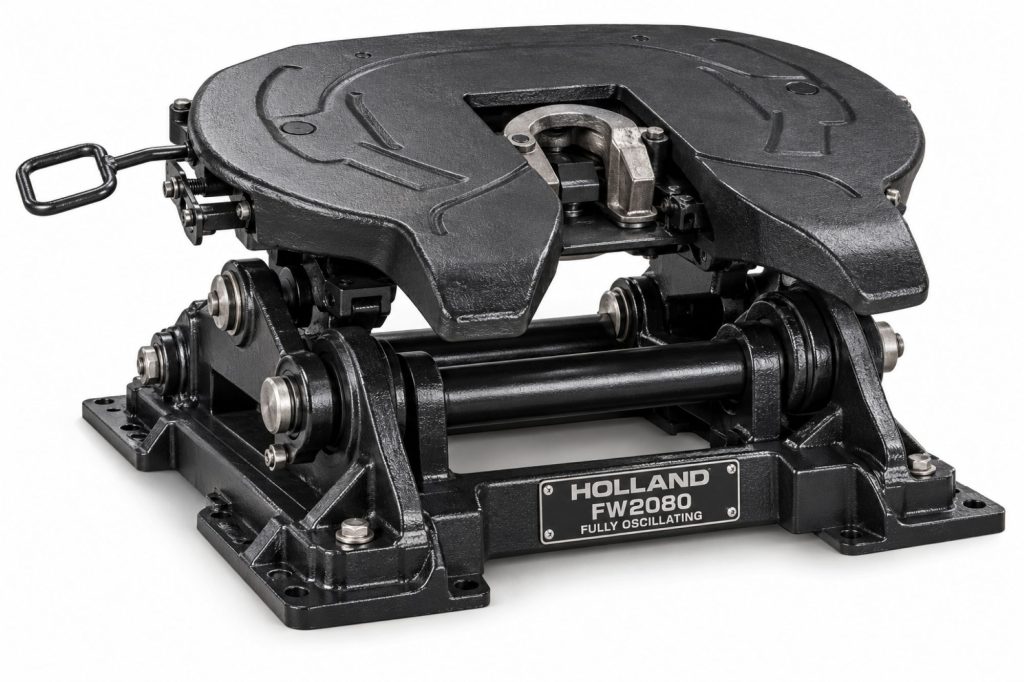
The Holland FW2080 Fully Oscillating Fifth Wheel is a severe-duty coupling system designed for trucks operating with heavy lowboy and specialized trailers over rough or uneven terrain. Unlike a conventional fifth wheel that primarily pivots forward and rearward, the FW2080 permits both longitudinal and side-to-side movement between the tractor and trailer.
This additional articulation helps the tractor and trailer follow uneven surfaces without forcing all twisting movement through the vehicle frames, trailer structure, or coupling components. The design is especially useful when transporting construction machinery and other heavy equipment into jobsites where the tractor and trailer may not remain level with each other.
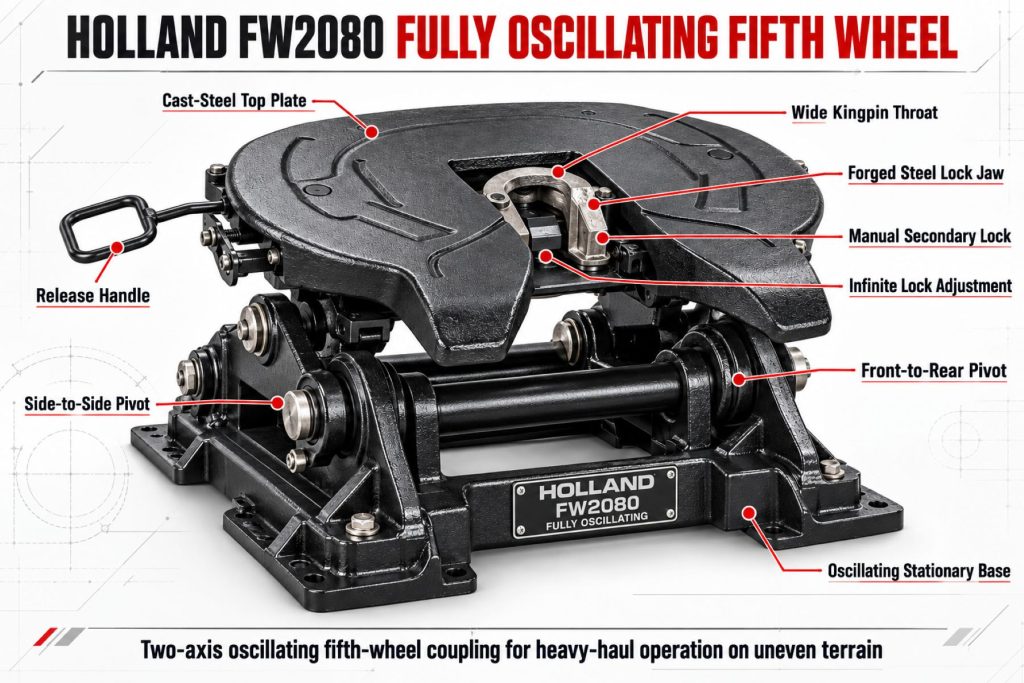
The fifth wheel combines a heavy-duty cast-steel top plate with an integrated stationary oscillating mounting system. It also uses a forged, machined, and heat-treated steel lock jaw, infinite lock adjustment, a manual secondary lock, and cast-in grease grooves.
Because a fully oscillating fifth wheel changes the vehicle’s handling characteristics, the FW2080 must only be selected for an approved application. SAF-Holland specifies that the loaded trailer’s center of gravity must be equal to or below the fifth-wheel height.
Key Characteristics
- Fully oscillating fifth-wheel design
- Front-to-rear and side-to-side articulation
- Severe-duty cast-steel top plate
- Integrated stationary mounting system
- 70,000-pound maximum vertical-load rating
- 200,000-pound maximum drawbar-pull rating
- 3.5-inch kingpin lock on the current North American model
- Forged, machined, and heat-treated steel lock jaw
- Infinite lock adjustment
- Manual secondary lock
- Cast-in grease grooves
- Optional air-release mechanism
- Optional oscillator lockouts
- Designed for rough and uneven terrain
- Intended for approved low-center-of-gravity applications
Major Components
- Cast-steel fifth-wheel top plate
- Kingpin throat
- Heat-treated steel lock jaw
- Lock-adjustment mechanism
- Manual secondary lock
- Release handle and linkage
- Oscillating mounting base
- Rocker and bracket assemblies
- Pivot points and bushings
- Mounting brackets
- Mounting fasteners and shear stops
- Grease grooves and lubrication fittings
- Optional oscillator lockouts
- Optional air-release cylinder and controls
Coupling Type and Design
The FW2080 is a fully oscillating fifth wheel rather than a standard semi-oscillating highway fifth wheel. Its mounting system allows the top plate to articulate forward and rearward while also moving from side to side.
The current North American FW2080 uses a 3.5-inch kingpin lock intended for compatible severe-duty trailers. Older, export, or application-specific versions may use different kingpin configurations, so the complete model and top-plate identification must be checked before ordering a fifth wheel or replacement components.
How the Coupling System Works
During coupling, the trailer kingpin enters the fifth wheel’s throat as the tractor backs beneath the trailer. The lock jaw closes around the kingpin, and the secondary locking system helps prevent unintended release.
After coupling, the top plate supports the trailer’s imposed vertical load while the locking mechanism transfers pulling and braking forces between the tractor and trailer. The oscillating mount permits controlled movement in two planes as the combination crosses uneven ground.
The lock mechanism uses infinite adjustment to compensate for normal wear within its approved service limits. This does not eliminate the need for inspection, measurement, lubrication, or replacement of worn parts.
Position and Function Within the Vehicle
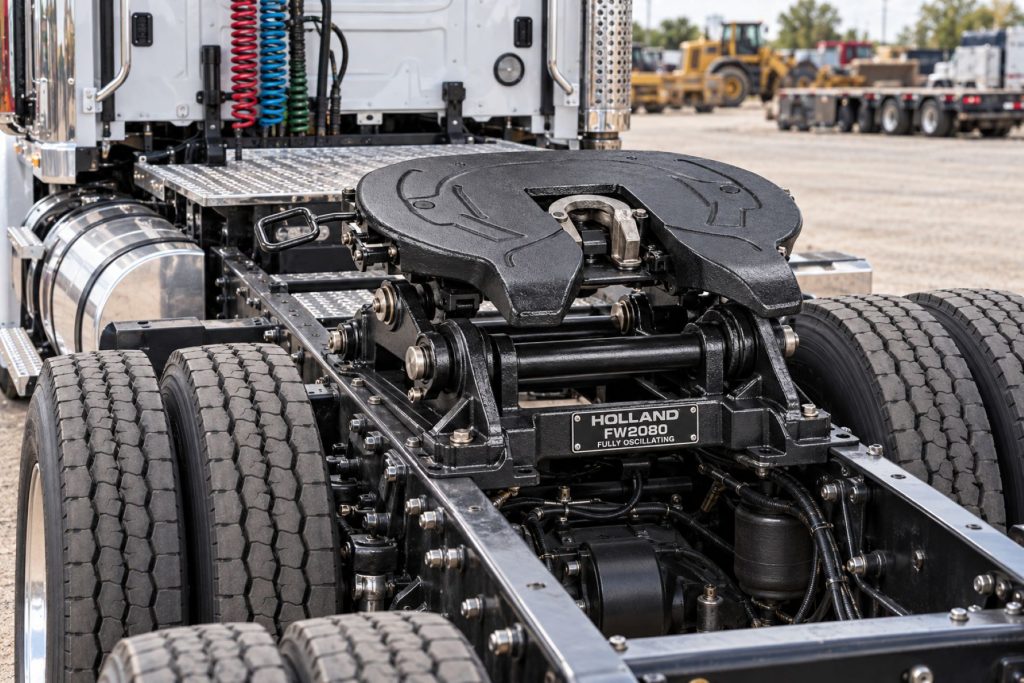
The FW2080 mounts above the tractor frame and rear-axle area. It forms the primary structural connection between the tractor and a compatible semitrailer.
The fifth wheel supports the front of the trailer, captures the trailer kingpin, transfers pulling and braking forces, and permits articulation between the two vehicles. Its side-to-side oscillation helps accommodate cross-axle terrain where the tractor and trailer would otherwise twist against one another.
Common Specifications
- Fifth-Wheel Type: Fully oscillating severe-duty fifth wheel
- Construction: Cast-steel top plate
- Maximum Vertical Load: 70,000 pounds
- Maximum Drawbar Pull: 200,000 pounds
- D-Value: 270 kN for the current North American 3.5-inch configuration
- Kingpin Size: 3.5 inches on the current North American model
- Mounting Arrangement: Stationary integrated oscillating mounting base
- Assembly Height: Approximately 14 inches for the listed FW2080-O stationary assembly
- Approximate Assembly Weight: 860 pounds for the listed FW2080-O configuration
- Lock Adjustment: Infinite adjustment
- Secondary Lock: Manual
- Air Release: Optional
- Oscillator Lockouts: Optional
Specifications can differ between markets, production periods, kingpin sizes, and complete assembly numbers. Confirm the identification plate and current SAF-Holland literature before making an application or parts decision.
Load Ratings and Operating Capacity
The current North American FW2080 carries a maximum vertical-load rating of 70,000 pounds and a maximum drawbar-pull rating of 200,000 pounds. These ratings apply only when the fifth wheel is correctly selected, installed, maintained, and operated within SAF-Holland’s application requirements.
The fifth-wheel rating does not independently determine the legal or mechanical capacity of the complete vehicle. Actual capacity remains limited by the lowest-rated tractor frame, mounting structure, axles, suspension, tires, wheels, kingpin, upper coupler, trailer structure, or other component.
The loaded trailer’s center of gravity must be equal to or below the top surface of the fifth wheel. A high center of gravity can reduce stability and create handling risks with a fully oscillating coupling.
Articulation and Oscillation
The FW2080 provides front-to-rear and side-to-side oscillation. This allows the tractor and trailer to assume different angles while moving across rough ground, crowned surfaces, jobsite entrances, and other uneven terrain.
Optional oscillator lockouts may be used in approved configurations to restrict side-to-side movement. Lockout selection and operation must follow the manufacturer’s instructions because restricting oscillation changes how forces pass through the fifth wheel and vehicle structures.
A fully oscillating fifth wheel is less laterally stable than a conventional highway fifth wheel. Drivers must account for the different handling response during cornering, lane changes, braking, and operation on side slopes.
Sliding and Adjustment System
The FW2080 uses an integrated stationary mounting system and is not a conventional fore-and-aft slider. Its normal installation does not allow the driver to reposition the fifth wheel along slider rails for axle-weight adjustment.
The term “infinite adjustment” refers to adjustment within the locking mechanism as wear occurs. It does not mean that the complete fifth-wheel assembly slides forward and rearward on the tractor frame.
Release and Locking Mechanism
The FW2080 uses a forged, machined, and heat-treated steel lock jaw to capture the trailer kingpin. Its primary mechanism is supported by a manual secondary lock that helps prevent accidental release.
A manual release handle is standard on applicable configurations. An optional air-release mechanism can allow the driver to initiate release through a pneumatic control, but the operator must still inspect the coupling and follow the complete uncoupling procedure.
The lock must never be judged by handle position alone. A visual inspection of the jaw and kingpin connection, followed by a controlled pull test, is required before road operation.
Air and Electronic Controls
Standard manually released FW2080 configurations do not require an air or electronic control system. Models equipped with the optional air-release mechanism require a compatible compressed-air supply, protected air lines, an actuator, and properly configured controls.
An air release is a release aid and does not replace visual confirmation, a pull test, parking-brake application, trailer support, or the manufacturer’s coupling and uncoupling procedures.
Mounting and Installation
The FW2080 must be mounted to a structure engineered for its vertical, pulling, braking, and oscillating loads. Installation instructions call for an adequately reinforced mounting plate, approved high-strength fasteners, and fore-and-aft shear stops at the mounting brackets.
Mounting height affects trailer clearance, driveline loading, vehicle stability, landing-gear clearance, and the relationship between the trailer’s center of gravity and the fifth-wheel surface. Fabrication and frame attachment must follow SAF-Holland instructions and the vehicle manufacturer’s requirements.
Vehicle Frame and Mounting Compatibility
Compatibility depends on the tractor frame, frame reinforcement, mounting-plate design, axle placement, suspension, tires, wheels, intended terrain, trailer load, and required fifth-wheel height.
The tractor and mounting structure must be engineered for the FW2080’s severe-duty loads. Installation should be reviewed by the truck manufacturer, body or equipment installer, qualified engineer, or another party authorized to approve the completed vehicle configuration.
Mating Component and Trailer Compatibility
The current North American FW2080 must be paired with a compatible 3.5-inch trailer kingpin and an upper-coupler structure rated for the intended service. The kingpin profile, bolster plate, mounting height, trailer swing clearance, and load rating must all match the fifth-wheel application.
The trailer must also satisfy the center-of-gravity restriction for fully oscillating operation. This requirement makes the FW2080 particularly appropriate for lowboy and low-loader trailers but unsuitable for many high-center-of-gravity trailers.
Common Applications
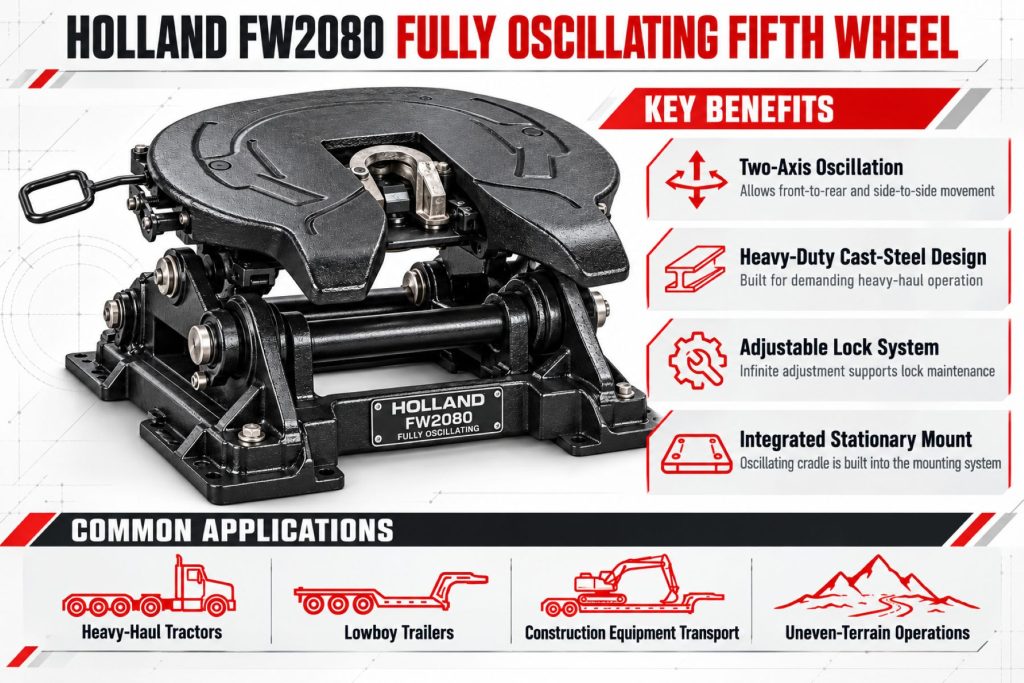
- Heavy-haul tractors
- Lowboy and low-loader trailers
- Construction-equipment transport
- Mining and quarry operations
- Oilfield and energy-service vehicles
- Off-highway equipment transport
- Rough-terrain hauling
- Specialized industrial transport
- Approved moderate- and severe-duty applications
Advantages
- Accommodates front-to-rear and side-to-side movement
- Designed for uneven and rough operating surfaces
- High vertical-load and drawbar-pull ratings
- Heavy-duty cast-steel construction
- Heat-treated steel lock jaw
- Integrated oscillating mounting system
- Infinite lock adjustment
- Manual secondary lock
- Optional air release
- Optional oscillator lockouts
- Well suited to lowboy heavy-equipment transport
Limitations or Considerations
- Loaded trailer center of gravity must be at or below fifth-wheel height
- Fully oscillating operation produces different handling characteristics
- Less laterally stable than a conventional semi-oscillating fifth wheel
- Not intended as a general replacement for every highway fifth wheel
- Heavy assembly adds substantial tractor weight
- Stationary mount does not provide normal slider adjustment
- Requires specialized mounting and frame engineering
- Oscillating pivots require additional inspection and lubrication
- Must use a compatible kingpin and upper coupler
- Capacity remains limited by the lowest-rated vehicle component
Driver and Operator Experience
A driver may notice more side-to-side movement between the tractor and trailer than with a conventional fifth wheel. This movement is intentional, but it changes the vehicle’s response during turns, lane changes, braking, and travel across side slopes.
Operators should use conservative speeds, smooth steering inputs, and careful route assessment. Extra caution is necessary whenever the trailer is heavily loaded or the combination moves over uneven terrain.
Coupling and Uncoupling Procedure
Before coupling, the driver should inspect the fifth wheel, confirm that the lock is open, check lubrication, verify the trailer height, and make sure the kingpin and upper coupler are not damaged. The trailer should contact the fifth wheel and ramp onto its surface as the tractor backs beneath it.
After the kingpin enters and the mechanism locks, the driver must perform a controlled pull test. The connection must then be inspected visually to confirm that the lock jaw is correctly positioned around the kingpin, the secondary lock is engaged, and there is no gap between the fifth wheel and trailer upper coupler.
Before uncoupling, the combination must be parked on suitable ground, the trailer secured, and the landing gear positioned to support the trailer. The driver should relieve binding from the lock before operating the release mechanism. These steps are only an overview and do not replace SAF-Holland instructions or fleet procedures.
Inspection and Wear Points
- Lock jaw and kingpin contact area
- Manual secondary lock
- Release handle and linkage
- Top-plate surface and throat
- Cast-in grease grooves
- Rocker and bracket assemblies
- Oscillating pivot points
- Bushings and pivot pins
- Mounting brackets
- Mounting plate and shear stops
- Frame attachment points
- Structural welds and fasteners
- Optional oscillator lockouts
- Optional air-release actuator and lines
- Trailer kingpin and upper-coupler plate
Lubrication Requirements
The top plate, locking mechanism, kingpin-contact surfaces, rocker assemblies, brackets, and oscillating pivots require lubrication at the intervals and locations specified by SAF-Holland.
The FW2080 includes cast-in grease grooves, but these grooves must be supplied with the correct lubricant. Rocker and bracket grease fittings also require service. Poor lubrication can increase steering resistance, accelerate wear, interfere with release, and place unnecessary stress on the tractor and trailer structures.
Maintenance and Ownership Notes
The FW2080 should be maintained using the inspection intervals, wear limits, lubricants, replacement parts, and rebuilding procedures published for the identified model. Severe off-highway service may require more frequent inspection and lubrication than normal highway operation.
Owners should monitor the top plate, lock jaw, secondary lock, release system, pivot assemblies, mounting structure, and trailer kingpin. Any cracked, bent, excessively worn, loose, or improperly repaired component should be addressed before the vehicle returns to service.
Common Coupling Problems
- High coupling: The kingpin enters above the locking mechanism instead of through the throat, potentially damaging the fifth wheel or creating an unsafe false connection.
- Failure to lock: Dirt, damage, poor adjustment, component wear, incorrect trailer height, or binding may prevent the jaw and secondary lock from engaging.
- Difficult release: Tractor-to-trailer pressure, dry components, damaged linkage, worn parts, or improper adjustment can make the release handle difficult to operate.
- Excessive kingpin play: Wear in the lock jaw, kingpin, or related components can create excessive movement and impact loading.
- Restricted oscillation: Dry pivots, damaged brackets, contamination, seized components, or incorrectly used lockouts can restrict movement.
- Excessive oscillation wear: Worn bushings, pivot pins, rocker components, or mounting parts can create looseness, noise, and poor control.
- Air-release failure: Low air pressure, damaged lines, valve problems, or a failed actuator may prevent an optional pneumatic release from operating.
- Structural damage: Overloading, high-center-of-gravity operation, loose mounting hardware, impacts, or improper installation can damage the mounting system or vehicle frame.
Safety and Service Precautions
Never operate the FW2080 with a trailer whose loaded center of gravity is above the fifth-wheel surface. Never exceed the fifth wheel’s ratings or the ratings of the tractor, mounting system, kingpin, upper coupler, or trailer.
Always confirm coupling through both visual inspection and a controlled pull test. Never place any part of the body between unsecured vehicles, beneath an unsupported trailer, or near an oscillating assembly that can move unexpectedly.
Repairs, welding, heating, machining, or component substitutions should not be performed unless specifically authorized by the manufacturer’s procedures.
Identification Information
Identification information may be found on a model plate, tag, casting, mounting base, or vehicle build record. Record the complete model and assembly numbers before ordering components.
- Holland FW2080 model designation
- Complete assembly and top-plate numbers
- Serial or production number
- Kingpin-lock size
- Fifth-wheel height
- Manual or air-release configuration
- Oscillator-lockout configuration
- Mounting-base type
- Vehicle identification number
- Trailer kingpin and upper-coupler information
Buying Considerations
- Confirm the required vertical-load and drawbar-pull ratings
- Verify the trailer’s loaded center-of-gravity height
- Match the fifth wheel to the correct kingpin size
- Confirm tractor-frame and mounting-plate strength
- Verify the required installed height
- Check tractor-to-trailer swing and articulation clearance
- Choose between manual and optional air release
- Determine whether oscillator lockouts are required
- Confirm replacement-parts and service support
- Review the additional weight of the complete assembly
- Use an installer experienced with severe-duty fifth wheels
- Confirm the current SAF-Holland application approval
Variants and Configurations
FW2080 configurations have varied by market, production period, kingpin size, release system, mounting arrangement, and oscillator-lockout equipment.
- North American 3.5-inch kingpin configuration
- Legacy or export 2-inch kingpin versions
- Manual-release arrangement
- Optional air-release arrangement
- Standard fully oscillating mount
- Optional oscillator lockouts
- Application-specific top-plate and mounting-base assemblies
These configurations should not be assumed interchangeable. Use the complete assembly number and current manufacturer information when selecting parts or a replacement fifth wheel.
Comparison to Similar Equipment
Compared with the Holland FW70 Heavy-Duty Fifth Wheel, the FW2080 adds full side-to-side oscillation for uneven-terrain operation. The FW70 is a heavy-duty fifth wheel but uses a more conventional articulation arrangement.
Compared with the Holland FW35 Fifth Wheel, the FW2080 provides greater vertical-load and drawbar-pull capacity and is intended for more specialized severe-duty service.
Compared with the Holland Kompensator Mounting System, the FW2080 integrates its fully oscillating function into a complete severe-duty fifth-wheel assembly.
Best Fit For
- Heavy-haul tractors operating over uneven terrain
- Lowboy and low-loader trailer combinations
- Construction-equipment transport
- Approved trailers with a low loaded center of gravity
- Severe-duty applications requiring 3.5-inch kingpin compatibility
- Operations requiring both longitudinal and lateral articulation
- Fleets able to support specialized inspection and maintenance
Related Vehicle and Trailer Types
- Heavy Haul Freight Guide
- Complete Guide to Semi Truck Types
- Lowboy Trailers
- Flatbed Trailers
- Removable Gooseneck Trailers
- Heavy-Haul Tractors
- Construction Trucks
Related Truck and Trailer Models
- Kenworth T880
- Peterbilt 567
- Western Star 49X
- Mack Granite
- International HX Series
- Volvo VHD
- Freightliner 122SD
Related Coupling Types
- Commercial Truck Fifth Wheels
- Heavy-Haul & Severe-Duty Fifth Wheels
- Fifth Wheel Sliders & Mounting Systems
- Trailer Kingpins & Upper Couplers
- Terminal Tractor & Yard Coupling Systems
- Pintle Hooks & Drawbar Couplings
Related Coupling Products
- Holland FW35 Fifth Wheel
- Holland FW33 Low-Lube Fifth Wheel
- Holland FW17 Lightweight Fifth Wheel
- Holland FWAL Aluminum Fifth Wheel
- Holland FW70 Heavy-Duty Fifth Wheel
Related Equipment Systems
- Fifth Wheels & Coupling Equipment
- Suspension Systems
- Axles & Differentials
- Brake Systems
- Tires & Wheels
- Equipment Systems
Related Guides
- Fifth Wheel System Explained
- Fixed vs Sliding Fifth Wheels
- How to Couple and Uncouple a Semi-Trailer Safely
- How to Inspect and Maintain a Fifth Wheel and Kingpin
- How to Choose a Commercial Truck Fifth Wheel
Regulatory and Compliance Notes
The fifth wheel, mounting structure, kingpin, upper coupler, tractor, and trailer must comply with applicable commercial-vehicle construction and operating requirements. Installation must not exceed certified axle, frame, suspension, tire, wheel, or gross vehicle weight ratings.
Heavy-haul combinations may also be subject to permits, route restrictions, axle-weight limits, bridge requirements, dimensional limits, and equipment-specific inspection rules. Mechanical capacity does not replace legal approval for a particular load or route.
Real World Operating Notes
The FW2080 is most useful when a heavy trailer must articulate across ground that would twist a conventional tractor-trailer combination. Its movement can reduce structural binding, but it also requires a driver who understands the handling of a fully oscillating coupling.
Operators should inspect the route for side slopes, soft ground, abrupt transitions, overhead restrictions, and areas where trailer articulation could create clearance problems. Load placement is especially important because the trailer’s loaded center of gravity must remain at or below the fifth-wheel surface.
Fifth-wheel lubrication and pivot maintenance should be treated as essential operating requirements rather than cosmetic service. Heavy loads and contaminated jobsite conditions can accelerate wear quickly.
Frequently Asked Questions
What is the Holland FW2080?
It is a severe-duty, fully oscillating fifth wheel designed to provide both front-to-rear and side-to-side movement between a tractor and trailer.
What is the FW2080 rated to carry?
The current North American model is rated for a maximum vertical load of 70,000 pounds and maximum drawbar pull of 200,000 pounds.
What kingpin size does the FW2080 use?
The current North American configuration uses a 3.5-inch kingpin lock. Legacy and export configurations may differ.
Why is the FW2080 fully oscillating?
Its side-to-side movement allows a tractor and trailer to follow uneven terrain without forcing all twisting movement through their frames and coupling structures.
Can the FW2080 be used with a high-center-of-gravity trailer?
No. SAF-Holland specifies that the loaded trailer’s center of gravity must be equal to or below the fifth-wheel height.
Does the FW2080 slide forward and rearward?
No. The standard complete assembly uses a stationary oscillating mounting base rather than a conventional fore-and-aft slider.
Is an air release available?
Yes. SAF-Holland lists an optional air-release lock mechanism for applicable FW2080 configurations.
Can the side-to-side movement be restricted?
Optional oscillator lockouts are available for approved configurations. They must be selected and operated according to the manufacturer’s instructions.
Does the FW2080 increase the truck’s legal capacity?
No. The complete vehicle remains limited by its certified ratings, lowest-rated component, and applicable road-weight regulations.
How should replacement parts be identified?
Use the complete fifth-wheel model, assembly number, top-plate number, kingpin size, release configuration, mounting arrangement, and vehicle information.
Availability and Where to Find
Holland FW2080 fifth wheels, complete assemblies, rebuild kits, lock components, release parts, mounting components, and service information may be available through SAF-Holland distributors, heavy-duty truck dealers, heavy-haul equipment installers, trailer dealers, and commercial-vehicle parts suppliers.
Availability depends on kingpin size, release configuration, oscillator-lockout equipment, mounting arrangement, and production status. Buyers should confirm the complete assembly number before ordering.
Current product information, technical literature, replacement parts, and distributor resources are available through the official SAF-Holland FW2080 product page.
Support Trucking Families
Truck Equipment Atlas supports the mission of Grey Cross, a nonprofit dedicated to helping families of truck drivers who lose their lives while on the road. As the site grows, part of its mission is to bring awareness and support to these families.
Podcast or Video Section
Learn More Through Audio and Video
Truck Equipment Atlas will continue expanding with podcast episodes, interviews, and equipment breakdowns to help drivers and fleets better understand trucks and equipment.
Follow the Growth of Truck Equipment Atlas
Truck Equipment Atlas continues to expand with new truck profiles, trailer coverage, diesel engine pages, equipment system resources, manufacturer information, and educational guides.
Visit our Site Updates page to explore recent additions, project milestones, and upcoming resources as we continue building one of the industry’s growing commercial trucking equipment reference libraries.
View the Latest Site Updates: Truck Equipment Atlas Site Updates