
Quick Facts
- Manufacturer: SAF-Holland
- Brand: Holland
- Product Model: FW35
- Product Type: Commercial truck fifth wheel
- Coupling Type: Semitrailer kingpin coupling
- Configuration: Stationary or sliding, depending on mounting system
- Top-Plate Construction: Cast steel
- Maximum Vertical Load: 55,000 pounds
- Maximum Drawbar Pull: 150,000 pounds
- Kingpin Compatibility: Standard 2-inch kingpin
- Locking System: TwinLock mechanism
- Release Options: Manual or optional air release
- Primary Applications: Highway, vocational, moderate-duty, and approved severe-duty operations
- Production Status: Current product family
Overview
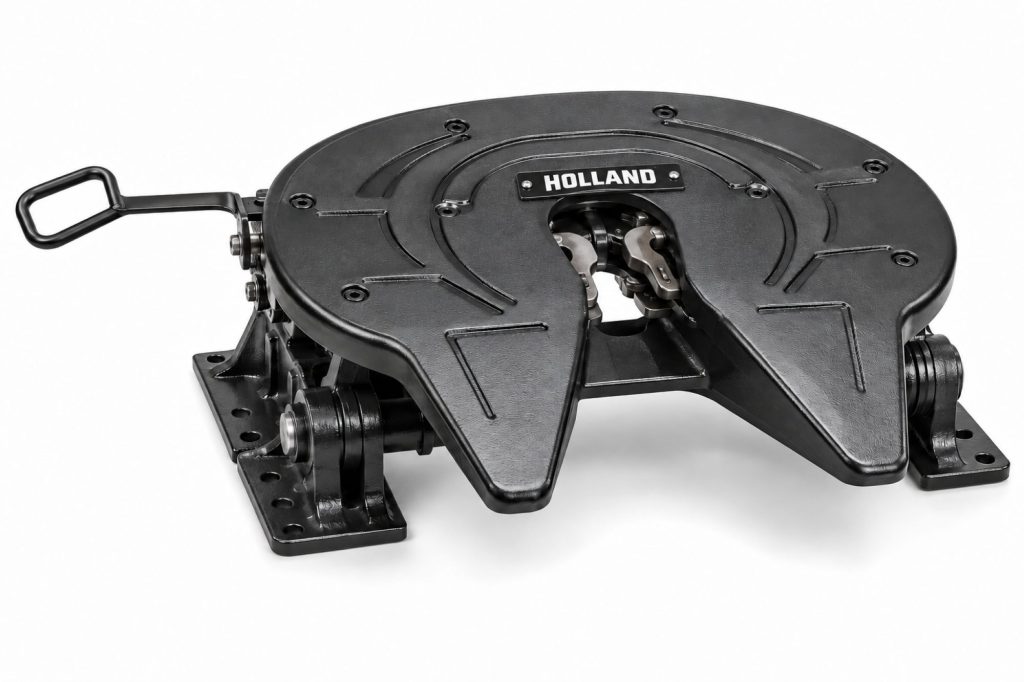
The Holland FW35 is a cast-steel fifth wheel designed to connect a commercial tractor with a semitrailer using a standard 2-inch kingpin. It is one of Holland’s most established fifth-wheel platforms and is available with multiple mounting, release, lubrication, and electronic-lock-verification options.
The FW35 uses Holland’s TwinLock mechanism to secure the trailer kingpin. Its product family includes stationary and sliding installations, manual and air-release systems, Kompensator mounting arrangements, No-Tilt configurations, and optional ELI-te electronic coupling technology.
The fifth wheel is designed for standard, moderate, and approved heavy or severe-duty applications when the correct mounting system and vehicle configuration are selected. The exact assembly must be matched to the tractor frame, fifth-wheel height, trailer design, operating terrain, and required capacity.
Key Characteristics
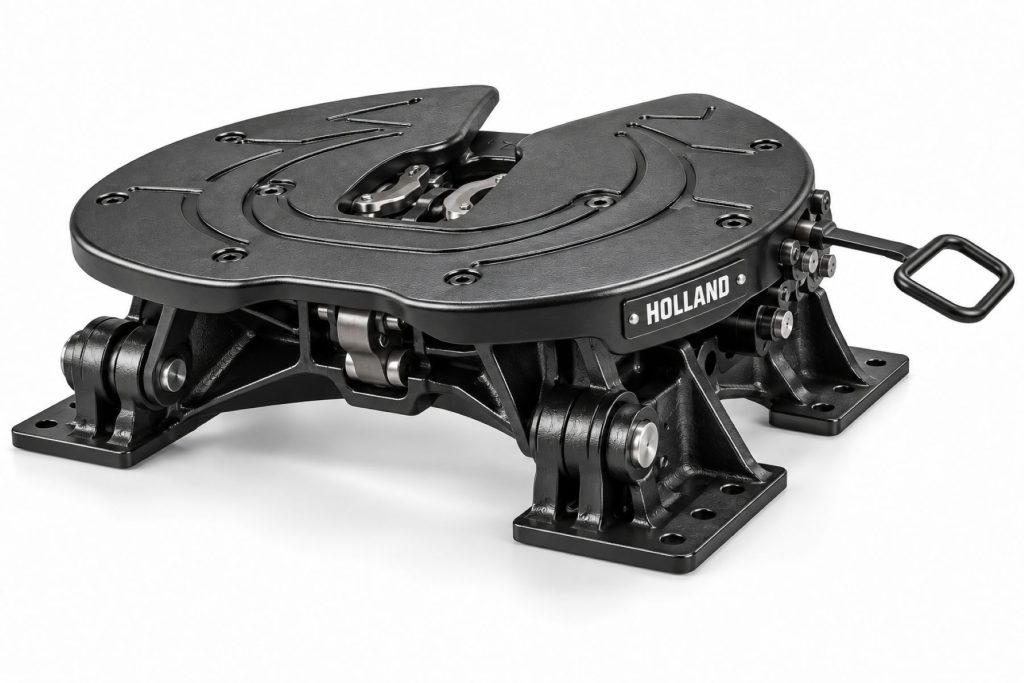
- Cast-steel fifth-wheel top plate
- Holland TwinLock kingpin-locking mechanism
- Infinite lock adjustment
- Visual lock indicator
- Automatic secondary lock
- Manual or optional air-operated release
- Optional ELI-te electronic lock-inspection technology
- NoLube articulation-pocket liners
- Stationary and sliding mounting options
- Kompensator and No-Tilt configurations available
- Designed for standard, moderate, and approved severe-duty applications
Major Components
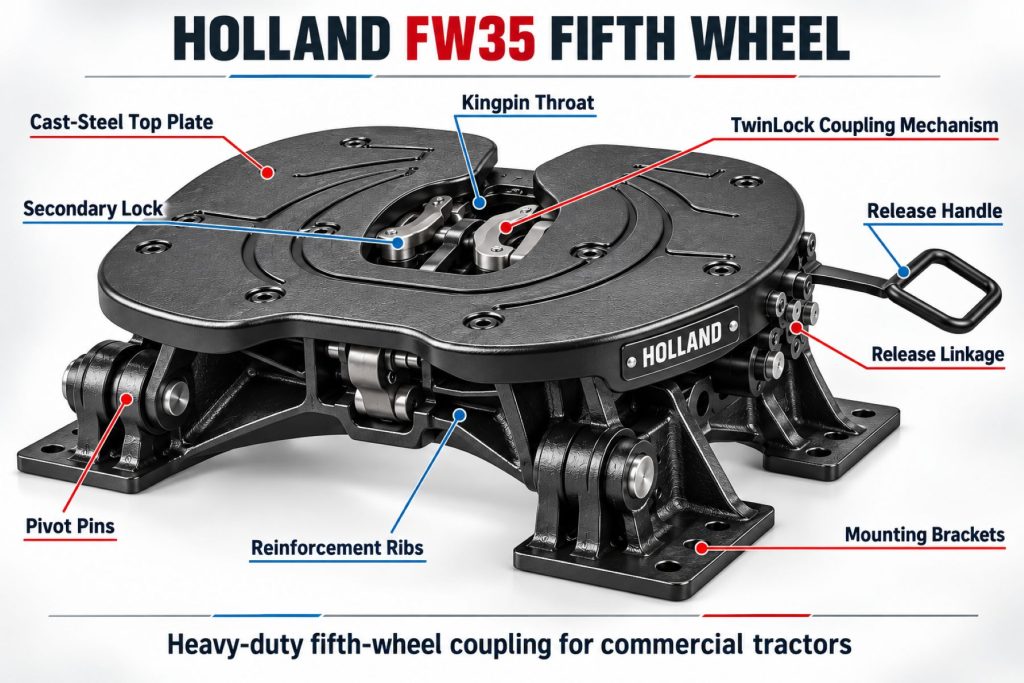
- Cast-steel top plate
- Fifth-wheel throat
- Twin locking jaws
- Locking yoke
- Release handle
- Automatic secondary lock
- Lock-adjustment mechanism
- Pivot pins
- Replaceable pocket inserts
- Mounting brackets
- Slider rails and locking plungers when equipped
- Air-release cylinder, valve, and lines when equipped
- ELI-te sensors and indicators when equipped
Coupling Type and Design
The FW35 is a tractor-mounted fifth wheel that couples with a standard 2-inch semitrailer kingpin. Its cast-steel top plate supports the trailer’s upper-coupler plate while allowing the tractor and trailer to articulate during turns and road movement.
The TwinLock mechanism closes around the kingpin from both sides. A visual lock indicator and automatic secondary lock help the operator confirm and retain the coupled condition.
How the Coupling System Works
As the tractor backs beneath the trailer, the kingpin enters the fifth-wheel throat and contacts the locking mechanism. The TwinLock jaws close around the kingpin, and the release mechanism returns to its locked position.
Once coupled, the fifth wheel supports part of the trailer’s vertical load and transfers pulling, braking, and cornering forces between the tractor and trailer. Pivoting between the top plate and mounting brackets permits normal front-to-rear articulation.
The driver must visually inspect the lock, perform a tug test, and confirm complete coupling before moving the vehicle.
Position and Function Within the Vehicle
The FW35 is installed above the tractor frame and generally ahead of, over, or near the drive-axle centerline. Its exact position affects tractor-to-trailer clearance and weight distribution between the steer and drive axles.
The fifth wheel provides the primary mechanical connection between the tractor and semitrailer. It supports trailer weight, retains the kingpin, permits articulation, and transfers acceleration, braking, and directional forces into the tractor frame.
Common Specifications
- Maximum Vertical Load: 55,000 pounds
- Maximum Drawbar Pull: 150,000 pounds
- Kingpin Size: 2 inches
- Top Plate: Cast steel
- Release: Manual or optional air release
- Mounting: Stationary, sliding, Kompensator, or No-Tilt configurations
- Common Nominal Slider Heights: Application-specific, including 7-, 8-, 9-, and 10-inch configurations
- Common Slider Travel: Application-specific, including 12-, 24-, 36-, and 48-inch configurations
Model numbers, mounting heights, slider travel, frame-width codes, assembly weights, and mounting arrangements vary. The complete model number must be verified before ordering or replacing an FW35 assembly.
Load Ratings and Operating Capacity
SAF-Holland lists the FW35 with a maximum vertical-load rating of 55,000 pounds and a maximum drawbar-pull rating of 150,000 pounds. These ratings apply only when the fifth wheel is correctly selected, installed, maintained, and used within an approved application.
The fifth-wheel rating does not automatically establish the tractor’s allowable gross combination weight. Frame, mounting assembly, axles, suspension, brakes, tires, wheels, trailer equipment, and legal weight limits must also be considered.
Articulation and Oscillation
A standard FW35 pivots forward and rearward through its mounting brackets, allowing the tractor and trailer to move across grades and normal road transitions.
Application-specific Kompensator systems can provide additional side-to-side compensation for trailers and operating environments requiring greater articulation. No-Tilt configurations restrict normal fifth-wheel tilting for approved applications such as certain frameless dump trailers.
Sliding and Adjustment System
Sliding FW35 assemblies allow the fifth wheel to move forward or rearward along frame-mounted rails. Repositioning the fifth wheel can adjust axle-weight distribution and tractor-to-trailer clearance.
Depending on the selected mounting assembly, slider travel may include 12-, 24-, 36-, or 48-inch configurations. Specialized systems can use other travel dimensions.
Both slider-locking plungers must be fully engaged before the vehicle is operated. Stationary FW35 assemblies do not include a sliding adjustment system.
Release and Locking Mechanism
The FW35 TwinLock mechanism uses two locking jaws to surround the trailer kingpin. The design includes infinite lock adjustment to compensate for normal wear and maintain the specified kingpin-to-lock relationship.
Standard configurations use a manual release handle. Optional air-release equipment allows the locking mechanism to be opened through a pneumatic control when the vehicle is safely parked and the system’s operating conditions are satisfied.
The automatic secondary lock provides an additional retention feature. It does not replace the required visual inspection and tug test.
Air and Electronic Controls
Standard manual-release FW35 assemblies do not require pneumatic or electronic controls. Optional air-release systems use the tractor’s compressed-air supply, an operating valve, air lines, and an actuator to open the fifth-wheel lock.
Optional ELI-te technology can provide electronic lock-inspection assistance and coupling-status information. Electronic confirmation should supplement—not replace—the driver’s required visual inspection and tug test.
Mounting and Installation
The FW35 can be installed using approved stationary or sliding mounting assemblies. Installation must account for frame width, bracket design, mounting height, fastener specifications, axle clearance, suspension movement, and tractor-to-trailer clearance.
Installation and frame attachment should follow the instructions for the exact fifth-wheel and mounting-system model. Welding, drilling, fastener substitution, or bracket modification outside approved procedures can reduce structural integrity.
Vehicle Frame and Mounting Compatibility
Compatibility depends on the tractor’s frame width, rail dimensions, crossmember arrangement, drive-axle position, suspension travel, intended trailer, fifth-wheel height, and required slider travel.
The complete FW35 assembly—including its top plate, brackets, slider, mounting angles, fasteners, and frame attachment—must meet the demands of the intended application. Capacity should never be determined from the top-plate rating alone.
Mating Component and Trailer Compatibility
The FW35 is designed for a properly installed, serviceable, SAE-compliant 2-inch trailer kingpin and compatible upper-coupler plate. The trailer plate must be sufficiently flat and structurally sound to maintain full contact with the fifth-wheel surface.
Bent, worn, improperly sized, or loosely mounted kingpins can prevent correct locking. Damaged upper couplers, excessive lube-plate thickness, contamination, and improper trailer height can also interfere with coupling.
Common Applications
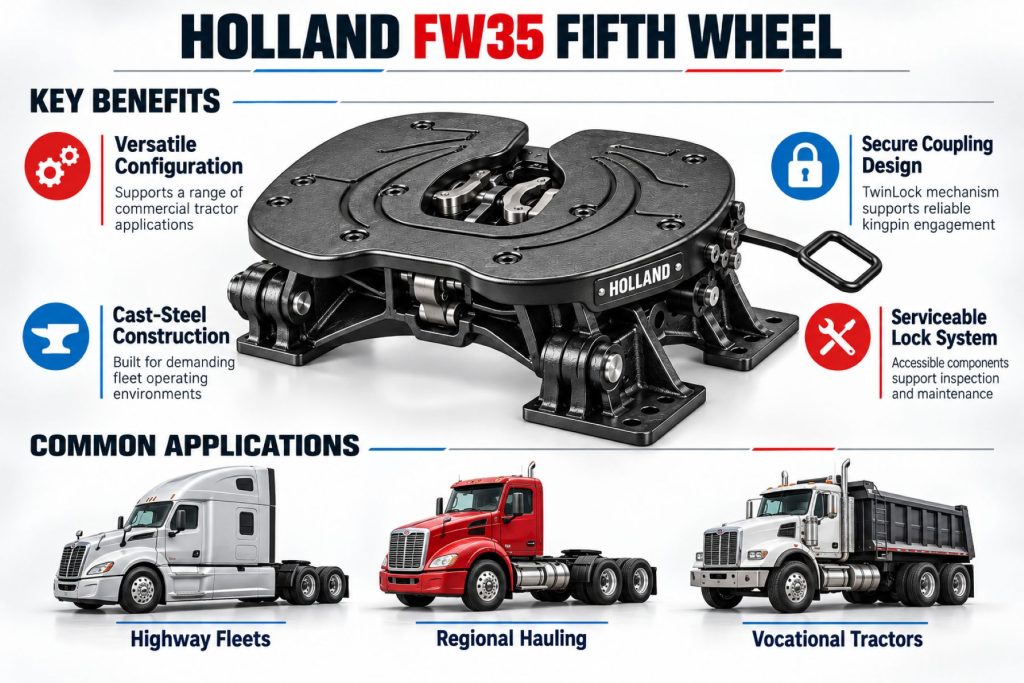
- Long-haul highway tractors
- Regional-haul tractors
- Vocational tractors
- Dry-van trailers
- Refrigerated trailers
- Flatbed and stretch trailers
- Tank and dry-bulk trailers with approved mounting equipment
- Framed and approved frameless dump trailers
- Lowboy trailers
- B-train configurations
- Converter dollies
Advantages
- Established cast-steel fifth-wheel design
- Broad application range
- TwinLock coupling mechanism
- Infinite lock adjustment
- Visual lock indicator
- Automatic secondary lock
- Manual and air-release options
- Stationary and sliding configurations
- Multiple mounting heights and travel options
- Replaceable wear and locking components
- Optional electronic coupling assistance
Limitations or Considerations
- Requires scheduled inspection, adjustment, and lubrication
- Standard top-plate surface requires proper lubrication
- Incorrect trailer height can cause high coupling or false coupling
- Slider systems add weight and maintenance points
- Air-release systems require a reliable air supply
- Not every mounting arrangement is approved for every trailer type
- The fifth-wheel rating does not override other vehicle ratings
- Heavy or off-road service requires the correct approved mounting system
Driver and Operator Experience
A properly maintained FW35 should couple securely and release without excessive force. Drivers should become familiar with the release handle, visual lock indicator, secondary lock, slider controls, and any optional air-release or electronic equipment.
Changes in fifth-wheel position can affect axle weights, turning clearance, ride behavior, and the distance between the tractor cab and trailer. Scale measurements should be used after slider adjustments when axle loading is uncertain.
Coupling and Uncoupling Procedure
Before coupling, inspect the fifth wheel, mounting system, kingpin, upper coupler, release mechanism, lubrication, slider locks, and air connections. Align the tractor with the trailer and confirm that the trailer is at the correct height.
- Confirm that the coupling area is level and clear.
- Verify that the fifth-wheel locks are ready to receive the kingpin.
- Back beneath the trailer slowly and in a straight line.
- Allow the trailer upper coupler to contact the fifth-wheel surface.
- Complete the coupling and set the parking brakes.
- Visually confirm that the locking jaws completely surround the kingpin.
- Confirm that the release handle and secondary lock are in their locked positions.
- Perform a tug test.
- Connect and inspect the air and electrical lines.
- Raise the landing gear and complete a final walk-around.
This overview does not replace SAF-Holland instructions, fleet procedures, driver training, or applicable safety requirements.
Inspection and Wear Points
- TwinLock jaws and kingpin contact surfaces
- Fifth-wheel throat
- Top-plate surface and grease grooves
- Release handle and linkage
- Automatic secondary lock
- Lock-adjustment components
- Pivot pins and pocket inserts
- Mounting brackets and fasteners
- Slider rails and locking plungers
- Air lines and release actuator
- Electronic sensors and wiring
- Trailer kingpin and upper-coupler plate
Lubrication Requirements
The standard FW35 requires the specified lubricant on the top-plate contact surface, locking mechanism, and other service points identified by SAF-Holland. Old grease, road debris, and contamination should be removed as required before fresh lubricant is applied.
NoLube articulation-pocket liners reduce lubrication requirements at the pivot connection but do not eliminate every lubrication requirement. Service practices must match the exact FW35 configuration.
Maintenance and Ownership Notes
Routine maintenance should include cleaning, lubrication, lock inspection, lock adjustment, fastener checks, slider inspection, and examination of the tractor frame and trailer upper coupler.
Worn locking components should be measured and replaced according to the applicable service manual. Replacement parts and rebuild kits must match the complete top-plate and mounting-system identification.
Common Coupling Problems
- High coupling: The kingpin enters above the locking mechanism because the trailer is too high, creating an unsafe or incomplete connection.
- Failure to lock: Contamination, improper alignment, damaged components, incorrect kingpin dimensions, or a worn locking mechanism can prevent full engagement.
- Difficult release: Pressure between the tractor and trailer, poor lubrication, contamination, damaged linkage, or lock maladjustment may prevent easy release.
- Excessive kingpin movement: Lock wear, kingpin wear, improper adjustment, or damaged components can create excessive play.
- Slider will not move: Locked plungers, air-system problems, rail contamination, frame distortion, or excessive binding may prevent adjustment.
- Slider plungers will not engage: Misalignment, debris, damaged teeth, air leakage, or worn components may prevent complete engagement.
- Air-release failure: Low air pressure, damaged lines, valve failure, actuator problems, or mechanical binding may prevent release.
Safety and Service Precautions
Never place any part of the body between an unsecured tractor and trailer. Chock the trailer wheels, set the parking brakes, and follow approved lockout and support procedures before inspection or service.
Never operate the vehicle without visually confirming complete kingpin engagement and performing a tug test. Electronic indicators and air-release controls do not replace physical coupling verification.
Identification Information
Identification information may be located on the fifth-wheel top plate, mounting assembly, slider, or product label.
- Complete FW35 assembly number
- Top-plate model number
- Serial or production information
- Left- or right-hand release configuration
- Manual or air-release mechanism
- Stationary or sliding mount
- Nominal fifth-wheel height
- Slider travel
- Frame-width and mounting codes
- Kompensator or No-Tilt configuration
Buying Considerations
- Confirm the required vertical-load and drawbar-pull capacity.
- Choose between stationary and sliding mounting.
- Determine the required mounting height and slider travel.
- Verify tractor-frame dimensions and mounting compatibility.
- Confirm standard, moderate, or severe-duty application requirements.
- Select manual or air release.
- Determine whether ELI-te electronic technology is required.
- Check whether Kompensator or No-Tilt mounting is necessary.
- Verify the trailer’s 2-inch kingpin and upper-coupler condition.
- Confirm replacement-parts and service support.
Variants and Configurations
- Stationary FW35
- Sliding FW35
- Manual-release configuration
- Air-release configuration
- ELI-te-equipped configuration
- Left-hand or right-hand release
- Inboard or outboard mounting
- Kompensator mounting system
- No-Tilt mounting system
- Different mounting heights and slider-travel lengths
Comparison to Similar Equipment
Compared with the Holland FW33, the FW35 uses a conventional lubricated top plate. The FW33 is the related LowLube configuration designed to reduce top-plate lubrication requirements.
Compared with the Holland FW17, the FW35 offers a heavier cast-steel platform and a broader range of standard, moderate, and approved severe-duty mounting configurations.
Compared with the Holland FW70, the FW35 has a lower maximum vertical-load rating. The FW70 is intended for higher-capacity and more demanding vocational applications.
Best Fit For
- Highway fleets needing a proven cast-steel fifth wheel
- Regional and vocational tractors
- Vehicles requiring stationary or sliding mounting
- Fleets wanting manual or air-release options
- Applications requiring a 2-inch kingpin connection
- Approved moderate and severe-duty operations
- Operators needing broad replacement-parts support
Related Vehicle and Trailer Types
- Commercial Trucks
- Commercial Trailers
- Highway tractors
- Regional tractors
- Vocational tractors
- Dry-van trailers
- Refrigerated trailers
- Flatbed trailers
- Tank trailers
- Dump trailers
- Lowboy trailers
Related Truck and Trailer Models
- Freightliner Cascadia
- Kenworth T680
- Peterbilt 579
- Volvo VNL
- International LT Series
- Mack Anthem
- Western Star 57X
- Application-compatible dry-van, refrigerated, flatbed, tank, dump, and lowboy trailers
Related Coupling Types
- Commercial Truck Fifth Wheels
- Fifth Wheel Sliders & Mounting Systems
- Heavy-Haul & Severe-Duty Fifth Wheels
- Trailer Kingpins & Upper Couplers
- Stationary fifth wheels
- Sliding fifth wheels
- Air-release fifth wheels
- Low-lubrication fifth wheels
- Oscillating fifth wheels
Related Coupling Products
- Holland FW33 Low-Lube Fifth Wheel
- Holland FW17 Lightweight Fifth Wheel
- Holland FWAL Aluminum Fifth Wheel
- Holland FW70 Heavy-Duty Fifth Wheel
- Holland FW2080 Fully Oscillating Fifth Wheel
Related Equipment Systems
- Fifth Wheels & Coupling Equipment
- Suspension Systems
- Axles & Differentials
- Brake Systems
- Tires & Wheels
- Equipment Systems
Related Guides
- Fifth Wheel System Explained
- Fixed vs Sliding Fifth Wheels
- How to Couple and Uncouple a Semi-Trailer Safely
- How to Inspect and Maintain a Fifth Wheel and Kingpin
- How to Choose a Commercial Truck Fifth Wheel
Regulatory and Compliance Notes
Fifth-wheel installation and operation must comply with applicable commercial-vehicle safety requirements, vehicle-manufacturer instructions, coupling-equipment standards, weight regulations, and inspection rules.
The fifth wheel, mounting system, tractor frame, trailer kingpin, upper coupler, axles, suspension, tires, wheels, and brakes must remain within their individual ratings. Moving a sliding fifth wheel does not legalize an overloaded vehicle or increase its certified ratings.
Real World Operating Notes
Correct trailer height is one of the most important coupling conditions. A trailer that is too high can allow the kingpin to pass above the locks, while a trailer that is too low can damage the fifth wheel, landing gear, or tractor components.
Fifth-wheel position should be established using actual axle weights and clearance measurements. Drivers should recheck slider-lock engagement whenever the fifth wheel is moved.
Road salt, ice, hardened grease, dirt, and other contamination can restrict locking and release movement. Cold-weather inspection and maintenance are especially important.
Frequently Asked Questions
What is the Holland FW35?
The FW35 is a cast-steel commercial fifth wheel designed to connect a tractor with a semitrailer using a standard 2-inch kingpin.
What is the FW35 vertical-load rating?
SAF-Holland lists a maximum vertical load of 55,000 pounds.
What is its maximum drawbar pull?
The listed maximum drawbar-pull rating is 150,000 pounds.
What kingpin size does the FW35 use?
The FW35 is designed for a standard 2-inch semitrailer kingpin.
Is the FW35 available as a sliding fifth wheel?
Yes. Stationary and sliding mounting configurations are available.
Can the FW35 use an air release?
Yes. An optional air-operated lock-release system is available for compatible configurations.
Does an electronic indicator replace a visual inspection?
No. Electronic coupling technology supplements the required visual inspection and tug test.
Does the FW35 require lubrication?
The standard FW35 requires lubrication at specified contact and locking points. NoLube pocket liners reduce lubrication at the articulation pockets but do not eliminate all service requirements.
How can the correct replacement parts be identified?
Use the complete assembly number, top-plate number, release orientation, mounting type, fifth-wheel height, slider travel, and production information.
Availability and Where to Find
The Holland FW35 and its replacement components may be available through SAF-Holland dealers, truck dealers, heavy-duty parts suppliers, fifth-wheel specialists, fleet-maintenance suppliers, and commercial-truck repair facilities.
Availability depends on mounting style, fifth-wheel height, slider travel, frame width, release configuration, and optional equipment. Buyers should verify the complete model number before ordering.
Current product information, manuals, parts resources, and dealer support are available through the official SAF-Holland FW35 product page.
Support Trucking Families
Truck Equipment Atlas supports the mission of Grey Cross, a nonprofit dedicated to helping families of truck drivers who lose their lives while on the road. As the site grows, part of its mission is to bring awareness and support to these families.
Podcast or Video Section
Learn More Through Audio and Video
Truck Equipment Atlas will continue expanding with podcast episodes, interviews, and equipment breakdowns to help drivers and fleets better understand trucks and equipment.
Follow the Growth of Truck Equipment Atlas
Truck Equipment Atlas continues to expand with new truck profiles, trailer coverage, diesel engine pages, equipment system resources, manufacturer information, and educational guides.
Visit our Site Updates page to explore recent additions, project milestones, and upcoming resources as we continue building one of the industry’s growing commercial trucking equipment reference libraries.
View the Latest Site Updates: Truck Equipment Atlas Site Updates