
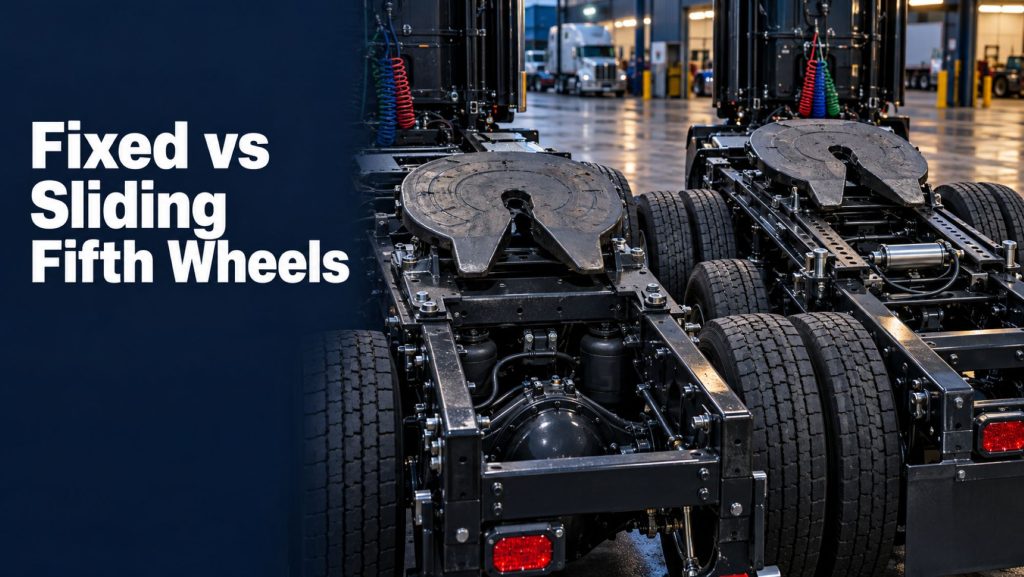
Commercial truck fifth wheels are available in two primary mounting configurations: fixed and sliding. Both connect the tractor to the semitrailer, support part of the trailer’s weight, lock around the kingpin, and allow the combination to turn. The key difference is whether the fifth wheel remains in one frame position or can move forward and rearward.
A fixed fifth wheel provides a simple, permanent mounting position. A sliding fifth wheel adds rails and locking components that allow its position to be changed when axle-weight distribution or tractor-to-trailer clearance must be adjusted.
This guide compares fixed and sliding fifth wheels, explains how each design works, examines their advantages and limitations, and identifies the operating factors that help determine which configuration is appropriate for a commercial truck.
What Is a Fixed Fifth Wheel?
A fixed fifth wheel, also called a stationary fifth wheel, is installed in one permanent location on the tractor frame. The top plate can still pivot on its mounting brackets, allowing the tractor and trailer to travel over changes in road angle, but the complete assembly does not slide forward or rearward along the frame.
The mounting position is selected during vehicle specification or installation. It must provide acceptable axle loading, trailer clearance, frame compatibility, and handling for the tractor’s intended operation.
How a Fixed Fifth Wheel Works
The coupling process is the same basic process used with other conventional fifth wheels. The tractor backs beneath the trailer, the kingpin enters the rear-facing throat, and the locking mechanism closes around the kingpin.
During operation, the fifth-wheel top plate supports the trailer’s upper coupler and transfers vertical and horizontal forces into the tractor frame. The kingpin provides the primary horizontal pivot for turning, while the fifth-wheel brackets allow controlled fore-and-aft tilting.
Because the mounting assembly cannot change position, the relationship between the fifth wheel and the tractor axles remains constant.
Advantages of a Fixed Fifth Wheel
- Simpler mounting system
- Fewer slider-related components
- Lower assembly weight in many configurations
- Reduced maintenance associated with rails, pins, wedges, and slider cylinders
- No risk of operating with slider locks improperly engaged
- Consistent tractor-to-trailer geometry
- Well suited to dedicated tractors and predictable trailer applications
A fixed fifth wheel can be an effective choice when the tractor pulls similar trailers, cargo placement is predictable, and the permanent mounting position provides the required axle weights and clearances.
Limitations of a Fixed Fifth Wheel
- Axle-weight distribution cannot be adjusted by moving the fifth wheel
- Cab-to-trailer clearance remains fixed
- Landing-gear and frame clearance remain fixed
- Less flexibility when changing trailer types
- Load-placement problems must be corrected elsewhere
- A poorly selected mounting position may limit the tractor’s usefulness
A fixed system does not prevent weight adjustments through cargo repositioning, trailer-axle movement, or other approved methods. It simply removes fifth-wheel movement as one of the available adjustment tools.
What Is a Sliding Fifth Wheel?
A sliding fifth wheel is mounted on rails that allow the complete fifth-wheel assembly to move forward or rearward along the tractor frame. Locking pins or wedges engage openings in the rails and hold the assembly securely in the selected position.
Most modern highway tractors use an air-operated release system controlled from the cab, although manual-release systems also exist. Releasing the slider does not open the fifth-wheel jaws or disconnect the trailer kingpin. It only releases the mounting assembly from the rails so the tractor can reposition beneath the coupled trailer.
Major Sliding Fifth-Wheel Components
Slider Rails
The rails are mounted along the tractor frame and provide the travel path for the fifth-wheel assembly. They contain regularly spaced locking positions.
Locking Pins or Wedges
Locking pins or wedges engage the slider rails and prevent movement during operation. Every required locking component must engage completely before the vehicle is driven.
Air Cylinder or Manual Release
An air cylinder commonly retracts the locking components when the driver activates the cab control. Manual systems use a mechanical release mechanism.
Stops and Retainers
Stops and retainers help keep the assembly within its intended travel range and attached to the mounting structure. They are safety components, not normal positioning locks.
How a Sliding Fifth Wheel Changes Weight Distribution
Changing fifth-wheel position changes where the trailer’s vertical load enters the tractor frame. This alters the division of weight between the steer axle and drive axles.
Moving the Fifth Wheel Forward
Moving the fifth wheel toward the tractor cab generally transfers more weight toward the steer axle and reduces some weight from the drive axles.
Moving the Fifth Wheel Rearward
Moving the fifth wheel toward the rear of the tractor generally reduces steer-axle loading and transfers more weight toward the drive axles.
The amount of weight transferred per slider position is not universal. It depends on wheelbase, axle spacing, slider-hole spacing, suspension layout, trailer configuration, cargo position, and the amount of vertical load carried by the fifth wheel. Axle weights should be verified on a suitable scale rather than estimated.
How Position Affects Tractor-to-Trailer Clearance
Fifth-wheel position affects more than axle weight. It also changes the physical relationship between the tractor and trailer.
- Forward position: decreases clearance between the tractor cab and trailer nose and may increase clearance near the trailer landing gear.
- Rearward position: increases cab-to-trailer clearance but can reduce clearance between the landing gear, tractor frame, mudflaps, tires, or other components.
The combination must retain sufficient clearance through sharp turns, uneven terrain, loading-dock approaches, and suspension movement. A position that corrects axle weight but permits trailer contact is unsafe.
General Sliding Process
Exact procedures vary by fifth-wheel model, tractor, and carrier. A general sliding sequence may include:
- Park on a firm, level surface with adequate space.
- Keep the tractor and trailer coupled and the fifth-wheel jaws locked around the kingpin.
- Secure the trailer according to the approved procedure.
- Release the slider locking mechanism.
- Confirm that the pins or wedges have fully retracted.
- Move the tractor slowly to reposition the fifth wheel on the rails.
- Reengage the slider lock.
- Move slightly as directed to help the locks seat.
- Visually confirm that every required pin or wedge is fully engaged.
- Verify clearance and obtain accurate axle weights.
A sliding fifth wheel must never be repositioned while the tractor-trailer combination is traveling on the road. No person should stand in a pinch zone or near moving equipment during adjustment.
Advantages of a Sliding Fifth Wheel
- Adjustable steer- and drive-axle loading
- Greater flexibility with variable freight
- Ability to accommodate different trailer types
- Adjustable cab-to-trailer clearance
- Useful for fleet tractors assigned to changing operations
- Can help optimize legal axle-weight distribution
- Provides another adjustment option when balancing a combination
Limitations of a Sliding Fifth Wheel
- Additional weight compared with many stationary mounts
- More components requiring inspection and maintenance
- Slider rails can collect corrosion, ice, dirt, and road debris
- Pins or wedges may bind or fail to engage completely
- Air cylinders, lines, and controls can leak or become damaged
- Incorrect positioning can create clearance or axle-loading problems
- Improperly locked sliders can allow dangerous movement
Fixed vs Sliding Fifth Wheels at a Glance
| Feature | Fixed Fifth Wheel | Sliding Fifth Wheel |
|---|---|---|
| Frame position | Permanent | Adjustable forward and rearward |
| Axle-weight adjustment | Not available through fifth-wheel movement | Can shift weight between steer and drive axles |
| Clearance adjustment | Fixed | Adjustable within the slider range |
| System complexity | Lower | Higher |
| Slider maintenance | Not required | Rails, locks, controls, and stops require inspection |
| Typical strength | Dedicated and predictable applications | Variable loads, trailers, and fleet assignments |
| Operating risk | Poor permanent placement | Incorrect position or incomplete lock engagement |
Which Applications Favor a Fixed Fifth Wheel?
- Dedicated tractor-and-trailer combinations
- Consistent trailer dimensions
- Predictable cargo placement
- Vocational equipment with a carefully engineered permanent position
- Applications prioritizing simplicity and lower component weight
- Operations where axle balance does not routinely change
Which Applications Favor a Sliding Fifth Wheel?
- General freight operations
- Tractors pulling multiple trailer types
- Loads with changing weight distribution
- Fleet tractors assigned to different routes and customers
- Operations needing periodic steer- and drive-axle adjustments
- Applications requiring adjustable cab or landing-gear clearance
Inspection Points for Fixed Fifth Wheels
- Top-plate cracks, distortion, and wear
- Mounting brackets and fasteners
- Pivot pins and bushings
- Locking jaws, wedge, and release handle
- Lubrication or replaceable wear surfaces
- Frame condition around the mounting area
- Kingpin and trailer upper-coupler condition
Additional Inspection Points for Sliding Fifth Wheels
- Slider-rail condition and secure mounting
- Complete engagement of every locking pin or wedge
- Locking-pocket wear or damage
- Air-cylinder, hose, valve, and fitting condition
- Manual-release linkage where equipped
- Rail stops and retainers
- Corrosion, contamination, ice, or debris restricting movement
- Excessive looseness between the slider and rails
Common Sliding Fifth-Wheel Problems
Pins Will Not Retract
Possible causes include pressure against the locks, low air pressure, a damaged cylinder, frozen components, corrosion, contamination, or bent linkage.
Pins Will Not Reengage
The assembly may be positioned between rail openings, or the locking components may be dirty, damaged, frozen, or misaligned. The vehicle must not be operated until the required locks are fully engaged.
Slider Will Not Move
Causes may include locks that remain partially engaged, corroded rails, frame twist, excessive contamination, mechanical damage, or improper operating technique.
Uneven Lock Engagement
One side may engage while another remains retracted. A glance at the cab control is not enough; the locking components must be visually inspected.
How to Choose Between Fixed and Sliding
The correct choice depends on the complete vehicle and its intended work. Important factors include:
- Tractor wheelbase and frame layout
- Expected trailer types and dimensions
- Steer- and drive-axle ratings
- Gross combination and vertical load ratings
- Cargo variability
- Cab, fairing, landing-gear, tire, and frame clearance
- Required slider travel
- Mounting height
- Highway, vocational, heavy-haul, or severe-service duty
- Fleet maintenance capabilities
- Weight-savings goals
- Vehicle and fifth-wheel manufacturer requirements
A sliding fifth wheel offers flexibility, but flexibility is only useful when the operator needs it and maintains the additional equipment correctly. A fixed fifth wheel offers simplicity, but only when its permanent position works across the intended operating range.
Frequently Asked Questions
Does sliding the fifth wheel change trailer-axle weight?
Sliding the tractor fifth wheel primarily changes weight distribution between the tractor’s steer and drive axles. Cargo position and sliding trailer tandems are commonly used to change the distribution between the tractor drive axles and trailer axles.
Can a fifth wheel be moved while driving?
No. A sliding fifth wheel must never be repositioned while the tractor-trailer combination is in motion. It must be adjusted using the approved stationary procedure.
Is a sliding fifth wheel always better?
No. Sliding systems provide adjustability but add weight, components, inspection points, and operating responsibilities. A properly specified fixed fifth wheel may be better for a dedicated application.
How far can a sliding fifth wheel move?
Available travel varies by assembly. Commercial slider systems are offered in multiple lengths, so the exact usable range must be confirmed from the model specification and installation.
Final Thoughts
Fixed and sliding fifth wheels perform the same essential coupling function, but they serve different operating needs. Fixed fifth wheels provide a simple and consistent mounting arrangement. Sliding fifth wheels allow the operator to change axle-weight distribution and tractor-to-trailer clearance.
The correct system is the one that matches the tractor, trailers, loads, axle ratings, clearances, and duty cycle. With either design, proper coupling, inspection, lubrication, mounting, and maintenance remain essential.
Continue Exploring Fifth Wheel and Coupling Equipment
- Fifth Wheel & Coupling Equipment Guides
- How Commercial Truck Fifth Wheels Work
- How to Couple and Uncouple a Semi-Trailer Safely
- How to Inspect and Maintain a Fifth Wheel and Kingpin
- How to Choose a Commercial Truck Fifth Wheel
- Fifth Wheels & Coupling Equipment
Important note: This guide provides general educational information. Fifth-wheel selection, installation, positioning, inspection, adjustment, maintenance, and repair must follow applicable regulations and the instructions published by the tractor, trailer, and fifth-wheel manufacturers.