
Western Star 4900
Quick Facts
• Manufacturer: Western Star Trucks
• Truck Class: Class 8 Highway and Severe-Duty Vocational Truck
• Common Configurations: Day Cab, Sleeper Cab, Set-Forward Axle, Set-Back Axle, Extended Hood, Twin Steer, Tandem Axle
• Primary Applications: Long-Haul Freight, Heavy Haul, Logging, Construction, Dump Operations, Oilfield Work, Specialized Freight
• Common Engine Options: Detroit DD13, Detroit DD15, Detroit DD16, Cummins X15
• Typical Transmission Options: Eaton Fuller Manual, Eaton UltraShift PLUS Automated, Allison Automatic
• Common Axle Setups: 4×2, 6×4, 8×4, 8×6, Twin Steer, Lift Axle Configurations
• GVWR Range: Up to approximately 109,000 lbs depending on configuration
• Front Axle Capacity: Approximately 12,000–44,000 lbs depending on configuration
• Rear Axle Capacity: Up to approximately 70,000 lbs depending on axle setup
• Cab Style: Traditional Long-Hood Steel Cab with Day Cab and Sleeper Options
• Production Status: No Longer in Production
Overview
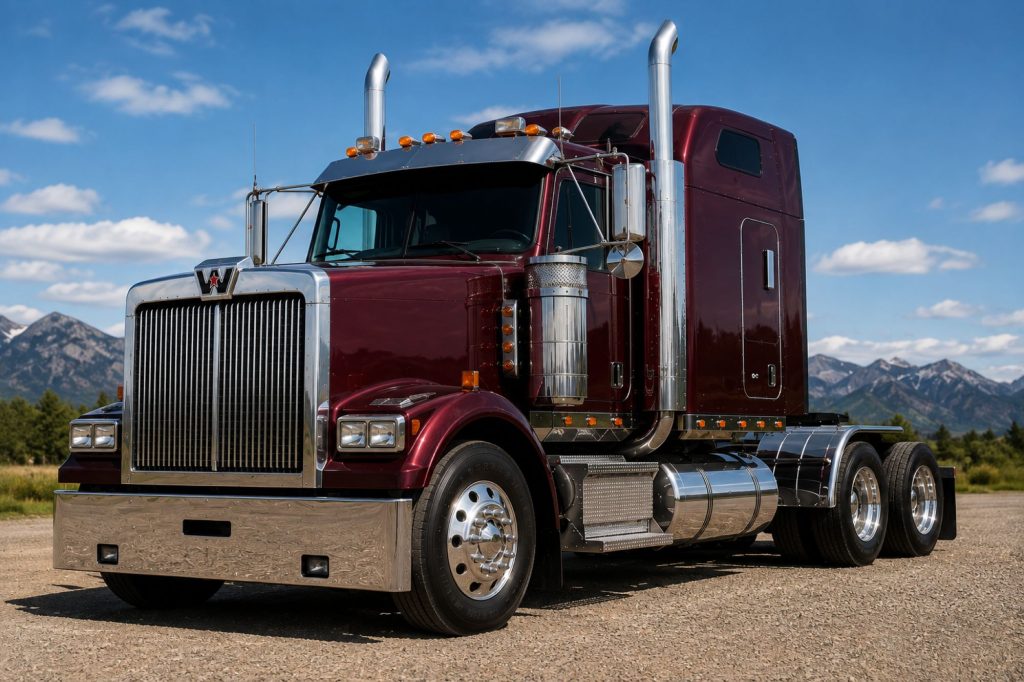
The Western Star 4900 is a traditional long-hood Class 8 truck developed for highway transportation, heavy haul, and severe-duty vocational operations. Recognized for its large chrome grille, squared hood, rugged cab construction, and extensive customization options, the 4900 became one of Western Star’s most identifiable truck platforms.
Unlike trucks designed primarily around aerodynamics and fleet fuel economy, the 4900 emphasized durability, vocational flexibility, driver appeal, and the ability to support demanding drivetrain and axle configurations. It was available in both highway-oriented sleeper configurations and specialized vocational setups for industries such as construction, logging, oilfield service, and heavy equipment transportation.
Western Star now classifies the 4900 as a legacy model. However, used examples remain active throughout North America, particularly in operations that require traditional styling, strong chassis construction, and application-specific configurations.
Key Characteristics
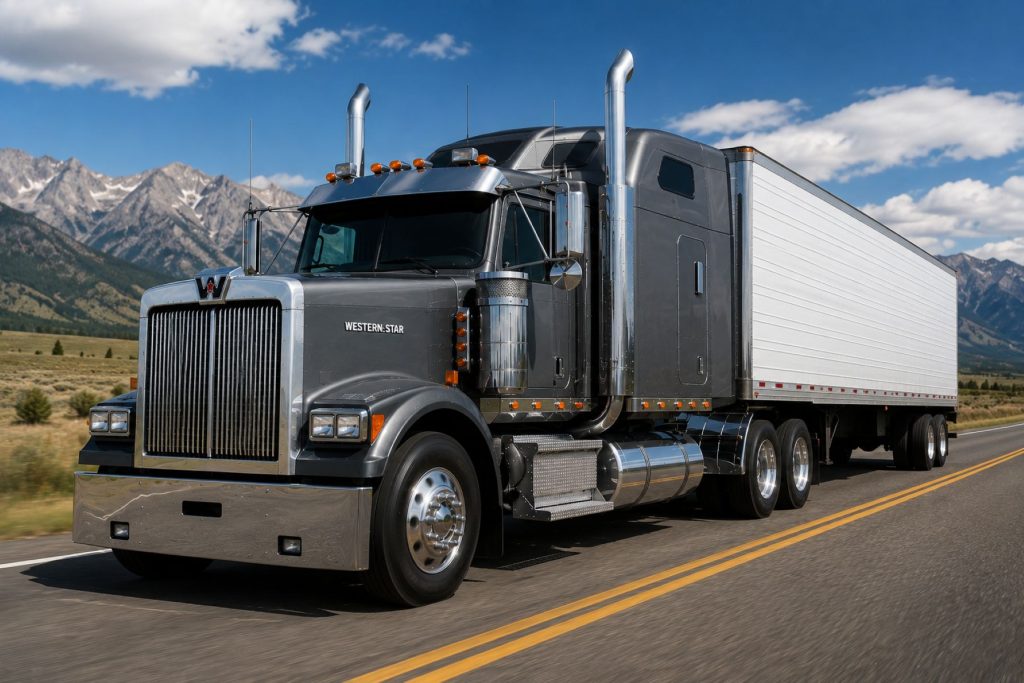
The Western Star 4900 stands out for its traditional appearance, heavy-duty construction, and broad range of available configurations. Depending on model and production year, buyers could select set-forward or set-back front axles, extended-hood configurations, twin-steer layouts, day cabs, and multiple sleeper sizes.
The truck’s chassis could be configured for both highway and severe-duty vocational work. Heavy frame options, high-capacity axles, multiple suspension choices, and compatibility with vocational bodies allowed the 4900 to serve as a tractor, dump truck, logging truck, heavy-haul truck, crane carrier, or oilfield support vehicle.
Its combination of customization and traditional styling also made the 4900 popular among owner-operators who wanted a working truck with a distinctive appearance.
Common Specifications
Engine Options
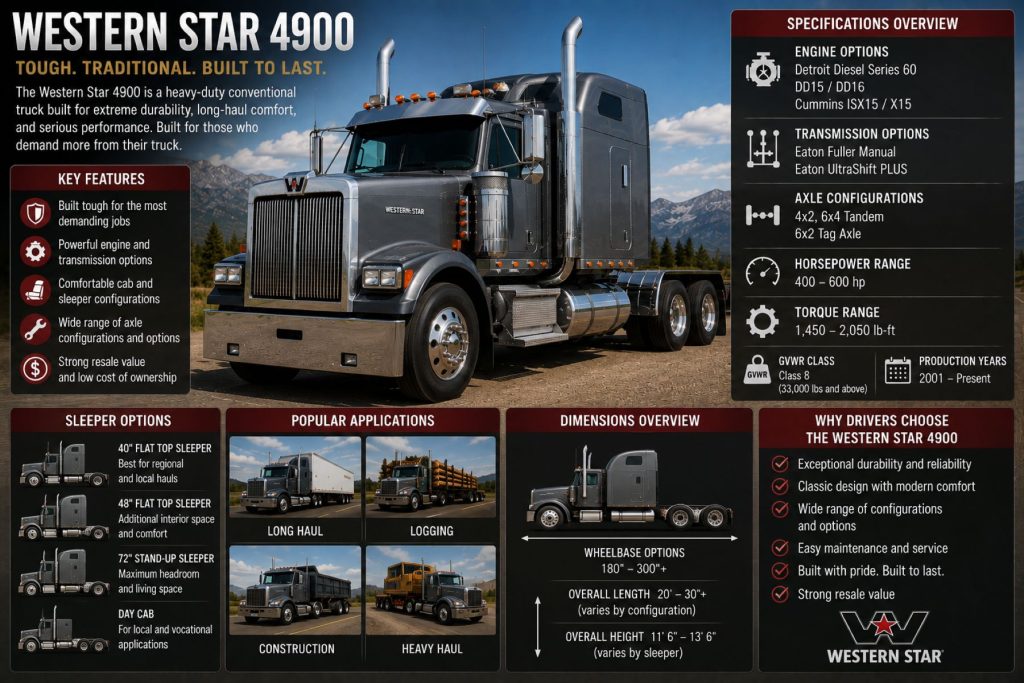
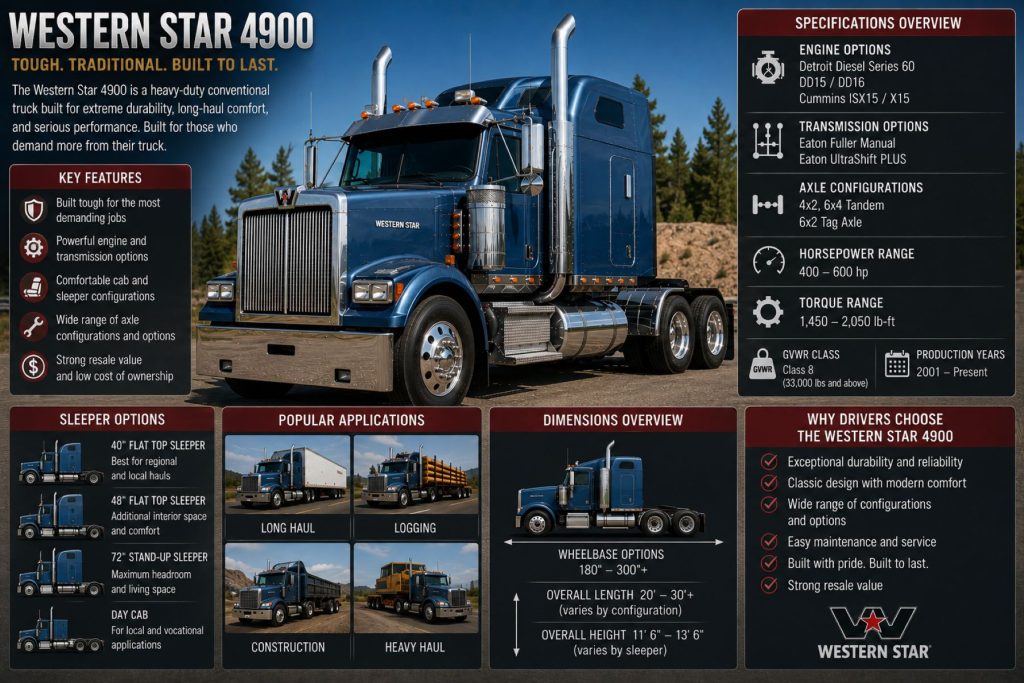
Engine availability varied by model year and configuration. Common options included the Detroit DD13, Detroit DD15, Detroit DD16, and Cummins X15.
Horsepower ratings generally ranged from approximately 350 to 600 horsepower, depending on the selected engine and production year.
Transmission Options
Common transmission choices included Eaton Fuller manual transmissions, Eaton UltraShift PLUS automated manual transmissions, and Allison automatic transmissions.
Manual transmissions were frequently selected for highway, logging, and heavy-haul applications. Allison automatic transmissions were commonly used in vocational configurations requiring frequent stopping, low-speed maneuvering, or PTO-driven equipment.
Axle Configurations
The 4900 was available with numerous axle arrangements, including 4×2, 6×4, 8×4, 8×6, twin-steer, tandem-drive, lift-axle, and specialized heavy-haul configurations.
Axle ratings varied significantly according to the truck’s intended application. Standard highway tractors generally used lighter axle configurations, while vocational and twin-steer models could support substantially higher front and rear axle capacities.
Wheelbase Range
Wheelbase varied considerably because the 4900 could be configured as a highway tractor, sleeper truck, vocational chassis, heavy-haul tractor, dump truck, or specialized equipment carrier.
Some configurations were available with wheelbases reaching approximately 448 inches.
Cab and Sleeper Options
The 4900 was available as a day cab or with several sleeper configurations. Sleeper offerings included low-roof and high-roof designs in multiple lengths, allowing the truck to support regional, long-haul, and owner-operator applications.
Common Applications
- Long-haul freight
- Heavy-haul transportation
- Oversized-load transportation
- Flatbed operations
- Logging and forestry work
- Construction operations
- Dump truck applications
- Oilfield service
- Crane and rigging operations
- Tanker operations
- Specialized equipment transportation
Advantages
- Strong chassis construction
- Broad range of axle configurations
- Multiple engine and transmission choices
- Day cab and sleeper availability
- Excellent vocational customization
- Traditional long-hood styling
- Strong heavy-haul capability
- Compatibility with PTO-driven equipment
- Good driver and owner-operator appeal
- Continued parts and service support
Limitations or Considerations
- No longer available as a new-production truck
- Lower fuel efficiency than modern aerodynamic highway trucks
- Heavy vocational configurations have greater empty weight
- Long-wheelbase models require additional maneuvering space
- Replacement parts for certain model-specific components may become harder to locate
- Older trucks may require extensive emissions-system maintenance
- Highly specialized configurations can increase repair costs
- Fuel economy varies by engine, gearing, axle setup, and application
Driver and Operator Experience
The Western Star 4900 provides a traditional truck-driving experience built around a long hood, upright seating position, substantial road presence, and straightforward cab controls.
Highway and sleeper configurations were designed to support extended trips, while vocational models emphasized visibility, durability, and convenient access to frequently used controls. Available sleeper sizes and interior packages allowed owner-operators and fleets to balance comfort with weight, wheelbase, and operating requirements.
Ride quality varies according to wheelbase, suspension, axle configuration, and application. Highway tractors equipped with air-ride suspension generally provide greater comfort, while heavy vocational suspensions prioritize stability and load capacity.
Maintenance and Ownership Notes
Maintenance requirements depend heavily on the truck’s engine, transmission, axle arrangement, production year, and operating environment.
Highway-operated trucks require routine attention to the engine, cooling system, brakes, suspension, driveline, and emissions equipment. Vocational trucks working in construction, logging, oilfield, or off-road environments may experience faster wear to suspension components, steering systems, tires, brakes, frame attachments, and electrical connections.
Western Star continues to provide parts and service assistance for legacy trucks through its dealer network. However, owners should verify the availability of model-specific body, cab, and interior components before purchasing an older truck.
Buying Considerations
When evaluating a used Western Star 4900, buyers should first determine whether the truck’s original specifications match the intended operation.
Important considerations include:
• Engine model and horsepower rating
• Transmission type
• Axle capacities and axle ratios
• Suspension configuration
• Wheelbase and turning requirements
• Frame condition and reinforcement
• Maintenance and repair history
• Emissions-system condition
• Sleeper size and cab configuration
• PTO and hydraulic equipment
• Previous highway or vocational use
• Availability of model-specific replacement parts
Buyers considering a former heavy-haul, logging, construction, or oilfield truck should inspect the frame, suspension, steering, driveline, and axle components carefully for wear or previous repairs.
Variants and Configurations
• 4900SF: Set-forward front axle configuration
• 4900SB: Set-back front axle configuration
• 4900EX: Extended-hood configuration
• 4900TS: Twin-steer severe-duty configuration
• 4900XD: Extreme-duty vocational configuration
• Day cab highway tractor
• Sleeper highway tractor
• Heavy-haul tractor
• Dump truck
• Logging truck
• Crane carrier
• Oilfield support truck
• Specialized vocational chassis
Comparison to Similar Trucks
The Western Star 4900 is commonly compared with traditional highway and severe-duty trucks such as the Kenworth W900, Peterbilt 389, Freightliner 122SD, International HX Series, and Western Star 6900XD.
Compared with the Kenworth W900 and Peterbilt 389, the 4900 offered a similar traditional long-hood appearance but was available in a broader range of severe-duty vocational configurations.
Compared with the Freightliner 122SD and International HX Series, the 4900 combined vocational capability with more extensive sleeper and highway-tractor options.
The 4900 was less aerodynamic than fleet-focused highway trucks, but it provided greater configuration flexibility for operators working across heavy-haul, construction, logging, and specialized transportation sectors.
Best Fit For
- Owner-operators who prefer traditional styling
- Heavy-haul and oversized-load carriers
- Logging and forestry operations
- Construction and aggregate fleets
- Oilfield service companies
- Specialized freight carriers
- Operators needing high-capacity axle configurations
- Buyers seeking a configurable used highway or vocational truck
Regulatory and Compliance Notes
The Western Star 4900 must meet the emissions requirements applicable to its engine and model year. Later-production trucks commonly use diesel particulate filters, selective catalytic reduction, diesel exhaust fluid, and other emissions-control equipment.
Because the 4900 was available with numerous axle and wheelbase configurations, operators must verify compliance with federal and state axle-weight, bridge-formula, vehicle-dimension, and gross-weight requirements.
Heavy-haul and oversized-load operations may require permits, route planning, escorts, warning equipment, and additional operating restrictions depending on load dimensions and jurisdiction.
Real World Operating Notes
In real-world service, the Western Star 4900 developed a strong reputation for durability, customization, and adaptability. It can still be found working as a highway tractor, heavy-haul truck, dump truck, logging truck, crane carrier, and specialized vocational vehicle.
Operators commonly value the truck’s traditional design, strong chassis options, mechanical accessibility, and ability to support demanding drivetrain and axle arrangements.
The truck’s operating costs depend heavily on its configuration. A highway sleeper tractor and a multi-axle vocational truck may share the 4900 name while having substantially different fuel economy, maintenance requirements, maneuverability, and ownership expenses.
Related Truck Types
• Day Cab Trucks
• Sleeper Trucks
• Heavy Haul Trucks
• Vocational Trucks
• Dump Trucks
Related Freight Types
• Construction & Aggregate Freight
• Logging & Forestry Freight
• Heavy Haul Freight
• Specialized & Niche Freight
Related Trailer Types
• Flatbed Trailers
• Lowboy / RGN Trailers
• Step Deck Trailers
• Dump Trailers
Related Equipment Systems
• Engines
• Transmissions
• Axles & Differentials
• Suspension Systems
• Brake Systems
• Tires & Wheels
Related Guides
• Heavy Haul Freight Guide
• PTO Systems Explained
• Oversize Load Transportation Guide
Frequently Asked Questions
Is the Western Star 4900 still in production?
No. Western Star now classifies the 4900 as a legacy model, and it has been replaced in the company’s current lineup by newer X-Series trucks.
What engines were available in the Western Star 4900?
Common engine options included the Detroit DD13, Detroit DD15, Detroit DD16, and Cummins X15. Availability depended on production year and configuration.
Was the Western Star 4900 used for heavy haul?
Yes. The 4900 was frequently configured for heavy-haul and oversized-load transportation using high-horsepower engines, heavy-duty frames, multiple drive axles, and lift-axle arrangements.
Was the Western Star 4900 available with a sleeper?
Yes. The 4900 was available with multiple sleeper lengths and roof configurations for long-haul and owner-operator applications.
What is the difference between the 4900SF and 4900SB?
The 4900SF uses a set-forward front axle, while the 4900SB uses a set-back front axle. The appropriate configuration depends on weight distribution, maneuverability, wheelbase, and vocational requirements.
Availability and Where to Find
Because the Western Star 4900 is no longer in production, it is primarily available through used commercial truck dealers, vocational-equipment dealers, heavy-haul truck specialists, fleet resellers, auctions, and online truck marketplaces.
Availability varies significantly according to model year, engine, transmission, sleeper size, axle arrangement, vocational equipment, mileage, and overall condition. Buyers should obtain maintenance records and arrange a complete mechanical and chassis inspection before purchasing a used truck.
Support Trucking Families
Truck Equipment Atlas supports the mission of Grey Cross, a nonprofit dedicated to helping families of truck drivers who lose their lives while on the road. As the site grows, part of its mission is to bring awareness and support to these families.
Podcast or Video Section
Learn More Through Audio and Video
Truck Equipment Atlas will continue expanding with podcast episodes, interviews, and equipment breakdowns to help drivers and fleets better understand trucks and equipment.
Follow the Growth of Truck Equipment Atlas
Truck Equipment Atlas continues to expand with new truck profiles, trailer coverage, diesel engine pages, equipment system resources, manufacturer information, and educational guides.
Visit our Site Updates page to explore recent additions, project milestones, and upcoming resources as we continue building one of the industry’s growing commercial trucking equipment reference libraries.
View the Latest Site Updates: Truck Equipment Atlas Site Updates