
Kenworth T280
Quick Facts
- Manufacturer: Kenworth Truck Company
- Truck Class: Class 6 Medium-Duty Commercial Truck
- Common Configurations: Straight Truck, Day Cab, Chassis Cab, Box Truck, Refrigerated Truck, Flatbed, Stake Bed, Dump Truck, Service Body, Utility Truck, Tow Truck
- Primary Applications: Local Delivery, Regional Distribution, Municipal Work, Utility Service, Landscaping, Construction Support, Towing and Recovery
- Common Engine Options: PACCAR PX-7, PACCAR PX-9, Cummins B6.7N Natural Gas
- Typical Transmission Options: PACCAR TX-8 Automatic, Allison Automatic, PACCAR TX-12 PRO in applicable configurations
- Common Axle Setup: 4×2 Single Rear Axle
- Maximum GVWR: Approximately 26,000 lbs
- Front Axle Capacity: Approximately 8,000–12,000 lbs
- Rear Axle Capacity: Approximately 11,500–21,000 lbs
- Maximum Horsepower: Up to approximately 380 horsepower depending on engine and configuration
- Maximum Torque: Up to approximately 1,250 lb-ft depending on engine and configuration
- Cab Style: Conventional Medium-Duty Day Cab
- Roof Options: Standard Low Roof and Optional Raised Roof
- Production Status: Active Production
Overview
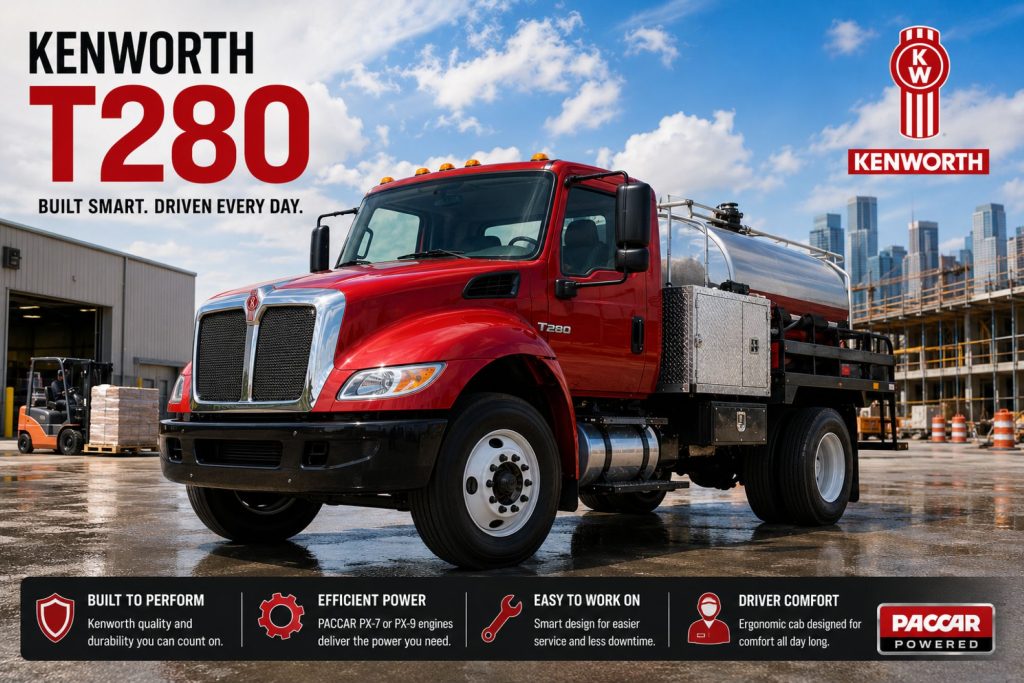
The Kenworth T280 is a Class 6 medium-duty truck designed for local delivery, regional distribution, municipal service, utility work, towing, landscaping, and light vocational operations.
With a maximum GVWR of approximately 26,000 pounds, the T280 provides greater commercial capability than many light-duty chassis while remaining smaller and more maneuverable than a Class 7 or Class 8 truck.
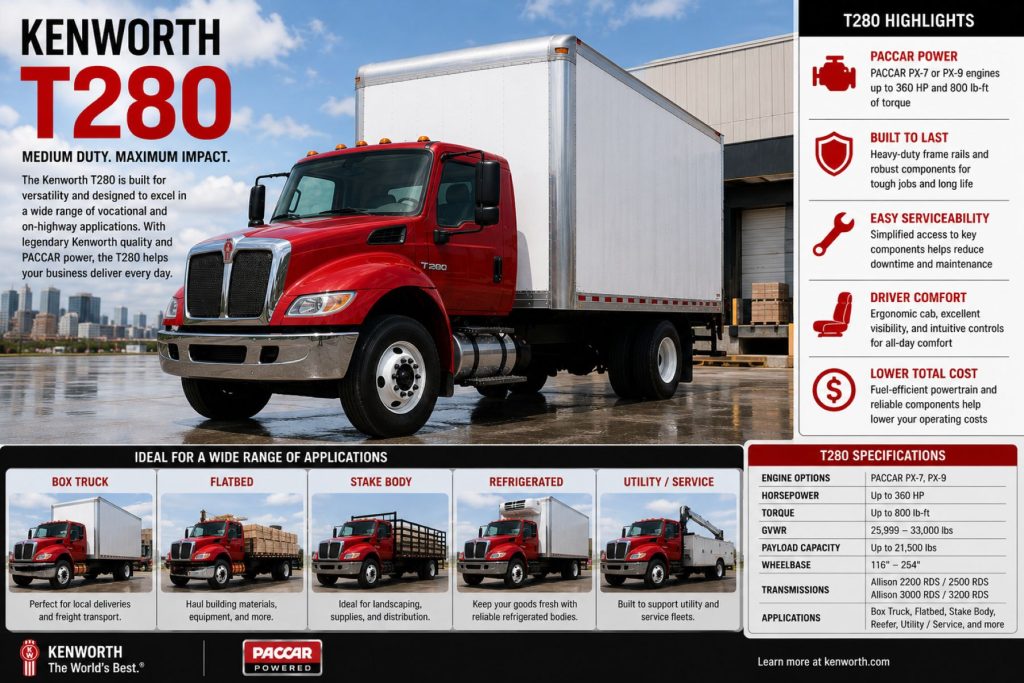
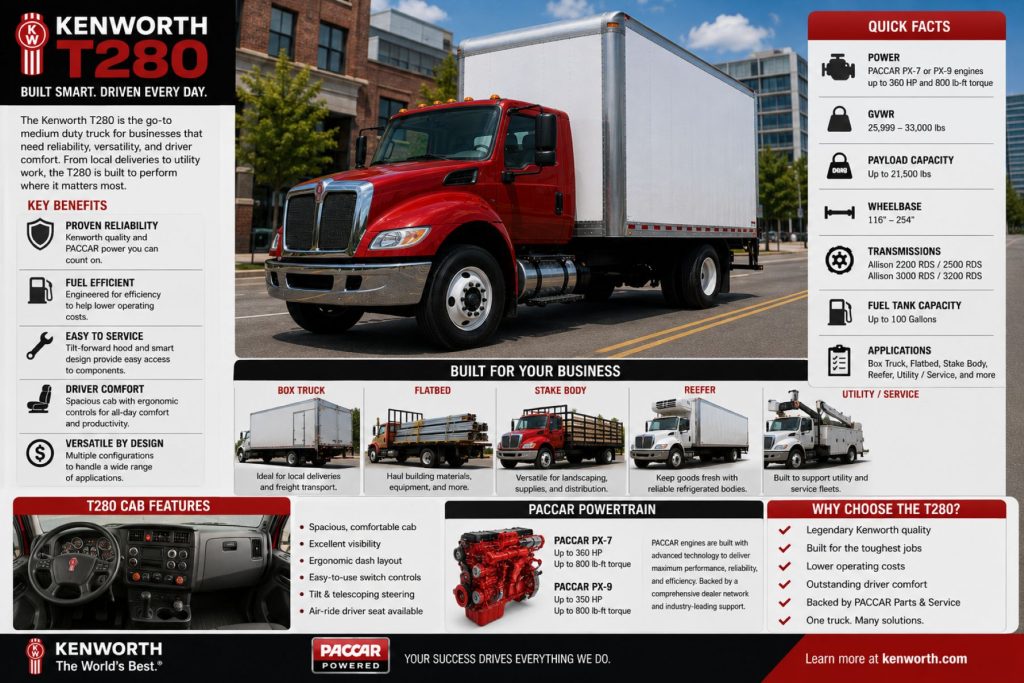
The T280 is available primarily as a 4×2 straight truck and can support numerous commercial bodies. Common installations include box bodies, refrigerated bodies, flatbeds, stake beds, dump bodies, tow equipment, service bodies, and utility equipment.
The truck combines a wide cab, strong driver visibility, multiple engine options, automatic-transmission availability, and a body-builder-friendly chassis. These features allow fleets to configure it for both freight delivery and specialized vocational truck applications.
Key Characteristics
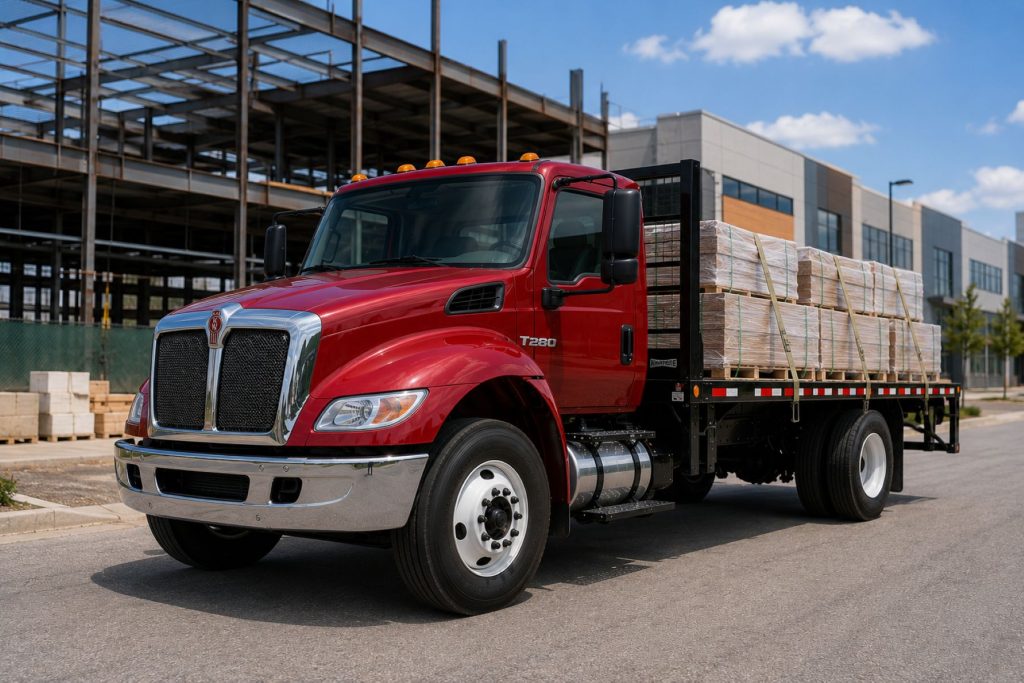
The Kenworth T280 is designed around versatility, driver comfort, maneuverability, and commercial-body compatibility.
Its conventional cab provides room for up to three occupants while maintaining the visibility required for urban streets, loading areas, job sites, and regional routes.
The available PACCAR engines and automatic transmissions allow buyers to match the powertrain to payload, terrain, route conditions, and vocational equipment.
Key characteristics include:
- Class 6 operating capacity
- Maximum GVWR of approximately 26,000 pounds
- 4×2 single-rear-axle configuration
- Wide 2.1-meter cab
- Standard low-roof configuration
- Optional raised-roof configuration
- Short aerodynamic hood
- Multiple wheelbase options
- PACCAR diesel engine availability
- Natural-gas engine availability on applicable configurations
- PACCAR TX-8 automatic transmission
- Allison automatic transmission options
- Body-builder-friendly chassis layout
- Multiple cargo and vocational body options
- Seven-inch digital driver display
- Strong visibility and urban maneuverability
Common Specifications
Engine Options
The Kenworth T280 can be configured with PACCAR diesel engines and, in applicable markets and model years, a Cummins natural-gas engine.
The PACCAR PX-7 is a 6.7-liter diesel engine commonly selected for pickup-and-delivery, box truck, refrigerated delivery, and lighter vocational operations. Available ratings can reach approximately 325 horsepower, depending on model year and specifications.
The PACCAR PX-9 is an 8.9-liter diesel engine available for applications requiring greater horsepower and torque. It can be useful for heavier bodies, towing, construction support, utility equipment, and more demanding regional work.
The Cummins B6.7N natural-gas engine has also been offered for applicable T280 configurations. It can operate with compressed or liquefied natural gas and may appeal to fleets pursuing alternative-fuel goals.
Additional information about diesel powertrains is available in How Diesel Truck Engines Work and Understanding Horsepower vs Torque.
Transmission Options
The PACCAR TX-8 automatic transmission is a common transmission for the T280. This eight-speed transmission is designed for pickup-and-delivery, utility, municipal, and vocational applications.
Allison automatic transmissions are also available in applicable configurations. Allison transmissions are widely used in operations involving traffic, frequent stops, towing, emergency service, and PTO-powered equipment.
The PACCAR TX-12 PRO automated transmission may be available in applicable PX-9 configurations requiring greater gross combination weight and vocational capability.
The correct transmission depends on engine torque, loaded weight, towing requirements, route conditions, operating speed, and vocational-equipment needs. More information is available through the Transmissions section.
Axle Configuration
The Kenworth T280 is commonly configured as a 4×2 straight truck with one steer axle and one powered rear axle.
Available front axle ratings generally range from approximately 8,000–12,000 pounds.
Available rear axle ratings generally range from approximately 11,500–21,000 pounds.
Actual axle availability depends on the engine, transmission, suspension, tires, wheels, brakes, body configuration, and intended application.
GVWR
The T280 is a Class 6 truck with a maximum GVWR of approximately 26,000 pounds.
Usable payload is lower than GVWR because the weight of the chassis, fuel, driver, passengers, cargo body, liftgate, refrigeration equipment, tools, and installed accessories must be deducted from the truck’s total rating.
Buyers should calculate the completed empty weight before estimating the truck’s actual cargo capacity.
Cab Configuration
The T280 uses Kenworth’s 2.1-meter-wide medium-duty cab. The cab can accommodate up to three occupants depending on seating specifications.
The design provides driver visibility, interior storage, accessible controls, and a conventional driving position suitable for local and regional commercial operations.
Roof Options
A standard low roof is available for applications requiring reduced overall height.
An optional raised roof provides additional interior headroom and may improve comfort for drivers spending longer periods inside the truck.
Hood Configuration
The T280 commonly uses a short aerodynamic hood with a bumper-to-back-of-cab measurement of approximately 107.5 inches.
The shorter hood and available wheelbases help improve turning ability and maneuverability in urban delivery and vocational environments.
Wheelbase Options
Wheelbase availability varies according to body length, cargo requirements, axle placement, equipment installation, and turning requirements.
Shorter wheelbases improve maneuverability, while longer wheelbases can support larger cargo bodies and specialized equipment.
The body manufacturer and chassis dealer should confirm proper cab-to-axle dimensions and loaded weight distribution before the truck is ordered.
Braking System
Brake configuration can vary depending on vehicle specifications. Available systems may include hydraulic or air brake equipment.
The braking system must be matched to GVWR, towing requirements, axle ratings, and the truck’s intended application.
Suspension Options
Available suspension configurations vary according to payload, axle capacity, ride-quality requirements, and vocational use.
A delivery truck may prioritize cargo protection and ride quality, while a dump truck or service vehicle may require greater load support and stability.
More information is available in the Suspension Systems section.
PTO Compatibility
Properly equipped T280 configurations can support a transmission-mounted power take-off.
A PTO can operate hydraulic pumps used by dump bodies, tow equipment, cranes, service bodies, spreaders, and other vocational systems.
Additional information is available in PTO System Explained.
Common Applications
The Kenworth T280 can support a wide variety of delivery and vocational applications.
- Local pickup and delivery
- Regional distribution
- Box truck operations
- Refrigerated delivery
- Food and beverage distribution
- Furniture and appliance delivery
- Moving operations
- Parcel and final-mile delivery
- Flatbed hauling
- Stake-bed hauling
- Landscaping operations
- Municipal service
- Utility work
- Construction support
- Service-body operations
- Mobile repair
- Towing and recovery
- Rollback vehicle transport
- Light dump operations
- Fuel and propane delivery
- Fire and emergency service
The correct configuration depends on cargo dimensions, loaded weight, body type, unloading requirements, route environment, and vocational-equipment needs.
Advantages
The Kenworth T280 offers several advantages for medium-duty commercial operations.
- Maximum GVWR of approximately 26,000 pounds
- Multiple diesel engine options
- Natural-gas availability in applicable configurations
- PACCAR TX-8 automatic transmission
- Allison automatic transmission availability
- Wide and comfortable cab
- Strong driver visibility
- Seating for up to three occupants
- Standard and raised-roof options
- Good urban maneuverability
- Multiple wheelbase options
- Broad commercial-body compatibility
- Conventional hood for service access
- Strong suitability for local and regional operations
- Available PTO compatibility
- Kenworth dealer and parts support
- Smaller footprint than larger Class 7 and Class 8 trucks
Limitations or Considerations
The Kenworth T280 may not be suitable for every operation.
- Lower payload capacity than larger Class 7 trucks
- Not designed for regular Class 8 freight operations
- Heavy commercial bodies can reduce usable payload
- Longer wheelbases can reduce maneuverability
- The truck may exceed individual axle ratings before reaching total GVWR
- Higher-output engines can increase purchase and operating costs
- Modern diesel emissions systems require proper maintenance
- Natural-gas configurations require appropriate fueling access
- Specialized equipment can substantially increase purchase price
- Some configurations may require a CDL because of trailer or combined weight
- PTO and hydraulic equipment require additional maintenance
- Engine and transmission availability can change by model year
Buyers should compare completed body weight, equipment weight, cargo, passengers, and accessories before selecting a chassis.
Driver and Operator Experience
The Kenworth T280 is designed to provide a driver-focused environment similar to Kenworth’s larger commercial trucks.
The wide cab provides room for the driver, passengers, storage, and work-related equipment. A seven-inch digital display presents vehicle information in a configurable format, while available steering-wheel controls allow drivers to access common functions without unnecessary movement.
The short aerodynamic hood and large windshield provide visibility in traffic, loading areas, parking lots, and job sites.
Automatic-transmission options reduce driver workload during routes involving frequent starts, stops, and low-speed maneuvering. This can be useful for delivery fleets employing drivers with different experience levels.
Ride quality depends on wheelbase, suspension, tires, body configuration, and loaded weight. Proper specification is important for protecting cargo and maintaining driver comfort.
Maintenance and Ownership Notes
The conventional hood provides access to the engine, cooling system, belts, filters, fluid checkpoints, and other routine service components.
Routine maintenance should include:
- Engine oil and filter service
- Fuel filter replacement
- Cooling-system inspection
- Transmission service
- Brake inspection and adjustment
- Tire-pressure and tread inspection
- Steering-system inspection
- Suspension inspection
- Axle and differential service
- Battery and electrical-system testing
- Diesel emissions-system maintenance
- Body-mount inspection
- Liftgate maintenance when equipped
- PTO and hydraulic-system inspection when equipped
- Refrigeration-unit maintenance when equipped
- Tow-body inspection when equipped
- Dump-body hinge and hydraulic-cylinder inspection
Commercial trucks used for frequent short trips, extensive idling, or stop-and-go delivery may require closer monitoring of the diesel particulate filter and aftertreatment system.
Operators should understand regeneration procedures and respond promptly to warning indicators. More information is available in Diesel Emissions Systems Explained.
Buying Considerations
Before purchasing a Kenworth T280, buyers should calculate the completed truck’s weight and operating requirements.
Important considerations include:
- Required GVWR
- Expected payload
- Cargo-body dimensions
- Completed empty weight
- Loaded front and rear axle weights
- Engine horsepower and torque
- Transmission selection
- Wheelbase and turning radius
- Cab-to-axle dimensions
- Standard or raised roof
- Suspension configuration
- Brake system
- Tire and wheel ratings
- Liftgate requirements
- Refrigeration equipment
- PTO requirements
- Hydraulic-equipment needs
- Trailer weight
- Combined vehicle rating
- Route length and road conditions
- Dealer and parts availability
- Used-truck maintenance history
A truck rated at 26,000 pounds GVWR may fit certain non-CDL operations. However, trailer weight, combined vehicle rating, hazardous materials, passenger capacity, and state regulations can change licensing requirements.
Buyers can use How to Choose the Right Commercial Truck to compare vehicle classifications, payload, body requirements, and operating conditions.
Variants and Configurations
The Kenworth T280 can support numerous commercial body and equipment configurations.
- Straight truck
- Chassis cab
- Box truck
- Refrigerated box truck
- Flatbed truck
- Stake-bed truck
- Beverage-delivery truck
- Moving truck
- Service-body truck
- Utility truck
- Municipal truck
- Landscape truck
- Light dump truck
- Tow truck
- Rollback carrier
- Mobile-repair truck
- Construction-support truck
- Fuel-delivery truck
- Propane-delivery truck
- Fire and emergency vehicle
Each body installation must be matched to the chassis wheelbase, frame, axle ratings, suspension, braking system, and available payload.
Comparison to Similar Trucks
The Kenworth T280 competes with other medium-duty commercial trucks, including the Freightliner M2 106, International MV Series, Hino L Series, and Peterbilt 535.
Compared with lighter commercial chassis, the T280 provides greater diesel-engine capability, commercial-body flexibility, and medium-duty durability.
Compared with the Freightliner M2 106 and International MV Series, the T280 competes through its PACCAR powertrain options, wide cab, driver-focused interior, and Kenworth dealer support.
Compared with the Hino L Series, the T280 provides a broader range of diesel engine, transmission, axle, and vocational specifications.
Compared with larger Class 7 models, the T280 provides less maximum capacity but may offer advantages in vehicle weight, maneuverability, acquisition cost, and licensing for certain applications.
The correct choice depends on payload, cargo-body requirements, powertrain preference, operating environment, maintenance support, and total ownership cost.
Best Fit For
- Local delivery fleets
- Regional distribution businesses
- Food and beverage distributors
- Moving companies
- Municipal departments
- Utility companies
- Landscaping businesses
- Construction contractors
- Towing and recovery operators
- Mobile service fleets
- Commercial rental fleets
- Businesses requiring a Class 6 box truck
- Operators preferring a conventional medium-duty cab
- Fleets prioritizing automatic-transmission availability
- Businesses needing more capability than a light-duty chassis
Regulatory and Compliance Notes
The Kenworth T280 must comply with federal, state, and local commercial-vehicle regulations based on its registered weight, actual loaded weight, cargo, trailer, and operating area.
Operators should monitor:
- Registered GVWR
- Actual loaded vehicle weight
- Front and rear axle weights
- Driver-license requirements
- Medical-card requirements
- USDOT registration requirements
- Vehicle inspection requirements
- Hours-of-service applicability
- Commercial insurance requirements
- Trailer and combined weight ratings
- Cargo-securement requirements
- Hazardous-material regulations when applicable
- State and local commercial-vehicle rules
- Diesel emissions requirements
A 26,000-pound GVWR does not automatically exempt every T280 operation from CDL requirements. A trailer, combined vehicle rating, hazardous materials, passenger use, or specific state regulation can change the required license or endorsement.
Operators should also verify that the completed truck remains within its axle, tire, wheel, suspension, and braking-system ratings.
Real World Operating Notes
In real-world operations, the Kenworth T280 performs best when its engine, transmission, wheelbase, axles, suspension, and commercial body are selected together.
A lightweight delivery box requires different specifications than a refrigerated body, tow body, dump body, utility crane, or heavy service installation.
Liftgates, refrigeration systems, hydraulic equipment, tool compartments, cranes, additional fuel tanks, and tow equipment reduce usable payload.
Buyers should obtain the completed truck’s empty weight before estimating cargo capacity. Individual axle weights should also be checked because a truck can remain below its total GVWR while exceeding a front or rear axle rating.
Operations involving frequent idling and short trips should monitor the diesel aftertreatment system carefully. Proper regeneration practices can help prevent avoidable downtime and repair expenses.
T280 trucks equipped with hydraulic equipment should receive regular PTO and hydraulic-system inspections.
Related Truck Types
Related Freight Types
Related Trailer Types
- Dry Van Freight
- Refrigerated Freight
- Flatbed Freight
- Construction and Aggregate Freight
- Specialty and Niche Freight
Related Equipment Systems
- Engines
- Transmissions
- Brake Systems
- Suspension Systems
- Axles and Differentials
- Safety Systems
- Electrical Systems
- Telematics and ELD Systems
- Tires and Wheels
Related Guides
Frequently Asked Questions
What class of truck is the Kenworth T280?
The Kenworth T280 is a Class 6 commercial truck with a maximum GVWR of approximately 26,000 pounds.
What engines are available in the Kenworth T280?
Common engine options include the PACCAR PX-7 and PACCAR PX-9. A Cummins natural-gas engine has also been available in applicable configurations.
What transmission does the Kenworth T280 use?
The PACCAR TX-8 automatic is a common transmission for the T280. Allison automatic transmissions and the PACCAR TX-12 PRO may also be available in applicable configurations.
Does the Kenworth T280 require a CDL?
A T280 rated at 26,000 pounds GVWR may be operated without a CDL in some circumstances. Trailer weight, combined vehicle rating, hazardous materials, passenger capacity, and state regulations can still create CDL requirements.
Can the Kenworth T280 be configured as a box truck?
Yes. The T280 can support dry freight and refrigerated box bodies for local and regional delivery operations.
Can the Kenworth T280 be configured as a dump truck?
Yes. The T280 can support lighter dump-body and landscaping configurations when the chassis, axles, suspension, transmission, and PTO system are specified correctly.
Is the Kenworth T280 suitable for regional delivery?
Yes. Its Class 6 capacity, automatic-transmission options, wide cab, and commercial-body flexibility make it suitable for local and regional distribution.
What is the difference between the Kenworth T280 and T380?
The T280 is primarily a Class 6 truck rated at approximately 26,000 pounds GVWR. The T380 is a larger Class 7 model offering higher axle ratings, payload capacity, and heavier vocational capability.
Availability and Where to Find
New Kenworth T280 trucks can be ordered through authorized Kenworth dealerships. Availability depends on engine, transmission, wheelbase, axle ratings, suspension, cab, and commercial-body requirements.
Used T280 trucks may be available through Kenworth dealerships, commercial-truck dealers, fleet-retirement sales, equipment auctions, and online commercial-vehicle marketplaces.
When evaluating a used T280, buyers should inspect the engine, transmission, diesel emissions system, frame, suspension, axles, brakes, tires, electrical equipment, commercial body, liftgate, and PTO equipment.
Maintenance records, engine hours, mileage, idle time, former cargo, and the truck’s previous application should be reviewed before purchase.
Support Trucking Families
Truck Equipment Atlas supports the mission of Grey Cross, a nonprofit dedicated to helping families of truck drivers who lose their lives while on the road. As the site grows, part of its mission is to bring awareness and support to these families.
Podcast or Video Section
Learn More Through Audio and Video
Truck Equipment Atlas will continue expanding with podcast episodes, interviews, and equipment breakdowns to help drivers and fleets better understand trucks and equipment.
Follow the Growth of Truck Equipment Atlas
Truck Equipment Atlas continues to expand with new truck profiles, trailer coverage, diesel engine pages, equipment system resources, manufacturer information, and educational guides.
Visit our Site Updates page to explore recent additions, project milestones, and upcoming resources as we continue building one of the industry’s growing commercial trucking equipment reference libraries.
View the Latest Site Updates: Truck Equipment Atlas Site Updates