
Kenworth T800
Quick Facts
• Manufacturer: Kenworth Truck Company
• Truck Class: Class 8 Highway, Heavy-Haul, and Severe-Duty Vocational Truck
• Common Configurations: Day Cab, Extended Day Cab, Sleeper Cab, Set-Back Axle, Wide-Hood T800W, Tandem Axle, Tridem Drive
• Primary Applications: Heavy Haul, Construction, Logging, Oilfield Operations, Dump Operations, Specialized Freight, Regional Hauling
• Common Engine Options: PACCAR MX-13, Cummins X15, Caterpillar C15 in older models
• Typical Transmission Options: Eaton Fuller Manual, Eaton UltraShift PLUS Automated, Allison Automatic
• Common Axle Setups: 4×2, 6×4, 8×4, 8×6, Tandem Drive, Tridem Drive, Lift Axle Configurations
• GVWR Range: Varies widely, with specialized configurations exceeding 100,000 lbs
• GCWR Range: Can exceed 200,000 lbs in properly configured heavy-haul applications
• Front Axle Capacity: Approximately 12,000–22,000+ lbs depending on configuration
• Rear Axle Capacity: Approximately 23,000–70,000+ lbs depending on axle setup
• Cab Style: Conventional Aluminum Cab with Day Cab and Sleeper Options
• Production Status: Final Production Year — Kenworth is ending T800W production in 2026
Overview
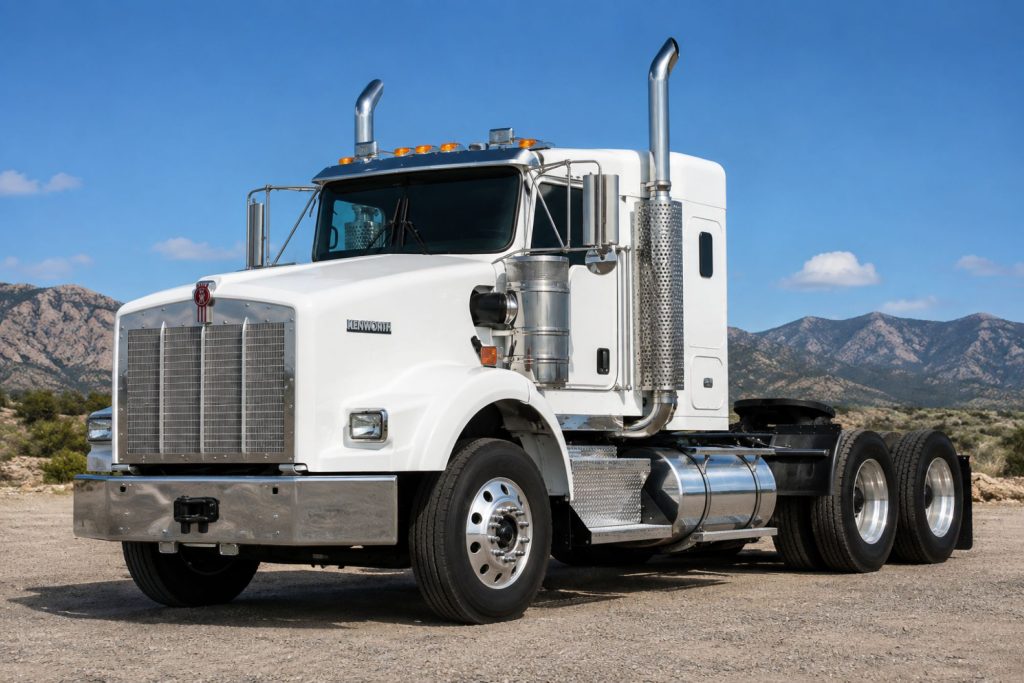
The Kenworth T800 is one of the most versatile Class 8 truck platforms produced by Kenworth. Introduced for demanding highway and vocational operations, the T800 has been used extensively in heavy haul, logging, construction, oilfield service, dump operations, regional transportation, and specialized equipment hauling.
Its sloped hood, set-back front axle, strong chassis, broad engine availability, and extensive configuration options allowed the T800 to combine vocational durability with improved visibility and maneuverability.
Unlike trucks designed for a single freight sector, the T800 could be configured as a highway tractor, heavy-haul tractor, dump truck, logging truck, oilfield vehicle, concrete mixer, crane carrier, or specialized vocational chassis.
The T800W wide-hood version was developed for high-horsepower engines, larger cooling systems, and demanding heavy-haul applications. Kenworth announced that production of the T800W and other legacy 1.9-meter-cab models will end during 2026.
Key Characteristics
The Kenworth T800 is recognized for its combination of durability, visibility, maneuverability, and configuration flexibility.
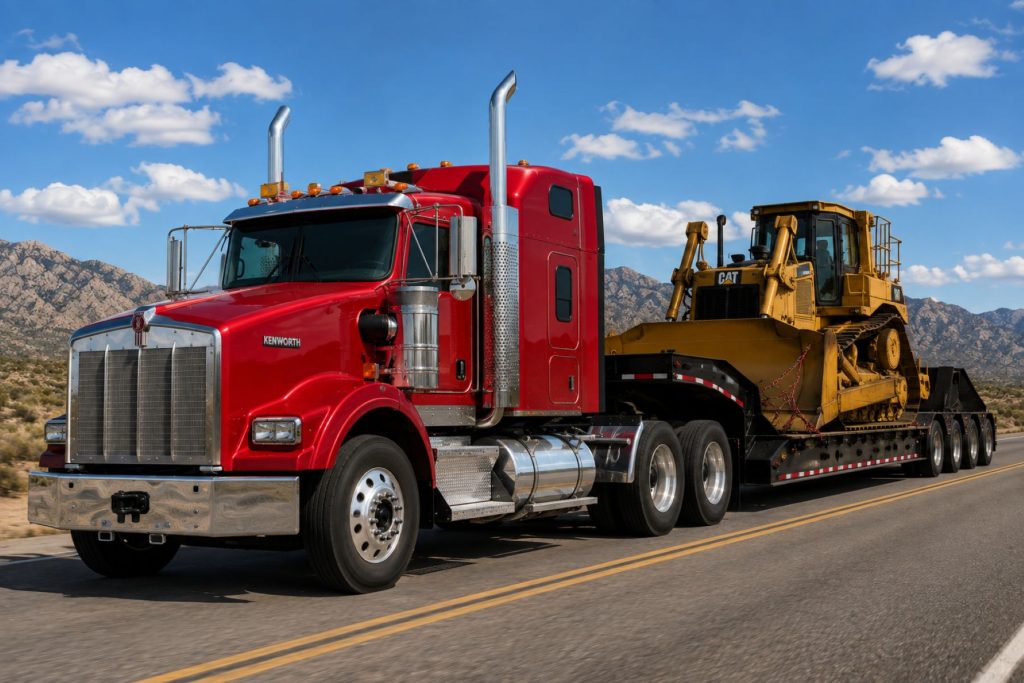
Its set-back front axle improves weight distribution and reduces the truck’s turning radius compared with many traditional long-hood platforms. The sloped hood also provides better forward visibility for highway, vocational, and jobsite operations.
Heavy-duty frame options, large cooling packages, high-capacity axles, vocational suspensions, PTO compatibility, and multiple wheelbase choices allowed fleets to configure the truck around specific operating requirements.
The T800 was also available with several cab and sleeper configurations, making it suitable for local vocational work, regional operations, and long-distance heavy haul.
Common Specifications
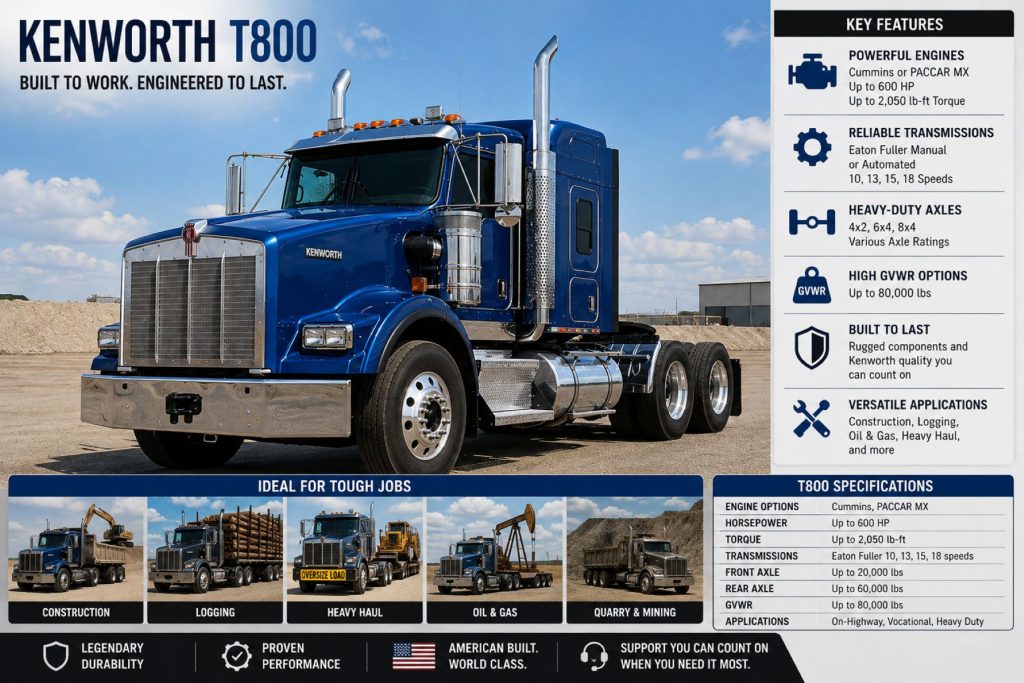
Engine Options
Engine availability varied considerably throughout the T800’s long production history.
Later-production models were commonly equipped with the PACCAR MX-13 or Cummins X15.
Older T800 trucks may use engines such as the Caterpillar C15, Caterpillar C13, Cummins ISX15, Detroit Series 60, or earlier PACCAR and Cummins platforms.
Horsepower and torque ratings depend on the engine, model year, cooling package, drivetrain, and intended application. Heavy-haul T800W configurations were designed to accommodate some of the highest engine ratings available during their production periods.
Transmission Options
Eaton Fuller manual transmissions were widely used in T800 highway, logging, oilfield, and heavy-haul configurations. Common choices included 10-, 13-, 15-, and 18-speed transmissions.
Eaton automated manual transmissions were available for operations seeking reduced driver workload and more consistent shifting.
Allison automatic transmissions were frequently selected for dump trucks, concrete mixers, municipal vehicles, oilfield equipment, and other vocational applications involving repeated low-speed operation or PTO-driven equipment.
Axle Configurations
The T800 was available with numerous axle arrangements, including 4×2, 6×4, 8×4, 8×6, tandem-drive, tridem-drive, lift-axle, pusher-axle, and twin-steer configurations.
Standard highway tractors generally used a 6×4 tandem-drive arrangement. Heavy-haul, oilfield, logging, and vocational trucks could be equipped with additional axles to improve traction, weight distribution, and legal payload capacity.
Suspension Options
Available suspension systems varied according to axle arrangement and application.
Highway tractors often used Kenworth air-ride suspension for improved comfort and cargo protection. Vocational configurations could use heavy-duty air, walking-beam, rubber-block, or mechanical suspensions designed for demanding terrain and high loads.
Cab and Sleeper Options
The T800 was available as a standard day cab, extended day cab, and with multiple sleeper configurations.
Sleeper availability included smaller flat-roof sleepers for regional and heavy-haul work and larger sleepers for long-distance operations. Specific sleeper sizes varied by model year and configuration.
Common Applications
- Heavy-haul transportation
- Oversized-load transportation
- Construction equipment hauling
- Logging and forestry operations
- Oilfield transportation
- Dump truck operations
- Concrete mixer applications
- Crane and rigging operations
- Tanker transportation
- Regional freight hauling
- Mining support
- Municipal service
- Specialized vocational work
Advantages
- Broad range of available configurations
- Strong heavy-haul capability
- Excellent vocational versatility
- Good forward visibility
- Set-back axle maneuverability
- Day cab and sleeper availability
- High-capacity axle options
- Tandem and tridem-drive configurations
- PTO compatibility
- Multiple transmission choices
- Strong chassis construction
- Good parts and service support
- Established reputation in severe-duty industries
- Strong resale demand for desirable configurations
Limitations or Considerations
- Production is ending during 2026
- New-truck availability is becoming limited
- Older trucks may require significant emissions-system repairs
- Heavy configurations have greater empty weight
- Fuel economy is lower than modern aerodynamic highway trucks
- Specialized components can increase repair costs
- Long wheelbases reduce maneuverability
- Multi-axle configurations require careful weight management
- Older model-specific cab parts may become harder to locate
- Previous vocational use may create significant chassis wear
- Specifications vary greatly among individual trucks
- Used trucks require thorough frame and driveline inspections
Driver and Operator Experience
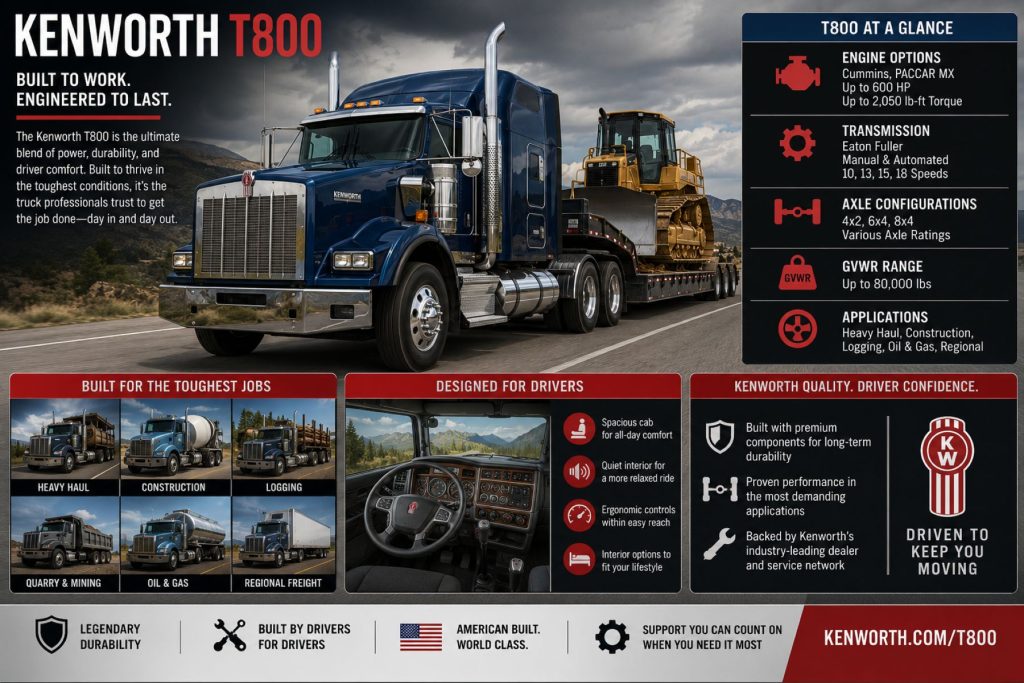
The Kenworth T800 provides a traditional Class 8 driving environment with strong visibility, straightforward controls, and a cab designed for both highway and vocational work.
Its sloped hood and set-back front axle help drivers see the road and jobsite area in front of the truck. The shorter turning radius is valuable when maneuvering around construction sites, oilfields, logging operations, equipment yards, and congested delivery locations.
Ride quality varies significantly by wheelbase, axle arrangement, suspension, tire configuration, and application. Highway tractors equipped with air-ride suspension generally provide greater comfort, while vocational suspension systems prioritize load capacity and durability.
Sleeper-equipped T800 models can support regional and long-distance heavy-haul work. Extended day cab configurations provide additional storage and interior room without requiring a full sleeper.
Maintenance and Ownership Notes
Maintenance requirements depend heavily on the T800’s model year, engine, transmission, axle configuration, and previous application.
Highway-operated trucks require routine attention to the engine, transmission, cooling system, brakes, suspension, driveline, emissions equipment, and fifth wheel.
Vocational trucks used in construction, logging, mining, or oilfield environments may experience accelerated wear to steering components, suspensions, driveline parts, tires, brakes, frames, electrical connections, and body equipment.
Heavy-haul configurations place additional stress on cooling systems, clutches, transmissions, driveshafts, differentials, axles, wheel ends, frame rails, fifth wheels, and towing equipment.
Because the T800 was produced for many years with numerous component combinations, buyers should use the VIN and original build information when ordering parts or planning repairs.
Buying Considerations
When evaluating a Kenworth T800, buyers should determine whether the truck’s original specifications match the intended work.
Important considerations include:
• Model year and production generation
• Standard T800 or wide-hood T800W
• Engine model and horsepower rating
• Transmission type and gear ratios
• Front and rear axle capacities
• Tandem or tridem-drive configuration
• Lift-axle and pusher-axle requirements
• Suspension type and capacity
• Frame thickness and reinforcement
• Wheelbase and maneuverability
• Day cab or sleeper configuration
• PTO and hydraulic-system requirements
• Fifth-wheel capacity and placement
• Cooling-system capacity
• Emissions-system condition
• Previous highway or vocational use
• Maintenance and repair history
• Availability of model-specific parts
Used vocational trucks should be inspected carefully for frame damage, cracks, corrosion, worn suspension mounts, driveline movement, axle problems, steering wear, and previous modifications.
Variants and Configurations
- Standard Kenworth T800
- Kenworth T800W wide-hood
- Short-hood T800
- Day cab configuration
- Extended day cab configuration
- Sleeper tractor configuration
- 6×4 tandem-drive tractor
- 8×4 vocational configuration
- 8×6 tridem-drive configuration
- Heavy-haul tractor
- Logging truck
- Dump truck
- Concrete mixer
- Crane carrier
- Oilfield service truck
- Tanker tractor
- Municipal vocational truck
Comparison to Similar Trucks
The Kenworth T800 is commonly compared with trucks such as the Kenworth T880, Kenworth C500, Western Star 4900, Volvo VNX, Freightliner 122SD, and International HX Series.
Compared with the newer Kenworth T880, the T800 uses Kenworth’s older 1.9-meter cab platform and offers a more traditional interior and exterior design. The T880 provides newer electronics, improved cab space, updated safety systems, and continued production availability.
Compared with the Kenworth C500, the T800 is generally better suited for mixed highway and vocational operations. The C500 places greater emphasis on extreme off-road and severe-duty work.
Compared with the Volvo VNX, the T800 offers a more traditional heavy-haul platform with a broad selection of historical engine, transmission, axle, and vocational configurations.
Best Fit For
- Heavy-haul carriers
- Construction fleets
- Logging companies
- Oilfield service operations
- Dump truck fleets
- Equipment transporters
- Crane and rigging companies
- Regional vocational fleets
- Mining support operations
- Tanker carriers
- Buyers seeking a proven used vocational truck
- Operators who prefer traditional Kenworth designs
Regulatory and Compliance Notes
The Kenworth T800 must comply with emissions requirements applicable to its engine and model year. Later-production trucks use diesel particulate filters, selective catalytic reduction, diesel exhaust fluid, and electronic emissions controls.
Earlier trucks may fall under different emissions requirements depending on model year and operating jurisdiction.
Axle-weight, gross-weight, bridge-formula, vehicle-dimension, and permit requirements vary according to configuration and operating region.
Heavy-haul and oversized-load operations may require permits, approved routes, escort vehicles, warning equipment, restricted travel periods, and additional insurance.
The truck’s mechanical ratings do not automatically establish the legal weight permitted on public roads. Operators must consider axle spacing, tire ratings, bridge laws, trailer specifications, and permit conditions.
Real World Operating Notes
In real-world service, the Kenworth T800 developed a reputation as one of the most adaptable Class 8 trucks in North America.
The platform can be found working as a highway tractor, heavy-haul truck, dump truck, logging truck, oilfield vehicle, concrete mixer, tanker tractor, and specialized vocational chassis.
Operators frequently value the T800 for its visibility, turning capability, straightforward design, broad component availability, and ability to support specialized axle and drivetrain arrangements.
Because individual T800 trucks were often built for specific customers and applications, two trucks with the same model designation may have significantly different capabilities, weights, maintenance requirements, and operating costs.
Related Truck Types
• Heavy Haul Trucks
• Vocational Trucks
• Day Cab Trucks
• Sleeper Trucks
• Dump Trucks
Related Freight Types
• Heavy Haul Freight
• Construction & Aggregate Freight
• Logging & Forestry Freight
• Flatbed Freight
• Specialized & Niche Freight
Related Trailer Types
• Lowboy / RGN Trailers
• Flatbed Trailers
• Step Deck Trailers
• Dump Trailers
• Log Trailers
Related Equipment Systems
• Engines
• Transmissions
• Axles & Differentials
• Suspension Systems
• Brake Systems
• PTO Systems
• Fifth Wheel Systems
• Tires & Wheels
Related Guides
• Heavy Haul Freight Guide
• Lift Axles Explained
• PTO Systems Explained
Frequently Asked Questions
Is the Kenworth T800 still in production?
Kenworth announced that production of the T800W wide-hood and its other legacy 1.9-meter-cab models will end during 2026.
What is the difference between the T800 and T800W?
The T800W uses a wider hood designed to accommodate large engines, high-capacity cooling systems, and demanding heavy-haul specifications.
What engines are commonly found in the Kenworth T800?
Later models commonly use the PACCAR MX-13 or Cummins X15. Older trucks may use Caterpillar C15, Caterpillar C13, Cummins ISX15, Detroit Series 60, and other engines.
Is the Kenworth T800 suitable for heavy haul?
Yes. Properly configured T800 and T800W trucks are widely used in heavy-haul, oilfield, logging, and oversized-load operations.
What truck replaced the Kenworth T800?
The Kenworth T880 serves as Kenworth’s newer primary vocational platform for many applications previously handled by the T800.
Availability and Where to Find
New Kenworth T800W availability is limited as Kenworth completes the model’s final production year in 2026.
Used Kenworth T800 trucks are widely available through Kenworth dealerships, commercial truck dealers, vocational-equipment specialists, heavy-haul truck brokers, fleet resellers, auctions, and online truck marketplaces.
Because the T800 was produced in numerous configurations, buyers should verify the VIN, original build sheet, engine, transmission, axle ratings, frame specifications, suspension, wheelbase, and previous application before purchasing.
Support Trucking Families
Truck Equipment Atlas supports the mission of Grey Cross, a nonprofit dedicated to helping families of truck drivers who lose their lives while on the road. As the site grows, part of its mission is to bring awareness and support to these families.
Podcast or Video Section
Learn More Through Audio and Video
Truck Equipment Atlas will continue expanding with podcast episodes, interviews, and equipment breakdowns to help drivers and fleets better understand trucks and equipment.
Follow the Growth of Truck Equipment Atlas
Truck Equipment Atlas continues to expand with new truck profiles, trailer coverage, diesel engine pages, equipment system resources, manufacturer information, and educational guides.
Visit our Site Updates page to explore recent additions, project milestones, and upcoming resources as we continue building one of the industry’s growing commercial trucking equipment reference libraries.
View the Latest Site Updates: Truck Equipment Atlas Site Updates