
Air Brake Systems Explained
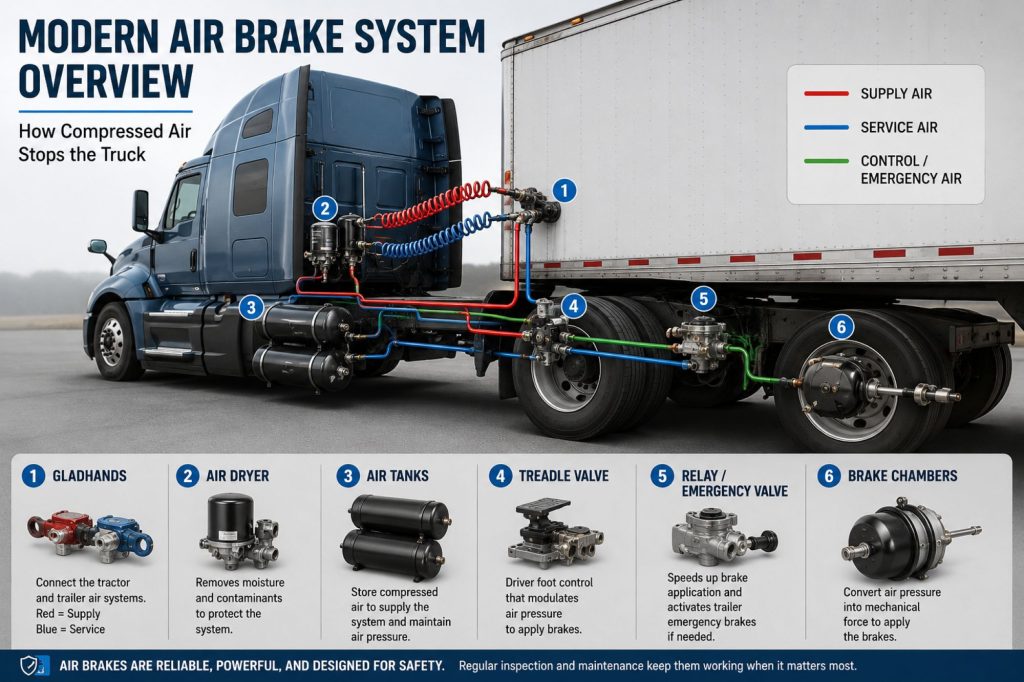
Air brake systems are one of the most important safety systems found on commercial trucks and trailers. Every day, millions of trucks across North America rely on compressed air to safely stop, control, and secure vehicles that can weigh up to 80,000 pounds or more.
Unlike passenger vehicles that use hydraulic braking systems, commercial trucks use air brakes because they provide greater stopping power, built-in safety features, and the ability to operate effectively across tractor-trailer combinations.
Whether you are a CDL student, owner-operator, fleet manager, technician, or trucking enthusiast, understanding air brake systems is essential to understanding how commercial vehicles operate safely.
This guide explains how air brake systems work, their major components, inspection procedures, common problems, and why they remain the industry standard for commercial transportation.
What Are Air Brakes?
Air brakes are braking systems that use compressed air rather than hydraulic fluid to apply braking force.
The system stores compressed air in reservoirs and uses that air to activate brake chambers located at each wheel position. When the driver presses the brake pedal, air pressure is directed to the brake chambers, causing the brakes to apply.
Air brake systems are commonly found on:
- Sleeper Trucks
- Day Cab Trucks
- Dump Trucks
- Tank Trucks
- Concrete Mixer Trucks
- Heavy Haul Trucks
- Commercial buses
- Tractor-trailer combinations
Because air can be continuously generated by an onboard compressor, air brake systems are highly reliable and well suited for heavy-duty applications.
Why Commercial Trucks Use Air Brakes
Commercial vehicles require braking systems capable of controlling and stopping extremely heavy loads safely and consistently.
Greater Stopping Power
Air brake systems are designed to handle significantly higher vehicle weights than hydraulic brake systems.
Fail-Safe Design
If air pressure drops too low, spring brakes automatically apply.
Continuous Air Supply
The engine-driven compressor continuously replenishes system pressure.
Tractor-Trailer Compatibility
Air systems can easily operate across multiple trailers and tractor-trailer combinations.
Durability
Air brake systems are designed to withstand demanding commercial operating conditions.

Main Components of an Air Brake System
Several major components work together to create braking force.
Air Compressor
The air compressor generates compressed air for the entire braking system.
Governor
The governor controls compressor operation and maintains proper system pressure.
Air Tanks
Air reservoirs store compressed air until it is needed.
Brake Pedal
The brake pedal controls how much air pressure is directed to the brakes.
Brake Chambers
Brake chambers convert air pressure into mechanical force.
Slack Adjusters
Slack adjusters transfer movement from the brake chamber to the braking components.
Brake Shoes and Drums
These components create friction that slows or stops the vehicle.

How Air Brakes Work
Air brake systems operate through a straightforward process.
Step 1: Air Is Compressed
The engine-driven compressor creates compressed air.
Step 2: Air Is Stored
Compressed air is stored inside air reservoirs.
Step 3: Driver Applies Brakes
When the brake pedal is pressed, air pressure is directed toward the brake chambers.
Step 4: Brake Chambers Activate
Air pressure enters the chambers and creates mechanical movement.
Step 5: Brakes Apply
The brake shoes press against the brake drums, creating friction.
Step 6: Vehicle Slows
The friction generated between the brake shoes and drums slows the vehicle.
Step 7: Air Is Released
When the driver releases the brake pedal, air pressure is exhausted and the brakes release.

Air Supply System
The air supply system creates, stores, and manages compressed air.
Air Compressor
The compressor is the heart of the air brake system.
It continuously generates compressed air while the engine is operating.
Governor
The governor controls compressor cycling.
Typical operating pressures include:
- Cut-in pressure: approximately 100 PSI
- Cut-out pressure: approximately 125 PSI
Wet Tank
The wet tank is the first air reservoir after the compressor.
Its purpose is to collect:
- Moisture
- Oil contamination
- Debris
Primary Tank
The primary tank supplies one braking circuit.
Secondary Tank
The secondary tank supplies a separate braking circuit.
Dual-circuit systems provide additional safety and redundancy.
Air Dryer
Most modern trucks use air dryers.
Air dryers help:
- Remove moisture
- Prevent corrosion
- Reduce freezing
- Improve system reliability
Proper air dryer maintenance is critical to air brake performance.
Foundation Brake Components
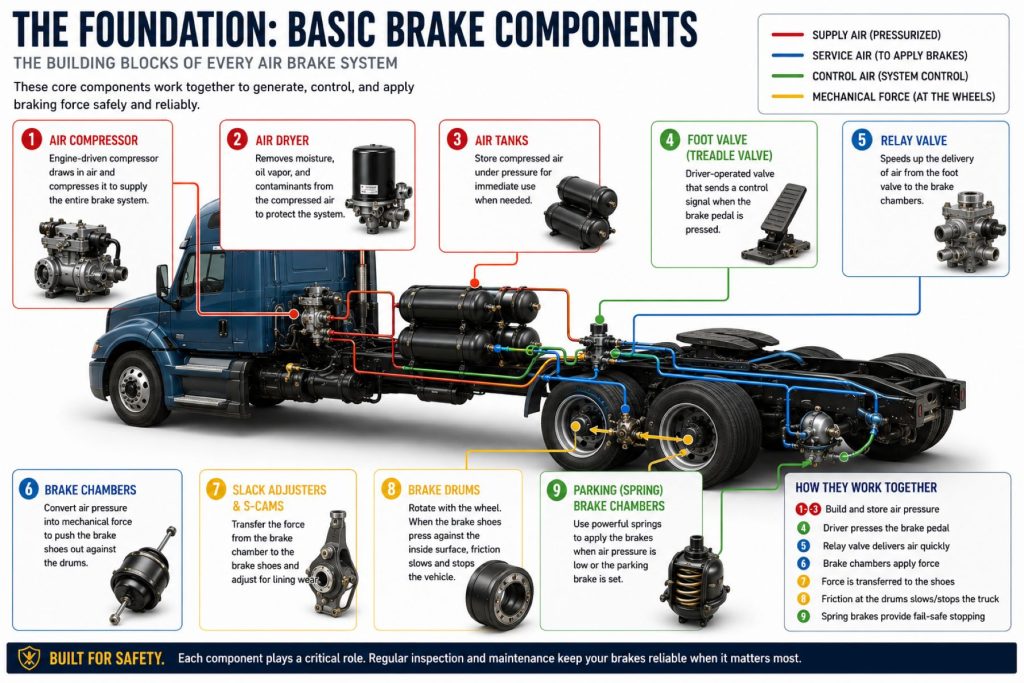
Foundation brakes create the actual stopping force at each wheel position.
Brake Chambers
Brake chambers convert air pressure into mechanical movement.
Pushrods
Pushrods transfer force from the brake chamber to the slack adjuster.
Slack Adjusters
Slack adjusters convert pushrod movement into braking force.
Most modern trucks use automatic slack adjusters.
Brake Shoes
Brake shoes contain friction material that contacts the drum.
Brake Drums
Brake drums rotate with the wheel assembly.
When the shoes contact the drum, friction slows the vehicle.
Air Disc Brakes
Some modern trucks use air disc brakes instead of traditional drum brakes.
Advantages include:
- Improved stopping performance
- Reduced brake fade
- Easier inspections
- Better heat dissipation
Air disc brakes are becoming increasingly common throughout the industry.
Tractor-Trailer Air Connections
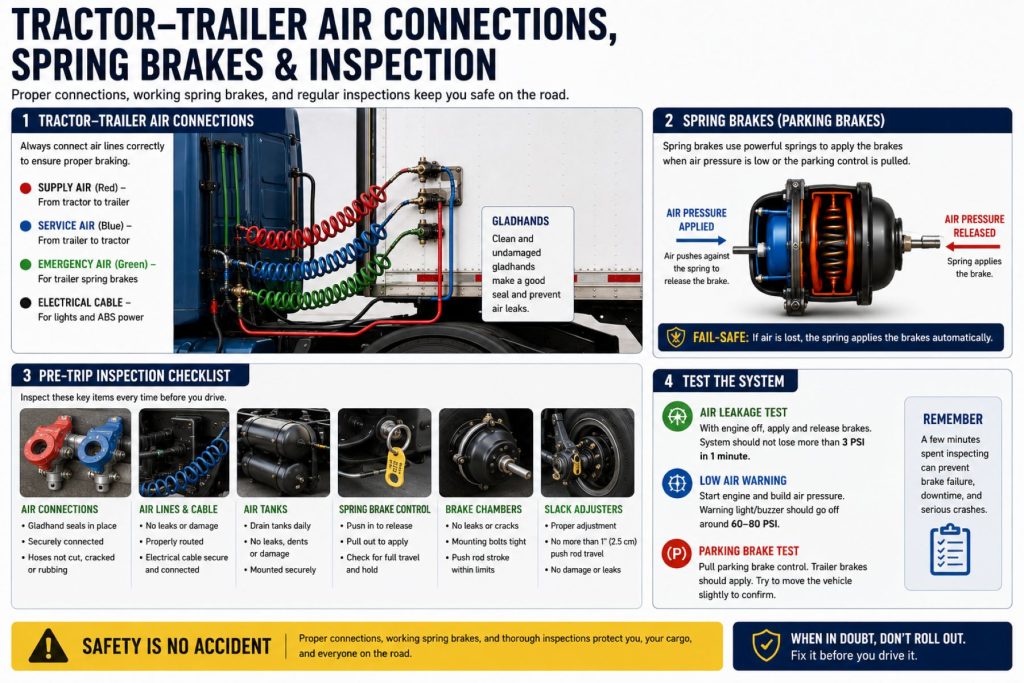
One of the greatest advantages of air brake systems is their ability to operate tractor-trailer combinations.
Glad Hands
Glad hands connect tractor and trailer air systems.
Service Line
The blue service line controls normal brake application.
Emergency Line
The red emergency line supplies air pressure to the trailer.
Trailer Air System
The trailer contains its own:
- Air tanks
- Brake chambers
- Air lines
- Valves
These systems work together with the tractor braking system.
Spring Brakes and Parking Brakes
Spring brakes provide one of the most important safety features in commercial vehicles.
How Spring Brakes Work
Large mechanical springs remain compressed during normal operation.
Air pressure holds the springs back.
When air pressure is removed, the springs automatically apply the brakes.
Parking Brake Operation
Pulling the parking brake valve releases air pressure and activates the spring brakes.
Emergency Brake Operation
If system pressure drops too low, spring brakes automatically apply to help prevent uncontrolled vehicle movement.
Air Pressure Gauges
Commercial vehicles typically have dual air pressure gauges.
Primary Gauge
Monitors one braking circuit.
Secondary Gauge
Monitors the second braking circuit.
Normal operating pressure generally ranges between:
- 100 PSI
- 125 PSI
Drivers should monitor these gauges regularly.
Low Air Pressure Warning Systems
Federal regulations require warning systems to alert drivers to dangerous pressure losses.
Warning Light
Activates when pressure drops below a safe level.
Warning Buzzer
Provides an audible warning.
Automatic Spring Brake Activation
If pressure continues to fall, spring brakes may automatically apply.
Air Brake Inspections
Proper inspections help identify problems before they become safety hazards.
Air Leakage Test
Measures pressure loss with brakes released.
Applied Pressure Test
Measures pressure loss while brakes are applied.
Low Air Warning Test
Confirms proper operation of warning devices.
Spring Brake Test
Verifies automatic spring brake activation.
Parking Brake Test
Ensures the vehicle remains secure when parked.
These inspection procedures are commonly performed during CDL pre-trip inspections.
Common Air Brake Problems
Even highly reliable systems require maintenance.
Air Leaks
Leaks are among the most common air brake issues.
Worn Slack Adjusters
Excessive brake stroke can reduce braking effectiveness.
Damaged Air Lines
Physical damage can cause pressure loss.
Faulty Brake Chambers
Brake chambers can develop leaks or mechanical failures.
Compressor Problems
Poor compressor performance can reduce available air pressure.
Moisture Contamination
Moisture buildup can cause corrosion and freezing.
Air Brakes vs Hydraulic Brakes
| Feature | Air Brakes | Hydraulic Brakes |
|---|---|---|
| Power Source | Compressed Air | Hydraulic Fluid |
| Common Application | Commercial Trucks | Passenger Vehicles |
| Fail-Safe Design | Yes | Limited |
| Trailer Compatibility | Excellent | Limited |
| Heavy Load Capability | Excellent | Moderate |
| System Complexity | Higher | Lower |
Air brakes remain the preferred braking system for heavy commercial vehicles.
Air Brake Safety Tips
Perform Daily Inspections
Inspect the braking system before every trip.
Monitor Air Pressure
Watch pressure gauges throughout operation.
Drain Air Tanks
Remove accumulated moisture when necessary.
Listen for Air Leaks
Investigate unusual air leakage immediately.
Maintain Proper Following Distance
Heavy vehicles require longer stopping distances.
Follow Maintenance Schedules
Routine maintenance improves safety and reliability.
Frequently Asked Questions
Why do semi trucks use air brakes?
Air brakes provide the stopping power, reliability, and fail-safe protection required for heavy commercial vehicles.
What happens if air pressure is lost?
Warning systems activate, and spring brakes eventually apply automatically.
What are glad hands?
Glad hands are couplings that connect tractor and trailer air systems.
How often should air brakes be inspected?
Drivers should inspect air brake systems during every pre-trip inspection.
What causes air brake failure?
Common causes include air leaks, damaged components, compressor problems, and inadequate maintenance.
Are air brakes difficult to maintain?
Properly maintained air brake systems are highly reliable but require routine inspections and preventive maintenance.
Related Truck Equipment Atlas Resources
Continue exploring Truck Equipment Atlas:
- Equipment Systems
- Truck Types
- Trailer Types
- Commercial Truck Engines
- Air Ride Suspension Systems
- ABS Systems
- Brake Chambers
- Slack Adjusters
- Heavy-Duty Truck Components
Final Thoughts
Air brake systems are among the most important safety systems found on commercial vehicles. Their ability to generate powerful braking force, provide fail-safe protection, and operate efficiently across tractor-trailer combinations has made them the industry standard for decades.
Understanding how air brakes function helps drivers, technicians, fleet managers, owner-operators, and equipment buyers make informed decisions regarding maintenance, safety, and equipment operation. As commercial vehicle technology continues to evolve, air brake systems remain a critical component in keeping trucks, drivers, and the motoring public safe.
Related Equipment Systems
- Air Ride Suspension
- Anti-Lock Braking System (ABS)
- Automatic Slack Adjusters
- Air Compressors
- Brake Chambers
- Air Dryers
Related Truck Types
Related Trailer Types
- Dry Van Trailers
- Refrigerated Trailers
- Flatbed Trailers
- Lowboy Trailers
- Tank Trailers
- Hopper Bottom Trailers