
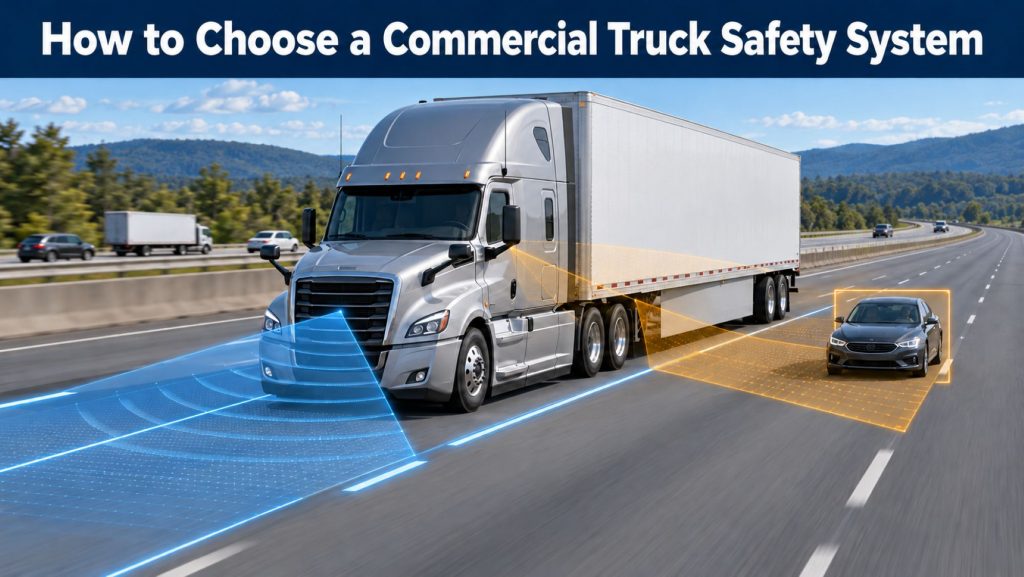
Commercial truck safety systems can help drivers recognize hazards earlier, maintain following distance, monitor blind spots, stay within a lane, and respond when a collision becomes likely. However, no single system is ideal for every truck, route, or fleet. The right choice depends on the vehicle, operating environment, driver needs, maintenance capabilities, and the specific crashes or risky events a fleet is trying to reduce.
This guide explains how to compare commercial truck safety systems, determine which features matter most, evaluate factory-installed and retrofit options, and plan a practical deployment. For a broader introduction to the technology, begin with How Commercial Truck Safety Systems Work.
Start with the Fleet’s Actual Safety Risks
The best safety-system purchase starts with evidence rather than a feature list. Review preventable collisions, near misses, insurance claims, roadside incidents, driver reports, telematics events, and damage patterns. The goal is to identify the situations that create the greatest exposure for the fleet.
- Rear-end risk: Look at hard-braking events, following-distance alerts, congestion exposure, and prior front-end collisions.
- Lane-departure risk: Consider long highway routes, nighttime operation, fatigue exposure, narrow lanes, and run-off-road incidents.
- Side-impact risk: Review lane-change collisions, urban routes, multi-lane highways, bicycle activity, and passenger-side blind spots.
- Backing risk: Consider loading docks, construction sites, refuse routes, yards, and locations where pedestrians work near moving vehicles.
- Rollover and loss-of-control risk: Examine vehicle configuration, cargo movement, curves, ramps, weather, and stability-related events.
A long-haul tractor operating mainly on interstates may benefit most from forward collision warning, automatic emergency braking, and adaptive cruise control. A refuse truck, delivery vehicle, or vocational truck working around people may need side detection, pedestrian alerts, and a 360-degree camera system. A mixed fleet may require several different safety packages rather than one universal specification.
Understand the Main Safety-System Categories
Collision Warning and Automatic Emergency Braking
Forward collision warning monitors the roadway ahead and alerts the driver when the truck is closing too quickly on another vehicle or obstacle. Automatic emergency braking can apply the brakes when the system determines that a collision is imminent and the driver has not responded sufficiently. Some systems also provide stationary-object warnings or integrate with electronic stability control.
These technologies are especially valuable for highway tractors, regional-haul vehicles, and fleets with frequent congestion exposure. Learn more in Collision Warning and Automatic Emergency Braking Explained.
Adaptive Cruise Control
Adaptive cruise control adjusts vehicle speed to help maintain a selected following distance. Commercial systems may coordinate the engine, transmission, retarder, and service brakes. This can reduce repetitive speed changes and help drivers maintain more consistent spacing, but it does not replace attentive driving or proper speed selection.
Fleets with substantial controlled-access highway mileage are the strongest candidates. Read Adaptive Cruise Control for Commercial Trucks Explained for a detailed look at operation and limitations.
Lane Departure Warning and Lane Keeping Assistance
Lane departure warning uses a forward-facing camera to identify lane markings and warn when the truck begins leaving its lane without an expected turn-signal input. Lane keeping assistance adds steering support intended to help the driver remain within the lane. Availability and intervention strength vary considerably among vehicle platforms.
These systems are often most useful for line-haul and regional operations with extended highway exposure. Their performance can be affected by worn markings, road construction, snow, glare, heavy rain, or a blocked camera. See Lane Departure Warning and Lane Keeping Assistance Explained.
Blind-Spot Detection and Camera Monitor Systems
Blind-spot systems use radar, ultrasonic sensors, cameras, or a combination of technologies to monitor areas beside or behind the vehicle. Camera systems may provide side views, reversing views, or a stitched overhead image. Some products add pedestrian, cyclist, or object detection.
These systems can be particularly important for urban delivery, refuse, construction, utility, transit, and other operations involving frequent turns or backing. Read Blind-Spot Detection and Camera Monitor Systems Explained before comparing coverage zones and display arrangements.
Match the System to the Duty Cycle
| Operating Environment | Common Risks | Features to Prioritize |
|---|---|---|
| Long-haul highway | Rear-end collisions, fatigue-related drift, inconsistent following distance | Forward collision warning, AEB, adaptive cruise control, lane departure warning |
| Regional and local delivery | Congestion, frequent lane changes, turns, cyclists, pedestrians | AEB, side blind-spot detection, turn alerts, side cameras |
| Construction and vocational | Backing, workers near the vehicle, uneven sites, limited visibility | Rear detection, 360-degree cameras, pedestrian detection, reversing alarms |
| Refuse and municipal | Repeated stops, close pedestrian activity, narrow streets, backing | Multi-camera coverage, side detection, pedestrian alerts, event recording |
| Tanker and high-center-of-gravity | Rollover, abrupt maneuvers, following-distance events | Electronic stability control, collision mitigation, lane warning |
Vehicle speed, route type, body configuration, trailer use, axle layout, braking system, and operating weather all influence the final specification. A system designed for a highway tractor may not provide the sensor placement or low-speed coverage needed on a mixer, refuse truck, or terminal tractor.
Decide Between Factory-Installed and Retrofit Systems
Factory-Installed Systems
Factory-installed safety systems are integrated into the truck’s braking, steering, engine, transmission, and vehicle communication networks. This integration can provide functions such as active braking, adaptive cruise control, lane keeping support, and coordinated dashboard warnings. Factory installation also simplifies sensor mounting, wiring protection, diagnostics, and warranty responsibility.
When ordering new trucks, compare the complete safety package rather than evaluating a single feature. Determine which sensors and functions are standard, which are optional, whether features require specific brake or steering equipment, and whether the system can be serviced throughout the fleet’s operating area.
Retrofit Systems
Retrofit systems can add forward collision alerts, lane warnings, blind-spot detection, cameras, pedestrian detection, or reversing protection to vehicles already in service. They are useful when a fleet wants consistent safety coverage across mixed model years or cannot wait for its normal replacement cycle.
Many retrofit products provide warnings but do not control the brakes or steering. Confirm exactly what the system does before purchasing. Installation quality is critical because sensor angle, mounting height, camera position, wiring, calibration, and display placement directly affect performance.
Compare Detection Technology and Coverage
Radar
Radar measures the distance and relative movement of objects and is widely used for forward collision mitigation, adaptive cruise control, and side-object detection. Ask about the sensor’s field of view, usable range, minimum operating speed, ability to track stationary objects, and resistance to weather or road contamination.
Cameras
Cameras can identify lane markings, classify road users, record events, and improve the driver’s view. Compare low-light performance, lens heating, cleaning requirements, image latency, display size, recording capability, and the position of the image on the screen. A technically capable camera is less useful if the driver must look too far away from the roadway to see it.
Ultrasonic Sensors
Ultrasonic sensors are commonly used for low-speed proximity and reversing applications. They can be effective at detecting nearby objects but normally cover a shorter range than radar. Mounting location, vehicle body shape, and exposure to mud or damage require careful consideration.
Sensor Fusion
Sensor-fusion systems combine information from radar, cameras, vehicle-speed inputs, braking controls, and other sources. The objective is to improve object confirmation and enable more capable interventions. Buyers should still evaluate each function separately because the presence of multiple sensors does not guarantee equal performance in every operating condition.
Evaluate Driver Alerts and Human Factors
A safety system must communicate clearly without overwhelming the driver. Compare the sound, location, timing, and escalation of alerts. Determine whether drivers can easily distinguish a forward-collision warning from a lane, blind-spot, following-distance, or system-fault alert.
- Confirm that visual indicators remain visible in bright daylight and at night.
- Listen to alerts with normal engine, road, radio, and HVAC noise present.
- Check whether warning volume is adjustable and whether critical alerts can be disabled.
- Evaluate false or nuisance alerts on the fleet’s actual routes.
- Determine how the system reports blocked, misaligned, or unavailable sensors.
- Make sure alerts support the driver instead of encouraging distraction.
Driver acceptance often depends on accurate alerts and good training. If a system frequently warns at harmless roadside objects or behaves differently from what drivers were taught, operators may stop trusting it. A controlled pilot is one of the best ways to identify those issues before a fleet-wide purchase.
Check Vehicle Compatibility and Integration
Confirm compatibility by vehicle identification number or complete vehicle specification whenever possible. Model year alone may not identify the braking architecture, steering hardware, communication network, windshield, mirror design, bumper structure, or body configuration.
- Truck make, model, model year, wheelbase, and cab configuration
- Brake system, electronic stability control, and available vehicle-network signals
- Steering system and support for active steering functions
- Bumper, grille, windshield, mirror, and body mounting locations
- Tractor-only, straight-truck, truck-trailer, or tractor-trailer operation
- Trailer length, body equipment, lift axles, and articulation
- Electrical load, environmental rating, wiring protection, and connector requirements
- Compatibility with existing telematics, cameras, and event-recording systems
For multi-brand fleets, ask whether the same driver interface and event terminology can be used across different vehicles. Excessive variation between trucks can complicate training and increase the chance that drivers misunderstand an alert.
Plan for Calibration, Inspection, and Maintenance
Safety technology requires ongoing support. Cameras and radar sensors may need inspection after windshield replacement, collision repair, bumper removal, suspension changes, alignment work, or other service that changes the sensor’s position. Dirt, snow, ice, paint, accessories, or physical damage can obstruct coverage.
- Ask what calibration equipment, targets, software, and technician training are required.
- Determine whether calibration is static, dynamic, or both.
- Confirm how faults appear to the driver and maintenance department.
- Review diagnostic access, software subscriptions, replacement-part availability, and warranty terms.
- Add sensor cleaning and damage checks to preventive-maintenance inspections.
- Document when calibration is required after repair or component replacement.
A lower purchase price may not produce a lower lifecycle cost if specialized service is unavailable or sensors are frequently damaged in the fleet’s application. Include downtime, calibration, subscriptions, replacement cameras, displays, radar units, wiring, and training in the cost comparison.
Review Data, Telematics, and Privacy Requirements
Connected safety systems may transmit alerts, video, vehicle data, driver behavior events, and diagnostic information. Decide which information the fleet genuinely needs and how it will be used. Useful reporting can help identify risky routes, coaching opportunities, repeat alerts, sensor faults, and changes after deployment.
Ask who owns the data, where it is stored, how long video remains available, who can access it, whether footage can be downloaded, and what happens when the subscription ends. Review cellular costs, data retention, cybersecurity practices, user permissions, and integration with the fleet’s existing platform. Related technology is covered in How Commercial Truck Telematics Systems Work and AI Dash Cameras and Video Telematics Explained.
Compare Commercial Truck Safety Products
The following planned Truck Equipment Atlas product pages represent several approaches to collision mitigation, lane support, blind-spot monitoring, camera visibility, and reversing protection. Product availability and compatibility can vary by vehicle platform and installation type.
- Bendix Wingman Fusion Collision Mitigation System
- Bendix Wingman Advanced Collision Mitigation System
- Bendix BlindSpotter Radar System
- ZF WABCO OnGuardACTIVE Collision Mitigation System
- ZF WABCO OnLaneALERT Lane Departure Warning System
- ZF WABCO OnLaneASSIST Lane Keeping Assistance System
- ZF WABCO OnSideALERT Blind-Spot Detection System
- ZF WABCO TailGUARD Reversing Safety System
- Detroit Assurance with Active Brake Assist 6
- Mobileye 8 Connect Collision Avoidance System
- Mobileye Shield+ Blind-Spot Detection System
- Stoneridge MirrorEye Camera Monitor System
- Brigade Backeye 360 Camera System
- Brigade Backeye 360 AI Camera System
- Brigade SA-BBS-107 White Sound Reversing Alarm
Run a Controlled Fleet Pilot
Before committing to a large order, install the proposed system on a representative group of vehicles. Include different routes, body types, terminals, weather conditions, and experienced drivers. Establish the evaluation period and success measures before the pilot begins.
- Record baseline collision, claim, hard-braking, lane, and backing-event data.
- Verify installation and calibration on every pilot vehicle.
- Train drivers and technicians on operation, limitations, warning meanings, and fault reporting.
- Collect driver feedback without relying on opinion alone.
- Review nuisance alerts, missed detections, system availability, maintenance time, and event data.
- Compare results with similar vehicles that did not receive the system.
- Adjust the specification, alert settings, training, or installation plan before expansion.
A successful pilot should answer whether the technology addresses the intended risk, works reliably in the fleet’s environment, is accepted by drivers, can be maintained efficiently, and produces useful information. It should also reveal whether a different combination of systems is needed for certain vehicle groups.
Questions to Ask Before Purchasing
- Which specific crashes or operating risks is this system designed to address?
- Does it warn the driver, intervene automatically, or do both?
- At what speeds and under what conditions is each function available?
- What objects and road users can the system detect?
- What are the coverage range, field of view, and known limitations?
- Is the system compatible with every intended truck, body, and trailer configuration?
- What installation and calibration procedures are required?
- How are blocked sensors, faults, and unavailable functions communicated?
- What training is available for drivers, managers, and technicians?
- What data is collected, who owns it, and what subscriptions are required?
- What parts, service, warranty, and technical support are available?
- How will the fleet measure safety performance and return on investment?
Safety-System Selection Checklist
- Define the fleet’s highest-priority collision and visibility risks.
- Separate must-have functions from desirable features.
- Match coverage to the vehicle’s routes, body, trailer, and duty cycle.
- Verify whether each feature is warning-only or actively controls the vehicle.
- Confirm installation, integration, calibration, and diagnostic requirements.
- Evaluate alert quality and driver-interface consistency.
- Calculate full lifecycle cost, including subscriptions and repairs.
- Review data ownership, video retention, security, and system integration.
- Conduct a representative pilot and document the results.
- Build inspection, cleaning, calibration, and training into fleet procedures.
Related Safety System Guides
- How Commercial Truck Safety Systems Work
- Collision Warning and Automatic Emergency Braking Explained
- Adaptive Cruise Control for Commercial Trucks Explained
- Lane Departure Warning and Lane Keeping Assistance Explained
- Blind-Spot Detection and Camera Monitor Systems Explained
Final Thoughts
Choosing a commercial truck safety system is not simply a matter of selecting the package with the most features. The strongest choice targets documented fleet risks, matches the vehicle and duty cycle, communicates clearly with the driver, and can be inspected and maintained throughout its service life.
No driver-assistance system eliminates the need for a qualified, attentive driver or sound fleet procedures. When technology, training, maintenance, and performance measurement are planned together, safety systems can become a practical part of a broader collision-prevention program.