
Quick Facts
- Manufacturer: Brigade Electronics.
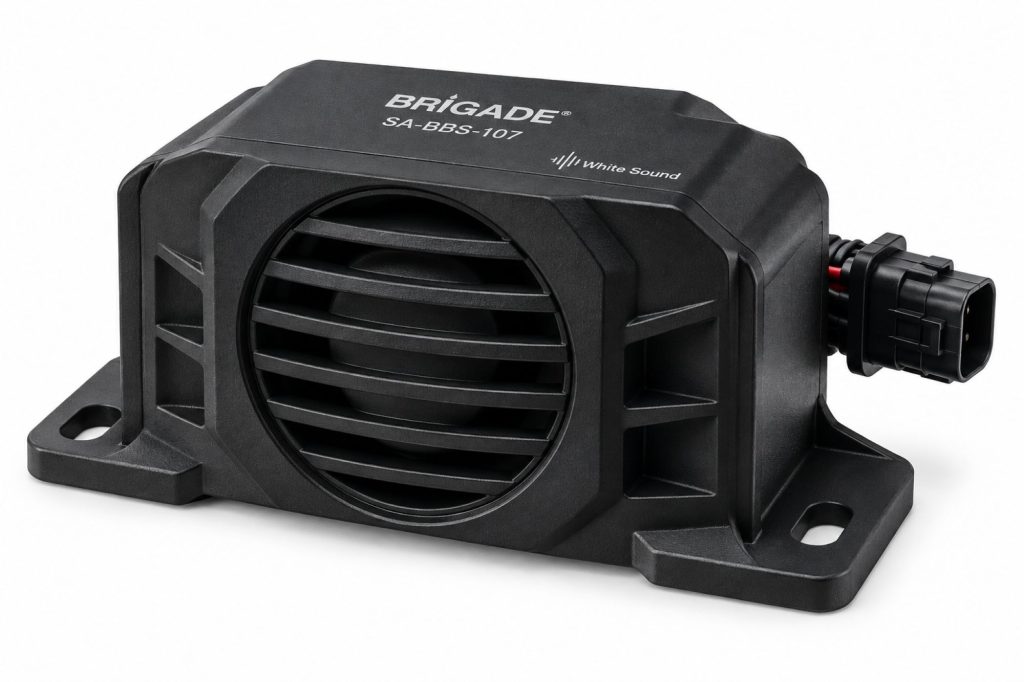
- Product: SA-BBS-107 White Sound smart reversing alarm.
- Documented part number: 1400; verify the supplier’s regional ordering reference.
- Equipment type: Self-adjusting external audible reversing alarm.
- Sound type: Multi-frequency broadband White Sound.
- Published output range: 87–107 dB.
- Electrical supply: 12–24 VDC.
- Primary section: Safety Systems.
Overview
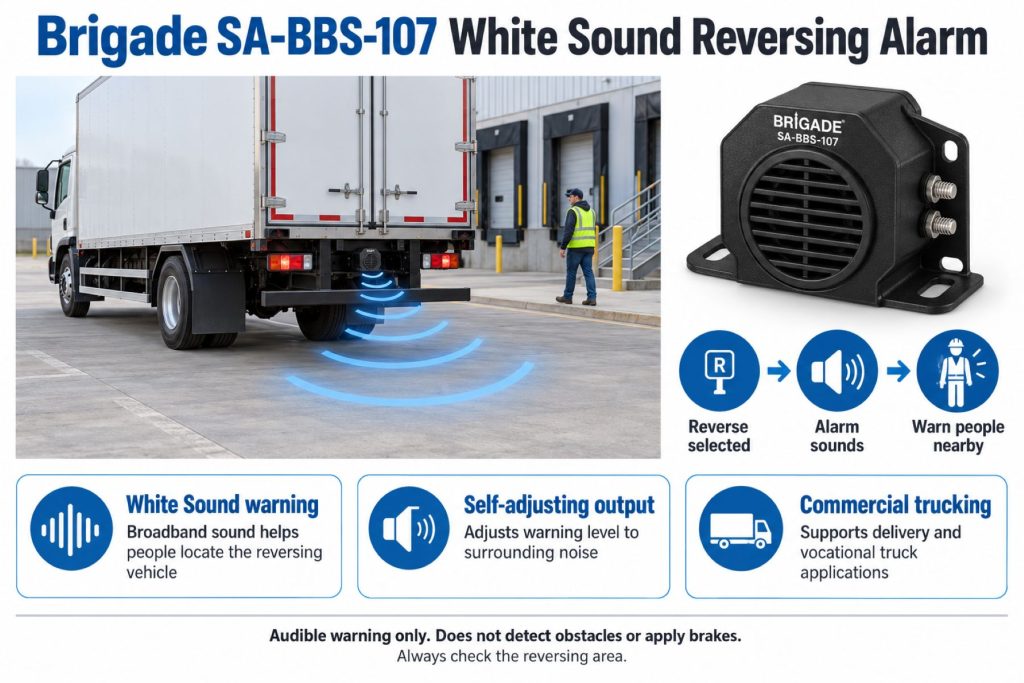
The Brigade SA-BBS-107 provides an external audible warning for reversing vehicles. Its purpose is to alert people nearby, rather than detect obstacles or show the driver a camera image.
Drivers remain responsible for checking the backing path and controlling the vehicle. An operating alarm does not establish that everyone nearby has heard it or moved clear.
This page describes the model and provides an installation-review framework. Use the supplied instructions and vehicle documentation for wiring, mounting, testing, and service.
Key Characteristics
- Provides an external warning during reversing.
- Uses a self-adjusting output arrangement.
- Requires suitable placement and vehicle integration.
- Must be distinguished from fixed-output alarm models.
- Works as one part of the vehicle’s backing-safety equipment.
Major Components
Identify the alarm and its installation components through the supplied parts information. Confirm whether mounting and wiring accessories are included.
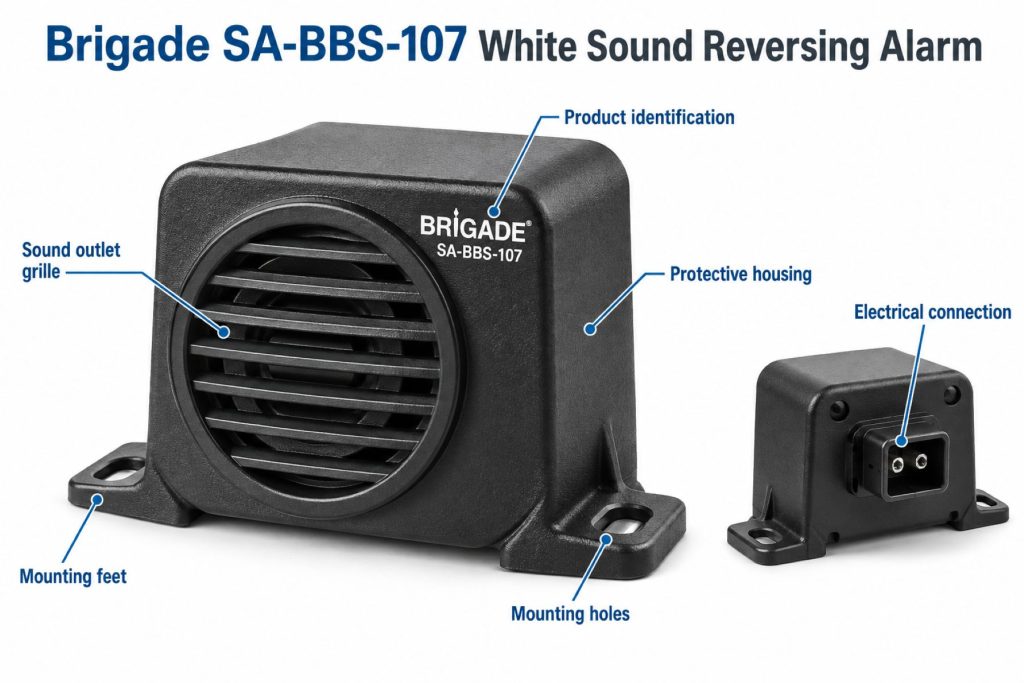
- Alarm housing and sound-producing assembly.
- Internal output-control electronics.
- Approved mounting hardware.
- Electrical connections and vehicle wiring.
- Required circuit protection and activation arrangement.
Product Type and Construction
The SA-BBS-107 is an electrical warning device. Evaluate the alarm, mounting, wiring, and activation circuit together when reviewing an installation.
Do not select a replacement solely by housing appearance. Verify model identity, output behavior, voltage, and connection requirements.
White Sound and Tonal Reversing Alarms
White Sound uses broadband output rather than a conventional single-tone warning. Brigade describes this approach as helping nearby people locate the source while reducing unnecessary noise spread.
Assess warning suitability in the actual operating environment. Avoid treating a sound description as proof that everyone will hear or correctly interpret the alarm.
How the Reversing Alarm Works
The approved vehicle circuit activates the alarm during the intended reversing condition. The unit produces its external warning while energized according to the installation design.
Confirm activation and deactivation through the supplied instructions. Do not assume a particular connector pinout or vehicle-circuit arrangement.
Self-Adjusting Sound Output
Brigade’s model literature describes adjustment approximately 5–10 dB above ambient noise within the alarm’s available output range. Confirm the current unit’s specification when ordering.
Self-adjustment does not provide unlimited output. Evaluate the installed warning under representative operating conditions rather than assuming it suits every noise environment.
Position and Function Within the Vehicle
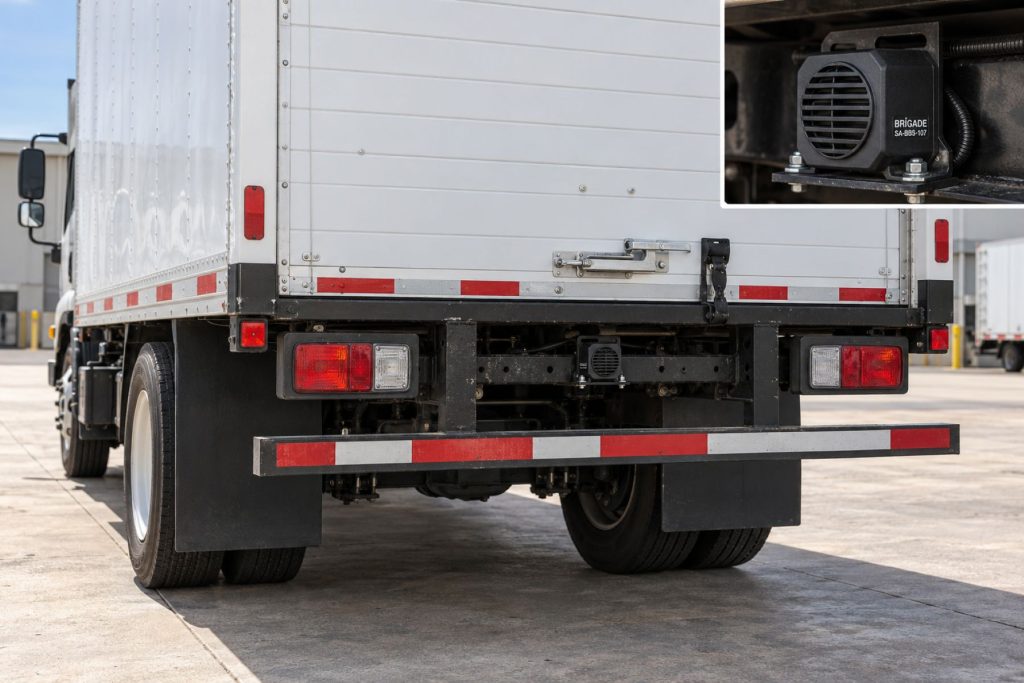
Select the mounting location through the approved installation guidance. Review nearby bodywork, loading equipment, chassis components, and the intended sound path.
For tractor-trailer combinations, determine the warning needs of the complete arrangement. An alarm on one part of the combination should not automatically be assumed suitable for all nearby areas.
Common Specifications
Brigade’s SA-BBS-107 literature lists the following values. Verify the supplied product label and current documentation before installation.
- Sound output: Self-adjusting, 87–107 dB.
- Electrical supply: 12–24 VDC.
- Maximum current: 1 amp.
- Dimensions: 172 × 79 × 95 mm.
- Mounting-hole centers: 153 mm.
- Ingress protection: IP68.
- Operating temperature: −40 to +85°C (−40 to +185°F).
- Mechanical vibration rating: 10G.
- Listed standard: SAE J994.
Warning Coverage and Operating Performance
Review the installed warning with the vehicle and its operating environment in mind. Do not convert the published sound level into a universal audible-distance claim.
Follow the required acceptance checks and site procedures. Confirm that mounting and surrounding equipment preserve the intended warning function.
Ambient Noise and Site Conditions
Consider representative vehicle activity and workplace conditions when selecting an alarm. Use the relevant installation and site-assessment procedures.
People may be distracted or unable to hear a warning. Maintain safe backing practices and any required pedestrian-separation or spotter arrangements.
Activation Conditions and Warning Behavior
Verify that the alarm operates during the intended reversing condition and stops as specified. Investigate intermittent activation using the vehicle’s wiring information.
Do not assume an alarm that sounded once will continue operating correctly. Include the required functional checks in the vehicle’s inspection process.
Reversing Warnings and Obstacle Detection
An audible reversing alarm warns people nearby; it does not establish obstacle detection, pedestrian recognition, or distance measurement.
Specify cameras, sensors, and braking assistance separately when those functions are needed.
Camera and Event-Recording Functions
Do not infer video viewing or recording from the alarm installation. Identify any separately fitted camera, recorder, or fleet service independently.
Electrical Requirements, Wiring, and Connections
Use approved instructions for polarity, power, grounding, circuit protection, and activation. Verify the vehicle circuit’s suitability before connecting the alarm.
Route wiring away from abrasion, moving components, heat, and exposed damage points. Match connection protection to the installation environment.
Vehicle Circuit and System Integration
Confirm the approved interface with the vehicle’s reversing circuit. Do not assume that direct connection is appropriate for every electronically controlled output.
Any relay, interface, or additional warning arrangement should follow the vehicle and alarm manufacturer’s guidance.
Controls, Indicators, and Driver Feedback
- Learn the expected reversing-warning behavior.
- Follow the approved functional-check procedure.
- Report missing, intermittent, or abnormal output.
- Do not assume an in-cab fault indicator is fitted.
- Review any vehicle-specific controls separately.
Driver Controls and System Availability
Do not assume the unit includes a mute, night mode, or driver-adjustable output control. Confirm the actual product and vehicle arrangement.
Follow fleet procedures when the warning is unavailable. Avoid unsupported bypasses or modifications.
Faults and Diagnostics
Record the symptom and circumstances before replacing the alarm. Review power, ground, activation, connections, mounting, and physical condition.
Use the supplied troubleshooting instructions and qualified electrical support. Verify the warning after repair.
Materials, Environmental Protection, and Durability
Inspect the housing, mounting points, connections, and sound outlet. Follow component-specific cleaning and installation instructions.
A published ingress rating does not replace correct installation or permit every cleaning method. Verify the applicable conditions in the product documentation.
Duty Cycle and Operating Conditions
Consider reversing frequency, workplace noise, vehicle use, and mounting exposure when selecting warning equipment.
Confirm suitability for the actual operation rather than choosing solely by the highest published sound level.
Mounting and Installation
Use approved mounting hardware, orientation, and placement. Review surrounding bodywork and equipment for obstruction or damage risk.
Do not relocate the alarm solely for convenience. Recheck the installed warning after relevant vehicle modifications.
Setup and Functional Verification
Follow the supplied commissioning and test procedure. Verify activation, mounting, electrical connections, and output under the specified conditions.
Use only the setup or adjustment procedures documented for the alarm and vehicle installation.
Vehicle and System Compatibility
Confirm suitability through Brigade, the vehicle manufacturer, or an authorized provider using the vehicle’s electrical and installation details.
Voltage compatibility alone does not establish that the alarm, mounting location, and activation circuit suit the intended application.
Related Component Compatibility
Verify the alarm, mounting hardware, wiring, connectors, protection, and any required interface together. Check other reversing equipment independently.
Common Applications
- Eligible commercial trucks requiring an external reversing warning.
- Supported vocational and delivery applications.
- Fleets reviewing warning suitability in changing noise environments.
- Operators maintaining existing SA-BBS-107 installations.
Advantages
- Provides an external reversing warning.
- Offers self-adjusting output within its documented range.
- Provides a defined model for replacement and specification review.
Limitations or Considerations
- Does not establish obstacle detection or distance measurement.
- Does not provide camera views or automatic vehicle control.
- Warning suitability must be assessed in the actual environment.
- Self-adjustment remains limited by the available output range.
- Drivers must continue checking the backing path.
Driver and Operator Experience
Explain the expected warning behavior and inspection procedure before assigning the vehicle. Reinforce that an alarm does not confirm a clear backing area.
Encourage reports of intermittent activation, damage, or abnormal sound. Specific observations help service personnel identify the problem.
Inspection and Wear Points
- Housing and sound-outlet condition.
- Mounting security.
- Harness abrasion and connection condition.
- Obstructions from bodywork or added equipment.
- Expected activation and warning behavior.
- Recent electrical or rear-body repairs.
Maintenance and Ownership Notes
Retain model identification, installation information, and repair records. Include the alarm in the vehicle’s required inspection and maintenance process.
After replacement or relevant vehicle work, complete the specified functional verification.
Common Reversing Alarm Problems
Areas to investigate include missing supply, poor ground, activation-circuit faults, damaged connections, loose mounting, and physical damage.
Follow the applicable troubleshooting process before replacing parts. Evaluate persistent output complaints with the installation and operating environment in mind.
Safety and Service Precautions
Follow Brigade and vehicle-manufacturer instructions for mounting, electrical work, and testing. Secure the vehicle and keep people clear during functional checks.
Do not bypass required warnings or assume nearby people will react to the alarm. Maintain safe reversing procedures.
Identification Information
Record the complete model name, product label, supplier reference, voltage, and installation details. Confirm the SA prefix when selecting the self-adjusting model.
Buying Considerations
- Confirm SA-BBS-107 rather than fixed-output BBS-107.
- Verify the current model and ordering reference.
- Review warning suitability for the operating environment.
- Check vehicle circuit and mounting requirements.
- Confirm supplied wiring and mounting accessories.
- Arrange installation and functional verification.
Variants and Configurations
Keep self-adjusting and fixed-output Brigade alarms distinct. Match specifications to the complete model name and current product documentation.
Do not infer voltage, sound output, controls, or approvals from a similar housing or related model number.
Comparison to Similar Equipment
Compare reversing alarms by sound type, output behavior, vehicle compatibility, installation, and operating suitability. Compare cameras and braking assistance separately because they perform different tasks.
- Brigade Backeye 360 Camera System
- Brigade Backeye 360 AI Camera System
- ZF WABCO TailGUARD Reversing Safety System
Best Fit For
- Operators maintaining documented SA-BBS-107 installations.
- Eligible trucks requiring a suitable external reversing warning.
- Fleets evaluating self-adjusting warning output.
- Maintenance teams verifying alarm identity and installation.
Related Vehicle and Trailer Types
These links provide equipment background and do not establish alarm suitability.
Related Truck and Trailer Models
Explore these profiles for general context. Confirm electrical and installation suitability independently.
Related Safety System Types
The resources below cover complementary visibility and detection equipment.
Related Safety System Products
- Brigade Backeye 360 Camera System
- Brigade Backeye 360 AI Camera System
- ZF WABCO TailGUARD Reversing Safety System
- Stoneridge MirrorEye Camera Monitor System
Related Equipment Systems
Related Guides
- Safety System Guides
- How Commercial Truck Safety Systems Work
- Blind-Spot Detection and Camera Monitor Systems Explained
- How to Choose a Commercial Truck Safety System
Regulatory and Compliance Notes
Confirm applicable requirements and installation suitability for the vehicle and worksite. A listed product standard does not by itself establish compliance for every operation.
Real World Operating Notes
Review warning complaints with activation, vehicle layout, mounting, and workplace conditions in mind.
Maintain safe backing procedures even when the alarm is functioning normally.
Frequently Asked Questions
Is SA-BBS-107 the same as BBS-107?
No. Confirm the complete model name when selecting self-adjusting or fixed-output equipment.
Does the alarm detect pedestrians or obstacles?
Do not treat an audible reversing alarm as an obstacle-detection system. Specify detection equipment separately.
Does self-adjusting mean unlimited sound output?
No. Adjustment remains within the unit’s documented output range.
Can it replace mirror checks or a required spotter?
No. Follow safe reversing practices and applicable site procedures.
Can any 12-volt or 24-volt vehicle use it?
Confirm circuit compatibility, mounting, and warning suitability rather than relying on voltage alone.
Availability and Where to Find
Contact Brigade Electronics or an authorized supplier for current model identification, ordering references, installation instructions, and support.
- Brigade SA-BBS-107 Product Page
- SA-BBS-107 Model-Specific US Product Sheet
- Brigade Electronics Official Website
Support Trucking Families
Truck Equipment Atlas supports the mission of Grey Cross, a nonprofit dedicated to helping families of truck drivers who lose their lives while on the road. As the site grows, part of its mission is to bring awareness and support to these families.
Video Overview
Truck Equipment Atlas will continue expanding with video overviews and equipment breakdowns to help drivers and fleets better understand commercial truck safety systems.
Follow the Growth of Truck Equipment Atlas
Truck Equipment Atlas continues to expand with new truck profiles, trailer coverage, diesel engine pages, equipment system resources, manufacturer information, and educational guides.
Visit our Site Updates page to explore recent additions, project milestones, and upcoming resources as we continue building one of the industry’s growing commercial trucking equipment reference libraries.
View the Latest Site Updates: Truck Equipment Atlas Site Updates