
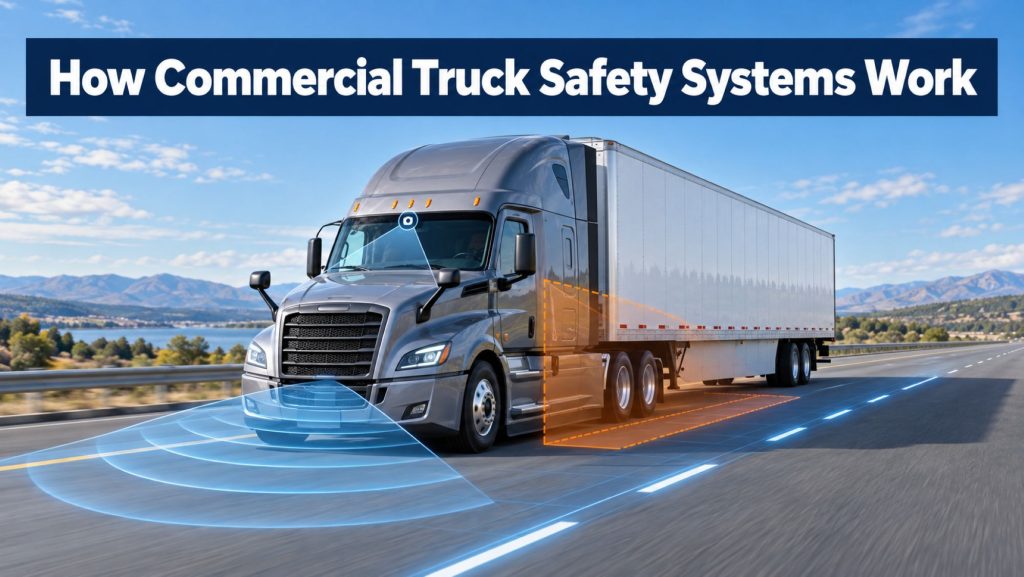
Commercial truck safety systems use radar, cameras, electronic controls, warning devices, and braking or steering assistance to help drivers recognize hazards and respond sooner. These technologies can monitor the road ahead, adjacent lanes, blind spots, following distance, lane position, and the area behind a vehicle.
Modern systems range from warning-only devices to integrated driver-assistance packages that can reduce engine torque, apply the service brakes, or provide limited steering support. Their capabilities vary by vehicle, sensor package, software version, and operating conditions.
This guide explains how the major commercial truck safety systems work, what they can and cannot do, how the technologies interact, and what fleets, drivers, technicians, and equipment buyers should consider when comparing them.
What Is a Commercial Truck Safety System?
A commercial truck safety system is a group of sensors, controllers, displays, warning devices, and vehicle interfaces intended to help reduce collision risk or improve driver awareness. Some systems operate independently, while others exchange information with the engine, transmission, braking system, steering system, instrument cluster, and telematics platform.
Common functions include:
- Forward-collision warning
- Automatic emergency braking
- Adaptive cruise control
- Lane-departure warning
- Lane-keeping assistance
- Blind-spot and side-object detection
- Rear obstacle detection and reversing assistance
- Camera-based indirect vision and surround-view monitoring
- Driver alerts, event recording, and fleet reporting
These systems assist the driver; they do not make the truck autonomous. The driver remains responsible for controlling the vehicle, maintaining a safe following distance, checking mirrors and surroundings, adjusting for weather and traffic, and responding to hazards.
The Main Parts of a Truck Safety System
Radar Sensors
Forward-looking radar measures the distance, relative speed, and position of objects ahead. Side-mounted radar can monitor adjacent lanes and areas beside the cab or trailer. Radar generally performs well in darkness and can measure range accurately, but heavy precipitation, contamination, damage, misalignment, or an obstructed sensor can reduce performance.
Cameras
Forward-facing cameras can identify lane markings, vehicles, pedestrians, traffic signs, and other visual features. Side, rear, and surround-view cameras expand the driver’s field of view. Camera performance depends on a clear lens, suitable lighting, correct mounting, calibration, and unobstructed views.
Electronic Control Units
An electronic control unit processes sensor information and determines whether to issue a warning or request vehicle intervention. Integrated systems may compare radar and camera data before acting. This sensor-fusion approach can improve object classification and provide more context than a single sensor alone.
Driver Displays and Alerts
Alerts may be visual, audible, or haptic. Examples include warning lamps, instrument-cluster messages, tones, seat vibration, and steering-wheel feedback. A useful alert should be noticeable without creating unnecessary distraction or alarm fatigue.
Brake, Engine, and Steering Interfaces
Systems with active intervention communicate with the vehicle’s electronic braking, engine, and sometimes steering controls. Depending on the system and situation, the truck may reduce throttle, disengage cruise control, apply foundation brakes, or provide limited steering input. Compatibility must be confirmed for the exact chassis and component configuration.
How the System Responds to a Hazard
- Sensing: Radar, cameras, or other sensors monitor the vehicle’s surroundings.
- Detection: Software identifies objects, lane boundaries, closing speed, or unsafe proximity.
- Risk calculation: The controller estimates whether the situation requires information, a warning, or intervention.
- Driver alert: The system warns the driver through the display, sound, vibration, or another signal.
- Vehicle assistance: If equipped and operating criteria are met, the system may reduce power, apply brakes, or assist steering.
- Event reporting: Some systems save event data or send information to a fleet platform for review.
The timing and strength of each response depend on the product, vehicle speed, object type, road geometry, driver input, sensor confidence, and system limits.
Collision Warning and Automatic Emergency Braking
Forward-collision warning monitors the path ahead and alerts the driver when the system calculates a potential conflict. Automatic emergency braking can add an active brake application when a collision appears imminent and the driver has not responded sufficiently.
Depending on the design, the system may respond to moving vehicles, stopped vehicles, stationary objects, or pedestrians. Capabilities are not identical across products or model years. Learn more in Collision Warning and Automatic Emergency Braking Explained.
Adaptive Cruise Control
Adaptive cruise control uses forward-sensor data to help maintain a selected following interval. When the truck approaches a slower vehicle, the system may reduce engine torque, request transmission action, apply an engine brake, or use the service brakes. It can resume the set speed when the lane clears, subject to its operating logic.
Adaptive cruise control is intended to reduce workload during suitable driving conditions, not to replace attentive speed and distance management. See Adaptive Cruise Control for Commercial Trucks Explained for a closer look at operation and selection.
Lane Departure Warning and Lane Keeping Assistance
Lane-departure warning uses a camera to track visible lane markings. If the truck begins to leave its lane without an expected turn-signal input, the system can warn the driver. Lane-keeping assistance adds limited steering support intended to help guide the vehicle toward the lane.
Faded markings, snow, standing water, glare, construction zones, sharp curves, and a dirty or blocked camera can limit operation. These systems do not remove the driver’s obligation to steer. Read Lane Departure Warning and Lane Keeping Assistance Explained.
Blind-Spot Detection and Camera Monitor Systems
Blind-spot detection systems use radar, ultrasonic sensors, cameras, or a combination of technologies to monitor areas that are difficult to see directly. They may cover the passenger side of the cab, the driver side, adjacent lanes, the trailer side, or the area behind the vehicle.
Camera monitor systems replace or supplement conventional mirror views with exterior cameras and in-cab displays. Surround-view systems combine multiple camera images to help the driver understand the vehicle’s immediate surroundings. Explore the differences in Blind-Spot Detection and Camera Monitor Systems Explained.
Reversing and Low-Speed Safety Systems
Reversing systems can combine cameras, radar, ultrasonic detection, audible alarms, and automatic braking. They are intended to improve awareness around loading docks, yards, construction sites, and congested delivery locations. Some systems warn only; others can apply trailer brakes when a rear obstacle is detected under defined conditions.
Broadband or “white sound” reversing alarms are designed to provide a directional warning near the vehicle. No reversing technology replaces a proper walk-around, clear communication, use of a spotter when appropriate, or stopping when the path cannot be confirmed.
Comparison of Major Safety Technologies
| Technology | Primary area monitored | Typical response | Important limitation |
|---|---|---|---|
| Forward-collision warning | Road ahead | Visual, audible, or haptic warning | May not recognize every object or situation |
| Automatic emergency braking | Forward travel path | Automatic brake application | May reduce impact severity without preventing every crash |
| Adaptive cruise control | Following distance | Adjusts power and braking | Driver must manage unsuitable road and weather conditions |
| Lane-departure warning | Lane position | Warns of unintended lane departure | Requires usable lane markings and camera visibility |
| Lane-keeping assistance | Lane position | Provides limited steering support | Does not provide hands-free or autonomous driving |
| Blind-spot detection | Side and adjacent-lane zones | Warns of detected road users or objects | Coverage zones and object detection vary |
| Camera monitor system | Side, rear, or surrounding views | Displays enhanced indirect vision | Lens condition, display placement, and calibration matter |
| Reversing detection | Area behind the vehicle | Warning or supported brake intervention | Does not eliminate the need to verify a clear path |
Integrated Safety Systems vs Standalone Equipment
Factory-Integrated Systems
Factory-integrated systems are engineered around the truck’s braking, engine, steering, electrical, instrument, and diagnostic networks. They can offer deeper vehicle intervention and consolidated driver displays. Service may require compatible diagnostic software, trained technicians, and model-specific calibration procedures.
Aftermarket and Standalone Systems
Aftermarket systems can add warnings, cameras, blind-spot detection, or event connectivity to vehicles that were not originally equipped with those functions. They can be valuable for mixed-age fleets, but performance depends on correct placement, electrical integration, calibration, driver-display location, and compatibility with the vehicle and body equipment.
Commercial Truck Safety System Product Examples
The following product profiles cover integrated collision-mitigation systems, lane and blind-spot technologies, camera-monitor equipment, and reversing solutions. Specifications and availability can vary by vehicle manufacturer, installation, model year, and software generation.
Bendix Safety Systems
- Bendix Wingman Fusion Collision Mitigation System
- Bendix Wingman Advanced Collision Mitigation System
- Bendix BlindSpotter Radar System
ZF WABCO Safety Systems
- ZF WABCO OnGuardACTIVE Collision Mitigation System
- ZF WABCO OnLaneALERT Lane Departure Warning System
- ZF WABCO OnLaneASSIST Lane Keeping Assistance System
- ZF WABCO OnSideALERT Blind-Spot Detection System
- ZF WABCO TailGUARD Reversing Safety System
Detroit Assurance
Mobileye Safety Systems
Stoneridge and Brigade Camera Systems
- Stoneridge MirrorEye Camera Monitor System
- Brigade Backeye 360 Camera System
- Brigade Backeye 360 AI Camera System
- Brigade SA-BBS-107 White Sound Reversing Alarm
How to Choose a Commercial Truck Safety System
- Identify the primary risk. Separate highway rear-end exposure, lane-departure risk, urban vulnerable-road-user exposure, reversing incidents, and limited indirect vision.
- Define the operating environment. Consider highway, regional, urban, refuse, construction, distribution, weather, traffic density, and day-versus-night operation.
- Confirm vehicle compatibility. Verify chassis, wheelbase, body, trailer, brake, steering, electrical, and communication-network requirements.
- Compare warnings and interventions. Determine whether the system warns only or can also manage throttle, braking, or steering.
- Review detection capabilities. Confirm the object types, speed ranges, coverage zones, and operating conditions specified by the manufacturer.
- Plan installation and calibration. Sensor height, alignment, aiming, wiring, mounting rigidity, and post-repair calibration can directly affect performance.
- Evaluate the driver interface. Alerts and displays should be understandable, visible, and consistent across the fleet where practical.
- Consider service support. Account for diagnostics, replacement parts, calibration equipment, technician training, warranty, and software support.
- Measure fleet results. Review event data, driver feedback, false or nuisance alert trends, maintenance findings, and incident changes.
For a full selection process, visit How to Choose a Commercial Truck Safety System.
Installation and Calibration Considerations
A safety system can only perform as designed when its components are correctly installed and calibrated. Radar angle, camera position, vehicle ride height, bumper damage, windshield replacement, wheel alignment, suspension changes, and body-equipment installation can affect sensor aim or the system’s reference values.
- Follow the vehicle and system manufacturer’s installation procedures.
- Use approved brackets, fasteners, wiring, connectors, and protective routing.
- Complete static or dynamic calibration when required.
- Check for diagnostic trouble codes before returning the vehicle to service.
- Verify operation after collision repair, windshield work, alignment, suspension repair, or sensor replacement.
- Document software versions, calibration results, and replaced components.
Inspection and Maintenance Basics
Drivers should include visible safety-system components in normal pre-trip and post-trip inspections. Technicians should follow the manufacturer’s diagnostic and calibration schedule rather than treating an illuminated warning as a minor convenience issue.
- Keep radar covers, camera lenses, and windshields clean and unobstructed.
- Inspect brackets, housings, wiring, connectors, and displays for damage.
- Do not cover sensors with accessories, decals, paint, snow, mud, or temporary equipment.
- Investigate warning lamps, unavailable-system messages, and repeated nuisance alerts.
- Check sensor alignment after front-end, mirror, body, suspension, or windshield repairs.
- Verify that tire size, ride height, alignment, and steering-angle information remain within specification.
- Test camera views and clean displays without damaging their coatings.
- Record faults and repairs so recurring problems can be identified.
Common Limitations and Misunderstandings
- A warning system does not guarantee that the driver will have enough time or distance to avoid a collision.
- Automatic emergency braking may lessen impact speed without preventing every crash.
- Lane systems may become unavailable when markings cannot be recognized.
- Blind-spot systems have defined detection zones and may not identify every road user or object.
- Camera views can be affected by dirt, water, ice, glare, darkness, damage, or blocked lenses.
- Curves, hills, construction zones, unusual vehicles, stationary objects, and roadside structures can challenge object classification.
- Aftermarket accessories or body equipment can obstruct sensors or change their field of view.
- Drivers need training on alert meanings, system limits, disable controls, and expected responses.
Frequently Asked Questions
Do commercial truck safety systems drive the truck?
No. The systems covered here provide driver assistance through warnings or limited braking and steering functions. The driver must remain attentive and in control at all times.
Can automatic emergency braking prevent every rear-end collision?
No. Performance depends on speed, traction, vehicle load, object recognition, system design, maintenance, and conditions. A system may prevent some collisions or reduce impact severity in others, but it cannot overcome every physical or operational limit.
Why does a lane-departure system sometimes become unavailable?
The camera may be unable to identify usable lane markings because of snow, heavy rain, glare, worn paint, road repairs, dirt, a blocked windshield area, or another condition listed by the manufacturer.
Do safety sensors need calibration after repairs?
Often, yes. Calibration may be required after sensor replacement, windshield replacement, collision repair, alignment, suspension work, ride-height changes, or removal of a sensor bracket. Follow the exact vehicle and system service information.
Can an older truck be equipped with safety technology?
Many older trucks can accept aftermarket collision-warning, lane-warning, blind-spot, camera, or reversing systems. Active braking or steering functions require more extensive integration and may not be available for every chassis.
Related Commercial Truck Safety Guides
- Collision Warning and Automatic Emergency Braking Explained
- Adaptive Cruise Control for Commercial Trucks Explained
- Lane Departure Warning and Lane Keeping Assistance Explained
- Blind-Spot Detection and Camera Monitor Systems Explained
- How to Choose a Commercial Truck Safety System
Final Thoughts
Commercial truck safety systems can add valuable layers of awareness and intervention, but their effectiveness depends on choosing the right technology, installing and calibrating it correctly, maintaining the sensors, and training drivers on both capabilities and limits.
The best system is not simply the one with the longest feature list. It is the one that fits the truck, operating environment, fleet risk, service network, and driver workflow—and continues to function correctly throughout the vehicle’s working life.