
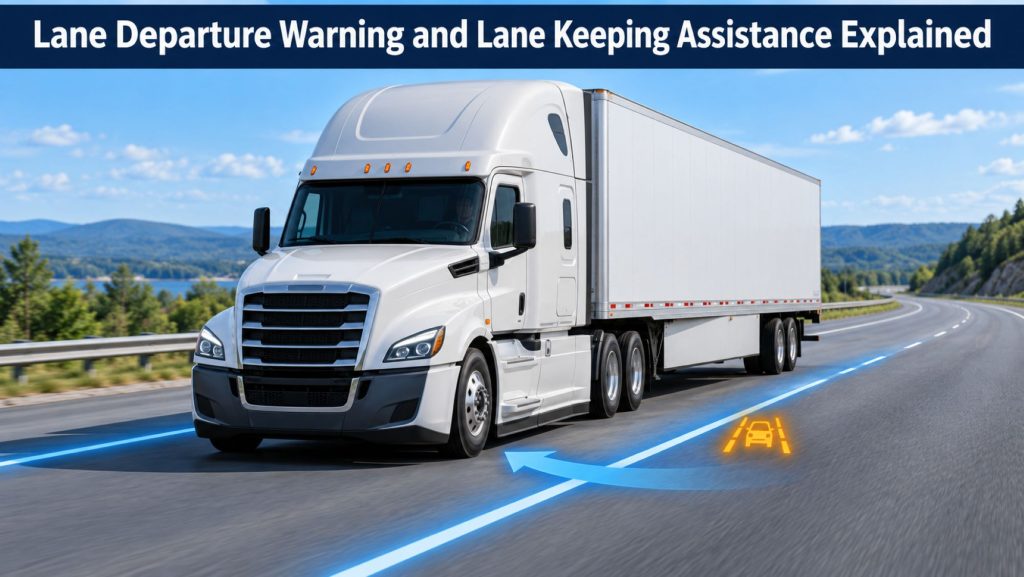
Lane-departure warning and lane-keeping assistance help commercial drivers recognize and correct unintended movement toward or across lane markings. Both technologies use a forward-facing camera to monitor the truck’s position, but they differ in how they respond.
A lane-departure warning system alerts the driver when the truck begins leaving its lane without an expected turn-signal input. Lane-keeping assistance adds limited steering support intended to guide the truck back toward the lane. More advanced lane-centering systems can provide continuous assistance under defined conditions.
This guide explains how these commercial-truck lane systems work, how warning-only and active systems differ, what conditions affect performance, and what drivers, fleets, technicians, and equipment buyers should consider.
What Is Lane-Departure Warning?
Lane-departure warning, commonly abbreviated LDW, monitors visible lane markings and estimates the truck’s position within the lane. When the system determines that the truck is crossing a marking unintentionally, it alerts the driver.
The warning may be an audible tone, simulated rumble-strip sound, steering-wheel vibration, seat vibration, instrument-panel message, or warning lamp. Some systems direct the alert toward the side of the departure so the driver can identify which lane boundary is being crossed.
LDW is normally a warning-only function. It does not steer the truck. The driver must evaluate the situation and make the appropriate steering correction.
What Is Lane-Keeping Assistance?
Lane-keeping assistance, or LKA, uses lane-position information to provide limited steering input when the truck begins drifting toward or across a lane boundary. The system is intended to assist the driver with a corrective response, not to take permanent control of steering.
Depending on the vehicle, steering assistance may be delivered through an electrically assisted steering gear, an overlay steering system, or another electronically controlled mechanism. The driver must keep hands on the wheel and remain responsible for vehicle position.
Lane-Departure Warning vs Lane-Keeping Assistance
| Feature | Lane-departure warning | Lane-keeping assistance |
|---|---|---|
| Primary response | Warns the driver | Warns and may provide limited steering support |
| Steering intervention | None | Corrective steering input under defined conditions |
| Driver responsibility | Driver makes every correction | Driver remains responsible and must supervise the assistance |
| Vehicle integration | Camera, controller, display, and warning device | Camera and controller plus compatible steering integration |
| Typical purpose | Bring unintended drift to the driver’s attention | Help guide the truck away from a lane boundary |
Feature names vary among manufacturers. A buyer should confirm whether a product is warning-only, supplies brief corrective assistance, continuously centers the vehicle, or combines several functions.
Lane Keeping vs Lane Centering
Lane-keeping assistance typically reacts as the vehicle approaches a lane boundary. Lane centering is designed to provide more continuous support near the middle of the detected lane. Both remain driver-assistance functions and require an attentive driver.
Lane centering may be combined with adaptive cruise control in a broader highway-assistance package. Even when speed and steering assistance operate together, the system is not automatically a hands-free or self-driving system.
Main Components of Commercial-Truck Lane Systems
Forward-Facing Camera
The camera is usually mounted high on the windshield near the center of the cab. It captures the road ahead and looks for painted lane lines, road edges, and other visual references. Its performance depends on an unobstructed view, correct mounting, approved windshield conditions, and proper calibration.
Electronic Controller
The controller processes camera images and estimates lane geometry, vehicle position, travel direction, and the time remaining before the truck reaches a lane boundary. It also evaluates vehicle speed, turn-signal status, steering input, and system availability.
Driver-Warning Interface
Warning-only systems communicate through sounds, vibrations, lights, and display messages. Drivers must understand the meaning of active, inactive, temporarily unavailable, and fault indications for the specific truck.
Steering Interface
Active lane assistance requires a steering system capable of receiving an electronic request. The interface may add torque at the steering wheel or command a limited steering correction while still allowing the driver to override it.
Vehicle Network Inputs
The lane controller may use information from turn signals, wheel-speed sensors, steering-angle sensors, yaw-rate sensors, stability control, and other vehicle systems. Accurate network data helps the controller distinguish normal maneuvers from unintended drift.
How a Lane-Departure Warning System Works
- The camera scans the road. Software searches the image for usable left and right lane boundaries.
- The system builds a lane model. It estimates lane width, curvature, and the truck’s position.
- Vehicle movement is evaluated. The controller determines whether the truck is moving toward a boundary.
- Driver intent is checked. Turn-signal use and other inputs can indicate an intentional lane change.
- A departure threshold is reached. If the drift appears unintended, the controller triggers an alert.
- The driver corrects the vehicle. Steering remains entirely under the driver’s control.
How Lane-Keeping Assistance Works
- Lane boundaries are identified. The camera and controller establish a usable lane model.
- The truck approaches a boundary. The controller determines that the movement is not an intended lane change.
- The driver is alerted. A visual, audible, or haptic warning may occur before or with steering assistance.
- Corrective torque is requested. The steering system provides a limited input toward the lane.
- The driver remains in control. The driver can steer, override the assistance, and complete the correction.
- The system disengages or resets. Assistance ends when the truck returns to an acceptable position or operating criteria are no longer met.
How the System Recognizes Driver Intent
A turn-signal input normally tells the system that crossing a lane marking is intentional. Depending on the product, strong driver steering input, braking, low speed, hazard-lamp use, or other conditions may also suppress or change lane assistance.
Failure to use a turn signal can cause an alert during an intentional lane change. This is one reason drivers may describe a properly operating system as producing unnecessary warnings. Consistent signal use improves both communication with other road users and system behavior.
When Lane Systems Become Available
Lane functions usually activate only when minimum operating conditions are met. These may include a specified road speed, recognizable lane markings, an unobstructed camera, valid steering and stability data, and no active system fault.
The instrument cluster may show whether both lane boundaries, one boundary, or no boundaries are currently recognized. Drivers should not assume the system is active simply because the vehicle is moving at highway speed.
Road and Weather Conditions That Affect Performance
- Faded, missing, covered, or temporary lane markings
- Snow, ice, standing water, mud, sand, or debris on the road
- Heavy rain, fog, blowing dust, or road spray
- Sun glare, deep shadows, darkness, or rapidly changing light
- Construction zones with shifted, overlapping, or conflicting markings
- Sharp curves, hill crests, narrow lanes, and lane splits
- Road edges without painted boundary lines
- Fresh pavement, repaired seams, tar lines, or other patterns that resemble markings
When the camera cannot identify reliable lane boundaries, the system may become temporarily unavailable. That response is different from a system fault, although the driver must control the truck in either case.
Vehicle Conditions That Affect Lane Assistance
- Incorrect wheel alignment or a steering wheel that is not centered
- Worn steering or suspension components
- Improper ride height or uneven vehicle loading
- Mismatched tires or incorrect tire size
- Camera movement after windshield or cab repair
- An incorrect steering-angle sensor value
- Faults in ABS, stability control, steering, or vehicle-network systems
- Body equipment or accessories that change the camera view or vehicle geometry
A truck that pulls to one side or requires constant steering correction should be inspected mechanically. Lane assistance should not be used to mask alignment, tire, steering, suspension, or load-distribution problems.
Warning Methods and Driver Experience
Commercial vehicles may use a simulated rumble-strip sound from the side of the departure, a steering-wheel vibration, a seat vibration, an instrument warning, or a combination of alerts. Active systems can also create noticeable steering-wheel torque.
The warning should be recognizable without becoming distracting. Fleets should investigate repeated nuisance alerts instead of encouraging drivers to ignore or permanently disable the system. Calibration, road conditions, driver signaling, alignment, and camera condition should all be considered.
Common Limitations and Misunderstandings
- Lane assistance does not make a commercial truck self-driving.
- The system may not operate when lane markings are unclear or missing.
- Warning-only LDW cannot steer the vehicle back into the lane.
- Lane-keeping input may not be strong enough to overcome a rapid or deliberate steering movement.
- The technology may not recognize road edges, curbs, barriers, or every temporary marking.
- A turn signal can suppress an alert even when a lane change is unsafe.
- The system does not determine whether another vehicle occupies the adjacent lane unless blind-spot technology is also installed.
- Drivers must remain prepared to steer through curves, work zones, weather, and emergency maneuvers.
Blind-spot monitoring and lane assistance address different risks. Learn how side sensors and camera systems work in Blind-Spot Detection and Camera Monitor Systems Explained.
Factory-Integrated vs Aftermarket Lane Systems
Factory-Integrated Systems
Factory-integrated systems communicate with the truck’s instrument cluster, turn signals, steering, stability control, and diagnostic network. An integrated lane-keeping system can provide steering assistance because the vehicle and safety components were engineered to work together.
Aftermarket Warning Systems
Aftermarket camera systems can add lane-departure warnings to older vehicles and mixed fleets. Most retrofit products are warning-only because active steering requires deeper vehicle integration. Correct camera placement, wiring, calibration, driver-display location, and vehicle measurements are essential.
Commercial-Truck Lane System Product Examples
Truck Equipment Atlas product profiles related to commercial lane warning and lane assistance include:
- ZF WABCO OnLaneALERT Lane Departure Warning System
- ZF WABCO OnLaneASSIST Lane Keeping Assistance System
- Detroit Assurance with Active Brake Assist 6
- Mobileye 8 Connect Collision Avoidance System
Functions vary by hardware, software, truck manufacturer, model year, and installation. Verify whether the selected product offers warning only, corrective steering, lane centering, or a combination of features.
How to Compare Lane Warning and Lane Assistance Systems
- Identify the assistance level. Determine whether the product warns, applies brief correction, or provides lane-centering support.
- Confirm the operating speed range. Review the speeds and conditions at which the system becomes active.
- Compare warning methods. Evaluate tones, directional rumble sounds, vibration, steering torque, and display messages.
- Review lane-detection performance. Examine guidance for curves, faded markings, temporary markings, darkness, and weather.
- Understand driver overrides. Confirm how turn signals, steering, braking, and fault conditions affect operation.
- Verify vehicle integration. Active steering requires compatible steering hardware, network communication, and validated software.
- Plan calibration and repair. Identify required targets, tools, procedures, training, and post-windshield service.
- Evaluate fleet data. Determine whether lane alerts, disable events, and faults can be reviewed through telematics.
- Compare support. Consider warranty, replacement cameras, software updates, diagnostics, and service availability.
For a complete safety-system selection process, visit How to Choose a Commercial Truck Safety System.
Inspection, Maintenance, and Calibration
- Keep the windshield and camera viewing area clean inside and outside.
- Inspect the windshield for chips, cracks, tint, decals, or damage near the camera.
- Check the camera bracket, cover, wiring, and connector for damage.
- Investigate warning lamps, unavailable messages, and repeated nuisance alerts.
- Maintain correct alignment, steering geometry, ride height, and tire size.
- Inspect steering and suspension components for wear or looseness.
- Calibrate the camera after required windshield, camera, alignment, cab, or collision repairs.
- Verify steering-angle and stability-control information when diagnosing active assistance.
- Document fault codes, calibration results, replaced components, and software versions.
A windshield replacement can change camera position even when the new glass appears correctly installed. Always follow the truck and system manufacturer’s calibration requirements before returning the vehicle to service.
Driver Training and Fleet Policies
Training should explain activation speed, lane indicators, warning sounds, steering assistance, turn-signal suppression, system limitations, unavailable messages, manual override, and cleaning requirements. Drivers should experience normal system behavior during controlled training rather than learning it during an unexpected highway event.
Fleet policies should prohibit using lane assistance as a substitute for attentive steering. Event reviews should consider road markings, construction, weather, driver inputs, camera condition, alignment, recent repairs, and available telematics or video data.
Frequently Asked Questions
Does lane-keeping assistance steer the truck by itself?
No. It provides limited steering support under defined conditions. The driver must keep control of the steering wheel, watch the road, and make all necessary corrections.
Why does the system warn during an intentional lane change?
The turn signal may not have been activated early enough, or the system may not have received the signal input. Incorrect calibration, lane geometry, or another fault can also contribute to repeated unexpected warnings.
Will lane assistance work on roads without painted lines?
Many systems require recognizable lane markings and may become unavailable when boundaries cannot be identified. Capabilities differ, so drivers should follow the specific vehicle documentation.
Does a windshield replacement require calibration?
Often, yes. Replacing or disturbing the windshield or camera can change the camera’s aim. Use the manufacturer’s required static, dynamic, or combined calibration procedure.
Can lane-departure warning be added to an older truck?
Aftermarket camera-based warning systems are available for many vehicles. Active steering assistance is more difficult to retrofit because it requires compatible steering hardware, controls, software, and validated integration.
Related Commercial Truck Safety Guides
- How Commercial Truck Safety Systems Work
- Collision Warning and Automatic Emergency Braking Explained
- Adaptive Cruise Control for Commercial Trucks Explained
- Blind-Spot Detection and Camera Monitor Systems Explained
- How to Choose a Commercial Truck Safety System
Final Thoughts
Lane-departure warning can bring unintended drift to the driver’s attention, while lane-keeping assistance can add a limited corrective steering response. Both depend on reliable lane detection, accurate vehicle information, correct calibration, and an attentive driver.
The most effective system is one that matches the truck and route, communicates clearly, receives proper maintenance, and is understood by the people who operate and service it. Lane technology adds support, but the driver always remains responsible for keeping the commercial vehicle safely positioned.