
Quick Facts
- Manufacturer: Parker Hannifin — Chelsea Products Division
- Product Series: Chelsea 870 Series
- Product Type: Hydraulic PowerShift power take-off
- Mounting Pattern: Ten-bolt transmission opening
- Primary Transmission Type: Heavy-duty automatic transmissions
- Primary Transmission Family: Application-specific Allison automatic transmissions
- Available Ratios: Nine
- Maximum Continuous Torque: 670 lb-ft, depending on ratio
- Maximum Published Power at 1,000 Output RPM: 128 horsepower, depending on ratio
- Shift System: 12- or 24-volt electric-over-hydraulic
- Output Options: Thirteen direct-pump and driveline configurations
- Available Technologies: Wet Spline, Electronic Overspeed Control, Quiet Gear, Smart Start, and shaft-brake configurations
- Approximate Weight: 56 pounds
- Primary Applications: Fire and rescue, refuse, vacuum trucks, oil and gas equipment, and snow-and-ice-control vehicles
- Production Status: Obsolete legacy product; current parts support and replacement options must be confirmed with Parker Chelsea
Overview
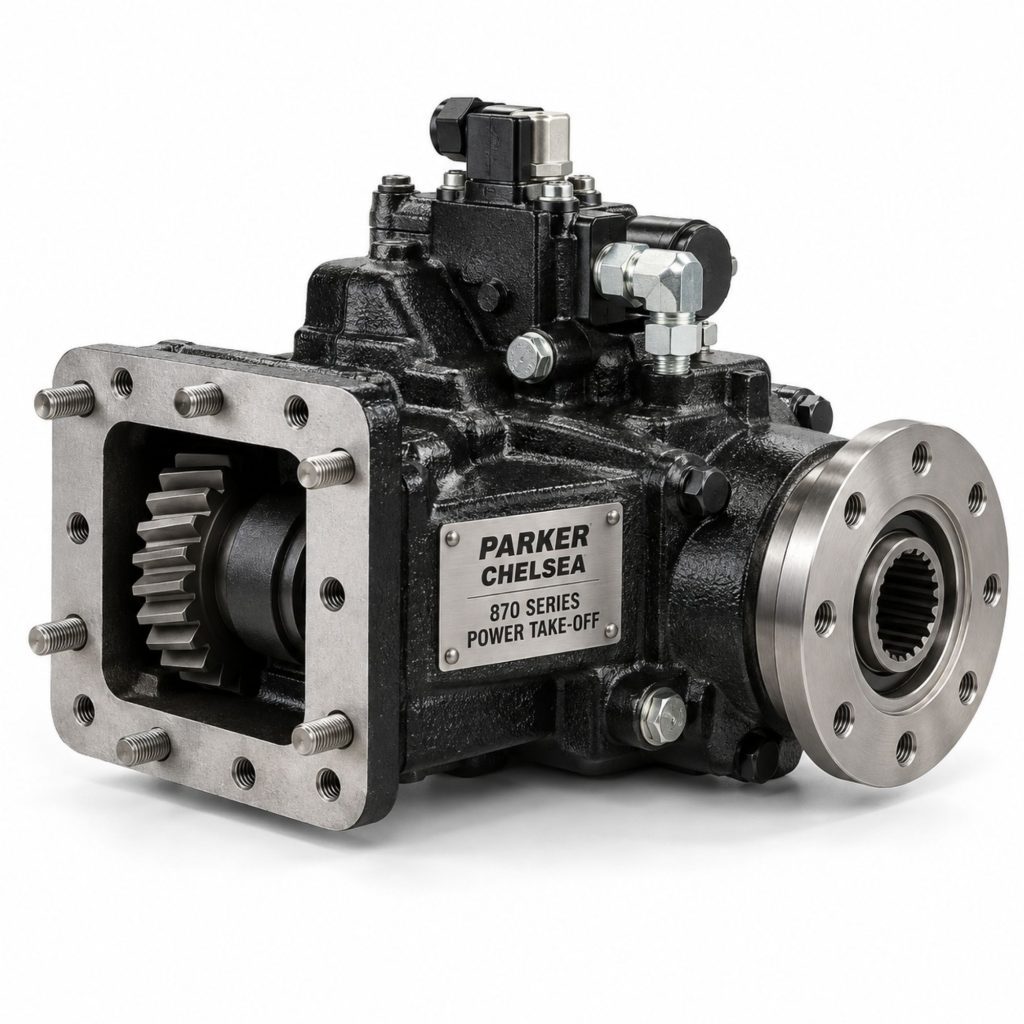
The Parker Chelsea 870 Series Power Take-Off is a heavy-duty hydraulic PowerShift PTO designed for compatible automatic transmissions with a ten-bolt PTO opening. It transfers power from the transmission to a directly mounted hydraulic pump or auxiliary driveline.
The 870 Series combines a compact housing with nine internal speed ratios and continuous torque ratings reaching 670 lb-ft. Its multiple ratios allow installers to match the output speed more closely to the hydraulic pump or driven equipment.
Available equipment included wet-spline pump outputs, Electronic Overspeed Control, Quiet Gear input gearing, Smart Start engagement, shaft-brake configurations, and multiple driveline and direct-pump outputs.
Parker currently identifies the Chelsea 870 Series as obsolete. Existing vehicles may still use the PTO, and replacement components or service support may remain available. New installations and complete replacement units should be reviewed with Parker Chelsea or an authorized distributor to determine the appropriate current product.
Key Characteristics
- Hydraulic PowerShift PTO design
- Ten-bolt transmission mounting pattern
- Compact housing
- Nine internal speed ratios
- Continuous torque ratings up to 670 lb-ft
- Thirteen output options
- 12- and 24-volt electric-over-hydraulic shifting
- Direct-pump and driveline outputs
- Wet-spline pump-output options
- Electronic Overspeed Control option
- Quiet Gear input option
- Smart Start option
- Shaft-brake output configurations
- Two primary assembly arrangements
- Pressure-lubricated configurations
- Legacy product requiring application-specific parts verification
Major Components
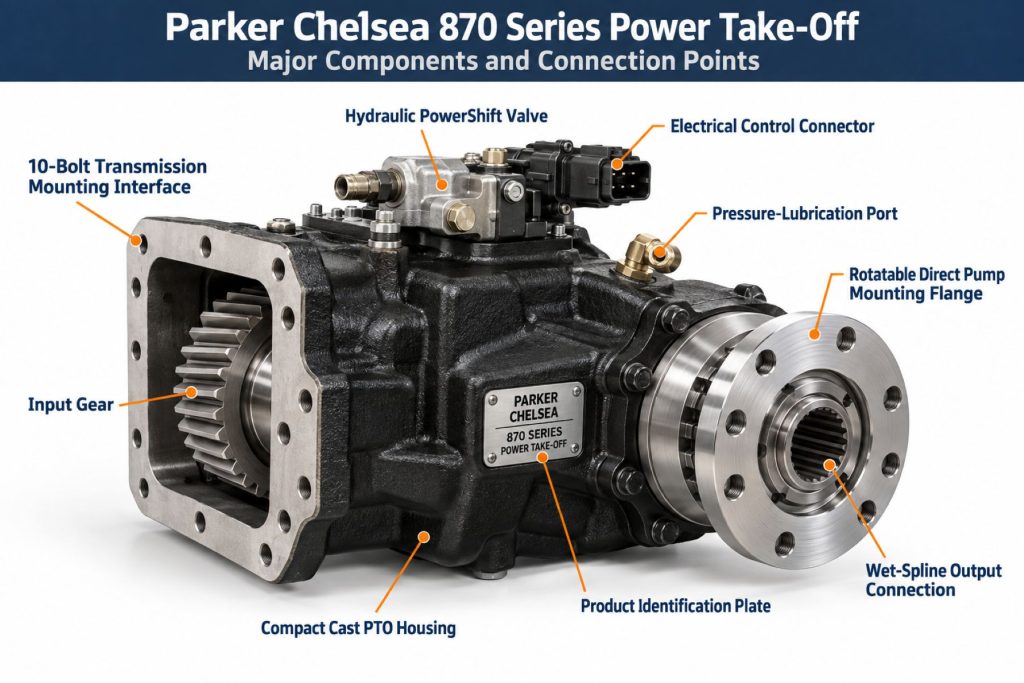
- Compact PTO housing
- Transmission input gear
- Internal gear train
- Hydraulic clutch assembly
- Clutch piston
- Hydraulic control valve
- Electric shift solenoid
- Output shaft
- Output bearings
- Direct-pump flange or driveline output
- Wet-spline lubrication components when equipped
- Shaft brake when specified
- Smart Start components when equipped
- Electronic Overspeed Control system when equipped
- Oil seals and O-rings
- Mounting studs and fasteners
- Pressure-lubrication passages
- Electrical wiring and connectors
Product Type and Construction
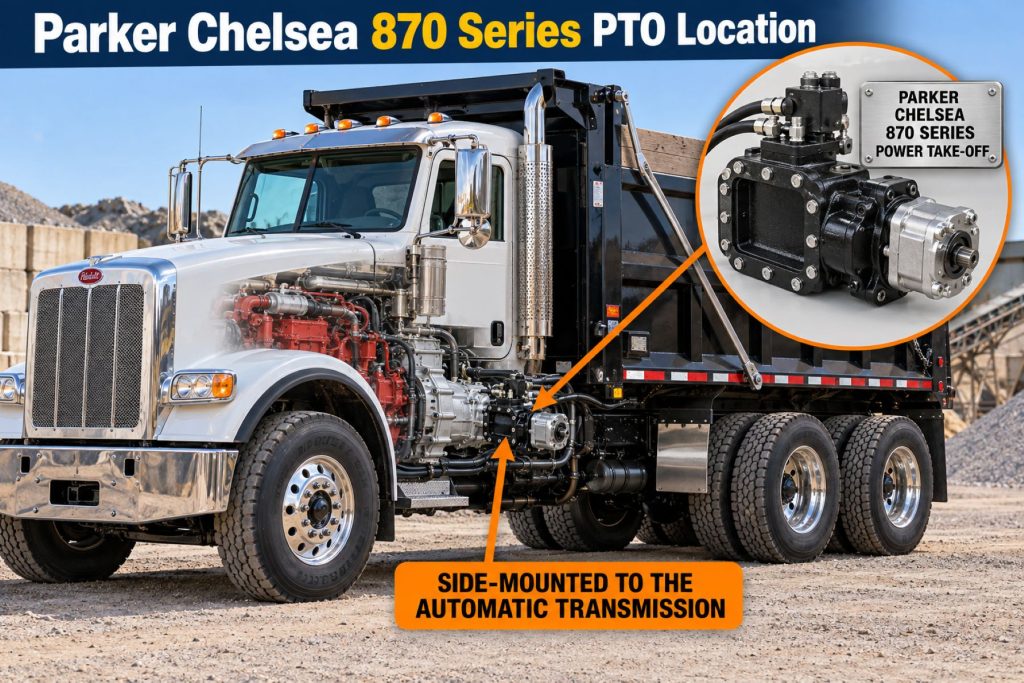
The Chelsea 870 is a transmission-mounted hydraulic PowerShift PTO. Its ten-bolt housing attaches to an approved PTO opening on a compatible automatic transmission.
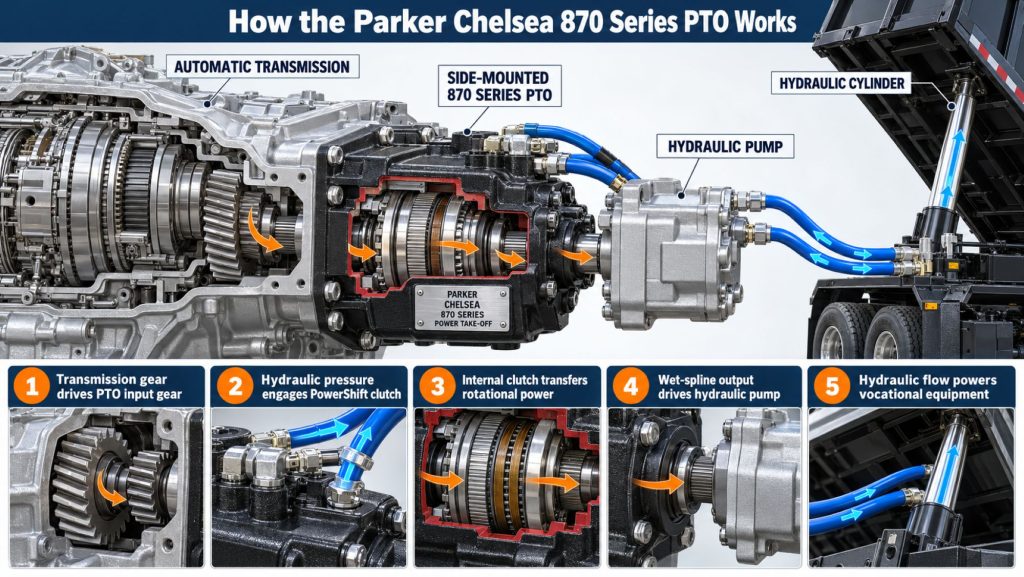
Hydraulic pressure operates an internal clutch that connects the transmission-driven input gear to the PTO output. This design allows electrically commanded engagement without using a conventional mechanical shift lever or cable.
The compact housing was designed to reduce clearance problems around frame rails, exhaust components, transmission features, and body equipment. Two assembly arrangements permit the housing bulge and output area to be positioned for different chassis installations.
How the Power Take-Off Works
The PTO input gear is driven by a compatible gear inside the transmission. When the vehicle or body-control system sends an approved engagement request, the PTO solenoid and hydraulic valve direct pressure to the internal clutch piston.
The applied clutch connects the rotating input assembly to the PTO output shaft. The internal ratio determines the relationship between transmission drive speed and PTO output speed.
The output then powers a directly mounted hydraulic pump or transfers power through a companion flange and auxiliary driveline. When disengagement is requested, hydraulic pressure is released or redirected and the internal clutch disconnects the output.
Position and Function Within the Vehicle
The 870 Series mounts to a compatible ten-bolt PTO opening on the automatic transmission. The assembly arrangement, valve position, output orientation, and pump location depend on the selected model and available chassis clearance.
The PTO can supply power for:
- High-flow hydraulic pumps
- Refuse-body hydraulic systems
- Vacuum pumps and blowers
- Fire apparatus equipment
- Rescue equipment
- Oilfield service systems
- Snowplows and material spreaders
- Hydraulic cranes
- Hydro-excavation equipment
- Recovery equipment
- Other heavy-duty vocational systems
Common Specifications
- PTO Type: Hydraulic PowerShift power take-off
- Mounting Pattern: Ten-bolt transmission opening
- Transmission Application: Application-specific heavy-duty automatic transmissions
- Available Ratio Codes: A, B, C, D, E, F, G, H, and J
- Published Continuous Torque Range: 335 to 670 lb-ft, depending on ratio
- Maximum Published Continuous Torque: 670 lb-ft or 908 N-m
- Maximum Published Power at 500 Output RPM: 64 horsepower or 48 kilowatts
- Maximum Published Power at 1,000 Output RPM: 128 horsepower or 95 kilowatts
- Approximate Weight: 56 pounds or approximately 25 kilograms
- Shift Options: 12- or 24-volt electric-over-hydraulic
- Lubrication Options: Pressure lubrication, rotated valve-body arrangements, and wet-spline configurations
- Assembly Arrangements: Right-side or left-side housing-bulge configurations
- Output Types: SAE pump mounts, ISO pump mount, DIN flanges, and 1410 Series companion-flange configurations
- Production Status: Obsolete; availability depends on remaining stock, service parts, remanufactured units, and approved replacement options
- All specifications must be confirmed using the complete Chelsea model number and the exact transmission application.
Power, Torque, Speed, and Operating Capacity
The 870 Series was offered with nine ratios and ratio-dependent continuous torque ratings. The highest-rated A ratio carries a published continuous rating of 670 lb-ft.
Published continuous torque ratings by ratio are:
- A ratio: 670 lb-ft
- B ratio: 630 lb-ft
- C ratio: 590 lb-ft
- D ratio: 550 lb-ft
- E ratio: 485 lb-ft
- F ratio: 430 lb-ft
- G ratio: 380 lb-ft
- H ratio: 355 lb-ft
- J ratio: 335 lb-ft
The PTO does not require a continuous-duty derating when operated within the published rating for its ratio. The hydraulic pump, auxiliary driveline, and driven equipment may have lower continuous ratings and must be evaluated separately.
Intended Transmission and Mounting Position
The 870 Series was developed for compatible heavy-duty automatic transmissions with a ten-bolt PTO opening. Transmission identification is required because the bolt pattern alone does not confirm input-gear, lubrication, control, or mounting compatibility.
The following information must be verified:
- Transmission manufacturer
- Transmission model and serial number
- Transmission specification
- PTO-opening location
- Transmission PTO-drive gear
- Required input option
- Selected internal ratio
- Housing assembly arrangement
- Valve-body orientation
- Output rotation
- Pump and chassis clearance
- Transmission lubrication requirements
PTO Engagement and Shift System
The 870 Series uses an electric-over-hydraulic PowerShift system. Electrical power activates a hydraulic control valve that applies transmission pressure to the PTO clutch.
Published shift arrangements included:
- 12-volt electric-over-hydraulic shift
- 24-volt electric-over-hydraulic shift
- 12-volt shift without an installation kit
- 24-volt shift without an installation kit
- 12-volt shift with Electronic Overspeed Control
- 24-volt shift with Electronic Overspeed Control
- 12-volt remote hydraulic valve
- 24-volt remote hydraulic valve
The exact engagement procedure depends on the transmission, vehicle programming, PTO controls, and body equipment.
Power Transfer and Output Design
The 870 Series was offered with thirteen outputs covering direct-mounted hydraulic pumps and remotely mounted driven equipment.
Output families included:
- 1410 Series companion flange
- DIN 120 driveline flange
- DIN 100 driveline flange
- Shaft-brake DIN 120 flange
- Shaft-brake DIN 100 flange
- Shaft-brake 1410 Series companion flange
- Smart Start DIN 120 flange
- Smart Start DIN 100 flange
- Smart Start 1410 Series companion flange
- Rotatable SAE B flange with SAE BB shaft
- Rotatable SAE B flange with SAE C shaft
- Rotatable SAE C flange with SAE C shaft
- Rotatable ISO 7653 pump mount with DIN 5462 shaft
Direct-mounted pump outputs must match the pump flange, pilot, shaft, spline, rotation, speed, and torque requirements. Driveline outputs require correct alignment, universal joints, guarding, and critical-speed analysis.
Wet Spline, Smart Start, and Shaft-Brake Options
Wet Spline directs lubricant to the connection between the PTO output shaft and hydraulic-pump input shaft. This helps reduce fretting, corrosion, and spline wear.
Smart Start was offered for applications requiring reduced shock loading during engagement. It moderates how power is applied to compatible driven equipment rather than applying the full load abruptly.
Shaft-brake configurations help stop or control output-shaft rotation after disengagement. This can be important where residual rotation affects the driven equipment or operating procedure.
These systems were optional and configuration-specific. Their presence must be confirmed from the complete PTO model number rather than assumed from the 870 Series designation.
Hydraulic Circuit and Equipment Integration
The 870 Series can power high-capacity hydraulic systems, but the PTO ratio, engine speed, pump displacement, system pressure, required flow, and duty cycle must be calculated together.
A complete hydraulic circuit may include:
- Direct-mounted hydraulic pump
- Hydraulic-fluid reservoir
- Suction hose and shutoff valve
- Pressure and return lines
- Directional-control valves
- Pressure-relief valve
- Hydraulic cylinders or motors
- Pressure and return filtration
- Hydraulic-oil cooler
- Temperature and pressure sensors
- Body-control interlocks
- Engine-speed controls
The complete system must remain within the ratings of the PTO, transmission, pump, hoses, valves, reservoir, and driven equipment.
Housing, Shaft, Bearing, and Clutch Design
The 870 Series uses a compact housing intended to reduce installation interference. High-capacity bearings and heavy-duty gear designs support its ratio-dependent continuous torque ratings.
The hydraulic clutch connects and disconnects the PTO output without using a manual sliding-gear engagement system. The clutch, input gear, output shaft, bearings, control valve, and seals depend on correct hydraulic pressure and lubrication.
Two housing assembly arrangements allow the main housing bulge to be positioned differently on the right or left side of the installation.
Controls and Electronic Integration
The PTO control system may communicate with the transmission controller, engine controller, vehicle electrical system, and vocational-body controls.
Possible control functions include:
- Dash-mounted PTO engagement switch
- PTO indicator lamp
- Transmission PTO-request circuit
- Electric hydraulic-control solenoid
- Parking-brake interlock
- Transmission-range interlock
- Vehicle-speed interlock
- Engine-speed control
- Remote throttle
- Body-equipment interlock
- Electronic Overspeed Control
- Automatic PTO disengagement
Controls and wiring must match the exact vehicle voltage, transmission, PTO shift package, and body system.
Electronic Overspeed Control and Quiet Gear
Electronic Overspeed Control was available to help protect hydraulic pumps and driven equipment from excessive PTO output speed. The system monitors operating conditions and can disengage or limit PTO operation when its configured threshold is exceeded.
Quiet Gear was an available input option designed to reduce PTO gear noise in compatible transmission applications. The special input must match the transmission’s PTO drive gear and cannot be substituted without confirming the complete application.
The presence and settings of these features should be confirmed from the PTO model number, installation kit, wiring, and vehicle programming.
Efficiency, Heat, and Lubrication
The 870 Series was offered with pressure-lubricated and wet-spline configurations. Correct transmission-fluid type, level, pressure, and temperature are essential for the gears, bearings, clutch, and output system.
Valve-body arrangements could be rotated to improve chassis clearance. Rotation and lubrication codes must be matched to the complete PTO specification.
Excessive torque, overspeed, clutch slip, low lubrication pressure, contaminated fluid, or hydraulic-system inefficiency can create abnormal heat and shorten PTO life.
Duty Cycle and Operating Conditions
The 870 Series was designed for continuous-duty applications without requiring the PTO to be derated below its published ratio-specific continuous torque rating.
Application suitability depends on:
- Selected ratio
- Required continuous torque
- Peak and shock loads
- Output speed
- Hydraulic-pump displacement
- System pressure
- Hydraulic-fluid temperature
- Transmission lubrication
- Vehicle movement during operation
- Ambient conditions
- Pump weight and support
- Driven-equipment duty cycle
The PTO’s continuous-duty capability does not automatically make every pump, hose, valve, driveline, or driven component suitable for continuous operation.
Mounting and Installation
The 870 Series mounts to an approved ten-bolt transmission opening. Installation requires the correct input gear, ratio, assembly arrangement, mounting hardware, lubrication system, controls, and output.
The installer must verify:
- Correct PTO and transmission combination
- Correct input option
- Required internal ratio
- Proper mounting surface and gasket
- Correct gear backlash
- Assembly arrangement
- Valve-body orientation
- Output rotation
- Pump or driveline clearance
- Electrical-system voltage
- Hydraulic shift-pressure supply
- Pressure-lubrication connections
- Pump support requirements
- Transmission-fluid level after installation
- Transmission-controller programming
A heavy direct-mounted pump may require a properly designed support bracket. Allowing excessive pump weight or hose loading to act on the PTO output can damage the housing, bearing cap, transmission case, or spline connection.
Transmission and Vehicle Compatibility
The Chelsea 870 Series must be matched to the exact automatic transmission and vehicle. A ten-bolt opening does not by itself establish compatibility.
Compatibility depends on:
- Transmission manufacturer
- Transmission model and specification
- PTO-opening location
- Transmission drive-gear design
- PTO input option
- Selected ratio
- Lubrication pressure and flow
- Transmission software
- Vehicle electrical voltage
- Frame and crossmember clearance
- Exhaust-system placement
- Pump dimensions
- Body and equipment layout
Because the 870 Series is obsolete, a replacement PTO should not be selected solely by matching the former torque rating or ten-bolt mounting pattern.
Pump, Driveshaft, and Driven-Equipment Compatibility
A direct-mounted hydraulic pump must match the PTO flange, pilot, shaft, spline, rotation, speed range, torque demand, and mounting dimensions.
Driveline configurations require a compatible DIN or 1410 Series flange, properly sized driveshaft, correct universal-joint angles, sufficient slip travel, critical-speed analysis, and guarding.
The complete system is limited by the lowest-rated PTO, pump, shaft, flange, universal joint, hydraulic component, or driven-equipment rating.
Hydraulic Fluid, Filtration, and Reservoir Compatibility
The hydraulic system should use fluid that meets the pump and equipment manufacturers’ viscosity, temperature, and additive requirements.
The reservoir, suction line, filters, breathers, return plumbing, and oil cooler must support the required flow without excessive restriction, aeration, backpressure, or heat.
Contaminated, aerated, or overheated hydraulic fluid can damage the pump and increase the load placed on the PTO.
Common Applications
- Fire apparatus
- Rescue vehicles
- Refuse trucks
- Vacuum trucks
- Hydro-excavation trucks
- Oilfield service vehicles
- Snowplows
- Salt and material spreaders
- Hydraulic-crane trucks
- Recovery vehicles
- Municipal equipment
- Heavy-duty wet-line systems
- Specialized vocational trucks
Advantages
- Continuous torque ratings up to 670 lb-ft
- No continuous-duty torque derating within the published rating
- Nine internal speed ratios
- Thirteen output options
- Compact housing
- Two assembly arrangements
- Wet-spline pump-output options
- Electronic Overspeed Control option
- Quiet Gear input option
- Smart Start engagement option
- Shaft-brake configurations
- 12- and 24-volt controls
- Direct-pump and driveline outputs
- Designed for demanding vocational applications
Limitations or Considerations
- The 870 Series is an obsolete legacy product
- Complete new PTO availability may be limited
- Replacement components must match the exact model
- Current replacement PTOs may require changes to controls or installation
- Torque capacity varies by ratio
- Transmission compatibility must be confirmed
- Gear backlash must be correctly established
- Hydraulic shift pressure must meet requirements
- Some applications require pressure lubrication
- Heavy pumps may require structural support
- Wet-spline outputs require proper lubrication
- Electronic controls may require diagnosis or replacement
- The ten-bolt pattern alone does not confirm interchangeability
Driver and Operator Experience
A correctly installed 870 Series PTO should provide controlled push-button engagement and stable power for heavy-duty hydraulic equipment.
Operators should monitor:
- PTO engagement confirmation
- Engine and output speed
- Hydraulic pressure
- Hydraulic-fluid temperature
- Transmission temperature
- Abnormal gear or clutch noise
- Pump or driveline vibration
- Unexpected disengagement
- Slow equipment response
- Fluid leakage
- Electronic Overspeed Control warnings
- Transmission or body-controller faults
PTO Engagement and Operating Procedure
The engagement procedure depends on the transmission, vehicle programming, PTO control system, and powered equipment. Operators must follow the instructions supplied for the exact vehicle.
A typical stationary procedure may require the parking brake to be applied, the transmission placed in an approved range, vehicle speed reduced to zero, and the engine returned to idle before the PTO request is activated.
After engagement is confirmed, engine speed should be increased only to the level required by the hydraulic pump or equipment. Electronic Overspeed Control should not be treated as a substitute for correct operator control or PTO-ratio selection.
Before road travel, the PTO should be disengaged when required and the body or auxiliary equipment secured in its transport position.
Inspection and Wear Points
- PTO housing and mounting surface
- Mounting studs and fasteners
- Input gear and gear contact pattern
- Gear backlash
- Hydraulic clutch assembly
- Output bearings
- Output shaft and splines
- Wet-spline lubrication system
- Pump flange and pilot
- Hydraulic control valve
- Electric shift solenoid
- Pressure-lubrication lines
- Wiring and connectors
- Electronic Overspeed Control components
- Pump support brackets
- Companion flange and auxiliary driveline
- Oil seals and O-rings
Lubrication Requirements
The 870 Series requires the correct transmission lubricant, operating level, pressure, and temperature. The gears, bearings, hydraulic clutch, and output system depend on the transmission lubrication circuit.
Wet-spline configurations direct lubricant to the PTO-and-pump spline connection. The lubrication path must remain open, correctly sealed, and free of restrictions.
Pressure-lubrication lines and fittings should be checked for leakage, kinks, abrasion, damage, and internal restriction.
Maintenance and Ownership Notes
Routine maintenance should include checking mounting fasteners, transmission lubricant, hydraulic-control pressure, electrical connections, output splines, pump support, pressure-lube lines, and auxiliary-driveline components.
Because the 870 Series is obsolete, owners should record all identification information before a failure occurs. Replacement parts should be investigated before disassembling a serviceable unit.
Changes in engagement time, noise, temperature, vibration, or hydraulic performance should be diagnosed promptly. Continuing to operate a slipping clutch, damaged spline, worn bearing, or poorly lubricated PTO can damage the transmission and powered equipment.
Common PTO and Hydraulic-System Problems
- PTO will not engage: Insufficient hydraulic pressure, a failed solenoid, damaged wiring, incorrect transmission programming, an unsatisfied interlock, or internal clutch damage may prevent engagement.
- PTO will not disengage: A sticking control valve, trapped hydraulic pressure, an electrical fault, or damaged clutch components may keep the output engaged.
- Clutch slips under load: Low apply pressure, contaminated fluid, worn clutch components, excessive torque, high temperature, or an internal hydraulic leak may cause slipping.
- Gear noise: Incorrect backlash, incompatible input gearing, bearing wear, damaged gear teeth, or insufficient lubrication can produce abnormal noise.
- Wet-spline wear: Insufficient lubrication, pump movement, misalignment, incorrect shaft geometry, or a loose support bracket may damage the PTO and pump splines.
- Overheating: Excessive torque, overspeed, clutch slip, restricted lubrication, hydraulic inefficiency, or inadequate cooling can raise operating temperature.
- Slow hydraulic operation: An incorrect PTO ratio, low engine speed, pump wear, suction restriction, low hydraulic-fluid level, internal leakage, or a relief-valve problem may reduce performance.
- Electronic-control fault: Failed wiring, connectors, speed sensors, control modules, solenoids, or incorrect programming may cause intermittent operation or unwanted disengagement.
Safety and Service Precautions
Before servicing the PTO or hydraulic system, shut down the engine, secure the vehicle, relieve hydraulic pressure, disconnect electrical power when required, and prevent the driven equipment from moving.
Never work beneath a raised body, crane, aerial device, outrigger, or hydraulically supported component without the manufacturer’s approved mechanical blocking or support system.
Auxiliary drivelines must be properly guarded. Hands, clothing, tools, and loose objects must be kept away from rotating shafts, flanges, and universal joints.
PTO installation, backlash adjustment, hydraulic-pressure testing, internal repair, and transmission programming should be completed by qualified personnel using the correct service information.
Identification Information
The complete Chelsea model number identifies the PTO series, mounting option, ratio, transmission input, lubrication configuration, shift system, assembly arrangement, and output.
Record the following information before ordering parts or evaluating a replacement:
- Complete Chelsea PTO model number
- PTO serial or production information
- Vehicle identification number
- Truck manufacturer and model
- Transmission manufacturer
- Transmission model and serial number
- Transmission specification
- PTO-opening position
- Ratio code
- Input option
- Lubrication code
- Shift-option code
- Assembly arrangement
- Output-option code
- Wet Spline, Smart Start, shaft brake, or EOC equipment
- Hydraulic-pump manufacturer and model
- Driven-equipment requirements
Do not order replacement parts or a substitute PTO from appearance or the 870 Series number alone.
Buying Considerations
- Confirm whether the existing PTO can be repaired
- Verify current parts availability before disassembly
- Record the complete 870 Series model number
- Identify the exact transmission
- Determine the required continuous and peak torque
- Calculate the required pump speed
- Match the original ratio or properly redesign the system
- Confirm the input gear and mounting arrangement
- Match the pump flange and shaft
- Identify all electronic-control features
- Confirm Wet Spline, Smart Start, shaft-brake, and EOC requirements
- Verify 12- or 24-volt controls
- Check chassis and pump clearance
- Evaluate current Parker replacement options
- Confirm whether wiring, plumbing, programming, or brackets must change
- Use a qualified PTO and hydraulic-system specialist
Variants and Configurations
- Nine internal ratio options
- Standard and Quiet Gear inputs
- Pressure-lubricated models
- Wet-spline models
- Valve body in standard position
- Valve body rotated 120 degrees
- Valve body rotated 240 degrees
- 12-volt electric-over-hydraulic shift
- 24-volt electric-over-hydraulic shift
- Electronic Overspeed Control packages
- Remote hydraulic-valve configurations
- Two assembly arrangements
- SAE direct-pump outputs
- ISO direct-pump output
- DIN driveline flanges
- 1410 Series companion flange
- Smart Start outputs
- Shaft-brake outputs
Comparison to Similar Equipment
Compared with the Parker Chelsea 280 Series Power Take-Off, the 870 provides substantially higher ratio-dependent continuous torque capacity. Both use ten-bolt transmission mounting, but they serve different power requirements and use different components.
Compared with the Parker Chelsea 590 Series Power Take-Off, the 870 is a side-mounted ten-bolt PTO with nine ratios. The 590 is a rear-mounted PTO with a fixed 1:1 ratio for a narrower group of transmissions.
Compared with the Parker Chelsea 489 Series Power Take-Off, the 870 is a hydraulic PowerShift PTO for automatic transmissions and continuous heavy-duty service. The 489 is primarily a mechanically shifted eight-bolt PTO for manual-transmission applications.
Because the 870 Series is obsolete, comparisons with current PTOs must include transmission compatibility, control changes, mounting geometry, output speed, torque, pump interface, and replacement-parts support.
Best Fit For
- Vehicles originally equipped with a Chelsea 870 Series PTO
- Fleets maintaining legacy vocational trucks
- Approved ten-bolt automatic-transmission applications
- Continuous-duty hydraulic systems
- Applications requiring multiple output-speed choices
- Fire and rescue apparatus
- Refuse trucks
- Vacuum and hydro-excavation equipment
- Oilfield service vehicles
- Snow-and-ice-control trucks
- Operators with access to experienced PTO service support
- Applications where compatible service parts remain available
Related Vehicle and Trailer Types
- Fire Trucks
- Refuse Trucks
- Vacuum Trucks
- Hydro-Excavation Trucks
- Oilfield Service Trucks
- Service Trucks
- Vocational Trucks
- Heavy-Haul Trucks
Related Truck and Trailer Models
- Freightliner 114SD
- Freightliner 122SD
- International HV Series
- International HX Series
- Kenworth T880
- Peterbilt 567
- Mack Granite
- Western Star 47X
Related PTO and Hydraulic System Types
- Power Take-Off Systems
- Hydraulic Pumps & Motors
- Wet Kits & Complete Hydraulic Systems
- Hydraulic Cylinders & Dump Hoists
- Hydraulic Valves, Controls & Reservoirs
- Hydraulic Hoses, Fittings & Filtration
Related PTO and Hydraulic Products
- Parker Chelsea 280 Series Power Take-Off
- Parker Chelsea 442 Series Power Take-Off
- Parker Chelsea 489 Series Power Take-Off
- Parker Chelsea 590 Series Power Take-Off
- Muncie TG Series Power Take-Off
- Muncie CS6 Series Power Take-Off
- Muncie FR6Q Power Take-Off
- Parker F1 Hydraulic Pump
- Parker F2 Twin-Flow Hydraulic Pump
- Parker Chelsea Wetline Hydraulic System
Related Equipment Systems
- PTO & Hydraulic Systems
- Transmissions
- Electrical Systems
- Brake Systems
- Suspension Systems
- Axles & Differentials
Related Guides
- PTO & Hydraulic System Guides
- How Commercial Truck PTO and Hydraulic Systems Work
- Commercial Truck Power Take-Off Types Explained
- How to Choose a PTO and Hydraulic Pump
- Commercial Truck Wet Kits Explained
- How to Inspect and Maintain Truck Hydraulic Systems
Regulatory and Compliance Notes
PTO and hydraulic-system installations must preserve the vehicle’s braking, steering, transmission, driveline, electrical, exhaust, emissions, fuel-system, and structural integrity.
The completed vehicle must remain within its axle, frame, tire, wheel, transmission, driveline, and gross vehicle weight ratings. Installing or replacing a PTO does not increase any certified vehicle rating.
Hydraulic hoses, rotating shafts, raised bodies, cranes, vacuum equipment, and other powered systems may be subject to workplace-safety, inspection, guarding, and operating requirements.
Changes made while replacing an obsolete 870 Series PTO must be reviewed for proper controls, output speed, hydraulic performance, equipment safety, and completed-vehicle compliance.
Real World Operating Notes
The 870 Series should be treated as a complete configured system rather than a generic ten-bolt PTO. Ratio, input gear, controls, lubrication, assembly arrangement, and output all affect compatibility.
A replacement PTO with the same maximum torque rating may still produce the wrong output speed or require different controls. Hydraulic flow and equipment speed should be recalculated whenever the PTO ratio changes.
Wet-spline lubrication can substantially reduce pump-shaft wear, but it must remain properly supplied and sealed. Dry splines, red fretting debris, oil leakage, or pump movement indicate a problem requiring inspection.
Because this is an obsolete product, owners should preserve identification tags, service records, wiring diagrams, installation instructions, and removed components until the repair or replacement has been completed successfully.
Frequently Asked Questions
What is the Parker Chelsea 870 Series PTO?
It is a ten-bolt hydraulic PowerShift PTO designed for compatible heavy-duty automatic transmissions and vocational hydraulic equipment.
Is the Chelsea 870 Series still in production?
Parker currently identifies the 870 Series as obsolete. Service parts, remaining inventory, remanufactured units, or application-specific replacements may still be available.
How much torque can the 870 Series handle?
The maximum published continuous rating is 670 lb-ft. Actual capacity ranges from 335 to 670 lb-ft depending on the selected ratio.
How many ratios were available?
The 870 Series was offered with nine internal speed ratios.
Is the 870 Series rated for continuous operation?
Yes. Parker published continuous torque and horsepower ratings for each ratio without requiring an additional PTO derating for continuous-duty use.
What is Electronic Overspeed Control?
Electronic Overspeed Control is an optional protection system designed to help prevent the PTO or driven equipment from operating above a configured speed limit.
What is Smart Start?
Smart Start is an optional engagement system intended to reduce shock loading when power is initially applied to compatible driven equipment.
Can the 870 directly mount a hydraulic pump?
Yes. Rotatable SAE and ISO direct-pump outputs were available, including wet-spline configurations.
Can any ten-bolt PTO replace the 870 Series?
No. The replacement must match the transmission, input gearing, ratio, rotation, torque, lubrication, controls, mounting clearance, and output requirements.
How is the correct replacement identified?
Use the complete Chelsea model number, transmission identification, ratio, input option, lubrication code, shift system, assembly arrangement, output, pump information, and driven-equipment requirements.
Availability and Where to Find
The Parker Chelsea 870 Series is an obsolete legacy product. Existing units may remain in operation, and selected service parts, repair components, remaining inventory, or remanufactured assemblies may be available.
Parts and application assistance may be available through Parker Chelsea distributors, commercial-truck dealers, PTO specialists, hydraulic-equipment suppliers, body builders, and heavy-duty repair facilities.
Before ordering, buyers should provide the complete PTO model number, transmission information, vehicle VIN, hydraulic-pump information, and driven-equipment requirements.
Current product status, technical support, parts information, and replacement guidance are available through the Parker Chelsea website.
Support Trucking Families
Truck Equipment Atlas supports the mission of Grey Cross, a nonprofit dedicated to helping families of truck drivers who lose their lives while on the road. As the site grows, part of its mission is to bring awareness and support to these families.
Podcast or Video Section
Learn More Through Audio and Video
Truck Equipment Atlas will continue expanding with podcast episodes, interviews, and equipment breakdowns to help drivers and fleets better understand trucks and equipment.
Follow the Growth of Truck Equipment Atlas
Truck Equipment Atlas continues to expand with new truck profiles, trailer coverage, diesel engine pages, equipment system resources, manufacturer information, and educational guides.
Visit our Site Updates page to explore recent additions, project milestones, and upcoming resources as we continue building one of the industry’s growing commercial trucking equipment reference libraries.
View the Latest Site Updates: Truck Equipment Atlas Site Updates