
ConMet TruTurn Brake Drum
Quick Facts
- Manufacturer: ConMet
- Product Family: TruTurn
- Product Type: Premium commercial-vehicle brake drum
- Brake Category: S-cam drum-brake component
- Material: Application-engineered cast iron
- Manufacturing Method: Turned-to-balance machining process
- Machined Surface Area: More than 95 percent of the drum’s interior and exterior surfaces
- Balancing: Inherently balanced through machining
- External Balance Weights: Not required
- Primary Positions: Steer, drive, trailer, and specialty axles, depending on part number
- Available Brake Sizes: Multiple 15-inch and 16.5-inch commercial configurations
- Common Configuration: 16.5-by-7-inch rear brake drum
- Mounting: Inboard or outboard, depending on model
- Wheel Systems: Hub-piloted or ball-seat systems, depending on part number
- Primary Applications: Trucks, tractors, trailers, buses, and vocational vehicles
- Product Position: ConMet’s premium brake-drum offering
- Primary Benefit: Uniform wall thickness and inherent balance for improved heat distribution, reduced vibration, and consistent braking
Overview
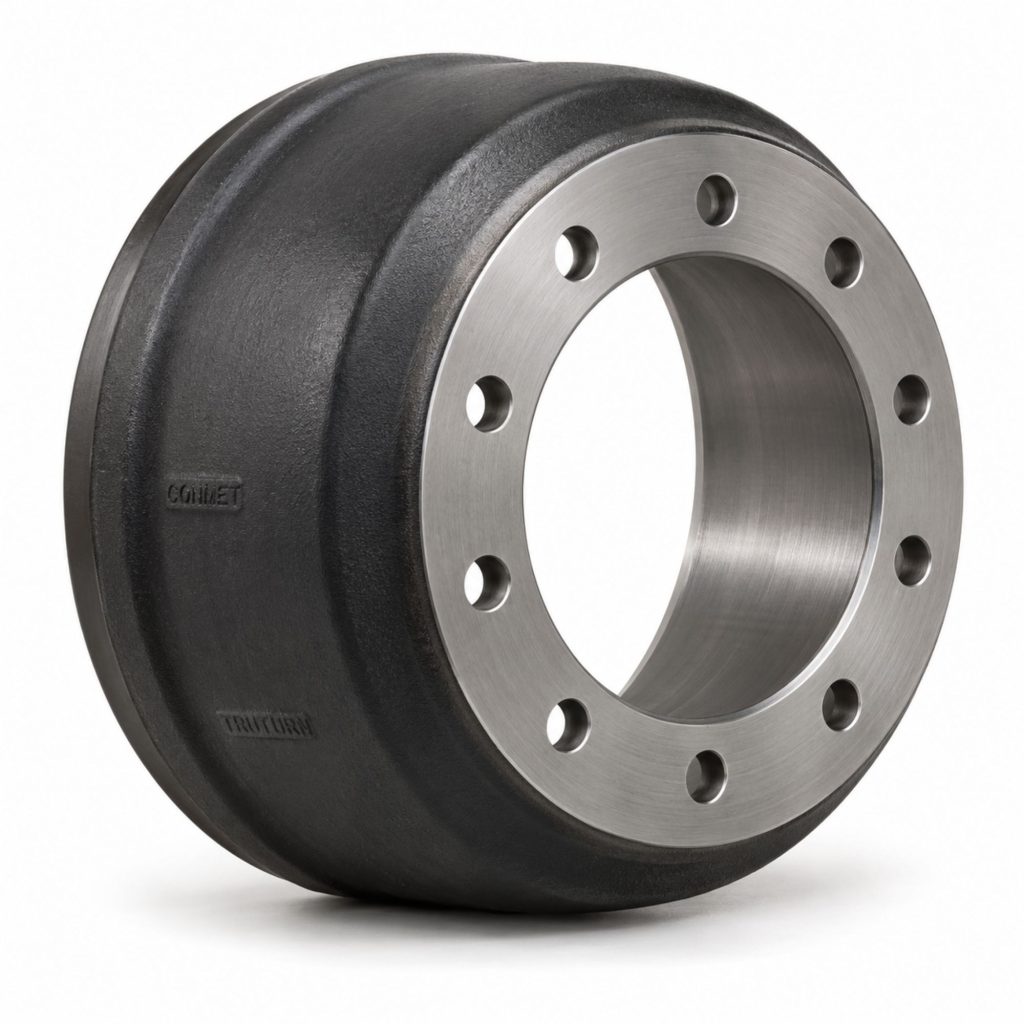
The ConMet TruTurn is a premium cast-iron brake drum designed for commercial trucks, tractors, trailers, buses, and vocational vehicles. It is available in multiple part numbers covering steer, drive, trailer, and specialty wheel-end applications.
TruTurn’s defining feature is ConMet’s turned-to-balance manufacturing process. Instead of adding welded balance weights or cutting isolated areas from the drum, ConMet machines more than 95 percent of the drum’s interior and exterior surfaces.
This process produces a more uniform wall thickness and makes the drum inherently balanced. The uniform structure helps distribute heat more evenly while reducing vibration, brake pulsation, and uneven friction-material wear.
Eliminating welded weights and aggressive balance cuts also preserves more of the drum’s original structural integrity. The result is a premium drum designed to provide consistent braking, lower operating temperatures, and long service life.
TruTurn is a product family rather than one universal brake drum. Each part number has its own brake diameter, lining width, mounting type, pilot diameter, bolt pattern, offset, overall depth, weight, axle position, and maximum wear diameter.
ConMet continues to identify TruTurn as its top-tier brake-drum offering. In 2026, the company added the broader aftermarket TruCast line while retaining TruTurn for customers seeking premium performance and manufacturing quality. ConMet brake components
Key Characteristics
- Premium cast-iron brake drum
- Turned-to-balance manufacturing process
- More than 95 percent machined surface area
- Uniform drum-wall thickness
- Inherent factory balance
- No welded balance weights
- No aggressive balance cuts
- More uniform heat distribution
- Reduced brake pulsation
- Reduced wheel-end vibration
- Consistent shoe-to-drum contact
- Multiple 15-inch and 16.5-inch sizes
- Steer-, drive-, and trailer-axle coverage
- Inboard- and outboard-mounted configurations
- OEM and aftermarket availability
- Compatible with ConMet wheel-end systems
Major Components
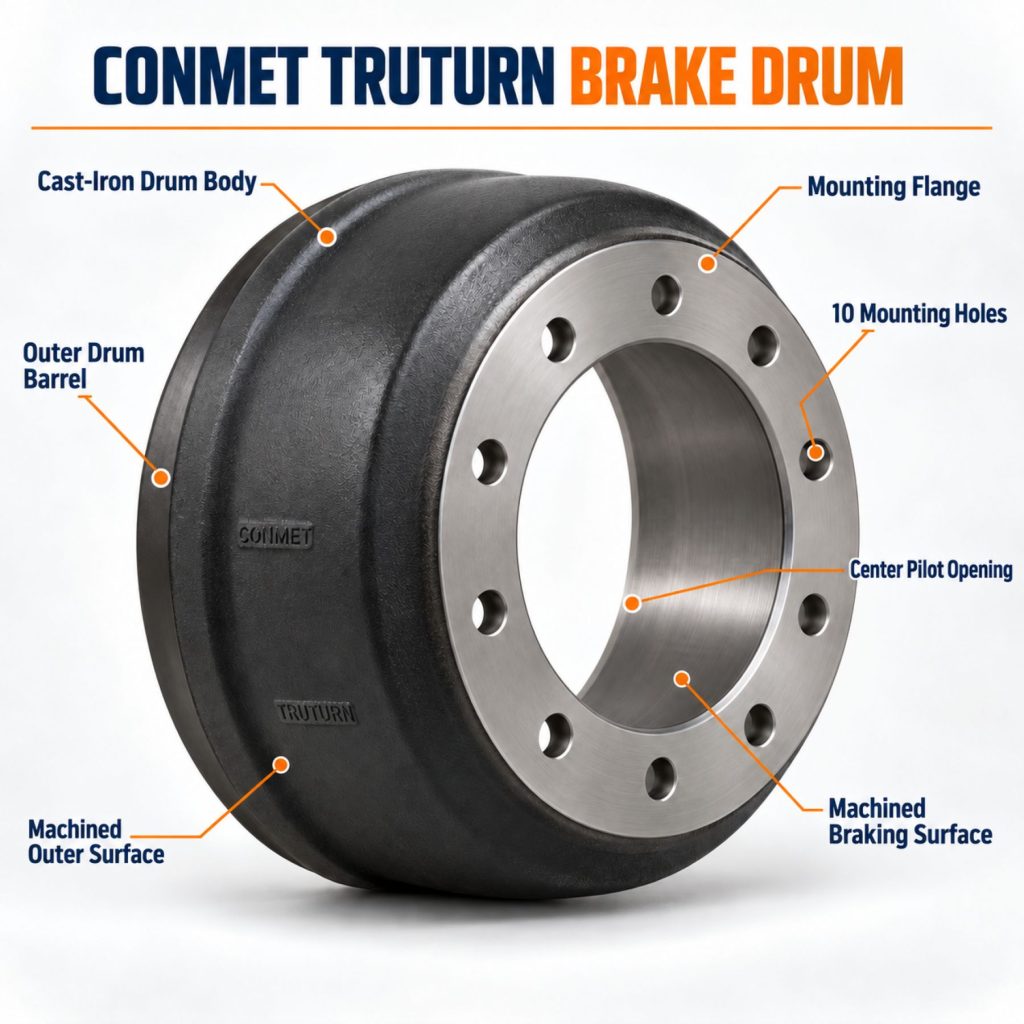
- Cast-iron drum body
- Internal braking surface
- External machined surface
- Open drum end
- Closed back plate
- Mounting flange
- Hub pilot
- Bolt holes
- Bolt circle
- Machined friction surface
- Machined mounting surface
- Machined pilot surface
- External cooling surface
- Maximum-diameter marking
- Casting identification
- Finished part number
- Date code
- Balance reference features
How the Brake Component or System Works
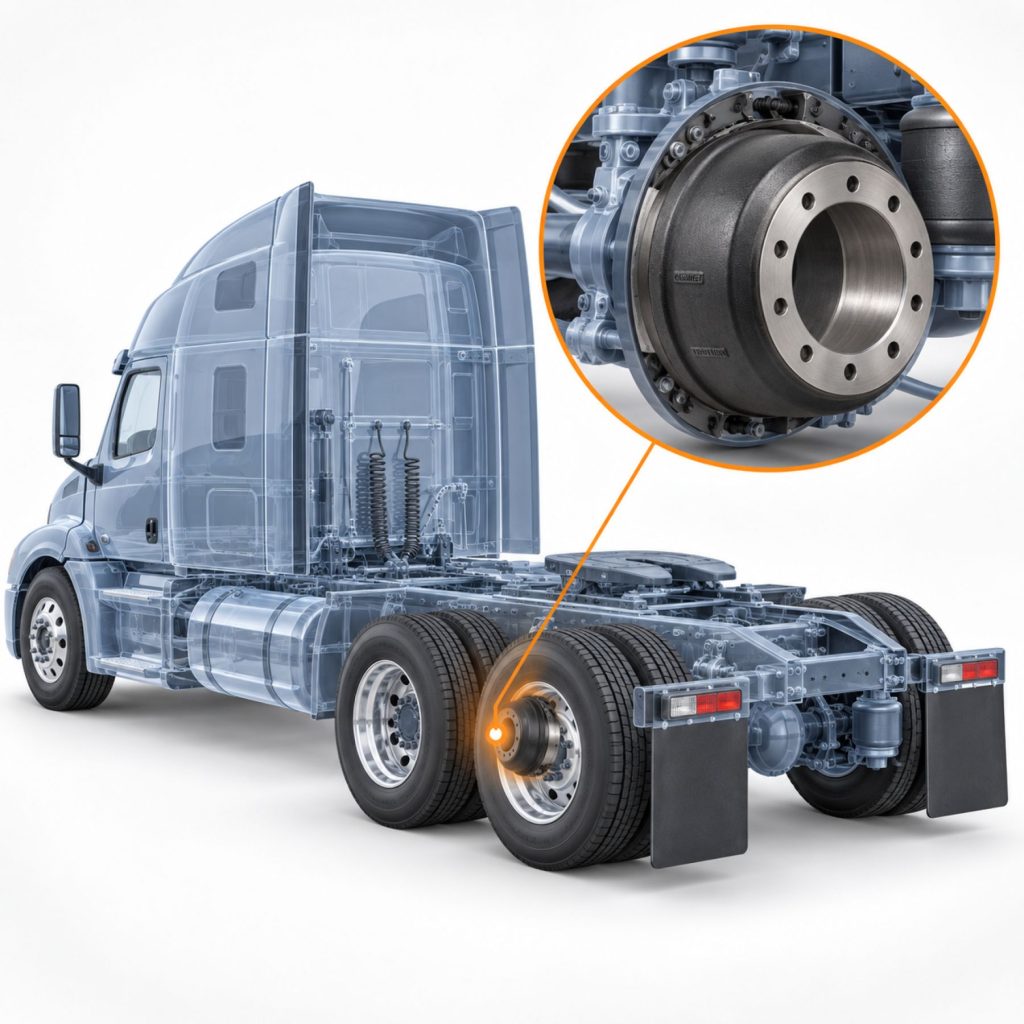
The TruTurn drum mounts to the wheel hub and rotates with the wheel. When the driver applies the service brakes, compressed air enters the brake chamber and moves the pushrod.
The pushrod rotates the slack adjuster and camshaft. The S-shaped cam head spreads the brake shoes outward until their friction linings contact the drum’s internal braking surface.
Friction between the stationary linings and rotating drum slows the wheel. The vehicle’s motion is converted into heat that is absorbed by the drum, friction material, hub, wheel, and surrounding air.
TruTurn’s uniform wall thickness helps distribute this heat around the drum. More even heat distribution can reduce localized hot spots, distortion, pulsation, and thermal stress.
When the brake releases, the shoe-return springs pull the linings away from the drum. The TruTurn continues rotating with the hub without intentional friction contact.
Position and Function Within the Brake System
The TruTurn is installed at the wheel end over a compatible S-cam foundation brake. Its specific position depends on the selected part number.
The drum performs several essential functions:
- Provides the friction surface for the brake linings
- Absorbs heat created during braking
- Releases heat into the surrounding air
- Transfers braking torque through the wheel end
- Maintains the required geometry around the brake shoes
- Helps protect internal brake components
- Supports balanced rotation of the wheel-end assembly
The drum does not independently create or control brake pressure. Its performance depends on the brake chamber, slack adjuster, camshaft, shoes, friction material, air system, ABS, hub, wheels, and tires.
Common Specifications
- Product Family: ConMet TruTurn
- Brake Type: Commercial S-cam drum brake
- Material: Cast iron
- Manufacturing: Turned-to-balance precision machining
- Machined Area: More than 95 percent of interior and exterior surfaces
- Balancing Method: Inherent balance through controlled machining
- Balance Weights: Not required
- Brake Diameters: Multiple 15-inch and 16.5-inch configurations
- Lining Widths: Application-specific
- Axle Positions: Steer, drive, trailer, and specialty applications
- Mounting: Inboard or outboard, depending on part number
- Wheel Mounting: Hub-piloted or ball-seat compatibility, depending on model
- Common Rear Configuration: 16.5-by-7-inch brake drum
- Common Trailer Configuration: 16.5-by-7-inch or 16.5-by-8⅝-inch, depending on axle and hub
- Maximum Wear Diameter: Cast or marked on the individual drum
- Market Availability: Original-equipment and aftermarket applications
- Product Position: Premium ConMet brake drum
Exact dimensions, weight, offset, pilot, bolt pattern, overall depth, mounting type, axle rating, and wear limit must be confirmed using the complete ConMet part number.
Operating Specifications and Performance
TruTurn’s machining process is designed to produce consistent wall thickness around the drum. Uniform material distribution helps the drum rotate smoothly and absorb heat more evenly.
ConMet identifies several operational benefits:
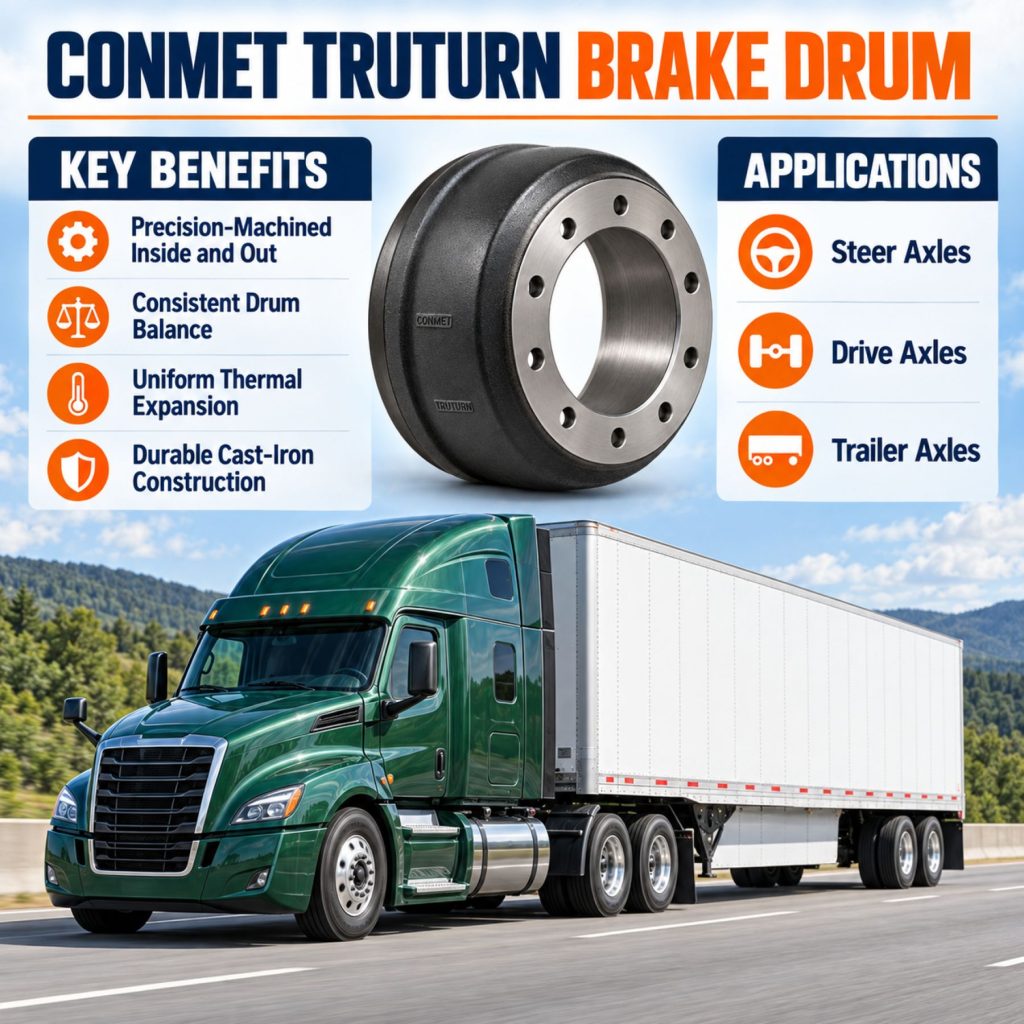
- Improved drum strength
- Reduced brake pulsation
- Lower operating temperatures
- Reduced vibration
- More consistent braking
- Maximum durability
- Longer potential component life
These benefits depend on the correct drum being installed on a properly maintained brake and wheel end. Actual performance varies with vehicle loading, route, braking frequency, friction material, drum size, brake balance, ambient conditions, and driver behavior.
The maximum diameter cast or marked on the drum is the controlling wear limit. If any part of the friction surface exceeds that dimension, the drum must be removed from service.
A TruTurn drum does not raise the vehicle’s certified gross axle weight rating. The axle, hub, wheels, tires, suspension, and complete brake system must support the application.
Braking Performance and System Integration
TruTurn works as part of a complete S-cam foundation-brake system. Drum balance and dimensional consistency can improve brake smoothness, but proper braking still depends on the surrounding components.
The complete system includes:
- Air brake chamber
- Pushrod and clevis
- Slack adjuster
- Camshaft
- Brake spider
- Rollers and anchor pins
- Brake shoes
- Friction linings
- Shoe-return springs
- Wheel hub
- Bearings and seals
- ABS components
A damaged chamber, excessive pushrod stroke, worn camshaft, contaminated lining, or incorrect friction material can reduce braking performance even when the drum remains serviceable.
Drums and friction material should be matched across an axle. Significant differences in diameter, surface condition, or friction formulation can create unequal braking torque and temperature.
Air Supply, Controls, and Electronic Integration
The TruTurn has no direct pneumatic or electronic connections. It responds to mechanical force generated by the air brake system.
It can operate within systems equipped with:
- Service brake chambers
- Spring-brake chambers
- Automatic slack adjusters
- Manual slack adjusters
- Relay valves
- Antilock braking systems
- Automatic traction control
- Electronic stability control
- Trailer roll-stability systems
- Wheel-speed sensors
- Electronic brake-stroke monitoring
ABS controls air pressure when wheel lockup is detected. It cannot compensate for an oversized, cracked, contaminated, distorted, or incorrectly installed drum.
Electronic stability systems may selectively apply individual brakes. Their performance still depends on serviceable drums, linings, chambers, valves, sensors, tires, and wheel ends.
Installation, Adjustment, and Brake Balance
The TruTurn must match the axle, hub, wheel, foundation brake, and mounting configuration. Installation should follow ConMet’s service procedures and the vehicle manufacturer’s torque requirements.
Important installation checks include:
- Confirming the complete ConMet part number
- Verifying brake diameter and width
- Confirming steer, drive, or trailer position
- Checking inboard or outboard mounting
- Confirming the pilot diameter
- Checking the bolt-circle diameter
- Verifying bolt-hole number and size
- Checking drum offset
- Confirming overall depth
- Inspecting the hub pilot
- Cleaning the mounting surfaces
- Inspecting wheel studs
- Measuring drum diameter
- Inspecting the braking surface
- Checking brake shoes and friction material
- Following the proper wheel-fastener sequence
- Tightening fasteners to specification
- Measuring applied pushrod stroke
- Comparing brake operation across the axle
The wheel or wheel nuts should never be used to force an incompatible drum onto the hub. Improper seating can create runout, vibration, cracking, and wheel-end looseness.
Foundation Brake, Axle, and Wheel-End Compatibility
TruTurn drums are available for many commercial wheel-end arrangements. Compatibility depends on the complete drum geometry rather than nominal brake size alone.
The correct part must match:
- Axle manufacturer
- Axle model
- Axle position
- Gross axle weight rating
- Hub manufacturer
- Hub model
- Hub-pilot diameter
- Bolt-circle diameter
- Number of bolt holes
- Bolt-hole diameter
- Drum offset
- Overall depth
- Brake-surface width
- Foundation-brake diameter
- Wheel mounting system
- Wheel size and offset
- ABS component clearance
- Vehicle brake certification
Certain ConMet drums are designed to accommodate either ball-seat or hub-piloted wheel systems through application-specific bolt-hole and pilot dimensions. This feature must be confirmed by part number rather than assumed.
TruTurn can also be paired with compatible ConMet Conventional, PreSet, and PreSet Plus hub systems when the wheel-end specification approves the combination.
Common Applications
- Line-haul tractors
- Regional-haul tractors
- Heavy-duty straight trucks
- Vocational trucks
- Dump trucks
- Concrete mixers
- Refuse trucks
- Construction vehicles
- Logging trucks
- Heavy-haul vehicles
- Tank trucks
- Municipal vehicles
- School buses
- Transit buses
- Motorcoaches
- Dry van trailers
- Refrigerated trailers
- Flatbed trailers
- Tank trailers
- Dump trailers
- Hopper trailers
- Container chassis
- Specialty commercial vehicles
Vehicle and Brake-System Compatibility
TruTurn drums can be found on numerous original-equipment and replacement wheel ends. The vehicle model alone does not confirm fitment.
Compatibility should be verified using:
- Vehicle identification number
- Vehicle manufacturer
- Model and model year
- Axle manufacturer
- Axle model and serial number
- Gross axle weight rating
- Hub assembly number
- Original brake-drum number
- ConMet drum part number
- Brake diameter
- Brake-shoe width
- Pilot diameter
- Bolt-circle diameter
- Bolt-hole dimensions
- Drum offset
- Overall depth
- Mounting type
- Wheel system
- ABS configuration
ConMet’s wheel-end application tools can help identify replacement drums using the hub, axle, vehicle, or original component information.
Advantages
- Premium brake-drum construction
- More than 95 percent machined surface area
- Uniform wall thickness
- Inherent factory balance
- No welded balance weights
- No material-removing balance notches
- Improved structural consistency
- More uniform heat distribution
- Reduced brake pulsation
- Reduced wheel-end vibration
- Consistent friction contact
- Potentially lower operating temperatures
- Multiple brake sizes
- Steer-, drive-, and trailer-axle coverage
- OEM and aftermarket support
- Compatible ConMet wheel-end options
Limitations or Considerations
- Premium price compared with value-oriented drums
- Heavier than some lightweight alternatives
- Complete inspection requires drum removal
- Different TruTurn part numbers are not interchangeable
- Nominal brake size does not confirm fitment
- Maximum diameter must be measured
- Drum brakes can experience fade when overheated
- Can crack after severe thermal stress
- Improper installation can create runout
- Mounting corrosion can prevent proper seating
- Brake dust accumulates inside the drum
- Contaminated friction material requires correction
- Drum does not eliminate brake-adjustment inspections
- Heavy drums require appropriate lifting equipment
- Does not increase the vehicle’s certified axle rating
Driver and Operator Experience
A properly installed TruTurn should provide smooth and predictable drum-brake operation. Its balance and uniform wall thickness are intended to reduce vibration and brake pulsation.
Drivers may notice smoother braking when replacing a distorted or poorly balanced drum. However, pedal response and stopping performance still depend on the complete pneumatic and mechanical brake system.
Drivers should report:
- Brake pulsation
- Steering-wheel vibration during braking
- Vehicle pulling
- Increased stopping distance
- Brake fade
- Burning odors
- Wheel-end smoke
- Grinding or scraping
- Brakes that release slowly
- ABS warning lamps
- Low-air warnings
- Excessive wheel-end heat
- Parking brakes that do not hold
Uniform drum construction does not replace proper speed selection, engine braking, and safe descent procedures.
Maintenance and Ownership Notes
- Inspect drums at scheduled intervals
- Measure internal drum diameter
- Check the cast maximum-diameter marking
- Inspect for visible cracks
- Check for heat checking
- Inspect for blue or discolored areas
- Check for hard spots
- Inspect for scoring and grooves
- Check for out-of-round wear
- Inspect the mounting flange
- Check the hub pilot
- Inspect bolt holes
- Check wheel studs
- Clean mounting surfaces
- Inspect brake shoes and linings
- Check for friction-material contamination
- Measure applied pushrod stroke
- Inspect slack-adjuster operation
- Check camshafts and rollers
- Inspect wheel bearings and seals
- Compare wheel-end temperatures
- Record drum measurements
- Replace damaged drums
- Replace drums and linings in axle sets when required
Common Brake-System Problems
- Cracked drum: Severe overheating, operation beyond the wear limit, overloading, improper mounting, corrosion between the drum and hub, or impact damage may cause cracking.
- Brake pulsation: Drum runout, out-of-round wear, hard spots, improper seating, wheel-end looseness, or damaged mounting surfaces may create pulsation.
- Uneven lining wear: Drum distortion, worn rollers, camshaft movement, incorrect shoes, or foundation-brake problems may prevent uniform contact.
- Heat checking: Repeated heating and cooling can create small cracks in the friction surface. Heavy or spreading heat checks may require replacement.
- Brake fade: Excessive temperature can reduce friction between the linings and drum during repeated or prolonged brake applications.
- Deep scoring: Exposed rivets, worn linings, foreign material, or continued operation after friction material is exhausted can score the drum.
- Glazed braking surface: Excessive heat, light repeated applications, or incompatible friction material can polish the drum surface and reduce friction.
- Excessive pushrod stroke: Worn linings, an oversized drum, incorrect adjustment, worn camshaft components, or slack-adjuster problems may increase stroke.
- Wheel-end vibration: Improper drum seating, hub problems, damaged wheels, loose fasteners, tire imbalance, or wheel-bearing looseness may cause vibration.
- Drum will not seat correctly: Rust, debris, an incorrect pilot, incompatible bolt holes, damaged studs, or the wrong part number may prevent proper installation.
- Brake pulling: Unequal drum condition, different friction materials, contamination, chamber problems, or pneumatic imbalance can cause side-to-side differences.
Safety and Service Precautions
Commercial brake drums are heavy and can remain dangerously hot after vehicle operation. Technicians should use safe lifting, supporting, and cooling procedures.
Before servicing a TruTurn wheel end:
- Park on a firm and level surface
- Chock the wheels
- Drain or isolate air pressure as directed
- Cage spring brakes when required
- Never disassemble a spring-brake chamber
- Support raised axles with approved stands
- Allow hot drums to cool naturally
- Wear eye, hand, and foot protection
- Use appropriate drum-handling equipment
- Control brake dust
- Follow approved wheel-removal procedures
- Use calibrated torque tools
- Follow the specified tightening sequence
Never work beneath a vehicle supported only by a jack. Never rapidly cool a hot drum with water because thermal shock can damage the casting.
Brake dust should not be cleaned with compressed air. Approved cleaning and containment procedures should be used.
Identification Information
ConMet drums can be identified using casting marks, finished part numbers, date codes, dimensions, and wheel-end information.
Record the following information:
- Vehicle manufacturer
- Vehicle identification number
- Vehicle model and model year
- Axle manufacturer
- Axle model
- Axle serial number
- Gross axle weight rating
- Hub manufacturer
- Hub assembly number
- Original drum number
- ConMet finished part number
- ConMet casting number
- Date code
- TruTurn marking
- Brake diameter
- Brake-shoe width
- Pilot diameter
- Bolt-circle diameter
- Number of bolt holes
- Bolt-hole diameter
- Drum offset
- Overall depth
- Mounting type
- Wheel mounting system
- Maximum wear diameter
- ABS configuration
The casting number and finished part number should not automatically be assumed to represent the same information. The complete service part number should be verified before ordering.
Buying Considerations
- Confirm the TruTurn product name
- Record the complete ConMet part number
- Identify the hub assembly
- Confirm the axle model
- Verify steer, drive, or trailer position
- Check the brake diameter
- Confirm the brake-shoe width
- Measure the pilot diameter
- Verify the bolt-circle diameter
- Count the bolt holes
- Confirm the bolt-hole size
- Check the drum offset
- Verify overall depth
- Determine inboard or outboard mounting
- Confirm hub-piloted or ball-seat compatibility
- Check the maximum wear diameter
- Verify the axle rating
- Inspect the opposite drum
- Match the friction material
- Use ConMet’s application tools
Variants and Configurations
- 15-inch brake configurations
- 16.5-inch brake configurations
- Steer-axle drums
- Drive-axle drums
- Trailer-axle drums
- Bus drums
- Vocational drums
- Inboard-mounted drums
- Outboard-mounted drums
- Hub-piloted configurations
- Ball-seat configurations
- Dual-compatible configurations
- Different lining widths
- Different pilot diameters
- Different bolt patterns
- Different offsets
- Different overall depths
- Application-specific axle ratings
- Conventional-hub applications
- PreSet hub applications
- PreSet Plus hub applications
Comparison to Similar Equipment
Compared with the Gunite 3600A Brake Drum, TruTurn uses ConMet’s turned-to-balance machining process across more than 95 percent of its surface. The Gunite 3600A is an established full-cast OEM and aftermarket drum using its own application-specific design.
Compared with the Webb Vortex Unlimited Brake Drum, TruTurn emphasizes uniform machining and inherent balance. Vortex Unlimited emphasizes external cooling ribs, visual wear indication, and optional CRT airflow vents.
Compared with ConMet TruCast, TruTurn remains ConMet’s premium brake-drum line. TruCast was introduced to provide broader aftermarket coverage with a reliable, value-oriented ConMet-engineered option.
Compared with a conventionally balanced drum, TruTurn does not rely on welded balance weights or isolated balance cuts. Its wall thickness is controlled through the turning process.
Compared with a lightweight steel-shell drum, TruTurn uses precision-machined cast-iron construction. A steel-shell drum may reduce weight but uses a different structure and service approach.
Compared with the Meritor Q Plus Cam Brake, TruTurn is only the rotating friction drum. The Q Plus includes the brake shoes, spider, camshaft, rollers, springs, and related foundation-brake components.
Best Fit For
- Vehicles originally equipped with TruTurn drums
- ConMet wheel-end systems
- Fleets seeking premium brake drums
- Operations concerned with brake vibration
- High-mileage line-haul tractors
- Regional-haul trucks
- Heavy-duty drive axles
- Commercial trailer axles
- Vocational trucks
- Commercial buses
- Stop-and-go applications
- Fleets tracking wheel-end maintenance costs
- Applications requiring precise drum balance
- Operations prioritizing consistent heat distribution
- Maintenance programs using detailed drum measurements
Related Vehicle and Trailer Types
- Complete Guide to Semi Truck Types
- Complete Guide to Semi-Trailer Types
- Class 7 trucks
- Class 8 trucks
- Sleeper tractors
- Day cab tractors
- Vocational trucks
- Dump trucks
- Concrete mixers
- Refuse trucks
- Heavy-haul vehicles
- School buses
- Transit buses
- Motorcoaches
- Dry van trailers
- Refrigerated trailers
- Flatbed trailers
- Tank trailers
- Dump trailers
- Hopper trailers
- Container chassis
Related Truck and Trailer Models
- Freightliner Cascadia
- Freightliner 114SD
- Kenworth T680
- Kenworth T880
- Peterbilt 579
- Peterbilt 567
- Mack Anthem
- Mack Granite
- Volvo VNL
- Volvo VHD
- International LT Series
- International HX Series
- Great Dane Champion Dry Van Trailer
- Great Dane Everest Refrigerated Trailer
- Utility 3000D Dry Van Trailer
- Utility 3000R Refrigerated Trailer
- Wabash DuraPlate Dry Van Trailer
Related Brake System Types
- Brake Systems
- Air Brake Systems
- Drum Brake Systems
- Trailer Brake Systems
- Brake Chambers & Actuators
- ABS & Electronic Braking Systems
- S-cam foundation brakes
- Service-brake systems
- Spring parking brakes
- Reduced Stopping Distance brake systems
- Heavy-duty wheel-end systems
Related Brake Products
- Gunite 3600A Brake Drum
- Webb Vortex Unlimited Brake Drum
- Meritor Q Plus Cam Brake
- Meritor Q Plus LX500 Cam Brake
- Meritor EX+ LS Air Disc Brake
- Hendrickson MAXX22T Trailer Air Disc Brake
- Bendix ADB22X Air Disc Brake
- Commercial brake shoes
- Automatic slack adjusters
- S-camshafts
- Air brake chambers
- Wheel hubs
- Brake hardware kits
Related Equipment Systems
- Equipment Systems
- Axles & Differentials
- Suspension Systems
- Tires & Wheels
- Drive axles
- Trailer axles
- Wheel hubs
- Wheel bearings
- Commercial wheels
- Vehicle air systems
Related Guides
- Brake System Guides
- Air Brake Systems Explained
- Air Disc Brakes vs Drum Brakes
- How to Inspect and Maintain Commercial Truck Brakes
- Tractor vs Trailer Brake Systems
- How Truck ABS and Electronic Stability Control Work
- Commercial Truck Brake Components Explained
Regulatory and Compliance Notes
Commercial brake drums must remain within the manufacturer’s dimensional and structural service limits. The maximum diameter cast or marked on the individual drum controls its allowable wear limit.
A drum may require replacement if:
- It is cracked
- The back plate is damaged
- Bolt holes are elongated
- Heavy heat checking is present
- It has been severely overheated
- It is out of round
- Deep grooves exceed allowable limits
- Any portion exceeds the maximum diameter
- Mounting surfaces are damaged
- It cannot seat correctly on the hub
ConMet recommends replacing drums and friction components in matched axle sets when required to preserve balanced braking.
The drum’s physical capacity does not increase the certified axle or vehicle rating. The complete axle, hub, wheels, tires, suspension, foundation brakes, and vehicle certification remain controlling.
Real World Operating Notes
TruTurn’s smooth exterior is the result of its extensive machining process. It should not be mistaken for material removed solely to correct imbalance.
The turned-to-balance process distributes material uniformly instead of relying on welded weights or isolated balance cuts. Damage to the machined surface should still be evaluated before installation.
Drum measurements should be taken at multiple locations. A single reading may not reveal taper, bell-mouthing, or out-of-round wear.
Drums should be compared across the axle. A new drum opposite an oversized or heat-damaged drum can contribute to unequal braking.
A balanced drum cannot correct a damaged hub, bent wheel, loose bearing, imbalanced tire, or incorrect installation. The entire wheel end should be inspected when vibration occurs.
New drums and friction material should be burnished according to the brake or vehicle manufacturer’s procedure.
Frequently Asked Questions
What is the ConMet TruTurn?
TruTurn is ConMet’s premium family of precision-machined commercial brake drums for truck, tractor, trailer, bus, and vocational applications.
What does turned-to-balance mean?
ConMet machines the drum to create uniform material distribution and inherent balance rather than adding welded weights or making isolated balance cuts.
How much of the drum is machined?
ConMet states that more than 95 percent of the drum’s interior and exterior surfaces are machined.
What are the benefits of uniform wall thickness?
Uniform walls help distribute heat evenly, reduce distortion and vibration, improve brake smoothness, and support consistent wear.
Does TruTurn use welded balance weights?
No. The turned-to-balance process eliminates the need for welded-on balance weights.
What brake sizes are available?
TruTurn includes multiple 15-inch and 16.5-inch commercial configurations. Exact lining widths and dimensions depend on part number.
Is TruTurn only for ConMet hubs?
TruTurn is commonly integrated with ConMet wheel ends, but application-specific drums may fit other approved hubs. Compatibility must be verified by part number and dimensions.
Is TruTurn the same as TruCast?
No. TruTurn is ConMet’s premium precision-machined drum. TruCast is a newer product line designed to provide broad aftermarket coverage and dependable value.
Does a balanced drum eliminate brake vibration?
It can reduce vibration caused by drum imbalance, but vibration can also result from drum runout, wheel imbalance, hub damage, bearing looseness, tires, or improper mounting.
Can a TruTurn replace a Gunite or Webb drum?
An approved ConMet cross-reference may identify a compatible replacement. Brake size, pilot, bolt pattern, offset, overall depth, mounting type, and rating must all match.
Should drums be replaced in pairs?
Replacing drums and friction components in axle sets helps preserve balanced braking and comparable wear.
How can the correct TruTurn drum be identified?
Use the ConMet part number, original drum number, hub number, axle information, brake dimensions, pilot, bolt pattern, offset, overall depth, and mounting type.
Availability and Where to Find
ConMet TruTurn brake drums are available through ConMet distributors, commercial-truck dealers, trailer dealers, heavy-duty parts suppliers, fleet-service providers, wheel-end specialists, and authorized repair facilities.
Availability depends on brake size, axle position, hub, wheel mounting system, bolt pattern, pilot diameter, offset, overall depth, and original equipment specification.
Before ordering, buyers should record the original drum and hub numbers. ConMet’s application resources can help identify the correct replacement and applicable cross-references.
Current product information, service literature, and application resources are available through the ConMet brake-components page and ConMet literature library.
Support Trucking Families
Truck Equipment Atlas supports the mission of Grey Cross, a nonprofit dedicated to helping families of truck drivers who lose their lives while on the road. As the site grows, part of its mission is to bring awareness and support to these families.
Podcast or Video Section
Learn More Through Audio and Video
Truck Equipment Atlas will continue expanding with podcast episodes, interviews, and equipment breakdowns to help drivers and fleets better understand trucks and equipment.
Follow the Growth of Truck Equipment Atlas
Truck Equipment Atlas continues to expand with new truck profiles, trailer coverage, diesel engine pages, equipment system resources, manufacturer information, and educational guides.
Visit our Site Updates page to explore recent additions, project milestones, and upcoming resources as we continue building one of the industry’s growing commercial trucking equipment reference libraries.
View the Latest Site Updates: Truck Equipment Atlas Site Updates