
Meritor Q Plus LX500 Cam Brake
Quick Facts
- Manufacturer: Meritor, a Cummins company
- Product Family: Q Plus
- Product Model: LX500
- Common Product Marking: Q+ LX500
- Product Type: Extended-lubrication S-cam drum-brake package
- Brake Category: Heavy-duty pneumatic foundation brake
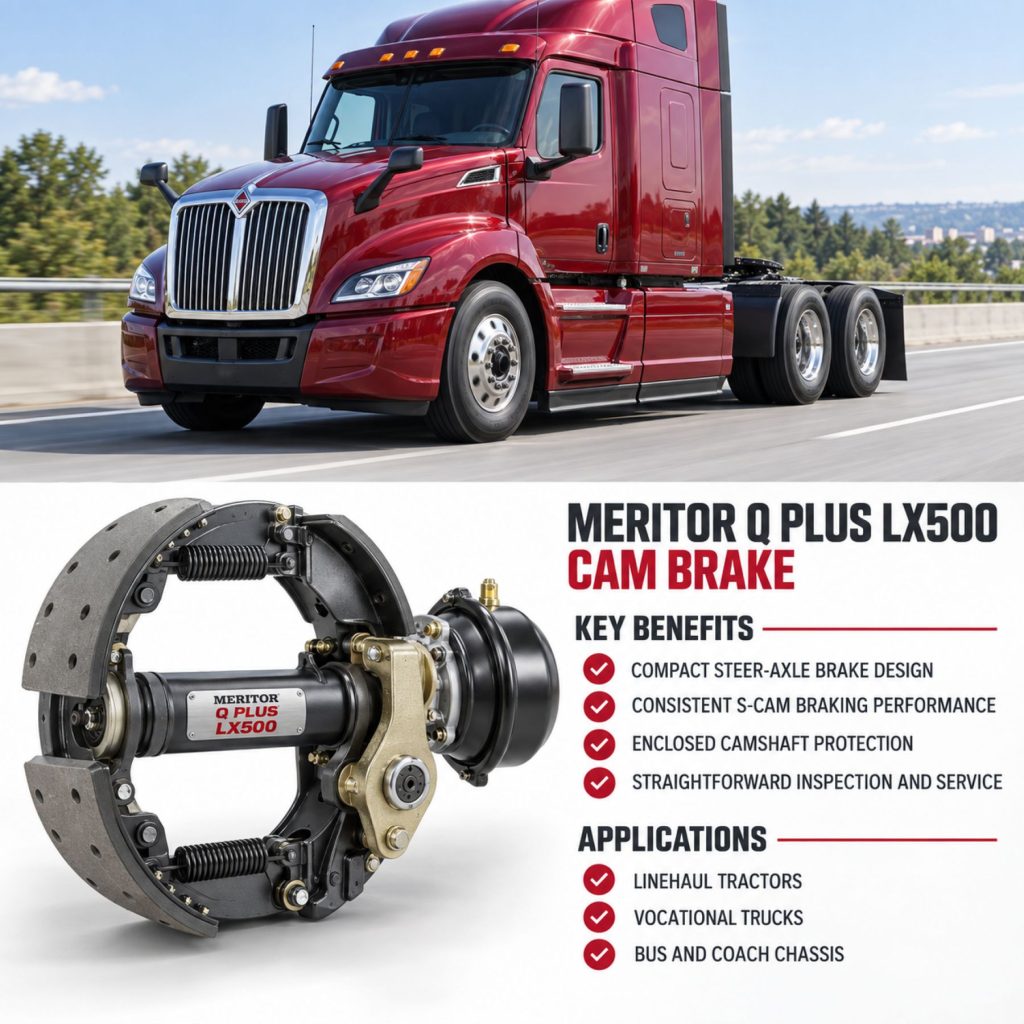
- Primary Positions: Steer and drive axles
- Primary Applications: Line-haul trucks, vocational vehicles, buses, and other heavy commercial vehicles
- Actuation: Air brake chamber, automatic slack adjuster, camshaft, and S-cam
- Adjustment: Factory-installed Meritor automatic slack adjuster
- Lubrication Feature: Extended lubrication intervals for the camshaft and automatic slack adjuster
- Line-Haul Lubrication Interval: Up to three years or 500,000 miles, whichever comes first, under specified operating conditions
- Other-Application Lubrication Interval: One year regardless of mileage
- Primary Benefit: Reduces scheduled lubrication requirements while retaining the familiar Q Plus drum-brake architecture
- Current Brand Ownership: Meritor became part of Cummins in 2022, while Meritor-branded brake products continue to be supported

Overview
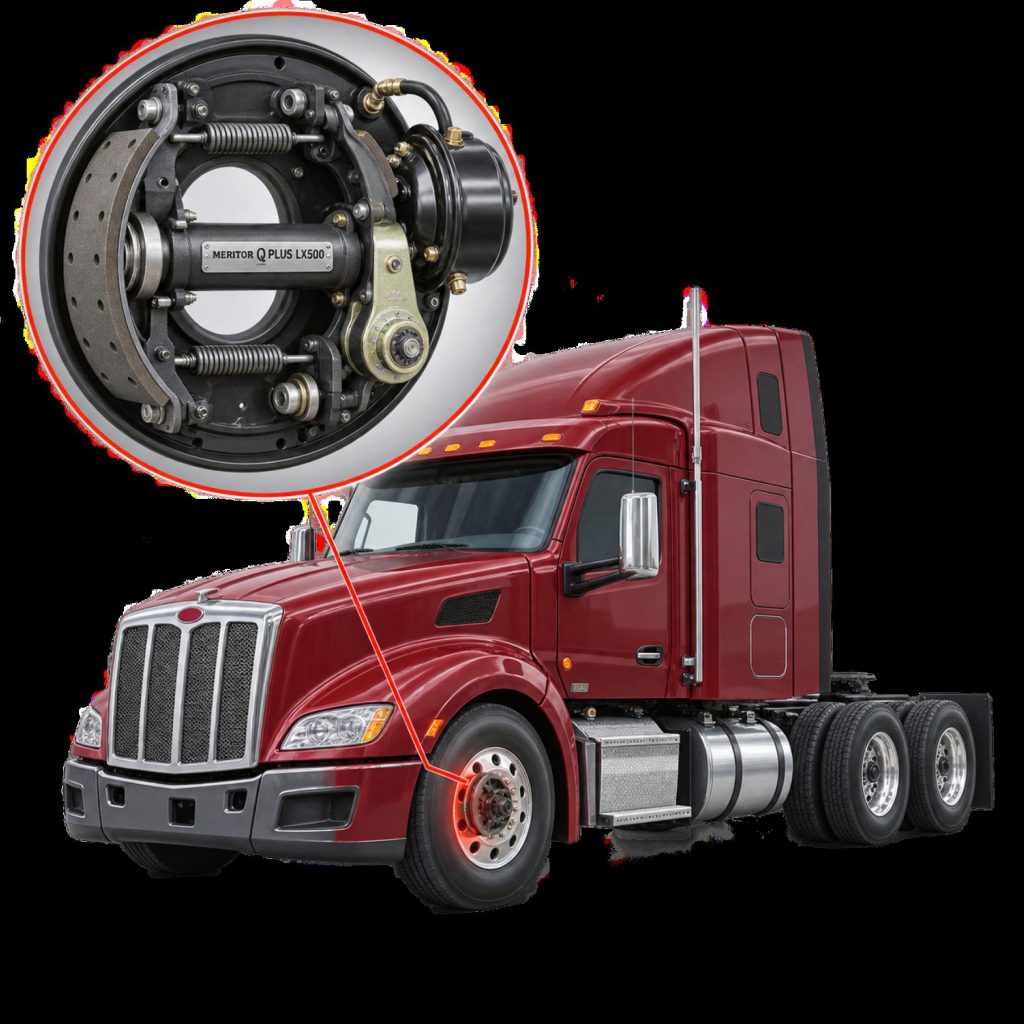
The Meritor Q Plus LX500 Cam Brake is an extended-lubrication version of the company’s Q Plus heavy-duty S-cam drum brake. It combines application-specific Q Plus foundation brakes with factory-installed Meritor automatic slack adjusters and an extended-lubrication package.
The LX500 was designed to reduce routine chassis-lubrication requirements without eliminating normal brake inspection and preventive maintenance. Seals, bushings, synthetic grease, and precision-machined components help retain lubricant while limiting the entry of water and contaminants.
For eligible on-highway line-haul applications, Meritor specifies that the LX500 camshaft and factory-installed automatic slack adjuster do not require periodic lubrication for three years or 500,000 miles, whichever occurs first. For other vehicle applications, the specified lubrication interval is one year regardless of mileage.
These intervals apply to properly identified LX500 packages under the conditions stated in Meritor’s service information. Brake linings, drums, chambers, springs, rollers, air lines, pushrod stroke, and other safety-related components still require regular inspection.
The LX500 should not be confused with the Q Plus MX500. The LX500 primarily adds an extended-lubrication package, while the MX500 combines LX500 components with an extended-maintenance friction package intended for specified on-highway line-haul applications.
Key Characteristics
- Q Plus S-cam drum-brake architecture
- Extended-lubrication cam-brake package
- Factory-installed Meritor automatic slack adjusters
- Special camshaft seals and bushings
- Factory-installed synthetic lubricant
- Plugged lubrication openings during the extended interval
- Identification tag covering the chamber-bracket grease plug
- Reduced scheduled lubrication requirements
- Available for steer- and drive-axle applications
- Multiple brake sizes and lining widths
- Quick-change Q Plus brake shoes
- Replaceable friction linings
- Compatible with commercial-vehicle ABS
- Suitable for line-haul and vocational vehicles
- Established Meritor aftermarket support
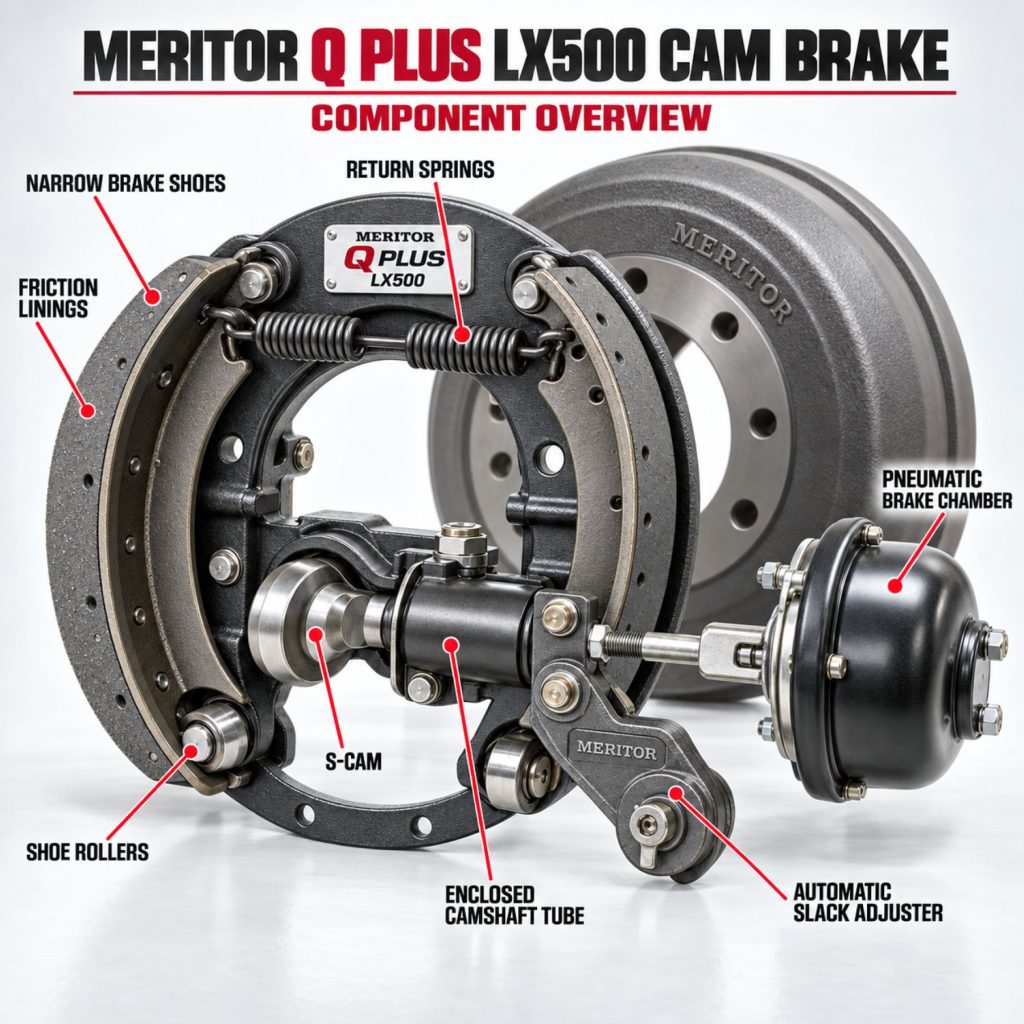
Major Components
- Q Plus brake spider
- Brake shoes
- Friction linings
- Anchor pins
- Anchor-pin bushings
- Brake rollers
- Roller retainers
- Shoe return springs
- Retaining springs
- S-camshaft
- Camshaft bushings
- Extended-lubrication camshaft seals
- Camshaft washers
- Camshaft support bracket
- Plugged lubrication opening
- LX500 identification tag
- Factory-installed synthetic grease
- Meritor automatic slack adjuster
- Threaded or welded clevis
- Brake chamber
- Brake chamber pushrod
- Clevis pin
- Brake drum
- Dust shield when equipped
- Mounting hardware
- ABS wheel-speed sensor
- ABS tone ring
- Wheel hub
- Wheel bearings and seals
How the Brake Component or System Works
When the driver applies the service brakes, compressed air enters the brake chamber. Air pressure moves the diaphragm and chamber pushrod.
The pushrod rotates the factory-installed automatic slack adjuster. The slack adjuster turns the camshaft, causing the S-shaped cam head to move the brake rollers and spread the shoes outward.
The friction linings press against the inside surface of the rotating brake drum. Friction converts the vehicle’s motion into heat, slowing or stopping the wheel.
When the brake is released, air leaves the chamber. Return springs pull the brake shoes away from the drum, and the mechanical components return to their released positions.
The automatic slack adjuster compensates for normal increases in shoe-to-drum clearance. It helps maintain the correct relationship between brake chamber stroke and camshaft movement.
The LX500 extended-lubrication components do not change the basic way the Q Plus brake creates stopping force. Instead, they protect the camshaft, bushings, and automatic slack adjuster so they can operate for longer periods before scheduled lubrication is required.
Position and Function Within the Brake System
The Q Plus LX500 is located at the wheel end and functions as the vehicle’s foundation brake. Depending on its configuration, it can be installed on steer or drive axles.
The complete braking sequence involves:
- The driver applying the brake pedal
- The foot valve creating an air-pressure signal
- Relay or ABS valves directing air to the brake chambers
- Brake chambers extending their pushrods
- Automatic slack adjusters rotating the camshafts
- S-cams spreading the brake shoes
- Friction linings contacting the drums
- Tires transferring braking force to the road
On drive axles equipped with spring-brake chambers, the same foundation-brake components also provide parking and emergency-brake functions.
The LX500 package does not independently regulate air pressure or prevent wheel lockup. Those functions are performed by the vehicle’s pneumatic controls, ABS, stability system, and driver inputs.
Common Specifications
- Brake Type: Pneumatically operated S-cam drum brake
- Product Family: Meritor Q Plus
- Package: LX500 extended-lubrication package
- Steer-Axle Brake Sizes: 15-inch by 4-inch or 15-inch by 5-inch
- Drive-Axle Brake Sizes: 16.5-inch by 7-inch or 16.5-inch by 8-inch
- Additional Drive-Axle Configuration: 15-inch by 8⅝-inch for selected 19.5-inch wheel applications
- Adjustment: Factory-installed Meritor automatic slack adjuster
- Slack-Adjuster Clevis: Threaded or welded, depending on configuration
- Line-Haul Lubrication Interval: Three years or 500,000 miles, whichever comes first
- Other-Application Lubrication Interval: One year regardless of mileage
- Lubricant: Meritor-approved synthetic grease specified in the service literature
- Actuation: Pneumatic brake chamber
- Foundation-Brake Position: Steer or drive axle
- ABS Compatibility: Compatible with properly specified commercial-vehicle ABS
- Friction Material: Application-specific
- Brake Drum: Application-specific commercial brake drum
The specifications above describe established LX500 configurations documented by Meritor. The exact brake size, lining, chamber, camshaft, slack adjuster, drum, axle rating, and lubrication procedure must be confirmed for the individual vehicle.
Operating Specifications and Performance
The LX500 provides the braking characteristics of the Q Plus foundation brake while extending the lubrication interval for the camshaft and automatic slack adjuster.
Under Meritor’s documented service schedule, an eligible on-highway line-haul LX500 installation can operate for three years or 500,000 miles before scheduled lubrication, whichever comes first. Other applications use a one-year interval regardless of mileage.
These extended intervals do not apply universally to every component or operating condition. Fleets must continue inspecting:
- Brake-lining thickness
- Applied pushrod stroke
- Brake-drum condition
- Air chambers
- Return springs
- Brake rollers
- Air hoses and fittings
- Automatic slack-adjuster operation
- Brake balance
- ABS components
Severe operating conditions, contamination, component damage, pressure washing, flooding, or unusual wear may require service before the scheduled interval.
Braking performance depends on brake size, chamber size, effective slack-adjuster length, air pressure, friction material, drum condition, axle loading, and tire traction.
Braking Performance and System Integration
The LX500 must be matched to the vehicle’s complete braking system. Correct brake torque depends on the relationship among the chamber, slack adjuster, camshaft, shoes, friction material, and drum.
All brakes on the same axle should use compatible components and friction materials. Mismatched parts can cause unequal stopping force and temperature differences.
Brake imbalance may result from:
- Different lining formulations
- Unequal pushrod stroke
- Incorrect slack-adjuster lengths
- Different chamber sizes
- Contaminated friction material
- Oversized or damaged drums
- Restricted camshaft movement
- Air-pressure differences
- Uneven axle loading
- ABS or valve problems
The extended-lubrication feature does not correct pneumatic imbalance, worn friction components, or incorrect brake adjustment.
Air Supply, Controls, and Electronic Integration
The Q Plus LX500 relies on the vehicle’s compressed-air system. The air compressor, dryer, reservoirs, valves, lines, chambers, and controls must supply clean air at the required pressure.
The brake can operate with:
- Truck and tractor air-brake systems
- Service brake chambers
- Spring-brake chambers
- Relay valves
- Quick-release valves
- Spring-brake control valves
- Antilock braking systems
- Automatic traction control
- Electronic stability control
- Wheel-speed sensors
ABS monitors wheel speed and adjusts chamber pressure when wheel lockup is detected. It does not mechanically inspect, lubricate, or adjust the LX500 foundation brake.
Stability-control systems may selectively apply individual brakes, but their performance depends on properly maintained foundation brakes, tires, sensors, valves, and electronic controls.
Installation, Adjustment, and Brake Balance
The LX500 must be installed using the brake size, camshaft, chamber, slack adjuster, clevis, and wheel-end components approved for the axle.
Important installation checks include:
- Confirming the brake is an LX500 package
- Verifying the brake size
- Matching the axle and spider
- Identifying camshaft rotation
- Checking camshaft length and spline
- Installing the correct brake shoes
- Matching the friction material
- Installing rollers and springs correctly
- Confirming slack-adjuster length
- Setting the clevis position
- Verifying brake chamber size
- Measuring applied pushrod stroke
- Inspecting the drum
- Checking wheel-end clearance
- Testing automatic slack-adjuster operation
- Confirming balanced braking across the axle
The factory-installed automatic slack adjuster should not be repeatedly adjusted manually to compensate for an unresolved problem.
Meritor specifies that the LX500 brake and slack adjuster should not be lubricated before the designated interval. The identification tag and grease plugs should remain in place during the extended-lubrication period.
Foundation Brake, Axle, and Wheel-End Compatibility
The Q Plus LX500 was offered in several steer- and drive-axle configurations.
Documented steer-axle packages include:
- 15-inch by 4-inch cam brake
- 15-inch by 5-inch cam brake
Documented drive-axle packages include:
- 16.5-inch by 7-inch cam brake
- 16.5-inch by 8-inch cam brake
- 15-inch by 8⅝-inch cam brake for selected 19.5-inch wheel applications
Compatibility depends on:
- Axle manufacturer
- Axle model
- Axle rating
- Brake spider
- Brake diameter
- Lining width
- Camshaft length
- Camshaft rotation
- Camshaft spline
- Automatic slack-adjuster length
- Brake chamber
- Brake drum
- Hub
- Wheel size
- ABS equipment
- Vehicle brake certification
An LX500 package should not be created by adding plugs or removing grease fittings from a standard Q Plus brake. The proper seals, bushings, lubricant, machined components, and factory-installed automatic slack adjuster are part of the complete package.
Common Applications
- On-highway line-haul tractors
- Regional-haul tractors
- Heavy-duty straight trucks
- Delivery trucks
- Vocational trucks
- Dump trucks
- Concrete mixers
- Refuse vehicles
- Construction trucks
- Utility trucks
- Tank trucks
- Municipal vehicles
- School buses
- Transit buses
- Motorcoaches
- Vehicles using 19.5-inch wheel applications
- Commercial vehicles seeking extended lubrication intervals
Vehicle and Brake-System Compatibility
The LX500 must be matched to the vehicle’s axle, brake, wheel-end, and operating application.
Compatibility should be verified using:
- Vehicle manufacturer
- Vehicle identification number
- Vehicle model and model year
- Axle manufacturer
- Axle model and serial number
- Gross axle weight rating
- LX500 identification tag
- Brake diameter and width
- Brake shoe number
- Friction-lining code
- Camshaft number
- Slack-adjuster number
- Clevis type
- Brake chamber size
- Drum number
- Hub configuration
- Wheel size
- ABS configuration
- Vehicle vocation
Similar vehicles may use standard Q Plus, LX500, MX500, or other foundation-brake packages. The model name of the truck alone does not confirm the installed brake.
Advantages
- Extended camshaft lubrication interval
- Extended automatic slack-adjuster lubrication interval
- Reduced scheduled greasing requirements
- Factory-installed automatic slack adjusters
- Special seals help exclude contaminants
- Synthetic grease retained within the assembly
- Precision-machined components
- Familiar Q Plus drum-brake operation
- Multiple steer- and drive-axle configurations
- Suitable for line-haul and vocational applications
- Replaceable brake shoes and friction linings
- Compatible with commercial-vehicle ABS
- Broad Meritor parts support
- Reduced routine maintenance downtime
- Established heavy-duty service history
Limitations or Considerations
- Extended lubrication does not eliminate brake inspection
- Lubrication intervals depend on vehicle application
- Non-line-haul applications use a shorter interval
- Brake linings and drums still require routine inspection
- Identification tags must remain in place
- Grease plugs should not be removed prematurely
- Standard Q Plus parts do not automatically create an LX500 package
- Different LX500 configurations are not universally interchangeable
- Brake drum removal is required for complete internal inspection
- Drums and wheel-end components are heavy
- Repeated braking can produce drum-brake fade
- Contaminated friction material usually requires replacement
- Pushrod stroke must still be measured
- Automatic slack adjusters require functional inspections
- Improper lubrication can damage seals or contaminate linings
- Older installations may require additional parts-identification work
Driver and Operator Experience
A properly maintained LX500 should provide braking performance comparable to an appropriately specified Q Plus drum brake. The primary operational difference is the reduced frequency of scheduled lubrication for the camshaft and automatic slack adjuster.
Drivers are unlikely to notice the extended-lubrication components during normal operation. They should still monitor the vehicle for changes in brake response.
Drivers should report:
- Increased stopping distance
- Vehicle pulling during braking
- Brake grabbing
- Delayed brake release
- Low-air warnings
- ABS warning lamps
- Burning odors
- Wheel-end smoke
- Grinding or scraping
- Unusual air loss
- Parking brakes that do not hold
- Different wheel-end temperatures
- Brake-stroke inspection failures
The extended-lubrication feature should never be interpreted as permission to ignore unusual brake behavior.
Maintenance and Ownership Notes
- Preserve the LX500 identification tag
- Do not lubricate before the specified interval
- Leave grease plugs installed during the extended interval
- Follow the correct line-haul or vocational schedule
- Inspect brake-lining thickness
- Measure applied pushrod stroke
- Inspect brake drums
- Measure drum diameter
- Check drums for cracks and heat damage
- Inspect shoes for contamination
- Check return springs
- Inspect rollers and retainers
- Check anchor pins
- Inspect camshaft movement
- Check extended-lubrication seals
- Inspect automatic slack-adjuster operation
- Check the chamber bracket
- Inspect brake chambers
- Check pushrods, clevises, and pins
- Inspect air hoses and fittings
- Compare wheel-end temperatures
- Inspect ABS sensors and tone rings
- Use Meritor-approved grease when lubrication becomes due
- Follow Meritor Maintenance Manual MM-96173
Common Brake-System Problems
- Excessive pushrod stroke: Worn linings, an oversized drum, incorrect initial adjustment, a damaged automatic slack adjuster, worn camshaft components, or incorrect brake geometry may create excessive stroke.
- Brake dragging: A restricted camshaft, damaged return springs, a binding slack adjuster, distorted shoes, trapped chamber pressure, or contaminated components may prevent complete release.
- Premature lubricant loss: Damaged seals, incorrect components, improper pressure washing, heat damage, contamination, or unauthorized servicing can compromise the extended-lubrication package.
- Water or contamination inside the camshaft assembly: Damaged seals, corrosion, flooding, or incorrect service procedures may allow contaminants to enter.
- Uneven lining wear: Worn anchor pins, damaged rollers, camshaft movement, distorted shoes, drum problems, or incorrect components can prevent even lining contact.
- Brake pulling: Unequal stroke, mismatched friction materials, contaminated linings, different chamber outputs, air-pressure differences, or uneven axle loading may cause side-to-side imbalance.
- Brake fade: Excessive heat produced by repeated applications, overloading, poor brake balance, or improper descent techniques can reduce friction.
- Cracked brake drum: Severe heat, operation beyond the wear limit, overloading, improper wheel installation, or impact damage may crack the drum.
- Automatic slack adjuster repeatedly requires adjustment: Incorrect installation, excessive drum diameter, worn foundation-brake components, chamber-bracket movement, or an internal adjuster problem may be responsible.
- Missing LX500 identification tag: The brake may be difficult to distinguish from another Q Plus package, increasing the risk of an incorrect maintenance procedure.
Safety and Service Precautions
Commercial air-brake systems contain stored pneumatic and mechanical energy. The vehicle must be secured before service begins.
Before servicing an LX500 brake:
- Park on a firm and level surface
- Chock the wheels
- Support raised axles with approved stands
- Drain or isolate air pressure as required
- Cage spring brakes when the procedure requires it
- Never disassemble a spring-brake chamber
- Allow hot drums to cool
- Wear eye and hand protection
- Use approved lifting equipment
- Control brake dust
- Follow specified torque procedures
- Use approved replacement parts
Do not lubricate the LX500 cam brake or automatic slack adjuster before the specified interval. Prematurely removing the identification tag and grease plugs can defeat the maintenance controls intended for the package.
When lubrication becomes due, the technician must follow the approved procedure, install the specified grease fittings, and use Meritor-approved synthetic grease.
The established service procedures are provided in Meritor Maintenance Manual MM-96173, covering the Q Plus LX500 and MX500 cam brakes.
Identification Information
An LX500 can be identified by tags and component features installed at the brake assembly.
Identification features include:
- A brake-shoe tag identifying the brake as Q Plus
- An additional lubrication-information tag attached to the chamber bracket
- A tag covering the plugged chamber-bracket grease opening
- Factory-installed automatic slack adjuster
- Plugged lubrication openings instead of exposed grease fittings during the extended interval
Record the following information:
- Vehicle manufacturer
- Vehicle identification number
- Vehicle model and model year
- Axle manufacturer
- Axle model
- Axle serial number
- Gross axle weight rating
- LX500 identification information
- Brake diameter
- Brake lining width
- Brake shoe number
- Friction-lining code
- Camshaft part number
- Camshaft length
- Camshaft rotation
- Camshaft spline
- Automatic slack-adjuster part number
- Slack-adjuster length
- Clevis type
- Brake chamber manufacturer
- Brake chamber size
- Brake drum part number
- Hub configuration
- Wheel size
- ABS configuration
The identification tag should not be removed until the maintenance procedure calls for accessing the lubrication opening.
Buying Considerations
- Confirm that the brake is an LX500
- Check for the lubrication-information tag
- Identify the axle model and serial number
- Verify steer- or drive-axle position
- Confirm brake diameter
- Confirm lining width
- Match brake shoe geometry
- Verify friction-lining material
- Identify camshaft rotation
- Confirm camshaft length and spline
- Match the automatic slack adjuster
- Identify the clevis type
- Confirm brake chamber size
- Check brake-drum condition
- Inspect camshaft seals and bushings
- Determine the vehicle’s application
- Confirm the correct lubrication interval
- Check whether the extended interval has expired
- Use Meritor-approved replacement components
- Consult the current service literature
Variants and Configurations
- 15-inch by 4-inch steer-axle brake
- 15-inch by 5-inch steer-axle brake
- 16.5-inch by 7-inch drive-axle brake
- 16.5-inch by 8-inch drive-axle brake
- 15-inch by 8⅝-inch drive-axle brake
- 19.5-inch wheel application
- On-highway line-haul configuration
- Vocational configuration
- Bus application
- Threaded-clevis automatic slack adjuster
- Welded-clevis automatic slack adjuster
- Left-hand camshaft
- Right-hand camshaft
- Different friction-material packages
- Different brake chambers
- Different axle ratings
- ABS-equipped configuration
- Application-specific brake drums
Comparison to Similar Equipment
Compared with the Meritor Q Plus Cam Brake, the LX500 adds a factory-engineered extended-lubrication package and factory-installed Meritor automatic slack adjusters. A standard Q Plus brake may follow conventional lubrication intervals.
Compared with the Meritor Q Plus MX500, the LX500 concentrates on extended camshaft and slack-adjuster lubrication. The MX500 adds proprietary extended-maintenance friction material and was designed specifically for eligible on-highway line-haul applications.
Compared with the Meritor EX+ LS Air Disc Brake, the LX500 uses shoes pressing against a drum. The EX+ LS uses a caliper and brake pads that clamp a disc rotor.
Compared with the Hendrickson MAXX22T Trailer Air Disc Brake, the LX500 is primarily documented in steer- and drive-axle truck configurations. The MAXX22T is designed for trailer air-disc-brake applications.
Compared with a conventional greasable S-cam brake, the LX500 can reduce scheduled lubrication downtime. It still requires complete brake inspections and proper service once the extended interval is reached.
Best Fit For
- Vehicles originally equipped with LX500 brakes
- On-highway line-haul tractors
- Regional-haul trucks
- Heavy-duty straight trucks
- Vocational vehicles
- Commercial buses
- Fleets seeking reduced lubrication downtime
- High-mileage operations
- Vehicles using factory-installed Meritor slack adjusters
- Fleets with documented preventive-maintenance programs
- Operators able to track time and mileage intervals
- Applications requiring proven Q Plus drum-brake operation
Related Vehicle and Trailer Types
- Complete Guide to Semi Truck Types
- Class 6 vs Class 7 vs Class 8 Trucks
- Class 7 trucks
- Class 8 trucks
- Sleeper tractors
- Day cab tractors
- Vocational trucks
- Dump trucks
- Concrete mixers
- Refuse trucks
- Tank trucks
- School buses
- Transit buses
- Motorcoaches
- Municipal vehicles
- Specialty commercial vehicles
Related Truck and Trailer Models
- Freightliner Cascadia
- Freightliner 114SD
- Kenworth T680
- Kenworth T880
- Peterbilt 579
- Peterbilt 567
- Mack Anthem
- Mack Granite
- Volvo VNL
- Volvo VHD
- International LT Series
- International HX Series
- Western Star 47X
- Western Star 49X
Related Brake System Types
- Brake Systems
- Air Brake Systems
- Drum Brake Systems
- Brake Chambers & Actuators
- ABS & Electronic Braking Systems
- S-cam foundation brakes
- Extended-lubrication brakes
- Service-brake systems
- Spring parking brakes
- Automatic slack-adjuster systems
Related Brake Products
- Meritor Q Plus Cam Brake
- Meritor EX+ LS Air Disc Brake
- Hendrickson MAXX22T Trailer Air Disc Brake
- Bendix ADB22X Air Disc Brake
- Bendix ADB22X-LT Air Disc Brake
- Haldex ModulT Air Disc Brake
- ZF WABCO MAXXUS L2.0 Air Disc Brake
- Bendix SR-7 Spring Brake Modulating Valve
- Meritor automatic slack adjusters
- Commercial brake chambers
- Commercial brake drums
- Q Plus brake shoes
- ABS modulator valves
Related Equipment Systems
- Equipment Systems
- Axles & Differentials
- Suspension Systems
- Tires & Wheels
- Compressed-air systems
- Steer axles
- Drive axles
- Wheel-end systems
- Vehicle stability systems
Related Guides
- Brake System Guides
- Air Brake Systems Explained
- Air Disc Brakes vs Drum Brakes
- How to Inspect and Maintain Commercial Truck Brakes
- How Truck ABS and Electronic Stability Control Work
- Commercial Truck Brake Components Explained
Regulatory and Compliance Notes
Commercial-vehicle brakes must meet applicable inspection, stopping-distance, and vehicle-safety requirements. The LX500 designation does not change the legal requirement to inspect and maintain the complete braking system.
Inspectors may evaluate:
- Applied pushrod stroke
- Brake adjustment
- Lining thickness
- Brake-drum condition
- Chamber condition
- Air leakage
- Automatic slack-adjuster operation
- Missing or damaged components
- Friction-material contamination
- ABS warning-lamp operation
- Parking-brake performance
A vehicle may be placed out of service if brake stroke exceeds the applicable limit or if required components are broken, missing, loose, contaminated, or worn beyond allowable specifications.
The brake chamber, slack-adjuster length, friction material, drum, and foundation-brake dimensions must remain consistent with the vehicle’s approved braking configuration.
Real World Operating Notes
The LX500 identification tag is essential because the assembly may resemble a conventional Q Plus brake. Removing the tag too early can cause technicians to apply the wrong lubrication schedule.
The absence of exposed grease fittings during the extended interval is intentional. Technicians should not modify the assembly simply because conventional fittings are not visible.
Line-haul and vocational intervals differ. Fleets must determine the actual vehicle application instead of automatically using the 500,000-mile interval.
Once the extended interval expires, the grease plugs are removed, specified fittings are installed, and approved lubricant is applied according to the service procedure.
Extended lubrication applies to the camshaft and automatic slack adjuster. It does not extend lining, drum, chamber, hose, or brake-inspection limits.
If an automatic slack adjuster repeatedly requires manual adjustment, the underlying brake problem should be diagnosed instead of repeatedly resetting the adjuster.
Frequently Asked Questions
What is the Meritor Q Plus LX500?
The LX500 is a Q Plus S-cam drum-brake package equipped with extended-lubrication camshaft components and factory-installed Meritor automatic slack adjusters.
How is the LX500 different from a standard Q Plus brake?
The LX500 uses special seals, bushings, synthetic grease, precision components, grease plugs, and factory-installed automatic slack adjusters to provide extended lubrication intervals.
What is the LX500 lubrication interval?
For specified on-highway line-haul applications, the interval is three years or 500,000 miles, whichever comes first. For other applications, it is one year regardless of mileage.
Does the extended interval eliminate brake maintenance?
No. Brake linings, drums, chambers, pushrod stroke, springs, rollers, air lines, ABS components, and overall brake operation still require scheduled inspection.
Should the LX500 be greased during routine chassis lubrication?
Not before its specified interval. The LX500 brake and automatic slack adjuster use plugged lubrication openings during the extended period.
How can an LX500 brake be identified?
Look for the Q Plus shoe tag and the additional lubrication-information tag attached to the chamber bracket over the plugged grease opening.
What brake sizes were offered?
Documented configurations include 15-inch by 4-inch and 15-inch by 5-inch steer brakes, 16.5-inch by 7-inch and 16.5-inch by 8-inch drive brakes, and a 15-inch by 8⅝-inch drive brake for selected 19.5-inch wheel applications.
Is the LX500 the same as the MX500?
No. Both include extended-lubrication components, but the MX500 also uses a proprietary extended-maintenance friction package for specified line-haul applications.
Does the LX500 use an automatic slack adjuster?
Yes. The package includes a factory-installed Meritor automatic slack adjuster with a threaded or welded clevis, depending on configuration.
Why should an automatic slack adjuster not be repeatedly adjusted manually?
Repeated loss of adjustment may indicate worn components, an oversized drum, incorrect installation, a damaged adjuster, or another foundation-brake problem.
Can a standard Q Plus brake be converted into an LX500?
The LX500 depends on a complete package of seals, bushings, lubricant, precision components, plugs, identification, and a factory-installed slack adjuster. A standard brake should not be treated as an LX500 without an approved Meritor procedure.
How can the correct replacement parts be identified?
Use the vehicle VIN, axle model and serial number, LX500 tag, brake size, shoe and lining numbers, camshaft information, slack-adjuster number, clevis type, chamber size, and drum number.
Availability and Where to Find
Q Plus LX500 replacement components may be available through Cummins and Meritor distributors, commercial-truck dealers, heavy-duty parts suppliers, brake specialists, fleet-maintenance providers, and authorized service facilities.
Because many LX500 installations may now be found on older vehicles, buyers should confirm whether individual parts have been superseded or included in updated service kits.
Available components may include brake shoes, friction linings, hardware kits, rollers, return springs, camshafts, bushings, seals, automatic slack adjusters, chambers, brake drums, and wheel-end parts.
Current Meritor product information and technical resources are available through the Cummins Drivetrain and Braking Systems website and the Meritor brake-products section.
Support Trucking Families
Truck Equipment Atlas supports the mission of Grey Cross, a nonprofit dedicated to helping families of truck drivers who lose their lives while on the road. As the site grows, part of its mission is to bring awareness and support to these families.
Podcast or Video Section
Learn More Through Audio and Video
Truck Equipment Atlas will continue expanding with podcast episodes, interviews, and equipment breakdowns to help drivers and fleets better understand trucks and equipment.
Follow the Growth of Truck Equipment Atlas
Truck Equipment Atlas continues to expand with new truck profiles, trailer coverage, diesel engine pages, equipment system resources, manufacturer information, and educational guides.
Visit our Site Updates page to explore recent additions, project milestones, and upcoming resources as we continue building one of the industry’s growing commercial trucking equipment reference libraries.
View the Latest Site Updates: Truck Equipment Atlas Site Updates