
Gunite 3600A Brake Drum
Quick Facts
- Manufacturer: Gunite
- Current Manufacturer: Rockford Brake Manufacturing
- Product Model: 3600A
- Product Type: Heavy-duty commercial-vehicle brake drum
- Brake Category: S-cam drum-brake component
- Brake Size: 16.5 inches by 7 inches
- Brake-Surface Width: 7.60 inches
- Mounting Type: Outboard or hub-piloted mounting
- Wheel Type: Disc wheel
- Pilot Diameter: 8.78 inches
- Bolt-Circle Diameter: 11.25 inches
- Bolt Pattern: 10 holes
- Bolt-Hole Diameter: 1.00 inch
- Approximate Drum Weight: 112 pounds
- Application Rating: Up to 26,000-pound gross axle weight rating in approved applications
- Balanced Version: 3600AX
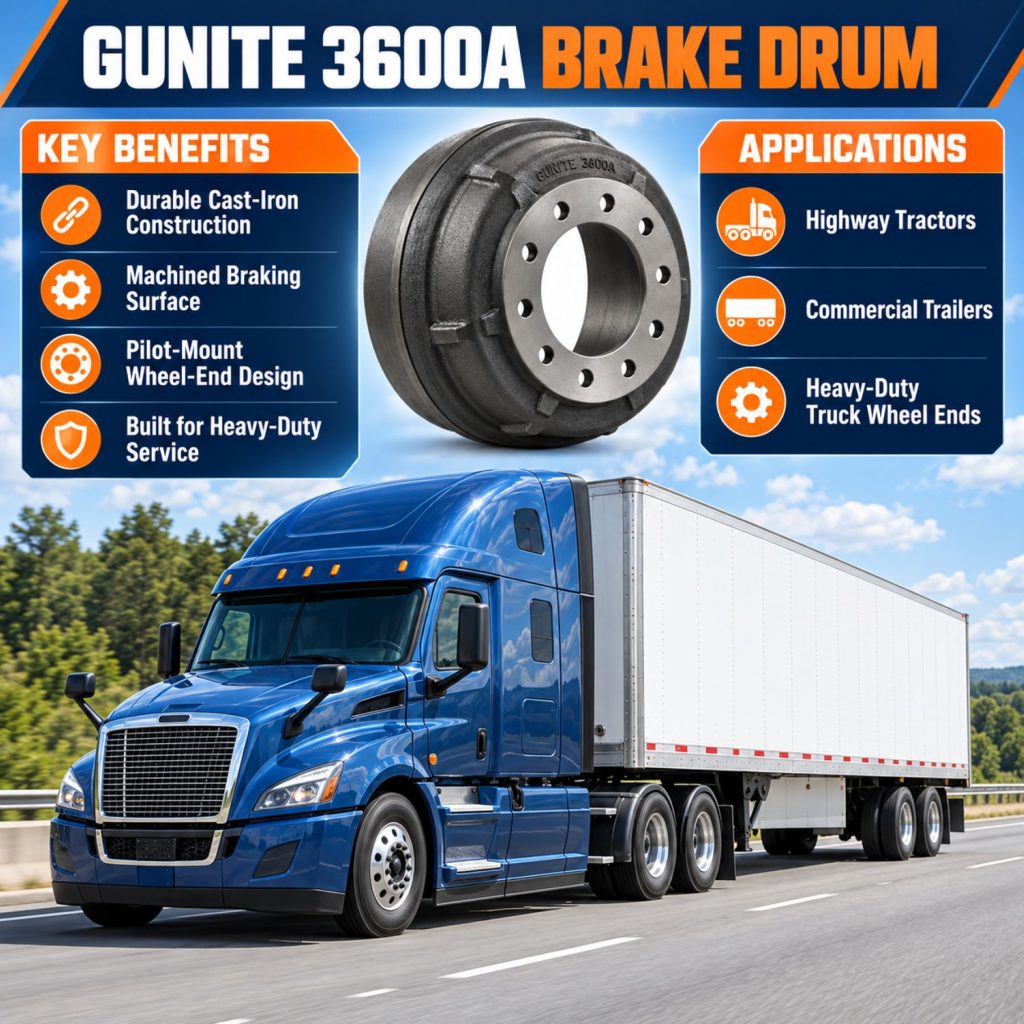
- Primary Applications: Heavy-duty trucks, tractors, trailers, buses, and vocational vehicles
- Primary Benefit: OEM-grade durability and broad compatibility with common 16.5-by-7-inch commercial drum brakes
Overview
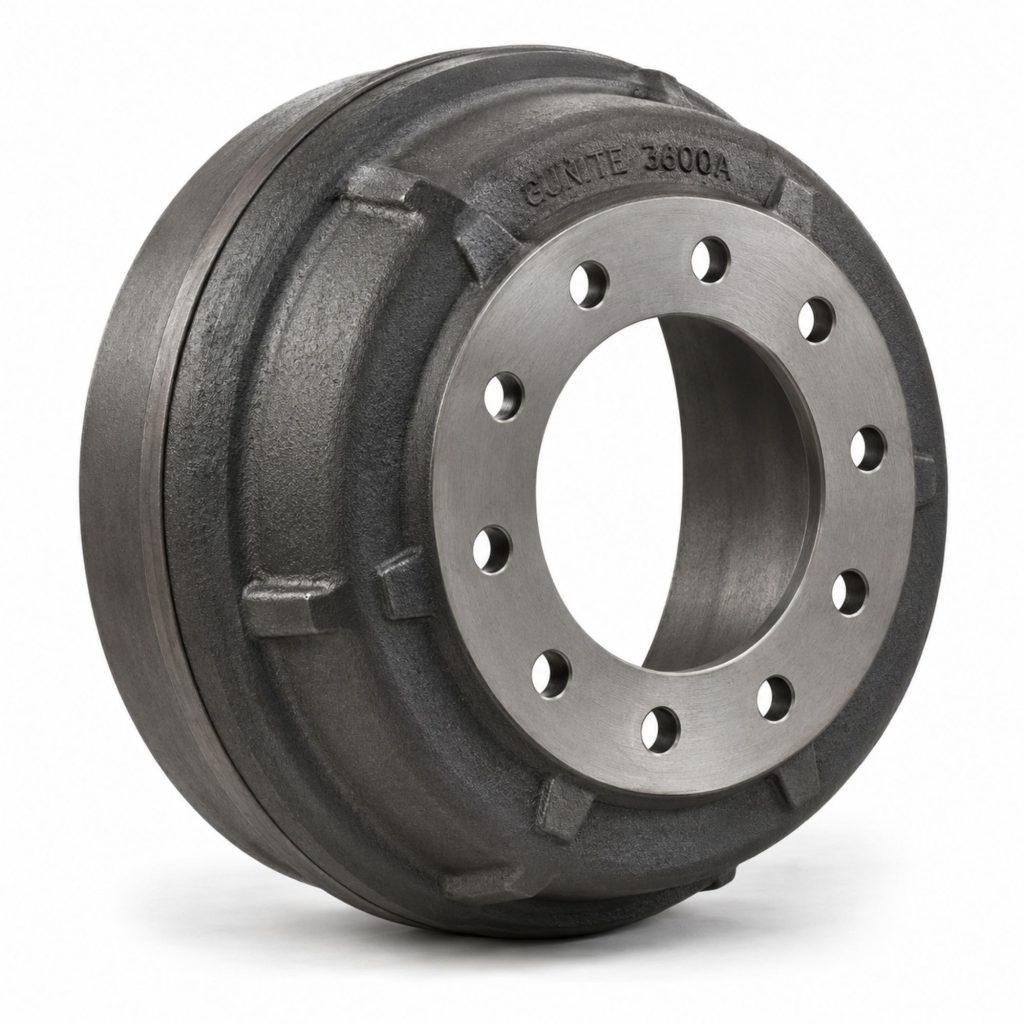
The Gunite 3600A is a full-cast commercial brake drum designed for 16.5-by-7-inch heavy-duty S-cam foundation brakes. It is widely used on truck, tractor, trailer, bus, and vocational-vehicle wheel ends.
The drum surrounds the brake shoes and provides the internal friction surface against which the linings press. During braking, friction between the linings and drum converts vehicle movement into heat.
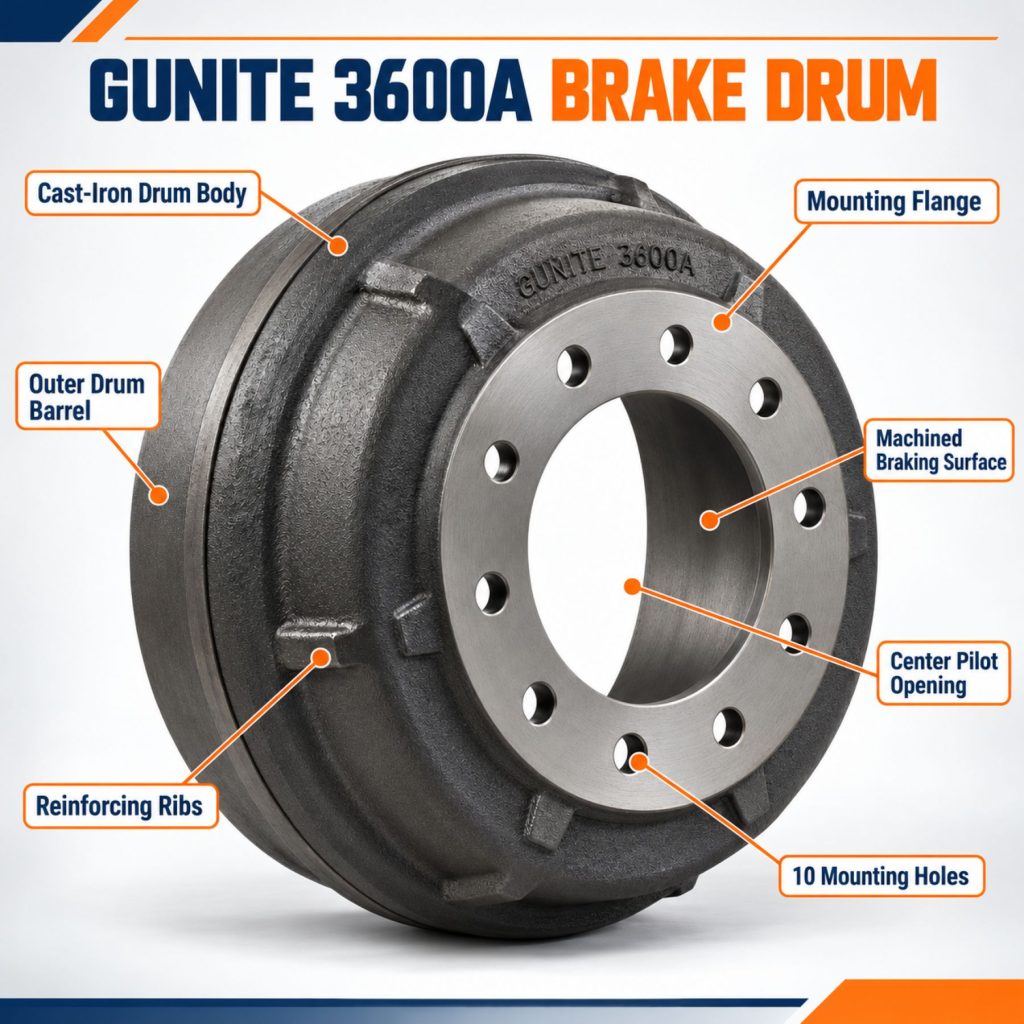
The 3600A uses an outboard, hub-piloted mounting arrangement with a 10-hole pattern, 1.00-inch bolt holes, an 11.25-inch bolt circle, and an 8.78-inch pilot diameter. Gunite lists the drum at approximately 112 pounds.
Gunite identifies the 3600A as an industry-standard brake drum and states that it has been tested and approved with common Reduced Stopping Distance friction linings. It is available for original-equipment and aftermarket applications.
Rockford Brake Manufacturing currently produces Gunite brake drums using established Gunite tooling and manufacturing processes. The company identifies itself as the exclusive source for Gunite’s 3600 and 3922 industry-standard drum products. Gunite brake-drum manufacturing information
Key Characteristics
- 16.5-by-7-inch brake size
- Full-cast commercial brake drum
- Outboard mounting configuration
- Hub-piloted wheel-end compatibility
- 10-hole mounting pattern
- 1.00-inch bolt holes
- 11.25-inch bolt circle
- 8.78-inch pilot diameter
- Approximately 112-pound drum weight
- Rated for approved applications up to 26,000-pound GAWR
- Compatible with common heavy-duty S-cam brakes
- Tested with Reduced Stopping Distance linings
- Available for original-equipment and aftermarket service
- Optional factory-balanced 3600AX version
- Made using established Gunite tooling and processes
- Designed for heavy-duty commercial service
Major Components
- Cylindrical drum body
- Internal braking surface
- Open drum end
- Closed mounting face
- Mounting flange
- Hub pilot
- Ten mounting holes
- Ventilation opening
- Cast reinforcement sections
- Machined friction surface
- Machined pilot surface
- Machined mounting surface
- Casting identification
- Finished part-number identification
- Balance correction on applicable versions
How the Brake Component or System Works
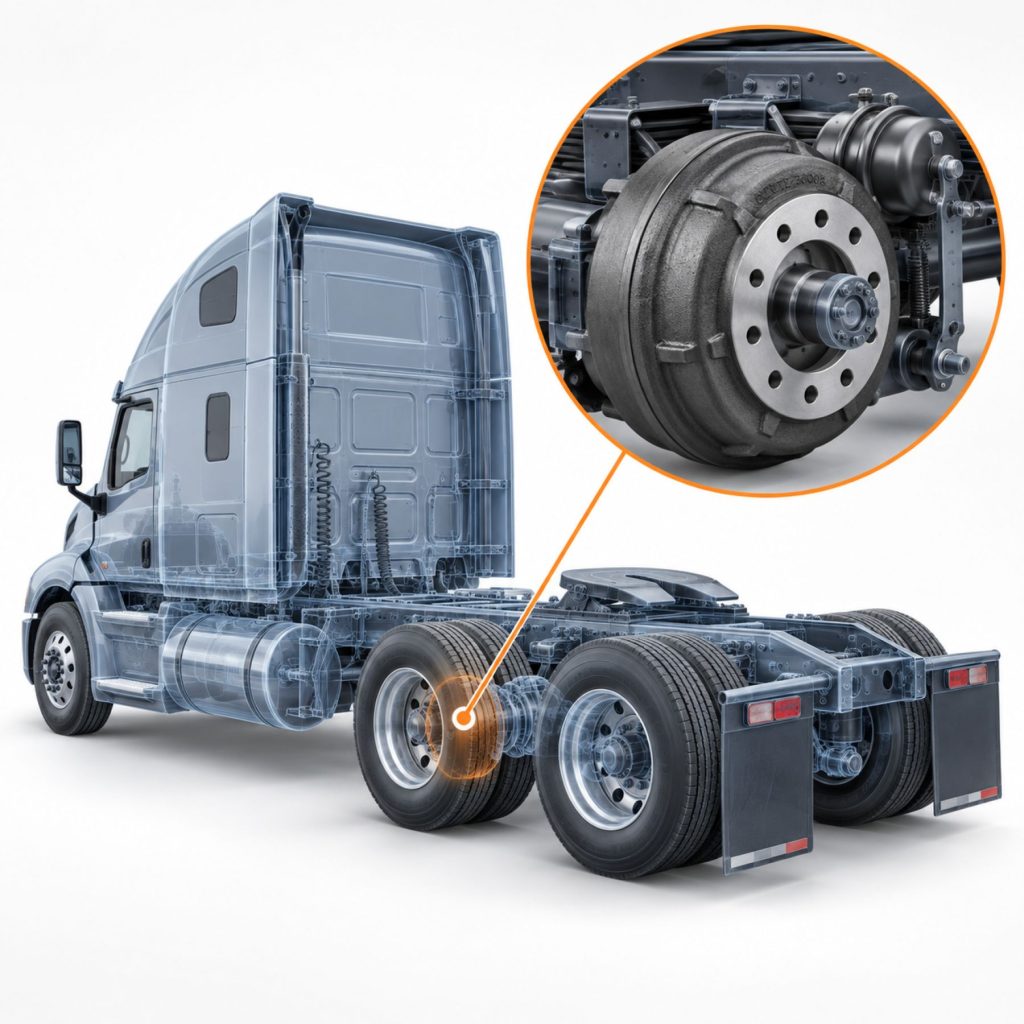
The 3600A rotates with the vehicle’s wheel and hub. When the driver applies the brakes, compressed air enters the brake chamber and moves its pushrod.
The pushrod rotates the slack adjuster and camshaft. The S-cam spreads the brake shoes outward until their friction linings contact the drum’s internal braking surface.
Friction between the stationary linings and rotating drum slows the wheel. The energy produced by the moving vehicle is converted into heat and absorbed by the drum, linings, hub, wheel, and surrounding air.
When the brake releases, return springs pull the shoes away from the drum. The drum continues rotating without intentional friction contact.
The 3600A does not create or control braking force by itself. Its performance depends on the condition and specification of the entire foundation brake, including the shoes, friction material, rollers, camshaft, slack adjuster, chamber, hub, and air system.
Position and Function Within the Brake System
The Gunite 3600A is installed at the wheel end over a compatible 16.5-by-7-inch S-cam foundation brake. It mounts to the hub and rotates with the wheel.
Its primary functions include:
- Providing the friction surface for the brake linings
- Absorbing heat generated during braking
- Transferring braking torque through the hub and wheel end
- Enclosing and protecting much of the foundation-brake assembly
- Supporting consistent shoe-to-drum contact
- Maintaining the required dimensional relationship with the brake shoes
The drum must remain properly centered on the hub. Excessive runout, an incorrect pilot diameter, damaged mounting surfaces, or improper wheel installation can create vibration, uneven wear, and braking problems.
Common Specifications
- Part Number: 3600A
- Balanced Part Number: 3600AX
- Brake Size: 16.5 inches by 7.00 inches
- Nominal Braking Diameter: 16.5 inches
- Brake-Surface Width: 7.60 inches
- Pilot Diameter: 8.78 inches
- Bolt-Circle Diameter: 11.25 inches
- Number of Bolt Holes: 10
- Bolt-Hole Diameter: 1.00 inch
- Wheel Type: Disc wheel
- Mounting Type: Outboard or hub-piloted mounting
- Approximate Weight: 112 pounds
- Application Rating: Up to 26,000-pound GAWR in approved configurations
- Foundation-Brake Compatibility: Application-specific 16.5-by-7-inch S-cam brakes
- RSD Compatibility: Tested and approved with common Reduced Stopping Distance linings
- Material: Application-engineered cast iron
- Market Position: Original-equipment and aftermarket replacement drum
Published specifications should be confirmed against the current Gunite catalog and the exact vehicle, axle, hub, wheel, and foundation-brake assembly before installation.
Operating Specifications and Performance
The 3600A absorbs and releases the heat generated during braking. Its thermal capacity, wall thickness, material consistency, mounting accuracy, and friction-surface condition directly influence brake performance.
Gunite lists the 3600A as a 112-pound full-cast drum for applications rated up to 26,000 pounds GAWR. This rating does not automatically establish the axle’s allowable capacity. The axle, suspension, hubs, bearings, wheels, tires, brakes, and vehicle certification must all support the intended rating.
Brake-drum performance is influenced by:
- Vehicle and axle weight
- Vehicle speed
- Brake-application frequency
- Length and grade of descents
- Brake-lining formulation
- Shoe-to-drum contact
- Applied pushrod stroke
- Air pressure
- Brake balance
- Drum diameter
- Drum temperature
- Wheel-end installation
- Tire traction
The drum should be inspected according to its service limits. Continued use after the maximum allowable diameter is reached can reduce strength, increase chamber stroke, and alter braking performance.
Braking Performance and System Integration
The 3600A must be used as part of a correctly matched 16.5-by-7-inch foundation-brake system. The drum, shoes, friction material, camshaft, chamber, and slack adjuster work together to produce the required braking torque.
Gunite states that the 3600A has been tested and approved with widely used Reduced Stopping Distance linings. However, RSD compliance applies to the certified braking system—not to the drum by itself.
Improperly matched components can cause:
- Reduced braking force
- Increased stopping distance
- Excessive drum temperature
- Uneven lining wear
- Brake pulling
- Brake fade
- Excessive pushrod stroke
- Drum cracking
- Premature ABS intervention
The correct friction material should be installed on both wheel ends of an axle. Brake drums should also have comparable dimensions and condition across the axle.
Air Supply, Controls, and Electronic Integration
The 3600A is a mechanical wheel-end component and has no electrical or pneumatic connections. It responds to braking force created by the air chamber and foundation-brake mechanism.
It can operate within brake systems equipped with:
- Service brake chambers
- Spring-brake chambers
- Manual slack adjusters
- Automatic slack adjusters
- Antilock braking systems
- Automatic traction control
- Electronic stability control
- Trailer roll-stability systems
- Wheel-speed sensors
- Electronic brake-stroke monitoring
ABS and stability systems regulate pneumatic pressure, but they cannot compensate for a cracked, oversized, contaminated, distorted, or improperly installed brake drum.
Electronic systems may reduce wheel lockup and improve stability, but the drum and friction components must remain within their mechanical service limits.
Installation, Adjustment, and Brake Balance
The 3600A must fit the hub pilot, bolt pattern, brake shoes, axle, and wheel-end arrangement correctly. Mounting surfaces should be clean, flat, and free of damage.
Important installation checks include:
- Confirming the complete 3600A part number
- Checking for a suffix after the basic number
- Verifying the 16.5-by-7-inch brake size
- Confirming the 8.78-inch pilot
- Confirming the 11.25-inch bolt circle
- Verifying the 10-hole pattern
- Confirming the 1.00-inch bolt holes
- Inspecting the hub pilot
- Cleaning mating surfaces
- Inspecting wheel studs
- Checking drum diameter
- Inspecting the friction surface
- Confirming shoe and lining compatibility
- Checking wheel and drum clearance
- Following the proper wheel-nut sequence
- Tightening fasteners to the vehicle manufacturer’s specification
- Measuring pushrod stroke after assembly
- Checking brake balance across the axle
The wheel should not be used to force an incorrect or damaged drum onto the hub. Improper seating can create runout, wheel-end looseness, vibration, and component failure.
Foundation Brake, Axle, and Wheel-End Compatibility
The 3600A is intended for selected heavy-duty wheel ends using 16.5-by-7-inch S-cam foundation brakes and hub-piloted disc wheels.
Compatibility depends on:
- Axle manufacturer
- Axle model
- Gross axle weight rating
- Hub model
- Hub pilot diameter
- Bolt-circle diameter
- Number of wheel studs
- Stud diameter
- Brake-spider position
- Brake-shoe width
- Drum offset
- Wheel size
- Wheel offset
- Tire configuration
- ABS tone-ring position
- Original brake certification
The 3600A may be used on drive or trailer axles in appropriate configurations. Fitment should be confirmed through the current Gunite catalog or an approved cross-reference using the original finished drum number.
The casting number alone may not identify every machined feature. Gunite warns that suffixes following the basic drum number are important because they can indicate dimensional, mounting, or balancing differences.
Common Applications
- Class 7 trucks
- Class 8 trucks
- Line-haul tractors
- Regional-haul tractors
- Heavy-duty straight trucks
- Dump trucks
- Concrete mixers
- Refuse trucks
- Construction vehicles
- Logging trucks
- Heavy-haul vehicles
- Tank trucks
- Municipal vehicles
- School buses
- Transit buses
- Motorcoaches
- Dry van trailers
- Refrigerated trailers
- Flatbed trailers
- Tank trailers
- Dump trailers
- Hopper trailers
- Container chassis
- Specialty commercial vehicles
Vehicle and Brake-System Compatibility
The Gunite 3600A fits a common North American commercial-vehicle wheel-end pattern, but its physical dimensions must be verified for every application.
Compatibility should be established using:
- Vehicle identification number
- Truck or trailer manufacturer
- Vehicle model and model year
- Axle manufacturer
- Axle model and serial number
- Gross axle weight rating
- Hub part number
- Original brake-drum number
- Finished Gunite part number
- Brake diameter
- Brake-shoe width
- Pilot diameter
- Bolt-circle diameter
- Bolt-hole size
- Drum offset
- Wheel size and offset
- ABS configuration
A 16.5-by-7-inch description alone is not enough to confirm fitment. Commercial brake drums can share the same brake size while using different pilots, bolt holes, bolt circles, offsets, mounting arrangements, and weight ratings.
Advantages
- Industry-standard commercial brake drum
- OEM and aftermarket availability
- Common 16.5-by-7-inch brake size
- Full-cast construction
- Up to 26,000-pound GAWR application coverage
- Tested with common RSD linings
- Broad heavy-duty vehicle compatibility
- Durable friction surface
- Consistent manufacturing dimensions
- Outboard mounting arrangement
- Common hub-piloted bolt pattern
- Available in a factory-balanced version
- Established fleet service history
- Domestic casting and machining
- Supported by current Gunite manufacturing
Limitations or Considerations
- Approximately 112 pounds per drum
- Heavier than lightweight brake-drum alternatives
- Drum removal is required for complete brake inspection
- Retains more heat than an exposed disc rotor
- Can experience brake fade during excessive heating
- Must be replaced when worn beyond service limits
- Can crack after severe thermal or mechanical stress
- Incorrect wheel installation can distort the drum
- Casting identification may not equal the finished part number
- Suffixes can indicate important product differences
- Not every 16.5-by-7-inch brake accepts the 3600A
- Brake dust accumulates inside the drum
- Contaminated friction surfaces require correction
- Requires appropriate lifting and handling equipment
- Does not independently establish vehicle or axle capacity
Driver and Operator Experience
Drivers should experience normal heavy-duty S-cam drum-brake operation when the 3600A is properly matched and maintained. Brake feel depends on the complete vehicle, air system, friction material, adjustment, loading, and temperature.
Drum-brake response may change as temperature increases. Long grades and repeated brake applications can generate enough heat to reduce friction and increase stopping distance.
Drivers should report:
- Increased stopping distance
- Vehicle pulling during braking
- Brake grabbing
- Pulsation or vibration
- Burning odors
- Wheel-end smoke
- Grinding or scraping
- Low-air warnings
- ABS warning lamps
- Brakes that release slowly
- Unusual wheel-end heat
- Parking brakes that do not hold
- Repeated brake-adjustment problems
A vehicle with a visibly cracked drum, wheel-end smoke, or extreme brake temperature should be removed from service and inspected.
Maintenance and Ownership Notes
- Inspect the drum at scheduled intervals
- Measure the internal drum diameter
- Check for visible cracks
- Inspect for heat checking
- Check for blue or discolored areas
- Inspect for hard spots
- Check for scoring and grooving
- Inspect for out-of-round wear
- Check mounting surfaces
- Inspect the pilot area
- Check bolt holes
- Inspect wheel studs
- Clean rust and debris from mating surfaces
- Inspect brake shoes and linings
- Check friction material for contamination
- Measure applied pushrod stroke
- Inspect slack-adjuster operation
- Check camshaft and rollers
- Inspect wheel bearings and seals
- Check for lubricant leakage
- Compare drum temperatures across the axle
- Follow the published discard dimensions
- Replace damaged drums
- Record drum measurements during service
Common Brake-System Problems
- Cracked drum: Excessive heat, severe braking, overloading, operation beyond the wear limit, improper wheel installation, or physical damage may cause cracks.
- Heat checking: Repeated heating and cooling can produce small surface cracks. The drum must be evaluated using the manufacturer’s inspection criteria.
- Out-of-round drum: Uneven heating, improper storage, incorrect installation, loose wheel fasteners, or excessive wear may distort the drum.
- Brake pulsation: Drum runout, out-of-round wear, hard spots, wheel-end looseness, or uneven mounting can create pulsation during braking.
- Deep scoring: Worn linings, exposed rivets, debris, damaged shoes, or continued operation after the friction material is exhausted can score the braking surface.
- Glazed braking surface: Excessive heat, light repeated brake applications, or incompatible friction material can create a polished surface and reduce friction.
- Brake fade: High drum and lining temperatures can temporarily reduce braking effectiveness.
- Uneven lining wear: Drum distortion, incorrect shoe geometry, worn rollers, camshaft movement, or foundation-brake problems may prevent full lining contact.
- Excessive pushrod stroke: Worn linings, an oversized drum, incorrect adjustment, worn camshaft components, or automatic slack-adjuster problems can increase stroke.
- Wheel-end vibration: An unbalanced drum, improper seating, damaged pilot, loose fasteners, tire imbalance, or hub problems may create vibration.
- Drum will not seat correctly: Rust, debris, damaged mating surfaces, the wrong pilot diameter, an incorrect bolt pattern, or an incompatible part may prevent installation.
Safety and Service Precautions
Brake drums are heavy and can cause serious injury if dropped or handled incorrectly. Appropriate lifting devices and safe work procedures should be used.
Before servicing the wheel end:
- Park on a firm and level surface
- Chock the wheels
- Release or cage spring brakes as required
- Drain or isolate air pressure
- Support raised axles with approved stands
- Allow hot brakes to cool naturally
- Wear eye, hand, and foot protection
- Use suitable drum-handling equipment
- Control brake dust
- Follow approved wheel-removal procedures
- Inspect lifting equipment before use
- Follow specified fastener torques
Never work beneath a vehicle supported only by a jack. Never disassemble a spring-brake chamber.
Hot brake drums should not be rapidly cooled with water. Sudden cooling can create thermal stress and may damage the drum.
Brake dust should not be blown from the assembly with compressed air. Approved cleaning and containment procedures should be followed.
Identification Information
Gunite explains that the casting identification on a brake drum does not always represent the complete finished part number. Machining and balancing variations may be identified by suffix letters.
Record the following information:
- Vehicle manufacturer
- Vehicle identification number
- Vehicle model and model year
- Axle manufacturer
- Axle model
- Axle serial number
- Gross axle weight rating
- Hub part number
- Original drum part number
- Gunite casting number
- Complete Gunite finished part number
- Part-number suffix
- Brake diameter
- Brake-surface width
- Pilot diameter
- Bolt-circle diameter
- Number of bolt holes
- Bolt-hole diameter
- Drum offset
- Mounting type
- Drum weight category
- Balanced or standard configuration
- Wheel size
- Brake shoe and lining information
Do not order a replacement drum using only the basic casting number. The complete finished part number and suffix must be verified.
Buying Considerations
- Confirm the complete 3600A part number
- Check for a suffix
- Determine whether 3600A or 3600AX is required
- Verify the 16.5-by-7-inch brake size
- Confirm the 7.60-inch brake surface
- Measure the hub pilot
- Confirm the 11.25-inch bolt circle
- Verify the 10-hole pattern
- Confirm the 1.00-inch bolt holes
- Check the drum offset
- Match the outboard mounting arrangement
- Verify the axle rating
- Confirm hub compatibility
- Check wheel compatibility
- Inspect the existing brake shoes
- Identify the friction material
- Compare drum condition across the axle
- Confirm RSD requirements
- Use an approved Gunite cross-reference
- Purchase from a qualified heavy-duty supplier
Variants and Configurations
- Gunite 3600A standard drum
- Gunite 3600AX balanced drum
- Standard full-cast configuration
- Factory-balanced configuration
- Original-equipment configuration
- Aftermarket replacement configuration
- 16.5-by-7-inch brake configuration
- Outboard-mounted configuration
- Hub-piloted configuration
- 10-hole mounting pattern
- 1.00-inch bolt-hole configuration
- Reduced Stopping Distance brake application
- Drive-axle application
- Trailer-axle application
- Application-specific hub arrangements
- Application-specific friction materials
Comparison to Similar Equipment
Compared with the Gunite 3600AX, the 3600A is the standard version of the drum. The X suffix identifies the applicable balanced configuration. The complete part number should be verified before ordering.
Compared with the Gunite 3922-series drum, the 3600A is positioned as an OEM-standard full-cast drum with broader approved capacity for certain 26,000-pound GAWR applications. Exact dimensions and applications must still be compared.
Compared with a lightweight commercial brake drum, the 3600A weighs more but provides a traditional full-cast structure and established service history. A lightweight drum may reduce vehicle weight but has its own application and inspection requirements.
Compared with an air-disc-brake rotor, the 3600A surrounds the brake shoes and retains more braking heat within the wheel end. A disc rotor is exposed and clamped by brake pads.
Compared with the Meritor Q Plus Cam Brake, the 3600A is only the rotating brake drum. The Q Plus is the complete S-cam foundation-brake mechanism containing the shoes, camshaft, springs, rollers, spider, and related components.
Compared with the Meritor Q Plus LX500 Cam Brake, the 3600A does not include extended-lubrication camshaft components or an automatic slack adjuster. It may serve as the friction drum for an approved compatible foundation-brake installation.
Best Fit For
- Vehicles originally equipped with a Gunite 3600A
- Compatible 16.5-by-7-inch S-cam brakes
- Approved applications up to 26,000-pound GAWR
- Heavy-duty drive axles
- Commercial trailer axles
- Line-haul tractors
- Regional-haul trucks
- Vocational vehicles
- Commercial buses
- High-mileage trailer fleets
- Fleets preferring full-cast brake drums
- Applications using common RSD linings
- Maintenance programs that regularly measure drum wear
- Operators requiring established aftermarket support
Related Vehicle and Trailer Types
- Complete Guide to Semi Truck Types
- Complete Guide to Semi-Trailer Types
- Class 7 trucks
- Class 8 trucks
- Sleeper tractors
- Day cab tractors
- Vocational trucks
- Dump trucks
- Concrete mixers
- Refuse trucks
- Heavy-haul vehicles
- School buses
- Motorcoaches
- Dry van trailers
- Refrigerated trailers
- Flatbed trailers
- Tank trailers
- Hopper trailers
- Container chassis
Related Truck and Trailer Models
- Freightliner Cascadia
- Freightliner 114SD
- Kenworth T680
- Kenworth T880
- Peterbilt 579
- Peterbilt 567
- Mack Anthem
- Mack Granite
- Volvo VNL
- International LT Series
- International HX Series
- Great Dane Champion Dry Van Trailer
- Utility 3000D Dry Van Trailer
- Wabash DuraPlate Dry Van Trailer
- Benson Aluminum Flatbed Trailer
Related Brake System Types
- Brake Systems
- Air Brake Systems
- Drum Brake Systems
- Trailer Brake Systems
- Brake Chambers & Actuators
- ABS & Electronic Braking Systems
- S-cam foundation brakes
- Service-brake systems
- Spring parking brakes
- Reduced Stopping Distance brake systems
- Heavy-duty wheel-end systems
Related Brake Products
- Meritor Q Plus Cam Brake
- Meritor Q Plus LX500 Cam Brake
- Meritor EX+ LS Air Disc Brake
- Hendrickson MAXX22T Trailer Air Disc Brake
- Bendix ADB22X Air Disc Brake
- Haldex ModulT Air Disc Brake
- Automatic slack adjusters
- Q Plus brake shoes
- Commercial brake chambers
- S-camshafts
- Brake hardware kits
- Wheel hubs
Related Equipment Systems
- Equipment Systems
- Axles & Differentials
- Suspension Systems
- Tires & Wheels
- Drive axles
- Trailer axles
- Wheel bearings
- Wheel hubs
- Commercial wheels
- Vehicle air systems
Related Guides
- Brake System Guides
- Air Brake Systems Explained
- Air Disc Brakes vs Drum Brakes
- How to Inspect and Maintain Commercial Truck Brakes
- Tractor vs Trailer Brake Systems
- How Truck ABS and Electronic Stability Control Work
- Commercial Truck Brake Components Explained
Regulatory and Compliance Notes
Commercial brake drums must remain within the applicable inspection and manufacturer service limits. A drum that is cracked, improperly mounted, contaminated, or worn beyond its allowable diameter may place the vehicle out of service.
Inspectors may evaluate:
- Visible drum cracks
- Missing sections of the drum
- Improper mounting
- Loose wheel-end components
- Friction-material contamination
- Brake adjustment
- Applied pushrod stroke
- Missing brake components
- Brake operation
- ABS warning-lamp status
The 26,000-pound GAWR application rating does not increase the certified capacity of an axle or vehicle. The complete axle, hub, wheel, tire, suspension, and brake system must support that rating.
Replacement drums must preserve the approved mounting dimensions, brake geometry, capacity, and braking-system certification.
Real World Operating Notes
The most important ordering detail is the complete finished part number. A basic Gunite casting number may appear on multiple finished configurations with different machining or balancing features.
The suffix should never be ignored. The 3600A and 3600AX may share the same basic drum design, but the balanced version has an additional product distinction that can affect ordering and fleet standardization.
Drums should normally be compared across the axle. Large differences in diameter, condition, or surface finish can contribute to unequal braking.
A new drum should be installed with compatible friction material. Proper shoe-to-drum contact and burnishing help establish stable braking performance.
Wheel-end temperature comparisons can identify potential problems. A hotter drum may indicate dragging or excessive braking, while a substantially cooler drum may indicate insufficient application.
Brake drums should be measured during service rather than judged only by appearance. Wear can increase the internal diameter even when the drum appears usable.
Frequently Asked Questions
What is the Gunite 3600A?
The 3600A is a full-cast commercial brake drum designed for compatible 16.5-by-7-inch S-cam foundation brakes.
What is the brake size?
The nominal brake size is 16.5 inches in diameter by 7 inches wide. Gunite lists the machined brake-surface width as 7.60 inches.
How much does the 3600A weigh?
Gunite’s published specification lists an approximate drum weight of 112 pounds.
What is its bolt pattern?
The drum uses 10 mounting holes measuring 1.00 inch on an 11.25-inch bolt circle.
What is the pilot diameter?
The published pilot diameter is 8.78 inches.
Is the 3600A an outboard-mounted drum?
Yes. Gunite identifies it as an outboard or hub-piloted mounting configuration.
What is the difference between 3600A and 3600AX?
The 3600A is the standard drum, while the X suffix identifies the applicable factory-balanced version.
Can the 3600A be used on a 26,000-pound axle?
Gunite lists it for approved applications up to 26,000 pounds GAWR. The complete axle, hub, wheels, tires, brakes, suspension, and vehicle certification must support the rating.
Is the 3600A compatible with RSD brakes?
Gunite states that the drum has been tested and approved with popular Reduced Stopping Distance friction linings. The complete brake system must still match its certified configuration.
Does every 16.5-by-7-inch brake use this drum?
No. Pilot diameter, bolt pattern, bolt-hole size, offset, mounting style, hub, wheel, and axle rating must also match.
Can a cracked drum be repaired?
A cracked commercial brake drum should be removed from service and replaced according to the manufacturer’s inspection criteria. Welding or structural repair is not an appropriate brake-drum service procedure.
How can the correct replacement drum be identified?
Use the complete finished part number, suffix, axle tag, hub number, brake dimensions, pilot diameter, bolt pattern, offset, and vehicle information.
Availability and Where to Find
The Gunite 3600A is available through heavy-duty truck-parts suppliers, commercial dealers, trailer dealers, brake specialists, wheel-end distributors, fleet-maintenance providers, and authorized Gunite outlets.
Buyers should confirm whether they need the standard 3600A or the balanced 3600AX. The basic casting number should be verified against the complete finished part number before purchase.
The drum may also appear in aftermarket cross-reference systems. Any cross-reference should be checked for brake size, pilot diameter, bolt circle, bolt-hole size, offset, mounting type, drum weight, and application rating.
Current manufacturing and product information is available through the Gunite website. Detailed dimensions and application listings are available in the Gunite Brake Drum Product Catalog.
Support Trucking Families
Truck Equipment Atlas supports the mission of Grey Cross, a nonprofit dedicated to helping families of truck drivers who lose their lives while on the road. As the site grows, part of its mission is to bring awareness and support to these families.
Podcast or Video Section
Learn More Through Audio and Video
Truck Equipment Atlas will continue expanding with podcast episodes, interviews, and equipment breakdowns to help drivers and fleets better understand trucks and equipment.
Follow the Growth of Truck Equipment Atlas
Truck Equipment Atlas continues to expand with new truck profiles, trailer coverage, diesel engine pages, equipment system resources, manufacturer information, and educational guides.
Visit our Site Updates page to explore recent additions, project milestones, and upcoming resources as we continue building one of the industry’s growing commercial trucking equipment reference libraries.
View the Latest Site Updates: Truck Equipment Atlas Site Updates