
Air Brake Systems
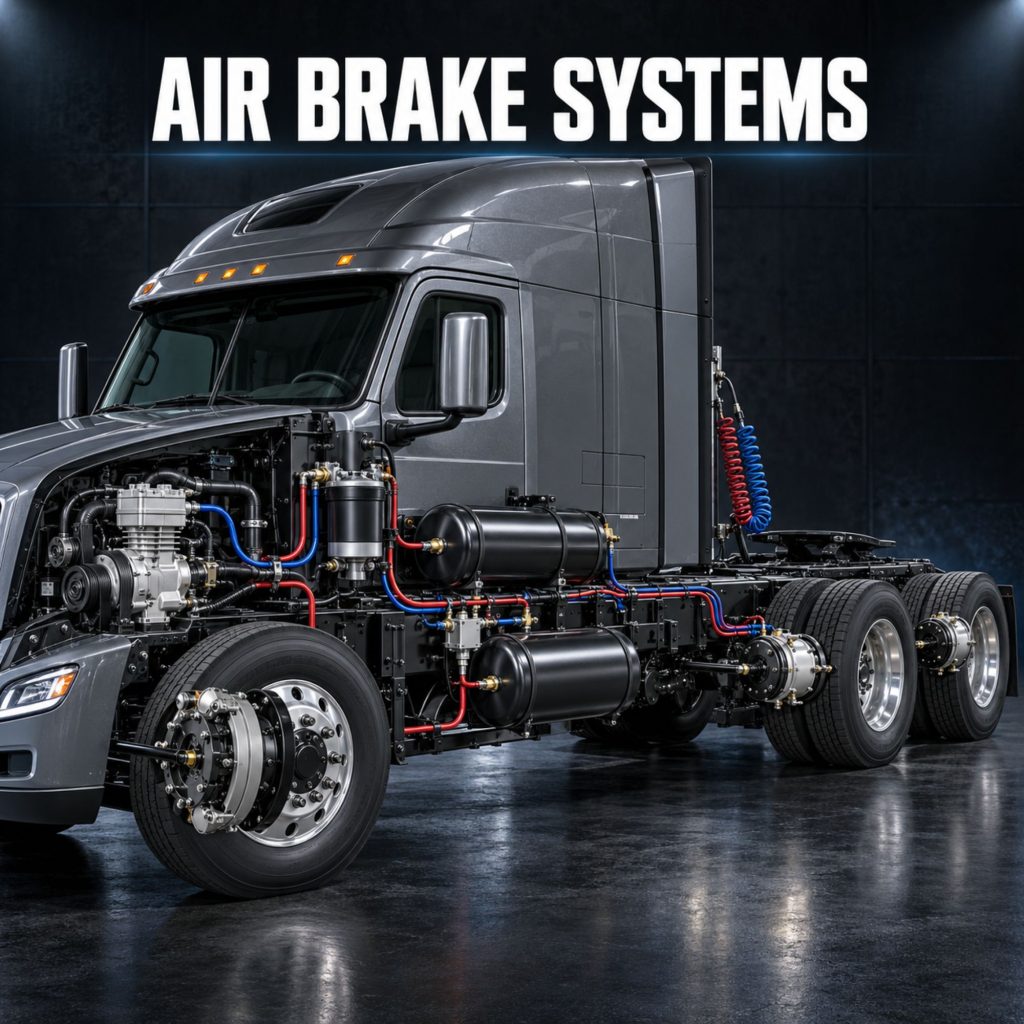
Commercial air brake systems use compressed air to apply, control, and release the service and parking brakes on heavy-duty trucks, tractors, buses, and trailers. Unlike hydraulic brake systems, compressed air is stored in reservoirs so braking energy remains available whenever the driver operates the brake pedal.
Air brake systems are widely used on Class 7 and Class 8 vehicles because they can control multiple axles, connect a tractor to a trailer, and support spring-applied parking and emergency brakes.
Truck Equipment Atlas covers air compressors, air dryers, reservoirs, valves, brake chambers, spring brakes, foundation brakes, air lines, ABS components, electronic controls, maintenance considerations, and individual air-brake products from major commercial-vehicle manufacturers.
Air Brake System Products on Truck Equipment Atlas
Explore the commercial air-brake components and systems being added to Truck Equipment Atlas:
Bendix
- Bendix Tu-Flo 550 Air Compressor
- Bendix BA-921 Air Compressor
- Bendix AD-9 Air Dryer
- Bendix AD-HF Air Dryer
- Bendix SR-7 Spring Brake Modulating Valve
Additional compressors, air dryers, reservoirs, valves, brake chambers, spring brakes, air-treatment components, and control systems will be added as the Truck Equipment Atlas Brake Systems Library continues to expand.
How Commercial Air Brake Systems Work
The engine drives an air compressor that supplies compressed air to the vehicle’s air system. The compressor governor controls when the compressor loads and unloads according to system pressure.
Before reaching the reservoirs, compressed air normally passes through an air dryer. The dryer removes moisture, oil contamination, and other material that could damage valves, freeze inside air lines, or reduce system reliability.
The reservoirs store compressed air until it is needed. Commercial vehicles commonly divide the stored air between primary and secondary circuits so that a failure in one part of the system does not automatically eliminate all service-brake capability.
When the driver presses the brake pedal, the foot valve meters air pressure into the service-brake circuits. Relay valves and other control valves help deliver air to the brake chambers near each axle.
The brake chambers convert air pressure into mechanical movement. That movement applies the foundation brakes at the wheels. Releasing the pedal exhausts service air from the chambers, allowing the brakes to release.
Major Air Brake System Components
A complete commercial air brake system may include:
- Air compressor
- Compressor governor
- Discharge line
- Air dryer
- Purge valve
- Desiccant cartridge
- Supply reservoir
- Primary reservoir
- Secondary reservoir
- Safety valve
- Drain valves
- Pressure-protection valves
- Check valves
- Foot brake valve
- Relay valves
- Quick-release valves
- Tractor-protection valve
- Trailer air-supply valve
- Spring-brake control valve
- Brake chambers
- Spring-brake chambers
- Slack adjusters
- Pushrods
- Air lines and hoses
- Gladhands
- Pressure gauges
- Low-air warning system
- Antilock braking components
- Electronic stability-control components
Exact component arrangements vary according to the vehicle, number of axles, brake design, trailer connections, and applicable safety requirements.
Air Compressors
The air compressor creates the compressed-air supply used by the braking system and other pneumatic equipment on the vehicle.
Most heavy commercial trucks use an engine-driven compressor. Depending on the engine and installation, the compressor may be gear-driven and may share engine lubrication and cooling systems.
Important air-compressor considerations include:
- Compressor displacement
- Air-delivery capacity
- Engine speed
- Duty cycle
- Cooling system
- Lubrication system
- Mounting arrangement
- Drive system
- Governor compatibility
- Air-system demand
- Discharge-line condition
- Vehicle application
Frequent compressor operation can indicate excessive air consumption or a leak elsewhere in the system. Oil or carbon buildup in the discharge line can also indicate compressor, cooling, lubrication, or duty-cycle problems.
Air Dryers and Moisture Control
Compressed air naturally contains moisture. Compression also creates heat, and contamination may enter the air stream from the compressor or surrounding environment.
The air dryer helps remove:
- Water vapor
- Condensed moisture
- Oil aerosols
- Dirt
- Carbon particles
- Other air-system contaminants
Many air dryers use a replaceable desiccant cartridge. During the purge cycle, stored air passes through the dryer in the opposite direction to remove accumulated moisture and contamination.
Air-dryer maintenance is especially important in cold climates because water inside air lines, valves, and reservoirs can freeze and restrict air flow.
Vehicles with high air demand may require an air dryer and purge system designed for their operating cycle. Refuse trucks, transit buses, delivery vehicles, vocational equipment, and trucks with air-operated accessories may cycle their compressors more frequently than conventional highway tractors.
Air Reservoirs
Air reservoirs store compressed air produced by the compressor. They allow the braking system to apply the brakes without waiting for the compressor to create pressure each time the driver uses the pedal.
A typical commercial vehicle may include:
- Supply or wet tank
- Primary service reservoir
- Secondary service reservoir
- Additional accessory reservoirs
- Trailer reservoirs
The supply reservoir receives air after it passes through the dryer. Primary and secondary reservoirs supply separate service-brake circuits.
Reservoirs may use manual drain valves or automatic draining equipment. Even when an air dryer is installed, reservoirs should be inspected for moisture, oil, corrosion, damaged mounting straps, and air leakage.
Primary and Secondary Brake Circuits
Modern commercial vehicles normally use a dual-circuit service-brake system. One circuit may control the rear brakes while the other controls the front brakes, although the exact arrangement depends on the vehicle.
The divided system helps preserve partial braking capability if one circuit develops a failure.
Each circuit may include its own:
- Reservoir
- Pressure gauge
- Low-pressure warning
- Delivery passages
- Control valves
- Brake chambers
A dual-circuit system does not make it safe to continue normal operation after a pressure loss. A low-air warning, abnormal gauge reading, or reduced braking response requires immediate attention.
Service Brakes
The service brakes are the brakes used during normal driving. The driver controls them through the brake pedal and foot valve.
Pressing the pedal meters air pressure according to pedal movement. Greater pedal force generally commands more brake-application pressure.
The service-brake system may control:
- Steer-axle brakes
- Drive-axle brakes
- Auxiliary-axle brakes
- Trailer brakes
- Drum brakes
- Air disc brakes
Relay valves are commonly used to reduce the time required for air to reach and exhaust from brake chambers located farther away from the foot valve.
Balanced brake operation depends on correctly matched chambers, foundation brakes, valves, air lines, friction materials, tires, and axle loads.
Parking and Emergency Brakes
Commercial air-brake systems commonly use spring-brake chambers for parking and emergency functions.
A spring-brake chamber contains a powerful mechanical spring. Air pressure compresses the spring during normal vehicle operation, allowing the brakes to remain released.
When the driver applies the parking brake, air is exhausted from the spring-brake chambers. The stored mechanical force of the springs applies the brakes.
If system pressure falls too low, the spring brakes may begin to apply automatically. This creates an emergency function that does not depend on maintaining normal air pressure.
Spring-brake chambers contain high internal force and should only be serviced using approved procedures. Improper disassembly can cause severe injury.
Brake Chambers and Actuators
Brake chambers convert pneumatic pressure into mechanical movement.
Common chamber configurations include:
- Service brake chambers
- Combination spring-brake chambers
- Steer-axle chambers
- Drive-axle chambers
- Trailer chambers
- Long-stroke chambers
- Disc-brake actuators
- Application-specific chambers
On an S-cam drum brake, the chamber pushrod moves the slack adjuster and camshaft. The rotating S-cam forces the brake shoes outward against the drum.
On an air disc brake, the actuator applies the caliper mechanism, pressing the brake pads against the rotor.
Chamber type, size, stroke, mounting, pushrod length, and brake compatibility must match the vehicle’s approved brake-system specification.
Air-Brake Valves
Commercial air brake systems use multiple valves to direct, regulate, protect, apply, and exhaust compressed air.
Common air-brake valves include:
- Foot valves
- Relay valves
- Quick-release valves
- Check valves
- Pressure-protection valves
- Tractor-protection valves
- Trailer-supply valves
- Spring-brake control valves
- Modulating valves
- Inversion valves
- Limiting valves
- ABS modulator valves
- Drain valves
- Safety valves
A valve that leaks, sticks, becomes contaminated, or responds slowly can change brake timing and pressure delivery. Replacement valves must match the original function, port arrangement, pressure settings, and vehicle application.
Tractor and Trailer Air Connections
A tractor and semitrailer normally use separate air lines for service-brake control and trailer air supply.
The connections commonly include:
- Service line
- Emergency or supply line
- Service gladhand
- Emergency or supply gladhand
- Tractor-protection valve
- Trailer air-supply control
- Trailer reservoir
- Trailer relay or emergency valve
- Trailer ABS connections
The supply line charges the trailer reservoirs and keeps the trailer spring brakes released. The service line sends a control signal when the driver applies the tractor brakes.
If the trailer separates or the supply line fails, the trailer’s emergency system is designed to apply the trailer brakes using stored air and spring-brake force, depending on its configuration.
Gladhands, seals, hoses, and connections should be inspected for leaks, cracking, contamination, and secure attachment before operation.
Drum and Air Disc Foundation Brakes
The air system supplies the force used to operate the foundation brakes at the wheels.
Two primary foundation-brake designs are used on commercial vehicles:
S-Cam Drum Brakes
S-cam drum brakes use a brake chamber, pushrod, slack adjuster, camshaft, brake shoes, friction linings, and drum.
Potential characteristics include:
- Established commercial-vehicle design
- Broad parts availability
- Familiar service procedures
- Strong braking capability
- Multiple brake sizes
- Enclosed friction surfaces
- Lower initial cost in many applications
Drum brakes require correct adjustment and can be affected by heat, contamination, worn drums, damaged linings, weak return springs, and excessive pushrod stroke.
Air Disc Brakes
Air disc brakes use an actuator, caliper, brake pads, rotor, guide pins, and adjustment mechanism.
Potential characteristics include:
- Consistent stopping performance
- Strong resistance to brake fade
- Easier friction inspection
- Reduced stopping distances in some configurations
- Automatic adjustment
- Balanced braking response
- Simplified pad replacement on some designs
Air disc brakes may have higher component costs and require correct caliper, rotor, pad, actuator, and wheel-end compatibility.
Explore Air Disc Brake Systems and Drum Brake Systems for more information.
Antilock Braking Systems
Antilock braking systems monitor wheel speed and reduce brake pressure when a wheel approaches lockup.
A commercial ABS arrangement may include:
- Wheel-speed sensors
- Tone rings
- Electronic control unit
- ABS modulator valves
- Wiring harnesses
- Warning lamps
- Diagnostic connectors
- Tractor-trailer communication
ABS does not eliminate normal stopping-distance requirements or compensate for poor traction, excessive speed, worn brakes, or improper loading. It helps the driver retain directional control by managing wheel lockup during hard braking.
An illuminated ABS warning lamp indicates that the system has detected a fault. Normal foundation-brake operation may remain available, but the ABS function may be limited or disabled until the problem is corrected.
Explore ABS & Electronic Braking Systems for additional information.
Electronic Stability Control
Electronic stability-control systems build on ABS capability by monitoring vehicle movement and driver inputs.
Depending on the system, stability control may use:
- Wheel-speed sensors
- Steering-angle sensor
- Yaw-rate sensor
- Lateral-acceleration sensor
- Brake-pressure sensors
- Electronic control unit
- ABS modulator valves
- Engine communication
When the system detects a potential rollover or loss of directional stability, it may reduce engine torque and apply selected brakes.
Stability control supports the driver but cannot overcome unsafe speed, severe weather, poor tire condition, improper loading, or the physical limits of the vehicle.
Air Pressure and Brake Operation
Correct air pressure is necessary for normal service-brake, parking-brake, and accessory operation.
Drivers should monitor:
- Primary air-pressure gauge
- Secondary air-pressure gauge
- Low-air warning light
- Low-air warning buzzer
- Air-pressure buildup time
- Governor cut-in pressure
- Governor cut-out pressure
- Compressor cycling
- Parking-brake operation
- Trailer air supply
- Audible air leaks
A vehicle that builds pressure slowly, loses air excessively, or repeatedly cycles the compressor may have leaks, compressor problems, air-dryer restrictions, governor faults, valve failures, or excessive system demand.
The vehicle should not be operated when air pressure or warning-system performance does not meet applicable inspection requirements.
Brake Balance and Timing
Brake balance refers to how effectively braking force is distributed across the vehicle’s axles and wheels.
Brake timing refers to how quickly the brakes at different positions apply and release.
Poor balance or timing may cause:
- Tractor-trailer instability
- Wheel lockup
- Trailer pushing
- Vehicle pulling
- Uneven brake wear
- Excessive stopping distance
- Premature ABS activation
- Brake overheating
- Reduced directional control
Correct balance depends on air delivery, valve selection, chamber sizing, foundation-brake condition, friction materials, adjustment, tire traction, axle load, and tractor-trailer compatibility.
Components should not be changed solely because they appear physically interchangeable. Differences in valve timing, chamber output, friction performance, and brake geometry can affect the operation of the complete vehicle.
Highway Air-Brake Applications
Long-haul and regional trucks require dependable brake performance during high-mileage highway operation.
Important considerations can include:
- Consistent stopping performance
- Air-system reliability
- Compressor efficiency
- Moisture control
- Brake fade resistance
- Tractor-trailer balance
- ABS compatibility
- Electronic stability control
- Friction-material life
- Brake inspection access
- Replacement-parts availability
- Maintenance intervals
Highway vehicles may travel long distances between service locations, making preventive inspection of air lines, chambers, valves, friction components, and wheel ends especially important.
Vocational Air-Brake Applications
Vocational trucks may place significantly different demands on air brake systems than highway tractors.
Common applications include:
- Dump trucks
- Refuse trucks
- Concrete mixers
- Construction trucks
- Logging trucks
- Heavy-haul tractors
- Tank trucks
- Utility trucks
- Municipal vehicles
- Snowplows
- Oilfield trucks
- Mining vehicles
- Fire apparatus
- Recovery vehicles
- Severe-service equipment
These vehicles may experience frequent brake applications, repeated low-speed stops, steep grades, mud, dust, water, corrosive material, high axle loads, and substantial air demand from auxiliary equipment.
Vocational applications may require higher-capacity compressors, specialized air dryers, additional reservoirs, severe-duty brake components, protective routing, and more frequent inspection.
Trailer Air-Brake Applications
Commercial trailers commonly use air brakes supplied and controlled by the towing vehicle.
Trailer braking equipment may include:
- Trailer reservoir
- Relay emergency valve
- Spring-brake chambers
- Service-brake chambers
- Drum brakes
- Air disc brakes
- ABS controller
- ABS modulator valves
- Wheel-speed sensors
- Air lines and hoses
- Gladhands
- Brake-adjustment components
- Trailer stability equipment
Trailer brake condition directly affects the stopping performance and stability of the complete tractor-trailer combination.
Explore Trailer Brake Systems for additional information.
Cold-Weather Air-Brake Operation
Cold weather can expose moisture-control and maintenance problems within an air brake system.
Potential cold-weather concerns include:
- Frozen air lines
- Frozen valves
- Restricted air flow
- Slow pressure buildup
- Air-dryer malfunction
- Accumulated reservoir moisture
- Damaged seals
- Stiff mechanical components
- Ice around foundation brakes
- Frozen drum brakes after parking
Proper air-dryer maintenance and reservoir inspection help reduce moisture-related freezing. Alcohol evaporators or other freeze-prevention equipment should only be used when approved for the vehicle’s air system.
Advantages of Commercial Air Brake Systems
Depending on the vehicle and application, air brake systems can provide:
- Effective braking for heavy commercial vehicles
- Stored braking energy
- Multiple protected circuits
- Tractor-to-trailer brake control
- Spring-applied parking brakes
- Emergency braking capability
- Control of multiple axles
- Compatibility with drum brakes
- Compatibility with air disc brakes
- ABS integration
- Electronic stability-control integration
- Air supply for approved vehicle accessories
- Broad commercial-vehicle service support
- Standardized inspection procedures
The actual performance depends on correct system design, vehicle loading, adjustment, maintenance, tire condition, and driver operation.
Air-Brake System Limitations and Considerations
Air brake systems contain numerous pneumatic, mechanical, and electronic components that must work together correctly.
Important considerations include:
- Air leaks
- Moisture contamination
- Compressor wear
- Air-dryer maintenance
- Reservoir corrosion
- Valve response
- Brake-chamber condition
- Pushrod stroke
- Foundation-brake wear
- Brake adjustment
- Air-line routing
- Tractor-trailer balance
- ABS faults
- Electrical connection problems
- Cold-weather operation
- Inspection requirements
- Technician training
- Replacement-parts compatibility
Compressed-air systems can have a short delay between pedal input and foundation-brake application. Correct valve placement, air-line size, component selection, and maintenance help keep response time within approved limits.
Driver and Operator Considerations
Drivers should understand the vehicle’s air-pressure gauges, warning devices, parking-brake controls, trailer-supply controls, and normal compressor cycle.
Important operating considerations include:
- Allowing pressure to build before moving
- Confirming low-air warnings operate
- Testing service brakes
- Testing parking brakes
- Checking trailer-brake operation
- Monitoring primary and secondary gauges
- Listening for air leaks
- Checking gladhands and hoses
- Watching ABS warning lamps
- Avoiding excessive brake use on long grades
- Selecting the proper transmission gear before descending
- Recognizing changes in brake response
- Completing required pre-trip and post-trip inspections
Drivers should never rely on repeated heavy brake applications to control speed on a long downgrade. Excessive heat can cause brake fade, damage friction components, and reduce stopping performance.
Maintenance and Ownership
Commercial air brake systems require regular inspection and preventive maintenance.
Important maintenance areas can include:
- Compressor condition
- Compressor drive system
- Governor operation
- Discharge line
- Air-dryer cartridge
- Air-dryer purge valve
- Reservoir drainage
- Reservoir condition
- Air lines and hoses
- Fittings and connections
- Foot valve
- Relay valves
- Protection valves
- Spring-brake valves
- Brake chambers
- Spring-brake chambers
- Pushrods
- Slack adjusters
- Camshafts and bushings
- Brake shoes and linings
- Brake drums
- Disc-brake calipers
- Brake pads
- Brake rotors
- Wheel-speed sensors
- Tone rings
- ABS wiring
- Warning lamps
- Tractor-trailer electrical connections
Maintenance requirements vary between manufacturers, vehicles, duty cycles, climates, brake designs, and operating conditions. Owners and technicians should follow the service procedures and inspection limits specified for the exact vehicle and components.
Choosing Commercial Air-Brake Components
Selecting or replacing an air-brake component requires identifying the complete vehicle and original braking configuration.
Important factors include:
- Vehicle manufacturer
- Vehicle model
- Model year
- Vehicle identification number
- Tractor or trailer application
- Axle position
- Number of axles
- Gross axle weight rating
- Brake type
- Brake size
- Air-compressor model
- Air-dryer model
- Valve function
- Valve port arrangement
- Brake-chamber type and size
- Standard-stroke or long-stroke chamber
- Foundation-brake manufacturer
- ABS configuration
- Electrical connectors
- Air-line size
- Mounting arrangement
- Duty cycle
- Operating environment
- Regulatory requirements
A component should not be selected only because it has a similar appearance. Incorrect valve, chamber, actuator, compressor, dryer, or foundation-brake components can alter pressure delivery, application timing, braking force, and vehicle safety.
Related Brake System Categories
Explore additional brake-system categories:
- Air Disc Brake Systems
- Drum Brake Systems
- Brake Chambers & Actuators
- ABS & Electronic Braking Systems
- Trailer Brake Systems
- Brake System Guides
Related Brake System Guides
- Air Brake Systems Explained
- Air Disc Brakes vs Drum Brakes
- How to Inspect and Maintain Commercial Truck Brakes
- Tractor vs Trailer Brake Systems
- How Truck ABS and Electronic Stability Control Work
- Commercial Truck Brake Components Explained
Related Truck Equipment Resources
- Commercial Trucks
- Commercial Trailers
- Brake Systems
- Suspension Systems
- Axles & Differentials
- Tires & Wheels
- Equipment Systems
Understanding how compressed-air production, air treatment, reservoirs, valves, brake chambers, foundation brakes, tires, wheel ends, ABS, vehicle loading, and driver operation work together is essential when evaluating a commercial air brake system.
Explore the Complete Brake Systems Library
Commercial air brake systems represent one part of the larger commercial braking-equipment landscape.
Visit the Truck Equipment Atlas Brake Systems Library to explore air brake systems, air disc brakes, drum brakes, brake chambers and actuators, ABS and electronic braking systems, trailer brake systems, individual component profiles, and educational guides.
Additional compressors, air dryers, valves, chambers, foundation brakes, electronic control systems, manufacturers, historical products, and educational resources will be added as Truck Equipment Atlas continues to expand.