
Hendrickson MAXX22T Trailer Air Disc Brake
Quick Facts
- Brand: Hendrickson
- Brake Model: MAXX22T
- Product Type: Pneumatically operated trailer air disc brake
- Brake Position: Trailer axle wheel end
- Caliper Design: Lightweight single-piston monobloc caliper
- Rotor Diameter: 415 mm
- Rotor Mounting: Inboard- or outboard-mounted, depending on configuration
- Wheel Sizes: 22.5-inch and 24.5-inch wheels
- Standard Brake Chamber: Size 20/24 on common configurations
- Supported Axle Load: Application-specific; ZF lists MAXX 22T applications up to 10 metric tons
- Maximum Brake Torque: Up to 21,000 Nm in applicable configurations
- Primary Applications: Dry vans, refrigerated trailers, flatbeds, tank trailers, vocational trailers, and specialty commercial trailers
- Common Hendrickson Integration: INTRAAX, INTRAAX-SP, VANTRAAX, ULTRAA-K, and TRLAXLE systems
- Technology Relationship: Hendrickson-branded brake package using ZF single-piston air-disc-brake technology
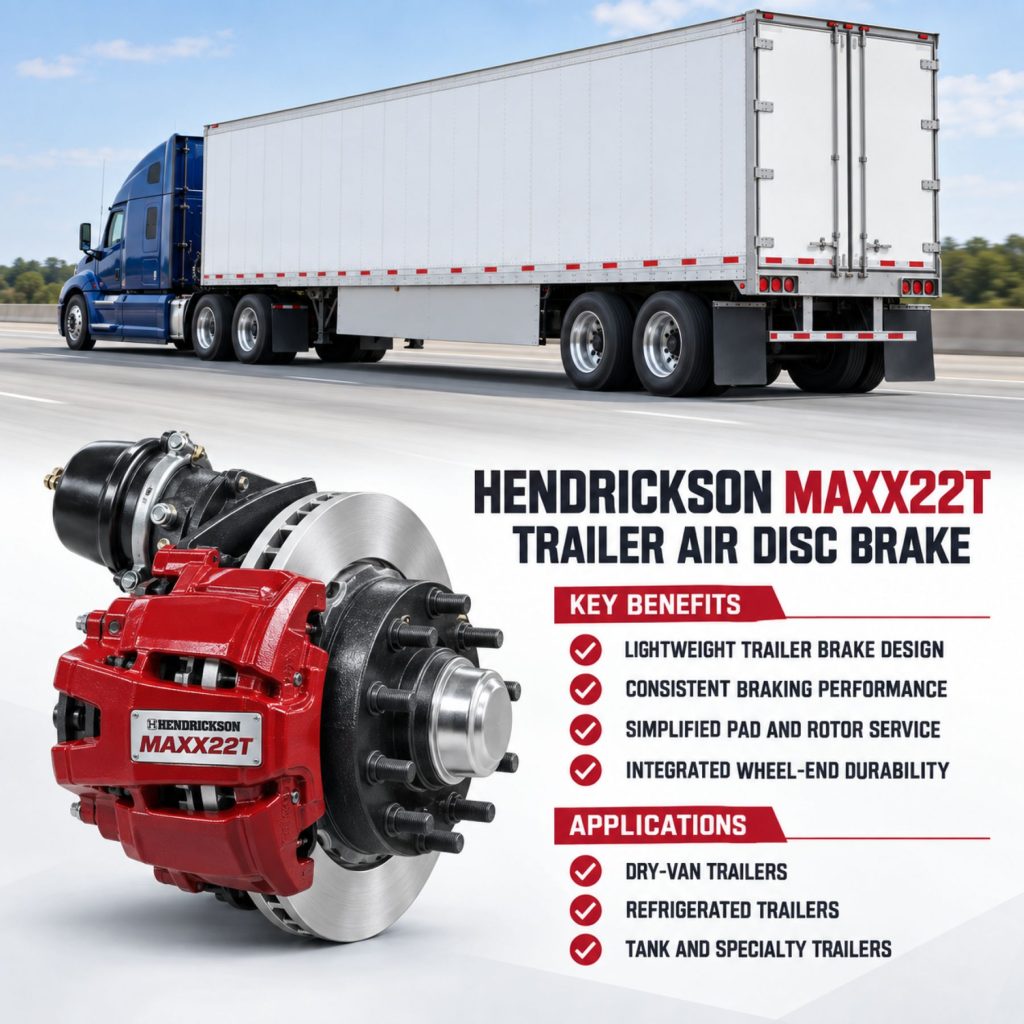
- Primary Benefit: Consistent trailer braking with reduced brake weight, simplified construction, and serviceable friction components
Overview
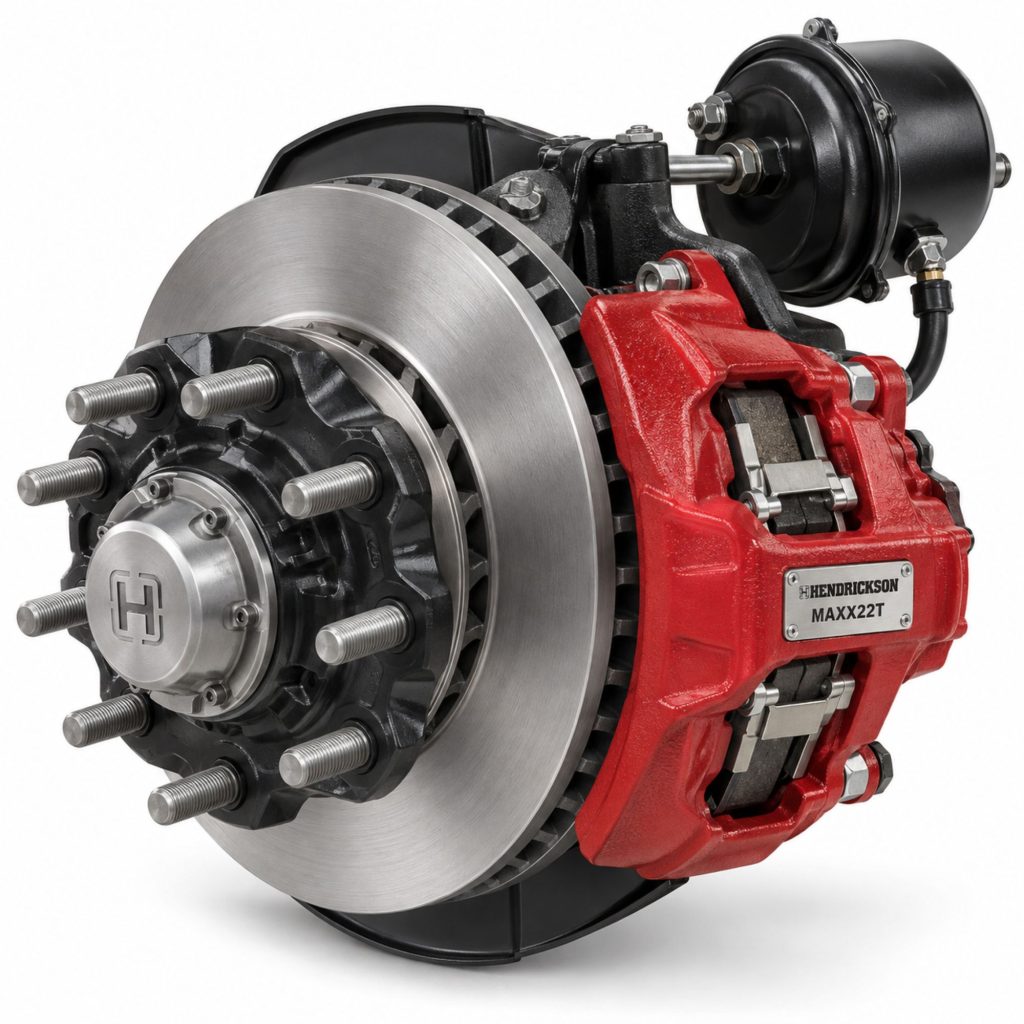
The Hendrickson MAXX22T is a lightweight air disc brake designed specifically for commercial trailer applications. It combines a single-piston monobloc caliper with a ventilated disc rotor, brake pads, an automatic adjustment mechanism, and a pneumatic brake chamber.
Hendrickson offers the MAXX22T as an integrated brake option on several of its trailer suspension and axle systems. These include selected INTRAAX, INTRAAX-SP, VANTRAAX, ULTRAA-K, and TRLAXLE configurations.
The MAXX22T uses ZF single-piston brake technology within a Hendrickson-branded and supported trailer brake package. Correct identification remains important because MAXX22T assemblies can differ by rotor position, spindle design, hub material, brake chamber, suspension model, and axle certification.
Compared with a conventional trailer drum brake, the MAXX22T provides more consistent braking during repeated or extended brake applications. It also allows technicians to inspect pad condition without removing a brake drum.
Hendrickson currently lists both inboard- and outboard-mounted 415 mm rotor packages for 22.5- and 24.5-inch wheels. The selected configuration must match the trailer axle, spindle, hub, suspension, brake chamber, and certification requirements. Hendrickson MAXX22T product information
Key Characteristics
- Trailer-specific air disc brake
- Lightweight single-piston caliper
- Compact monobloc caliper construction
- 415 mm ventilated disc rotor
- Inboard- and outboard-mounted rotor configurations
- Designed for 22.5-inch and 24.5-inch wheels
- Automatic running-clearance adjustment
- Sealed caliper guide system
- Replaceable brake-pad set
- Pad-wear indication capability
- Consistent performance during repeated braking
- Compatible with trailer ABS and roll-stability systems
- Available on selected Hendrickson integrated suspension systems
- Available with selected Hendrickson non-integrated trailer axles
- Reduced brake fade compared with many drum-brake configurations
- No external slack adjuster
- No conventional S-camshaft
Major Components
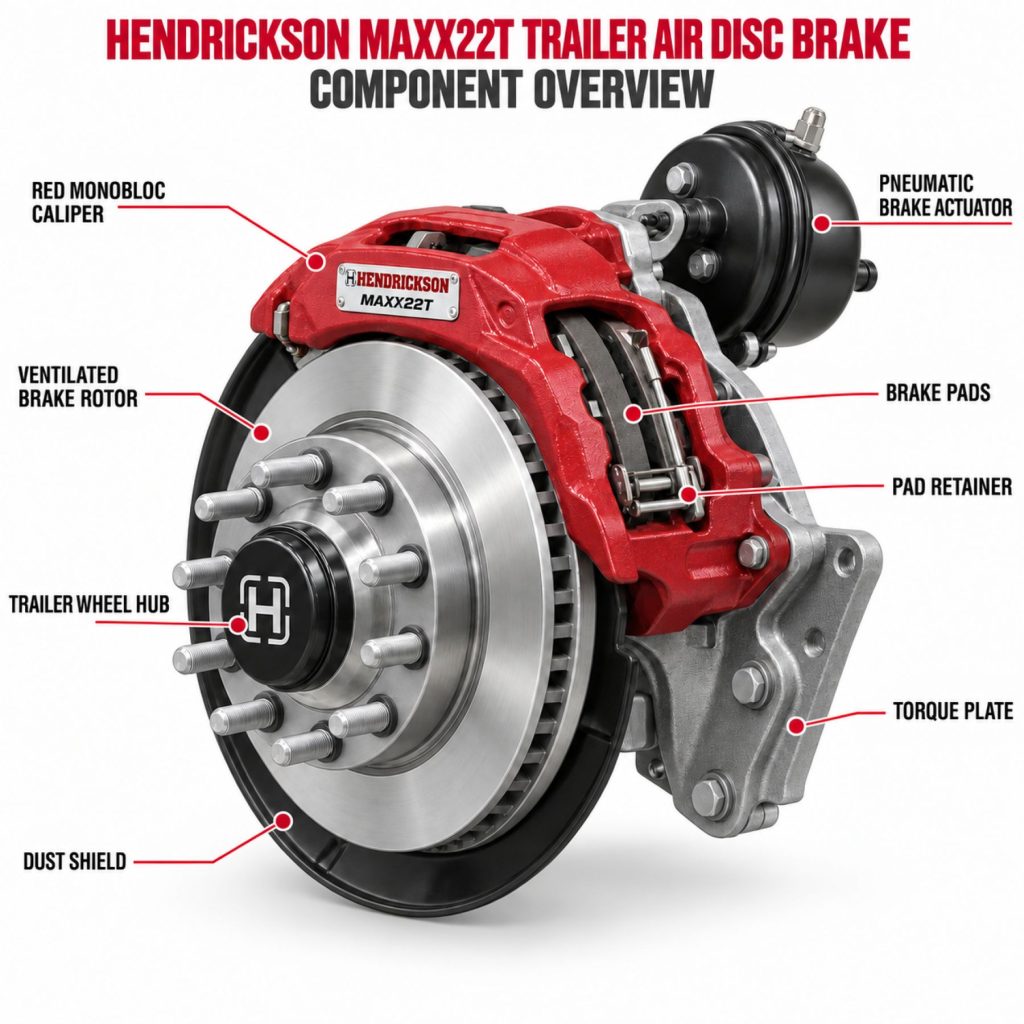
- MAXX22T monobloc caliper
- Single-piston clamping mechanism
- Caliper carrier
- Caliper guide pins and protective boots
- Automatic adjuster mechanism
- Brake pads
- Pad-retaining spring
- Pad-retaining bar and fasteners
- Pad-wear indicator
- Wear-sensor wiring when equipped
- 415 mm ventilated rotor
- Rotor mounting hardware
- Hub and rotor assembly
- Pneumatic brake chamber
- Brake chamber mounting bracket
- Air hose and fittings
- Caliper mounting bolts and washers
- Axle spindle
- Wheel hub
- Wheel bearings
- Hub seal
- Hubcap
- ABS tone ring
- Wheel-speed sensor
How the Brake Component or System Works
When the driver applies the service brakes, compressed air travels through the trailer’s brake-control system to the MAXX22T brake chamber. Air pressure moves the chamber mechanism, which applies force to the caliper’s internal operating system.
The caliper converts this force into clamping pressure. The inboard brake pad moves against the rotor, and the sliding-caliper arrangement brings the outboard pad into contact with the opposite rotor surface.
Friction between the pads and rotating rotor converts the trailer’s motion into heat. The ventilated rotor releases this heat into the surrounding air.
When the driver releases the brake pedal, air pressure is removed from the service chamber. The brake releases and the pads return to their designed running clearance.
The internal adjustment mechanism compensates for normal pad and rotor wear. This helps preserve the intended clearance without using the external slack adjuster found on an S-cam drum brake.
Position and Function Within the Brake System
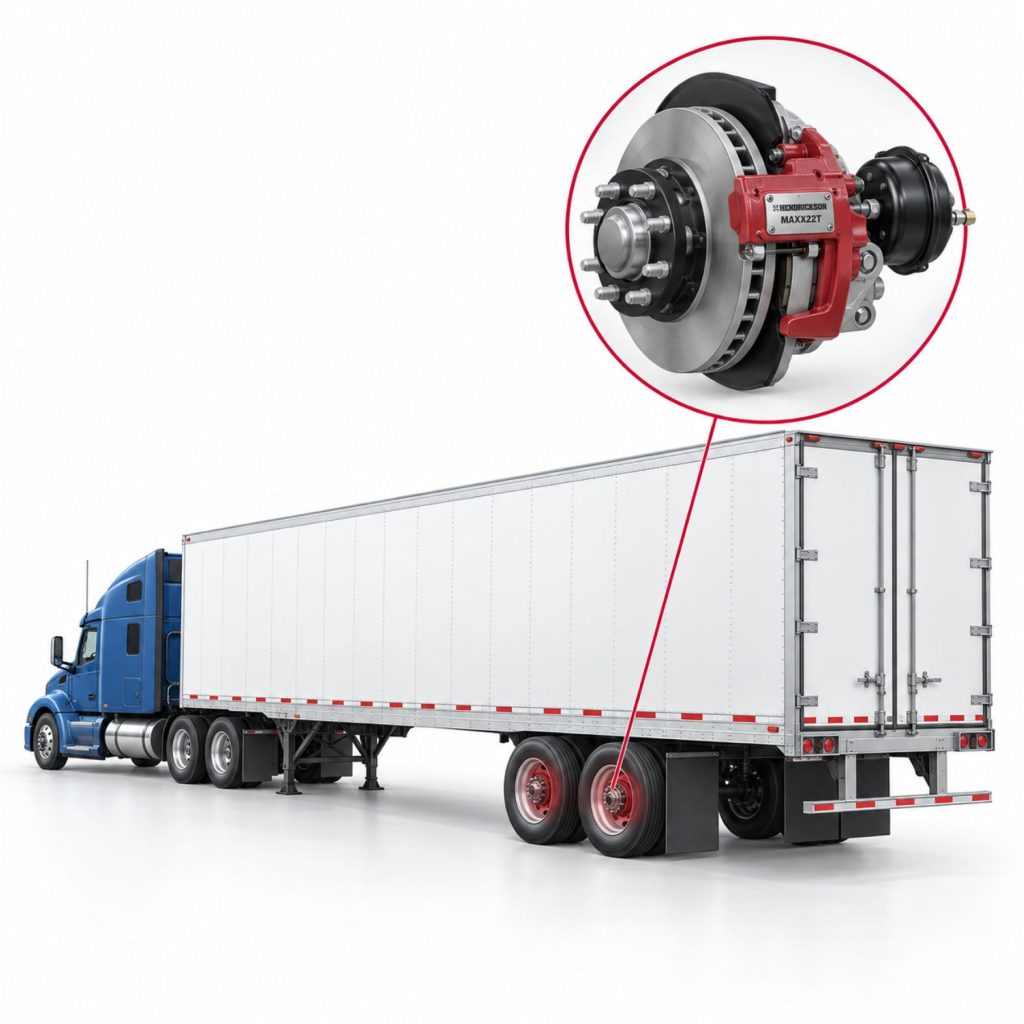
The MAXX22T is mounted at each equipped trailer wheel end. It functions as the foundation brake that converts pneumatic control pressure into mechanical clamping force.
The complete braking sequence involves:
- The tractor generating the driver’s braking command
- The trailer control line transmitting that command
- Trailer relay or ABS valves directing air to the brake chambers
- The brake chambers applying the MAXX22T calipers
- The brake pads clamping the rotors
- The tires transferring braking force to the road
The brake also works with the trailer’s parking and emergency-brake system when spring-brake chambers are installed. Loss of trailer supply pressure causes the spring section of the chamber to apply the parking brakes according to the trailer system’s design.
MAXX22T brakes do not independently control brake timing or wheel slip. Those functions are handled by the trailer’s valves, ABS, electronic braking system, and roll-stability equipment.
Common Specifications
- Brake Type: Pneumatic trailer air disc brake
- Caliper Type: Sliding single-piston monobloc caliper
- Rotor Diameter: 415 mm
- Rotor Design: Ventilated disc
- Rotor Position: Inboard or outboard, depending on axle configuration
- Wheel Compatibility: 22.5-inch and 24.5-inch commercial trailer wheels
- Common Spindles: HN, HP, or HX, depending on rotor and hub arrangement
- Common Brake Chamber: Standard size 20/24
- Maximum Brake Torque: Up to 21,000 Nm in applicable ZF MAXX 22T configurations
- Axle-Load Capability: Application-specific; configurations may support trailer axle loads up to 10 metric tons
- Adjustment: Internal automatic running-clearance adjustment
- Wear Monitoring: Visual inspection provisions and optional electronic pad-wear sensing
- ABS Compatibility: Compatible with properly specified trailer ABS
- Stability-System Compatibility: Compatible with properly specified roll-stability systems
- Suspension Integration: Selected Hendrickson INTRAAX, INTRAAX-SP, VANTRAAX, and ULTRAA-K systems
- Non-Integrated Axle Availability: Selected Hendrickson TRLAXLE configurations
Specifications vary by suspension, axle, spindle, rotor position, hub, brake chamber, and brake certification. The trailer identification and Hendrickson assembly information must be checked before ordering components.
Operating Specifications and Performance
The MAXX22T is designed to provide predictable braking across repeated service-brake applications. Its exposed ventilated rotor can release heat more effectively than a brake drum that encloses its friction surfaces.
ZF identifies the MAXX 22T as a trailer-specific brake capable of producing up to 21,000 Nm of braking torque and supporting applications with axle loads up to 10 metric tons. These figures describe eligible configurations and should not be applied automatically to every Hendrickson installation. ZF MAXX 22T product information
Actual stopping performance depends on:
- Brake chamber size and operating pressure
- Caliper and pad condition
- Rotor thickness and condition
- Trailer axle loading
- Tire condition and road traction
- Tractor-to-trailer brake balance
- ABS and stability-system operation
- Air-system timing
- Trailer suspension geometry
- Brake certification for the complete axle assembly
The brake should never be uprated through component substitutions without confirming the complete axle and vehicle certification.
Braking Performance and System Integration
The MAXX22T must operate as part of a balanced tractor-trailer braking system. Brake torque, chamber size, axle loading, control-valve timing, and tire traction all affect how the combination vehicle stops.
Air disc brakes commonly provide a more direct response than S-cam drum brakes. If a tractor and trailer use different foundation-brake designs, correct pneumatic balance becomes especially important.
Poor brake balance can cause:
- The tractor to perform too much of the stopping work
- The trailer brakes to apply too aggressively
- Uneven pad or lining wear
- Excessive rotor or drum temperatures
- Trailer instability
- Premature ABS intervention
- Reduced brake-component life
Replacement chambers, pads, rotors, calipers, and valves must preserve the trailer’s approved brake configuration.
Air Supply, Controls, and Electronic Integration
The MAXX22T relies on the trailer’s compressed-air system. The trailer reservoir stores air, while relay or ABS-modulator valves direct pressure to the brake chambers.
The brake can be integrated with:
- Trailer antilock braking systems
- Roll-stability support systems
- Electronically controlled braking systems
- Wheel-speed sensors
- Electronic pad-wear sensors
- Trailer diagnostic systems
- Tire-pressure control systems
- Spring-brake emergency and parking systems
Hendrickson notes that its air disc brake packages can be used with roll-stability systems and electronically controlled braking systems. Selected packages can also be combined with the TIREMAAX PRO tire-pressure control system.
The pad-wear sensor monitors friction-material condition but does not replace physical inspection. Wiring, connectors, routing, and warning functions should be checked during scheduled service.
Installation, Adjustment, and Brake Balance
MAXX22T installation requires the exact caliper orientation, rotor arrangement, mounting hardware, brake chamber, hose routing, and fastener procedures specified for the axle.
Important installation checks include:
- Confirming left- and right-hand caliper positions
- Inspecting mounting surfaces
- Using specified caliper fasteners
- Following the required tightening sequence and torque
- Confirming chamber compatibility
- Checking chamber and hose clearance
- Inspecting guide-pin movement
- Verifying rotor runout and thickness
- Confirming wheel and tire clearance
- Testing automatic adjustment
- Checking ABS sensor operation
- Confirming balanced brake application across the axle
The brake’s internal adjuster should not be treated like an external drum-brake slack adjuster. Adjustment and reset procedures must follow the MAXX22T service literature.
After brake service, the technician should perform an operational inspection before returning the trailer to service.
Foundation Brake, Axle, and Wheel-End Compatibility
Hendrickson offers different MAXX22T wheel-end packages.
The outboard-mounted version commonly uses:
- HX spindle
- 415 mm outboard rotor
- Steel hub
- 22.5-inch or 24.5-inch wheel
- Standard size 20/24 chamber
The inboard-mounted version commonly uses:
- HN or HP spindle
- 415 mm inboard rotor
- Ductile-iron or Dura-Light hub
- 22.5-inch or 24.5-inch wheel
- Standard size 20/24 chamber
The brake may be available with selected:
- INTRAAX AANT configurations
- INTRAAX AANLS configurations
- INTRAAX AANL configurations
- INTRAAX AAL configurations
- INTRAAX AAEDL configurations
- INTRAAX AAEDT configurations
- INTRAAX-SP AAZNT configurations
- VANTRAAX HKANT configurations
- VANTRAAX HKAT configurations
- VANTRAAX HKARL configurations
- ULTRAA-K UTKNT configurations
- TRLAXLE non-integrated axles
Availability depends on the exact suspension and axle ordering guide. A model-family name alone does not confirm compatibility.
Common Applications
- Dry van trailers
- Refrigerated trailers
- Flatbed trailers
- Curtain-side trailers
- Container chassis
- Tank trailers
- Bulk trailers
- Hopper trailers
- Dump trailers
- Livestock trailers
- Automotive transport trailers
- Specialty commercial trailers
- Line-haul trailer fleets
- Regional delivery trailers
- High-mileage commercial trailers
- Trailers operating on long grades
Vehicle and Brake-System Compatibility
The MAXX22T is intended for properly engineered commercial trailer axle systems. Compatibility must be confirmed at the axle and wheel-end level rather than solely by trailer manufacturer.
Selection depends on:
- Trailer manufacturer and model
- Trailer model year
- Suspension model
- Axle model and capacity
- Spindle type
- Rotor mounting position
- Hub material and design
- Wheel size and offset
- Tire size
- Brake chamber size
- ABS configuration
- Stability-control configuration
- Parking-brake requirements
- Gross axle weight rating
- Original brake certification
A MAXX22T caliper should not be substituted for another air disc brake merely because the mounting area appears similar.
Advantages
- Consistent braking during repeated applications
- Good resistance to brake fade
- Trailer-specific lightweight design
- Single-piston operating system
- Compact monobloc caliper
- Fewer components than some earlier brake designs
- Automatic running-clearance adjustment
- No external slack adjuster
- No S-camshaft or camshaft bushings
- Accessible brake-pad inspection
- Replaceable pads without removing a brake drum
- Available electronic pad-wear sensing
- Compatible with trailer ABS
- Compatible with roll-stability systems
- Integrated Hendrickson axle and suspension availability
- Inboard- and outboard-rotor options
- Potential reduction in wheel-end weight
Limitations or Considerations
- Requires the correct Hendrickson axle configuration
- Parts are not automatically interchangeable with other MAXX brakes
- Caliper orientation must be identified correctly
- Rotor replacement can require substantial wheel-end disassembly
- Inboard-rotor service generally requires hub removal
- Specialized service procedures and tools may be required
- Rotor damage can result from severely worn pads
- Guide pins and protective boots require inspection
- Incorrect pad installation can damage the brake
- Air hoses require correct routing and clearance
- Electronic wear sensors add wiring and connectors
- Replacement components must preserve brake certification
- Brake parts may cost more than common drum-brake components
- Mixed tractor and trailer brake types require proper balance
- Technicians require air-disc-brake training
Driver and Operator Experience
A properly maintained MAXX22T-equipped trailer should provide smooth and predictable braking. Drivers may notice a quicker or more direct response than with a comparable trailer using S-cam drum brakes.
Air disc brakes can maintain more consistent performance during repeated stops and long descents, but they do not eliminate the need for proper speed selection and engine braking.
Drivers should report:
- Trailer pulling during braking
- Delayed trailer-brake application
- Brake warning lamps
- ABS warning lamps
- Pad-wear warnings
- Grinding or scraping noises
- Burning odors
- Wheel-end smoke
- Excessive heat
- Air leaks
- Trailer instability
- Unexpected wheel lockup
- Reduced stopping performance
A trailer with suspected brake damage should be inspected before continued operation.
Maintenance and Ownership Notes
- Inspect brake-pad thickness
- Inspect rotor thickness
- Check rotor surfaces for cracks or heat damage
- Inspect the caliper for free movement
- Check guide pins and protective boots
- Inspect the pad-retaining system
- Check the automatic adjuster
- Inspect the brake chamber
- Check chamber mounting fasteners
- Inspect air hoses and fittings
- Check hose routing through full suspension travel
- Inspect caliper mounting bolts
- Check wheel bearings and hub seals
- Inspect for lubricant contamination
- Test ABS warning and diagnostic functions
- Inspect wheel-speed sensors and tone rings
- Check pad-wear sensor wiring when equipped
- Compare brake temperatures across the axle
- Use approved replacement pads and components
- Follow Hendrickson service intervals and procedures
Common Brake-System Problems
- Uneven brake-pad wear: Restricted caliper movement, damaged guide components, rotor problems, incorrect installation, or wheel-end movement may cause one pad to wear faster than the other.
- Brake dragging: A sticking caliper, damaged guide system, adjuster malfunction, trapped air pressure, contaminated components, or incorrect chamber installation may prevent complete release.
- Reduced braking force: Low air pressure, a damaged chamber, contaminated pads, worn friction material, rotor damage, incorrect adjustment, or pneumatic-system problems may reduce braking.
- Rotor scoring: Worn pads, embedded debris, damaged friction material, or continued operation after the pads reach their service limit can score the rotor.
- Rotor heat checking: Repeated high-temperature operation can create surface checking. The rotor must be evaluated using the manufacturer’s inspection criteria.
- Brake pulling: Unequal chamber pressure, different pad conditions, caliper restriction, rotor contamination, tire problems, or uneven axle loading may create side-to-side imbalance.
- Air leakage: Damaged hoses, fittings, chambers, relay valves, or ABS modulators can reduce available braking pressure.
- ABS warning lamp: Wheel-speed sensor problems, damaged wiring, excessive sensor gap, tone-ring damage, low voltage, or a stored electronic fault may illuminate the warning lamp.
- Pad-wear warning: The friction material may have reached its warning point, or the sensor and wiring may be damaged.
- Abnormal noise: Loose hardware, worn pads, damaged rotors, foreign material, caliper movement, or wheel-bearing problems can produce clicking, scraping, or grinding sounds.
Safety and Service Precautions
Commercial air brake systems contain stored pneumatic and mechanical energy. The trailer must be secured before brake or wheel-end service begins.
Before servicing the MAXX22T:
- Park on a firm and level surface
- Chock the wheels
- Support raised equipment with approved stands
- Drain or isolate air pressure as directed
- Cage spring brakes when the procedure requires it
- Never disassemble a spring-brake chamber
- Allow hot brakes to cool
- Wear suitable eye and hand protection
- Follow approved lifting procedures
- Use calibrated torque tools
- Replace specified one-time-use fasteners
- Keep grease and oil away from pads and rotors
A spring-brake chamber can cause severe injury if opened incorrectly. Chamber replacement and caging must follow the chamber manufacturer’s instructions.
Hendrickson’s MAXX22T installation and maintenance procedures should be consulted before inspecting, adjusting, rebuilding, or replacing the caliper. MAXX22T installation and maintenance information
Identification Information
Identification may be found on the caliper, axle tag, suspension tag, brake chamber, hub, or trailer certification records.
Record the following information:
- Trailer manufacturer
- Vehicle identification number
- Trailer model and model year
- Hendrickson suspension model
- Hendrickson axle model
- Axle serial number
- Suspension assembly number
- MAXX22T caliper part number
- Left- or right-hand caliper position
- Inboard- or outboard-mounted rotor
- Spindle type
- Rotor diameter and part number
- Hub part number and material
- Brake-pad part number
- Brake chamber manufacturer
- Brake chamber size
- Wheel size
- ABS configuration
- Pad-wear sensor configuration
- Brake certification information
Similar-looking MAXX22T components may have different mounting, chamber, rotor, or certification requirements. Parts should not be ordered by appearance alone.
Buying Considerations
- Confirm the complete axle and suspension model
- Record the axle serial number
- Determine whether the rotor is inboard or outboard
- Identify the spindle type
- Confirm the wheel size
- Verify the rotor diameter
- Identify the hub material
- Confirm the brake chamber size
- Identify left- and right-hand calipers
- Check pad-wear sensor requirements
- Verify ABS compatibility
- Confirm brake-certification requirements
- Check whether mounting hardware is included
- Determine whether fasteners are reusable
- Inspect rotor condition before ordering pads
- Check guide-pin and boot condition
- Verify wheel-bearing and seal requirements
- Use approved friction material
- Confirm parts availability through Hendrickson
- Compare individual components with complete service kits
Variants and Configurations
- Inboard-mounted 415 mm rotor
- Outboard-mounted 415 mm rotor
- HN spindle configuration
- HP spindle configuration
- HX spindle configuration
- Ductile-iron hub configuration
- Dura-Light hub configuration
- Steel-hub configuration
- 22.5-inch wheel configuration
- 24.5-inch wheel configuration
- Size 20/24 brake-chamber configuration
- Application-specific alternative chamber sizes
- Left-hand caliper
- Right-hand caliper
- Pad-wear sensor configuration
- Non-sensor configuration
- INTRAAX integrated package
- INTRAAX-SP integrated package
- VANTRAAX integrated package
- ULTRAA-K integrated package
- TRLAXLE non-integrated axle package
Comparison to Similar Equipment
Compared with the ZF WABCO MAXXUS L2.0 Air Disc Brake, the MAXX22T is designed primarily for trailer wheel ends. MAXXUS L2.0 is associated primarily with powered commercial-vehicle applications.
Compared with the Haldex ModulT Air Disc Brake, both use lightweight single-piston air-disc-brake architectures. Their calipers, carriers, pads, adjusters, rotors, and service parts are not interchangeable.
Compared with the Meritor EX+ LS Air Disc Brake, the MAXX22T provides a different caliper, adjuster, mounting, and wheel-end package. Selection depends on the original axle and suspension specification.
Compared with the Bendix ADB22X-LT Air Disc Brake, the MAXX22T uses a 415 mm rotor in Hendrickson’s listed configurations, while the ADB22X-LT packages listed by Hendrickson use a 430 mm rotor.
Compared with a conventional trailer drum brake, the MAXX22T generally provides more consistent repeated-stop performance and easier friction-material inspection. Drum brakes may have lower initial component costs and broader familiarity among repair facilities.
Best Fit For
- Trailers originally equipped with MAXX22T brakes
- Hendrickson integrated suspension systems
- Selected Hendrickson TRLAXLE axles
- Line-haul trailers
- Regional delivery trailers
- High-mileage fleets
- Trailers operating on long grades
- Fleets prioritizing consistent brake response
- Fleets seeking reduced wheel-end weight
- Operations using trailer roll-stability systems
- Maintenance programs equipped for air disc brakes
- Trailers requiring 22.5-inch or 24.5-inch wheels
Related Vehicle and Trailer Types
- Complete Guide to Semi-Trailer Types
- Dry van trailers
- Refrigerated trailers
- Flatbed trailers
- Tank trailers
- Container chassis
- Hopper trailers
- Dump trailers
- Livestock trailers
- Curtain-side trailers
- Specialty commercial trailers
Related Truck and Trailer Models
- Great Dane Champion Dry Van Trailer
- Great Dane Everest Refrigerated Trailer
- Wabash DuraPlate Dry Van Trailer
- Wabash ArcticLite Refrigerated Trailer
- Utility 3000D Dry Van Trailer
- Utility 3000R Refrigerated Trailer
- MAC Aluminum Flatbed Trailer
- Polar Tank Trailer
- Timpte Super Hopper Trailer
- Wilson Pacesetter Hopper Trailer
Related Brake System Types
- Brake Systems
- Air Brake Systems
- Air Disc Brake Systems
- Trailer Brake Systems
- ABS & Electronic Braking Systems
- Brake Chambers & Actuators
- Drum Brake Systems
- Trailer foundation brakes
- Pneumatic disc brakes
- Spring parking brakes
- Trailer emergency-brake systems
Related Brake Products
- ZF WABCO MAXXUS L2.0 Air Disc Brake
- Haldex ModulT Air Disc Brake
- Meritor EX+ LS Air Disc Brake
- Bendix ADB22X Air Disc Brake
- Bendix ADB22X-LT Air Disc Brake
- Bendix SR-7 Spring Brake Modulating Valve
- Trailer brake chambers
- Trailer ABS modulators
- Air-brake relay valves
- Pad-wear monitoring systems
Related Equipment Systems
- Equipment Systems
- Suspension Systems
- Axles & Differentials
- Hendrickson INTRAAX
- Hendrickson VANTRAAX
- Hendrickson ULTRAA-K Slider System
- Trailer air systems
- Trailer wheel ends
- Tires and wheels
- Trailer electrical systems
- Tire-pressure control systems
Related Guides
- Brake System Guides
- Air Brake Systems Explained
- Air Disc Brakes vs Drum Brakes
- How to Inspect and Maintain Commercial Truck Brakes
- Tractor vs Trailer Brake Systems
- How Truck ABS and Electronic Stability Control Work
- Commercial Truck Brake Components Explained
Regulatory and Compliance Notes
Commercial trailer brakes must comply with the applicable vehicle-safety standards and brake-certification requirements for the jurisdiction in which the trailer is manufactured and operated.
The installed chamber, rotor, caliper, tire, wheel, axle, and ABS configuration must remain consistent with the trailer’s approved braking specification.
Changing brake chambers, friction material, rotor dimensions, axle components, or control valves can alter brake torque and balance. Any substitution should be supported by the appropriate manufacturer documentation and certification.
Brake inspection requirements may include:
- Minimum friction-material thickness
- Rotor thickness and condition
- Air leakage limits
- Brake-chamber condition
- Hose and fitting condition
- ABS warning-lamp operation
- Secure mounting
- Functional parking brakes
- Balanced application
- Absence of contaminated friction surfaces
The trailer must also remain within its certified gross axle and gross vehicle weight ratings.
Real World Operating Notes
Technicians should identify the brake before disassembly. Trailer fleets may operate visually similar axles equipped with different air disc brake brands, rotor sizes, chamber arrangements, or pad sets.
Inboard-mounted rotors generally require hub removal for rotor replacement. Outboard-mounted rotors can simplify certain rotor-service procedures, but the exact steps still depend on the hub and wheel-end package.
Pad replacement should include inspection of both rotor surfaces, caliper movement, guide components, retaining hardware, chamber condition, and wheel-end integrity.
Brake temperature should be compared across the axle after a reported dragging or performance problem. A significantly hotter wheel end may indicate a dragging brake, while a substantially cooler wheel end may indicate insufficient application.
New pads require a proper bedding process. Until the friction surfaces mate correctly, maximum braking performance may not be available.
Air disc brakes still require scheduled inspection. Automatic adjustment and electronic wear monitoring do not make the brake maintenance-free.
Frequently Asked Questions
What is the Hendrickson MAXX22T?
The MAXX22T is a lightweight, single-piston air disc brake designed for commercial trailer axles and integrated Hendrickson suspension systems.
Is the MAXX22T made by Hendrickson or ZF?
It is offered as a Hendrickson-branded trailer brake package and uses ZF single-piston air-disc-brake technology. Parts and service identification should follow the exact Hendrickson axle installation.
What size rotor does the MAXX22T use?
Hendrickson lists 415 mm inboard- and outboard-mounted rotor configurations.
What wheel sizes can be used?
Hendrickson lists MAXX22T packages for 22.5-inch and 24.5-inch wheels.
Is the MAXX22T a single-piston brake?
Yes. It uses a lightweight single-piston sliding-caliper design.
Does it use a slack adjuster?
No external slack adjuster is used. Running clearance is managed by the caliper’s internal automatic adjuster.
Can it be used with trailer ABS?
Yes. The brake can be integrated with properly specified trailer ABS, roll-stability, and electronic braking systems.
Which Hendrickson suspensions offer the MAXX22T?
Availability includes selected INTRAAX, INTRAAX-SP, VANTRAAX, and ULTRAA-K configurations. It may also be ordered with selected TRLAXLE non-integrated axles.
Are inboard- and outboard-rotor parts interchangeable?
No. The hub, spindle, rotor, mounting hardware, and service procedures differ between configurations.
Why is one brake pad wearing faster than the other?
Restricted caliper movement, guide-system damage, rotor problems, contamination, incorrect installation, or wheel-end movement may cause uneven wear.
Can MAXX22T parts be replaced with parts from another MAXX brake?
Parts should not be substituted based on the MAXX name or visual similarity. Use the caliper, axle, suspension, and wheel-end identification information.
How can the correct replacement parts be identified?
Use the trailer VIN, Hendrickson suspension and axle tags, axle serial number, caliper number, spindle type, rotor position, hub information, chamber size, and wheel size.
Availability and Where to Find
The MAXX22T is available as an air disc brake option on selected Hendrickson trailer suspension and axle systems. New-system availability depends on the suspension model, axle capacity, spindle, hub, rotor position, wheel size, and brake certification.
Replacement calipers, pads, rotors, hubs, chambers, fasteners, sensors, and service kits may be available through Hendrickson distributors, trailer dealers, fleet-parts suppliers, heavy-duty brake specialists, and commercial trailer repair facilities.
Before ordering, buyers should provide the axle serial number and complete suspension information. Hendrickson’s Parts Plus lookup resources and technical literature can help identify the correct components.
Current product details, literature, technical support, and distributor information are available through the Hendrickson MAXX22T product page.
Support Trucking Families
Truck Equipment Atlas supports the mission of Grey Cross, a nonprofit dedicated to helping families of truck drivers who lose their lives while on the road. As the site grows, part of its mission is to bring awareness and support to these families.
Podcast or Video Section
Learn More Through Audio and Video
Truck Equipment Atlas will continue expanding with podcast episodes, interviews, and equipment breakdowns to help drivers and fleets better understand trucks and equipment.
Follow the Growth of Truck Equipment Atlas
Truck Equipment Atlas continues to expand with new truck profiles, trailer coverage, diesel engine pages, equipment system resources, manufacturer information, and educational guides.
Visit our Site Updates page to explore recent additions, project milestones, and upcoming resources as we continue building one of the industry’s growing commercial trucking equipment reference libraries.
View the Latest Site Updates: Truck Equipment Atlas Site Updates