
Drum Brake Systems
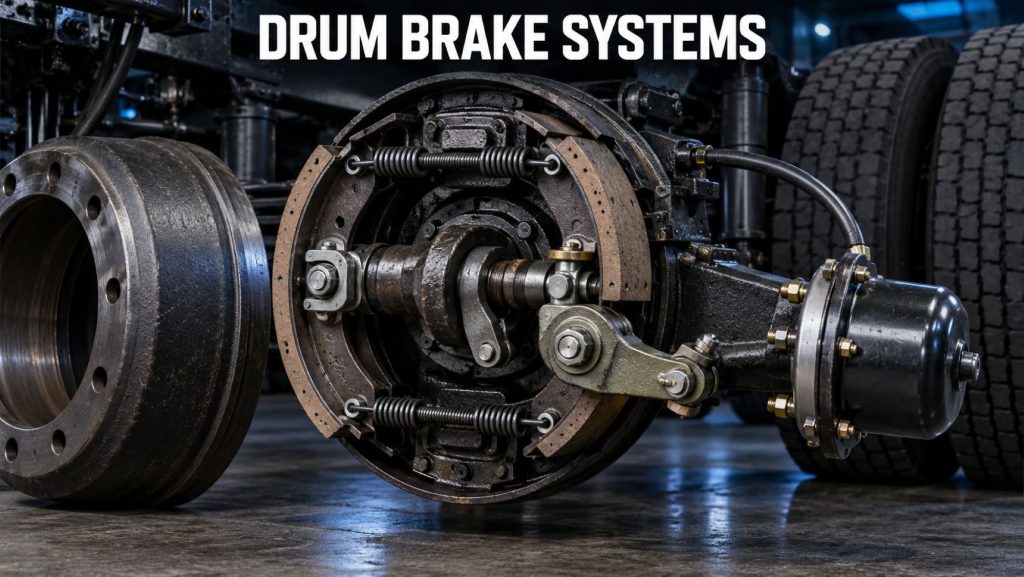
Commercial drum brake systems use brake shoes and friction linings that press against the inside surface of a rotating brake drum. The friction created between the linings and drum slows or stops the vehicle.
Drum brakes are widely used on drive axles, trailer axles, auxiliary axles, and some steer axles in highway, regional, vocational, construction, heavy-haul, bus, and specialty commercial applications.
Truck Equipment Atlas covers S-cam foundation brakes, brake shoes, friction linings, drums, camshafts, slack adjusters, brake chambers, return springs, mounting hardware, inspection requirements, maintenance considerations, and individual drum-brake products from major commercial braking manufacturers.
Drum Brake Systems on Truck Equipment Atlas
Explore the commercial drum brake systems and components being added to Truck Equipment Atlas:
Cummins-Meritor
Gunite
Webb
ConMet
Additional cam brakes, brake drums, shoes, friction materials, slack adjusters, and related foundation-brake components will be added as the Truck Equipment Atlas Brake Systems Library continues to expand.
How Commercial Drum Brakes Work
When the driver presses the brake pedal, compressed air is directed through the vehicle’s control valves to the brake chambers.
The air pressure moves a diaphragm inside each chamber. The diaphragm extends the chamber pushrod, which rotates the slack adjuster and brake camshaft.
An S-shaped cam at the opposite end of the camshaft rotates between two brake shoes. The S-cam forces the shoes outward until their friction linings contact the inside surface of the brake drum.
Friction between the stationary linings and rotating drum converts vehicle motion into heat. This slows the wheel and vehicle.
When the driver releases the brake pedal, air exhausts from the service side of the chamber. Return springs pull the brake shoes away from the drum, and the brake releases.
Major Drum Brake Components
A commercial S-cam drum brake assembly may include:
- Brake drum
- Brake shoes
- Friction linings
- S-camshaft
- Cam head
- Camshaft bushings
- Camshaft seals
- Slack adjuster
- Brake chamber
- Spring-brake chamber
- Pushrod
- Clevis
- Brake spider
- Anchor pins
- Anchor-pin bushings
- Return springs
- Retaining springs
- Rollers
- Roller retainers
- Dust shields
- Mounting hardware
- Lubrication fittings
- Wheel-speed sensor
- ABS tone ring
- Hub and wheel-end components
Exact component designs vary between manufacturers, brake sizes, axle positions, wheel configurations, and vehicle applications.
S-Cam Foundation Brakes
S-cam drum brakes are among the most common foundation brakes used on North American heavy commercial vehicles.
The system is named for the S-shaped cam that spreads the brake shoes during an application.
Potential characteristics include:
- Established commercial-vehicle design
- Strong braking capability
- Broad parts availability
- Familiar service procedures
- Multiple brake sizes
- Highway and vocational configurations
- Compatibility with service and spring-brake chambers
- Compatibility with automatic slack adjusters
- Steer, drive, auxiliary, and trailer applications
The complete brake assembly must be correctly matched to the axle rating, drum size, chamber size, slack-adjuster length, camshaft, wheel equipment, and intended duty cycle.
Brake Drums
The brake drum rotates with the wheel and provides the friction surface contacted by the brake linings.
Commercial brake drums are commonly manufactured from cast iron or engineered iron alloys designed to withstand repeated heating and cooling.
Important brake-drum characteristics include:
- Drum diameter
- Brake width
- Pilot diameter
- Bolt-hole pattern
- Mounting configuration
- Overall depth
- Maximum wear diameter
- Material composition
- Heat capacity
- Weight
- Balance
- Axle compatibility
Brake drums may use inboard, outboard, hub-piloted, spoke-wheel, or other application-specific mounting arrangements.
A replacement drum must match the hub, wheel, axle, foundation brake, brake size, and approved vehicle application.
Brake Shoes and Friction Linings
Brake shoes support the friction linings that contact the inside of the drum.
The friction material must provide controlled braking across a wide range of temperatures, vehicle weights, speeds, and operating conditions.
Brake shoes and linings should be inspected for:
- Remaining lining thickness
- Uneven wear
- Cracking
- Chipping
- Glazing
- Oil contamination
- Grease contamination
- Heat damage
- Loose rivets
- Damaged bonding
- Bent shoe tables
- Worn roller contact areas
- Worn anchor-pin openings
- Correct lining position
Replacement friction materials should be approved for the vehicle and foundation brake. Using mismatched lining materials across an axle can affect brake balance and stopping performance.
Brake Chambers
Brake chambers convert compressed-air pressure into the mechanical movement required to apply the foundation brakes.
Common chamber configurations include:
- Service brake chambers
- Combination spring-brake chambers
- Standard-stroke chambers
- Long-stroke chambers
- Steer-axle chambers
- Drive-axle chambers
- Trailer chambers
- Auxiliary-axle chambers
Brake-chamber size affects the amount of force delivered to the slack adjuster and camshaft. Installing an incorrect chamber can change brake output and create an imbalance between wheels or axles.
Combination spring-brake chambers also contain a powerful mechanical spring used for parking and emergency braking. They should only be serviced using approved safety procedures.
Explore Brake Chambers & Actuators for additional information.
Slack Adjusters
The slack adjuster connects the brake-chamber pushrod to the camshaft. It converts linear pushrod movement into camshaft rotation.
Most modern commercial vehicles use automatic slack adjusters designed to maintain the correct relationship between lining wear and chamber stroke.
Important slack-adjuster considerations include:
- Automatic or manual design
- Arm length
- Spline size
- Spline count
- Clevis position
- Installation angle
- Chamber compatibility
- Camshaft compatibility
- Lubrication requirements
- Adjustment mechanism
An automatic slack adjuster that repeatedly requires manual adjustment may have an underlying mechanical problem. The chamber, pushrod, clevis, camshaft, bushings, shoes, drum, return springs, and adjuster should be inspected.
Repeated manual adjustment should not be used as a permanent repair.
Camshafts and Bushings
The S-camshaft transfers movement from the slack adjuster to the brake shoes.
Camshafts and their support bushings must rotate freely while maintaining proper alignment.
Wear or damage may cause:
- Excessive free movement
- Uneven brake application
- Brake drag
- Poor brake release
- Abnormal pushrod stroke
- Uneven lining wear
- Reduced braking force
- Lubricant contamination
- Excessive component noise
Camshafts may differ by length, spline, cam-head design, rotation direction, axle position, and brake model. Left- and right-hand components may not be interchangeable.
Brake Spiders and Anchor Points
The brake spider supports the foundation-brake components and attaches the brake assembly to the axle.
Brake shoes pivot against anchor pins or other support points mounted to the spider.
Inspection areas can include:
- Cracks
- Distortion
- Corrosion
- Loose fasteners
- Damaged welds
- Worn anchor-pin openings
- Worn bushings
- Damaged mounting surfaces
- Contamination
- Improper repairs
A damaged or distorted spider can prevent the shoes from contacting the drum evenly and may cause poor braking, abnormal wear, or brake drag.
Brake Stroke and Adjustment
Brake stroke is the distance the chamber pushrod moves when the brake is applied.
Excessive pushrod stroke may indicate:
- Worn brake linings
- Worn brake drum
- Incorrect adjustment
- Failed automatic slack adjuster
- Worn camshaft bushings
- Incorrect chamber installation
- Damaged foundation-brake components
- Excessive component clearance
- Incorrect clevis position
Brake stroke must remain within the applicable inspection limit for the chamber type and size.
Long-stroke chambers normally have different identification and allowable stroke limits than standard-stroke chambers. Technicians and inspectors must correctly identify the chamber before evaluating stroke.
Drum-Brake Heat and Brake Fade
Braking converts vehicle motion into heat. The drum, linings, shoes, and surrounding components must absorb and release that heat.
During repeated or prolonged braking, drum temperature can rise substantially.
Excessive heat may cause:
- Brake fade
- Reduced friction
- Expanded drums
- Glazed linings
- Cracked drums
- Heat checking
- Damaged seals
- Wheel-bearing damage
- Tire damage
- Brake fire
- Permanent drum distortion
As the drum heats, it expands away from the brake shoes. This can increase the distance the shoes must travel before contacting the drum and may contribute to reduced braking effectiveness.
Drivers should select an appropriate transmission gear before descending a grade and use engine braking or retarders when available and appropriate.
Brake-Drum Inspection
Commercial brake drums should be inspected according to the vehicle and component manufacturers’ procedures.
Important inspection areas include:
- Maximum inside diameter
- Surface cracking
- Heat checking
- Deep scoring
- Grooving
- Out-of-round condition
- Bell-mouthing
- Hard spots
- Blue discoloration
- Missing material
- Mounting damage
- Wheel-stud damage
- Pilot damage
- Corrosion
- Oil or grease contamination
A drum should not remain in service beyond its marked or specified wear limit.
Brake drums suspected of damage should be cleaned and inspected carefully. Dirt, rust, and brake dust can hide cracks or surface defects.
Steer-Axle Drum Brakes
Some commercial trucks, buses, and specialty vehicles use drum brakes on the steer axle.
Important steer-axle considerations include:
- Left-to-right brake balance
- Chamber size
- Slack-adjuster length
- Camshaft rotation
- Drum condition
- Lining material
- Tire traction
- Wheel alignment
- Suspension condition
- Steering-component condition
Unequal braking on the steer axle may cause the vehicle to pull during a stop.
Brake condition should be evaluated together with tire pressure, tread, wheel alignment, wheel bearings, suspension, and steering components.
Drive-Axle Drum Brakes
Drum brakes are widely used on single and tandem drive axles.
Drive-axle systems commonly use combination spring-brake chambers that provide service, parking, and emergency-brake functions.
Drive-axle applications must account for:
- Gross axle weight rating
- Single or tandem configuration
- Brake size
- Chamber size
- Spring-brake requirements
- Drum capacity
- Suspension design
- Wheel configuration
- Tire capacity
- ABS equipment
- Differential and axle clearances
- Vehicle duty cycle
Drive-axle brakes must be balanced with the steer-axle and trailer brakes to provide stable stopping performance.
Trailer Drum Brakes
S-cam drum brakes remain common on dry vans, refrigerated trailers, flatbeds, tank trailers, dump trailers, container chassis, and specialty trailers.
Trailer drum-brake equipment may include:
- Brake drums
- Brake shoes
- Friction linings
- S-camshafts
- Automatic slack adjusters
- Service chambers
- Spring-brake chambers
- Relay emergency valve
- Trailer ABS
- Wheel-speed sensors
- Tone rings
- Air lines
- Gladhands
- Suspension-mounted axle components
Trailer brake condition directly affects the stopping performance and stability of the complete tractor-trailer combination.
Explore Trailer Brake Systems for additional information.
Truck and Trailer Brake Balance
A tractor-trailer combination depends on balanced braking across the steer, drive, and trailer axles.
Poor brake balance may cause:
- Trailer pushing
- Tractor pulling
- Wheel lockup
- Uneven lining wear
- Overheated drums
- Premature ABS operation
- Increased stopping distance
- Vehicle instability
- Trailer swing
- Reduced directional control
Brake balance depends on:
- Air-delivery timing
- Valve operation
- Chamber size
- Slack-adjuster length
- Brake dimensions
- Friction material
- Drum condition
- Brake adjustment
- Axle loading
- Tire traction
- ABS operation
- Tractor and trailer compatibility
Components that appear physically similar may deliver different braking performance. Replacement parts must match the original brake specification and approved application.
Drum Brakes and Air Disc Brakes
Drum brakes and air disc brakes both use compressed air to create braking force, but their foundation-brake mechanisms are different.
Drum brakes use:
- Brake drums
- Brake shoes
- Friction linings
- S-camshafts
- Slack adjusters
- Return springs
Air disc brakes use:
- Brake rotors
- Brake pads
- Calipers
- Pneumatic actuators
- Internal adjustment mechanisms
Potential drum-brake advantages can include lower initial cost, broad parts availability, familiar maintenance procedures, multiple severe-duty configurations, and established service support.
Potential air disc brake advantages can include easier friction inspection, strong fade resistance, automatic adjustment, consistent response, and simplified pad replacement on some systems.
The correct brake depends on the vehicle, axle, application, operating environment, maintenance capabilities, and total ownership cost.
Learn more in Air Disc Brakes vs Drum Brakes.
Drum Brakes and ABS
Drum brakes can be integrated with an antilock braking system.
ABS equipment may include:
- Wheel-speed sensors
- Tone rings
- Electronic control unit
- Modulator valves
- Wiring harnesses
- Warning lamps
- Tractor-trailer communication
When a wheel approaches lockup, ABS can reduce and reapply air pressure to help maintain wheel rotation and directional control.
ABS does not correct worn linings, cracked drums, excessive pushrod stroke, contaminated friction material, damaged chambers, poor tires, or improper loading.
Explore ABS & Electronic Braking Systems for additional information.
Highway Drum-Brake Applications
Long-haul and regional vehicles require dependable braking during high-mileage highway operation.
Important considerations can include:
- Friction-material life
- Drum life
- Brake adjustment
- Highway stopping performance
- Mountain operation
- Tractor-trailer balance
- Brake temperature
- ABS compatibility
- Inspection access
- Replacement-parts availability
- Technician familiarity
- Maintenance intervals
- Vehicle downtime
Properly maintained drum brakes can provide reliable service across demanding highway duty cycles. Actual component life depends on route, vehicle weight, driver operation, brake balance, friction material, and maintenance practices.
Vocational Drum-Brake Applications
Vocational vehicles can place substantial demands on drum brakes.
Common applications include:
- Dump trucks
- Refuse trucks
- Concrete mixers
- Construction trucks
- Logging trucks
- Heavy-haul tractors
- Tank trucks
- Utility trucks
- Municipal vehicles
- Snowplows
- Oilfield trucks
- Mining vehicles
- Fire apparatus
- Recovery vehicles
- Severe-service equipment
These vehicles may experience frequent stopping, steep grades, high axle loads, mud, water, road salt, dust, abrasive material, and repeated low-speed brake applications.
Vocational drum brakes may require larger brake sizes, heavy-duty drums, severe-duty friction materials, protective components, and more frequent inspection.
Advantages of Commercial Drum Brakes
Depending on their design and application, commercial drum brakes can provide:
- Strong braking capability
- Established heavy-duty design
- Broad replacement-parts availability
- Familiar service procedures
- Multiple brake sizes
- Highway configurations
- Vocational configurations
- Severe-service configurations
- Steer, drive, auxiliary, and trailer applications
- Compatibility with spring brakes
- Compatibility with automatic slack adjusters
- ABS integration
- Lower initial cost in many applications
- Extensive industry service support
The actual benefits depend on correct brake selection, installation, adjustment, vehicle loading, maintenance, tire traction, and driver operation.
Drum-Brake Limitations and Considerations
No single drum-brake configuration is appropriate for every commercial vehicle.
Important considerations include:
- Brake adjustment
- Pushrod stroke
- Drum wear
- Lining wear
- Heat buildup
- Brake fade
- Drum expansion
- Camshaft wear
- Bushing wear
- Slack-adjuster condition
- Chamber compatibility
- Friction-material selection
- Brake balance
- Contamination
- Inspection access
- Component weight
- Vehicle duty cycle
- Technician training
- Replacement-parts compatibility
An incorrectly adjusted or poorly maintained drum brake can create excessive stopping distance, brake imbalance, overheating, rapid wear, or an out-of-service inspection condition.
Driver and Operator Considerations
Drivers should understand the normal braking behavior of the vehicle and report changes promptly.
Important warning signs include:
- Vehicle pulling during braking
- Increased stopping distance
- Brake warning lamps
- ABS warning lamps
- Grinding or scraping noises
- Burning odors
- Smoke near a wheel
- Excessive wheel-end heat
- Reduced braking force
- Brake drag
- Air leaks
- Low air pressure
- Changes in pedal response
- Parking-brake problems
- Abnormal brake-chamber movement
Drivers should avoid riding the brakes on long downgrades. Continuous light braking can create enough heat to cause fade and component damage.
Maintenance and Ownership
Commercial drum brakes require regular inspection and preventive maintenance.
Important maintenance areas can include:
- Brake-lining thickness
- Lining condition
- Brake-shoe condition
- Brake-drum diameter
- Drum surface condition
- Drum cracking
- Brake-chamber condition
- Spring-brake chamber condition
- Pushrod stroke
- Slack-adjuster operation
- Camshaft condition
- Camshaft bushings
- Camshaft seals
- Brake return springs
- Anchor pins
- Brake rollers
- Brake spider
- Dust shields
- Lubrication points
- Air lines and fittings
- Wheel-speed sensors
- ABS tone rings
- Hub and wheel bearings
- Wheel seals
- Tire condition
Maintenance requirements vary between manufacturers, models, brake sizes, axle positions, duty cycles, friction materials, and operating environments. Owners and technicians should follow the procedures and service limits specified for the exact brake system.
Choosing a Commercial Drum Brake
Selecting a drum brake or replacement component requires evaluating the complete axle, wheel-end, suspension, and vehicle specification.
Important factors include:
- Truck or trailer application
- Vehicle manufacturer
- Model and model year
- Axle manufacturer
- Axle model
- Axle position
- Gross axle weight rating
- Wheel size
- Tire size
- Hub configuration
- Brake diameter
- Brake width
- Brake-drum dimensions
- Friction-material specification
- Chamber type and size
- Slack-adjuster length
- Camshaft configuration
- Spring-brake requirements
- ABS configuration
- Suspension compatibility
- Highway or vocational operation
- Operating environment
- Expected brake temperature
- Maintenance capabilities
- Parts availability
- Dealer and service support
There is no single best drum brake for every commercial vehicle. The correct brake is one properly matched to the axle, wheels, tires, suspension, air system, operating conditions, and work the vehicle is expected to perform.
Related Brake System Categories
Explore additional brake-system categories:
- Air Brake Systems
- Air Disc Brake Systems
- Brake Chambers & Actuators
- ABS & Electronic Braking Systems
- Trailer Brake Systems
- Brake System Guides
Related Brake System Guides
- Air Brake Systems Explained
- Air Disc Brakes vs Drum Brakes
- How to Inspect and Maintain Commercial Truck Brakes
- Tractor vs Trailer Brake Systems
- How Truck ABS and Electronic Stability Control Work
- Commercial Truck Brake Components Explained
Related Truck Equipment Resources
- Commercial Trucks
- Commercial Trailers
- Brake Systems
- Air Brake Systems
- Axles & Differentials
- Suspension Systems
- Tires & Wheels
- Equipment Systems
Understanding how the brake drum, shoes, friction linings, camshaft, slack adjuster, brake chamber, axle, wheel end, air system, ABS, tires, vehicle loading, and driver operation work together is essential when evaluating a commercial drum brake system.
Explore the Complete Brake Systems Library
Drum brakes represent one part of the larger commercial braking-equipment landscape.
Visit the Truck Equipment Atlas Brake Systems Library to explore air brake systems, air disc brakes, drum brakes, brake chambers and actuators, ABS and electronic braking systems, trailer brake systems, individual equipment profiles, and educational guides.
Additional cam brakes, drums, brake shoes, friction materials, slack adjusters, manufacturers, historical systems, and educational resources will be added as Truck Equipment Atlas continues to expand.