
Trailer Brake Systems
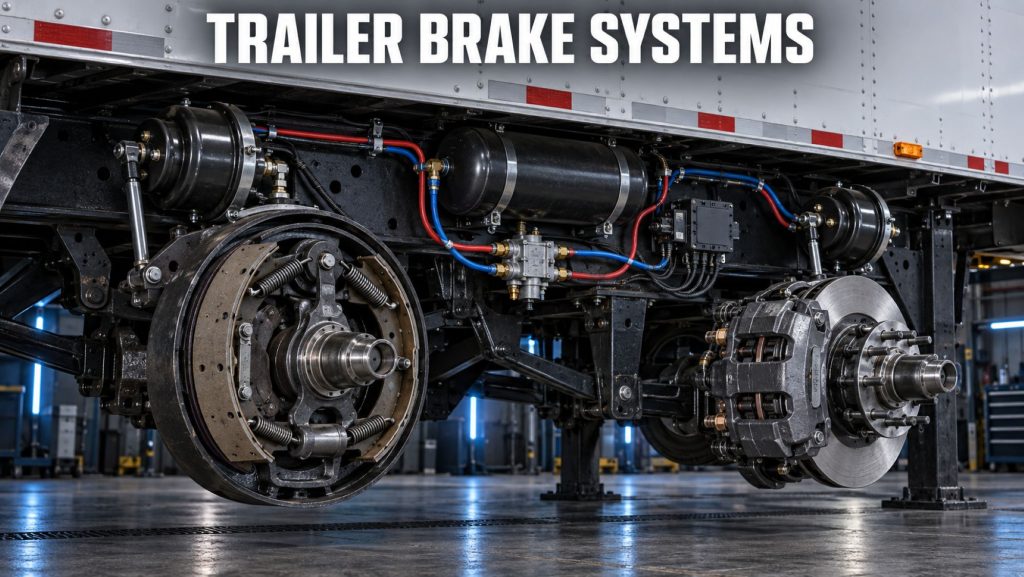
Commercial trailer brake systems use compressed air, control valves, brake chambers, foundation brakes, and electronic components to slow, stop, and hold a trailer. The tractor supplies and controls the air used by the trailer’s braking system.
Most heavy commercial trailers use air-operated drum brakes or air disc brakes. Modern trailers also use antilock braking systems, spring-applied parking brakes, emergency-brake functions, and electronic stability technologies.
Truck Equipment Atlas covers trailer air systems, relay emergency valves, reservoirs, spring brakes, drum brakes, air disc brakes, ABS controllers, modulator valves, wheel-speed sensors, tractor-trailer connections, inspection requirements, maintenance considerations, and individual trailer-brake products from major commercial braking manufacturers.
Trailer Brake Systems on Truck Equipment Atlas
Explore the commercial trailer-brake systems and products being added to Truck Equipment Atlas:
Bendix
Haldex
SAF-Holland
Additional trailer ABS, relay emergency valves, air disc brakes, drum brakes, spring brakes, stability systems, air controls, and related trailer-braking components will be added as the Truck Equipment Atlas Brake Systems Library continues to expand.
Related Trailer-Brake Products
Other products in the Brake Systems Library that may be used in trailer applications include:
These products remain listed in their primary Air Disc Brake or ABS and Electronic Braking categories while also connecting to the Trailer Brake Systems library.
How Commercial Trailer Brake Systems Work
The tractor supplies compressed air to the trailer through the emergency or supply line. This air charges the trailer reservoirs and releases the trailer’s spring brakes.
When the driver presses the tractor’s brake pedal, a control signal travels through the service line to the trailer.
A trailer relay valve uses that signal to release stored air from the trailer reservoir into the service-brake chambers. This allows the trailer brakes to apply quickly without depending on air traveling directly from the tractor reservoirs to every trailer wheel.
The brake chambers convert air pressure into mechanical movement.
On an S-cam drum brake, the chamber pushrod moves the slack adjuster and camshaft. The S-cam forces the brake shoes against the inside of the drum.
On an air disc brake, the actuator applies the caliper, pressing the brake pads against the rotor.
When the driver releases the brake pedal, the relay valve exhausts air from the service chambers and the foundation brakes release.
Major Trailer Brake System Components
A commercial trailer brake system may include:
- Trailer air reservoir
- Supply air line
- Service air line
- Emergency or supply gladhand
- Service gladhand
- Relay emergency valve
- Trailer-supply valve
- Pressure-protection components
- Check valves
- Drain valves
- Air lines and hoses
- Service brake chambers
- Combination spring-brake chambers
- Automatic slack adjusters
- S-camshafts
- Brake shoes
- Friction linings
- Brake drums
- Air disc brake actuators
- Brake calipers
- Brake pads
- Brake rotors
- Trailer ABS controller
- ABS modulator valves
- Wheel-speed sensors
- ABS tone rings
- Trailer ABS warning lamp
- Electrical wiring harnesses
- Tractor-to-trailer electrical connection
- Trailer stability-control components
Exact equipment depends on the trailer type, number of axles, suspension, foundation brakes, production year, and electronic control configuration.
Tractor-to-Trailer Air Connections
A tractor and semitrailer normally use two pneumatic connections:
- Emergency or supply line
- Service or control line
The lines connect through gladhands mounted at the rear of the tractor and front of the trailer.
The supply line charges the trailer reservoirs and keeps the trailer spring brakes released during normal operation.
The service line carries the braking signal created when the driver presses the brake pedal or operates an approved trailer-brake control.
The lines are commonly color-coded:
- Red for the emergency or supply line
- Blue for the service or control line
Color alone should not be used to verify a connection. The tractor and trailer connections, labels, routing, and system operation should be checked.
Trailer Gladhands and Air Hoses
Gladhands create removable seals between the tractor and trailer air systems.
They should be inspected for:
- Damaged seals
- Missing seals
- Cracked housings
- Loose fittings
- Corrosion
- Dirt or debris
- Oil contamination
- Air leakage
- Improper connection
- Damaged locking surfaces
- Restricted passages
Trailer air hoses should be inspected for:
- Cracking
- Chafing
- Kinking
- Stretching
- Heat damage
- Improper support
- Contact with the catwalk
- Contact with the driveshaft
- Excessive sag
- Incorrect routing
An air leak at a gladhand or hose can slow reservoir charging, increase compressor cycling, reduce available air pressure, or cause the trailer spring brakes to apply.
Trailer Air Reservoirs
The trailer reservoir stores compressed air supplied by the tractor.
Stored air allows the trailer brakes to respond without waiting for air to travel from the tractor each time the driver applies the brakes.
Trailer reservoirs should be inspected for:
- Air leakage
- Moisture accumulation
- Oil contamination
- Internal corrosion
- External corrosion
- Damaged mounting brackets
- Loose mounting straps
- Damaged drain valves
- Impact damage
- Improper repairs
The reservoir should be drained and maintained according to the trailer and brake-system manufacturers’ instructions.
Excessive moisture may indicate problems with the tractor’s air dryer, compressor, maintenance program, or operating duty cycle.
Relay Emergency Valves
The relay emergency valve is a central part of many trailer air-brake systems.
Its functions may include:
- Charging the trailer reservoir
- Relaying service-brake pressure
- Applying trailer brakes after supply-line failure
- Controlling spring-brake release
- Protecting stored trailer air
- Exhausting brake-chamber pressure
During normal braking, the service-line signal causes the relay valve to direct reservoir air into the brake chambers.
If supply-line pressure is lost, the valve helps initiate the trailer’s emergency-brake response according to its design.
Replacement relay emergency valves must match the trailer’s air-system arrangement, brake chambers, reservoir, axle count, and approved application.
Trailer Service Brakes
The trailer service brakes operate when the driver presses the tractor brake pedal.
The amount of service-line pressure generally follows the driver’s braking demand. The trailer relay valve uses that signal to apply the trailer’s foundation brakes.
Trailer service-brake performance depends on:
- Tractor control pressure
- Service-line condition
- Relay-valve operation
- Reservoir pressure
- Air-line size and routing
- Brake-chamber size
- Foundation-brake condition
- Brake adjustment
- Axle loading
- Tire traction
- ABS operation
- Tractor-trailer brake balance
A delay or imbalance in trailer brake application can affect the stability and stopping distance of the complete combination.
Trailer Spring Brakes
Combination spring-brake chambers provide service, parking, and emergency functions.
The spring-brake section contains a powerful mechanical spring. Air pressure compresses the spring and allows the brake to release.
When the trailer parking brakes are applied or trailer supply pressure is removed, air exhausts from the spring-brake chambers. The mechanical springs then apply the foundation brakes.
Spring brakes may apply when:
- The driver operates the parking-brake control
- The trailer is disconnected
- The trailer-supply line separates
- Supply pressure falls below the system’s operating range
- The emergency system activates
Spring-brake chambers contain substantial stored mechanical energy. They should only be serviced according to approved procedures.
Trailer Emergency Braking
The trailer emergency-brake system is designed to apply braking force if the trailer loses its normal supply connection.
Possible causes include:
- Trailer separation
- Broken supply hose
- Disconnected gladhand
- Major air leak
- Tractor-protection valve activation
- Loss of tractor air pressure
- Damaged trailer plumbing
The exact response depends on the trailer valve and spring-brake configuration.
Emergency braking is not a substitute for properly maintained coupling equipment. Fifth wheels, kingpins, locking mechanisms, safety equipment, air lines, and electrical connections must all be inspected before operation.
Trailer Drum Brakes
S-cam drum brakes remain widely used on commercial trailers.
A trailer drum-brake assembly may include:
- Brake chamber
- Pushrod
- Clevis
- Automatic slack adjuster
- S-camshaft
- Camshaft bushings
- Brake spider
- Brake shoes
- Friction linings
- Return springs
- Brake drum
- Wheel-speed sensor
- ABS tone ring
Potential drum-brake characteristics include:
- Established heavy-duty design
- Broad parts availability
- Familiar service procedures
- Multiple brake sizes
- Highway and vocational configurations
- Lower initial cost in many applications
Drum brakes require correct adjustment and can be affected by excessive heat, worn linings, oversized drums, damaged return springs, camshaft wear, contamination, and excessive pushrod stroke.
Explore Drum Brake Systems for additional information.
Trailer Air Disc Brakes
Trailer air disc brakes use a pneumatic actuator and caliper to press brake pads against a rotor.
Potential advantages can include:
- Consistent stopping performance
- Strong resistance to brake fade
- Automatic adjustment
- Easier pad inspection
- Simplified pad replacement on some systems
- Balanced braking response
- Effective ABS integration
- Reduced stopping distances in some configurations
Trailer air disc brake selection depends on:
- Axle rating
- Wheel size
- Hub configuration
- Rotor design
- Suspension
- Tire capacity
- Actuator type
- Parking-brake requirements
- ABS configuration
- Operating environment
- Trailer duty cycle
Explore Air Disc Brake Systems for additional information.
Trailer Antilock Braking Systems
Trailer ABS monitors wheel speed and controls brake pressure when a wheel approaches lockup.
A trailer ABS may include:
- Electronic control unit
- Relay modulator valve
- Wheel-speed sensors
- Tone rings
- Wiring harnesses
- Power connection
- Trailer ABS warning lamp
- Diagnostic connector
- Tractor communication
The controller compares wheel-speed signals. If a monitored wheel decelerates too quickly, the system may hold, reduce, and reapply brake pressure.
ABS helps preserve wheel rotation and vehicle stability during hard braking. It does not create additional traction or correct mechanical brake defects.
Trailer ABS Configurations
Trailer ABS configurations are often described by the number of wheel-speed sensors and modulator channels.
Possible configurations include:
- Two sensors and one modulator
- Two sensors and two modulators
- Four sensors and two modulators
- Four sensors and three modulators
- Application-specific multi-axle arrangements
The correct configuration depends on:
- Number of trailer axles
- Axle spacing
- Suspension design
- Air-line plumbing
- Foundation-brake type
- Lift-axle equipment
- Trailer stability functions
- Controller capability
- Approved manufacturer configuration
Additional sensors or modulators should not be added without confirming compatibility with the controller, wiring, plumbing, and trailer design.
Trailer ABS Warning Lamp
The trailer ABS warning lamp provides information about the trailer’s antilock system.
The lamp normally illuminates during the startup check and turns off after the controller confirms normal operation.
An illuminated warning lamp may indicate:
- Wheel-speed sensor fault
- Tone-ring problem
- Damaged wiring
- Corroded connector
- Modulator-valve fault
- Controller fault
- Power-supply problem
- Ground problem
- Incorrect configuration
- Communication fault
Normal foundation-brake operation may remain available during some ABS faults, but the antilock function may be limited or disabled.
The warning should be diagnosed promptly.
Power-Line Carrier Communication
Some trailer ABS systems use power-line carrier communication to send information through the existing electrical power circuit.
This may allow the trailer ABS to communicate warning or diagnostic information to the tractor without requiring a separate communication wire.
Power-line communication depends on:
- Correct electrical voltage
- Clean power supply
- Proper ground connections
- Compatible tractor equipment
- Compatible trailer equipment
- Serviceable connectors
- Undamaged wiring
- Correct controller configuration
Corrosion, voltage loss, poor grounds, damaged connectors, or incompatible components can interfere with communication.
Trailer Stability Systems
Trailer stability-control systems build on ABS hardware and may monitor trailer movement for developing rollover conditions.
Depending on the system, stability control may use:
- Wheel-speed sensors
- Lateral-acceleration sensor
- Brake-pressure information
- Electronic control unit
- ABS modulator valves
- Trailer loading estimates
- Tractor communication
When excessive lateral movement is detected, the system may automatically apply selected trailer brakes to reduce speed.
Trailer stability control supports the driver but cannot prevent every rollover.
Vehicle speed, cargo position, center of gravity, tire traction, road shape, and driver input remain critical.
Tractor and Trailer Brake Balance
A tractor-trailer combination depends on balanced braking across the tractor steer axle, tractor drive axles, and trailer axles.
Poor brake balance may cause:
- Trailer pushing
- Tractor pulling
- Trailer wheel lockup
- Tractor wheel lockup
- Uneven brake wear
- Brake overheating
- Premature ABS activation
- Increased stopping distance
- Trailer swing
- Reduced directional stability
Brake balance depends on:
- Tractor control pressure
- Trailer service-line response
- Relay-valve timing
- Brake-chamber size
- Foundation-brake type
- Brake adjustment
- Friction material
- Axle loading
- Tire traction
- ABS operation
- Tractor and trailer compatibility
Learn more in Tractor vs Trailer Brake Systems.
Trailer Brake Timing
Brake timing describes how quickly the trailer brakes apply and release after receiving a control signal.
Timing can be affected by:
- Air-line length
- Air-line diameter
- Relay-valve location
- Relay-valve condition
- Reservoir location
- Reservoir pressure
- Air leaks
- Restricted lines
- Incorrect plumbing
- Chamber size
- ABS modulator valves
- Trailer length
- Number of axles
Excessive delay may allow the trailer to push the tractor before its brakes apply fully. Brakes that release too slowly may drag and overheat.
Replacement valves and air lines must maintain the approved timing and flow characteristics of the trailer brake system.
Sliding Tandem and Suspension Considerations
Many semitrailers use sliding tandem suspension systems.
Moving the slider changes:
- Axle position
- Weight distribution
- Air-line movement
- Wiring-harness movement
- ABS sensor connections
- Brake-chamber clearance
- Tire clearance
- Vehicle handling
Flexible air lines and wiring must have enough length to accommodate the slider’s full travel without dragging, stretching, pinching, or rubbing.
Slider locks, air lines, electrical wiring, suspension components, brake chambers, and axle connections should be inspected after moving the tandem.
Lift-Axle Trailer Brakes
Some trailers use liftable or auxiliary axles.
Brake-system considerations may include:
- Axle raised or lowered position
- Air-suspension controls
- Brake-chamber clearance
- Air-line routing
- ABS sensor arrangement
- Modulator configuration
- Wheel-speed signal when lifted
- Automatic axle deployment
- Load-based control
- Regulatory requirements
Lift-axle brake and ABS configurations must be approved for the trailer design and operating jurisdiction.
Highway Trailer Applications
Highway trailers require dependable braking across long-distance and high-mileage service.
Common applications include:
- Dry vans
- Refrigerated trailers
- Flatbeds
- Step decks
- Tank trailers
- Hopper trailers
- Container chassis
- Automobile transporters
- Lowboy trailers
- Specialized trailers
Important highway considerations can include:
- Tractor-trailer balance
- Foundation-brake life
- Brake heat
- ABS reliability
- Air-line protection
- Electrical connections
- Slider movement
- Replacement-parts availability
- Inspection access
- Maintenance intervals
- Trailer interchange
- Vehicle downtime
Trailers that connect to multiple tractors should be inspected for compatible air and electrical connections before operation.
Vocational and Severe-Duty Trailer Applications
Vocational trailers may operate in construction, logging, aggregate, waste, oilfield, mining, and heavy-haul service.
These applications may expose brake systems to:
- Mud
- Water
- Dust
- Road salt
- Gravel
- Stone impacts
- Extreme articulation
- High axle loads
- Steep grades
- Frequent low-speed stops
- Corrosive materials
- Off-highway operation
Severe-duty applications may require specialized brake sizes, friction materials, drums, rotors, chambers, protective routing, and shorter inspection intervals.
Advantages of Commercial Trailer Brake Systems
Depending on their design and application, modern trailer brake systems can provide:
- Braking across multiple trailer axles
- Tractor-controlled service braking
- Stored compressed-air supply
- Spring-applied parking brakes
- Emergency-brake capability
- Drum-brake compatibility
- Air disc brake compatibility
- Antilock braking
- Stability-control capability
- Tractor-trailer communication
- Multiple axle configurations
- Highway and vocational applications
- Diagnostic fault storage
- Broad commercial service support
The actual performance depends on correct system design, trailer loading, foundation-brake condition, tire traction, maintenance, and driver operation.
Trailer Brake System Limitations and Considerations
No single trailer brake configuration is appropriate for every application.
Important considerations include:
- Trailer type
- Number of axles
- Gross axle weight ratings
- Drum or air disc brakes
- Brake size
- Brake-chamber size
- Spring-brake requirements
- ABS configuration
- Air-line routing
- Electrical wiring
- Suspension design
- Sliding-tandem movement
- Lift-axle operation
- Tractor compatibility
- Trailer loading
- Brake balance
- Operating environment
- Inspection requirements
- Replacement-parts availability
- Technician training
A trailer with poorly adjusted, damaged, contaminated, or unbalanced brakes can increase stopping distance and reduce the stability of the complete combination.
Driver and Operator Considerations
Drivers should check trailer brake operation during every pre-trip inspection.
Important inspection and operating areas include:
- Air-line connections
- Gladhand seals
- Electrical connection
- Trailer air pressure
- Air leakage
- Spring-brake release
- Service-brake response
- Trailer ABS warning lamp
- Brake-chamber condition
- Pushrod stroke
- Slack-adjuster position
- Air hoses and wiring
- Foundation-brake condition
- Wheel-end heat
- Burning odors
- Smoke near a wheel
- Tractor-trailer brake balance
Drivers should report changes in trailer braking, pulling, pushing, ABS warnings, air loss, or wheel-end temperature immediately.
Maintenance and Ownership
Commercial trailer brake systems require regular inspection and preventive maintenance.
Important maintenance areas can include:
- Gladhands and seals
- Supply and service hoses
- Air lines and fittings
- Air reservoir
- Reservoir drain valve
- Relay emergency valve
- Check valves
- Brake chambers
- Spring-brake chambers
- Pushrod stroke
- Automatic slack adjusters
- Camshafts and bushings
- Brake shoes and linings
- Brake drums
- Air disc brake calipers
- Brake pads
- Brake rotors
- Wheel-speed sensors
- Tone rings
- ABS modulator valves
- Electronic control unit
- Wiring harnesses
- Electrical connectors
- Warning lamp
- Wheel bearings
- Hub seals
- Tires and wheels
Maintenance requirements vary between manufacturers, trailer types, brake designs, axle configurations, duty cycles, and operating environments. Owners and technicians should follow the procedures specified for the exact trailer and braking system.
Choosing a Commercial Trailer Brake System
Selecting trailer brake equipment requires evaluating the complete trailer specification.
Important factors include:
- Trailer manufacturer
- Trailer model
- Model year
- Vehicle identification number
- Trailer type
- Number of axles
- Axle manufacturer and model
- Gross axle weight rating
- Suspension type
- Fixed or sliding tandem
- Lift-axle equipment
- Drum or air disc brakes
- Brake size
- Chamber size and stroke
- Spring-brake requirements
- Hub and wheel-end design
- Wheel and tire size
- ABS configuration
- Stability-control requirements
- Air-line arrangement
- Electrical system
- Tractor compatibility
- Highway or vocational operation
- Maintenance capabilities
- Parts and service support
There is no single best trailer brake system for every application. The correct system is one properly matched to the axles, suspension, wheels, tires, air system, electrical system, cargo, operating environment, and towing equipment.
Related Brake System Categories
Explore additional brake-system categories:
- Air Brake Systems
- Air Disc Brake Systems
- Drum Brake Systems
- Brake Chambers & Actuators
- ABS & Electronic Braking Systems
- Brake System Guides
Related Brake System Guides
- Air Brake Systems Explained
- Air Disc Brakes vs Drum Brakes
- How to Inspect and Maintain Commercial Truck Brakes
- Tractor vs Trailer Brake Systems
- How Truck ABS and Electronic Stability Control Work
- Commercial Truck Brake Components Explained
Related Truck Equipment Resources
- Commercial Trucks
- Commercial Trailers
- Brake Systems
- Air Brake Systems
- Commercial Trailer Axles
- Trailer Suspension Systems
- Axles & Differentials
- Suspension Systems
- Tires & Wheels
- Equipment Systems
Understanding how the tractor air supply, trailer reservoirs, relay valves, brake chambers, foundation brakes, ABS, axles, suspension, tires, trailer loading, and driver controls work together is essential when evaluating a commercial trailer brake system.
Explore the Complete Brake Systems Library
Trailer brake systems represent one part of the larger commercial braking-equipment landscape.
Visit the Truck Equipment Atlas Brake Systems Library to explore air brake systems, air disc brakes, drum brakes, brake chambers and actuators, ABS and electronic braking systems, trailer brake systems, individual equipment profiles, and educational guides.
Additional trailer ABS systems, relay valves, chambers, drum brakes, air disc brakes, stability technologies, manufacturers, historical systems, and educational resources will be added as Truck Equipment Atlas continues to expand.