
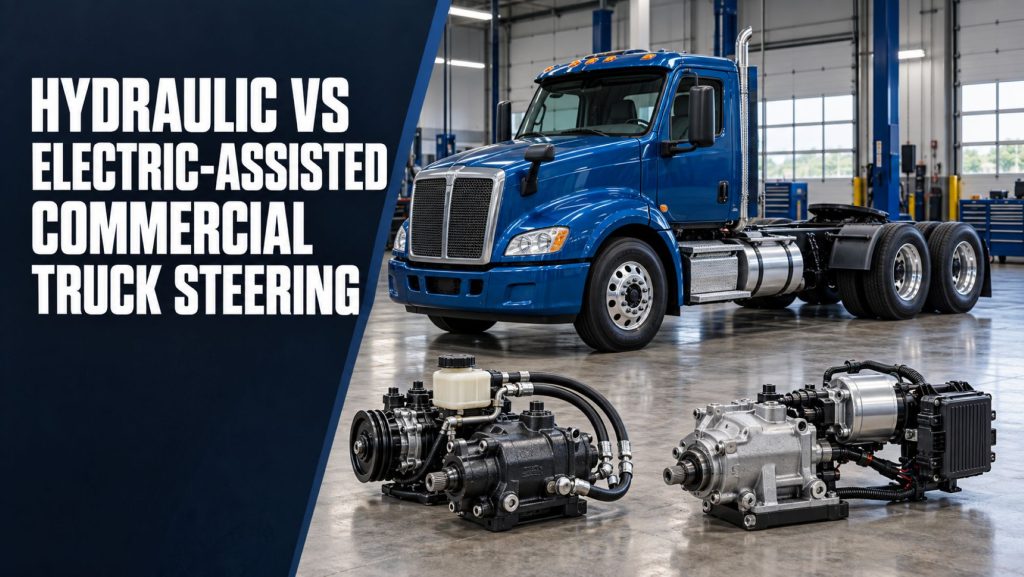
Commercial trucks depend on steering assistance to help the driver turn heavy steer-axle loads safely and predictably. Conventional hydraulic power steering has served this role for decades, while electric-assisted and electrohydraulic systems are becoming more common as manufacturers pursue greater efficiency, electronic control, and integration with advanced driver-assistance systems.
This guide compares hydraulic and electric-assisted commercial truck steering, explains how each system works, and examines their differences in steering feel, energy use, maintenance, reliability, vehicle integration, and application suitability.
For a broader explanation of steering gears, columns, shafts, linkages, kingpins, and steer axles, begin with How Commercial Truck Steering Systems Work.
Why Commercial Trucks Need Steering Assistance
A loaded commercial truck may place thousands of pounds on its front axle. Tire contact area, steering geometry, vehicle speed, road surface, axle rating, and front-mounted equipment can all increase the effort required to turn the steer wheels.
Steering assistance reduces driver effort while allowing the mechanical steering system to control wheel direction. It must work with the steering gear, pitman arm, drag link, steering arms, tie rod, kingpins, wheel ends, tires, and commercial truck steer axle.
The amount and character of assistance must also change with operating conditions. A truck needs substantial assistance during low-speed maneuvering, but excessive assistance at highway speed can reduce road feel and make the vehicle overly sensitive.
What Is Hydraulic Power Steering?
Hydraulic power steering uses pressurized fluid to multiply the force the driver applies through the steering wheel. An engine-driven pump normally circulates fluid from a reservoir to the steering gear through pressure and return hoses.
When the driver turns the steering wheel, a control valve inside the steering gear directs hydraulic pressure to the appropriate side of a piston. The piston assists movement of the sector shaft and pitman arm, which transfers force through the steering linkage to the steer wheels.
Some high-capacity or multi-axle applications use a second steering gear, an assist cylinder, or another hydraulic arrangement to provide additional force. These systems must be synchronized and correctly adjusted to avoid binding, unequal travel, or component overload.
Main Hydraulic Steering Components
- Engine-driven hydraulic pump
- Power-steering fluid reservoir
- Pressure and return hoses
- Hydraulic steering gear
- Internal control valve and power piston
- Fluid cooler on applications that require one
- Filters or strainers where specified
- Assist cylinder or secondary steering gear on some vehicles
- Mechanical steering column, shaft, pitman arm, drag link, and tie rod
Although hydraulic steering uses principles similar to other truck hydraulic equipment, its circuit is dedicated to vehicle control. It should not be confused with the vocational systems described in the PTO and Hydraulic System Guides.
What Is Electric-Assisted Steering?
Electric-assisted steering uses an electric motor, electronic controls, or an electrically powered hydraulic pump to supply or manage steering assistance. The term can describe more than one design, so the exact architecture must be identified before comparing systems or planning service.
In a fully electric power-steering system, an electric motor applies assistance through the steering gear, column, or another mechanical drive. Sensors measure driver input and vehicle conditions, and an electronic control unit determines how much assistance to provide.
In an electrohydraulic system, an electric motor drives a hydraulic pump. Hydraulic pressure still performs the steering work, but the pump is not continuously driven by the engine. This approach can reduce parasitic loss and allows pump operation to respond to demand.
Main Electric-Assisted Steering Components
- Electric assist motor or electrically driven hydraulic pump
- Electronic control unit
- Steering-wheel torque or input sensor
- Steering-angle and position sensors
- Vehicle-speed and network data inputs
- Power electronics, wiring, connectors, fuses, and relays
- Mechanical steering gear and linkage
- Hydraulic reservoir, hoses, and fluid on electrohydraulic designs
- Diagnostic software and fault-monitoring functions
Hydraulic vs Electric-Assisted Steering at a Glance
| Comparison Area | Hydraulic Steering | Electric-Assisted Steering |
|---|---|---|
| Source of assistance | Engine-driven pump and hydraulic pressure | Electric motor or electrically driven hydraulic pump |
| Energy use | Pump may consume power whenever the engine operates | Assistance can be supplied mainly when demanded |
| Low-speed effort | Strong, proven assistance when correctly specified | Assistance can be precisely increased during maneuvering |
| Highway feel | Determined largely by gear, valve, pump, and chassis tuning | Assistance can be varied electronically with speed and conditions |
| ADAS integration | Limited without added actuators or overlay hardware | Well suited to active electronic steering functions |
| Routine service | Fluid, hoses, seals, pump, reservoir, and gear inspection | Electrical, sensor, software, wiring, motor, and diagnostic checks |
| Leak potential | Possible at hoses, fittings, seals, pump, and gear | Lower on fully electric systems; still present on electrohydraulic systems |
| Technical requirements | Hydraulic pressure, flow, contamination, and mechanical diagnosis | Electrical, electronic, network, software, and mechanical diagnosis |
| Common applications | Widely used across highway and vocational trucks | Growing in newer highway, electric, and electronically integrated vehicles |
Steering Feel and Driver Effort
A well-maintained hydraulic system can deliver strong, consistent assistance and familiar road feel. Its behavior depends on pump output, steering-gear design, valve tuning, fluid condition, tire loading, alignment, and the condition of the mechanical linkage.
Electric assistance can be programmed to provide greater help at low speed and less at highway speed. This variable assistance can make parking and yard maneuvering easier while maintaining a firmer response during highway operation.
Neither technology automatically guarantees better steering feel. Poor calibration, worn chassis components, incorrect alignment, or unsuitable tires can affect either design. The steer axle and front suspension must remain correctly aligned and in serviceable condition.
Energy Efficiency and Fuel Use
A conventional engine-driven hydraulic pump can create parasitic loss because it is driven whenever the engine runs, even when the truck is traveling straight and requires little steering assistance. The actual loss varies with pump design, operating pressure, engine speed, temperature, and system demand.
Electric and electrohydraulic systems can reduce this continuous demand by supplying assistance primarily when needed. The energy still comes from the vehicle, but its use can be managed more precisely. Any efficiency benefit depends on the complete truck, duty cycle, electrical architecture, steering load, and control strategy.
Advanced Driver-Assistance Integration
Electric-assisted steering can accept commands from vehicle control systems, making it useful for lane-centering support, crosswind compensation, active return-to-center functions, parking assistance, stability-related corrections, and other driver-assistance features.
These systems do not eliminate the driver’s responsibility to control the vehicle. Feature capability varies by truck, and steering intervention is limited by system design, operating conditions, sensor availability, and manufacturer programming.
Conventional hydraulic steering can support some advanced functions through separate electric actuators or steering-overlay devices, but a natively electric-assisted architecture generally provides a more direct path for electronic control.
Hydraulic Steering Advantages
- Long history in medium- and heavy-duty commercial vehicles
- Strong assistance for heavy front-axle loads
- Familiar operation and service procedures
- Broad parts and repair support
- Proven use in severe-duty and vocational applications
- Mechanical and hydraulic behavior that experienced technicians understand
- Availability in single-gear, dual-gear, and assist-cylinder configurations
Hydraulic Steering Limitations
- Continuous pump-related parasitic load on many designs
- Potential fluid leaks from hoses, fittings, seals, pumps, and gears
- Fluid degradation, aeration, contamination, and overheating
- More hoses and fluid-service requirements
- Less direct integration with active electronic steering functions
- Changes in assistance when pump output or engine speed is inadequate
- Possible noise from cavitation, low fluid, restriction, or pump wear
Electric-Assisted Steering Advantages
- Assistance can be matched to speed, load, and operating conditions
- Reduced continuous parasitic demand in many applications
- Improved integration with driver-assistance and vehicle-control systems
- No hydraulic fluid, hoses, or pump on fully electric designs
- Flexible packaging for some vehicle platforms
- Useful compatibility with battery-electric and alternative-power vehicles
- Electronic fault monitoring and diagnostic capability
Electric-Assisted Steering Limitations
- Greater dependence on electrical power and network communication
- More sensors, electronic modules, connectors, and software
- Specialized diagnostic equipment and technician training
- Potentially higher component-replacement cost
- System behavior may vary with calibration and software version
- Electrohydraulic versions retain fluid and leak-related service needs
- Availability may be limited for some severe-duty or older platforms
Reliability and Fail-Safe Operation
Commercial truck steering systems retain a mechanical path between the steering wheel and steer wheels, but loss of assistance can sharply increase the effort needed to control the vehicle. The driver should treat any steering warning, sudden effort change, binding, or inconsistent response as a serious safety concern.
A hydraulic system may lose assistance because of a failed drive, damaged pump, low fluid, ruptured hose, internal leakage, restriction, or steering-gear problem. An electric-assisted system may reduce or disable assistance because of a motor, sensor, wiring, voltage, control-module, software, or communication fault.
Backup strategies differ by manufacturer and platform. Operators and technicians should never assume two trucks will react the same way after a fault. Warning indicators, diagnostic codes, derate behavior, and emergency procedures should be checked in the vehicle manufacturer’s information.
Maintenance Differences
Hydraulic steering maintenance centers on fluid condition and level, hose routing, leaks, pump drive condition, reservoir cleanliness, filter restrictions, temperature, and steering-gear adjustment. The correct fluid specification is essential because incompatible fluid can damage seals or change system performance.
Fully electric systems remove many fluid-related tasks but add inspection of high-current connections, grounds, wiring harnesses, connectors, sensors, electronic modules, and fault history. Electrohydraulic systems require both sets of skills because they combine electrical pump control with a hydraulic circuit.
Neither system removes the need to inspect the mechanical steering linkage, kingpins, wheel bearings, front suspension, or tires. Irregular steering behavior can originate outside the assist system. The guides on commercial truck tire inspection and maintenance and truck suspension components provide additional context.
Common Hydraulic Steering Problems
- Low, contaminated, incorrect, or aerated fluid
- Leaking hoses, fittings, seals, reservoir, pump, or steering gear
- Worn, slipping, or damaged pump drive
- Restricted reservoir vent, filter, suction line, or return line
- Pump cavitation, whining, overheating, or reduced output
- Internal steering-gear leakage or valve problems
- Uneven assistance, binding, looseness, or poor return to center
- Incorrect adjustment of a dual-gear or assist-cylinder system
Common Electric-Assisted Steering Problems
- Low system voltage or charging-system problems
- Damaged wiring, connectors, grounds, fuses, or relays
- Torque, angle, position, or vehicle-speed sensor faults
- Electric motor or power-electronics faults
- Control-module communication errors
- Calibration or software-related problems
- Intermittent or reduced assistance
- Hydraulic pump, fluid, hose, or leak problems on electrohydraulic designs
Symptoms That Require Inspection
- Sudden increase or decrease in steering effort
- Steering that binds, sticks, surges, or feels inconsistent
- Vehicle wandering, pulling, shimmying, or failing to return toward center
- Unusual pump, motor, gear, or linkage noise
- Hydraulic fluid leakage or burning odor
- Steering or stability warning lights
- Intermittent assistance after bumps, turns, or temperature changes
- Steering-wheel position that no longer matches straight-ahead travel
- Rapid or uneven steer-tire wear
Pulling or directional instability can also result from brake imbalance. The Air Brake Systems section explains the components that affect commercial truck braking and vehicle control.
Highway and Long-Haul Applications
Highway tractors can benefit from speed-sensitive assistance, lane-support integration, reduced parasitic demand, and consistent on-center behavior. Electric-assisted steering is therefore a natural fit for newer highway platforms equipped with advanced electronic controls.
Conventional hydraulic steering remains widely suitable for highway use and has extensive service support. The best choice depends on the truck platform, expected ownership period, available diagnostics, driver-assistance features, parts support, and fleet maintenance capability.
Vocational and Severe-Duty Applications
Dump trucks, refuse trucks, mixers, heavy-haul tractors, off-highway vehicles, and trucks with front-mounted equipment may impose high steering loads and operate in dirt, vibration, heat, moisture, and repeated low-speed turning conditions.
Hydraulic systems remain common in these applications because they can provide substantial assist force and are available in proven heavy-duty configurations. Electric-assisted systems may still be appropriate when specifically engineered for the axle load, environment, duty cycle, electrical capacity, and expected steering demand.
Steering technology alone does not determine durability. The complete specification must account for the frame, axle, suspension, wheel cut, tires, front-mounted equipment, and operating environment. Review How to Choose a Commercial Truck Suspension when evaluating the related front-chassis requirements.
Battery-Electric and Alternative-Power Trucks
A battery-electric truck cannot rely on a conventional engine-driven accessory in the same way as a diesel truck. Electric or electrohydraulic steering can provide assistance whenever the vehicle control system is active, including conditions when no combustion engine is running.
This does not make every electric steering system identical. Voltage level, power demand, thermal management, redundancy, axle loading, and electronic architecture vary by vehicle. Service personnel must follow procedures for both the steering system and the truck’s electrical safety requirements.
Can Hydraulic Steering Be Converted to Electric Assistance?
A commercial truck steering conversion is not a simple accessory swap. Steering capacity, mounting structure, electrical supply, control logic, sensor integration, linkage geometry, wheel cut, fault behavior, and regulatory compliance must all be evaluated.
Changing the assist system without engineering approval can create unsafe steering behavior or overload related components. Conversions should use a complete, approved system designed for the exact chassis and should be performed by qualified professionals.
How to Choose Between Hydraulic and Electric-Assisted Steering
The correct system is the one engineered for the truck’s full operating requirements rather than the one with the newest technology or the fewest components.
- Steer-axle rating and actual loaded front-axle weight
- Highway, regional, urban, vocational, or off-highway duty cycle
- Required low-speed steering force and wheel cut
- Single or multiple steer axles
- Front-mounted body or vocational equipment
- Advanced driver-assistance features
- Diesel, hybrid, battery-electric, or alternative-power platform
- Electrical-system capacity and voltage architecture
- Operating temperature, contamination, vibration, and moisture
- Dealer, parts, software, and diagnostic support
- Fleet technician training and service equipment
- Initial price, downtime risk, and long-term ownership cost
The Steering System Must Be Evaluated as a Whole
Hydraulic or electric assistance cannot correct a worn or incorrectly specified mechanical steering system. Steering performance depends on the combined condition of the steering wheel and column, intermediate shaft, steering gear, mounting hardware, pitman arm, drag link, steering arms, tie rod, kingpins, wheel bearings, suspension, alignment, wheels, and tires.
Tire construction, inflation, load, and wear directly influence steering effort and response. Explore Commercial Truck Tire Types Explained, Steer vs Drive vs Trailer Tires, and How to Read Commercial Truck Tire Sizes and Ratings for additional information.
Final Comparison
Hydraulic steering remains a proven choice for commercial trucks because it supplies substantial assist force, supports heavy-duty configurations, and is familiar to fleets and repair facilities. Its principal tradeoffs are continuous pump demand, hydraulic-fluid maintenance, and leak potential.
Electric-assisted steering offers demand-based energy use, programmable steering effort, electronic diagnostics, and stronger integration with driver-assistance technology. Its tradeoffs include increased dependence on sensors, wiring, software, electrical power, and specialized diagnostic support.
Neither design is universally best. The safest and most effective steering system is one designed for the truck’s axle load, chassis, application, environment, electronic architecture, and maintenance resources—and kept in proper operating condition throughout its service life.
Related Truck Equipment Atlas Guides
- How Commercial Truck Steering Systems Work
- How Commercial Truck Driveline Systems Work
- How Commercial Truck Suspension Systems Work
- Truck Suspension Components Explained
- Commercial Truck Steer Axles
- Steer Axle and Front Suspensions
- Commercial Truck Tire Types Explained
- Explore All Truck Equipment Guides