
Quick Facts
- Manufacturer: ZF
- Product Name: ReAX
- Product Type: Adaptive commercial-vehicle steering-assistance system
- Steering Architecture: Electronic steering assistance combined with conventional hydraulic power steering
- Common Configuration: Column-mounted electric steering-assistance unit integrated with the vehicle’s hydraulic steering system
- Primary Functions: Variable steering assistance, reduced low-speed effort, steering stabilization, return-to-center assistance, and driver-comfort improvement
- Electronic Integration: Uses vehicle signals, sensors, software, and electronic control to adapt steering behavior
- Primary Applications: Heavy-duty highway tractors and compatible commercial vehicles
- Driver Benefit: Smoother, more precise steering with reduced fatigue
- Compatibility: Vehicle- and original-equipment-application specific

Overview
The ZF ReAX Adaptive Steering System is an electronically controlled steering-assistance system designed for commercial vehicles. It combines an electric motor, electronic control unit, sensors, and software with the vehicle’s conventional hydraulic power-steering system.
The hydraulic steering gear continues to provide the substantial assistance required to steer a heavy commercial vehicle. ReAX adds electronically controlled torque through the steering column, allowing steering effort and response to change according to vehicle speed, operating conditions, and driver input.
At low speeds, additional electric assistance can reduce the effort required during parking, terminal operation, and tight maneuvering. At highway speeds, the system can support more stable and precise steering behavior while reducing the amount of continuous correction required from the driver.
ReAX is an integrated original-equipment system rather than a universal add-on component. The steering column, electric actuator, hydraulic gear, sensors, wiring, software, chassis electronics, alignment, and driver-assistance functions must all be configured for the specific vehicle.
Key Characteristics
- Adaptive electronic steering assistance
- Works with conventional hydraulic power steering
- Column-mounted electric-assist architecture on applicable vehicles
- Variable assistance based on speed and operating conditions
- Reduced steering effort during low-speed maneuvering
- Improved steering precision and stability at highway speeds
- Electronic return-to-center assistance
- Can help reduce the effect of road disturbances on the driver
- Designed to reduce fatigue and improve driver comfort
- Uses sensors, software, and vehicle-network information
- Supports integration with compatible driver-assistance functions
- Application-specific installation and calibration
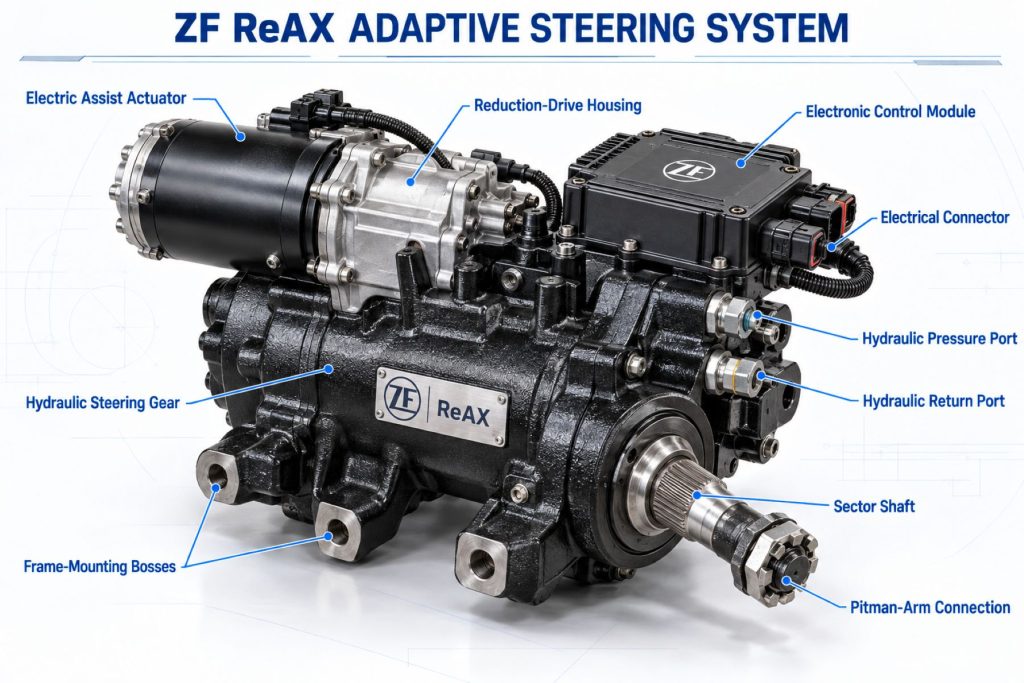
Major Components
- Adaptive steering control unit
- Electric steering-assist motor
- Motor-drive electronics
- Steering-column assembly
- Steering torque sensor
- Steering-angle or position sensor
- Intermediate steering shaft
- Hydraulic power-steering gear
- Power-steering pump
- Hydraulic reservoir, hoses, and fittings
- Vehicle-network connections
- Power-supply wiring and protection
- Software and application calibration
- Warning indicators and diagnostic functions
- Steering linkage and front-axle components
Product Type and Construction
ReAX is a hybrid steering-assistance architecture. It retains the mechanical steering path and hydraulic steering assistance used by heavy commercial vehicles while adding electronically controlled torque through an electric actuator.
The actuator, sensors, controller, steering column, intermediate shaft, and hydraulic steering gear operate as one coordinated system. Vehicle-specific software determines the amount and direction of supplemental steering torque.
How the Driveline or Steering Component Works
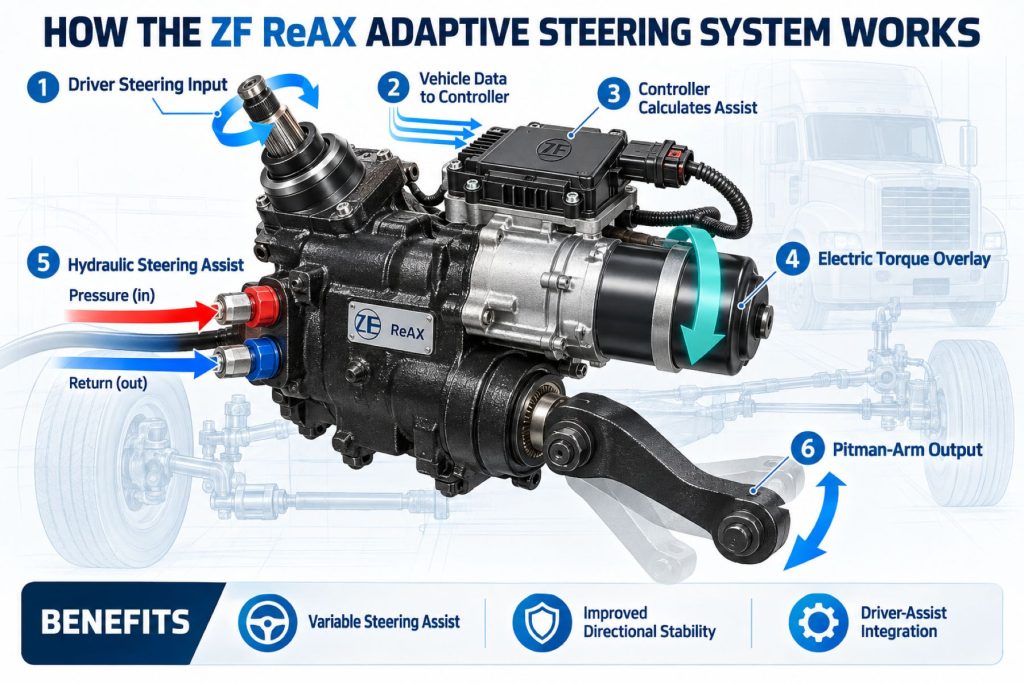
When the driver turns the steering wheel, torque and position sensors detect the steering input. The ReAX controller evaluates that information together with vehicle-speed and other available chassis signals.
The controller commands the electric motor to add or modify steering torque through the steering column. The hydraulic steering gear continues producing the primary force needed to move the pitman arm, steering linkage, steering knuckles, and front wheels.
The amount of electronic assistance changes according to the operating situation. Additional assistance may be supplied during low-speed maneuvering, while different control behavior can support stability, precision, and return-to-center response at highway speeds.
Position and Function Within the Vehicle
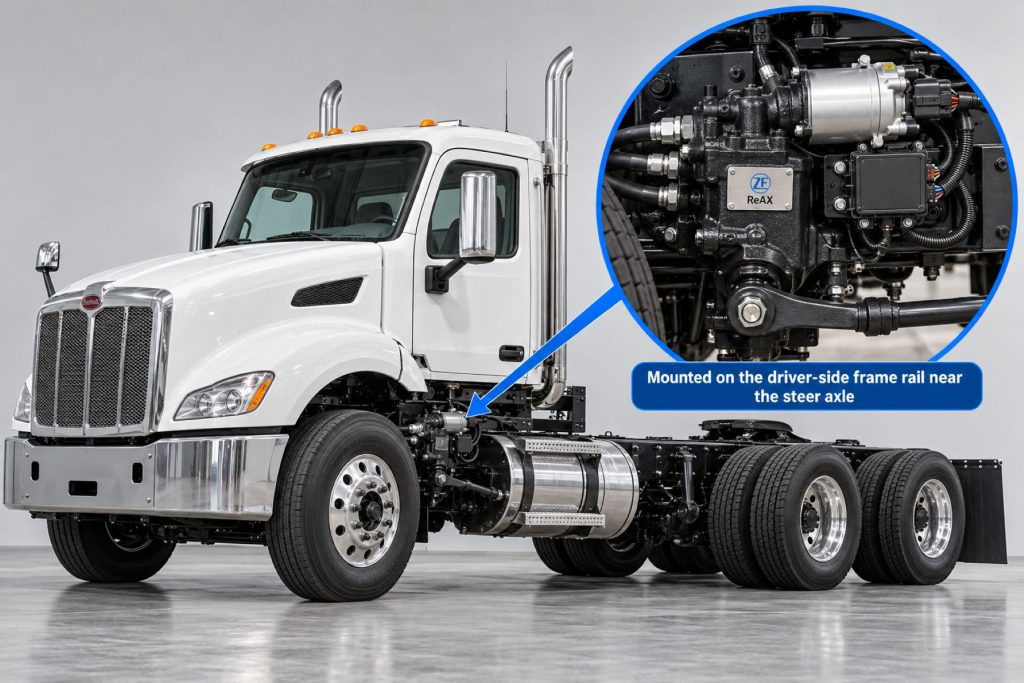
The column-mounted ReAX actuator is installed within the steering path between the steering wheel and hydraulic steering gear. Its electronic controller communicates with compatible vehicle systems through the vehicle network.
The system supplements the driver’s steering input. It does not replace the mechanical steering connection or the hydraulic steering gear required to handle heavy commercial-vehicle steering loads.
Common Specifications
- System Type: Electronically controlled adaptive steering assistance
- Base Steering System: Conventional hydraulic power steering
- Electric Assistance: Steering-column-mounted electric motor on applicable configurations
- Control Method: Electronic control using driver input and vehicle signals
- Primary Sensor Inputs: Steering torque, steering position or angle, vehicle speed, and application-specific chassis information
- Vehicle Communication: Application-specific electronic vehicle network
- Hydraulic Components: Power-steering gear, pump, reservoir, hoses, fittings, fluid, and cooling equipment where specified
- Mechanical Output: Hydraulic steering-gear sector shaft and pitman arm
- Installation: Original-equipment and vehicle-specific
- Calibration: Requires approved vehicle and steering-system programming
Operating Capacity and Performance
ReAX performance depends on the electric actuator, controller, software calibration, power supply, hydraulic steering gear, pump output, front-axle loading, tire equipment, alignment, and steering geometry.
The system’s operating limits are application-specific. Electrical voltage, current, motor torque, hydraulic pressure, flow, steering ratio, travel, and thermal limits must be confirmed through the vehicle and ZF service information.
Installation Position and System Function
ReAX is commonly positioned at the steering column, where the electric actuator can apply controlled torque while preserving the mechanical path to the hydraulic steering gear.
The system assists steering rather than carrying front-axle loads directly. Its effectiveness depends on the condition and correct installation of the complete steering column, hydraulic gear, linkage, axle, suspension, wheels, and tires.
Torque Transfer or Steering-Assist Function
ReAX adds electronically commanded torque to the driver’s input. This supplemental torque can reduce physical effort, encourage return toward center, and counter selected disturbances transmitted through the steering system.
The hydraulic steering gear supplies the substantial force needed to steer the front wheels. The system therefore combines mechanical input, electric assistance, and hydraulic assistance.
Driveline Geometry and Operating Angles
The steering-column and intermediate-shaft geometry must allow the mechanical steering path to move freely. Universal-joint angles, shaft phasing, slip travel, cab movement, and alignment must remain within the vehicle manufacturer’s specifications.
Binding, excessive joint angles, incorrect phasing, or insufficient slip travel can create poor steering feel and may interfere with the system’s electronic control response.
Steering Geometry and Movement
ReAX cannot compensate for incorrect mechanical geometry. Caster, camber, toe, axle position, ride height, steering stops, linkage angles, kingpin condition, and tire specifications must remain correct.
Mechanical alignment establishes the foundation for steering stability. The electronic system then applies its assistance according to the calibrated vehicle response.
Slip, Articulation, and Operating Travel
The steering column and intermediate shaft must accommodate normal cab and chassis movement without binding, bottoming, or separation. The hydraulic gear and linkage must remain within their approved operating travel.
Steering stops should limit wheel movement correctly. The electric actuator and hydraulic gear should not be used as substitutes for properly adjusted mechanical axle stops.
Bearings, Joints, Shafts, Gears, and Structural Design
The ReAX installation includes steering-column bearings, shafts, universal joints, slip connections, electric-motor gearing, and mechanical interfaces. The hydraulic steering gear contains additional bearings, shafts, piston components, and sector gearing.
Wear or looseness in any of these components can affect sensor readings, steering precision, free play, noise, and driver feedback.
Materials and Component Construction
ReAX uses high-strength steering shafts, precision bearings, electric-motor components, sensors, electronic modules, wiring, connectors, and structural mounting hardware designed for commercial-vehicle service.
The associated hydraulic steering gear uses a heavy-duty housing and hardened internal components. All structural and electronic components must match the original vehicle configuration.
Hydraulic and Electric Steering Assistance
ReAX combines two forms of assistance. The hydraulic system supplies the primary force required to steer a heavy axle, while the electric motor modifies the torque felt and applied through the steering column.
This arrangement allows adaptive steering behavior without eliminating the proven hydraulic steering architecture used on heavy commercial vehicles.
Electronic Controls and Driver-Assistance Integration
The ReAX controller analyzes driver input and compatible vehicle signals to calculate supplemental steering torque. Depending on the vehicle, the system may communicate with stability-control, lane-support, braking, chassis, or other driver-assistance systems.
Available functions depend on the original vehicle specification. ReAX should not be assumed to provide automated lane keeping, collision avoidance, or autonomous steering unless those functions are specifically installed and approved on the vehicle.
Speed, Torque, and Load Management
Electronic assistance can be varied with vehicle speed. Greater assistance may be supplied during low-speed maneuvering, while more controlled assistance can support stable highway operation.
Steer-axle loading, tire pressure, road surface, crosswinds, alignment, hydraulic output, electrical voltage, and system temperature all influence steering demand and performance.
Vibration, Balance, and Noise Control
ReAX can help reduce the amount of selected road disturbance and steering correction reaching the driver. It cannot correct mechanical vibration caused by damaged tires, wheel imbalance, loose wheel bearings, worn kingpins, poor alignment, or damaged suspension components.
Noise or vibration should be diagnosed across the hydraulic, electrical, steering-column, front-axle, wheel, tire, and suspension systems.
Lubrication, Sealing, and Contamination Protection
The electric actuator and electronic controller depend on sealed housings, connectors, and wiring protection. Water intrusion, corrosion, damaged seals, or contaminated connectors can cause intermittent or permanent faults.
The hydraulic steering system requires approved fluid and clean hoses, reservoirs, fittings, pumps, and steering-gear components. Hydraulic contamination can damage the pump and steering gear even when the ReAX electronics remain functional.
Duty Cycle and Operating Conditions
ReAX is designed for commercial-vehicle operating conditions that may include long highway trips, urban maneuvering, terminal operation, changing loads, crosswinds, uneven pavement, and repeated steering corrections.
Low-speed vocational operation, severe heat, heavy axle loading, electrical faults, contamination, and damaged steering components may increase system demand or reduce performance.
Mounting and Installation
Installation involves the steering column, electric actuator, control module, wiring, sensors, intermediate shaft, hydraulic steering gear, and vehicle network. Mounting and programming are specific to the approved vehicle application.
Replacement components must be installed using the specified fasteners, torque procedures, shaft alignment, connector protection, software, and calibration process.
Alignment, Driveline, and Mounting Geometry
The steering column, actuator, intermediate shaft, and hydraulic gear must remain correctly aligned. Bent brackets, loose mounts, improper shaft angles, or incorrect installation can create binding and misleading electronic faults.
Front-axle alignment should be verified before final electronic calibration. Calibrating the system while mechanical alignment is incorrect can produce poor steering behavior.
Vehicle, Transmission, Axle, and Steering Compatibility
Compatibility depends on the vehicle manufacturer, model, production year, steering column, hydraulic gear, steer axle, electrical architecture, controller software, sensors, network configuration, wheels, and tires.
Powertrain information may also affect electrical communication, hydraulic pump operation, packaging, and calibration. ReAX should not be transferred to another vehicle without an approved application.
Related Component and System Compatibility
ReAX must be compatible with the steering wheel, column, shafts, hydraulic steering gear, power-steering pump, reservoir, hoses, pitman arm, drag link, tie rod, axle, suspension, wheels, tires, electrical system, and vehicle network.
Driver-assistance integration requires compatible sensors, controllers, software, communication messages, and safety strategies. Similar components should not be substituted without approved part and calibration information.
Common Applications
- Heavy-duty highway tractors
- Long-haul tractors
- Regional-haul tractors
- Fleet vehicles operating long daily distances
- Commercial vehicles requiring reduced low-speed steering effort
- Vehicles equipped with compatible advanced driver-assistance systems
- Applications prioritizing driver comfort and reduced fatigue
- Vehicles designed with integrated hydraulic and electronic steering
Advantages
- Reduces low-speed steering effort
- Improves maneuverability in confined areas
- Supports smoother and more precise steering
- Can improve return-to-center behavior
- Can reduce continuous steering corrections
- Helps reduce driver fatigue
- Retains conventional hydraulic steering capability
- Maintains a mechanical steering connection
- Adapts steering assistance to operating conditions
- Supports compatible driver-assistance integration
- Can improve overall driver comfort
Limitations or Considerations
- Vehicle- and application-specific system
- Requires compatible electronics and network communication
- Requires approved software and calibration
- Does not eliminate hydraulic steering-system maintenance
- Electrical faults may disable adaptive assistance
- Hydraulic faults can still produce heavy steering
- Sensor errors can affect steering-assistance behavior
- Diagnosis may require manufacturer-level equipment
- Mechanical alignment must be correct before calibration
- Component replacement may require programming
- Functions vary by vehicle specification
Driver and Operator Experience
Drivers may notice lighter steering during low-speed maneuvering and a more controlled steering feel at highway speeds. The system is designed to reduce physical effort without disconnecting the driver from the mechanical steering system.
Changes in steering effort, centering, warning indicators, vibration, noise, or system availability should be reported promptly. Drivers should not assume adaptive assistance will correct mechanical steering or alignment defects.
Steering Feel and Driver Feedback
ReAX can modify the steering torque felt by the driver. Assistance may feel lighter during parking and more controlled during highway travel.
Steering feel still depends on front-axle load, tires, alignment, hydraulic pressure, road surface, suspension condition, software calibration, and the operation of the electric actuator.
Operating Speed, Angle, and Load Management
The system varies assistance according to vehicle speed and calibrated operating conditions. It must also monitor steering position, torque, electrical demand, and available system information.
Operators should avoid holding the steering wheel against full lock. ReAX does not remove the hydraulic pressure and heat generated when the steering system is forced against its travel limits.
Control Setup and System Calibration
Calibration may include steering-center position, torque-sensor zeroing, steering-angle position, motor control, vehicle identity, tire and axle information, and communication with related chassis systems.
Calibration should be performed after applicable steering-column, actuator, hydraulic-gear, axle, linkage, alignment, sensor, controller, or software service. Required procedures depend on the vehicle manufacturer.
Inspection and Wear Points
- Steering wheel and column
- Electric steering-assist actuator
- Actuator and controller mounts
- Steering torque and position sensors
- Intermediate-shaft universal joints
- Slip shaft and protective boots
- Wiring harnesses and connectors
- Power and ground connections
- Hydraulic steering gear
- Power-steering pump, reservoir, and hoses
- Pitman arm and drag link
- Tie rod, steering arms, and kingpins
- Wheel bearings, wheels, and tires
- Diagnostic trouble codes and warning indicators
Lubrication Requirements
Use the hydraulic steering fluid specified by the vehicle manufacturer. Maintain the correct fluid level and protect the system from water, dirt, metal particles, air, and incompatible fluids.
Steering shafts, linkage joints, and other external mechanical components should be lubricated according to their individual service requirements. The electric actuator should not be opened or lubricated unless specifically directed by approved service information.
Component Service Life and Rebuildability
Service life depends on operating environment, steering demand, electrical condition, hydraulic maintenance, alignment, contamination protection, software integrity, vibration, and collision history.
Electronic actuators, controllers, and sensors may be serviced as complete assemblies rather than rebuilt in a general repair shop. Hydraulic steering gears may have separate new or remanufactured replacement programs.
Shaft, Joint, Bearing, Gear, and Linkage Service Life
Wear can develop in steering-column bearings, universal joints, slip shafts, actuator gearing, hydraulic steering-gear components, pitman-arm splines, drag-link ends, tie-rod ends, kingpins, and wheel bearings.
Mechanical wear should be corrected before adaptive-steering calibration. Electronic assistance should not be used to mask looseness, binding, or damaged steering components.
Seal, Hose, Sensor, and Electronic Service Life
Heat, age, contamination, hydraulic pressure, abrasion, moisture, corrosion, and vibration affect seals, hoses, sensors, wiring, connectors, and electronic modules.
Intermittent electronic faults may be caused by low voltage, weak grounds, loose connectors, damaged wiring, water intrusion, network faults, or sensor calibration rather than a failed actuator.
Maintenance and Ownership Notes
Maintenance includes mechanical steering inspections, hydraulic-fluid checks, leak inspections, wiring and connector checks, software diagnostics, alignment verification, and calibration when required.
Fleets should retain access to compatible diagnostic equipment and current service information. Unapproved programming, wiring modifications, steering-component substitutions, or alignment changes may affect system operation.
Common Driveline and Steering Problems
- Adaptive assistance unavailable: Low voltage, a blown fuse, wiring damage, controller faults, communication problems, or sensor errors may disable electronic assistance.
- Heavy low-speed steering: Electric-assist faults, inadequate hydraulic pressure, low fluid, trapped air, binding linkage, or excessive front-axle loading may be responsible.
- Incorrect return-to-center behavior: Poor alignment, binding joints, incorrect calibration, steering-angle errors, tire problems, or actuator faults may affect centering.
- Steering pull or drift: Alignment, tires, brakes, suspension, loading, road crown, sensor calibration, or steering-control faults may cause the condition.
- Warning indicator: Stored diagnostic trouble codes may identify electrical, sensor, communication, calibration, or actuator problems.
- Intermittent assistance: Loose connections, low system voltage, overheating, network interruptions, damaged wiring, or hydraulic problems may be responsible.
- Noise or vibration: Actuator mounts, steering shafts, hydraulic aeration, pumps, tires, wheels, kingpins, linkage, or suspension components should be inspected.
- Steering-wheel position incorrect: Mechanical misalignment, improper shaft installation, steering-angle calibration, or front-end alignment may be responsible.
Safety and Service Precautions
Adaptive steering is safety-critical. Diagnosis and repair should follow current ZF and vehicle-manufacturer service procedures.
- Secure the vehicle before steering-system service.
- Disconnect electrical power according to the approved procedure.
- Relieve hydraulic pressure before opening the hydraulic circuit.
- Do not probe or apply power to electronic circuits without approved instructions.
- Protect connectors and hydraulic ports from contamination.
- Do not weld, heat, straighten, or modify steering components.
- Use approved replacement parts and software.
- Verify mechanical alignment before calibration.
- Clear and recheck diagnostic trouble codes.
- Confirm steering travel and component clearance.
- Complete the required calibration and controlled road test.
Identification Information
Identification may be found on the steering actuator, steering column, electronic controller, hydraulic steering gear, wiring labels, or vehicle build records.
- Vehicle manufacturer
- Vehicle identification number
- Vehicle model and model year
- ReAX assembly number
- Electric-actuator part number
- Electronic-control-unit number
- Software and calibration identification
- Steering-column configuration
- Torque- and position-sensor information
- Hydraulic steering-gear model and specification
- Power-steering-pump information
- Electrical-system voltage
- Connector and wiring configuration
Buying Considerations
- Confirm that the vehicle was designed for ReAX.
- Use the vehicle identification number and original build information.
- Match the complete actuator and controller part numbers.
- Verify steering-column and intermediate-shaft compatibility.
- Confirm hydraulic steering-gear compatibility.
- Match the vehicle’s electrical architecture and voltage.
- Verify sensor and connector configurations.
- Confirm software and calibration availability.
- Determine whether programming requires dealer-level equipment.
- Inspect used components for impact, corrosion, or water damage.
- Review warranty and core-return requirements.
- Use a facility experienced with electronic commercial-vehicle steering.
Variants and Configurations
- Column-mounted ReAX configurations
- Different steering-column lengths and mounting arrangements
- Different electric-actuator specifications
- Application-specific electronic controllers
- Different hydraulic steering-gear pairings
- Different electrical-system configurations
- Vehicle-specific sensor and network integration
- Different steering-assistance calibrations
- Different driver-assistance integrations
- Application-specific software versions
Comparison to Similar Equipment
Compared with the ZF TRW THP Series Steering Gear, ReAX adds electronically controlled steering torque to a conventional hydraulic steering system. A THP gear provides hydraulic assistance but does not provide the complete ReAX adaptive-control function by itself.
Compared with the ZF TRW TAS Series Steering Gear, ReAX provides a more electronically integrated steering experience with variable assistance and compatible driver-assistance functions.
Compared with the R.H. Sheppard M-Series Steering Gear, ReAX is an adaptive steering system rather than only an integral hydraulic steering gear.
Compared with the planned ZF Commercial Vehicle Electric Power Steering, ReAX retains conventional hydraulic steering assistance. A full electric power-steering system replaces hydraulic components with an integrated electric motor and controller.
Best Fit For
- Vehicles originally equipped with ZF ReAX
- Heavy-duty highway tractors
- Long-haul vehicles with high annual mileage
- Applications requiring frequent low-speed maneuvering
- Fleets prioritizing driver comfort and retention
- Vehicles requiring adaptive steering effort
- Compatible vehicles with advanced driver-assistance systems
- Fleets with electronic steering diagnostic capabilities
- Operators seeking hydraulic steering with electronic assistance
Related Vehicle and Trailer Types
- Highway Tractors
- Class 7 and Class 8 Trucks
- Sleeper-Cab Trucks
- Day-Cab Trucks
- Regional-Haul Trucks
- Commercial Buses
- Vocational Trucks
Related Truck and Trailer Models
- Freightliner Cascadia
- Kenworth T680
- Peterbilt 579
- Volvo VNL
- International LT Series
- Mack Anthem
- Western Star 57X
Related Driveline and Steering System Types
- Advanced Steering & Lane-Keeping Systems
- Steering Columns & Driver Controls
- Steering Gears & Steering Linkage
- Power Steering Pumps & Hydraulic Assist
- Commercial Truck Driveshafts
- Universal Joints, Slip Yokes & Center Bearings
Related Driveline and Steering Products
- ZF TRW THP Series Steering Gear
- ZF TRW TAS Series Steering Gear
- R.H. Sheppard M-Series Steering Gear
- ZF Commercial Vehicle Electric Power Steering
- Bendix Lane Keep Assist
- ZF OnGuardMAX
- Dana Spicer Life Series Commercial Driveshaft
Related Equipment Systems
- Drivelines & Steering Systems
- Safety Systems
- Electrical Systems
- Suspension Systems
- Axles & Differentials
- Tires & Wheels
- Brake Systems
- Telematics & ELD Systems
- Equipment Systems
Related Guides
- Driveline & Steering System Guides
- How Commercial Truck Steering Systems Work
- Hydraulic vs Electric-Assisted Commercial Truck Steering
- Common Commercial Truck Driveline Vibrations and Steering Problems
- Commercial Truck Steering Components Explained
- How to Inspect Commercial Truck Steering Systems
- How Commercial Truck Lane-Keeping Systems Work
Regulatory and Compliance Notes
ReAX is part of a safety-critical steering system. Mechanical, hydraulic, electrical, and electronic components must remain in safe operating condition and comply with applicable commercial-vehicle inspection and maintenance requirements.
Modifications must not interfere with steering control, vehicle-network communication, electronic stability control, driver-assistance functions, diagnostic reporting, axle ratings, tire clearance, or completed-vehicle certification.
Electronic steering assistance does not relieve the driver of responsibility for maintaining control of the vehicle. Driver-assistance functions must be operated according to the vehicle manufacturer’s instructions.
Real World Operating Notes
The most noticeable ReAX benefit may occur during repeated low-speed maneuvering, where supplemental electric torque reduces the physical effort required to turn the steering wheel.
At highway speeds, the system may help the vehicle feel more stable and reduce the number of small corrections required from the driver. Actual behavior depends on the vehicle and calibration.
Mechanical alignment remains essential. A vehicle with worn steering linkage, damaged tires, incorrect caster, or loose wheel bearings may still steer poorly even when the ReAX system is operating normally.
An electronic-assistance warning does not necessarily mean the mechanical steering connection has been lost. However, steering effort or behavior may change, and the vehicle should be inspected according to the manufacturer’s instructions.
Frequently Asked Questions
What is ZF ReAX?
ReAX is an adaptive steering system that combines electronic steering assistance with the conventional hydraulic power steering used on heavy commercial vehicles.
Does ReAX replace the hydraulic steering gear?
No. ReAX works with the hydraulic steering system. The hydraulic gear continues providing the primary force required to steer the vehicle.
How does ReAX reduce driver effort?
An electronically controlled electric motor adds steering torque through the steering column according to driver input, vehicle speed, and other available vehicle signals.
Does ReAX steer the truck automatically?
ReAX provides adaptive steering assistance. Any automated lane-support or driver-assistance functions depend on the complete vehicle specification and installed systems.
What happens if electronic assistance becomes unavailable?
The mechanical and hydraulic steering systems remain, but steering feel and effort may change. The warning should be diagnosed according to the vehicle manufacturer’s instructions.
What happens if hydraulic assistance is lost?
The mechanical steering connection remains, but steering effort can become extremely high. The vehicle should be stopped safely and repaired.
Does ReAX require calibration?
Yes. Calibration may be required after steering, sensor, controller, alignment, axle, software, or electrical service.
Can ReAX be added to any truck?
No. It requires a compatible steering column, hydraulic system, electrical architecture, vehicle network, sensors, software, and approved vehicle application.
What can cause a ReAX warning?
Possible causes include low voltage, wiring damage, connector problems, sensor faults, calibration errors, communication faults, controller problems, or actuator faults.
How are replacement components identified?
Use the vehicle identification number, original build information, actuator and controller numbers, software identification, steering-column configuration, and hydraulic steering-gear information.
Availability and Where to Find
ZF ReAX systems and replacement components may be available through authorized vehicle dealers, ZF service channels, commercial-vehicle steering specialists, and heavy-duty parts suppliers.
Availability depends on the vehicle manufacturer, model, model year, steering-column configuration, actuator, electronic controller, software, hydraulic steering gear, and original-equipment specification.
Current product and commercial-vehicle support information is available through the ZF Commercial Vehicle Solutions website.
Support Trucking Families
Truck Equipment Atlas supports the mission of Grey Cross, a nonprofit dedicated to helping families of truck drivers who lose their lives while on the road. As the site grows, part of its mission is to bring awareness and support to these families.
Podcast or Video Section
Learn More Through Audio and Video
Truck Equipment Atlas will continue expanding with podcast episodes, interviews, and equipment breakdowns to help drivers and fleets better understand trucks and equipment.
Follow the Growth of Truck Equipment Atlas
Truck Equipment Atlas continues to expand with new truck profiles, trailer coverage, diesel engine pages, equipment system resources, manufacturer information, and educational guides.
Visit our Site Updates page to explore recent additions, project milestones, and upcoming resources as we continue building one of the industry’s growing commercial trucking equipment reference libraries.
View the Latest Site Updates: Truck Equipment Atlas Site Updates