
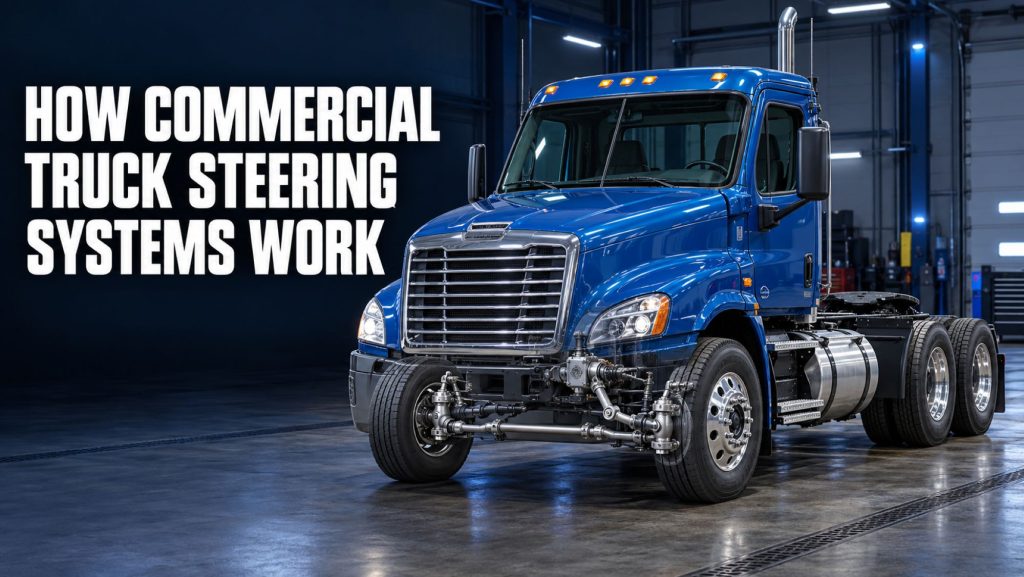
Commercial truck steering systems allow drivers to control vehicles that may weigh tens of thousands of pounds while maintaining stability, predictable handling, and safe directional control. Although the steering wheel is the part the driver sees, the complete system includes the steering column, steering gear, linkage, power-assist components, steer axle, wheel ends, and tires.
Each component must work together with minimal looseness and the correct alignment. Wear or damage anywhere in the system can cause wandering, excessive steering effort, uneven tire wear, poor return-to-center behavior, vibration, or loss of control. This guide explains how commercial truck steering systems work, the major components involved, common system designs, warning signs, and the factors that affect inspection and maintenance.
What a Commercial Truck Steering System Does
The steering system converts movement of the steering wheel into a controlled change in the angle of the front wheels. It must provide enough mechanical advantage and power assistance for the driver to steer a heavily loaded truck without making the vehicle feel unstable or overly sensitive.
A properly operating steering system performs several important functions:
- Changes vehicle direction accurately in response to steering-wheel input
- Provides sufficient power assistance at low speed and during tight maneuvers
- Maintains directional stability at highway speed
- Allows the front wheels to turn at the proper relationship through curves
- Communicates useful road feel without transmitting excessive shock to the driver
- Returns the wheels toward the straight-ahead position after a turn
How Steering Input Reaches the Wheels
When the driver turns the steering wheel, the steering shaft carries that rotary input through the steering column to the steering gear. The steering gear multiplies the driver’s effort and changes rotary motion into movement of the pitman arm. The pitman arm moves the drag link, which turns the steering arm and one steering knuckle. A tie rod connects the steering knuckles so both steer wheels change direction together.
On most heavy trucks, hydraulic pressure assists this movement inside the steering gear. Newer systems may also use electric or electrohydraulic assistance and electronic controls. Regardless of the assist method, the mechanical connection between the steering wheel and steer axle remains essential to vehicle control. Readers unfamiliar with the supporting axle assembly can begin with How Commercial Truck Axles and Differentials Work.
Major Commercial Truck Steering Components
Steering Wheel and Steering Column
The steering wheel gives the driver leverage and control. The steering column supports the shaft that transfers input toward the steering gear. Depending on the truck, the column may include tilt and telescoping adjustments, universal joints, a collapsible section, bearings, and electronic sensors.
Intermediate Steering Shaft
The intermediate shaft connects the steering column to the steering gear. Universal joints and slip sections allow it to operate despite cab position, frame movement, and component angles. Worn joints, damaged splines, loose fasteners, or binding in the shaft can create play or stiffness at the steering wheel.
Steering Gear
The steering gear is the central mechanical and hydraulic component in many heavy-truck systems. A recirculating-ball steering gear uses a worm shaft, ball bearings, piston, and sector shaft to multiply steering input. Hydraulic pressure applied to the piston reduces the effort required to move the linkage and turn the tires.
Pitman Arm
The pitman arm attaches to the steering gear’s sector shaft. As the sector shaft rotates, the arm moves through an arc and transfers force to the drag link. Its retaining hardware and splined connection must remain tight.
Drag Link
The drag link connects the pitman arm to the steering arm on the steer axle. Ball-and-socket joints at its ends allow movement as the axle and suspension travel. Excessive looseness at either joint can create steering-wheel free play and delayed response.
Steering Arms, Knuckles, and Kingpins
Steering arms transmit drag-link and tie-rod movement to the steering knuckles. Each knuckle pivots around a kingpin or equivalent pivot arrangement at the end of the steer axle. Kingpins, bushings, bearings, and thrust components support the vehicle while allowing the wheels to turn. Wear in this area can affect steering precision, wheel alignment, and tire life. The Commercial Truck Steer Axles section provides additional information about steer-axle equipment and component profiles.
Tie Rod and Tie-Rod Ends
The tie rod links the left and right steering knuckles. It keeps the steer wheels moving together and provides the adjustment used to set toe. Bent tie rods, loose clamps, damaged boots, or worn tie-rod ends can cause wandering and irregular tire wear.
Power-Steering Pump and Reservoir
The power-steering pump supplies pressurized hydraulic fluid to the steering gear. The reservoir stores fluid and helps manage expansion, aeration, and contamination. Hoses carry fluid between the pump, reservoir, steering gear, cooler, and any auxiliary steering components. Correct fluid level and condition are critical to reliable assistance.
Steer Axle, Wheel Ends, and Tires
The steer axle supports the front of the truck and establishes the mounting geometry for the knuckles and linkage. Wheel bearings, hubs, wheels, tires, suspension parts, and alignment settings all influence how the steering system feels and responds. A steering complaint may therefore originate outside the steering gear itself. Explore the Axle and Differential Guides for more information about axle construction, ratings, and applications.
Common Types of Commercial Truck Steering Systems
| System Type | How It Works | Common Applications | Key Considerations |
|---|---|---|---|
| Manual steering | Driver effort moves the steering gear and linkage without powered assistance | Older or specialized light-duty equipment | Simple design but high steering effort, especially at low speed |
| Hydraulic power steering | An engine-driven pump provides hydraulic assistance through the steering gear | Most conventional heavy trucks | Proven and powerful; requires fluid, hoses, seals, and pump maintenance |
| Electrohydraulic steering | An electric motor powers the hydraulic pump when assistance is needed | Some newer commercial platforms and specialized vehicles | Can reduce parasitic loss and provide demand-based assistance |
| Electric power steering | An electric motor applies steering assistance without a conventional hydraulic pump | Many light- and medium-duty vehicles and emerging heavy-truck designs | Supports electronic control features and eliminates hydraulic-fluid service |
| Auxiliary or dual steering gear | A second gear or assist cylinder helps move a high-capacity steer axle | Heavy vocational trucks and high front-axle-weight applications | Requires proper synchronization, plumbing, adjustment, and inspection |
Hydraulic Power Steering Operation
Hydraulic power steering remains common in heavy commercial trucks because it can provide substantial assistance under high front-axle loads. The pump draws fluid from the reservoir and sends it to a control valve in the steering gear. When the truck travels straight, the valve keeps pressure balanced. When the driver turns the wheel, the valve directs pressure to one side of the gear’s power piston while fluid from the opposite side returns to the reservoir.
The pressure difference helps move the piston and sector shaft in the requested direction. As the steering wheel approaches the commanded position, the valve begins to recenter, reducing assistance. This gives the driver controlled power support instead of an uncontrolled on-or-off response.
Steering Geometry and Wheel Alignment
Correct steering geometry helps a truck track straight, turn smoothly, and use its steer tires evenly. Alignment is not limited to pointing both tires straight ahead. It includes several related angles and measurements. The guide to Steer vs Drive vs Trailer Tires explains why steer-tire construction and wear have such a direct effect on directional control.
- Toe: The difference between the distance across the front and rear of the steer tires. Incorrect toe is a frequent cause of rapid tire wear.
- Camber: The inward or outward tilt of a wheel when viewed from the front. It affects tire contact and directional behavior.
- Caster: The forward or rearward tilt of the steering pivot when viewed from the side. Caster contributes to stability and return-to-center action.
- Ackermann geometry: The relationship that allows the inside wheel to turn more sharply than the outside wheel during a curve.
- Axle and frame alignment: Drive-axle thrust angle, frame condition, suspension position, and ride height can make a truck pull or travel off-center even when steer-axle settings appear correct.
Alignment should be measured only after loose or damaged steering, suspension, wheel-end, and tire components have been corrected. Adjusting alignment around worn parts may hide the symptom temporarily without repairing the cause. Irregular wear patterns should also be evaluated using the inspection areas covered in How to Inspect and Maintain Commercial Truck Tires.
How Suspension and Loading Affect Steering
Commercial truck steering does not operate independently of the suspension and load. Worn spring pins, bushings, shackles, torque rods, shock absorbers, or suspension mounts can allow unwanted axle movement. Incorrect ride height can change driveline and steering geometry. Uneven loading can alter tire contact, steering effort, and vehicle balance. See How Commercial Truck Suspension Systems Work for a complete explanation of how the suspension connects the frame, steer axle, and road.
Excessive weight on the steer axle may increase steering effort and component stress, while insufficient steer-axle loading can reduce traction and directional authority. Loads must remain within the truck’s axle, tire, wheel, and vehicle ratings.
Steering Systems on Vocational and Multi-Axle Trucks
Heavy vocational trucks may use steering equipment beyond the conventional single steering gear and front steer axle. High-capacity front axles may use a slave gear or hydraulic assist cylinder. Twin-steer trucks use two steerable front axles, while some lift axles and trailing axles are steerable to reduce tire scrub and improve maneuverability. These configurations are covered throughout the Axle and Differential Guides and Suspension System Guides.
These systems require the axles to steer in the correct direction and at coordinated angles. Mechanical linkages, hydraulic circuits, electronic controls, centering devices, and axle-locking systems may all be involved. Manufacturer procedures are especially important when inspecting or adjusting a multi-axle steering system.
Driver-Assistance and Electronic Steering Technology
Modern trucks increasingly combine mechanical steering with electronic sensors and driver-assistance systems. Steering-angle sensors tell vehicle controllers where the driver is directing the truck. Lane-departure systems may warn the driver when the truck drifts, while lane-keeping or steering-assist systems can apply limited corrective input on equipped vehicles. Steering-angle information may also be used by the stability functions explained in How Truck ABS and Electronic Stability Control Work.
Electronic assistance does not replace the driver or eliminate the need for sound mechanical components. Cameras, radar units, steering sensors, yaw sensors, alignment, tires, and brakes may all affect system performance. Calibration may be required after steering, suspension, alignment, windshield, or sensor-related service.
Common Steering Problems and Warning Signs
| Symptom | Possible Causes |
|---|---|
| Excessive steering-wheel play | Worn shaft joints, loose steering gear, incorrect gear adjustment, worn drag-link or tie-rod ends, or worn kingpins |
| Hard steering | Low fluid, weak pump, restricted hose, steering-gear problem, binding linkage, low tire pressure, or excessive front-axle load |
| Truck pulls to one side | Tire-pressure difference, brake drag, alignment error, road crown, suspension damage, axle misalignment, or uneven loading |
| Wandering or constant correction | Loose linkage, worn suspension parts, incorrect caster or toe, rear-axle thrust-angle problem, tires, or steering-gear wear |
| Poor return to center | Insufficient caster, binding kingpins or linkage, column-shaft binding, or steering-gear adjustment problems |
| Noise while turning | Low or aerated fluid, pump wear, belt or drive problem, hose restriction, or excessive system pressure |
| Steering-wheel vibration or shimmy | Tire or wheel imbalance, damaged tire, loose wheel bearing, worn kingpins, alignment issues, or suspension wear |
| Fluid leakage | Damaged hoses, loose fittings, worn seals, cracked reservoir, or steering-gear leakage |
Commercial Truck Steering Inspection
A steering inspection should evaluate the entire system rather than a single component. The truck should be secured correctly, and any under-vehicle or raised-axle inspection should follow appropriate shop safety procedures.
- Check steering-wheel free play. Excessive movement before the steer tires respond may indicate wear or looseness.
- Inspect the steering column and shaft. Look for loose mounting, worn universal joints, damaged splines, missing fasteners, and contact with surrounding parts.
- Inspect the steering gear. Check mounting fasteners, sector-shaft area, input seal, housing, pitman-arm attachment, and evidence of leakage or movement.
- Inspect the linkage. Examine the drag link, tie rod, steering arms, clamps, retaining hardware, joint boots, and lubrication points.
- Check kingpins and wheel ends. Evaluate looseness, binding, bearing condition, lubrication, and visible damage using the correct service procedure.
- Inspect the hydraulic system. Check fluid level and condition, pump drive, reservoir, cooler, fittings, and hoses for leaks, rubbing, heat damage, or deterioration.
- Inspect the tires and wheels. Confirm proper inflation and look for irregular wear, damage, mismatched tires, loose fasteners, or wheel problems. Use the Tire & Wheel Guides for additional tire-position, sizing, wheel, and maintenance information.
- Review suspension and alignment condition. Look for worn bushings, broken or shifted springs, incorrect ride height, damaged shocks, and evidence of axle misalignment. The Truck Suspension Components Explained guide can help identify the related parts that require attention.
- Perform an operational check. Listen for abnormal noise and evaluate effort, response, return to center, tracking, and vibration under safe conditions.
Steering System Maintenance
Maintenance intervals and procedures vary by truck, steering gear, axle, suspension, and operating environment. The vehicle and component manufacturers’ current instructions should always control. Common maintenance practices include:
- Maintaining the specified power-steering fluid at the correct level
- Using only the approved fluid type and avoiding contamination
- Lubricating kingpins, tie-rod ends, drag-link ends, and other serviceable points at the specified intervals
- Keeping steering-gear, linkage, axle, and wheel-end fasteners properly secured
- Replacing damaged boots, leaking hoses, and worn joints before looseness becomes severe
- Maintaining correct tire pressure and matching tires appropriately across the steer axle using the size, rating, and inflation information explained in How to Read Commercial Truck Tire Sizes and Ratings
- Correcting suspension and wheel-end wear before performing alignment
- Calibrating applicable electronic systems after repairs that affect steering position or vehicle geometry
A steering gear should not be adjusted simply to remove play unless the rest of the system has been inspected and the manufacturer’s procedure confirms adjustment is appropriate. Incorrect adjustment can cause binding, poor return to center, internal damage, or unsafe operation.
Factors That Affect Steering System Life
Steering-system life depends heavily on the truck’s application and maintenance. Urban delivery and refuse trucks may accumulate frequent low-speed turns and curb contact. Dump trucks, mixers, logging trucks, and other vocational equipment may face heavy front-axle loads, rough surfaces, dirt, water, and shock loading. Highway tractors generally experience fewer extreme steering events but accumulate high mileage.
Proper lubrication, correct tire inflation, reasonable loading, accurate alignment, and early repair of looseness can extend component life. Ignoring one worn part often increases stress on nearby joints, tires, wheel ends, and suspension components. Operators comparing tire designs for different positions can also review Commercial Truck Tire Types Explained.
Frequently Asked Questions
Why do most heavy trucks use hydraulic power steering?
Hydraulic systems can provide strong, dependable assistance for heavy steer-axle loads and low-speed maneuvering. They are also well established across heavy-truck service networks.
What causes excessive play in a truck’s steering wheel?
Possible causes include worn steering-shaft joints, loose steering-gear mounting, internal gear wear or misadjustment, worn drag-link or tie-rod ends, kingpin wear, and loose wheel bearings. The full system should be inspected before any adjustment is made.
Can bad alignment make a truck wander?
Yes. Incorrect caster, toe, axle alignment, or rear-axle thrust angle can contribute to wandering. Tires, suspension wear, loading, road crown, and loose steering components can produce similar symptoms.
Why does power-steering fluid foam?
Foaming usually indicates air entering the system, an incorrect fluid level, contaminated or incompatible fluid, a suction-side leak, or improper bleeding after service. Aerated fluid can cause noise and inconsistent assistance.
Does replacing steering parts require an alignment?
Repairs involving tie rods, steering arms, kingpins, axle components, suspension position, or other parts that affect wheel geometry commonly require an alignment check. Applicable steering-angle and driver-assistance sensors may also require calibration.
The Role of Steering in Truck Safety and Operating Cost
The steering system directly affects vehicle control, driver workload, tire life, and confidence behind the wheel. Small amounts of wear across several components can combine into a significant handling problem. Regular inspection and prompt correction of leaks, looseness, binding, tire problems, suspension wear, and alignment issues help keep the truck predictable and reduce avoidable operating costs.
Understanding how the steering wheel, steering gear, linkage, steer axle, suspension, wheels, and tires work together makes it easier to identify developing problems and maintain safe directional control throughout the truck’s service life.
Continue Exploring Commercial Truck Systems
- Commercial Truck Steer Axles
- How Commercial Truck Axles and Differentials Work
- How Commercial Truck Suspension Systems Work
- Truck Suspension Components Explained
- Steer vs Drive vs Trailer Tires
- How to Inspect and Maintain Commercial Truck Tires
- Aluminum vs Steel Commercial Truck Wheels
- How Truck ABS and Electronic Stability Control Work