
Quick Facts
- Manufacturer: R.H. Sheppard
- Parent Company: Bendix Commercial Vehicle Systems
- Product Series: M-Series
- Product Type: Integral hydraulic power-steering gear
- Common Model Families: Application-specific M-Series configurations, including M80-, M90-, M100-, and M110-family gears
- Primary Function: Converts steering-wheel input and hydraulic pressure into controlled pitman-arm movement
- Primary Applications: Heavy-duty highway tractors, vocational trucks, buses, motorhomes, emergency vehicles, and specialty commercial chassis
- Assistance Type: Hydraulic power steering
- Installation: Chassis-frame mounted with an application-specific pitman arm and steering linkage
- Replacement Identification: Complete steering-gear model, specification, rotation, mounting, and vehicle information required
Overview
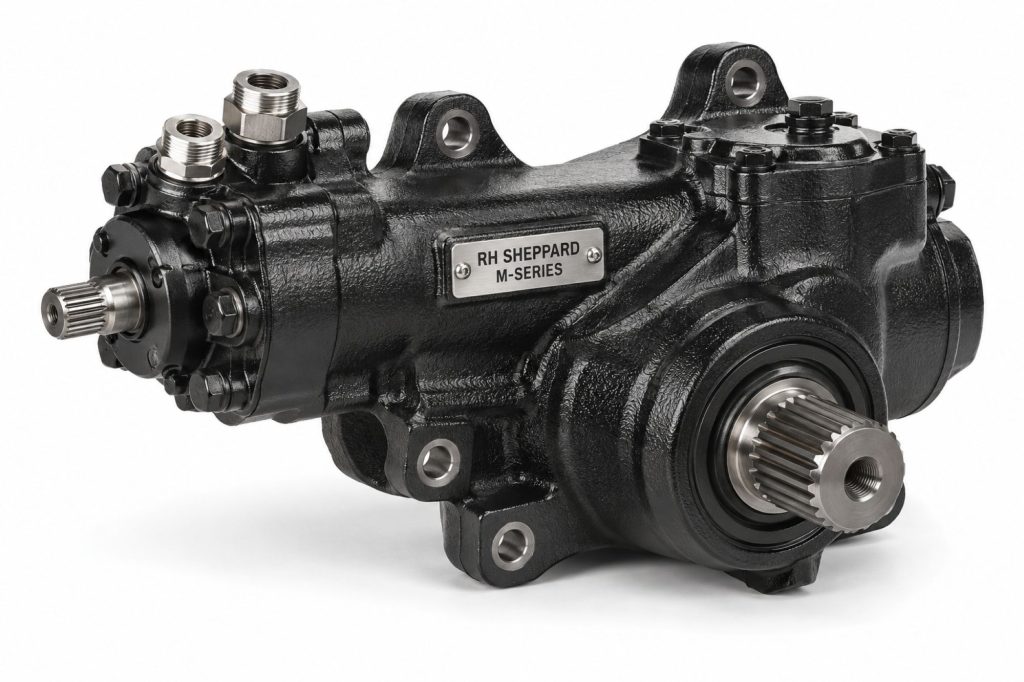
The R.H. Sheppard M-Series is a family of integral hydraulic power-steering gears used on heavy commercial vehicles. The steering gear combines mechanical steering input, a hydraulic control valve, an internal power piston, and a sector-shaft output in one frame-mounted assembly.
Hydraulic pressure reduces the effort required to steer heavily loaded front axles, especially during low-speed maneuvering. The mechanical connection between the steering wheel and steering linkage remains present, allowing the driver to retain steering control if hydraulic assistance is lost, although steering effort becomes substantially higher.
M-Series gears have been produced in numerous application-specific configurations. Housing size, steering ratio, mounting pattern, input-shaft arrangement, sector-shaft dimensions, output rotation, hydraulic connections, internal travel, and pitman-arm requirements may differ between vehicles.
The complete identification information must be used when ordering a replacement or remanufactured gear. A visually similar M-Series unit should not be treated as interchangeable without confirmed application data.
Key Characteristics
- Integral hydraulic power-steering construction
- Designed for heavy commercial-vehicle steering loads
- Mechanical and hydraulic steering functions combined in one assembly
- Application-specific mounting and output configurations
- Multiple gear sizes for different steer-axle and vehicle requirements
- Hydraulic assistance during low-speed and high-load steering
- Mechanical steering connection remains during hydraulic-assist loss
- Compatible with single-gear and approved dual-gear steering systems
- Available through new, service-replacement, and remanufactured channels
- Replacement selection based on complete application information
Major Components
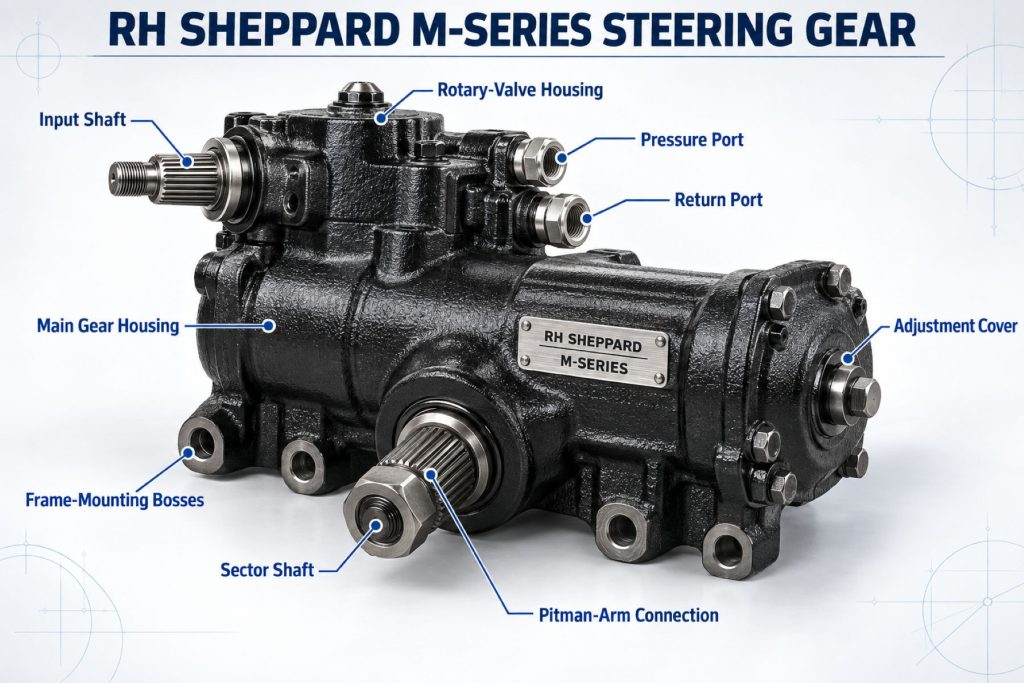
- Steering-gear housing
- Input shaft
- Hydraulic control valve
- Worm-shaft assembly
- Power piston
- Internal gear teeth
- Sector shaft
- Pitman-arm connection
- Bearings and bushings
- Input- and sector-shaft seals
- Pressure and return ports
- Relief or travel-control components
- Auxiliary hydraulic ports where equipped
- Frame-mounting bosses and fasteners
Product Type and Construction
The M-Series is an integral hydraulic steering gear. Its heavy-duty housing contains the control-valve, piston, gear, bearing, shaft, and hydraulic-cylinder functions needed to convert steering-wheel rotation into movement of the steering linkage.
Internal components are precision-machined to control hydraulic flow and mechanical movement. The housing also provides the structural mounting points required to transfer steering loads into the vehicle frame.
How the Driveline or Steering Component Works
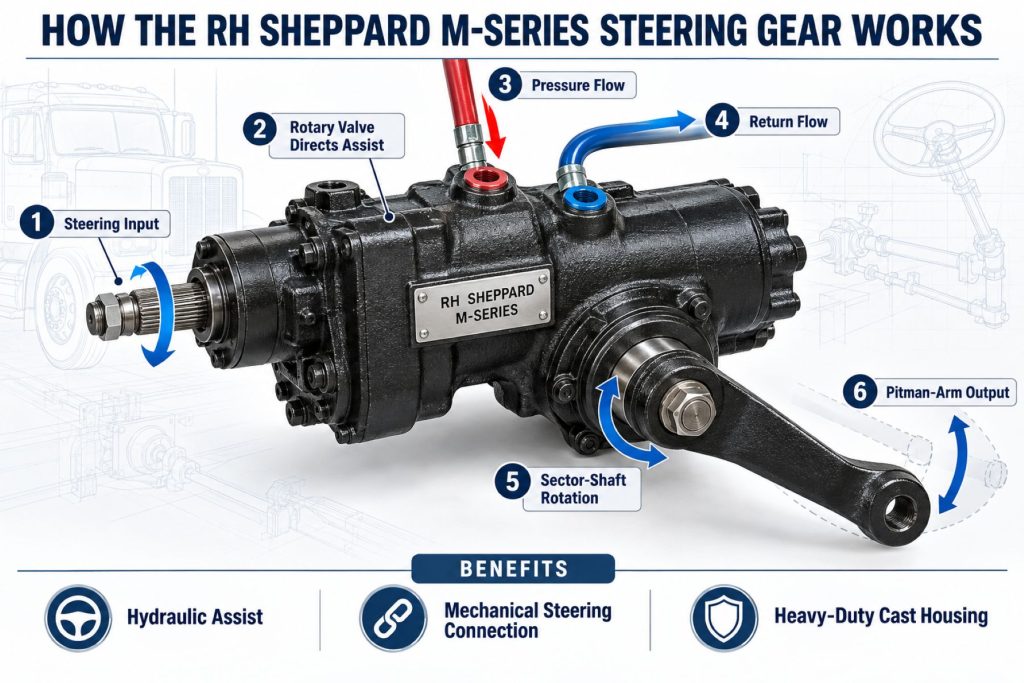
Turning the steering wheel rotates the steering column, intermediate shaft, and steering-gear input shaft. The internal control valve responds to the direction and force of the driver’s input and directs pressurized fluid to the appropriate side of the power piston.
Hydraulic pressure assists piston movement. Internal gear teeth convert this movement into rotation of the sector shaft and pitman arm. The pitman arm moves the drag link, steering arm, tie rod, steering knuckles, and steer wheels.
When steering demand decreases, the valve moves toward its neutral position and balances hydraulic assistance. The exact internal operating arrangement depends on the identified M-Series model.
Position and Function Within the Vehicle
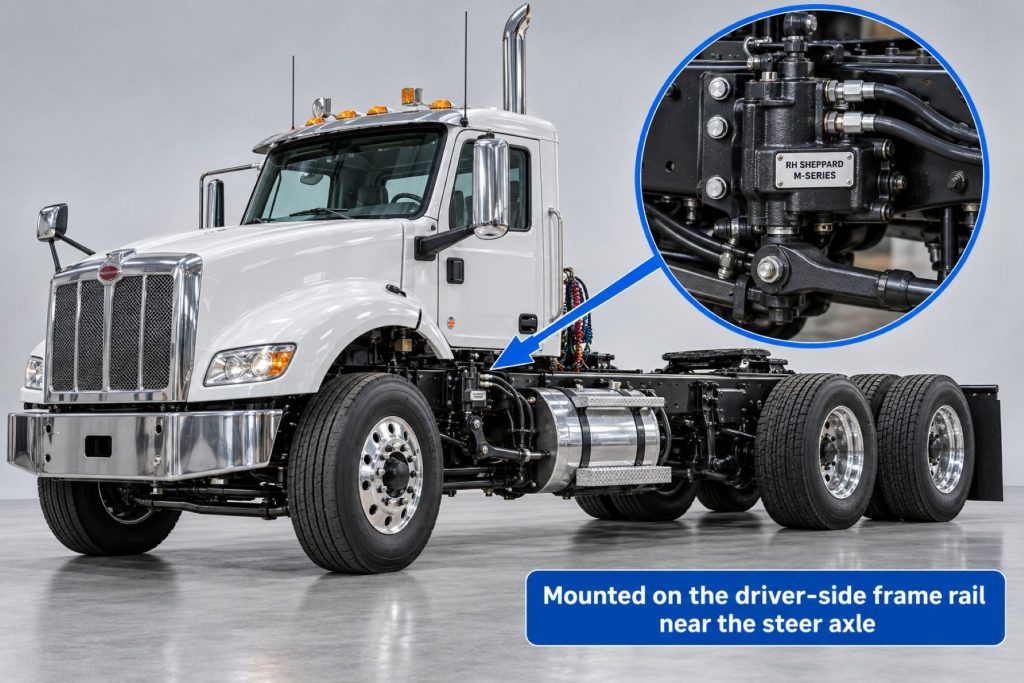
The steering gear is normally mounted to a reinforced section of the chassis frame near the front axle. Its input shaft connects to the steering column through an intermediate shaft, while the output sector shaft connects to the pitman arm.
Its function is to multiply and assist driver input while precisely controlling the mechanical steering linkage. It must remain securely mounted and correctly aligned with the steering column and linkage.
Common Specifications
- Steering-Gear Type: Integral hydraulic power steering
- Product Family: R.H. Sheppard M-Series
- Common Model Families: M80, M90, M100, M110, and related application-specific configurations
- Vehicle Position: Chassis frame near the steer axle
- Input: Steering column and intermediate steering shaft
- Output: Sector shaft and pitman arm
- Hydraulic Connections: Pressure and return, with auxiliary connections on selected configurations
- Steering Ratio: Application-specific
- Operating Pressure and Flow: Determined by the exact gear and vehicle hydraulic system
- Mounting Pattern: Application-specific frame mounting
- Rotation and Travel: Determined by the complete steering-gear model and specification
Operating Capacity and Performance
Operating capacity depends on the exact M-Series gear, steering ratio, hydraulic pressure and flow, sector-shaft configuration, pitman arm, front-axle loading, tire size, and steering geometry.
The gear must be matched to the vehicle’s approved steering system. A larger housing or similar appearance does not confirm that a gear has the correct capacity or operating characteristics.
Installation Position and System Function
Installation position is determined by the chassis frame, steer axle, steering column, suspension, and linkage layout. The gear may be mounted in different orientations depending on the vehicle.
The installation must provide full steering travel without contact between the pitman arm, drag link, axle, suspension, frame, tires, hoses, or body equipment.
Torque Transfer or Steering-Assist Function
The M-Series combines driver-applied torque with hydraulic force supplied by the power-steering pump. This reduces steering-wheel effort while retaining a mechanical connection through the steering gear and linkage.
If hydraulic assistance is lost, mechanical steering remains possible, but the driver may experience extremely high steering effort, particularly at low speed.
Driveline Geometry and Operating Angles
The steering-column intermediate shaft must connect to the steering-gear input without binding. Universal-joint angles, shaft phasing, slip travel, cab movement, and input-shaft alignment must remain within the vehicle manufacturer’s requirements.
Incorrect shaft geometry can cause stiffness, inconsistent steering effort, poor return-to-center response, noise, or accelerated wear.
Steering Geometry and Movement
Steering performance depends on the relationship among the gear, pitman arm, drag link, steering arm, tie rod, axle, kingpins, suspension, wheels, and tires.
Correct caster, camber, toe, ride height, axle position, steering stops, and linkage geometry are necessary for predictable steering response and tire wear.
Slip, Articulation, and Operating Travel
The intermediate steering shaft must accommodate normal cab and chassis movement without bottoming, separating, or binding. The steering gear must remain within its approved internal travel throughout the complete wheel-steering range.
Axle stops should limit wheel travel correctly. The steering system should not use the gear’s internal limits as the primary wheel stops.
Bearings, Joints, Shafts, Gears, and Structural Design
The M-Series uses precision bearings, shafts, internal gear surfaces, a hydraulic piston, and a sector-shaft assembly to transfer steering movement. These components operate under repeated hydraulic and mechanical loads.
External steering shafts, universal joints, pitman arms, drag links, tie rods, steering arms, and kingpins are separate parts but directly influence steering-gear operation and perceived free play.
Materials and Component Construction
M-Series gears use heavy-duty cast housings with hardened and precision-machined internal components. Shafts, gear teeth, bearings, bushings, ball tracks where applicable, and sealing surfaces are manufactured to withstand commercial-vehicle steering loads.
Internal parts should be replaced only with approved components matched to the identified gear. Similar-looking components may differ in dimensions, hardness, travel, or load capacity.
Hydraulic and Electric Steering Assistance
The M-Series relies on hydraulic assistance supplied by the vehicle’s power-steering pump. The complete system also includes a reservoir, approved fluid, pressure and return hoses, fittings, and application-specific filtration or cooling equipment.
Some newer vehicles may combine a hydraulic gear with electronically controlled pumps or supplemental steering-assistance technology. Those systems still require correct mechanical and hydraulic compatibility.
Electronic Controls and Driver-Assistance Integration
A conventional M-Series gear is hydraulically and mechanically controlled. Vehicle-level electronic systems may use steering-angle sensors, stability-control inputs, lane-departure warnings, or other driver-assistance components.
Steering-angle or related electronic systems may require recalibration after steering-gear replacement, linkage work, alignment, axle repair, or steering-column service.
Speed, Torque, and Load Management
Pump output, engine speed, relief settings, hydraulic temperature, front-axle loading, tire pressure, road surface, and steering speed affect the demands placed on the gear.
Holding the steering wheel against full lock can create excessive pressure and heat. Operators should release steering pressure after reaching the travel limit.
Vibration, Balance, and Noise Control
Steering vibration, shimmy, or noise may come from tires, wheels, alignment, kingpins, wheel bearings, suspension, linkage, hydraulic aeration, pump cavitation, intermediate shafts, or the steering gear.
Diagnosis should include the complete front axle and steering system instead of assuming the steering gear is the source.
Lubrication, Sealing, and Contamination Protection
Approved power-steering fluid lubricates internal components and transfers hydraulic force. Shaft seals, housing seals, hose connections, and protective components retain fluid and limit contamination.
Dirt, water, metal particles, degraded hose material, or incompatible fluid can damage the valve, piston, bearings, seals, pump, and precision-machined surfaces.
Duty Cycle and Operating Conditions
M-Series gears may operate in highway, regional, urban, construction, refuse, transit, emergency, recreational, and severe vocational service.
Frequent low-speed maneuvering, rough terrain, high steer-axle loads, contamination, and high hydraulic temperatures can increase component wear compared with normal highway operation.
Mounting and Installation
Installation requires the correct mounting pattern, frame condition, fasteners, pitman arm, steering-column connection, hydraulic fittings, hose routing, and application-specific gear.
The hydraulic system must be filled and bled according to the applicable procedure. Air trapped in the system may cause noise, foaming, uneven assistance, overheating, or pump damage.
Alignment, Driveline, and Mounting Geometry
The steering gear must mount squarely against an undamaged frame surface. Loose fasteners, cracked frame rails, distorted brackets, incorrect pitman-arm indexing, or steering-shaft misalignment can affect steering control.
Front-end alignment should be checked after gear or major linkage service. Steering-wheel position and electronic steering-angle calibration may also require correction.
Vehicle, Transmission, Axle, and Steering Compatibility
Compatibility depends on the vehicle manufacturer, model, model year, steer-axle rating, frame arrangement, steering column, pitman arm, linkage geometry, pump output, hydraulic connections, tires, and complete steering-gear identification.
The transmission does not normally drive the gear directly, but engine and powertrain packaging can affect pump mounting, hose routing, cooling, and service access.
Related Component and System Compatibility
The gear must be compatible with the power-steering pump, reservoir, fluid, hoses, fittings, cooler, filter, steering column, intermediate shaft, pitman arm, drag link, tie rod, axle stops, wheels, and tires.
Dual-gear steering systems require approved hydraulic routing and synchronized mechanical geometry. Primary and auxiliary gears should not be mixed without verified application information.
Common Applications
- Heavy-duty highway tractors
- Regional-haul tractors
- Dump trucks
- Concrete mixers
- Refuse trucks
- Heavy-haul tractors
- Fire and emergency vehicles
- Transit and commercial buses
- Motorhomes
- Municipal and utility trucks
- Construction vehicles
- Specialty commercial chassis
Advantages
- Reduces steering effort on heavy commercial vehicles
- Combines mechanical and hydraulic functions in one assembly
- Supports heavily loaded steer axles
- Available in multiple application-specific sizes
- Mechanical steering connection remains during hydraulic-assist loss
- Suitable for highway and vocational applications
- Can be integrated into approved dual-gear steering systems
- Established commercial-vehicle service history
- New and remanufactured replacement options may be available
Limitations or Considerations
- Requires a dependable hydraulic system
- Incorrect pressure or flow can damage components
- Hydraulic leaks can reduce assistance
- Replacement must match the exact application
- Contaminated or incorrect fluid can damage the gear and pump
- Improper mounting can affect steering control
- Loss of hydraulic assistance greatly increases steering effort
- Internal adjustment requires approved procedures
- Steering complaints may originate outside the gear
- Older configurations may require careful parts identification
Driver and Operator Experience
A correctly operating M-Series system should provide predictable steering assistance, manageable low-speed effort, stable highway tracking, and controlled response to driver input.
Drivers should report changes in effort, free play, pull, wander, return-to-center behavior, noise, vibration, steering-wheel position, or visible fluid leakage.
Steering Feel and Driver Feedback
Steering feel is influenced by the gear ratio, hydraulic pressure, steer-axle load, tires, caster, linkage condition, road surface, suspension, and vehicle speed.
Heavy, loose, inconsistent, or slow-returning steering should be investigated promptly. These symptoms do not automatically confirm an internal steering-gear failure.
Operating Speed, Angle, and Load Management
Operators should avoid forcing the steering system against stationary tires or holding the steering wheel at full lock. These practices increase hydraulic pressure, temperature, tire scrub, and mechanical loading.
Overloaded steer axles, wide tires, low tire pressure, soft ground, or poor alignment can significantly increase steering demand.
Control Setup and System Calibration
Setup may include centering the gear, indexing the pitman arm, setting axle stops, adjusting approved travel-control components, bleeding the hydraulic circuit, centering the steering wheel, and aligning the front axle.
Vehicles with steering-angle sensors, electronic stability control, lane-keeping systems, or supplemental steering assistance may require electronic calibration after service.
Inspection and Wear Points
- Steering-gear housing
- Frame and mounting brackets
- Mounting fasteners
- Input shaft and steering-column connection
- Sector shaft and seals
- Pitman arm and retaining hardware
- Pressure and return hoses
- Hydraulic fittings and ports
- Reservoir fluid level and condition
- Drag-link ends
- Tie-rod ends
- Steering arms and kingpins
- Intermediate-shaft universal joints and slip shaft
- Evidence of leakage, looseness, binding, cracking, or interference
Lubrication Requirements
Use only the power-steering fluid approved for the vehicle and hydraulic system. Fluid should remain at the correct level and free of water, dirt, metal particles, aeration, and incompatible additives.
External steering-linkage and steering-shaft joints should be lubricated according to their individual service requirements.
Component Service Life and Rebuildability
Service life depends on duty cycle, axle loading, hydraulic condition, alignment, operating temperature, contamination control, maintenance, road conditions, and collision history.
Many M-Series gears can be professionally remanufactured. Correct rebuilding requires specialized tools, approved parts, precision measurements, adjustments, and functional testing.
Shaft, Joint, Bearing, Gear, and Linkage Service Life
Wear can develop in the input shaft, internal bearings, piston and gear surfaces, sector shaft, pitman-arm splines, intermediate-shaft joints, drag link, tie rod, kingpins, and steering arms.
The complete steering system should be inspected before the gear is adjusted or replaced for excessive free play.
Seal, Hose, Sensor, and Electronic Service Life
Age, heat, contamination, pressure cycling, abrasion, and incorrect fluid can deteriorate seals and hydraulic hoses. Leakage may occur at shafts, fittings, hose crimps, reservoirs, pumps, or coolers.
Steering-angle sensors and electronic assistance components should be diagnosed using the applicable vehicle procedures rather than replaced solely because a steering-system warning is present.
Maintenance and Ownership Notes
Inspect the steering gear, hydraulic circuit, frame mounting, steering column, pitman arm, and linkage at scheduled service intervals. Fluid loss, looseness, unusual noise, or changes in steering behavior require prompt investigation.
Do not assume all steering free play originates inside the gear. Worn kingpins, wheel bearings, steering-column joints, drag-link ends, tie-rod ends, pitman-arm splines, or loose mounting hardware can produce similar symptoms.
Common Driveline and Steering Problems
- Heavy steering: Low fluid, trapped air, inadequate pump output, hydraulic restrictions, excessive axle load, binding linkage, poor alignment, or internal wear may increase effort.
- Excessive free play: Loose steering-shaft joints, worn pitman-arm splines, linkage wear, loose mounting hardware, or internal gear wear may be responsible.
- Steering wander: Incorrect caster, worn kingpins, loose wheel bearings, tire problems, linkage wear, frame movement, or gear wear may reduce directional control.
- Poor return to center: Binding components, insufficient caster, incorrect steering-shaft geometry, tight adjustment, hydraulic restrictions, or tire problems may interfere with return.
- Hydraulic leakage: Worn seals, damaged hoses, loose fittings, cracked reservoirs, or damaged sealing surfaces may cause fluid loss.
- Noise or foaming: Low fluid, trapped air, pump cavitation, restrictions, incorrect fluid, or improper bleeding may create noise and bubbles.
- Overheating: Continuous full-lock operation, incorrect pump output, restrictions, severe duty, poor cooling, or internal leakage may raise fluid temperature.
- Steering pull: Tires, brakes, alignment, suspension, road crown, axle position, or uneven loading may be responsible rather than the steering gear.
Safety and Service Precautions
Commercial-vehicle steering is safety-critical. Service should follow the applicable R.H. Sheppard, Bendix, vehicle-manufacturer, and fleet procedures.
- Secure the vehicle before working beneath or around it.
- Relieve hydraulic pressure before disconnecting lines.
- Keep contamination out of open ports and hoses.
- Use approved lifting equipment for the heavy steering gear.
- Do not heat, weld, straighten, or modify steering components unless specifically approved.
- Use the specified mounting hardware and torque procedures.
- Verify pitman-arm installation and retention.
- Bleed the hydraulic system completely.
- Confirm full travel and component clearance.
- Perform alignment and electronic calibration when required.
- Complete a controlled road test before returning the vehicle to service.
Identification Information
Identification information may be stamped into the housing or shown on an attached manufacturer label. Record all available information before ordering a replacement gear or service parts.
- Vehicle manufacturer
- Vehicle identification number
- Vehicle model and model year
- Complete Sheppard model number
- Serial, specification, or assembly number
- Input-shaft configuration
- Sector-shaft configuration
- Output rotation
- Mounting pattern
- Hydraulic-port arrangement
- Pitman-arm information
- Single- or dual-gear steering arrangement
Buying Considerations
- Confirm the complete steering-gear model and specification.
- Verify the vehicle identification number and original application.
- Match the mounting pattern and housing orientation.
- Confirm input-shaft type and steering-column connection.
- Verify sector-shaft dimensions and output rotation.
- Match the pitman arm and steering-linkage arrangement.
- Check hydraulic-port sizes and locations.
- Confirm approved pump pressure and flow.
- Identify auxiliary or dual-gear requirements.
- Review warranty and core-return requirements for remanufactured gears.
- Confirm installation, bleeding, alignment, and calibration procedures.
Variants and Configurations
- Different M-Series housing sizes
- Different steering ratios
- Different mounting patterns
- Different input-shaft configurations
- Different sector-shaft arrangements
- Different output rotations
- Different hydraulic-port locations
- Single-steering-gear systems
- Dual-gear or auxiliary-assist systems
- Highway and vocational configurations
- New, service-replacement, and remanufactured assemblies
Comparison to Similar Equipment
Compared with the ZF TRW TAS Series Steering Gear, the Sheppard M-Series uses a different housing, internal design, mounting system, adjustment procedure, and application-identification structure.
Compared with the ZF TRW THP Series Steering Gear, the M-Series represents an alternative heavy-commercial-vehicle hydraulic steering-gear family with different ratios, connections, service procedures, and vehicle applications.
Compared with a fully electric steering system, the M-Series relies on hydraulic pressure for assistance. It may still operate alongside vehicle-level electronic sensors and driver-assistance technology.
Compared with manual steering, hydraulic assistance substantially reduces driver effort but adds pumps, hoses, fluid, seals, and thermal-management requirements.
Best Fit For
- Vehicles originally equipped with a matching Sheppard M-Series gear
- Heavy-duty highway tractors
- Regional and vocational trucks
- Vehicles with heavily loaded front axles
- Buses, motorhomes, and specialty chassis
- Severe-duty steering applications
- Approved single- or dual-gear steering systems
- Fleets with hydraulic steering service capabilities
- Applications with verified model and specification information
Related Vehicle and Trailer Types
- Highway Tractors
- Class 6, Class 7, and Class 8 Trucks
- Heavy-Haul Tractors
- Dump Trucks
- Concrete Mixer Trucks
- Refuse Trucks
- Fire and Emergency Vehicles
- Commercial Buses
Related Truck and Trailer Models
- Freightliner Cascadia
- Freightliner M2 106
- Kenworth T680
- Kenworth T880
- Peterbilt 579
- Peterbilt 567
- International LT Series
- International HX Series
- Mack Anthem
- Mack Granite
- Volvo VNL
- Western Star 49X
Related Driveline and Steering System Types
- Steering Gears & Steering Linkage
- Power Steering Pumps & Hydraulic Assist
- Steering Columns & Driver Controls
- Advanced Steering & Lane-Keeping Systems
- Commercial Truck Driveshafts
- Universal Joints, Slip Yokes & Center Bearings
Related Driveline and Steering Products
- ZF TRW TAS Series Steering Gear
- ZF TRW THP Series Steering Gear
- R.H. Sheppard D-Series Steering Gear
- R.H. Sheppard S-Series Steering Gear
- Bendix Reman Sheppard Steering Gear
- R.H. Sheppard Power Steering Pump
- ZF ReAX Steering System
Related Equipment Systems
- Drivelines & Steering Systems
- Suspension Systems
- Axles & Differentials
- Tires & Wheels
- Brake Systems
- Electrical Systems
- Safety Systems
- Equipment Systems
Related Guides
- Driveline & Steering System Guides
- How Commercial Truck Steering Systems Work
- Hydraulic vs Electric-Assisted Commercial Truck Steering
- Common Commercial Truck Driveline Vibrations and Steering Problems
- Commercial Truck Steering Components Explained
- How to Inspect Commercial Truck Steering Systems
- Common Commercial Truck Power-Steering Problems
Regulatory and Compliance Notes
Commercial-vehicle steering systems must remain in safe operating condition and comply with applicable inspection, maintenance, and out-of-service requirements. Excessive free play, insecure mounting, damaged linkage, serious leakage, cracked components, or steering interference may make a vehicle unsafe to operate.
Replacement or modification must preserve approved steering geometry, axle ratings, tire clearance, linkage travel, frame integrity, and electronic safety-system operation.
Real World Operating Notes
Many apparent steering-gear problems originate elsewhere in the front axle, steering linkage, tires, suspension, or hydraulic system. A complete inspection should be performed before replacing the gear.
Fluid aeration may cause noise, foaming, inconsistent assistance, and overheating. Leaks should be corrected and the system properly bled before the gear is condemned.
Vehicle loading and tire condition have a substantial effect on steering effort. A correctly functioning gear cannot compensate for an overloaded axle, underinflated tires, worn kingpins, loose linkage, or incorrect alignment.
Frequently Asked Questions
What is the R.H. Sheppard M-Series?
It is a family of integral hydraulic power-steering gears designed for heavy commercial vehicles.
Which M-Series steering gear fits my truck?
The correct gear depends on the complete model and specification, vehicle identification number, mounting pattern, input and output configuration, rotation, hydraulic ports, pitman arm, and steering system.
Can an M-Series gear replace a TRW steering gear?
Not automatically. Mounting, ratio, travel, rotation, hydraulic, linkage, and vehicle requirements must be verified through an approved application or conversion.
Can the vehicle steer if hydraulic assistance fails?
The mechanical connection remains, but steering effort becomes substantially higher. The vehicle should be stopped safely and inspected.
What causes heavy steering?
Possible causes include low fluid, trapped air, inadequate pump output, restrictions, binding linkage, poor alignment, excessive axle loading, tire problems, or internal gear wear.
What causes excessive steering free play?
Free play may originate in the steering column, intermediate shaft, pitman arm, drag link, tie rod, kingpins, wheel bearings, mounting points, or steering gear.
Can an M-Series steering gear be rebuilt?
Many configurations can be professionally remanufactured using approved parts, specialized tools, precision adjustments, and functional testing.
Why is the complete model number important?
M-Series gears may differ in mounting, ratio, rotation, travel, shaft configuration, port arrangement, and capacity even when their housings appear similar.
Should all free play be removed through gear adjustment?
No. The source of the free play must first be located throughout the complete steering system. Gear adjustment must follow the approved service procedure.
Who owns R.H. Sheppard?
R.H. Sheppard operates as part of Bendix Commercial Vehicle Systems, which supports commercial-vehicle steering products and services.
Availability and Where to Find
R.H. Sheppard M-Series steering gears, remanufactured assemblies, service components, seals, pitman arms, hoses, and related steering parts may be available through commercial-truck dealers, Bendix and Sheppard distributors, heavy-duty parts suppliers, steering specialists, and professional remanufacturers.
Availability depends on the exact model, specification, mounting arrangement, rotation, shaft configuration, hydraulic connections, vehicle application, and production status. All identification information should be verified before ordering.
Current product information, service resources, and distributor support are available through the Bendix website.
Support Trucking Families
Truck Equipment Atlas supports the mission of Grey Cross, a nonprofit dedicated to helping families of truck drivers who lose their lives while on the road. As the site grows, part of its mission is to bring awareness and support to these families.
Podcast or Video Section
Learn More Through Audio and Video
Truck Equipment Atlas will continue expanding with podcast episodes, interviews, and equipment breakdowns to help drivers and fleets better understand trucks and equipment.
Follow the Growth of Truck Equipment Atlas
Truck Equipment Atlas continues to expand with new truck profiles, trailer coverage, diesel engine pages, equipment system resources, manufacturer information, and educational guides.
Visit our Site Updates page to explore recent additions, project milestones, and upcoming resources as we continue building one of the industry’s growing commercial trucking equipment reference libraries.
View the Latest Site Updates: Truck Equipment Atlas Site Updates