
Quick Facts
- Manufacturer: Dana Incorporated
- Brand: Spicer
- Product Series: Spicer Life Series
- Product Model: SPL350
- Product Type: Heavy-duty commercial-vehicle driveshaft
- Primary Applications: Linehaul, heavy-haul, and vocational trucks
- Primary Powertrain Application: High-torque and engine-downspeeding drivetrains
- Driveline Position: Main, auxiliary, or application-specific driveline position
- Joint Design: High Power Density Spicer Life Series universal joint
- Lubrication Options: Relubricatable and optional service-free configurations
- Primary Function: Transfers torque between the transmission, power divider, and drive axle
- Production Status: Current application and component availability should be confirmed with Dana or an authorized Spicer distributor
Overview
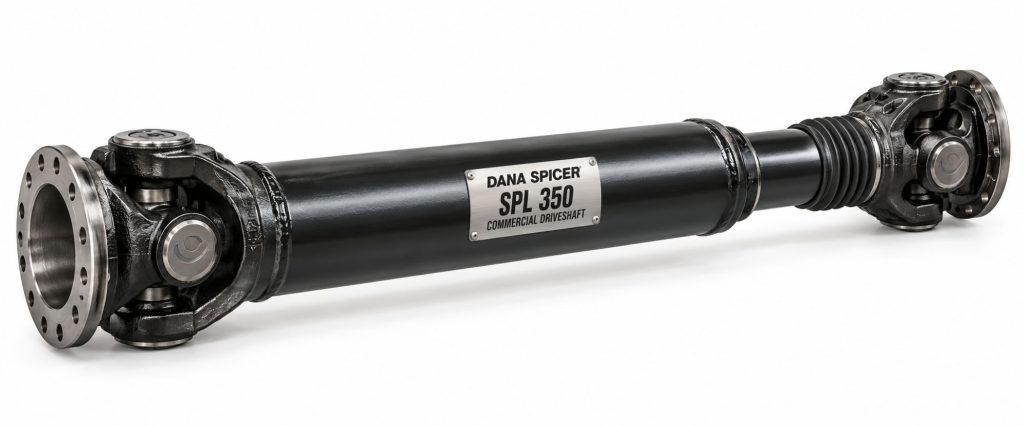
The Dana Spicer SPL 350 Driveshaft is a heavy-duty commercial driveline designed for high-torque linehaul, heavy-haul, and vocational trucks. Dana developed the SPL350 to support modern powertrains that use engine downspeeding, fast axle ratios, and high transmitted torque to improve highway efficiency.
Engine downspeeding allows a truck to operate at lower engine speeds during highway travel, but it can increase the torque passing through the transmission, driveshaft, and drive axles. The SPL350 uses Dana’s High Power Density design to support these increased driveline stresses.
The SPL350 is available in application-specific lengths, tube configurations, end connections, and lubrication arrangements. Correct selection requires complete analysis of torque, rotational speed, driveshaft length, operating angles, axle ratio, suspension movement, and vehicle duty cycle.
Key Characteristics
- Heavy-duty Spicer Life Series driveshaft
- Designed for high-torque commercial powertrains
- Supports engine-downspeeding applications
- Designed for linehaul, heavy-haul, and vocational service
- High Power Density universal-joint architecture
- Available with an optional service-free design
- Accommodates driveline-angle and suspension-travel changes
- Application-specific tube, slip, and end-yoke configurations
- Designed to support fast axle ratios
- Integrates with other application-approved Dana drivetrain components
Major Components
- Driveshaft tube
- SPL350 universal-joint assemblies
- Universal-joint cross
- Bearing cups
- Bearing retainers
- Tube yokes
- End yokes or flange yokes
- Slip yoke and spline assembly
- Dust cap and seals
- Retaining bolts and related hardware
- Lubrication fitting on serviceable joints
- Balance weights
- Center-bearing equipment on applicable multi-piece drivelines
Product Type and Construction
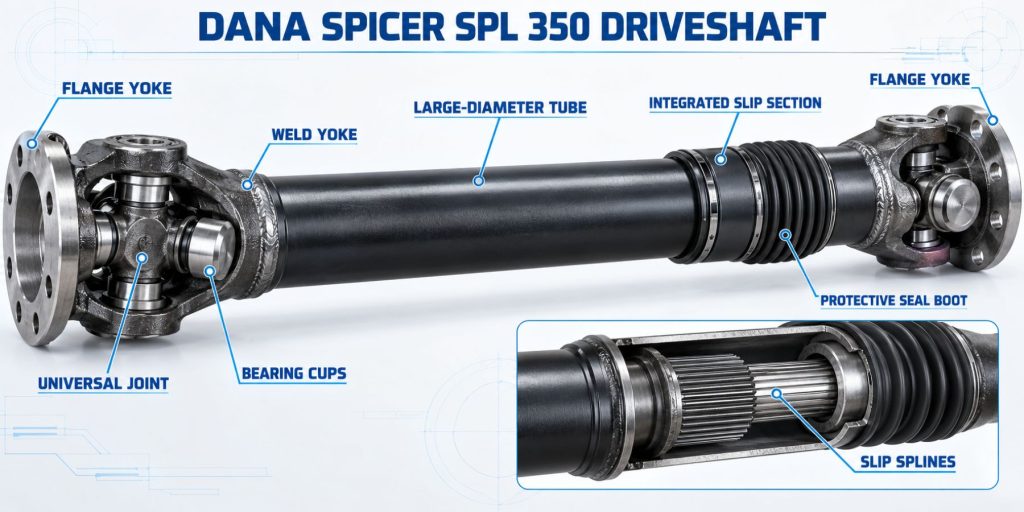
The SPL350 is a tubular steel driveshaft assembly built around large-capacity Spicer universal joints. Its High Power Density design concentrates substantial torque capacity within a configuration intended for modern commercial-truck chassis.
The tube connects the driveshaft yokes and carries torsional loads. Universal joints permit angular movement, while the slip-spline assembly accommodates changes in driveline length as the axle and suspension move relative to the transmission.
How the Driveline or Steering Component Works
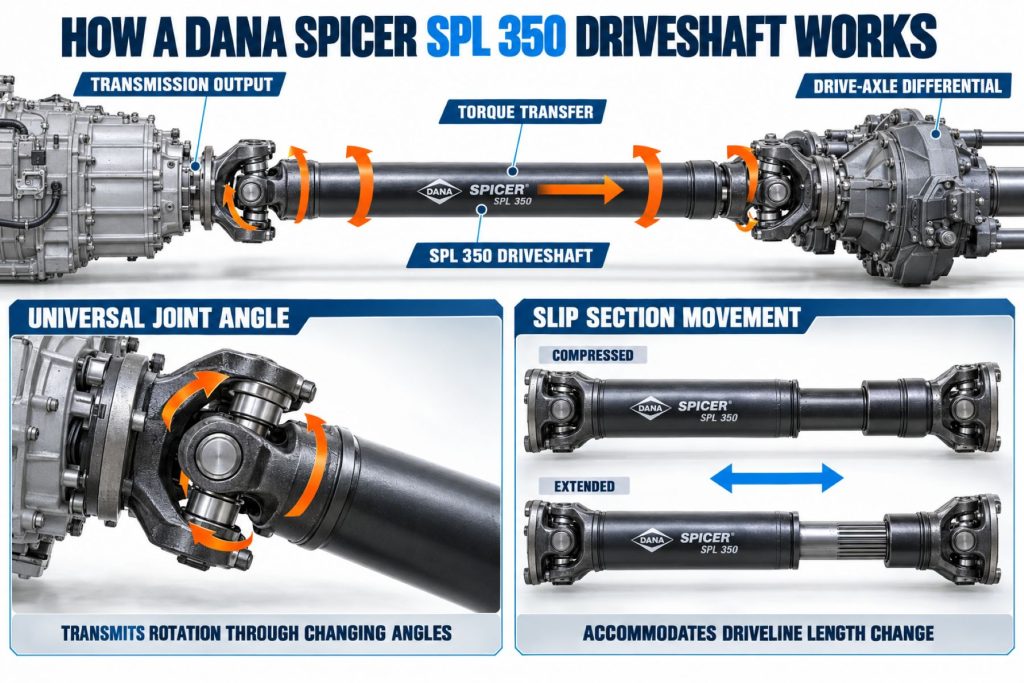
Torque leaves the transmission through its output connection and enters the front of the SPL350 driveshaft. The driveshaft tube carries rotational force toward the drive axle, power divider, or next driveline section.
The universal joints allow torque to pass between components positioned at different angles. The slip assembly changes effective length as the axle moves through suspension travel. Correct phasing, balance, joint angles, lubrication, and spline engagement allow the system to operate without damaging vibration or binding.
Position and Function Within the Vehicle
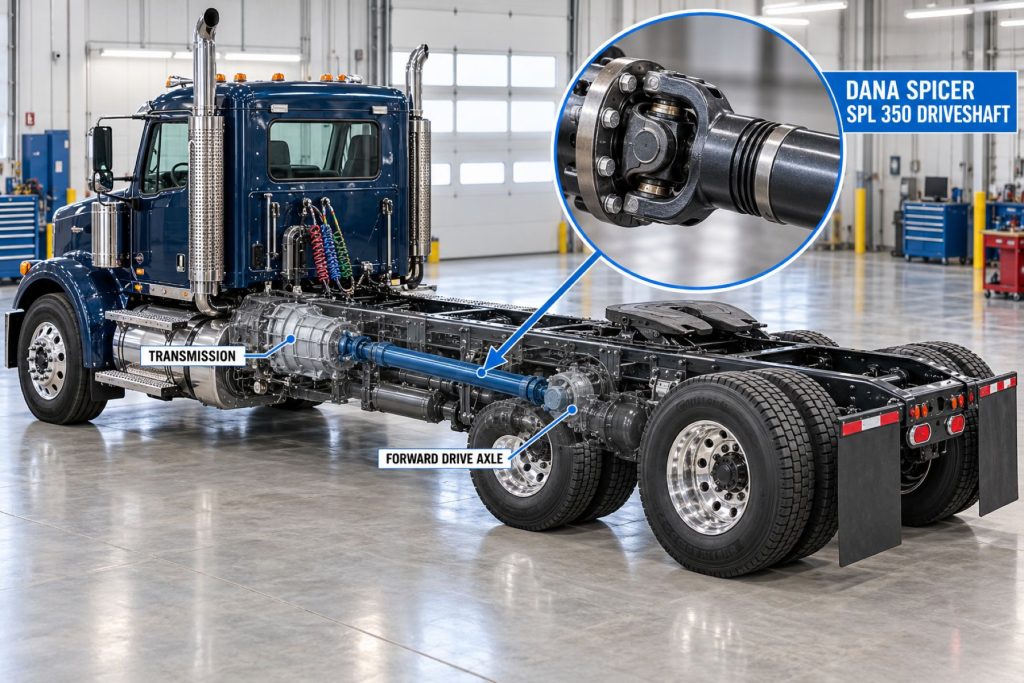
The SPL350 may be installed between the transmission and forward drive axle, between sections of a multi-piece driveline, or in another Dana-approved position. Its location depends on the wheelbase, transmission, drive-axle arrangement, frame layout, suspension, and completed vehicle design.
Its function is to transfer rotational torque while accommodating changes in angle and distance between the powertrain components it connects.
Common Specifications
- Series: Spicer SPL350
- Component Category: Heavy-duty commercial driveshaft
- Primary Service: Linehaul, heavy-haul, and vocational operation
- Powertrain Use: Conventional and engine-downspeeding drivetrains
- Driveshaft Arrangement: One-piece or multi-piece, depending on the vehicle
- Universal-Joint Series: SPL350
- Common Universal-Joint Bearing-Cap Diameter: Approximately 2.559 inches in identified SPL350 round-bearing configurations
- Common Bearing-Cap Span: Approximately 6.772 inches in identified SPL350 configurations
- Lubrication: Relubricatable or optional service-free design
- Tube Length and Construction: Application-specific
- End Connections: Selected for the transmission, power divider, transfer case, or axle installation
Dimensions, torque capacity, operating speed, and component numbers must be confirmed for the exact driveshaft assembly. Common universal-joint dimensions should not be used as the only basis for parts selection.
Operating Capacity and Performance
The SPL350 is designed to withstand the increased torque stresses associated with high-efficiency heavy-truck drivetrains. Dana describes the SPL350 as having a High Power Density design, substantial universal-joint torque capacity, and an expected service life of up to one million miles in properly specified downsped powertrains.
Actual service life and operating capacity depend on the complete driveshaft assembly, tube length, rotational speed, operating angle, lubrication arrangement, vehicle loading, maintenance, and duty cycle. The general product-family capability should not be treated as a rating for every installation.
Installation Position and System Function
The SPL350 can function as the primary driveshaft in a heavy highway tractor or as part of a multi-piece driveline in a long-wheelbase or vocational truck. The installation position determines the necessary shaft length, tube construction, joint angles, slip travel, and end connections.
A driveline should be treated as a complete system. The driveshaft must be matched with the engine, transmission, axle gearing, suspension, tires, frame configuration, and intended vehicle loading.
Torque Transfer or Steering-Assist Function
The SPL350 transfers rotational torque and does not provide steering assistance. Its tube, yokes, joints, and splines transmit power between the vehicle’s transmission and driven axle system.
Downsped engines can produce high driveshaft torque at relatively low rotational speeds. Shock loading caused by abrupt clutch engagement, driveline windup, wheel hop, traction changes, or sudden gear selection can add to these normal operating forces.
Driveline Geometry and Operating Angles
Universal-joint angles must remain within the limits established for the vehicle and driveshaft configuration. The working angles at opposite ends of a driveshaft should be coordinated to reduce rotational-speed fluctuation and vibration.
Suspension ride height, axle position, engine and transmission mounts, center-bearing height, frame modifications, and vocational equipment can all affect driveline geometry. Angles should be measured with the vehicle at its specified operating height.
Steering Geometry and Movement
The SPL350 is not a steering component, so steering geometry does not directly control its operation. Chassis alignment, suspension position, axle movement, and frame condition can nevertheless affect driveshaft alignment and operating angles.
Slip, Articulation, and Operating Travel
The slip assembly allows the driveshaft to change length as the axle travels through jounce, rebound, and frame articulation. The splines must maintain sufficient engagement throughout the complete suspension range without allowing the shaft to bottom internally.
Universal joints provide controlled angular articulation. Excessive angles increase bearing loads, heat, vibration, and wear and should not be used to compensate for incorrect chassis geometry.
Bearings, Joints, Shafts, Gears, and Structural Design
The SPL350 universal joint uses a large steel cross, round bearing cups, precision bearing elements, seals, and external retention hardware. Its High Power Density architecture is designed to carry substantial torque while permitting driveline articulation.
The tube, weld yokes, end connections, and slip assembly form the structural driveshaft. The assembly contains no reduction gears; speed and torque pass through according to the ratios established by the transmission and axles.
Materials and Component Construction
The SPL350 uses high-strength steel components selected for torsional strength, fatigue resistance, wear resistance, and dimensional stability. Tube diameter and wall thickness vary according to driveshaft length, operating speed, and torque requirements.
Bearing surfaces, splines, seals, and yoke interfaces are manufactured to controlled tolerances. Components that appear physically similar may have different materials, dimensions, heat treatment, or load capacity and should not be substituted without verification.
Hydraulic and Electric Steering Assistance
Hydraulic and electric steering assistance are not part of the SPL350 driveshaft. A truck equipped with this driveline may use conventional hydraulic steering, electric-assisted hydraulic steering, or another approved steering system independently of the driveshaft.
Electronic Controls and Driver-Assistance Integration
The SPL350 is primarily mechanical and normally does not have a dedicated electronic controller. Its loading is influenced by electronically controlled engines, automated transmissions, traction control, stability systems, axle locks, and engine-torque-management programming.
Powertrain calibration should remain compatible with the approved driveshaft, transmission, axle, and vehicle ratings.
Speed, Torque, and Load Management
Driveshaft loading is affected by engine output, transmission ratio, axle ratio, gross vehicle weight, tire traction, road grade, operating surface, and driver input. Low transmission gears can multiply torque significantly even when the vehicle is moving slowly.
Rotational speed becomes critical during highway travel. A shaft capable of carrying the required torque may still be unsuitable if its length and tube construction allow it to approach a damaging resonant speed.
Vibration, Balance, and Noise Control
Driveshaft balance, universal-joint phasing, operating angles, tube runout, slip-spline condition, yoke alignment, and center-bearing position all influence vibration. A missing balance weight or dented tube can produce vibration that increases with road or driveshaft speed.
Tire imbalance, wheel runout, axle problems, worn powertrain mounts, and incorrect suspension height can create similar symptoms. The complete vehicle should be inspected before the driveshaft is identified as the cause.
Lubrication, Sealing, and Contamination Protection
Relubricatable SPL350 joints and slip assemblies require the specified grease and service procedure. Lubricant must reach the required bearing and spline surfaces without damaging the seals.
Optional service-free joints use factory lubrication and sealed bearing assemblies. Damaged seals, water intrusion, abrasive contamination, improper cleaning, and high-pressure washing near sealing surfaces can reduce component life.
Duty Cycle and Operating Conditions
The SPL350 supports linehaul, heavy-haul, and demanding vocational operation. Service life depends on vehicle weight, road surface, grades, start-and-stop frequency, operating angles, lubrication, contamination, torque reversals, and shock loading.
Construction, logging, mining-support, refuse, heavy-haul, and severe vocational trucks may require shorter inspection intervals than highway tractors operating at steady speed.
Mounting and Installation
Installation requires the correct driveshaft length, tube configuration, end connections, slip position, universal-joint phasing, fasteners, and tightening procedure. Mating surfaces should be cleaned and inspected before assembly.
The installed driveshaft must clear crossmembers, air tanks, exhaust equipment, hydraulic components, body structures, and other chassis equipment throughout suspension and powertrain movement.
Alignment, Driveline, and Mounting Geometry
The transmission output, driveshaft sections, center bearings, power divider, and axle input must be positioned to produce acceptable working angles. Multi-piece drivelines also require correct center-bearing height, alignment, and support condition.
Final measurements should be taken at normal ride height after the vehicle’s suspension, axle position, powertrain mounts, and frame have been inspected.
Vehicle, Transmission, Axle, and Steering Compatibility
SPL350 compatibility depends on:
- Truck manufacturer and model
- Model year and vehicle identification number
- Engine torque and control calibration
- Transmission manufacturer and model
- Transmission output connection
- Drive-axle manufacturer and model
- Axle ratio and power-divider design
- Single-, tandem-, or multi-drive-axle arrangement
- Wheelbase and frame configuration
- Suspension type and ride height
- Driveshaft length and operating speed
- Maximum vehicle and combination weight
- Linehaul, heavy-haul, or vocational duty cycle
Related Component and System Compatibility
The SPL350 must be matched with approved universal joints, end yokes, flange yokes, slip assemblies, bearing retainers, center bearings, transmission outputs, power dividers, and axle-input connections.
SPL350 components should not be mixed with another driveshaft series solely because they appear similar. Series, dimensions, hardware, joint retention, and application approval must all match.
Common Applications
- Linehaul tractors
- Engine-downsped highway tractors
- Heavy-haul tractors
- Vocational trucks
- Dump trucks
- Concrete mixers
- Logging trucks
- Construction trucks
- Refuse trucks
- Heavy recovery vehicles
- Oilfield-support trucks
- Specialized commercial chassis
Advantages
- Designed for high-torque heavy-truck drivetrains
- Supports engine-downspeeding strategies
- Suitable for linehaul, heavy-haul, and vocational service
- High Power Density universal-joint design
- Optional service-free configuration
- Supports fast axle ratios when correctly engineered
- Accommodates suspension movement and driveline-angle changes
- Available in application-specific assemblies
- Supported through Dana and Spicer distribution channels
- Can integrate with other Dana drivetrain components
Limitations or Considerations
- Must be engineered for the specific torque, speed, length, and operating angle
- Large components can be heavier and more difficult to service
- Incorrect joint angles can cause vibration and premature wear
- Tube damage can make the assembly unsafe
- Improper phasing can produce severe cyclic vibration
- Relubricatable joints require correct grease and service intervals
- Service-free joints still require regular inspection
- Incorrect retaining hardware can allow joint movement or separation
- Driveshaft modification requires professional measurement and balancing
- Similar SPL products are not automatically interchangeable
Driver and Operator Experience
A correctly specified and balanced SPL350 should operate without noticeable driveline vibration. Drivers may notice a problem as a clunk during torque changes, a shudder under load, vibration within a particular speed range, or unusual noise beneath the cab.
New vibration, metallic impact, scraping, or repeated clunking should be reported immediately. Continued operation can cause additional damage or create a driveshaft-separation hazard.
Steering Feel and Driver Feedback
The SPL350 does not directly control steering feel. Severe driveline vibration may travel through the frame, cab, floor, seat, or steering column and may be mistaken for a tire, wheel, suspension, or steering problem.
Operating Speed, Angle, and Load Management
Drivers should avoid abusive clutch engagement, aggressive rocking, abrupt forward-to-reverse shifts, and other actions that produce severe driveline shock. High-weight vehicles should be operated within the approved powertrain and traction-control procedures.
Changes to tire size, axle ratio, transmission, governed speed, wheelbase, suspension, or ride height should trigger a new review of driveshaft speed and geometry.
Control Setup and System Calibration
The SPL350 does not require electronic calibration. Engine torque management, automated-transmission shifts, traction control, stability control, and axle-locking logic can influence the forces applied to the driveline.
Powertrain programming should remain within the approved driveshaft, transmission, clutch, axle, and vehicle ratings.
Inspection and Wear Points
- Universal-joint bearing cups
- Joint cross and seals
- Bearing retainers and fasteners
- End-yoke and flange connections
- Slip splines
- Dust cap and sealing surfaces
- Driveshaft tubing
- Welded yoke connections
- Balance weights
- Center bearing and support when equipped
- Transmission and axle yokes
- Clearance around nearby chassis equipment
Lubrication Requirements
Lubrication requirements depend on whether the installed SPL350 uses relubricatable or service-free universal joints. Serviceable joints and slip assemblies should receive Dana-approved lubricant at the specified interval and through the proper service procedure.
Service-free joints should not be drilled, modified, or fitted with improvised grease fittings. A damaged or contaminated sealed joint should be inspected and replaced as required.
Component Service Life and Rebuildability
Universal joints, slip components, yokes, bearing retainers, center bearings, and related hardware may be replaceable depending on the assembly and damage. A qualified driveshaft facility can inspect tube straightness, welds, splines, yoke alignment, runout, and balance.
A bent, cracked, severely corroded, or improperly welded driveshaft should not be returned to service without an approved professional repair.
Shaft, Joint, Bearing, Gear, and Linkage Service Life
Dana indicates that a properly specified SPL350 may provide up to one million miles of life in a downsped powertrain. Actual results depend on joint angles, torque, lubrication, balance, contamination, loading, vehicle operation, and maintenance.
The driveshaft contains no reduction gears or steering linkage. Related transmission, power-divider, and axle components must be inspected separately when diagnosing a driveline problem.
Seal, Hose, Sensor, and Electronic Service Life
Universal-joint and slip-spline seals protect internal surfaces from lubricant loss, dirt, water, and road contamination. Torn, hardened, displaced, or leaking seals can shorten component life.
The SPL350 normally contains no hydraulic hoses, electronic sensors, or dedicated modules. Nearby air lines, wiring, and hydraulic hoses must remain securely routed away from the rotating driveshaft.
Maintenance and Ownership Notes
Inspect the driveshaft according to the vehicle and component manufacturers’ schedules and whenever vibration, looseness, impact damage, overheating, or lubricant loss is reported.
- Check universal joints for looseness, corrosion, heat, and damaged seals
- Inspect the tube for dents, cracks, scoring, and missing balance weights
- Verify bearing-retainer and connection-hardware condition
- Inspect slip splines for wear and adequate engagement
- Lubricate serviceable components correctly
- Check center bearings on multi-piece drivelines
- Measure driveline angles after suspension or powertrain changes
- Investigate new vibration before continued operation
- Record assembly and component numbers in fleet maintenance files
Common Driveline and Steering Problems
- Speed-related vibration: Imbalance, tube damage, incorrect phasing, excessive runout, worn joints, poor angles, or center-bearing misalignment may cause vibration.
- Clunk during torque changes: Worn universal joints, loose yokes, damaged slip splines, axle backlash, or transmission-output wear may create a clunk.
- Universal-joint wear: Lubrication loss, contamination, excessive angles, overload, damaged seals, or incorrect installation can shorten bearing life.
- Slip-spline binding: Corrosion, contamination, spline damage, improper lubrication, or insufficient travel may prevent normal length changes.
- Tube damage: Road debris, improper lifting, equipment interference, or a previous driveline failure may dent, bend, or score the tube.
- Center-bearing failure: Misalignment, damaged rubber support, incorrect setup, or driveline vibration can damage the bearing on a multi-piece assembly.
- Loose bearing retainers: Incorrect hardware, improper torque, contaminated mating surfaces, or joint movement can allow the connection to loosen.
- Abnormal heat: Binding bearings, excessive operating angles, poor lubrication, or damaged slip components can generate excessive heat.
Safety and Service Precautions
A damaged or loose driveshaft can separate while rotating and cause severe vehicle damage, personal injury, or loss of control. A vehicle should be removed from service when its driveshaft, joints, retaining hardware, or supports appear unsafe.
- Secure and support the vehicle before working underneath it
- Do not rely on air suspension or hydraulic lifting equipment alone
- Allow hot driveline components to cool
- Mark driveshaft orientation before removal when required
- Use the correct bearing retainers, bolts, and torque procedure
- Do not strike or heat universal-joint components
- Do not straighten or weld a driveshaft through an unapproved process
- Keep personnel and equipment away from a rotating driveline
- Professionally balance altered or repaired assemblies
Identification Information
Identification may appear on a tube label, metal tag, yoke marking, universal-joint kit, parts record, or vehicle build record. Record:
- Vehicle manufacturer
- Vehicle identification number
- Truck model and model year
- Driveshaft assembly number
- SPL350 series identification
- Universal-joint kit number
- End-yoke or flange-yoke numbers
- Tube outside diameter
- Driveshaft length at the required reference points
- Slip-spline configuration
- Transmission model and output connection
- Drive-axle model and input connection
- Service-free or relubricatable joint design
Buying Considerations
- Confirm that the SPL350 is approved for the vehicle
- Use the original driveshaft assembly number when available
- Verify engine and transmission torque
- Determine maximum driveshaft rotational speed
- Confirm the vehicle’s axle ratio and intended road speed
- Measure the shaft using the specified reference points
- Match the end-yoke or flange connections
- Confirm universal-joint retention style
- Select the correct service-free or relubricatable configuration
- Check tube construction and critical-speed capability
- Verify slip travel and spline engagement
- Use a qualified heavy-duty driveshaft supplier
Variants and Configurations
- Relubricatable universal-joint configuration
- Optional service-free universal-joint configuration
- Application-specific driveshaft lengths
- Different tube diameters and wall thicknesses
- One-piece driveshaft assemblies
- Multi-piece driveline assemblies
- Different end-yoke and flange-yoke connections
- Application-specific slip-spline assemblies
- Main-driveshaft configurations
- Auxiliary driveline configurations where approved
Comparison to Similar Equipment
Compared with the Dana Spicer SPL 250 High-Torque Driveshaft, the SPL350 is positioned for greater torque demand and includes heavy-haul among its primary application categories.
Compared with the Dana Spicer SPL 170 Driveshaft, the SPL350 uses a substantially larger driveline platform for high-torque heavy-truck applications.
Compared with the Dana Spicer SPL 350 High-Torque Driveshaft, the standard SPL350 and SPL350 HT belong to related product families but should not be assumed to have identical ratings or components.
Compared with the Meritor Permalube RPL Series Driveline, the SPL350 uses Dana’s Spicer joint, yoke, spline, and service architecture.
Best Fit For
- Trucks originally equipped with an SPL350
- Engine-downsped highway tractors
- High-torque linehaul trucks
- Heavy-haul tractors
- Severe vocational trucks
- Vehicles using fast axle ratios
- Fleets seeking optional service-free universal joints
- Applications requiring a large Spicer Life Series driveline
- Vehicles receiving a professionally engineered driveline replacement
Related Vehicle and Trailer Types
- Semi tractors
- Linehaul tractors
- Heavy-haul tractors
- Vocational trucks
- Dump trucks
- Concrete mixers
- Logging trucks
- Refuse trucks
- Construction vehicles
- Heavy recovery vehicles
- Oilfield-support trucks
Related Truck and Trailer Models
- Freightliner Cascadia
- Kenworth T680
- Kenworth T880
- Kenworth W990
- Peterbilt 579
- Peterbilt 567
- Volvo VNL
- Volvo VHD
- Mack Anthem
- Mack Granite
- International LT Series
- International HX Series
- Western Star 49X
Related Driveline and Steering System Types
- Commercial Truck Driveshafts
- Universal Joints, Slip Yokes & Center Bearings
- Heavy-duty driveshafts
- High-torque driveshafts
- Engine-downspeeding drivelines
- Single-piece driveshafts
- Multi-piece driveshafts
- Service-free universal joints
- Relubricatable universal joints
Related Driveline and Steering Products
- Dana Spicer Life Series Commercial Driveshaft
- Dana Spicer SPL High-Torque Series Driveshaft
- Dana Spicer SPL 140 Driveshaft
- Dana Spicer SPL 170 Driveshaft
- Dana Spicer SPL 250 High-Torque Driveshaft
- Dana Spicer SPL 350 High-Torque Driveshaft
- Meritor Permalube RPL Series Driveline
- Dana Spicer SPL Universal Joint
- Dana Spicer Dura-Tune Center Bearing
Related Equipment Systems
- Drivelines & Steering Systems
- Transmissions
- Axles & Differentials
- Suspension Systems
- Engines
- Brake Systems
- Tires & Wheels
- Equipment Systems
Related Guides
- Driveline & Steering System Guides
- How Commercial Truck Driveline Systems Work
- Single-Piece vs Multi-Piece Truck Driveshafts
- How to Inspect and Maintain Driveshafts and Universal Joints
- Common Commercial Truck Driveline Vibrations and Steering Problems
- How Commercial Truck Steering Systems Work
Regulatory and Compliance Notes
The driveshaft must remain securely attached, structurally sound, and free from conditions that could cause separation or contact with other vehicle systems. Inspection requirements may vary by jurisdiction, vehicle type, fleet policy, and operating authority.
Installing an SPL350 does not increase the truck’s certified gross vehicle weight, gross combination weight, axle ratings, transmission rating, or legal capacity. Modified drivelines should be engineered and documented according to applicable manufacturer and final-stage vehicle requirements.
Real World Operating Notes
Driveline vibration may occur only within a narrow speed range or under a particular load. Recording vehicle speed, engine speed, transmission gear, throttle position, road condition, and whether the truck is accelerating or coasting can help identify the source.
Ride height should be verified before driveline angles are measured. Replacing universal joints without correcting a geometry, balance, or alignment problem can result in repeat failure.
A driveshaft that has been shortened, lengthened, retubed, or fitted with replacement yokes should be assembled and dynamically balanced by a qualified commercial driveshaft facility.
Frequently Asked Questions
What is the Dana Spicer SPL350?
The SPL350 is a heavy-duty commercial driveshaft designed for high-torque linehaul, heavy-haul, vocational, and engine-downspeeding applications.
What is High Power Density?
High Power Density is Dana’s description of the SPL350 design used to provide substantial torque capacity and bearing performance within the driveshaft platform.
Is the SPL350 designed for engine downspeeding?
Yes. Dana specifically positions the SPL350 as part of a drivetrain solution for managing the increased torque associated with engine downspeeding and fast axle ratios.
Is the SPL350 service-free?
An optional service-free design is available. Other configurations may use relubricatable joints, so the installed component numbers must be checked.
How long can an SPL350 driveshaft last?
Dana states that the SPL350 may provide up to one million miles of life expectancy in a properly specified downsped powertrain. Actual life varies with application, maintenance, geometry, lubrication, loading, and operating conditions.
Can an SPL350 replace an SPL250?
Not without application review. Tube construction, length, joint size, end connections, operating angles, rotational speed, torque requirements, and chassis clearances must all be evaluated.
What causes an SPL350 driveshaft to vibrate?
Possible causes include imbalance, damaged tubing, incorrect phasing, worn joints, improper operating angles, center-bearing misalignment, yoke runout, or slip-spline wear.
Why is critical speed important?
A driveshaft operating near its resonant speed can deflect and create severe vibration. Allowable speed depends on shaft length, tube construction, support arrangement, and installation.
How is the correct replacement identified?
Use the original assembly number, vehicle identification number, universal-joint series, tube dimensions, end connections, installed length, transmission information, axle information, and complete vehicle application.
Does an SPL350 increase the truck’s weight rating?
No. Vehicle capacity remains limited by its certified frame, axles, suspension, brakes, tires, wheels, transmission, and gross weight ratings.
Availability and Where to Find
Dana Spicer SPL350 driveshaft assemblies, universal joints, bearing retainers, yokes, slip components, and related replacement parts may be available through authorized Spicer distributors, commercial-truck dealers, heavy-duty parts suppliers, and qualified driveshaft repair facilities.
Availability depends on the required assembly length, tube specification, end connections, universal-joint design, slip configuration, and vehicle application. The original driveshaft number and complete vehicle information should be provided before ordering.
Current product information and parts resources are available through the Spicer SPL 350 Driveshaft page, the Dana website, and the Spicer Parts website.
Support Trucking Families
Truck Equipment Atlas supports the mission of Grey Cross, a nonprofit dedicated to helping families of truck drivers who lose their lives while on the road. As the site grows, part of its mission is to bring awareness and support to these families.
Podcast or Video Section
Learn More Through Audio and Video
Truck Equipment Atlas will continue expanding with podcast episodes, interviews, and equipment breakdowns to help drivers and fleets better understand trucks and equipment.
Follow the Growth of Truck Equipment Atlas
Truck Equipment Atlas continues to expand with new truck profiles, trailer coverage, diesel engine pages, equipment system resources, manufacturer information, and educational guides.
Visit our Site Updates page to explore recent additions, project milestones, and upcoming resources as we continue building one of the industry’s growing commercial trucking equipment reference libraries.
View the Latest Site Updates: Truck Equipment Atlas Site Updates