
Quick Facts
- Manufacturer: Dana Incorporated
- Brand: Spicer
- Product Series: SPL140
- Product Type: Commercial-vehicle driveshaft system
- System Category: Driveline and power-transfer equipment
- Primary Vehicle Class: Medium-duty commercial vehicles
- Driveline Positions: Main, coupling, or application-specific driveshaft position
- Universal-Joint Series: Spicer SPL140
- Lubrication Options: Relubricatable and service-free configurations, depending on the assembly
- Primary Applications: Delivery trucks, buses, utility vehicles, municipal trucks, motorhomes, and other medium-duty commercial vehicles
- Production Status: Current Spicer Life Series product; exact assemblies and components depend on the application
Overview
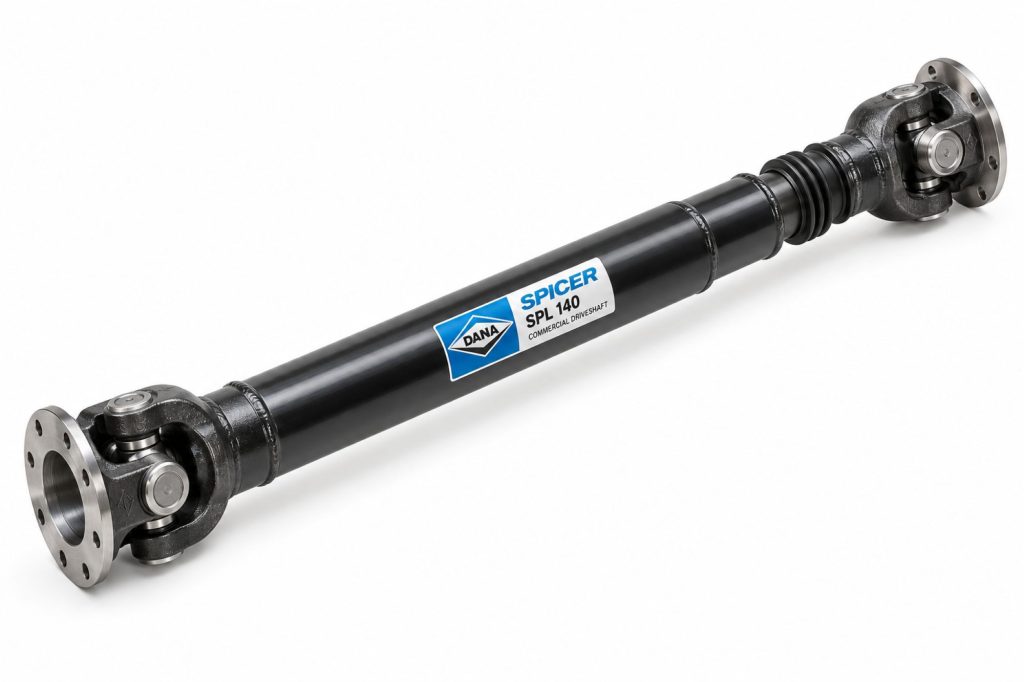
The Dana Spicer SPL 140 Driveshaft is a medium-duty commercial-vehicle driveshaft system within the Spicer Life Series product family. It transfers rotational power from the transmission to a drive axle or between other approved driveline components.
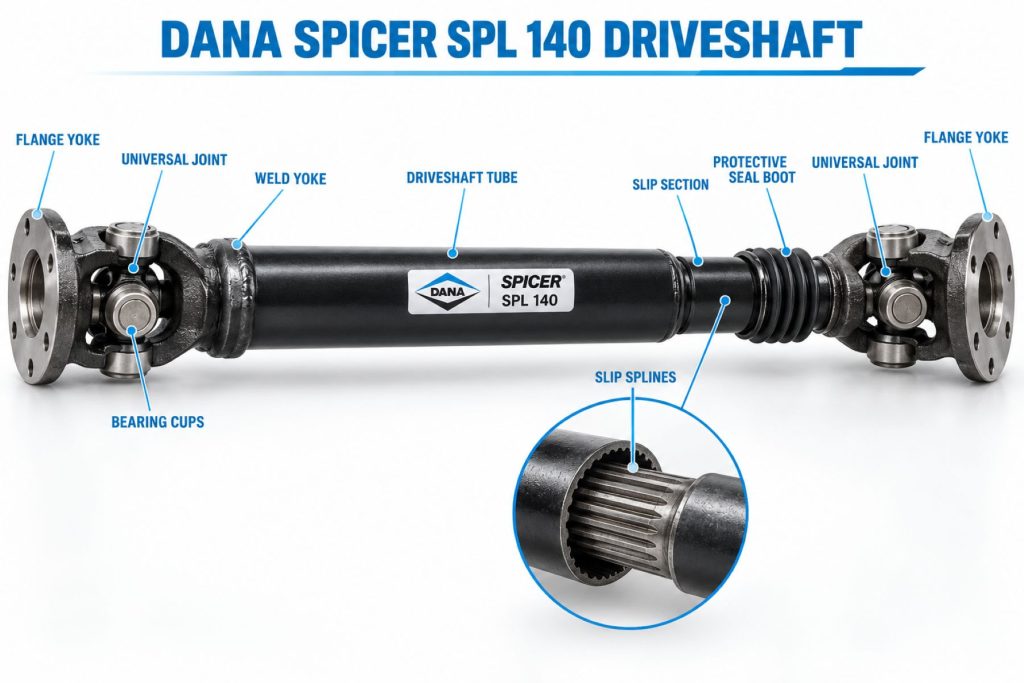
The SPL140 system combines application-specific driveshaft tubing, yokes, universal joints, bearing assemblies, slip components, seals, fasteners, and mounting connections. These parts work together while accommodating driveline angles, suspension movement, and changes in the distance between the transmission and drive axle.
Dana updated the medium-duty SPL140 product with an increased maximum torque rating of up to seven percent for applicable configurations. The exact capacity still depends on the complete shaft assembly, operating speed, installed length, joint angles, vehicle loading, and duty cycle.
Service-free and relubricatable SPL140 configurations may be available. The full driveshaft assembly number and vehicle information should be used before ordering complete shafts or replacement components.
Key Characteristics
- Medium-duty commercial-vehicle driveshaft system
- Part of the Dana Spicer Life Series
- SPL140 universal-joint architecture
- Optimized torque-carrying capability
- Updated configurations received an increased maximum torque rating
- Service-free and relubricatable options may be available
- Compact packaging for medium-duty chassis
- Precision-balanced shaft assemblies
- Slip assembly accommodates driveline-length changes
- Multiple tubing, length, yoke, and flange configurations
- Designed for compatibility with approved transmissions and drive axles
- Genuine replacement components available through the Spicer parts network
Major Components
- Driveshaft tubing
- SPL140 universal-joint cross
- Universal-joint bearing assemblies
- Round bearing caps
- Tube yokes
- End yokes or flange yokes
- Slip yoke or slip-spline assembly
- Splined shaft
- Joint and spline seals
- Protective boot where specified
- Universal-joint straps, bolts, or retainers
- Balance weights
- Center-bearing assembly in applicable multipiece drivelines
Product Type and Construction
The SPL140 is a modular driveshaft system rather than one universal shaft assembly. Dana combines SPL140 universal joints with the tubing, shaft length, wall thickness, yokes, flanges, slip components, and mounting hardware required by the specific vehicle.
A hollow driveshaft tube provides torsional strength while controlling rotating mass. Forged and machined yokes connect the tube to the universal joints, while the slip assembly allows controlled axial movement.
Service-free versions use sealed and permanently lubricated joint components. Relubricatable versions include provisions for scheduled grease service. The installed configuration must be identified before maintenance is performed.
How the Driveline Component Works
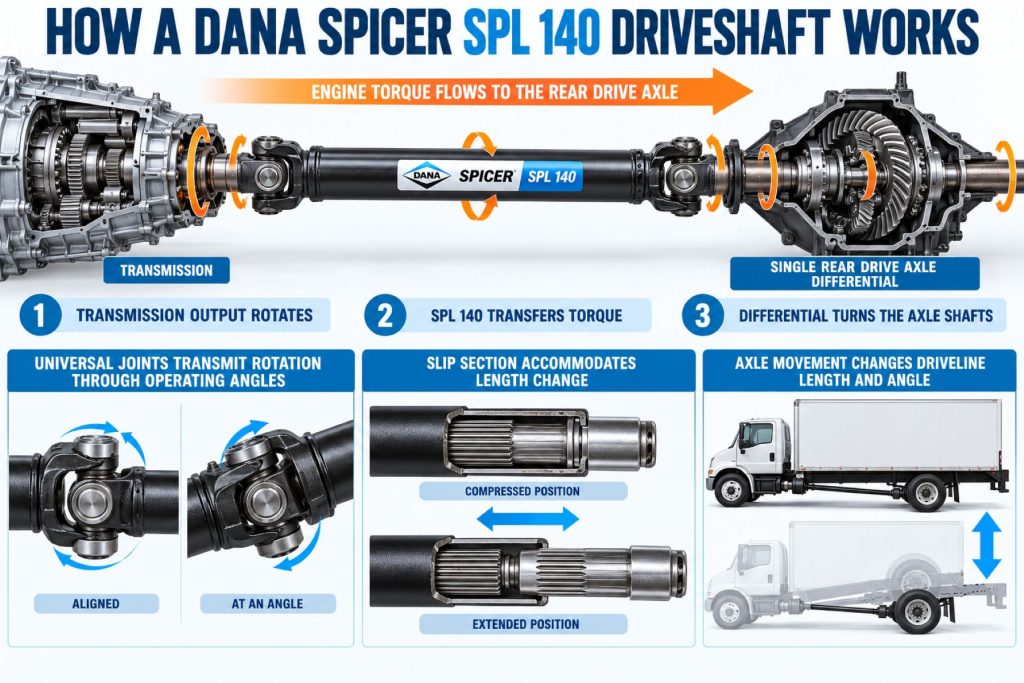
The driveshaft receives rotational torque from the transmission output or another driveline component. Torque passes through the end yoke or flange, universal joint, shaft tube, opposite universal joint, and axle input connection.
The universal joints allow the shaft to transfer torque when the connected components operate at an angle. The slip assembly allows the shaft’s effective length to change as the drive axle moves through its suspension travel.
Correct shaft balance, phasing, slip engagement, operating angles, attachment, and lubrication are necessary for smooth and reliable power transfer.
Position and Function Within the Vehicle
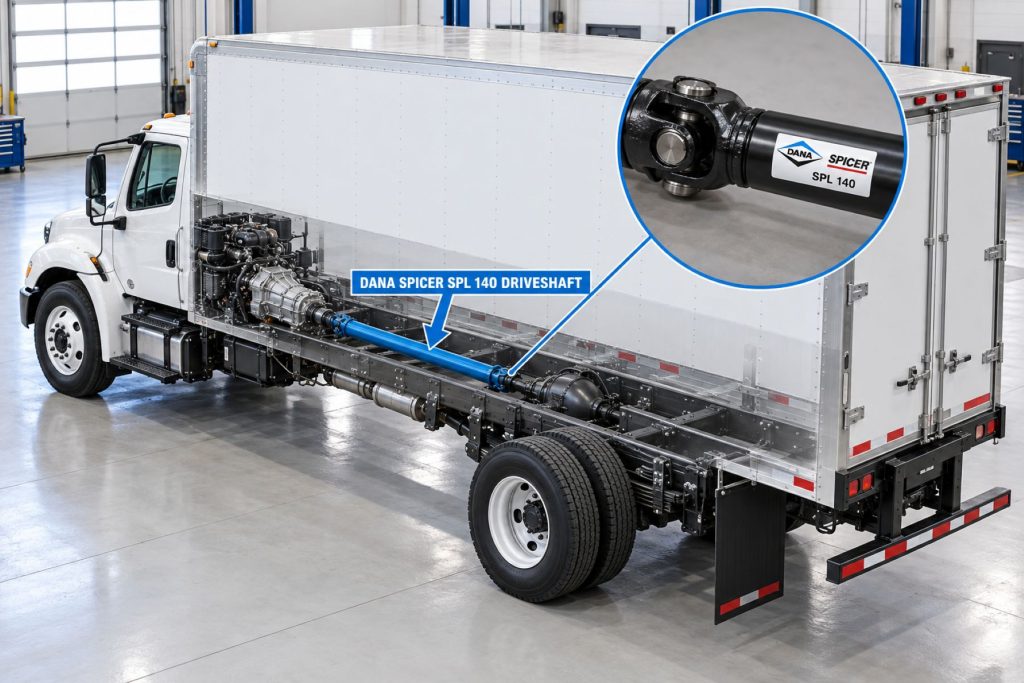
The SPL140 driveshaft is positioned between components that must transfer rotating power while moving relative to one another. A common installation connects a medium-duty transmission to a single rear drive axle.
Longer-wheelbase vehicles may use the SPL140 as one section of a multipiece driveline supported by a center bearing. The shaft’s exact position determines its speed, torque, length, angle, slip-travel, and attachment requirements.
Common Specifications
- Product Series: SPL140
- Product Family: Spicer Life Series
- Primary Service Category: Medium-duty commercial vehicles
- Shaft Arrangement: Single-piece or multipiece, depending on vehicle requirements
- Driveline Position: Main, coupling, or other approved driveshaft position
- Universal-Joint Bearing-Cap Diameter: Approximately 1.937 inches on common SPL140 joint configurations
- Universal-Joint Span: Approximately 5.46 inches on common full-round SPL140 configurations
- Lubrication: Service-free or relubricatable, depending on assembly
- Tube and Shaft Dimensions: Application-specific
- Yoke and Flange Options: Selected for the approved transmission, axle, and driveline interfaces
- Balance Requirements: Application-specific dynamic balance specification
Universal-joint dimensions do not establish the capacity of the complete shaft. Torque rating, maximum speed, installed length, tubing, joint angles, and attachment specifications must be confirmed for the exact driveshaft assembly.
Operating Capacity and Performance
The SPL140 is designed for medium-duty commercial-vehicle torque and operating-speed requirements. Dana announced an increase of up to seven percent in the maximum torque rating of applicable SPL140 configurations following product testing and engineering updates.
The allowable capacity of a complete shaft depends on transmitted torque, rotational speed, shaft length, tubing, operating angles, vehicle loading, shock loading, and required service life.
A shaft that meets the torque requirement may still be unsuitable if its length and tubing do not provide adequate critical-speed capability.
Installation Position and System Function
The SPL140 may function as the main transmission-to-axle driveshaft or as one section of a multipiece driveline. Each position has different shaft-speed, torque, length, slip-travel, and operating-angle requirements.
A shaft intended for one vehicle or driveline position should not be transferred to another application without engineering and dimensional verification.
Torque Transfer or Steering-Assist Function
The SPL140 transfers torque from the transmission or upstream driveline component toward the drive axle. It does not create torque and does not provide steering assistance.
The shaft must transmit power while accommodating universal-joint articulation and slip-spline movement without binding, excessive vibration, or interference.
Driveline Geometry and Operating Angles
Universal-joint operating angles affect vibration, bearing loading, lubrication, heat generation, and component life. The transmission output, driveshaft sections, center bearing, and axle input must be treated as one coordinated geometry.
Excessive or improperly matched angles can cause cyclic speed variation and driveline vibration. Ride-height changes, suspension modifications, powertrain-mount wear, frame repairs, and axle-position changes can alter these angles.
Driveline angles should be measured with the vehicle at its specified ride height and in the operating condition identified by the vehicle manufacturer.
Steering Geometry and Movement
The SPL140 does not directly affect steering geometry. However, changes to the suspension, frame, axle position, or ride height can influence both vehicle alignment and driveline geometry.
The driveshaft must retain adequate clearance from steering linkage, hydraulic hoses, electrical wiring, exhaust components, crossmembers, and suspension parts throughout vehicle operation.
Slip, Articulation, and Operating Travel
The universal joints provide angular articulation between the transmission, driveshaft, and axle. The slip assembly allows axial movement as the distance between driveline components changes during suspension travel.
The slip assembly must maintain adequate spline engagement while retaining enough compression clearance. Insufficient engagement can weaken the connection, while inadequate compression clearance can load the transmission or axle bearings.
Corrosion, contamination, damaged splines, or inadequate lubrication can cause the slip assembly to bind.
Bearings, Joints, Shafts, Gears, and Structural Design
The SPL140 system combines a hollow driveshaft tube with forged yokes, a universal-joint cross, round bearing caps, splined slip components, seals, and application-specific attachment hardware.
Rolling-element bearings inside the universal-joint caps allow the joint to articulate while carrying torque. A multipiece driveline may use a center bearing and support bracket to divide a long driveline into shorter shaft sections.
The driveshaft contains no reduction gears. Gear reduction occurs inside the transmission or drive axle.
Materials and Component Construction
SPL140 assemblies use engineered steel tubing, forged yokes, heat-treated universal-joint components, precision-machined splines, rolling-element bearings, and application-specific sealing materials.
Exact tubing dimensions, wall thicknesses, yoke designs, heat treatments, and fasteners vary by shaft assembly. Similar-looking components should not be substituted without confirming the part numbers and specifications.
Hydraulic and Electric Steering Assistance
Hydraulic and electric steering assistance are not part of the SPL140 driveshaft. Nearby steering hoses, wiring, sensors, and mechanical linkage must be securely routed away from the rotating shaft and universal joints.
Electronic Controls and Driver-Assistance Integration
The SPL140 is a mechanical component and normally does not require an electronic control module. Its condition can still influence transmission operation, vehicle-speed calculations, stability systems, traction controls, and vibration diagnostics.
A mechanical driveline fault may exist without producing a dedicated diagnostic code. Electronic information should therefore be considered alongside physical inspection and road-speed analysis.
Speed, Torque, and Load Management
Driveshaft speed changes with road speed, tire diameter, axle ratio, transmission gear, and shaft position. Torque changes with engine output, transmission ratio, vehicle weight, road grade, traction, and driver input.
Shock loading can occur during abrupt clutch engagement, wheel hop, driveline binding, sudden traction changes, or harsh shifting. The complete shaft should be selected for maximum anticipated conditions rather than average operation alone.
Vibration, Balance, and Noise Control
Dynamic balance, tube straightness, joint condition, phasing, runout, operating angles, and mounting alignment all affect noise and vibration. A problem may become more noticeable at a particular vehicle or driveshaft speed.
Dented tubing, missing balance weights, corrosion, debris buildup, worn universal joints, loose yokes, or incorrect assembly can disturb driveshaft balance.
A shaft should not be welded, heated, straightened, shortened, or lengthened without approved procedures and professional rebalancing.
Lubrication, Sealing, and Contamination Protection
Relubricatable SPL140 configurations require the specified grease at the appropriate maintenance interval. Lubricant must reach the bearing and spline lubrication paths identified by Dana.
Service-free configurations use permanently lubricated and sealed components. These assemblies still require inspection for seal damage, looseness, overheating, corrosion, and contamination.
Universal-joint and slip-assembly seals help retain lubricant while limiting the entry of water, dirt, road salt, and other contaminants.
Duty Cycle and Operating Conditions
The SPL140 serves medium-duty commercial vehicles operating in highway, regional, urban, municipal, bus, utility, and vocational service. Actual operating conditions can vary substantially within the same vehicle class.
Frequent starts, stop-and-go operation, steep grades, high loads, contamination, temperature extremes, and repeated suspension movement can increase driveline stress and maintenance requirements.
Mounting and Installation
Installation requires the correct shaft length, SPL140 joint configuration, tubing, yokes, flanges, fasteners, slip position, phasing, and operating angles. Mating surfaces should be clean and undamaged.
The shaft must be supported during removal and installation. Driveshaft sections should be marked before disassembly when their original orientation or phasing must be preserved.
After installation, attachment-hardware torque, slip travel, joint movement, center-bearing alignment, driveline angles, and clearance around surrounding components should be verified.
Alignment, Driveline, and Mounting Geometry
Powertrain mounts, transmission position, center-bearing height, axle-pinion angle, suspension ride height, and frame alignment determine the geometry in which the shaft operates.
Geometry should be checked after transmission, axle, suspension, center-bearing, or frame work. It should also be inspected when universal joints repeatedly fail or a new speed-related vibration appears.
Vehicle, Transmission, Axle, and Steering Compatibility
Compatibility depends on the vehicle manufacturer, model, VIN, wheelbase, engine torque, transmission, drive axle, axle ratio, suspension, ride height, driveline position, shaft speed, and duty cycle.
The transmission and axle yokes or flanges must match the SPL140 shaft connections. The shaft must also remain clear of the frame, crossmembers, exhaust, brake equipment, steering system, suspension, hydraulic lines, and electrical wiring.
Related Component and System Compatibility
The SPL140 driveshaft must be compatible with the transmission output, drive-axle input, universal joints, yokes, flanges, slip assembly, center-bearing arrangement, and suspension travel.
Replacement joints, yokes, strap kits, fasteners, splines, seals, and center bearings must match the identified shaft. Component appearance alone should not be used to determine interchangeability.
Common Applications
- Medium-duty delivery trucks
- Pickup-and-delivery vehicles
- School buses
- Shuttle buses
- Commercial buses
- Motorhomes
- Municipal trucks
- Utility vehicles
- Service trucks
- Emergency vehicles
- Regional straight trucks
- Specialty commercial chassis
Advantages
- Designed specifically for medium-duty commercial vehicles
- Compact driveline packaging
- Optimized torque-carrying capability
- Updated maximum torque rating in applicable configurations
- Service-free options can reduce scheduled lubrication
- Relubricatable configurations support established maintenance programs
- Precision-balanced assembly supports smooth operation
- Multiple tubing, yoke, flange, and shaft-length options
- Genuine Spicer service components are available
- Suitable for several medium-duty vehicle types and duty cycles
Limitations or Considerations
- Exact specifications vary between SPL140 assemblies
- Universal-joint dimensions do not establish complete shaft capacity
- Incorrect operating angles can create vibration and premature wear
- Improper phasing can produce severe vibration
- Shaft length and tubing must satisfy critical-speed requirements
- Dented tubing can affect balance and structural strength
- Service-free joints require replacement when worn
- Relubricatable joints require scheduled grease service
- Vehicle and driveline compatibility must be verified
- Driveshaft modification requires qualified equipment and technicians
Driver and Operator Experience
A correctly specified and maintained SPL140 driveshaft should operate without noticeable vibration, clunking, binding, or speed-related droning. Normal operation is largely transparent to the driver.
Drivers should report vibration, shudder during acceleration, clunking during power changes, scraping, or unusual noise beneath the vehicle. These symptoms should be investigated before continued operation causes additional damage.
Steering Feel and Driver Feedback
The driveshaft does not directly control steering feel. Driveline vibration can still be transmitted through the floor, seat, pedals, dashboard, or steering wheel.
Diagnosis should determine whether the vibration follows road speed, engine speed, torque application, suspension movement, or steering input.
Operating Speed, Angle, and Load Management
The SPL140 must remain within the approved torque, rotational-speed, operating-angle, shaft-length, and slip-travel limits of the complete driveline.
Overloading, excessive road speed, shock loading, wheel hop, poor joint angles, or insufficient slip travel can shorten component life and create a risk of driveline failure.
Control Setup and System Calibration
The mechanical SPL140 driveshaft does not normally require electronic programming or calibration. After installation, technicians should verify shaft phasing, balance orientation, joint movement, operating angles, attachment-hardware torque, slip position, and clearance.
Inspection and Wear Points
- Universal-joint cross
- Bearing caps and seals
- Slip splines and protective boot
- Driveshaft tube straightness
- Dents, gouges, corrosion, and impact damage
- Tube-to-yoke welds
- End yokes and flange yokes
- Universal-joint straps and fasteners
- Balance weights
- Center-bearing assembly where equipped
- Center-bearing bracket and rubber support
- Lubricant leakage or contamination
- Clearance around nearby chassis components
Lubrication Requirements
Relubricatable SPL140 universal joints and slip assemblies require the specified grease at the appropriate service interval. The lubricant must reach the intended bearing and spline lubrication paths.
Service-free joints use permanent lubrication and sealed bearing assemblies. They do not receive routine grease service but still require condition inspections.
The correct maintenance procedure should be confirmed using the complete driveshaft and universal-joint identification.
Component Service Life and Rebuildability
Service life depends on vehicle loading, operating speed, joint angles, balance, lubrication, contamination, alignment, road conditions, and driving practices.
Universal joints, yokes, slip components, center bearings, and complete shaft assemblies may be replaceable or rebuildable when suitable parts and approved procedures are available.
Driveshaft rebuilding should be performed by a qualified facility capable of inspecting welds and tubing, measuring runout, verifying phasing, and dynamically balancing the completed shaft.
Shaft, Joint, Bearing, Gear, and Linkage Service Life
The shaft tube can remain serviceable for an extended period when it stays straight, correctly balanced, and free from structural damage. Universal joints, slip splines, seals, and center bearings are wear components.
The SPL140 does not contain reduction gears or steering linkage. Gear and linkage service requirements belong to the transmission, axle, or steering system.
Seal, Hose, Sensor, and Electronic Service Life
Universal-joint and slip-assembly seals should be inspected for cracking, displacement, lubricant loss, and contamination entry. Damaged seals can reduce bearing and spline life.
The standard SPL140 does not contain hydraulic hoses, sensors, or electronic modules. Nearby hoses and wiring must remain protected from the rotating shaft.
Maintenance and Ownership Notes
Routine maintenance should include inspection for looseness, damaged seals, missing balance weights, dented tubing, cracked welds, worn slip splines, damaged center bearings, loose fasteners, and contact with surrounding equipment.
Relubricatable components should be serviced according to the applicable Dana and vehicle-manufacturer schedule. Service-free components should not be treated as inspection-free.
New vibration should be diagnosed before it damages universal joints, transmission bearings, axle bearings, seals, mounts, or chassis equipment.
Common Driveline and Steering Problems
- Speed-related vibration: Shaft imbalance, dented tubing, missing balance weights, incorrect phasing, excessive runout, or poor driveline angles may be responsible.
- Clunk during acceleration or deceleration: Worn universal joints, loose yokes, worn splines, loose fasteners, or driveline backlash may cause the noise.
- Universal-joint wear: Lubrication loss, contamination, excessive operating angles, overloading, or incorrect installation can shorten joint life.
- Slip-spline binding: Corrosion, contamination, damaged splines, inadequate lubrication, or incorrect assembly can prevent normal movement.
- Center-bearing failure: Misalignment, incorrect mounting height, damaged rubber support, shaft imbalance, or excessive joint angles may be responsible.
- Repeated fastener loosening: Incorrect hardware, improper torque, worn mating surfaces, vibration, or damaged yokes can loosen attachments.
- Tube or weld damage: Road debris, corrosion, impact, improper lifting, overloading, or unapproved repairs can compromise the shaft.
- Repeated replacement failure: Poor geometry, imbalance, mounting problems, or incompatible parts can damage newly installed components.
Safety and Service Precautions
A driveshaft is heavy and can rotate at high speed. The vehicle must be secured against movement, and the shaft must be properly supported before fasteners are removed.
Do not operate a vehicle with a loose, cracked, severely dented, improperly attached, or visibly failing driveshaft. A separated shaft can damage the vehicle and create a serious roadway hazard.
Driveshaft welding, straightening, shortening, lengthening, and balancing should be performed by a qualified driveline facility using approved specifications and procedures.
Identification Information
Identification may be found on a driveshaft label, component tag, universal-joint kit, yoke, vehicle build record, or parts record. Record the complete information before ordering components.
- Vehicle manufacturer, model, year, and VIN
- SPL140 series designation
- Complete driveshaft assembly or part number
- Driveline position
- Installed shaft length and measurement method
- Tube diameter and wall specification
- Universal-joint part number and dimensions
- End-yoke or flange type
- Slip-assembly configuration
- Center-bearing information where applicable
- Transmission and axle manufacturers and models
- Service-free or relubricatable design
Buying Considerations
- Confirm that the required product is the SPL140 series.
- Identify the driveshaft’s exact position in the vehicle.
- Verify maximum engine and driveline torque.
- Calculate maximum rotational speed.
- Confirm installed and compressed shaft lengths.
- Verify tubing and critical-speed requirements.
- Match transmission and axle connections.
- Confirm universal-joint and yoke dimensions.
- Choose the correct lubrication configuration.
- Verify operating angles and slip travel.
- Check center-bearing requirements for multipiece drivelines.
- Review the vehicle’s duty cycle and normal loading.
- Confirm replacement-component and service support.
- Use a qualified driveline facility for custom shaft work.
Variants and Configurations
- Service-free SPL140 configurations
- Relubricatable SPL140 configurations
- Single-piece driveshaft assemblies
- Multipiece driveshaft assemblies
- Main driveshaft configurations
- Coupling-shaft configurations
- Different shaft lengths
- Application-specific tubing diameters and wall thicknesses
- Different end-yoke and flange-yoke arrangements
- Different slip-spline configurations
- Strap-retained and application-specific joint attachments
- Vehicle-specific balance and critical-speed specifications
Comparison to Similar Equipment
Compared with the Dana Spicer Life Series Commercial Driveshaft family as a whole, the SPL140 is a specific medium-duty series. Other Life Series models serve different torque, vehicle, and duty-cycle requirements.
Compared with the planned Dana Spicer SPL 170 Driveshaft, the SPL140 generally serves lower-capacity medium-duty applications. The SPL170 extends into medium-duty, linehaul, and vocational service.
Compared with the Dana Spicer SPL High-Torque Series Driveshaft, the SPL140 is intended for conventional medium-duty applications rather than the highest-torque linehaul, vocational, and heavy-haul requirements.
Compared with a conventional non-SPL driveshaft, the SPL140 uses Dana’s specific universal-joint, bearing, sealing, yoke, and slip-system designs. Components should not be assumed interchangeable across driveline families.
Best Fit For
- Vehicles originally equipped with an SPL140 driveline
- Medium-duty straight trucks
- Pickup-and-delivery vehicles
- School and commercial buses
- Motorhomes and recreational vehicles
- Municipal and utility trucks
- Service and emergency vehicles
- Fleets seeking an application-specific medium-duty driveshaft
- Operators seeking service-free options where available
- Fleets using genuine Spicer replacement components
Related Vehicle and Trailer Types
- Class 6 vs Class 7 vs Class 8 Trucks
- Straight Trucks
- Box Trucks
- Dump Trucks
- Utility Trucks
- School Buses
- Motorcoaches
- Recreational Vehicles
Related Truck and Trailer Models
- Freightliner M2 106
- Freightliner 108SD
- International MV Series
- International CV Series
- Kenworth T280
- Peterbilt 536
- Peterbilt 537
- Mack MD Series
Related Driveline and Steering System Types
- Commercial Truck Driveshafts
- Universal Joints, Slip Yokes & Center Bearings
- Steering Gears & Steering Linkage
- Power Steering Pumps & Hydraulic Assist
- Steering Columns & Driver Controls
- Advanced Steering & Lane-Keeping Systems
Related Driveline and Steering Products
- Dana Spicer Life Series Commercial Driveshaft
- Dana Spicer SPL High-Torque Series Driveshaft
- Dana Spicer SPL 170 Driveshaft
- Meritor Permalube RPL Series Driveline
- Dana Spicer SPL Universal Joint
- Meritor Permalube RPL Universal Joint
- Dana Spicer Dura-Tune Center Bearing
- ZF TRW TAS Series Steering Gear
Related Equipment Systems
- Drivelines & Steering Systems
- Transmissions
- Axles & Differentials
- Suspension Systems
- Engines
- Brake Systems
- Tires & Wheels
- Equipment Systems
Related Guides
- Driveline & Steering System Guides
- How Commercial Truck Driveline Systems Work
- How Commercial Truck Steering Systems Work
- Single-Piece vs Multi-Piece Truck Driveshafts
- How to Inspect and Maintain Driveshafts and Universal Joints
- Hydraulic vs Electric-Assisted Commercial Truck Steering
- Common Commercial Truck Driveline Vibrations and Steering Problems
Regulatory and Compliance Notes
Driveshaft installation and repair must preserve safe vehicle operation and comply with applicable vehicle-manufacturer, component-manufacturer, inspection, and workplace-safety requirements.
A modified driveshaft must retain adequate torque capacity, critical-speed capability, balance, operating geometry, fastener retention, slip travel, and chassis clearance.
Visible looseness, cracked or damaged tubing, failing universal joints, missing fasteners, or unsafe center-bearing support may require the vehicle to be removed from service until repaired.
Real World Operating Notes
An SPL140 universal joint may appear similar to other commercial joints, but bearing dimensions, yokes, retainers, sealing, lubrication, and capacity can differ. Replacement parts should be identified from the complete series and assembly information.
Driveline vibration should not automatically be blamed on the shaft. Tires, wheels, axle alignment, ride height, powertrain mounts, center bearings, transmission components, and axle components can produce similar symptoms.
Driveline angles should be verified before repeatedly replacing universal joints. A new joint installed into an improperly aligned driveline may fail again.
Service-free components reduce lubrication work but do not eliminate the need for inspections. Relubricatable versions require access to every specified lubrication point.
Frequently Asked Questions
What is the Dana Spicer SPL 140 Driveshaft?
It is a medium-duty commercial-vehicle driveshaft system within Dana’s Spicer Life Series.
What vehicles use the SPL140?
Applications may include delivery trucks, straight trucks, buses, municipal vehicles, utility trucks, motorhomes, emergency vehicles, and other medium-duty commercial chassis.
Is the SPL140 service-free?
Service-free and relubricatable configurations may be available. The installed assembly must be identified before establishing its maintenance requirements.
What are the common SPL140 universal-joint dimensions?
Common full-round configurations use bearing caps approximately 1.937 inches in diameter and a span of approximately 5.46 inches. The exact joint and attachment must be confirmed by part number.
Did Dana increase the SPL140 torque rating?
Yes. Dana announced an increase of up to seven percent in the maximum torque rating of applicable updated SPL140 configurations.
Can an SPL170 replace an SPL140?
Not automatically. Shaft length, tubing, yokes, universal joints, clearances, speed capability, weight, and vehicle requirements must all be evaluated.
What causes SPL140 driveshaft vibration?
Possible causes include imbalance, dented tubing, missing balance weights, worn universal joints, incorrect phasing, excessive runout, improper joint angles, and center-bearing problems.
Can a damaged SPL140 shaft be repaired?
Some assemblies can be professionally rebuilt or replaced. The shaft must be inspected, assembled, measured, and dynamically balanced by a qualified driveline facility.
How is the correct replacement driveshaft identified?
Use the vehicle VIN, SPL140 designation, complete shaft number, driveline position, shaft dimensions, tubing, yoke or flange type, transmission model, and axle information.
Does the SPL140 increase the vehicle’s weight rating?
No. The vehicle remains limited by its certified frame, axle, suspension, brake, tire, wheel, and gross vehicle weight ratings.
Availability and Where to Find
Dana Spicer SPL140 driveshaft assemblies and replacement components may be available through authorized Spicer distributors, commercial-truck dealers, bus and motorhome service facilities, heavy-duty parts suppliers, and qualified driveline repair shops.
Availability depends on shaft dimensions, tubing, yokes, flanges, universal joints, slip components, lubrication configuration, and vehicle application.
Current product information, application guidance, service literature, warranty information, and distributor resources are available through the Dana Spicer Life Series driveshaft page and the Spicer Parts website.
Support Trucking Families
Truck Equipment Atlas supports the mission of Grey Cross, a nonprofit dedicated to helping families of truck drivers who lose their lives while on the road. As the site grows, part of its mission is to bring awareness and support to these families.
Podcast or Video Section
Learn More Through Audio and Video
Truck Equipment Atlas will continue expanding with podcast episodes, interviews, and equipment breakdowns to help drivers and fleets better understand trucks and equipment.
Follow the Growth of Truck Equipment Atlas
Truck Equipment Atlas continues to expand with new truck profiles, trailer coverage, diesel engine pages, equipment system resources, manufacturer information, and educational guides.
Visit our Site Updates page to explore recent additions, project milestones, and upcoming resources as we continue building one of the industry’s growing commercial trucking equipment reference libraries.
View the Latest Site Updates: Truck Equipment Atlas Site Updates