
Aperia Halo Connect Tire Inflation System
Quick Facts
- Manufacturer: Aperia Technologies
- Product Family: Halo Connect
- Current Advanced Configuration: Halo Connect i3
- Product Type: Intelligent automatic tire-inflation and monitoring system
- System Category: Tire pressure monitoring and inflation system
- Primary Function: Automatically maintains programmed tire pressure while providing connected tire-condition data
- Power Source: Self-powered by wheel rotation
- External Air Supply: Not required for normal inflation operation
- Mounting Position: Vehicle wheel end
- Wheel-Position Coverage: Compatible steer, drive, trailer, and other commercial-vehicle wheel positions, depending on configuration
- Connectivity: Application-specific Bluetooth, radio-frequency, CAN, GPS, and LTE connectivity
- Primary Applications: Medium- and heavy-duty trucks, tractors, trailers, buses, and fleet vehicles
- Primary Benefit: Combines automatic inflation with connected monitoring, alerts, analytics, and maintenance information
Overview
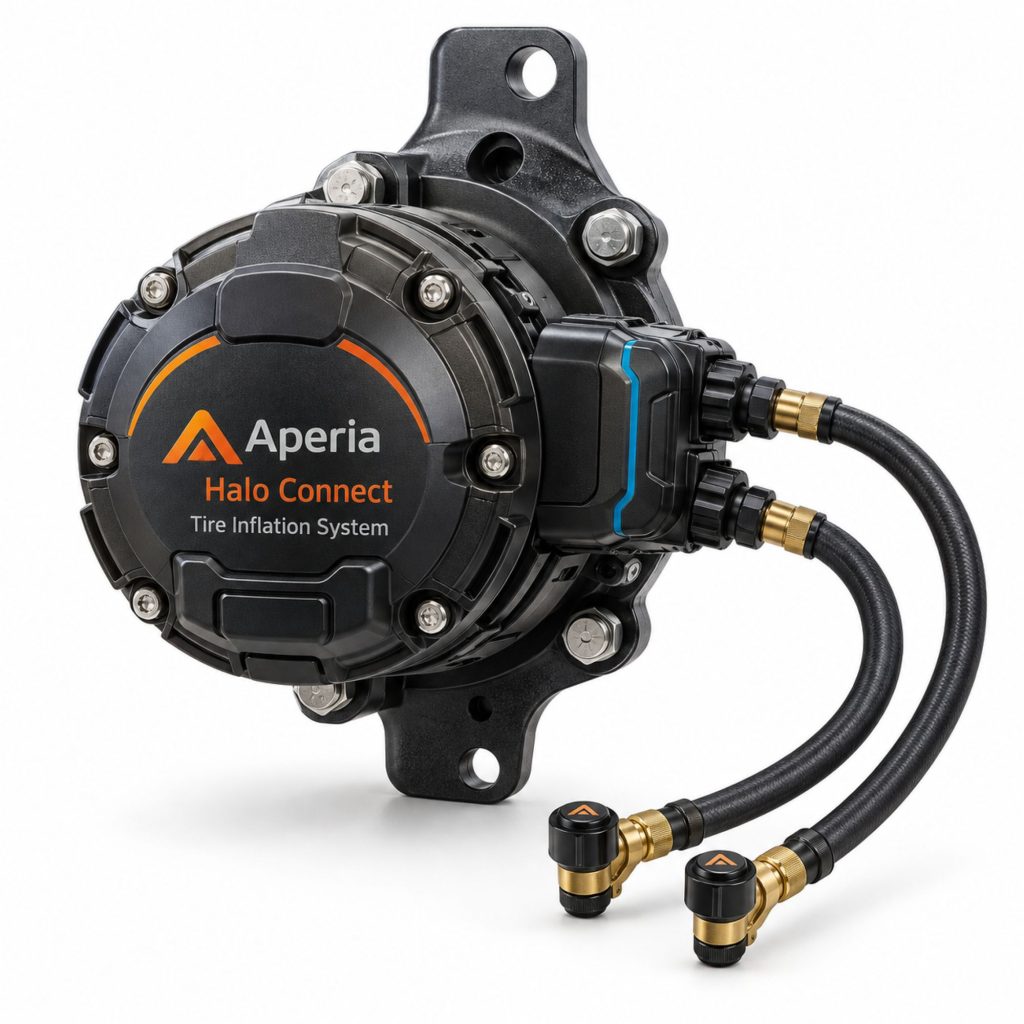
The Aperia Halo Connect is an intelligent automatic tire-inflation system developed for commercial trucks, tractors, trailers, buses, and fleet vehicles. It combines Aperia’s wheel-end Halo inflator with connected monitoring and tire-management capabilities.
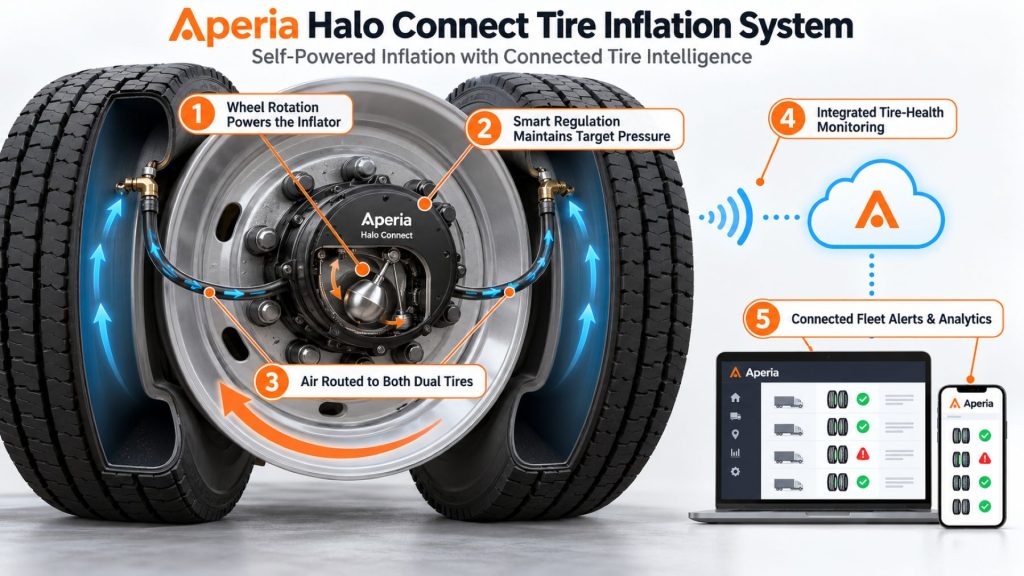
Unlike automatic tire-inflation systems that depend on a vehicle-mounted compressor and air lines routed through the axle, the Halo unit generates inflation pressure through wheel rotation. An internal pendulum-like mass remains relatively stationary as the wheel turns, creating the mechanical motion needed to operate the pump.
Halo Connect adds digital information and fleet-management capabilities to the inflation system. Depending on the selected configuration, fleets can monitor tire pressure, temperature trends, inflation activity, equipment location, system health, and maintenance conditions through connected dashboards and alerts.
The current Halo Connect i3 configuration expands these functions with integrated pressure sensing, two-way communication, configurable alerts, customized inflation settings, and remote pressure-setpoint adjustment.
Key Characteristics
- Wheel-end automatic tire-inflation system
- Self-powered through normal wheel rotation
- Does not require a central vehicle air supply for normal inflation
- Maintains a programmed tire-pressure target
- Combines automatic inflation with connected tire monitoring
- Can support steer, drive, and trailer wheel positions when properly configured
- Provides remote tire-condition and maintenance information
- Supports configurable alerts and fleet analytics
- Can identify gradual pressure loss and repeated inflation activity
- Designed for medium- and heavy-duty commercial vehicles
- Retrofit and fleet-integration configurations may be available
- Halo Connect i3 supports two-way communication and remote adjustments
Major Components
- Halo wheel-end inflator
- Internal pendulum-driven pumping mechanism
- Pressure regulator
- Wheel-end mounting bracket
- Hub-cap or axle-cap mounting hardware
- Tire air hoses
- Valve-stem connections
- Integrated pressure-sensing equipment
- Temperature-monitoring capability where equipped
- Wireless communication hardware
- Vehicle gateway or connected communication components
- GPS and LTE equipment where specified
- Halo Connect fleet-management platform
- Web and mobile dashboard access
- Alert, reporting, and analytics tools
Inflation-System Type and Design
Halo Connect uses an individual wheel-end inflator rather than a central compressor supplying air through the axle. The inflator mounts near the hub or axle cap and connects to the tire valve through application-specific hoses.
A pendulum-like internal mass creates relative movement as the wheel rotates. This movement powers the pumping mechanism, allowing the unit to generate inflation pressure while the vehicle travels.
A regulator limits inflation to the selected pressure target. Once tire pressure reaches that setting, the unit stops adding air. If pressure drops below the target and the wheel is turning, the Halo can resume pumping.
How the Tire Inflation System Works
As the wheel rotates, the inflator’s internal mechanism converts relative rotational movement into pumping action. The pump draws in filtered atmospheric air, compresses it, and sends it through the connected tire hoses.
If tire pressure is below the programmed target, the regulator allows the unit to add air. When the target is reached, the regulator stops inflation to help prevent overinflation under normal operating conditions.
Halo Connect combines this inflation activity with connected sensors and communication equipment. Tire-condition and system data can be transmitted to the fleet platform, allowing maintenance personnel to identify tires requiring inspection even when inflation has temporarily maintained their operating pressure.
Position and Function Within the Vehicle
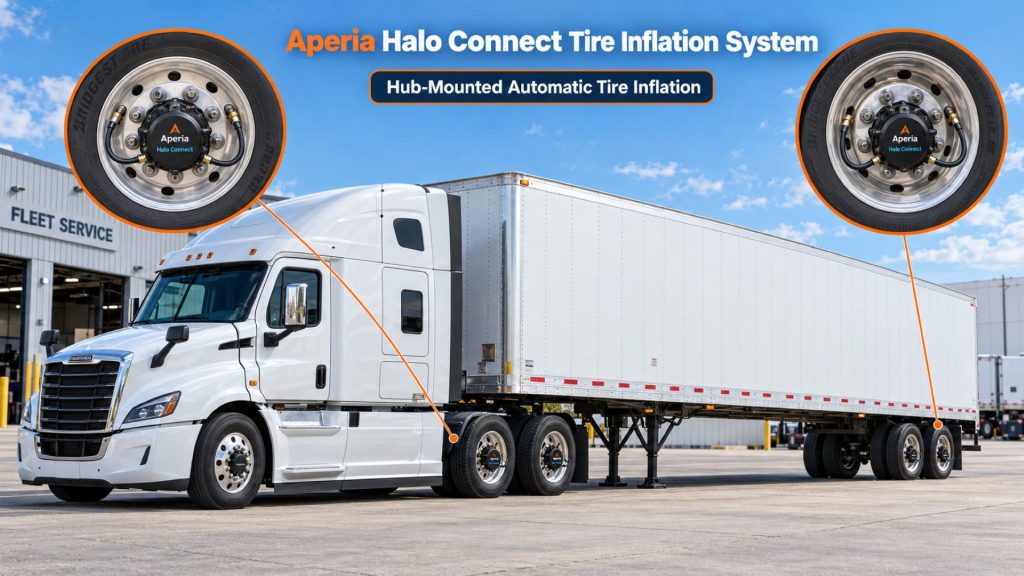
The Halo inflator mounts externally at the wheel end using an application-specific bracket near the axle cap or hub cap. Air hoses extend from the inflator to one or more tire valves at that wheel position.
Its primary mechanical function is to maintain the selected tire pressure as the vehicle moves. Its connected function is to report tire and inflation information so fleet personnel can identify leaks, abnormal pressure behavior, temperature concerns, and maintenance needs.
Common Specifications
- System Type: Intelligent wheel-end automatic tire-inflation system
- Inflation Method: Mechanically powered pump using wheel rotation
- External Compressor Requirement: None for normal Halo inflation operation
- Mounting Location: Axle cap, hub cap, or application-specific wheel-end bracket
- Pressure Control: Factory- or fleet-configured regulated inflation target
- Wheel Configurations: Application-specific single- and dual-tire arrangements
- Wheel-Position Applications: Steer, drive, trailer, and other approved commercial-vehicle positions
- Operating Capability: Capable of generating inflation pressure whenever the equipped wheel is rolling
- Environmental Range: Aperia reports Halo operation across severe hot- and cold-weather environments
- Connectivity: Configuration-specific Bluetooth, RF, CAN, GPS, and LTE communication
- Monitoring Functions: Pressure, inflation activity, system condition, and additional tire data depending on version
- Platform: Halo Connect digital tire-management and analytics system
Inflation Specifications and Performance
Halo Connect is designed to maintain a selected pressure target by adding air when tire pressure falls below the regulator setting. The correct target depends on tire size, load, axle position, vehicle configuration, operating speed, and the fleet’s approved inflation-pressure program.
The system can compensate for normal air loss and many gradual leaks while the vehicle is moving. Inflation capacity is not unlimited, however. A large puncture, damaged casing, failed valve, separated hose, or major wheel leak can exceed the system’s ability to maintain pressure.
Inflation activity should be treated as maintenance information. A tire that repeatedly requires added air may remain operational temporarily, but the underlying leak still needs to be located and repaired.
Pressure Management and Tire Protection
Maintaining proper tire pressure can reduce excessive casing flex, heat generation, irregular wear, rolling resistance, and stress on tire components. It can also help protect the casing for future retreading when the tire is otherwise suitable.
Automatic inflation does not correct overloading, impact damage, tread separation, exposed cords, excessive tread wear, brake heat, or wheel-end problems. Physical inspections remain necessary even when the system reports normal pressure.
Sensor Programming and Tire-Position Assignment
Connected Halo configurations must be assigned to the correct vehicle, axle, wheel end, and tire position. Accurate assignments allow the platform to identify the location of a pressure issue, leak, or unusually active inflator.
Fleet records should be updated when inflators, tires, wheels, axles, tractors, or trailers are replaced or reassigned. Incorrect position information can direct maintenance personnel to the wrong wheel end or cause equipment data to appear under the wrong vehicle.
Connected Monitoring and Fleet Integration
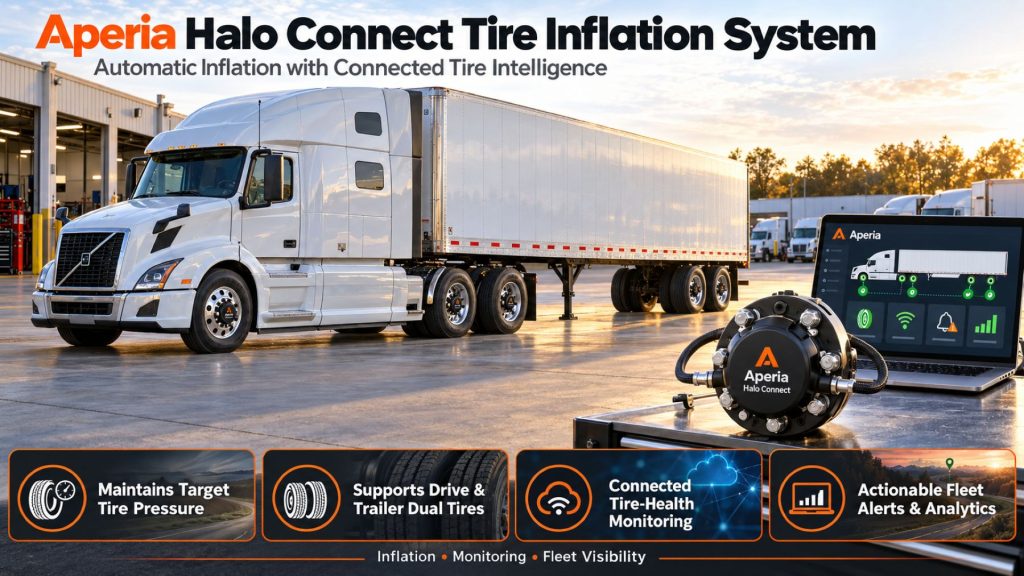
Halo Connect combines automatic inflation with connected tire data, alerts, and analytics. Fleet personnel can use the system to identify tires losing pressure, review inflation events, prioritize inspections, and monitor tire-system performance across multiple vehicles.
Halo Connect i3 supports two-way communication through application-specific Bluetooth, radio-frequency, CAN, GPS, and LTE connections. Current configurations may allow remote pressure-setpoint adjustments, customized inflation settings, and integration with compatible fleet-management systems.
Available functions depend on the installed hardware, software, account, service package, vehicle configuration, and current Aperia support.
Installation and System Setup
The wheel-end bracket, inflator, hoses, fittings, and valve connections must match the axle, hub, wheel, tire arrangement, and available clearance. Components should be positioned to avoid contact with wheels, lug nuts, brake equipment, suspension parts, debris, and service tools.
After mechanical installation, technicians must verify the pressure setting, hose routing, valve condition, leak-free connections, wheel clearance, and correct system operation. Connected versions also require proper vehicle registration, wheel-position assignment, communication setup, and alert configuration.
Tire, Wheel, Axle, and Hub Compatibility
Compatibility depends on the axle and hub design, axle-cap or hub-cap arrangement, wheel size, wheel material, tire position, single- or dual-tire configuration, valve orientation, brake equipment, and available operating clearance.
A system should not be transferred to another vehicle solely because the wheels or tires appear similar. The correct Aperia application information and mounting hardware should be used for every installation.
Common Applications
- Long-haul highway tractors
- Regional-haul tractors
- Commercial straight trucks
- Dry van trailers
- Refrigerated trailers
- Flatbed trailers
- Tanker trailers
- Vocational trucks
- Buses and motorcoaches
- Private and dedicated fleets
- Leasing and rental fleets
- Mixed truck and trailer fleets
Vehicle and Fleet-System Compatibility
Halo Connect can support a range of medium- and heavy-duty fleet vehicles, but the complete system must be matched to the specific wheel-end configuration. Compatibility also depends on the fleet’s connectivity, telematics, maintenance, data-management, and tire-pressure requirements.
Fleets using multiple tractor, trailer, axle, hub, and wheel types may require different brackets, hoses, fittings, and software configurations across the fleet.
Advantages
- Automatically adds air when pressure falls below the selected target
- Uses wheel rotation instead of a central vehicle compressor
- Does not require air lines routed through the axle
- Can support tractor and trailer wheel positions
- Combines inflation with connected tire-condition information
- Can identify repeated inflation activity and developing leaks
- May reduce tire-related roadside interruptions
- Can help improve tire life and casing preservation
- May reduce rolling resistance caused by underinflation
- Supports fleetwide monitoring and maintenance planning
- Allows application-specific alerts and analytics
- Halo Connect i3 supports remote pressure-setting functions
Limitations or Considerations
- Inflation occurs when the equipped wheel is rotating
- Large or rapid leaks can exceed the system’s inflation capacity
- The system cannot repair punctures or structural tire damage
- Wheel-end components and hoses require regular inspection
- Incorrect pressure settings can affect tire performance and wear
- Mounting hardware must match the exact wheel-end application
- External components may be exposed to road debris and impacts
- Connected functions depend on proper communication and account setup
- Data service or platform costs may apply
- Automatic inflation does not replace tire and wheel inspections
- Repeated inflation can temporarily conceal a leak requiring repair
- Installation adds components to wheel-end service procedures
Driver and Operator Experience
Drivers generally do not need to activate the mechanical inflation process. The unit operates automatically when the wheel turns and tire pressure is below the selected setting.
Connected alerts may be delivered through fleet dashboards, mobile tools, telematics systems, maintenance personnel, or compatible vehicle interfaces. Drivers should follow fleet procedures when warned of rapid pressure loss, abnormal temperature, excessive inflation activity, or a system fault.
Inspection and Wear Points
- Inflator housing and mounting bracket
- Axle-cap or hub-cap attachment points
- Air hoses and protective routing
- Valve-stem connections
- Hose fittings and seals
- Schrader valves and service ports
- Wheel and lug-nut clearance
- Evidence of air leakage
- Impact, abrasion, or corrosion damage
- Connected communication hardware
- Missing, stale, or incorrect system data
- Repeated inflation events at the same tire position
Maintenance and Ownership Notes
Inspect Halo units during scheduled tire, wheel-end, brake, and preventive-maintenance service. Check the mounting hardware, hoses, fittings, valves, clearance, and exterior condition before returning the vehicle to operation.
Fleet personnel should review inflation activity and alerts instead of relying only on the tire’s current pressure. Frequent pumping can indicate a developing leak even when the system continues maintaining the target pressure.
Wheel, tire, and brake technicians should be informed that the vehicle uses Halo equipment. Hoses and wheel-end components must be disconnected, protected, and reinstalled correctly during service.
Common Tire-Inflation System Problems
- Tire remains underinflated: A leak exceeding pump capacity, restricted hose, incorrect pressure setting, damaged inflator, valve problem, or insufficient vehicle movement may be responsible.
- Frequent inflation activity: A puncture, leaking valve, damaged hose, loose fitting, bead leak, cracked wheel, or casing problem may be causing continued air loss.
- One tire in a dual assembly remains low: A blocked or damaged hose, closed valve, incorrect connection, or tire-specific leak may prevent normal inflation.
- Air leaking at the wheel end: Loose fittings, damaged seals, worn hoses, valve problems, or impact damage may allow air to escape.
- Inflator or hose damage: Road debris, curb contact, improper installation, insufficient clearance, or incorrect wheel service can damage external components.
- Incorrect pressure: The regulator may have the wrong target setting, or the tire may be unsuitable for the programmed pressure and vehicle load.
- Missing connected data: Communication failure, incorrect vehicle assignment, damaged hardware, loss of power, cellular coverage, or account configuration may interrupt reporting.
- Incorrect wheel-position information: The inflator or sensor may not have been reassigned after tire, wheel, axle, tractor, or trailer service.
Safety and Service Precautions
Automatic inflation should never be used to keep a visibly damaged tire in service. A tire that has operated severely underinflated may contain internal casing damage even after the system restores pressure.
Before servicing the tire, wheel, valve, hub, brake, or Halo equipment, technicians should secure the vehicle and follow the correct procedures for releasing pressure and disconnecting the system. Only trained personnel should service commercial tire and wheel assemblies.
After service, verify hose clearance, component attachment, pressure settings, leak-free connections, correct wheel-position assignment, and normal system operation.
Identification Information
Identification information may appear on the Halo inflator, connected hardware, mounting kit, packaging, fleet platform, service records, or vehicle installation documentation.
Record the complete Halo model, serial or device number, pressure setting, axle and hub information, wheel size, tire size, wheel position, single- or dual-tire configuration, bracket number, hose specification, communication hardware, software configuration, and vehicle identification before ordering components.
Buying Considerations
- Identify every wheel position requiring inflation protection
- Confirm steer, drive, trailer, or specialty-axle application
- Verify axle-cap or hub-cap compatibility
- Match the system to single- or dual-tire arrangements
- Confirm wheel, tire, valve, and brake clearance
- Select the correct inflation-pressure target
- Determine whether connected monitoring is required
- Review Halo Connect and Halo Connect i3 capabilities
- Confirm communication and telematics compatibility
- Review platform, subscription, and data-service requirements
- Plan installation, training, and maintenance procedures
- Confirm replacement hose, bracket, and inflator availability
- Choose an installer familiar with commercial wheel-end systems
Variants and Configurations
- Halo automatic tire inflator
- Halo Connect connected tire-management system
- Halo Connect i3 intelligent inflation system
- Steer-tire inflation configurations
- Drive-axle configurations
- Trailer-axle configurations
- Single-tire wheel-end arrangements
- Dual-tire wheel-end arrangements
- Different pressure-setpoint configurations
- Application-specific mounting brackets
- Different hose and valve arrangements
- Fleet telematics and connected-platform integrations
Comparison to Similar Equipment
Compared with the Meritor Tire Inflation System by P.S.I., Halo Connect uses self-contained wheel-end inflators instead of routing air from the trailer or vehicle air system through the axles.
Compared with the Hendrickson TIREMAAX PRO-LB Tire Inflation System, Halo Connect can be applied to compatible tractor and trailer wheel positions and does not depend on a central compressed-air supply for normal inflation.
Compared with the Continental ContiConnect Live Tire-Monitoring System or Bendix SmarTire Trailer-Link TPMS, Halo Connect actively adds air instead of providing monitoring and alerts alone.
Best Fit For
- Fleets wanting automatic inflation on tractors and trailers
- Operations with high tire-related roadside-service costs
- Long-haul trucks operating away from maintenance terminals
- Fleets seeking connected tire-health information
- Vehicles experiencing gradual tire-pressure loss
- Fleets focused on casing preservation and retreadability
- Operations seeking to reduce underinflation-related fuel use
- Leasing companies managing different vehicle configurations
- Mixed fleets needing wheel-position-specific inflation protection
- Fleets wanting inflation data integrated into maintenance planning
Related Vehicle and Trailer Types
- Semi Trucks
- Dry Van Trailers
- Refrigerated Trailers
- Flatbed Trailers
- Tanker Trailers
- Lowboy Trailers
- Dump Trailers
- Intermodal Container Chassis
Related Truck and Trailer Models
- Freightliner Cascadia
- Kenworth T680
- Peterbilt 579
- Volvo VNL
- International LT Series
- Mack Anthem
- Western Star 57X
- Great Dane Champion SE
- Utility 4000D-X Composite
- Wabash DuraPlate Dry Van
Related Tire and Inflation System Types
- Tire Pressure Monitoring & Inflation Systems
- Steer & All-Position Truck Tires
- Drive Tires
- Trailer Tires
- Vocational & Severe-Service Tires
- Commercial Truck Wheels
Related Tire-Monitoring and Inflation Products
- Continental ContiConnect Live Tire-Monitoring System
- Continental ContiPressureCheck TPMS
- Bendix SmarTire Trailer-Link TPMS
- Hendrickson TIREMAAX PRO-LB Tire Inflation System
- Hendrickson TIREMAAX PRO Tire Inflation System
- Hendrickson TIREMAAX CP Tire Inflation System
- Meritor Tire Inflation System by P.S.I.
- STEMCO Aeris Tire Inflation System
- P.S.I. TireView LIVE
- P.S.I. ThermALERT Wheel-End Heat Warning System
Related Equipment Systems
- Tires & Wheels
- Telematics & ELD Systems
- Electrical Systems
- Safety Systems
- Axles & Differentials
- Brake Systems
- Trailer Suspension Systems
Related Guides
- Tire & Wheel Guides
- How Tire Pressure Monitoring and Inflation Systems Work
- How to Read Commercial Truck Tire Sizes and Ratings
- How to Inspect and Maintain Commercial Truck Tires
- Commercial Truck Tire Types Explained
- Steer vs Drive vs Trailer Tires
- How Commercial Truck Telematics Systems Work
Regulatory and Compliance Notes
Halo Connect does not increase a tire, wheel, axle, or vehicle weight rating. Tire pressure must be appropriate for the actual load and remain within the limits established by the tire, wheel, axle, and vehicle manufacturers.
Automatic inflation does not replace required pre-trip, post-trip, periodic, or roadside inspections. The driver and motor carrier remain responsible for ensuring that every tire, wheel, valve, hose, and wheel-end component is safe and serviceable.
System installation must preserve proper wheel, brake, suspension, steering, valve, and tire operation and comply with applicable commercial-vehicle requirements.
Real World Operating Notes
A self-powered wheel-end inflator is especially useful on tractors because it does not require routing a central air supply through powered axles. It can also be applied to trailers without depending on one shared inflation line across the axle group.
The system’s ability to maintain pressure can reduce the immediate effect of a small leak, but fleets should not ignore repeated inflation activity. The leak may continue growing until it exceeds the system’s pumping capacity.
The greatest maintenance value comes from combining automatic inflation with connected information. Inflation protects the tire in operation, while alerts and analytics help the fleet locate and repair the underlying problem.
Frequently Asked Questions
What is the Aperia Halo Connect Tire Inflation System?
It is a wheel-end automatic tire-inflation system that combines Aperia’s self-powered Halo inflator with connected tire monitoring, alerts, and fleet analytics.
How does Halo generate air pressure?
An internal pendulum-like mechanism uses the wheel’s rotation to power a small pump that supplies air to the connected tire or tires.
Does Halo Connect require the truck’s air compressor?
No. The Halo inflator is self-powered by wheel rotation and does not require a central vehicle air supply for normal inflation operation.
Can Halo Connect overinflate a tire?
The regulator is designed to stop adding air when the selected pressure target is reached. Correct regulator selection and system setup remain essential.
Does the system work while the vehicle is parked?
The inflator generates pressure through wheel rotation. It can pump whenever the equipped wheel is rolling, but it does not generate new pumping action while the wheel remains stationary.
Can Halo Connect be used on steer tires?
Yes. Aperia offers application-specific Halo inflation equipment for steer tires, expanding coverage across compatible commercial truck and trailer wheel positions.
Can drivers still check tire pressure manually?
Yes. Halo equipment includes service points that allow technicians or drivers to verify pressure using approved procedures and an accurate gauge.
Will Halo Connect repair a leaking tire?
No. It can replace air lost through some gradual leaks, but the puncture, valve, hose, wheel, or casing problem must still be inspected and repaired.
What is Halo Connect i3?
Halo Connect i3 is an advanced configuration combining automatic inflation, integrated pressure sensing, two-way communication, configurable alerts, customized inflation settings, and remote pressure-setpoint adjustment.
How are the correct replacement components identified?
Use the Halo model, device or serial number, axle and hub information, bracket number, tire and wheel configuration, wheel position, pressure setting, and hose specifications.
Availability and Where to Find
Aperia Halo and Halo Connect systems, mounting kits, hoses, fittings, replacement components, connected services, and technical support may be available directly from Aperia Technologies, through Aperia’s online store, participating commercial-truck dealers, fleet-equipment suppliers, tire dealers, and authorized installation or service providers.
Availability depends on the required wheel position, axle, hub, wheel, tire arrangement, pressure setting, vehicle application, connected-service package, and geographic market. Buyers should confirm whether Halo Connect, Halo Connect i3, or another current Halo configuration is appropriate for the fleet.
Current product information, application support, replacement parts, and purchasing resources are available through the Aperia Halo Connect website.
Support Trucking Families
Truck Equipment Atlas supports the mission of Grey Cross, a nonprofit dedicated to helping families of truck drivers who lose their lives while on the road. As the site grows, part of its mission is to bring awareness and support to these families.
Podcast or Video Section
Learn More Through Audio and Video
Truck Equipment Atlas will continue expanding with podcast episodes, interviews, and equipment breakdowns to help drivers and fleets better understand trucks and equipment.
Follow the Growth of Truck Equipment Atlas
Truck Equipment Atlas continues to expand with new truck profiles, trailer coverage, diesel engine pages, equipment system resources, manufacturer information, and educational guides.
Visit our Site Updates page to explore recent additions, project milestones, and upcoming resources as we continue building one of the industry’s growing commercial trucking equipment reference libraries.
View the Latest Site Updates: Truck Equipment Atlas Site Updates