
Meritor Tire Inflation System by P.S.I.
Quick Facts
- Manufacturer: Pressure Systems International, commonly known as P.S.I.
- Product Name: Meritor Tire Inflation System by P.S.I.
- Common Abbreviation: MTIS by P.S.I.
- Product Type: Automatic trailer tire-inflation system
- System Category: Automatic tire inflation and pressure maintenance
- Primary Position: Commercial trailer axles and wheel ends
- Pressure Control: Maintains a preset target pressure by adding air when required
- Air Supply: Existing trailer compressed-air reservoir
- Air Routing: Control box, axle passages, rotary unions, hubcaps, and tire hoses
- Driver Notification: Trailer-mounted indicator lamp
- Optional Technology: ThermALERT wheel-end heat warning and telematics integration where equipped
- Common Applications: Dry vans, refrigerated trailers, flatbeds, tank trailers, and specialized commercial trailers
- Installation: Original-equipment or approved retrofit installation
- Primary Benefit: Automatically maintains trailer tire pressure to help reduce underinflation-related tire wear, fuel use, and downtime
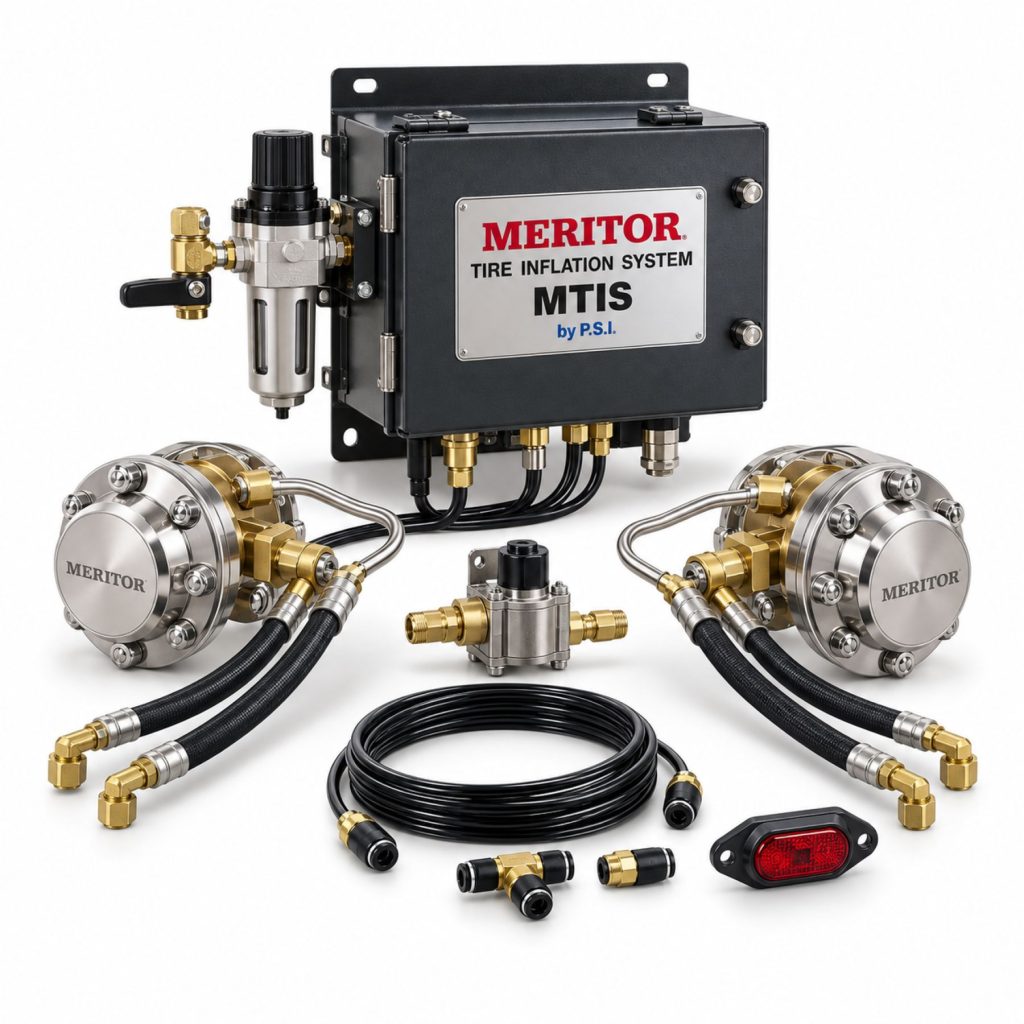
Overview
The Meritor Tire Inflation System by P.S.I. is an automatic tire-inflation system designed for commercial trailers. It uses compressed air from the trailer’s existing air system to maintain connected tires at a preset pressure while the vehicle is operating.
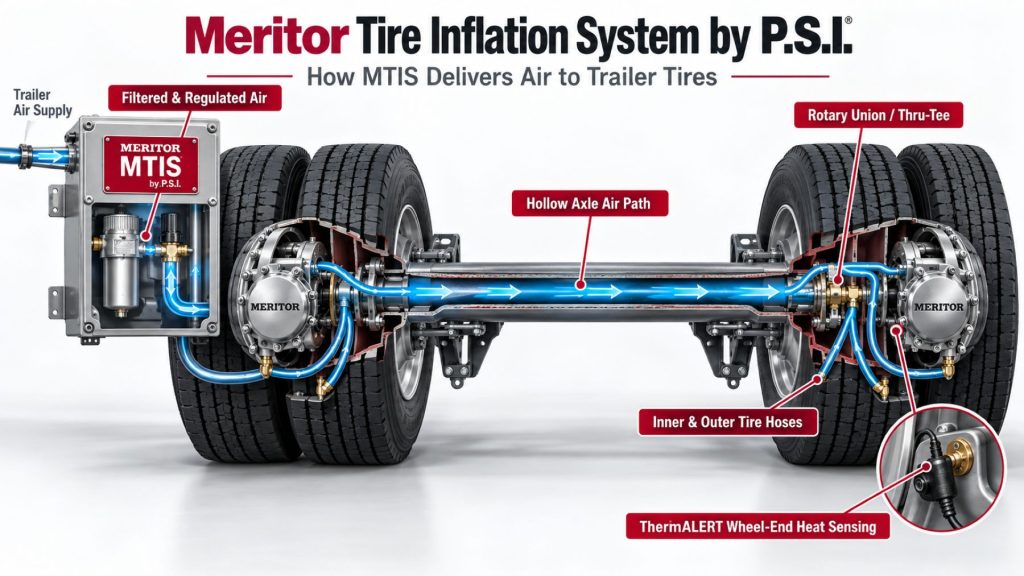
Air travels from the trailer reservoir through a pressure-protection valve and control box before entering the trailer axles. The axles act as air passages, carrying air toward rotary unions at the spindle ends. Hubcap fittings and flexible hoses then deliver air to the tires.
If a tire falls below the system setting because of normal pressure loss or a slow puncture, MTIS supplies air until the target is restored or until the system can no longer compensate for the leak. A trailer-mounted indicator lamp warns the driver when excessive airflow suggests a significant leak or system problem.
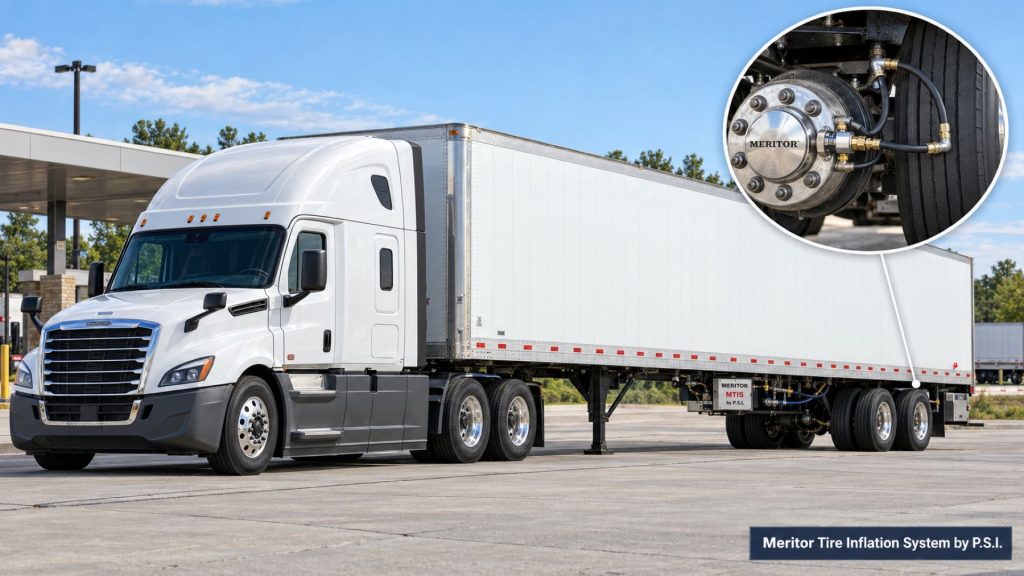
Key Characteristics
- Automatic trailer tire inflation
- Uses the trailer’s existing compressed-air supply
- Maintains a preset tire-pressure target
- Inflates tires affected by normal pressure loss or slow leaks
- Uses the axle structure as part of the air-delivery path
- Rotary union is the principal moving component
- Isolation valves help protect unaffected tires
- Trailer-mounted warning indicator
- Dual filtration helps control moisture and contamination
- Compatible with multiple trailer axle and wheel-end configurations
- Available for original-equipment and retrofit installation
- Optional ThermALERT wheel-end heat-warning technology
- Telematics integration available in applicable configurations
Major Components
- Trailer air reservoir connection
- Pressure-protection valve
- System shutoff valve
- Particulate filter
- Control box
- Pressure regulator and adjustment mechanism
- Flow-sensing switch
- System pressure drain or petcock
- Trailer indicator lamp
- Electrical wiring harness
- Axle supply lines
- Axle press plugs
- Stator tubes
- Rotary union assemblies
- Through-tees
- Inflation-system hubcaps
- Tire hoses
- Check valves or isolation valves
- Optional ThermALERT components
- Identification and warning decals
System Type and Design
MTIS by P.S.I. is a pressure-maintenance system rather than a load-responsive pressure-adjustment system. The control assembly is set to a target cold inflation pressure, and the system adds air whenever connected tire pressure falls below that setting.
The trailer axle carries air internally, eliminating the need for long exposed air lines along the axle beam. At each spindle, a stator and rotary union transfer air from the stationary axle into the rotating hubcap assembly.
Flexible hoses connect the hubcap through-tees to the tire valve stems. Check valves help isolate an individual leaking tire so the remaining tires do not lose pressure through the same circuit.
How the Tire Inflation System Works
Compressed air from the trailer reservoir enters the MTIS control box through a pressure-protection valve. The protection valve helps preserve sufficient air for the trailer braking system before allowing air to flow into the tire-inflation circuit.
The controller regulates pressure according to the system’s preset target. Air travels through supply lines into the trailer axles, which function as conduits to the spindle ends.
Rotary unions transfer air from the nonrotating axle components into the rotating hubs. Air then passes through the hubcaps and flexible hoses to the tires. When tire pressure reaches the system setting, airflow stops.
If airflow continues because of a puncture, loose connection, or system leak, the flow-sensing switch activates the trailer indicator lamp. This alerts the driver that the system is working continuously or requires inspection.
Position and Function Within the Vehicle
MTIS is installed on the trailer and serves its axle and wheel-end assemblies. The control box is normally mounted beneath the trailer, while the indicator lamp is positioned where the driver can see it through the tractor’s mirror.
The system performs several functions:
- Receives compressed air from the trailer reservoir
- Protects the brake system through a pressure-protection valve
- Regulates air to the preset tire-pressure target
- Routes air through the trailer axles
- Transfers air into the rotating wheel ends
- Inflates tires that fall below the preset pressure
- Helps compensate for normal pressure loss and slow punctures
- Isolates leaking tire positions when possible
- Warns the driver when excessive airflow occurs
- Supports optional wheel-end heat detection and telematics
Common Specifications
- System Type: Automatic trailer tire-inflation system
- Pressure Function: Adds air to maintain a preset target pressure
- Pressure Setting: Application-specific and selected for the installed tires and axle load
- Air Supply: Trailer compressed-air reservoir
- Brake-System Protection: Pressure-protection valve
- Air Routing: Controller, axle passages, stators, rotary unions, hubcaps, and tire hoses
- Driver Alert: Trailer-mounted indicator lamp
- Tire Arrangements: Application-specific dual or wide-base single configurations
- Axle Compatibility: Approved Meritor and non-Meritor trailer axles when properly configured
- Wheel-End Lubrication: Oil or grease configurations with compatible hubcaps and components
- Installation: Original equipment or approved retrofit
- Optional Equipment: ThermALERT wheel-end heat warning and telematics integration
Pressure Settings and Operating Capacity
The target pressure is selected according to the tire manufacturer’s load-and-inflation requirements, trailer axle loading, tire size, wheel capacity, and fleet operating conditions. The setting should normally reflect the required cold tire pressure for the application.
MTIS can only add air when trailer reservoir pressure exceeds the pressure required by the tires. It cannot generate pressure independently of the tractor and trailer compressed-air system.
The system’s ability to compensate for leakage depends on the size of the leak, available reservoir pressure, compressor capacity, air-system condition, and number of affected tires. A rapid or severe leak can exceed its delivery capacity.
Pressure Maintenance and Leak Compensation
MTIS is designed to maintain the configured target pressure while the vehicle is operating. It compensates for normal diffusion, temperature-related pressure changes, small valve leaks, and certain tread punctures that release air slowly enough for the system to keep pace.
The system is not a tire-repair device. A tire receiving continuous air still requires inspection and repair. Continued operation with a damaged tire may allow the condition to worsen even when inflation pressure appears acceptable.
Isolation valves help prevent pressure loss from spreading to the remaining tires when one tire or hose develops a leak. Their effectiveness depends on correct component condition and installation.
Indicator Lamp and Driver Alerts
The trailer indicator lamp is connected to a flow-sensing switch in the control assembly. The lamp illuminates when airflow exceeds the system’s normal threshold, indicating that one or more tires may be low or that the system has a leak.
A lamp may illuminate temporarily after startup if tires require air. If it remains on, turns on frequently, or activates while driving after pressures should have stabilized, the trailer should be inspected.
The standard indicator does not identify the exact tire or component causing the airflow. The driver or technician must inspect every tire, hose, hubcap, fitting, axle connection, and control component.
Air Supply, Controls, and Electronic Integration
The trailer reservoir provides the system’s air supply. A pressure-protection valve prioritizes brake-system requirements and prevents the inflation system from using air when reservoir pressure is below the valve’s opening threshold.
The control box contains the shutoff valve, filters, regulator, flow-sensing components, drain, and related fittings. Its pressure adjustment should only be changed according to approved procedures and verified with an accurate test gauge.
Optional configurations may communicate system activity or ThermALERT wheel-end heat warnings through compatible trailer ABS power-line carrier communication, telematics devices, or P.S.I. TireView LIVE equipment.
ThermALERT Wheel-End Heat Warning
ThermALERT is an optional MTIS feature designed to warn of excessive wheel-end heat. High temperatures may result from bearing problems, loss of lubrication, dragging brakes, or other developing wheel-end failures.
When the heat-sensing components reach their activation condition, the system produces a warning intended to alert the driver. The vehicle should be stopped safely and the affected wheel end inspected according to the applicable service procedure.
ThermALERT supplements rather than replaces regular brake, bearing, seal, lubrication, and wheel-end inspections.
Installation and Pressure Adjustment
Installation involves the trailer air supply, control box, axle preparation, spindle components, rotary unions, compatible hubcaps, tire hoses, electrical wiring, indicator lamp, and system identification decals.
Axle preparation must follow the approved procedure for the specific axle and spindle. Incorrect drilling, sealing, press-plug installation, stator positioning, or rotary-union installation can create leaks or damage wheel-end components.
After installation, the system must be leak-tested and its pressure setting verified. The pressure should only be adjusted using an accurate gauge and the applicable P.S.I. or Meritor service procedure.
Trailer, Axle, and Wheel-End Compatibility
MTIS must be matched to the trailer’s complete axle, spindle, hub, lubrication, tire, and wheel configuration. Compatibility depends on:
- Trailer manufacturer and model
- Trailer axle manufacturer and model
- Axle spindle design
- Number of controlled axles
- Oil- or grease-lubricated wheel ends
- Hubcap design and bolt pattern
- Dual or wide-base single tire arrangement
- Tire size and target pressure
- Wheel and valve-stem configuration
- Trailer air-reservoir capacity
- Brake-system air requirements
- ABS and electrical configuration
- ThermALERT or telematics requirements
- Original-equipment or retrofit installation
Common Applications
- Dry van trailers
- Refrigerated trailers
- Flatbed trailers
- Tank trailers
- Moving-floor trailers
- Drop-deck trailers
- Dump trailers
- Automotive transport trailers
- Long-haul commercial trailers
- Regional delivery trailers
- Dual-tire trailer axles
- Approved wide-base single-tire trailer axles
Advantages
- Automatically adds air to underinflated trailer tires
- Uses the trailer’s existing compressed-air supply
- Helps maintain a consistent preset pressure
- Can compensate for normal pressure loss and certain slow leaks
- Helps reduce underinflation-related tread wear
- Supports improved fuel efficiency
- May extend tire and casing life
- Can reduce tire-related roadside service events
- Indicator lamp provides a visible driver warning
- Isolation valves help protect unaffected tires
- Available for new trailers and approved retrofits
- Optional ThermALERT warns of excessive wheel-end heat
- Can integrate with compatible telematics equipment
Limitations or Considerations
- Maintains a fixed target rather than automatically changing pressure with axle load
- Requires a dependable trailer compressed-air supply
- Cannot compensate for every rapid or severe tire leak
- Does not repair punctures or structural tire damage
- Indicator lamp does not identify the exact leaking tire
- Air lines, filters, fittings, rotary unions, hubcaps, and hoses require inspection
- Contaminated or wet air can affect system operation
- Pressure settings must match the tires and maximum axle loading
- Axle preparation must follow approved procedures
- Wheel-end service requires attention to inflation-system components
- Manual tire inspections remain necessary
- The system does not increase tire, wheel, axle, or trailer ratings
Driver and Operator Experience
MTIS operates automatically while the trailer air system is charged. Drivers normally do not need to add air manually during ordinary operation, but they remain responsible for tire inspection and responding to warnings.
A brief indicator-lamp event may occur while the system restores pressure. A lamp that remains illuminated or repeatedly activates can indicate a tire puncture, loose hose, leaking fitting, low reservoir pressure, or system fault.
The system can temporarily maintain pressure during certain slow leaks, giving the driver an opportunity to reach an appropriate repair location. This capability should not be interpreted as permission to continue operating indefinitely with a damaged tire.
Sensor Programming and Tire-Position Assignment
Standard MTIS is a pneumatic inflation system and does not require individual electronic pressure sensors to be assigned to every tire position. The trailer indicator lamp reports excessive system airflow rather than displaying separate pressure readings for each tire.
If MTIS is combined with TireView LIVE or another compatible monitoring platform, sensor identification, trailer assignment, alert thresholds, and tire-position mapping must be programmed according to that system’s instructions.
Fleet records should identify the trailer, axle positions, installed MTIS configuration, target pressure, tire sizes, and any telematics hardware associated with the system.
Inspection and Wear Points
Routine inspection should include:
- Control-box enclosure and mounting
- Pressure-protection valve
- System shutoff valve
- Particulate filters
- Pressure regulator
- Drain petcock
- Flow-sensing switch
- Air-supply lines and fittings
- Axle press plugs and seals
- Stator tubes
- Rotary unions
- Hubcaps and through-tees
- Tire hoses and knurled fittings
- Tire valve-stem connections
- Indicator lamp and wiring
- ThermALERT components where equipped
- Signs of air leakage, abrasion, heat damage, or contamination
Maintenance and Ownership Notes
- Inspect every tire during pre-trip and scheduled maintenance
- Verify tire pressure manually at scheduled intervals
- Confirm the system shutoff valve is open during normal operation
- Drain and service filters according to the maintenance schedule
- Inspect air lines and hoses for rubbing, cracking, and kinking
- Check fittings for leakage
- Inspect rotary unions and hubcaps during wheel-end service
- Check wheel-end lubricant level and condition
- Test the indicator lamp and wiring
- Verify target pressure after regulator service
- Maintain the tractor and trailer air dryers and reservoirs
- Investigate repeated indicator-lamp activation
- Use approved replacement parts
- Follow the applicable MTIS maintenance manual
Common Tire-Inflation-System Problems
- Indicator lamp remains illuminated: A low tire, tire puncture, loose hose, leaking fitting, low reservoir pressure, or system fault may cause continued airflow.
- System will not inflate tires: A closed shutoff valve, insufficient reservoir pressure, blocked filter, damaged regulator, restricted line, or failed rotary union may prevent air delivery.
- One tire remains low: A damaged tire hose, closed or blocked isolation valve, valve-stem problem, tire puncture, or wheel-end restriction may isolate that tire.
- Incorrect system pressure: Regulator adjustment, an inaccurate test gauge, restricted flow, contamination, or component wear may cause an incorrect pressure setting.
- Air leakage at the hub: A worn rotary union, damaged through-tee, hubcap seal problem, loose fitting, or improperly installed stator may be responsible.
- Moisture or contamination: Air-dryer problems, neglected filters, or reservoir contamination can restrict valves and damage internal components.
- False warning indication: Damaged wiring, a faulty flow switch, incorrect adjustment, or an electrical connection problem may illuminate the indicator.
- Wheel-end heat warning: A ThermALERT activation may indicate bearing damage, inadequate lubrication, dragging brakes, or another serious wheel-end condition.
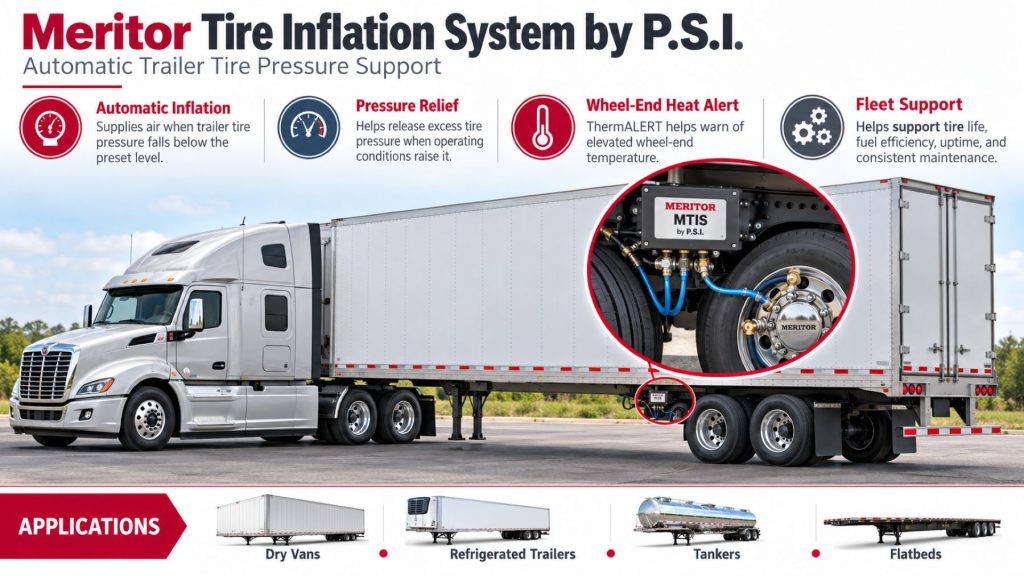
Safety and Service Precautions
- Chock the trailer wheels before beginning service
- Turn off the system and drain pressure before disconnecting components
- Never work beneath a trailer supported only by a jack
- Wear eye protection when working with compressed air
- Keep hands and tools clear of pressurized fittings
- Do not exceed approved tire or wheel pressure ratings
- Do not assume a tire is safe solely because the system maintains pressure
- Inspect any tire that causes continuous system operation
- Follow approved axle-preparation and spindle-service procedures
- Protect rotary unions and stator components during wheel-end service
- Respond immediately to a ThermALERT warning
- Follow P.S.I., Meritor, tire-manufacturer, axle-manufacturer, and fleet procedures
Identification Information
System information may be found on the control box, trailer decals, hubcaps, axle tags, and individual components. Record the following information before ordering parts:
- Trailer manufacturer, model, and VIN
- Axle manufacturer and model
- Spindle configuration
- MTIS system model or kit number
- Control-box part number
- Preset tire pressure
- Number of controlled axles
- Dual or wide-base single tire arrangement
- Hubcap manufacturer and part number
- Oil- or grease-lubricated wheel end
- Rotary-union and stator configuration
- Tire-hose configuration
- ThermALERT equipment where installed
- Telematics hardware where installed
- Tire size, load range, and required pressure
Buying Considerations
- Identify the trailer and axle configuration
- Confirm axle and spindle compatibility
- Determine the number of controlled axles
- Choose dual or wide-base single tire equipment
- Verify tire load and pressure requirements
- Confirm the desired preset pressure
- Check trailer reservoir capacity and condition
- Verify oil- or grease-lubricated hubcap requirements
- Determine original-equipment or retrofit installation
- Review axle-preparation requirements
- Confirm indicator-lamp and electrical requirements
- Decide whether ThermALERT is required
- Review telematics integration options
- Confirm replacement-parts availability
- Use a qualified trailer and tire-inflation-system installer
Variants and Configurations
- Standard MTIS configurations
- MTIS with ThermALERT
- Dual-tire systems
- Wide-base single-tire systems
- Single-axle installations
- Tandem-axle installations
- Multi-axle trailer installations
- Oil-lubricated wheel-end configurations
- Grease-lubricated wheel-end configurations
- Different preset pressure settings
- Meritor trailer-axle applications
- Approved non-Meritor axle applications
- Original-equipment installations
- Fleet retrofit kits
- Telematics-enabled configurations
System parts and installation details vary by axle, spindle, hubcap, tire arrangement, and trailer application. The complete kit and component numbers should be verified before ordering.
Comparison to Similar Equipment
Compared with the Hendrickson TIREMAAX PRO-LB Tire Inflation System, MTIS maintains a preset pressure rather than automatically changing its target according to trailer axle load.
Compared with the Hendrickson TIREMAAX PRO Tire Inflation System, standard MTIS focuses primarily on adding air to tires below the target. TIREMAAX PRO also provides active pressure relief.
Compared with the STEMCO AerisIS Tire Inflation System, MTIS uses P.S.I.’s control, axle-routing, rotary-union, and wheel-end component architecture. Compatibility and service support depend on the trailer fleet.
Compared with the Aperia HALO Tire Inflator, MTIS uses the trailer’s centralized compressed-air supply and axle plumbing. HALO uses wheel rotation to generate inflation pressure at individual wheel positions.
Best Fit For
- Long-haul trailer fleets
- Dry van and refrigerated fleets
- Trailers experiencing recurring tire-pressure loss
- Fleets seeking reduced roadside tire downtime
- Applications using a consistent cold tire-pressure target
- Dual-tire trailer configurations
- Approved wide-base single-tire configurations
- New trailers specified with automatic tire inflation
- Existing trailers suitable for retrofit installation
- Fleets wanting optional wheel-end heat warnings
- Operators integrating tire data with telematics platforms
Related Vehicle and Trailer Types
- Dry Van Trailers
- Refrigerated Trailers
- Flatbed Trailers
- Tank Trailers
- Step Deck Trailers
- Dump Trailers
- Car Hauler Trailers
- Heavy Haul Trailers
Related Truck and Trailer Models
- Wabash DuraPlate Dry Van
- Great Dane Champion Dry Van
- Utility 4000D-X Composite Dry Van
- Hyundai Translead Composite XT Dry Van
- Great Dane Everest Reefer
- Utility 3000R Refrigerated Trailer
- Fontaine Revolution Flatbed
Related Tire and Wheel Types
- Tire Pressure Monitoring & Inflation Systems
- Trailer Tires
- Commercial Truck Wheels
- Aluminum Commercial Truck Wheels
- Steel Commercial Truck Wheels
- Wide-Base Commercial Wheels
Related Tire and Wheel Products
- Hendrickson TIREMAAX PRO-LB Tire Inflation System
- Hendrickson TIREMAAX PRO Tire Inflation System
- Hendrickson TIREMAAX CP Tire Inflation System
- STEMCO AerisIS Tire Inflation System
- Aperia HALO Tire Inflator
- Continental ContiPressureCheck TPMS
- P.S.I. TireView LIVE
- P.S.I. ThermALERT Wheel-End Heat Warning System
Related Equipment Systems
- Tires & Wheels
- Trailer Suspension Systems
- Suspension Systems
- Axles & Differentials
- Brake Systems
- Electrical Systems
- Telematics & ELD Systems
- Safety Systems
Related Guides
- Tire & Wheel Guides
- How Tire Pressure Monitoring and Inflation Systems Work
- How to Read Commercial Truck Tire Sizes and Ratings
- How to Inspect and Maintain Commercial Truck Tires
- Commercial Truck Tire Types Explained
- Steer vs Drive vs Trailer Tires
- How Commercial Truck Suspension Systems Work
- Truck Suspension Components Explained
Regulatory and Compliance Notes
MTIS does not change the tire, wheel, axle, suspension, or trailer load ratings. The preset pressure must remain within the approved limits of every component and satisfy the tire manufacturer’s requirements for the trailer’s maximum axle loading.
Commercial tires must still comply with applicable tread-depth, condition, load, and inflation requirements. An automatic inflation system does not make a damaged, overloaded, mismatched, or worn tire compliant.
Installation and service work must preserve trailer brake operation, air-system integrity, wheel-end sealing, ABS communication, electrical function, and required safety systems.
Real World Operating Notes
MTIS can keep a slowly leaking tire inflated long enough for the driver to reach a suitable service location, but the lamp warning should never be ignored. Continuous airflow means the system is compensating for a condition that requires inspection.
The system target should be selected for the trailer’s maximum expected axle load. Because standard MTIS does not automatically lower pressure when the trailer is empty, fleets operating many lightly loaded miles should consider how fixed pressure affects tread wear.
Wheel-end service can disturb stators, rotary unions, hubcaps, and hoses. The inflation system should be leak-tested after hub, bearing, seal, brake, or axle work.
MTIS reduces pressure-related maintenance demands but does not eliminate manual inspections. Tires can retain pressure while still having cuts, exposed cords, tread separation, impact damage, or irregular wear.
Frequently Asked Questions
What is the Meritor Tire Inflation System by P.S.I.?
It is an automatic trailer tire-inflation system that uses compressed air from the trailer reservoir to maintain connected tires at a preset pressure.
What does MTIS stand for?
MTIS stands for Meritor Tire Inflation System.
Does MTIS monitor each tire electronically?
Standard MTIS is primarily pneumatic. Its warning lamp indicates excessive system airflow but does not normally display an individual electronic pressure reading for every tire.
Can MTIS inflate a tire with a puncture?
It may compensate for certain slow punctures if the leak does not exceed system capacity. The damaged tire still requires prompt inspection and repair.
Can MTIS remove excess tire pressure?
Standard MTIS primarily adds air to maintain a fixed target. It should not be confused with systems specifically designed to provide active pressure relief or load-based adjustment.
What does the trailer indicator lamp mean?
It indicates excessive airflow through the system. A tire may be low, a hose or fitting may be leaking, or another component may require service.
What is ThermALERT?
ThermALERT is an optional wheel-end heat-warning feature intended to alert the driver to excessive temperature associated with a developing wheel-end problem.
Can MTIS be installed on an existing trailer?
Many trailers can be retrofitted when their axles, spindles, hubs, wheel ends, tires, and air systems are compatible with an approved kit.
Does MTIS replace manual tire inspections?
No. Drivers and technicians must continue inspecting pressure, tread, sidewalls, valves, wheels, hoses, and wheel-end condition.
How are the correct replacement parts identified?
Use the trailer VIN, axle and spindle information, MTIS kit number, control-box number, hubcap type, lubrication system, tire arrangement, preset pressure, and individual component numbers.
Availability and Where to Find
The Meritor Tire Inflation System by P.S.I. may be available as factory-installed equipment on new trailers or as an approved retrofit for compatible in-service trailers.
Complete systems and replacement components may be available through P.S.I. distributors, trailer manufacturers, commercial-trailer dealers, Cummins-Meritor parts channels, tire-inflation specialists, heavy-duty parts suppliers, and qualified trailer repair facilities.
Current product resources, installation information, service literature, training videos, and replacement components are available through the P.S.I. resources website.
Support Trucking Families
Truck Equipment Atlas supports the mission of Grey Cross, a nonprofit dedicated to helping families of truck drivers who lose their lives while on the road. As the site grows, part of its mission is to bring awareness and support to these families.
Podcast or Video Section
Learn More Through Audio and Video
Truck Equipment Atlas will continue expanding with podcast episodes, interviews, and equipment breakdowns to help drivers and fleets better understand trucks and equipment.
Follow the Growth of Truck Equipment Atlas
Truck Equipment Atlas continues to expand with new truck profiles, trailer coverage, diesel engine pages, equipment system resources, manufacturer information, and educational guides.
Visit our Site Updates page to explore recent additions, project milestones, and upcoming resources as we continue building one of the industry’s growing commercial trucking equipment reference libraries.
View the Latest Site Updates: Truck Equipment Atlas Site Updates