
Hendrickson TIREMAAX PRO-LB Tire Inflation System
Quick Facts
- Manufacturer: Hendrickson
- Product Name: TIREMAAX PRO-LB
- Product Type: Load-based automatic trailer tire-pressure control system
- System Category: Tire inflation, pressure relief, equalization, and monitoring system
- Primary Position: Trailer axles and wheel ends
- Pressure Control: Automatically inflates and relieves tire pressure
- Load Input: Trailer air-spring pressure
- Dual-Tire Setting Range: 85 to 120 psi
- Wide-Base Single Setting Range: 100 to 120 psi
- Minimum Pressure Threshold: 75 psi for dual tires and 90 psi for wide-base single tires
- Compatible Tire Arrangements: Dual and wide-base single configurations when properly specified
- Common Suspension Compatibility: Selected Hendrickson INTRAAX, VANTRAAX, and ULTRAA-K systems
- Air Supply: Trailer compressed-air reservoir
- Driver Notification: Trailer-mounted indicator lamp
- Primary Benefit: Adjusts tire pressure to changing axle loads instead of maintaining one fixed pressure under every loading condition
Overview
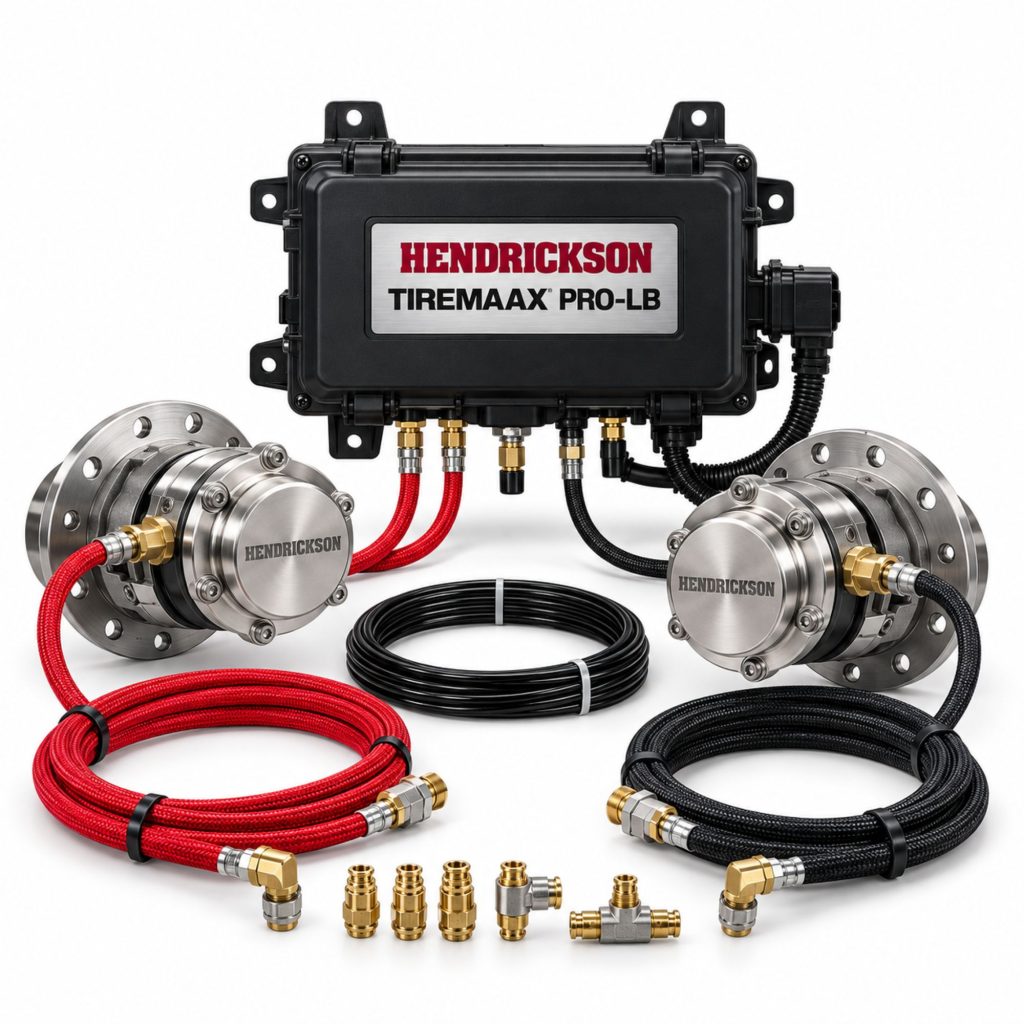
The Hendrickson TIREMAAX PRO-LB is an automatic trailer tire-pressure control system that changes tire pressure in response to axle load. Unlike a conventional inflation system that maintains one fixed target pressure, PRO-LB uses pressure from the trailer suspension’s air springs to estimate axle loading and adjust tire pressure accordingly.
The system can add air when pressure is too low, relieve excess pressure, equalize connected tires, and maintain a configured minimum threshold. This allows a trailer to operate with tire pressures better matched to loaded, partially loaded, and empty conditions.
PRO-LB builds on the capabilities of TIREMAAX PRO by adding load-based pressure adjustment. Its purpose is to help improve the tire contact patch, control irregular tread wear, support fuel efficiency, extend casing life, and reduce tire-related downtime.
Key Characteristics
- Automatic trailer tire-pressure control
- Load-based tire-pressure adjustment
- Uses air-spring pressure to estimate axle load
- Inflates tires when pressure is below the applicable target
- Relieves pressure when it exceeds the applicable control range
- Equalizes connected tire pressures
- Maintains a configured minimum pressure threshold
- Compensates for changing loads and operating conditions
- Supports dual and wide-base single tire arrangements
- Trailer-mounted warning indicator
- Protective hubcap valves help isolate individual leaking tires
- Integration with selected Hendrickson trailer suspensions and wheel ends
Major Components
- TIREMAAX PRO-LB controller assembly
- Controller enclosure and identification decal
- Pressure regulator
- Minimum-pressure adjustment mechanism
- Controller supply valve
- Trailer reservoir supply line
- Air-spring signal line
- Damping tank or signal-conditioning components where specified
- Delivery air lines
- Axle air passages or internal axle tubing
- Spindle plugs and fittings
- Rotary unions
- Hubcaps with integral isolation valves
- Flexible tire hoses
- Tire valve-stem connections
- Electrical harness
- Trailer-mounted indicator lamp
- Pressure test ports
- Emergency air-supply port
System Type and Design
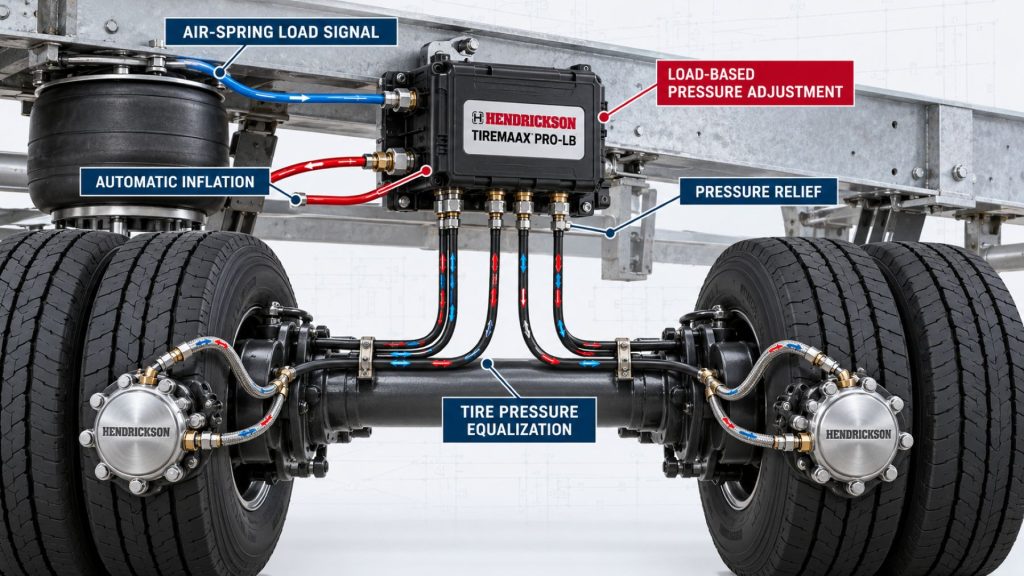
TIREMAAX PRO-LB is a load-responsive tire-pressure control system for air-suspended trailers. The controller receives clean, dry compressed air from the trailer reservoir and a separate pressure signal from the suspension air springs.
Because air-spring pressure changes with trailer loading, the controller can use that signal to vary the tire-pressure target. The system maintains a minimum tire pressure when the trailer is empty or lightly loaded and increases the target as axle load rises.
Air is routed from the controller through the axles and wheel ends to the tires. Rotary unions allow the stationary air supply to communicate with the rotating hubs and wheels.
How the Tire Inflation System Works
The trailer reservoir supplies compressed air to the PRO-LB controller. The controller compares its configured pressure relationship with the signal received from the suspension air springs.
When trailer loading increases, air-spring pressure rises. The controller responds by increasing the tire-pressure target. When the trailer is unloaded or lightly loaded, air-spring pressure falls and the controller reduces the target without allowing pressure to drop below the configured minimum threshold.
If tire pressure is below the applicable target, the controller supplies air through the axle and wheel-end plumbing. If pressure is excessive, the controller vents air until pressure returns to its intended operating range.
The trailer air reservoir must remain above the desired tire pressure because the controller cannot deliver more pressure than the available supply. The system also requires clean, dry trailer air for dependable operation.
Position and Function Within the Vehicle
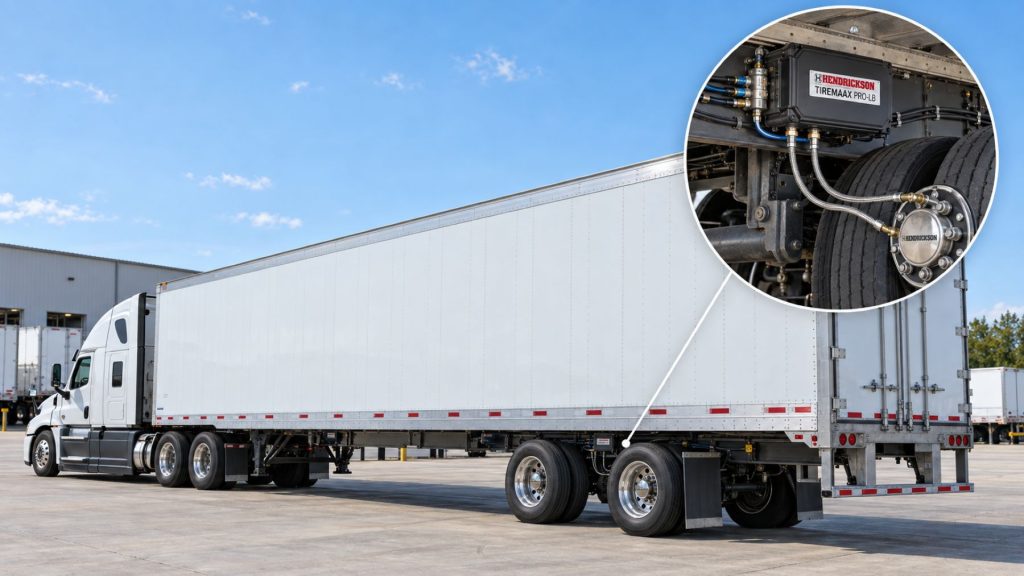
TIREMAAX PRO-LB is installed on a commercial trailer and serves its tire and wheel-end assemblies. The controller is normally mounted beneath the trailer in a protected but serviceable location.
The system performs several functions:
- Monitors the pressure relationship within the tire-delivery circuit
- Uses suspension air pressure as an axle-load signal
- Adds air to tires that fall below the applicable target
- Relieves excess pressure under controlled conditions
- Adjusts target pressure as trailer load changes
- Equalizes connected tires
- Protects unaffected tires from a leaking tire through hubcap isolation valves
- Activates an indicator lamp when inflation or service attention is required
- Helps maintain a more appropriate tire contact patch
- Reduces the need for manual pressure changes between loaded and empty operation
Common Specifications
- System Type: Load-based automatic trailer tire-pressure control system
- Pressure Functions: Inflation, pressure relief, equalization, and load-based adjustment
- Load Signal: Suspension air-spring pressure
- Dual-Tire Setting Range: 85 to 120 psi
- Wide-Base Single Setting Range: 100 to 120 psi
- Dual-Tire Minimum Threshold: 75 psi
- Wide-Base Single Minimum Threshold: 90 psi
- Air Supply: Clean, dry compressed air from the trailer reservoir
- Indicator: Trailer-mounted warning lamp
- Tire Arrangements: Application-specific dual or wide-base single tires
- Suspension Categories: Controller calibrated for the applicable Hendrickson suspension category
- Primary Suspension Families: Selected INTRAAX, VANTRAAX, and ULTRAA-K models
- Maximum Recommended Installation: Normally no more than two PRO-LB-controlled axles per vehicle combination without Hendrickson engineering approval
Pressure Settings and Operating Capacity
The selected cold tire pressure must satisfy the tire manufacturer’s requirements for the actual axle load. PRO-LB then changes the target within its calibrated range as the air-spring load signal changes.
Hendrickson identifies a setting range of 85 to 120 psi for dual-tire systems and 100 to 120 psi for wide-base single systems. The corresponding minimum-pressure thresholds are 75 psi for dual tires and 90 psi for wide-base single tires.
The controller lid decal identifies the applicable suspension category, minimum pressure, and cold tire pressure at the specified axle load. Those values must match the trailer’s suspension, tires, axle loading, and approved application.
Load-Based Pressure Adjustment
Commercial trailers can experience large differences between empty and fully loaded axle weights. Tires inflated for maximum load may operate at excessive pressure for their actual load when the trailer is empty or lightly loaded.
PRO-LB uses air-spring pressure to respond to this variation. As axle load rises, the system increases tire pressure. As axle load falls, it reduces pressure while maintaining the configured minimum threshold.
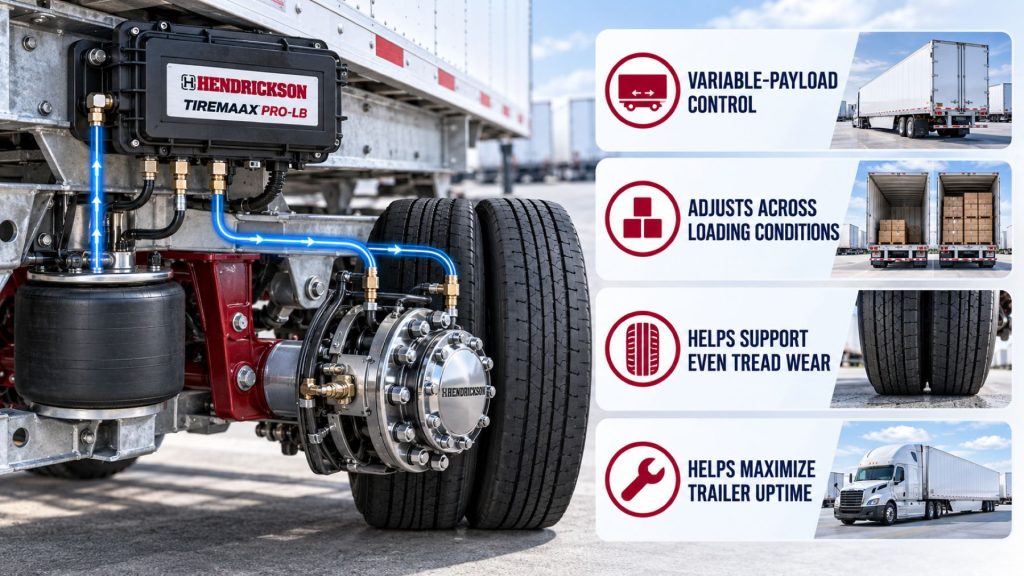
This load-based approach is intended to preserve a more appropriate tire contact patch, limit irregular wear during lightly loaded operation, and maintain sufficient pressure as payload increases.
Inflation, Relief, and Equalization
When tire pressure falls below the applicable target, PRO-LB routes reservoir air to the tires. The indicator lamp may illuminate while the system is actively correcting pressure.
If pressure rises above the allowable control range because of temperature, altitude, or reduced loading, the controller can vent excess air. Normal venting from the controller may therefore be part of system operation rather than evidence of a leak.
The controller typically keeps pressure below approximately 10 psi above the intended target, with Hendrickson noting that normal control may be approximately 5 to 7 psi above the target before relief occurs.
Air Supply, Controls, and Electrical Integration
The system receives compressed air from the trailer reservoir. Reservoir pressure must be greater than the required tire pressure, and the air supply must remain clean and dry.
The controller contains the regulation, load-sensing, minimum-pressure, delivery, and relief functions. An electrical harness connects the controller to a trailer-mounted indicator lamp that alerts the driver when the system is delivering air for an extended period or may require service.
If the indicator remains illuminated continuously for more than approximately ten minutes while the vehicle is operating, one or more tires may be low or the system may require inspection. Repeated cycling can indicate a slow leak in a tire or system line.
Installation and Calibration
Installation requires correct controller selection, suspension-category calibration, air-spring signal plumbing, axle preparation, wheel-end components, tire hoses, electrical wiring, and leak testing.
The controller must be matched to the suspension family and tire arrangement. Calibration and field verification require the Hendrickson PRO-LB field adjustment tool or another procedure specifically approved by Hendrickson.
During adjustment, the trailer reservoir should be fully charged, the parking brakes applied, and the wheels chocked. The technician verifies both the cold pressure at the specified axle-load signal and the minimum pressure for the empty or lightly loaded condition.
Trailer, Axle, and Wheel-End Compatibility
PRO-LB must be matched to the complete trailer, suspension, axle, wheel-end, and tire configuration. Compatibility depends on:
- Trailer manufacturer and model
- Suspension family and model
- Suspension capacity and category
- Axle model and spindle configuration
- Number of controlled axles
- Dual or wide-base single tires
- Cold tire-pressure requirement
- Tire load and inflation tables
- Hubcap and rotary-union design
- Wheel and valve-stem arrangement
- Trailer air-reservoir capacity
- Air-supply cleanliness and pressure
- Electrical and indicator-lamp requirements
- Original-equipment or approved retrofit availability
Common Applications
- Dry van trailers
- Refrigerated trailers
- Flatbed trailers
- Tank trailers
- Moving-floor trailers
- Drop-deck trailers
- Specialized highway trailers
- Trailers operating with highly variable payloads
- Fleets accumulating significant empty miles
- Applications using dual trailer tires
- Applications using wide-base single trailer tires
- Selected Hendrickson integrated suspension and axle systems
Advantages
- Automatically responds to changing axle load
- Adds air when tire pressure is below the applicable target
- Relieves excessive tire pressure
- Maintains a minimum pressure threshold
- Reduces dependence on one fixed fully loaded pressure
- Can improve tire contact under lightly loaded conditions
- Helps reduce irregular tread wear
- Supports longer tire and casing life
- May improve fuel efficiency through better pressure control
- Reduces manual pressure-adjustment requirements
- Provides a visible warning indicator
- Integrates with selected Hendrickson suspension and wheel-end systems
Limitations or Considerations
- Requires an air-suspended trailer
- Requires clean, dry compressed air
- Cannot supply pressure above available reservoir pressure
- Must be calibrated for the specific suspension and tire arrangement
- Not every Hendrickson suspension model accepts PRO-LB
- Thirty-thousand-pound-capacity systems may be excluded
- Installation on more than two axles per vehicle combination is generally not advised without engineering review
- Air lines, hoses, seals, and rotary unions add service points
- Normal controller venting may be mistaken for a system leak
- The indicator lamp does not identify the exact leaking tire
- Manual tire inspections and pressure checks remain necessary
- The system cannot repair a damaged tire or replace proper tire maintenance
Driver and Operator Experience
During normal operation, the system works automatically without requiring the driver to change tire pressure after each change in payload. The driver may occasionally hear air exhausting from the controller as it relieves pressure.
The indicator lamp may illuminate temporarily when the system is adding air, particularly during startup after tires have cooled. A lamp that remains on for an extended period or cycles repeatedly requires investigation.
Drivers must continue conducting normal pre-trip and post-trip tire inspections. PRO-LB does not identify tread damage, exposed cords, sidewall cuts, loose wheel nuts, damaged wheels, or every type of rapid tire failure.
Sensor Programming and Tire-Position Assignment
PRO-LB is primarily a pneumatic pressure-control system rather than a wheel-position TPMS requiring individual electronic sensor assignment. Its standard warning system monitors system activity rather than displaying a separate pressure reading for every tire.
If the trailer also uses an independent tire-pressure monitoring or telematics system, those sensors must be programmed and assigned according to that system’s instructions. Their pressure thresholds should be coordinated with PRO-LB’s changing load-based targets to avoid unnecessary alerts.
Inspection and Wear Points
Routine inspection should include:
- Controller enclosure and mounting
- Controller supply valve
- Reservoir supply line
- Air-spring signal line
- Damping tank and related fittings
- Axle supply lines
- Spindle plugs and internal axle tubing
- Rotary unions
- Hubcaps and isolation valves
- Flexible tire hoses
- Valve-stem connections
- Electrical harness and connectors
- Indicator lamp operation
- Controller test ports and vent
- Signs of air leakage, abrasion, heat damage, or contamination
Maintenance and Ownership Notes
- Check all tires manually during regular inspections
- Confirm the controller supply valve remains open during normal operation
- Inspect hoses for rubbing, cracking, and kinking
- Check fittings and air lines for leakage
- Inspect hubcaps and rotary unions
- Test the trailer-mounted indicator lamp
- Maintain the tractor and trailer air dryers and reservoirs
- Drain moisture from air reservoirs as required
- Verify pressure settings after controller service
- Confirm suspension-category calibration
- Inspect electrical wiring and connectors
- Use genuine or approved replacement parts
- Follow wheel-end service procedures that protect the inflation components
- Consult Hendrickson before changing tire size or wheel arrangement
Common Tire-Inflation-System Problems
- Indicator lamp remains illuminated: One or more tires may be low, the system may be supplying air continuously, reservoir pressure may be insufficient, or the system may require service.
- Repeated indicator cycling: A slow tire leak, damaged hose, loose fitting, leaking rotary union, or other plumbing leak may be responsible.
- System will not inflate tires: A closed supply valve, low reservoir pressure, restricted line, controller fault, blockage, or disconnected plumbing may prevent air delivery.
- System will not relieve pressure: Incorrect calibration, controller contamination, damaged relief components, restricted plumbing, or an incorrect load signal may be responsible.
- Incorrect load-based pressure: A leaking or restricted air-spring signal line, incorrect suspension category, calibration error, or suspension problem can affect the controller’s response.
- One tire remains low: A closed or damaged hubcap valve, blocked hose, leaking tire, valve-stem problem, or failed wheel-end component may isolate that position.
- Excessive controller venting: Normal pressure relief, incorrect adjustment, an excessive air-spring signal, or a controller fault may cause noticeable exhaust.
- Contaminated controller: Moisture, oil, or debris from the trailer air system can interfere with regulation and valve operation.
Safety and Service Precautions
- Chock the trailer wheels before beginning service
- Apply the trailer parking brakes when instructed
- Never work beneath a trailer supported only by a jack
- Relieve system pressure before disconnecting pressurized lines
- Wear eye protection when working with compressed air
- Keep hands and tools clear of exhausting ports
- Do not exceed approved tire or wheel pressure ratings
- Do not assume the system makes a visibly damaged tire safe
- Close the controller supply valve when isolating a significant system leak
- Verify every tire has adequate pressure before returning the trailer to service
- Use approved procedures during hub and wheel-end service
- Follow Hendrickson, tire-manufacturer, trailer-manufacturer, and fleet instructions
Identification Information
System information is located on the controller enclosure, lid decal, suspension identification tag, axle tags, and individual components. Record the following information before ordering parts or adjusting the system:
- Trailer manufacturer, model, and VIN
- Hendrickson suspension family and model
- Suspension category
- Axle model and serial information
- TIREMAAX system type
- Controller assembly part number
- Minimum tire-pressure setting
- Cold tire pressure at the specified axle load
- Dual or wide-base single configuration
- Hubcap and rotary-union part numbers
- Hose and fitting configuration
- Indicator-lamp and wiring information
- Tire size, load range, and required pressure
Buying Considerations
- Confirm that the trailer uses a compatible air suspension
- Identify the exact suspension model and category
- Verify axle and spindle compatibility
- Choose dual or wide-base single configuration
- Confirm the tire manufacturer’s load and pressure requirements
- Verify the desired cold and minimum pressure settings
- Check trailer air-reservoir capacity and condition
- Confirm the number of axles to be controlled
- Determine original-equipment or retrofit availability
- Verify hubcap and wheel-end compatibility
- Confirm indicator-lamp and electrical requirements
- Review installation labor and axle-preparation requirements
- Check replacement-parts and service-tool availability
- Use an installer familiar with trailer tire-inflation systems
Variants and Configurations
- Dual-tire configurations
- Wide-base single-tire configurations
- Different cold-pressure settings
- Different minimum-pressure thresholds
- Suspension Category A calibration
- Suspension Category B calibration
- Suspension Category C calibration
- INTRAAX-compatible systems
- VANTRAAX-compatible systems
- ULTRAA-K-compatible systems
- Different hubcap and rotary-union arrangements
- Original-equipment installations
- Approved retrofit configurations
- Integration with selected HXL wheel-end packages
System availability depends on suspension model, axle, capacity, wheel end, tire arrangement, and trailer specification. The complete application should be verified with Hendrickson before ordering.
Comparison to Similar Equipment
Compared with the Hendrickson TIREMAAX PRO Tire Inflation System, PRO-LB adds automatic load-based pressure adjustment. TIREMAAX PRO inflates, equalizes, and relieves pressure around a configured target, while PRO-LB changes its target according to the suspension load signal.
Compared with the Hendrickson TIREMAAX CP Tire Inflation System, PRO-LB provides pressure relief and load-based adjustment in addition to automatic inflation.
Compared with the Meritor Tire Inflation System, TIREMAAX PRO-LB uses Hendrickson’s suspension air-spring signal to vary tire pressure with axle load. The correct choice depends on trailer, axle, wheel-end, and fleet requirements.
Compared with the Pressure Systems International ATIS Tire Inflation System, PRO-LB emphasizes automatic load-responsive pressure adjustment rather than maintaining only one fixed inflation target.
Best Fit For
- Trailers with widely changing payloads
- Fleets accumulating substantial empty or lightly loaded mileage
- Applications experiencing irregular wear from excessive pressure at low load
- Selected Hendrickson INTRAAX-equipped trailers
- Selected Hendrickson VANTRAAX-equipped trailers
- Selected Hendrickson ULTRAA-K-equipped trailers
- Dual-tire trailer applications
- Wide-base single-tire trailer applications
- Fleets seeking automatic inflation and pressure relief
- Operators focused on tire life, uptime, and fuel efficiency
Related Vehicle and Trailer Types
- Dry Van Trailers
- Refrigerated Trailers
- Flatbed Trailers
- Tank Trailers
- Step Deck Trailers
- Dump Trailers
- Car Hauler Trailers
- Heavy Haul Trailers
Related Truck and Trailer Models
- Wabash DuraPlate Dry Van
- Great Dane Champion Dry Van
- Utility 4000D-X Composite Dry Van
- Hyundai Translead Composite XT Dry Van
- Great Dane Everest Reefer
- Utility 3000R Refrigerated Trailer
- Fontaine Revolution Flatbed
Related Tire and Wheel Types
- Tire Pressure Monitoring & Inflation Systems
- Trailer Tires
- Commercial Truck Wheels
- Aluminum Commercial Truck Wheels
- Steel Commercial Truck Wheels
- Wide-Base Commercial Wheels
Related Tire and Wheel Products
- Hendrickson TIREMAAX PRO Tire Inflation System
- Hendrickson TIREMAAX CP Tire Inflation System
- Meritor Tire Inflation System
- Pressure Systems International ATIS Tire Inflation System
- STEMCO AerisIS Tire Inflation System
- Aperia HALO Tire Inflator
- Continental ContiPressureCheck TPMS
Related Equipment Systems
- Tires & Wheels
- Suspension Systems
- Trailer Suspension Systems
- Axles & Differentials
- Brake Systems
- Electrical Systems
- Telematics & ELD Systems
- Safety Systems
Related Guides
- Tire & Wheel Guides
- How Tire Pressure Monitoring and Inflation Systems Work
- How to Read Commercial Truck Tire Sizes and Ratings
- How to Inspect and Maintain Commercial Truck Tires
- Commercial Truck Tire Types Explained
- Steer vs Drive vs Trailer Tires
- How Commercial Truck Suspension Systems Work
- Truck Suspension Components Explained
Regulatory and Compliance Notes
TIREMAAX PRO-LB does not change the tire, wheel, axle, suspension, or trailer load ratings. Inflation settings must remain within the approved limits of every component and satisfy the tire manufacturer’s requirements for the actual axle load.
Commercial tires must still meet applicable inspection, tread-depth, condition, load, and inflation requirements. An automatic inflation system does not make a damaged, overloaded, or improperly matched tire compliant.
Installation and repair work must preserve brake operation, air-system integrity, wheel-end sealing, electrical function, and required trailer safety systems.
Real World Operating Notes
PRO-LB is particularly relevant for fleets whose trailers frequently alternate between loaded and empty operation. Maintaining maximum-load pressure during every empty mile can reduce the tire contact patch and contribute to irregular wear.
Audible air exhaust from the controller can be normal when the system is reducing pressure. Trailers should carry the applicable warning label so drivers and technicians do not automatically treat every relief event as a leak.
Cold tires may lose pressure while parked. The indicator lamp may illuminate at startup while the system restores the correct load-based value.
The system improves pressure management but does not eliminate manual inspections. A tire can retain pressure while still having tread separation, impact damage, exposed reinforcement, or other unsafe conditions.
Frequently Asked Questions
What is Hendrickson TIREMAAX PRO-LB?
It is an automatic trailer tire-pressure control system that inflates, relieves, equalizes, and adjusts pressure according to axle load.
How does PRO-LB determine trailer load?
It monitors suspension air-spring pressure. Higher air-spring pressure generally indicates greater axle load, allowing the controller to increase the tire-pressure target.
Can the system remove air from the tires?
Yes. PRO-LB can relieve excess pressure caused by changing load, temperature, or operating conditions.
What pressure range does PRO-LB support?
Hendrickson lists 85 to 120 psi for dual-tire settings and 100 to 120 psi for wide-base single-tire settings.
Will PRO-LB completely deflate tires when the trailer is empty?
No. The controller maintains a minimum threshold. Hendrickson lists 75 psi for dual tires and 90 psi for wide-base single tires.
Why is air exhausting from the controller?
The system may be relieving pressure as part of normal operation. Continuous or unexplained venting should still be inspected for incorrect adjustment, an excessive load signal, contamination, or controller problems.
What does the indicator lamp mean?
It normally indicates that the system is actively supplying air or requires attention. A lamp that remains on for more than approximately ten minutes can indicate a low tire, air leak, insufficient supply, or system problem.
Can PRO-LB be installed on any trailer?
No. It requires a compatible air suspension, axle, wheel-end configuration, tire arrangement, air supply, and approved Hendrickson application.
Does PRO-LB replace manual tire inspections?
No. Drivers and technicians must continue inspecting tire pressure, tread, sidewalls, valves, wheels, hoses, and wheel ends.
How are replacement parts identified?
Use the trailer VIN, suspension model, suspension category, controller part number, pressure settings, axle information, tire arrangement, and individual component numbers.
Availability and Where to Find
Hendrickson TIREMAAX PRO-LB may be available as original equipment on compatible trailers or as an approved retrofit for selected Hendrickson suspension, axle, and wheel-end configurations.
Systems and replacement parts may be available through Hendrickson distributors, trailer manufacturers, commercial-trailer dealers, heavy-duty parts suppliers, tire-inflation specialists, and qualified trailer repair facilities.
Current product information, application details, service literature, parts information, and support resources are available through the Hendrickson TIREMAAX PRO-LB website.
Support Trucking Families
Truck Equipment Atlas supports the mission of Grey Cross, a nonprofit dedicated to helping families of truck drivers who lose their lives while on the road. As the site grows, part of its mission is to bring awareness and support to these families.
Podcast or Video Section
Learn More Through Audio and Video
Truck Equipment Atlas will continue expanding with podcast episodes, interviews, and equipment breakdowns to help drivers and fleets better understand trucks and equipment.
Follow the Growth of Truck Equipment Atlas
Truck Equipment Atlas continues to expand with new truck profiles, trailer coverage, diesel engine pages, equipment system resources, manufacturer information, and educational guides.
Visit our Site Updates page to explore recent additions, project milestones, and upcoming resources as we continue building one of the industry’s growing commercial trucking equipment reference libraries.
View the Latest Site Updates: Truck Equipment Atlas Site Updates