
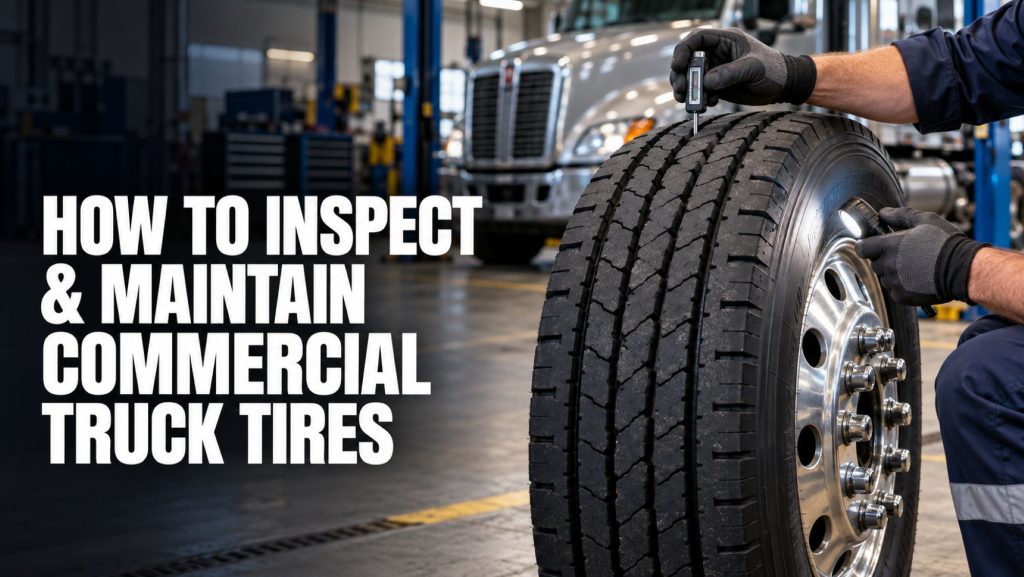
Commercial truck tires carry heavy loads, operate for long hours, and regularly encounter heat, road debris, curbs, potholes, and changing weather conditions. A small pressure loss, embedded object, uneven wear pattern, or damaged valve can develop into a roadside failure if it is not found early.
A consistent tire inspection and maintenance program helps improve safety, reduce unexpected downtime, extend casing life, and control one of the largest recurring equipment expenses for many fleets. Inspections should cover more than tread depth. Tire pressure, sidewall condition, wheel condition, tread wear, dual-tire spacing, valve hardware, and service history all matter.
This guide explains how to inspect and maintain commercial truck tires during pre-trip checks, scheduled maintenance, and professional tire service. Always follow the tire, wheel, and vehicle manufacturers’ current procedures, along with applicable regulations and fleet policies.
Why Commercial Truck Tire Inspections Matter
Tire problems rarely improve on their own. A slow leak can lead to underinflation, excessive heat, casing damage, irregular wear, and eventual failure. Misalignment can gradually remove tread from one shoulder, while a dragging brake or wheel-end problem can expose the tire to damaging heat.
Regular inspections help identify developing problems before they result in:
- Roadside tire failures and service calls
- Vehicle downtime and delivery delays
- Damage to wheels, mud flaps, air lines, body panels, or trailer components
- Reduced fuel efficiency caused by underinflation
- Premature tread removal or loss of casing value
- Unsafe handling, braking, or traction
- Commercial vehicle inspection violations
The best tire program combines frequent driver observations with accurate pressure checks, tread measurements, wheel-end inspections, maintenance records, and professional evaluation when damage is discovered.
When Commercial Truck Tires Should Be Inspected
Tire inspection is not a single maintenance event. Different levels of inspection should occur throughout the tire’s service life.
| Inspection Point | What to Check |
|---|---|
| Before each trip | Visible inflation condition, tread damage, sidewall damage, exposed material, bulges, cuts, lodged objects, and obvious wheel problems |
| During stops | Changes in tire appearance, unusual heat, pressure warnings, fresh damage, smoke, odor, or objects trapped between duals |
| After striking an object | Impact damage, air loss, wheel damage, sidewall distortion, vibration, and steering changes |
| At scheduled maintenance | Accurate cold pressure, tread depth, wear pattern, valve condition, dual matching, wheel condition, alignment indicators, and service history |
| Before mounting or returning a tire to service | Complete internal and external inspection by a trained tire service professional |
A walk-around inspection can identify many problems, but appearance alone cannot confirm correct inflation pressure or internal casing condition.
Begin With a Safe Walk-Around Inspection
Park the vehicle on firm, level ground when possible. Secure the vehicle against movement, follow company safety procedures, and provide enough lighting to see the complete tread and sidewall area.
Walk around the truck and trailer slowly. View each tire from more than one angle instead of checking only the outward-facing sidewall. Look between dual tires and behind wheel openings where damage can be difficult to see.
- Compare the general shape of tires on the same axle.
- Look for one tire sitting lower than the others.
- Check whether the tread appears square and evenly supported.
- Look for fresh rubber dust, scuffing, cuts, or impact marks.
- Inspect the surrounding wheel and suspension area for fluid leaks or loose components.
- Check for smoke, unusual odors, or signs of excessive wheel-end heat.
Never place yourself underneath an unsecured vehicle or between equipment that could move.
Check Tire Inflation Pressure
Inflation pressure is one of the most important parts of commercial tire maintenance. Underinflation increases tire deflection and heat generation. Overinflation can reduce the tire’s ability to absorb impacts and may contribute to irregular wear or damage.
Check pressure when tires are cold, before normal operation has generated heat. Use an accurate commercial tire gauge rather than striking the tire or judging its appearance. A tire can be dangerously underinflated while still appearing nearly normal.
Use the Correct Operating Pressure
The correct operating pressure is not automatically the maximum pressure molded onto the tire’s sidewall. It should be established using reliable axle weights, the tire manufacturer’s load-and-inflation table, vehicle requirements, and fleet policy.
Never exceed the lowest pressure or load limit assigned to the tire, wheel, valve, or other component in the assembly. If the fleet does not have an established pressure specification, consult the tire and vehicle manufacturers or a qualified commercial tire professional.
Investigate Repeated Pressure Loss
Repeatedly adding air without finding the source of the leak is not a repair. Pressure loss may be caused by:
- A puncture or damaged repair
- A leaking valve core or valve stem
- A damaged valve extension
- Bead-area damage or contamination
- Wheel cracks, corrosion, or sealing-surface problems
- Damage caused by operating underinflated or overloaded
A tire suspected of operating severely underinflated or overloaded may have internal damage that cannot be seen while it is mounted. Do not simply reinflate it and return it to service. The assembly should be handled cautiously and evaluated by trained tire service personnel following approved procedures.
Learn more about monitoring equipment in the Tire Pressure Monitoring and Inflation Systems guide.
Inspect Tread Depth
Use a calibrated tread-depth gauge and measure the major tread grooves. Take readings at multiple points around the tire because tread depth can vary across the tread face and around the circumference.
Under federal requirements for many commercial motor vehicles, tires on the front wheels must generally have at least 4/32 inch of tread depth in every major groove. Other tires must generally have at least 2/32 inch. Measurement rules and exceptions apply, and fleets may use higher removal standards to protect safety and casing value.
Do not rely only on tread-wear indicators. Record actual measurements so the fleet can track wear rates, plan replacements, and identify mechanical problems.
Inspect the Tread for Damage
Examine the complete tread surface, including the grooves and shoulders. Rotate or reposition the vehicle only when it can be done safely so hidden portions of the tread can be inspected.
- Cuts, cracks, punctures, and impact breaks
- Nails, screws, stones, metal, or other embedded objects
- Missing chunks or torn tread blocks
- Exposed cords, belts, or casing material
- Tread separation, raised areas, or distorted tread
- Contamination from fuel, oil, solvents, or other chemicals
- Heat damage, discoloration, or melted rubber
Do not pull an embedded object from an inflated tire during a roadside inspection. Removing it may cause rapid air loss. Mark the location and have the tire evaluated under controlled service conditions.
Inspect Sidewalls and Bead Areas
The sidewall flexes continuously while supporting the vehicle, making sidewall condition especially important. Inspect both the outward-facing and inward-facing sidewalls whenever access allows.
- Cuts, cracking, weather checking, or abrasion
- Bulges, bubbles, or localized distortion
- Exposed or damaged cords
- Curb damage and deep scuffing
- Damage from contact with suspension, body, or trailer components
- Heat discoloration near the bead or wheel flange
- Irregular bead seating or signs that the tire has moved on the wheel
A bulge may indicate broken or separated internal components and requires immediate professional evaluation. Never puncture, press, strike, or attempt to flatten a sidewall bulge.
Recognize Common Tire Wear Patterns
Irregular wear is often a symptom rather than the original problem. Correcting the mechanical or operational cause early may protect the remaining tread and prevent the same pattern from appearing on the replacement tire.
| Wear Pattern | Possible Conditions to Investigate |
|---|---|
| Wear on both shoulders | Underinflation, overloading, excessive deflection, or application conditions |
| Wear concentrated near the center | Inflation or load mismatch, rim selection, or application conditions |
| One-sided shoulder wear | Alignment, camber, axle, suspension, or bent-component problems |
| Feathered tread ribs | Toe misalignment or lateral scrubbing |
| Cupping or scalloping | Loose or worn suspension components, wheel-end problems, imbalance, or irregular road contact |
| Localized flat spot | Wheel lockup, brake problems, severe skidding, or parking-related conditions |
| Rapid or uneven dual-tire wear | Pressure mismatch, diameter mismatch, load distribution, spacing, or wheel-end problems |
These patterns are diagnostic clues, not final diagnoses. Tire design, axle position, route, speed, loading, road surface, and maintenance history can all influence wear.
Inspect Dual-Tire Assemblies
Dual assemblies require special attention because the tires must share the load while operating side by side. A pressure or diameter mismatch can cause one tire to carry more load and generate more heat.
- Check the pressure of each tire separately.
- Confirm that both tires are compatible in size, construction, and application.
- Compare tread depth and overall diameter according to the tire manufacturer’s matching limits.
- Inspect the space between the tires for trapped rocks, metal, wood, or other debris.
- Look for sidewall contact between the dual tires.
- Confirm adequate dual spacing under the expected load.
- Make sure valve stems and extensions are accessible, secure, and not rubbing other components.
Do not assume both tires have the same pressure because they appear similar. Each tire must be checked with an accurate gauge.
Inspect Valve Stems, Extensions, and Caps
Valve hardware provides access for inflation checks while maintaining the air seal. Inspect valve stems for cracks, looseness, bending, corrosion, and contact with the wheel or brake components.
Valve extensions should be properly supported and should not rub the wheel opening. Use sealing valve caps designed for the application. A missing or damaged cap can allow dirt and moisture into the valve and removes an important secondary seal.
If a tire continues losing pressure, inspect the valve core, stem base, extension connections, bead area, and wheel instead of replacing only the cap.
Inspect Wheels and Wheel-End Components
Tire condition cannot be separated from wheel and wheel-end condition. During inspection, look for:
- Cracks, bends, dents, or distorted wheel flanges
- Excessive corrosion or damaged sealing surfaces
- Elongated bolt holes or damaged fastener seats
- Loose, missing, damaged, or incorrectly installed fasteners
- Rust trails or movement indicators around fasteners
- Hub oil, grease, brake fluid, or other leaks
- Signs of excessive brake or bearing heat
A damaged wheel can affect tire sealing, support, alignment, and safety. Review the Commercial Truck Wheels guide for additional wheel information.
Maintain Proper Alignment and Suspension Condition
Alignment problems can remove usable tread even when inflation pressure is correct. Steering and suspension wear may also cause irregular tire contact, vibration, wandering, or poor handling.
Schedule an alignment or chassis inspection when the vehicle develops:
- Rapid one-sided shoulder wear
- Feathering across the tread ribs
- Repeated irregular wear on the same axle position
- Steering pull or an off-center steering wheel
- Dog tracking or visible axle misalignment
- Uneven ride height
- Loose, worn, bent, or damaged suspension components
Replacing the tire without correcting the underlying alignment or suspension problem may quickly damage the new tire.
Rotation and Position Changes
Tire rotation is not automatically required at one universal mileage interval for every commercial truck. Rotation decisions should consider the tread design, axle position, wear pattern, vehicle application, manufacturer recommendations, and fleet maintenance plan.
Before moving a tire to another position, confirm that it is approved for that axle and direction of rotation. A tire designed or worn for a drive position may not be appropriate for steer service. Directional tires must be mounted to rotate in the intended direction.
For more information about axle-position requirements, read Steer vs Drive vs Trailer Tires.
Commercial Tire Repairs
A commercial tire repair should begin with removing the tire from the wheel and completing a thorough internal and external inspection. An external plug by itself does not provide the inspection or repair process needed to determine whether the tire is safe to return to service.
Repairability depends on factors such as:
- The location, size, angle, and type of injury
- Whether the tire was operated underinflated or flat
- The condition of the inner liner, belts, casing, and bead area
- Previous repairs and accumulated damage
- The tire manufacturer’s repair limits
- The intended axle position and service application
Repairs, mounting, demounting, and inflation of commercial truck tires should be performed by trained personnel using approved equipment and safety procedures.
Protect Tire Casings for Retreading
A commercial tire casing can retain significant value when it is removed from service before excessive damage occurs. Running a tire flat, allowing severe irregular wear, or delaying removal after belt or sidewall damage may make the casing unsuitable for retreading.
- Maintain correct inflation pressure throughout the tire’s service life.
- Remove tires before they reach the fleet’s casing-protection limit.
- Repair approved injuries promptly using proper procedures.
- Avoid mixing poorly matched tires in dual assemblies.
- Correct alignment, suspension, and brake problems early.
- Record casing identification, repairs, removals, and retread history.
When a Tire Should Be Removed From Service
Remove the vehicle from operation or obtain professional assistance when a tire has a condition that could make continued operation unsafe. Examples include:
- A flat tire or audible air leak
- Exposed cords, belts, or casing material
- A tread or sidewall separation
- A bulge, bubble, or serious distortion
- Major cuts, impact damage, or bead damage
- Evidence of severe underinflation or overload operation
- Tread depth below the applicable minimum
- Contact between dual tires
- A damaged wheel or insecure wheel assembly
- Smoke, fire, extreme heat, or a strong burning odor near the tire or wheel end
Do not continue driving merely to reach a more convenient location when the tire or wheel assembly may be unsafe.
Commercial Truck Tire Maintenance Checklist
- Park safely and secure the vehicle against movement.
- Walk around the truck and trailer with adequate lighting.
- Inspect the tread, shoulders, sidewalls, bead areas, and visible inner sidewalls.
- Look for cuts, bulges, separations, exposed material, and embedded objects.
- Check cold inflation pressure with an accurate commercial gauge.
- Inspect valve stems, extensions, and sealing caps.
- Measure and record tread depth at multiple locations.
- Compare wear patterns across the axle and vehicle.
- Inspect dual spacing, pressure matching, diameter matching, and trapped debris.
- Inspect wheels, fasteners, hubs, and surrounding suspension components.
- Correct the source of pressure loss or irregular wear instead of treating only the symptom.
- Document measurements, repairs, tire movements, and removal reasons.
Frequently Asked Questions
How often should commercial truck tire pressure be checked?
Tires should receive a visual check before operation, while accurate gauge checks should follow the fleet’s established inspection schedule and occur often enough to identify pressure loss before damage develops. Pressure should also be checked when a monitoring system reports a problem or when a tire appears different from the others.
Can tire pressure be checked when the tire is hot?
A hot reading may help identify a serious difference between tires, but normal operating pressure should be checked and adjusted cold according to the fleet and manufacturer procedures. Do not release air from a properly inflated hot tire simply because its pressure increased during operation.
Can I tell whether a truck tire is low by looking at it?
No. A commercial tire can be significantly underinflated without appearing flat, especially in a dual assembly. Use an accurate pressure gauge or an approved monitoring system.
What is the minimum legal tread depth for commercial truck tires?
For many commercial motor vehicles operating under federal requirements, front-wheel tires must generally have at least 4/32 inch in every major tread groove, while other tires must generally have at least 2/32 inch. Applicable measurement rules, vehicle types, jurisdictions, and fleet policies should always be confirmed.
Should an embedded nail be removed during a pre-trip inspection?
No. Removing an embedded object from an inflated tire could cause rapid air loss. Mark the location and arrange for controlled inspection by trained tire service personnel.
Why do dual tires need to be matched?
Dual tires operate together and must share the load. Differences in pressure, diameter, tread depth, or construction can cause unequal loading, additional heat, and accelerated wear.
Does a tire pressure monitoring system replace manual inspections?
No. A monitoring system can provide useful warnings, but it does not replace inspections for cuts, separations, irregular wear, tread depth, valve damage, wheel problems, or trapped debris.
Explore Commercial Truck Tire Guides
- Commercial Truck Tire Types Explained
- Steer vs Drive vs Trailer Tires
- How to Read Commercial Truck Tire Sizes and Ratings
- Steer Tires
- Drive Tires
- Trailer Tires
- Vocational and Severe-Service Tires
Explore the Tires & Wheels Library
Visit the Tires & Wheels guide library for more information about commercial tire applications, truck wheels, tire-pressure systems, selection, inspection, and maintenance.
Related Guide Libraries
Continue Exploring Truck Equipment Atlas
Truck Equipment Atlas publishes practical guides covering commercial truck components, specifications, selection, inspection, and maintenance. Visit Site Updates to find newly published and recently updated resources.