
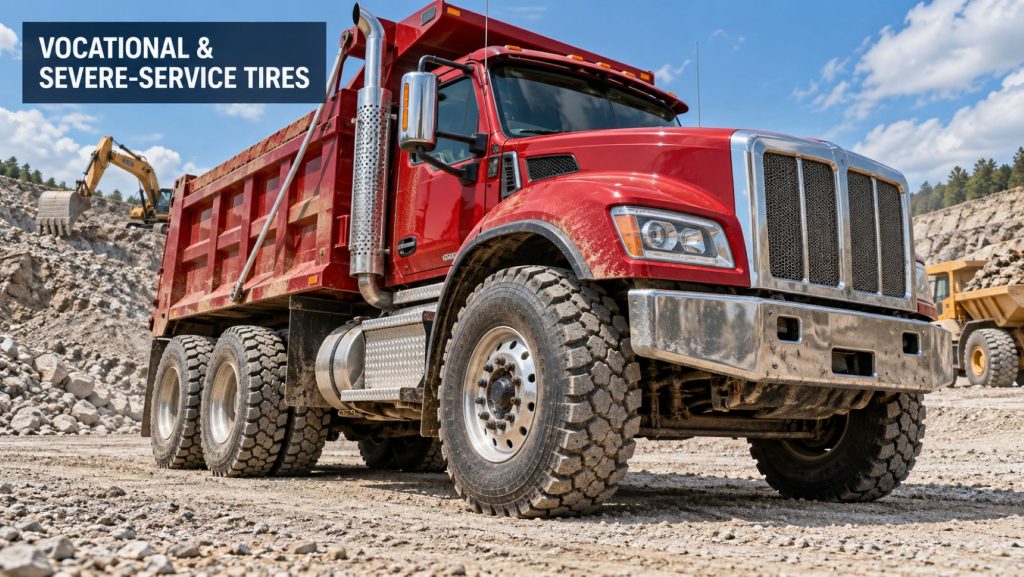
Vocational and severe-service tires are designed for commercial vehicles that operate on construction sites, gravel roads, logging routes, quarries, landfills, agricultural properties, oilfields, and other demanding surfaces. These tires must withstand heavy loads, abrasive materials, repeated impacts, tight turns, and frequent transitions between paved roads and off-road terrain.
This Truck Equipment Atlas sub-hub covers commercial tires engineered for construction, mixed-service, on-road and off-road, refuse, logging, mining, utility, agricultural, and other demanding vocational applications.
Vocational and Severe-Service Tire Products on Truck Equipment Atlas
Explore individual vocational and severe-service tire profiles covering tread design, axle position, traction, casing protection, cut resistance, operating applications, maintenance requirements, and replacement considerations.
Michelin
Bridgestone
Goodyear
Continental
What Are Vocational and Severe-Service Tires?
Vocational tires are commercial tires developed for trucks and trailers that perform specialized work. Unlike tires intended primarily for predictable highway service, vocational tires may encounter loose material, broken pavement, sharp debris, deep mud, gravel, curbs, rocks, construction waste, and severe turning forces.
Severe-service tires use application-specific tread patterns, compounds, belt packages, sidewall protection, and casing construction. Their primary purpose is to provide dependable performance and resist damage in conditions that can quickly destroy a conventional highway tire.
The proper tire depends on the vehicle, axle position, surface conditions, load, speed, annual mileage, percentage of off-road use, and type of vocational work.
How Severe-Service Tires Work
Severe-service tires support heavy vehicle loads while maintaining traction and resisting cuts, chips, punctures, impacts, and casing damage. They may be used in steer, all-position, drive, or trailer applications when approved by the tire manufacturer.
Their construction must balance several operating requirements:
- On-road stability
- Off-road traction
- Cut and chip resistance
- Stone rejection
- Impact resistance
- Sidewall protection
- Heat management
- Even tread wear
- Casing durability
- Retreadability
An aggressive tread can improve traction on loose surfaces, but it may produce more noise, heat, tread movement, and rolling resistance during highway operation. Application matching is therefore essential.
Severe-Service Tire Construction
Vocational tires may use reinforced materials and construction features to withstand repeated exposure to harsh operating conditions.
Major components and features may include:
- Cut- and chip-resistant tread compounds
- Deep tread blocks or ribs
- Open shoulder designs
- Wide circumferential and lateral grooves
- Stone ejectors or groove-bottom protectors
- Heavy-duty steel belt packages
- Reinforced casing construction
- Protective sidewall ribs
- Thick undertread
- Durable bead assemblies
- Retreadable casings
The precise construction varies by axle position, tire size, intended service, and manufacturer.
On-Road and Off-Road Service
Many vocational trucks spend part of the workday on public roads and part on unpaved jobsites. Tires developed for this mixed service must provide stable road manners while resisting damage from loose rock, gravel, mud, debris, and uneven terrain.
Common mixed-service conditions include:
- Highway travel between jobsites
- Gravel access roads
- Construction entrances
- Quarry and mine roads
- Landfill surfaces
- Logging roads
- Agricultural fields and farm roads
- Oilfield and utility access roads
The expected percentage of paved and unpaved operation should be considered before selecting a tire. A tire optimized for limited off-road exposure may not be suitable for continuous severe off-road use.
Vocational Steer and All-Position Tires
Steer and all-position vocational tires must provide predictable steering response while resisting impacts, cuts, curb damage, and irregular wear. They often use rib-type tread patterns with stronger shoulders and more protective construction than conventional highway steer tires.
All-position designs may be approved for steer, drive, trailer, or auxiliary axle positions depending on the model and application. Tire manufacturers’ position and service recommendations should always be followed.
Important vocational steer-tire characteristics include:
- Directional stability
- Wet and loose-surface traction
- Wide tread footprint
- Cut- and chip-resistant compounds
- Protected groove bottoms
- Reinforced sidewalls
- Stone-ejection features
- Durable casing construction
Vocational Drive Tires
Vocational drive tires transfer engine torque to surfaces that may include pavement, gravel, mud, loose dirt, rock, or construction debris. They commonly use deep block or lug tread patterns with multiple biting edges.
Important vocational drive-tire characteristics include:
- Forward traction
- Self-cleaning tread design
- Open shoulders
- Deep tread blocks
- Resistance to chunking and tearing
- Stone rejection
- Stable tread blocks
- Durable casing construction
Extremely aggressive tread designs may provide better loose-surface traction but can create additional tread movement, noise, heat, and rolling resistance on paved roads.
Vocational Trailer Tires
Vocational trailer tires support heavy loads while resisting scrub, cuts, impacts, punctures, and casing damage. Specialized trailers may operate through tight jobsites, across uneven ground, and around sharp debris.
Trailer-tire selection depends on axle configuration, load, road surface, turning frequency, suspension type, and the amount of highway operation. Spread-axle and multi-axle trailers can create especially high lateral scrub during tight turns.
Some all-position severe-service tires may be approved for trailer use, but the selected model must meet the required position, load, speed, and application ratings.
Cut, Chip, and Puncture Resistance
Sharp rock, broken concrete, scrap metal, construction waste, and other debris can cut the tread or sidewall. Smaller pieces of material may also chip portions of the tread from the tire during repeated operation.
Severe-service tires may use specialized compounds and protective construction intended to resist:
- Tread cuts
- Tread chipping
- Chunking
- Stone drilling
- Sidewall abrasion
- Penetration damage
- Impact breaks
- Bead-area damage
No tire is immune to jobsite damage. Drivers must avoid hazards when possible and report impacts, cuts, pressure loss, or visible damage promptly.
Stone Ejection and Casing Protection
Stones can become trapped in deep tread grooves. Repeated pressure may drive them farther into the tread and potentially damage the belt package or casing.
Vocational tires may use stone ejectors, groove-bottom platforms, angled groove walls, or self-cleaning patterns to reduce stone retention. These features help protect the casing and preserve its potential for retreading.
Embedded stones and debris should be removed during inspections when this can be done safely and without damaging the tire.
Traction and Self-Cleaning Tread Design
Loose mud, dirt, gravel, and other materials can fill tread grooves and reduce the tire’s ability to grip the surface. Self-cleaning tread patterns are designed to release material as the tire rotates.
Traction may be supported by:
- Open shoulders
- Deep lateral grooves
- Widely spaced tread blocks
- Multiple biting edges
- Sipes
- Directional tread designs
- Specialized rubber compounds
Tire traction must be supported by correct loading, inflation pressure, differential operation, driver technique, and vehicle speed.
Tire Sizes and Ratings
Vocational tires are available in several commercial sizes, load ranges, tread depths, speed ratings, and wheel configurations. Common sizes may include 11R22.5, 11R24.5, 12R22.5, 315/80R22.5, 385/65R22.5, 425/65R22.5, and wide-base severe-service sizes.
Before selecting a tire, confirm:
- Tire size
- Load range and load index
- Speed rating
- Maximum load and inflation pressure
- Approved wheel and rim width
- Overall diameter and width
- Minimum dual spacing
- Revolutions per mile
- Axle-position approval
- On-road and off-road service limitations
The tire must also fit within the available suspension, brake, fender, body, and steering clearances throughout the complete range of vehicle movement.
Inflation Pressure and Heavy Loads
Correct inflation is essential to traction, casing durability, heat control, impact resistance, fuel economy, and tread wear. The required cold pressure should be based on the actual load and the tire manufacturer’s current load-and-inflation tables.
Underinflation can cause excessive flexing, heat buildup, sidewall damage, irregular wear, reduced fuel efficiency, and casing failure. Overinflation may reduce the contact area, increase impact sensitivity, decrease traction, and contribute to center wear.
Vocational vehicles should be weighed in their normal loaded configuration. Equipment, fluids, body installations, auxiliary axles, and uneven cargo distribution can create tire loads that are not obvious from the vehicle’s overall weight.
Speed, Heat, and Operating Conditions
Some severe-service tires have operating limits that differ from tires intended for sustained highway use. Deep tread, heavy loads, low inflation, high ambient temperatures, and extended road speeds can increase heat generation.
Operators should confirm the tire’s speed rating and any application-specific restrictions. A tire suitable for low-speed jobsite service may not be appropriate for long-distance highway operation at sustained speeds.
Heat-related risks increase when the tire is overloaded, underinflated, damaged, mismatched with its dual partner, or exposed to dragging brakes and wheel-end problems.
Common Severe-Service Tire Wear and Damage
Vocational tire wear can reveal inflation, alignment, suspension, loading, wheel-end, or application problems.
- Cutting and chipping: Portions of the tread are damaged by sharp or abrasive surfaces.
- Chunking: Larger sections of tread rubber separate during severe operation.
- Stone drilling: Trapped stones work into the groove bottom and threaten the casing.
- Shoulder wear: One or both shoulders wear faster than the center.
- Center wear: The center of the tread wears faster than the shoulders.
- Heel-and-toe wear: Tread blocks wear unevenly from their leading edge to their trailing edge.
- Cupping: Repeated high and low areas develop around the tread.
- Sidewall abrasion: The sidewall is damaged by curbs, rocks, debris, or equipment contact.
- Impact damage: Internal or external damage occurs after striking a severe obstacle.
- Irregular dual wear: Paired tires wear differently because of mismatched size, pressure, load, or condition.
The cause should be identified and corrected before replacement tires are placed into the same service.
Inspection and Maintenance
Vocational and severe-service tires should be inspected frequently because their operating environments expose them to damage that may develop rapidly.
Inspections should include:
- Cold inflation pressure
- Tread depth across the full tread width
- Cuts, punctures, cracks, bulges, and exposed cords
- Tread chipping or chunking
- Embedded stones and debris
- Sidewall abrasion and impact marks
- Irregular or rapid wear
- Objects trapped between dual tires
- Valve stems, caps, and extensions
- Wheel and rim condition
- Wheel fasteners
- Oil or grease contamination
- Signs of brake or wheel-end overheating
- Suspension and steering clearance
Tires should be inspected after severe impacts, operation through hazardous debris, significant pressure loss, overloading, or other unusual events.
Retreading Severe-Service Tires
Some vocational tire casings can be professionally retreaded when they remain structurally sound. Casing protection is especially important because cuts, impacts, underinflation, and stone penetration may eliminate the casing’s retread value.
A casing must be inspected and approved by a qualified retreader. Suitability depends on its age, previous service, repairs, damage, maintenance history, operating environment, and construction.
Proper casing management can reduce total tire cost, but tires should be removed before damage or excessive wear makes the casing unusable.
Common Applications
- Dump trucks
- Concrete mixers
- Refuse trucks
- Logging trucks
- Construction vehicles
- Crane trucks
- Utility trucks
- Oilfield vehicles
- Mining and quarry trucks
- Agricultural trucks
- Heavy-haul tractors
- Roll-off trucks
- Specialized vocational trailers
- Emergency and municipal vehicles
Choosing the Right Vocational Tire
The correct vocational tire must match the vehicle’s actual operating environment. Buyers and fleet managers should consider:
- Steer, all-position, drive, trailer, or auxiliary axle use
- Vehicle type and vocational body
- Expected axle loading
- Percentage of on-road and off-road operation
- Road and jobsite surfaces
- Required traction
- Cut, chip, and puncture exposure
- Typical operating speed
- Annual mileage
- Single, dual, or wide-base configuration
- Expected tread life
- Casing value and retread strategy
- Local dealer and roadside-service availability
- Total cost per operating hour or mile
A highway tire should not be substituted simply because it has the same size and load rating. The tread compound, casing, belt package, sidewall protection, speed capability, and intended service must also match the application.
Related Tire and Wheel Categories
- Tires & Wheels
- Steer & All-Position Truck Tires
- Drive Tires
- Trailer Tires
- Commercial Truck Wheels
- Tire Pressure Monitoring & Inflation Systems
Related Tire and Wheel Guides
- Tire & Wheel Guides
- Commercial Truck Tire Types Explained
- Steer vs Drive vs Trailer Tires
- How to Read Commercial Truck Tire Sizes and Ratings
- How to Inspect and Maintain Commercial Truck Tires
- Aluminum vs Steel Commercial Truck Wheels
Related Vehicle and Equipment Resources
- Commercial Trucks
- Commercial Trailers
- Axles & Differentials
- Suspension Systems
- Auxiliary & Lift Axle Suspensions
- Brake Systems
- Equipment Systems
Expanding the Vocational Tire Library
Truck Equipment Atlas will continue expanding this section with additional construction, refuse, logging, mining, agricultural, mixed-service, on-road and off-road, and extreme-service commercial tires.
Future additions will provide more comparisons covering tread design, traction, cut resistance, casing protection, axle position, maintenance, retreadability, and application-specific tire selection.
Explore the Complete Truck Equipment Atlas Library
Truck Equipment Atlas provides educational resources covering commercial trucks, trailers, engines, transmissions, axles, suspension systems, brake systems, fifth wheels, tires, wheels, and other equipment used throughout the trucking industry.
Visit the Equipment Systems section to explore how major commercial vehicle components work together.
Follow the Growth of Truck Equipment Atlas
Truck Equipment Atlas continues to expand with new truck profiles, trailer coverage, diesel engine pages, equipment-system resources, manufacturer information, and educational guides.
Visit our Site Updates page to explore recent additions, project milestones, and upcoming resources as we continue building one of the industry’s growing commercial trucking equipment reference libraries.
View the Latest Site Updates: Truck Equipment Atlas Site Updates