
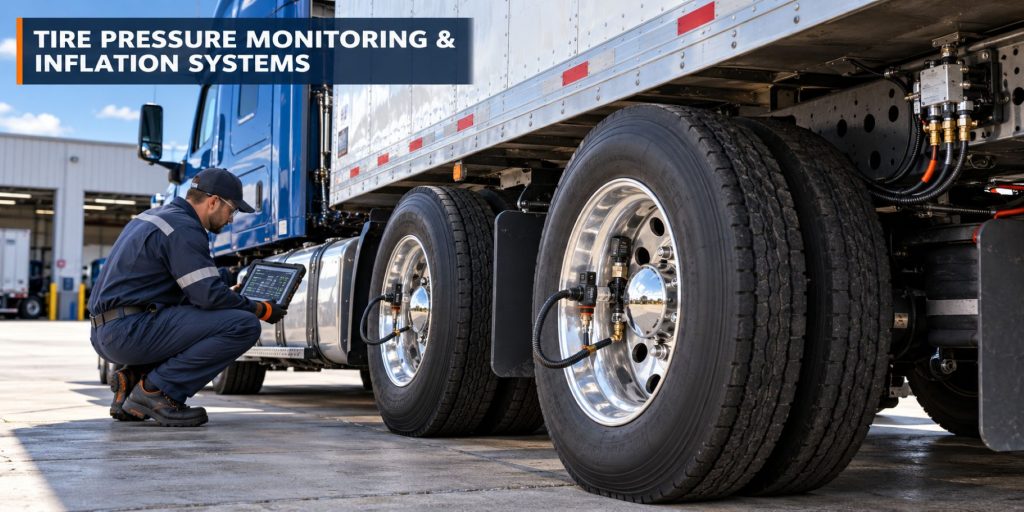
Tire pressure monitoring and inflation systems help commercial fleets detect pressure problems, maintain selected inflation pressures, reduce tire-related downtime, and improve visibility into tire and wheel-end conditions. Systems range from pressure-monitoring sensors that alert drivers and fleet managers to automatic inflation systems that add air while the vehicle is operating.
This section of Truck Equipment Atlas covers tire pressure monitoring systems, automatic tire inflation systems, load-based inflation systems, wheel-end inflators, connected tire-management platforms, and related controls used on commercial trucks, tractors, buses, and trailers.
Tire Pressure Monitoring and Inflation Products on Truck Equipment Atlas
Truck Equipment Atlas is building a growing library of tire-monitoring and inflation products from manufacturers serving the commercial truck, tractor, trailer, bus, and vocational-vehicle industries.
Hendrickson
P.S.I. and Meritor
Bendix
Continental
Aperia Technologies
Additional tire pressure monitoring systems, automatic tire inflation systems, wheel-end inflators, trailer inflation products, sensors, controllers, and connected tire-management platforms will be added as the Truck Equipment Atlas Tires and Wheels Library expands.
What Are Tire Pressure Monitoring and Inflation Systems?
Tire pressure monitoring and inflation systems are designed to help drivers and fleets identify or correct tire-pressure conditions before they result in excessive tire wear, poor fuel economy, roadside downtime, or tire failure.
A tire pressure monitoring system measures tire conditions and reports that information through a display, warning indicator, mobile application, web portal, or fleet-management platform. Depending on the system, it may monitor tire pressure, temperature, leakage rates, mileage, location, and other tire or wheel-end information.
An automatic tire inflation system maintains a selected pressure by supplying air when tire pressure falls below the system’s target. Some systems use the vehicle or trailer air supply, while wheel-end systems may generate inflation pressure through wheel rotation.
Monitoring and inflation functions may be offered separately or combined in one connected tire-management platform.
Tire Pressure Monitoring Systems
A tire pressure monitoring system, commonly called TPMS, uses sensors to measure tire pressure and communicate warnings or operating data. Commercial systems may provide information directly to the driver or transmit it to maintenance personnel and fleet managers.
Depending on the product and installation, TPMS information may be displayed through:
- In-cab warning lights
- Digital driver displays
- Trailer-mounted warning lamps
- Mobile applications
- Fleet web portals
- Maintenance dashboards
- Telematics and fleet-management systems
A monitoring system alerts the operator to a potential problem, but a conventional TPMS does not automatically add air to the tire. The driver or maintenance department must inspect the tire and take the appropriate action.
Automatic Tire Inflation Systems
An automatic tire inflation system, commonly called ATIS, supplies air when tire pressure falls below a selected level. On many trailer systems, compressed air passes from the trailer air supply through a controller, axle passages, rotary unions, wheel-end components, and hoses before reaching the tires.
Wheel-end inflation systems may operate differently. A self-contained inflator can use wheel rotation to generate pumping action without routing air through the axle or relying on the vehicle’s compressed-air system.
Inflation capability varies by product. Some systems only add air, while more advanced systems may also equalize pressure, relieve excessive pressure under controlled conditions, adjust target pressure according to axle load, or report tire information through a connected platform.
TPMS Compared With Automatic Tire Inflation
TPMS and automatic inflation systems address different parts of tire management. A monitoring system identifies changing tire conditions and alerts the operator. An automatic inflation system supplies air to maintain its selected pressure setting.
A connected system may combine both functions by maintaining pressure while also reporting tire condition, inflation activity, leakage trends, temperature, mileage, and maintenance alerts.
Neither system eliminates the need for tire inspection. A tire can still have tread damage, sidewall damage, embedded objects, irregular wear, loose wheel hardware, valve problems, or structural defects that pressure information alone cannot identify.
How Tire Pressure Monitoring Systems Work
Direct commercial TPMS installations use sensors associated with individual tires or wheel positions. These sensors measure pressure and may also record temperature or other operating information.
Sensor information is transmitted to a receiver, electronic control unit, gateway, or connected telematics device. The system compares the measurements with programmed warning thresholds and generates an alert when it detects a condition requiring attention.
More advanced systems can send information beyond the vehicle. Fleet personnel may receive tire alerts through a web portal, mobile application, email, text notification, or integration with another fleet-management system.
How Trailer Tire Inflation Systems Work
Many trailer inflation systems use the trailer’s compressed-air supply. A pressure-protection device helps preserve air for the braking system before air is supplied to the inflation equipment.
Air entering the inflation system is regulated to the selected tire pressure. It then travels through the trailer axles or dedicated air passages to rotary unions at the wheel ends. Flexible hoses connect the wheel-end hardware to the tire valves.
When tire pressure falls below the selected setting, the system supplies air. A warning lamp or connected monitoring platform may alert the operator when the system is actively supplying air or detects a possible leak.
Major System Components
Components vary according to whether the system monitors pressure, inflates tires, or combines both functions. Commercial systems may include:
- Tire-pressure sensors
- Tire-temperature sensors
- Valve-stem sensors
- Internal tire sensors
- Wheel-end inflators
- Pressure regulator or control box
- Pressure-protection valve
- Axle air passages
- Rotary unions and stators
- Spindle plugs
- Hubcaps and wheel-end fittings
- Tire hoses and valve connections
- Electronic control unit
- Wireless receiver or gateway
- Driver display or warning lamp
- Telematics communication unit
- Antennas, wiring, and connectors
- Mobile applications and fleet software
Truck and Tractor Systems
Truck and tractor tire-management systems may monitor or inflate steer, drive, tag, pusher, and other axle positions. The correct equipment depends on the axle, wheel, tire, hub, operating pressure, and available mounting space.
Tractor installations can present different challenges from trailer systems because driven and steerable wheel ends cannot always use the same axle-routed air design. Wheel-mounted inflation systems and wireless sensors can provide alternatives for these positions.
Applications may range from highway tractors to refuse trucks, buses, delivery vehicles, vocational trucks, and mixed truck-and-trailer fleets.
Trailer Tire Systems
Trailer tire inflation is one of the most established commercial applications for automatic pressure maintenance. Trailer systems can use the existing air supply and axle structure to distribute regulated air to multiple wheel positions.
These systems may be installed on dry vans, refrigerated trailers, flatbeds, tank trailers, dump trailers, container chassis, vocational trailers, and other compatible equipment.
Compatibility must be confirmed for the trailer axle, spindle, wheel end, hubcap, tire configuration, brake equipment, suspension, and air-system layout.
Load-Based Tire Pressure Control
Some advanced trailer systems can modify tire pressure according to axle load. This allows the system to use a lower target pressure when the trailer is lightly loaded and a higher target when axle loading increases.
Load-based pressure control is intended to better match tire inflation with operating conditions. The complete system must be properly configured for the trailer, axle load, tire capacity, and manufacturer-approved pressure range.
Not every automatic inflation system provides load-based control. Conventional systems generally maintain one preset pressure unless the controller is manually adjusted or replaced.
Telematics and Fleet Integration
Connected tire-management systems can transmit information from the vehicle to fleet personnel. This allows maintenance teams to identify pressure loss, recurring inflation events, temperature warnings, and other tire conditions without waiting for the vehicle to return to a maintenance facility.
Depending on the platform, connected information may include:
- Individual tire pressure
- Tire temperature
- Low-pressure warnings
- High-temperature warnings
- Leak-rate information
- Inflation-system activity
- Vehicle or trailer location
- Mileage and operating history
- Maintenance recommendations
- Fleet-wide tire-performance reports
Available data, communication methods, subscription requirements, and third-party integrations vary by manufacturer and product.
Pressure, Temperature, and Leakage Information
Pressure is the primary measurement used by most tire-monitoring systems, but it does not tell the entire story. Tire pressure naturally changes with temperature, vehicle loading, road speed, operating time, and environmental conditions.
Systems that monitor temperature can provide additional warning of abnormal heat. Excessive heat may be related to underinflation, overloading, brake drag, bearing problems, tire damage, or another wheel-end condition.
Leak-rate monitoring can help distinguish a gradual pressure change from a more urgent air loss. Connected analytics may also identify recurring inflation activity that indicates a tire, valve, hose, fitting, or wheel-end leak.
Driver Alerts and Operator Response
Drivers should understand the meaning of every tire-system indicator used on their equipment. A warning may identify low pressure, excessive temperature, rapid pressure loss, active inflation, communication failure, sensor malfunction, or another system condition.
An automatic inflation system warning should not be ignored because the system is adding air. Repeated or continuous inflation can indicate a puncture, damaged hose, leaking fitting, faulty valve, wheel-end leak, or other condition requiring inspection.
Drivers should follow the vehicle, tire, and system manufacturers’ procedures when responding to an alert. A tire showing rapid pressure loss, visible damage, unusual heat, smoke, vibration, or instability should be treated as a potential safety problem.
Installation and Vehicle Compatibility
Tire pressure monitoring and inflation equipment must be matched to the vehicle, axle, wheel end, tire, and intended operating environment. A system designed for a trailer axle may not be suitable for a tractor drive axle or steer axle.
Compatibility can depend on:
- Vehicle or trailer manufacturer
- Axle manufacturer and model
- Spindle design
- Driven, steerable, or non-driven axle position
- Single- or dual-tire configuration
- Steel or aluminum wheels
- Wheel and tire size
- Hubcap and wheel-end design
- Disc- or drum-brake clearance
- Required cold inflation pressure
- Available compressed-air supply
- Electrical and communication architecture
- Trailer or tractor telematics equipment
Installation should follow the instructions for the exact system, axle, hub, wheel, and tire configuration.
Axle, Spindle, Hubcap, and Wheel Compatibility
Axle-routed trailer inflation systems require compatible axle and spindle components. Air passages must remain sealed while rotary unions allow the wheel to turn. Hubcaps, spindle plugs, stators, hoses, and fittings must match the selected wheel-end configuration.
Wheel-mounted inflators must fit the wheel end without interfering with lug nuts, hubcaps, valve stems, wheel covers, body components, or adjacent tires. The mounting hardware must be appropriate for the wheel and vehicle application.
Sensor fitment can also vary. Valve-mounted and internal sensors must be matched to the valve stem, rim, tire, pressure range, temperature range, and required communication system.
Air Supply, Electrical Power, and Communication
Trailer inflation systems commonly use compressed air supplied through the tractor-trailer air system. A pressure-protection valve or similar device helps prevent the tire system from reducing air pressure required for brake operation.
Electronic monitoring systems may use replaceable batteries, long-life sealed sensor batteries, vehicle electrical power, or self-powered wheel-end technology. Gateways and telematics equipment may require dedicated power, antennas, wiring, data subscriptions, or integration with an existing fleet platform.
The system’s power and communication requirements should be reviewed before installation, especially when equipment from several manufacturers must operate together.
Inspection and Maintenance
Tire-monitoring and inflation systems require routine inspection. Maintenance should be performed with the vehicle secured and according to the system, axle, wheel-end, and tire manufacturers’ procedures.
Common inspection points include:
- Tire pressure verified with an accurate gauge
- Sensor condition and mounting
- Sensor battery status
- Valve stems and valve cores
- Inflation hoses and tire connections
- Air lines, fittings, and seals
- Controller and pressure setting
- Pressure-protection valve
- Rotary unions and wheel-end components
- Hubcaps and spindle seals
- Warning lamps and driver displays
- Wiring, antennas, and connectors
- Gateway and telematics communication
- Software configuration and tire-position assignments
The tires still require normal tread, sidewall, casing, valve, wheel, and wheel-end inspection.
Common System Problems
Repeated low-pressure warning: A puncture, leaking valve, damaged tire, loose hose, temperature change, incorrect threshold, or faulty sensor may be responsible.
Continuous inflation activity: A significant tire leak, damaged hose, loose fitting, leaking rotary union, or wheel-end sealing problem may cause the system to supply air continuously.
No inflation at the tire: A closed valve, restricted line, damaged controller, insufficient supply pressure, blocked axle passage, failed rotary union, or disconnected hose may prevent airflow.
Incorrect pressure: The controller may be improperly adjusted, the system may have been specified for a different pressure, or a regulator, sensor, valve, or gauge may be inaccurate.
Missing sensor signal: A depleted battery, damaged sensor, incorrect tire-position assignment, receiver problem, antenna issue, electrical fault, or communication interference may interrupt reporting.
False or inconsistent alerts: Incorrect programming, temperature effects, sensor damage, poor communication, or a mismatched pressure threshold may cause inconsistent warnings.
Air-system pressure loss: Damaged air lines, fittings, seals, controllers, or wheel-end components can create an air leak affecting system operation.
Data not reaching the fleet portal: Gateway power loss, antenna damage, subscription problems, cellular coverage, software configuration, or integration faults may interrupt connected reporting.
Benefits
- Earlier identification of tire-pressure problems
- Automatic correction of underinflation on compatible systems
- More consistent tire pressure
- Reduced tire-related roadside downtime
- Improved tire-life management
- Reduced rolling resistance associated with underinflation
- Better visibility into tire and wheel-end conditions
- Remote fleet alerts and maintenance planning
- Reduced need to depend solely on manual pressure checks
- Improved identification of recurring leaks
- Support for preventive tire maintenance
Limitations and Considerations
- Systems do not replace complete tire and wheel inspections.
- A conventional TPMS warns about a problem but does not add air.
- An inflation system can temporarily mask a continuing leak.
- Not every inflation system can relieve excessive pressure.
- Pressure targets must match the tire, axle load, and application.
- Sensor batteries and electronic components have finite service lives.
- Air hoses, rotary unions, seals, and fittings require maintenance.
- Telematics services may require subscriptions.
- Equipment compatibility varies by axle and wheel-end configuration.
- Improper installation can create leaks, component damage, or inaccurate reporting.
Common Applications
- Long-haul highway tractors
- Regional and local-delivery trucks
- Dry-van trailers
- Refrigerated trailers
- Flatbed trailers
- Tank trailers
- Container chassis
- Dump and bulk trailers
- Vocational trucks
- Refuse vehicles
- Transit, school, and motorcoach buses
- Mixed tractor-and-trailer fleets
Choosing the Right System
The correct system depends on whether the fleet needs monitoring, automatic inflation, connected reporting, or a combination of these functions.
Before selecting equipment, buyers should consider:
- Truck, tractor, trailer, or bus application
- Axle and wheel positions to be covered
- Required tire pressure
- Single- or dual-tire arrangement
- Axle, spindle, hub, and wheel compatibility
- Monitoring-only or automatic inflation requirements
- Need for pressure relief or load-based adjustment
- Driver-display requirements
- Fleet telematics integration
- Cellular service and subscription costs
- Replacement-sensor and service-part availability
- Installation and maintenance support
- Expected equipment service life
Related Tire and Wheel Categories
- Tires & Wheels
- Steer & All-Position Truck Tires
- Drive Tires
- Trailer Tires
- Vocational & Severe-Service Tires
- Commercial Truck Wheels
Related Tire and Wheel Guides
- Tire & Wheel Guides
- Commercial Truck Tire Types Explained
- Steer vs Drive vs Trailer Tires
- How to Read Commercial Truck Tire Sizes and Ratings
- How to Inspect and Maintain Commercial Truck Tires
- Aluminum vs Steel Commercial Truck Wheels
Related Equipment Systems
- Equipment Systems
- Axles & Differentials
- Suspension Systems
- Brake Systems
- Electrical Systems
- Telematics & ELD Systems
- Safety Systems
Expanding the Tire Pressure Management Library
Truck Equipment Atlas will continue expanding this section with additional tire pressure monitoring systems, automatic tire inflation systems, wheel-end inflators, connected tire-management platforms, sensors, controllers, replacement components, and maintenance resources.
Future coverage will include systems for highway tractors, trailers, buses, vocational trucks, severe-service equipment, and specialized commercial vehicles.
Explore the Complete Tires and Wheels Library
Visit the Tires & Wheels hub to explore commercial truck tires, trailer tires, vocational tires, severe-service tires, wheels, tire pressure monitoring systems, automatic inflation systems, product profiles, and educational guides.
Follow the Growth of Truck Equipment Atlas
Truck Equipment Atlas continues to expand with new truck profiles, trailer coverage, diesel engine pages, equipment-system resources, manufacturer information, product profiles, and educational guides.
Visit our Site Updates page to explore recent additions, project milestones, and upcoming resources as we continue building one of the industry’s growing commercial trucking equipment reference libraries.
View the Latest Site Updates: Truck Equipment Atlas Site Updates