
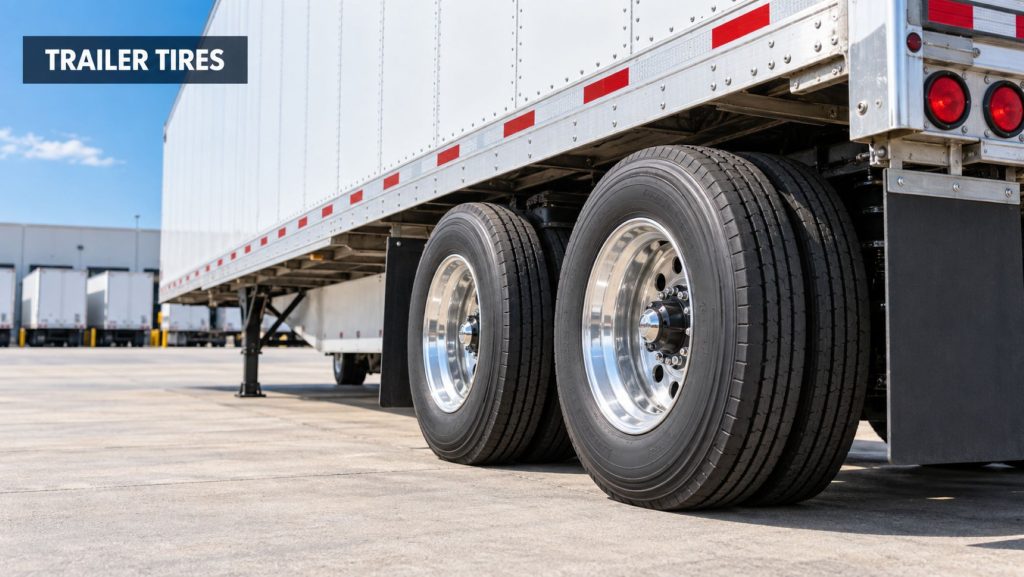
Commercial trailer tires support freight and equipment while managing sustained highway speeds, changing axle loads, lateral forces, braking forces, tight turns, and repeated loading cycles. Unlike steer and drive tires, trailer tires are not responsible for steering the tractor or transferring engine torque to the road.
This Truck Equipment Atlas sub-hub covers trailer-position tires used on dry vans, refrigerated trailers, flatbeds, tank trailers, dump trailers, specialized heavy-haul equipment, and other commercial trailers.
Trailer Tire Products on Truck Equipment Atlas
Explore individual commercial trailer-tire profiles covering tread design, fuel efficiency, casing construction, axle compatibility, operating applications, maintenance requirements, and replacement considerations.
Michelin
Bridgestone
Goodyear
Continental
What Are Commercial Trailer Tires?
Trailer tires are designed for installation on the non-driven axles of commercial trailers. Their primary responsibilities are supporting the trailer and cargo, maintaining stability, resisting lateral scrub, transferring braking force, and operating efficiently over long distances.
Trailer-position tires commonly use ribbed tread patterns with continuous shoulders. This design can help reduce rolling resistance, control irregular wear, maintain directional stability, and resist the lateral forces produced when a trailer turns.
The proper tire depends on the trailer type, axle configuration, load, route, annual mileage, turning frequency, road surface, weather exposure, wheel size, and fleet-maintenance program.
How Trailer Tires Work
Trailer tires carry vertical load while rolling freely behind the towing vehicle. They do not transmit engine torque, but they must absorb braking forces when the trailer brakes are applied.
During a turn, the trailer axles follow a tighter path than the tractor. Because most trailer axles do not steer, the tires may slide slightly across the pavement. This lateral movement is known as scrub and becomes more severe during tight turns, docking maneuvers, and operation with spread-axle or multi-axle trailers.
A commercial trailer tire must balance:
- Load-carrying capacity
- Low rolling resistance
- Resistance to lateral scrub
- Stable braking performance
- Even tread wear
- Heat management
- Casing durability
- Retreadability
Trailer Tire Construction
Commercial radial trailer tires use several structural and tread components to support heavy loads while controlling heat, wear, and rolling resistance.
Major components include:
- Trailer-position tread pattern
- Continuous shoulder ribs
- Circumferential grooves
- Tread compound
- Steel belt package
- Radial body plies
- Inner liner
- Sidewalls
- Bead assemblies
- Retreadable casing
Exact tread compounds, belt arrangements, casing technologies, tread depths, and operating limits vary by manufacturer, tire size, and product model.
Trailer Tire Tread Designs
Many highway trailer tires use shallow rib-type tread patterns with continuous shoulders. The reduced tread movement can help control heat, rolling resistance, and irregular wear.
Common trailer-tire tread features include:
- Continuous shoulder ribs
- Multiple circumferential grooves
- Low-void tread patterns
- Stone-ejector features
- Decoupling grooves
- Scrub-resistant shoulder compounds
- Fuel-efficient tread compounds
- Reinforced casing construction
Regional, spread-axle, and multi-axle trailers may need more scrub-resistant tread designs than trailers operating primarily in straight-line highway service.
Long-Haul Trailer Tires
Long-haul trailer tires are designed for extended operation at sustained highway speeds. Their engineering frequently emphasizes low rolling resistance, consistent wear, heat control, casing durability, and long removal mileage.
Common long-haul priorities include:
- Fuel efficiency
- Stable highway tracking
- Even rib wear
- Resistance to shoulder wear
- Low heat generation
- Durable casing construction
- Retread potential
Fleet operators should compare fuel efficiency with expected removal mileage, casing value, maintenance demands, and total cost per mile.
Regional and High-Scrub Trailer Tires
Regional trailers may experience frequent turns, backing maneuvers, loading-dock approaches, stop-and-go operation, and contact with curbs. These conditions can increase shoulder wear and lateral scrub.
High-scrub trailer tires may use reinforced shoulders, specialized compounds, winged tread designs, or other features intended to control rapid wear.
Applications that may require increased scrub resistance include:
- Spread-axle flatbeds
- Multi-axle trailers
- Regional dry vans
- Pickup-and-delivery trailers
- Beverage trailers
- Urban delivery equipment
- Trailers frequently entering tight loading areas
Standard Dual and Wide-Base Trailer Tires
Standard Dual Trailer Tires
A conventional trailer axle commonly uses a dual-tire assembly on each end of the axle. Dual tires must be closely matched for size, overall diameter, inflation pressure, tread depth, and load capacity.
Incorrectly matched dual tires can cause uneven load sharing, excess heat, rapid wear, casing damage, and contact between the two sidewalls.
Wide-Base Trailer Tires
Wide-base trailer tires replace a conventional dual pair with one larger tire and wheel assembly when the trailer, axle, wheel, and operating requirements permit it.
Potential benefits may include reduced assembly weight, fewer tires and wheels, lower rolling resistance, and increased usable payload. Considerations include wheel offset, axle loading, suspension clearance, roadside replacement availability, and the operational effect of losing one tire.
Trailer Tire Sizes and Ratings
Trailer tires are available in several commercial sizes, load ranges, speed ratings, tread depths, and wheel configurations. Common sizes may include 11R22.5, 295/75R22.5, 11R24.5, 285/75R24.5, 445/50R22.5, and several 17.5-inch low-profile sizes.
The correct tire must match the trailer manufacturer’s requirements and the approved wheel dimensions. Buyers and service technicians should confirm:
- Tire size
- Load range
- Load index
- Speed rating
- Maximum load and inflation pressure
- Approved rim width
- Overall diameter and width
- Minimum dual spacing
- Revolutions per mile
- Single- or dual-tire rating
- Recommended axle position and service application
Load capacity depends on the tire size and inflation pressure. The tire manufacturer’s current load-and-inflation tables should be used when establishing operating pressure.
Inflation Pressure and Load Capacity
Correct inflation is essential to trailer-tire safety, fuel efficiency, casing life, heat control, and tread-wear performance. Trailer tires often operate without the driver directly above them, making pressure-monitoring practices especially important.
Underinflation can cause excessive flexing, heat buildup, shoulder wear, increased rolling resistance, casing damage, and tire failure. Overinflation may contribute to center wear, reduced impact absorption, smaller contact patches, and increased sensitivity to road hazards.
Inflation pressure should be checked when tires are cold with a calibrated gauge. Pressure should be based on the actual load carried and should never exceed the limitations of the tire, wheel, valve, or axle system.
Trailer Tire Inflation and Monitoring Systems
Automatic tire-inflation systems can help maintain a selected trailer-tire pressure by supplying air from the trailer’s compressed-air system. Tire-pressure monitoring systems measure pressure and may also monitor temperature or provide alerts.
These systems support tire maintenance, but they do not replace physical inspections. A tire can remain near its target pressure while still having tread damage, sidewall damage, irregular wear, a failed wheel component, or another unsafe condition.
Explore related equipment in Tire Pressure Monitoring & Inflation Systems.
Fuel Efficiency and Rolling Resistance
A standard tandem-axle semitrailer commonly uses eight tires, so trailer-tire rolling resistance can significantly affect the complete vehicle’s fuel consumption.
Low-rolling-resistance trailer tires use specialized tread patterns, compounds, casing designs, and internal construction to reduce energy loss as the tires flex under load.
Actual fuel performance is also affected by:
- Inflation pressure
- Trailer loading
- Axle alignment
- Wheel-bearing condition
- Brake drag
- Road speed
- Road surface and weather
- Tread depth
- Trailer aerodynamics
- Driver behavior
Trailer Axle Alignment and Tire Wear
Trailer axle alignment affects tracking, rolling resistance, stability, and tire life. A misaligned axle can drag tires sideways as the trailer travels, causing rapid or irregular wear.
Alignment should be checked after:
- Suspension repairs
- Axle replacement
- Collision or curb damage
- Wheel-end repairs
- Changes to suspension ride height
- Appearance of irregular tire wear
- Reports of trailer tracking problems
Alignment should be evaluated together with suspension condition, axle position, ride height, wheel bearings, tire pressure, and loading practices.
Common Trailer Tire Wear Patterns
Trailer-tire wear patterns can reveal inflation, alignment, suspension, wheel-end, brake, or application problems.
- Shoulder wear: One or both shoulders wear faster than the center of the tread.
- Center wear: The center ribs wear faster than the shoulders.
- Diagonal wear: Angled wear patterns form across the tread.
- Feathered wear: Tread ribs develop sharp and rounded edges from lateral movement.
- Cupping or scalloping: Repeated high and low areas appear around the tire.
- Flat spotting: A localized area wears flat after wheel lockup, brake problems, or prolonged parking.
- Rapid scrub wear: Shoulders and tread ribs wear quickly during tight turns or spread-axle operation.
- Irregular dual wear: One tire wears differently because of mismatched diameter, pressure, load, or mechanical condition.
The underlying cause should be corrected before installing replacement tires. Otherwise, the new tires may develop the same wear pattern.
Trailer Tire Inspection and Maintenance
Routine trailer-tire inspections should include:
- Cold inflation pressure
- Tread depth across the full tread width
- Irregular or rapid wear
- Cuts, punctures, cracks, bulges, and exposed cords
- Objects trapped between dual tires
- Sidewall contact between duals
- Valve stems, caps, and extensions
- Wheel and rim condition
- Wheel fasteners
- Oil or grease contamination
- Signs of overheated brakes or wheel bearings
- Automatic inflation-system lines and fittings
- Proper spacing and matching of dual assemblies
A tire with structural damage, severe underinflation, exposed reinforcement, excessive heat, or another unsafe condition should be evaluated by a qualified commercial-tire professional.
Trailer Tire Rotation and Matching
Trailer-tire rotation practices depend on the tread design, axle position, wear pattern, trailer configuration, and manufacturer recommendations.
Dual tires should be closely matched for overall diameter, tread depth, construction, and inflation pressure. A larger tire may carry more than its intended share of the load while the smaller tire drags or scrubs.
Differences between forward and rearward trailer-axle wear may indicate scrub, axle misalignment, suspension movement, brake imbalance, or differences in loading.
Retreading Trailer Tires
Commercial trailer positions are commonly served by professionally retreaded tires. Retreading allows a serviceable casing to receive a replacement tread after the original tread reaches its planned removal point.
Each casing must be inspected before retreading. Its suitability depends on age, previous service, repairs, maintenance history, casing condition, operating environment, and the retreader’s acceptance standards.
Potential benefits include reduced tire cost per mile, longer casing utilization, lower raw-material consumption, and improved fleet tire-program efficiency.
Common Trailer Tire Applications
- Dry van trailers
- Refrigerated trailers
- Flatbed trailers
- Step-deck trailers
- Tank trailers
- Dump trailers
- Lowboy and RGN trailers
- Car-hauler trailers
- Livestock trailers
- Grain and hopper trailers
- Converter dollies
- Heavy-haul and specialized trailers
Choosing the Right Trailer Tire
The best trailer tire is the one matched to the trailer’s actual work. Buyers and fleet managers should consider:
- Long-haul, regional, urban, vocational, or mixed service
- Trailer type and cargo
- Tandem, spread-axle, or multi-axle configuration
- Annual mileage
- Expected axle and tire loading
- Highway and off-road operating percentages
- Frequency of tight turns and docking maneuvers
- Standard dual or wide-base configuration
- Fuel-efficiency goals
- Expected removal mileage
- Casing value and retread strategy
- Local dealer and roadside-service availability
- Total cost per mile
Fleets should compare actual operating results from similar trailers and routes instead of selecting tires only by initial purchase price.
Related Tire and Wheel Categories
- Tires & Wheels
- Steer & All-Position Truck Tires
- Drive Tires
- Vocational & Severe-Service Tires
- Commercial Truck Wheels
- Tire Pressure Monitoring & Inflation Systems
Related Tire and Wheel Guides
- Tire & Wheel Guides
- Commercial Truck Tire Types Explained
- Steer vs Drive vs Trailer Tires
- How to Read Commercial Truck Tire Sizes and Ratings
- How to Inspect and Maintain Commercial Truck Tires
- Aluminum vs Steel Commercial Truck Wheels
Related Trailer and Equipment Resources
- Commercial Trailers
- Trailer Suspension Systems
- Trailer Brake Systems
- Axles & Differentials
- Suspension Systems
- Brake Systems
- Equipment Systems
Expanding the Trailer Tire Library
Truck Equipment Atlas will continue expanding this section with additional long-haul, regional, high-scrub, wide-base, low-profile, vocational, and severe-service trailer tires.
Future additions will provide more comparisons covering tread design, fuel efficiency, scrub resistance, casing construction, retreadability, maintenance, and application-specific tire selection.
Explore the Complete Truck Equipment Atlas Library
Truck Equipment Atlas provides educational resources covering commercial trucks, trailers, engines, transmissions, axles, suspension systems, brake systems, fifth wheels, tires, wheels, and other equipment used throughout the trucking industry.
Visit the Equipment Systems section to explore how major commercial vehicle components work together.
Follow the Growth of Truck Equipment Atlas
Truck Equipment Atlas continues to expand with new truck profiles, trailer coverage, diesel engine pages, equipment-system resources, manufacturer information, and educational guides.
Visit our Site Updates page to explore recent additions, project milestones, and upcoming resources as we continue building one of the industry’s growing commercial trucking equipment reference libraries.
View the Latest Site Updates: Truck Equipment Atlas Site Updates