
Continental ContiConnect Live Tire-Monitoring System
Quick Facts
- Manufacturer: Continental
- Product Name: ContiConnect Live
- Product Type: Connected commercial-vehicle tire-monitoring system
- System Category: Tire pressure monitoring and digital tire management
- Primary Measurements: Tire pressure and temperature, with additional connected-tire data depending on sensor and configuration
- Monitoring Method: In-tire or compatible valve-cap sensors communicating through vehicle-mounted hardware
- Data Access: ContiConnect platform, mobile devices, web portal, alerts, and compatible telematics integrations
- Vehicle Coverage: Trucks, trailers, buses, and other compatible commercial vehicles
- Primary Function: Provides remote tire-condition visibility while vehicles are operating
- Inflation Capability: Monitoring only; the system does not automatically add air to tires
- Primary Applications: Long-haul, regional, distribution, bus, trailer, and mixed commercial fleets
- Current Product Family: Continental ContiConnect digital tire-management solutions
Overview
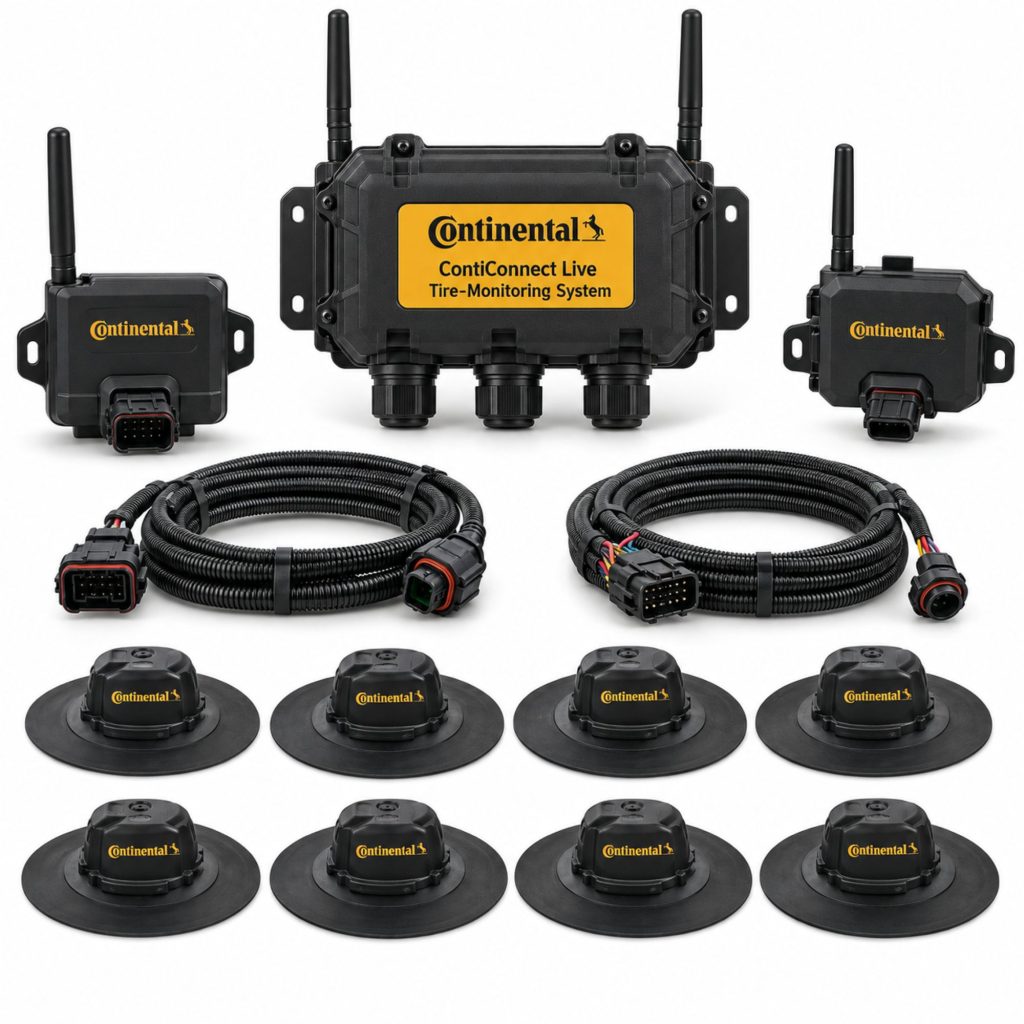
Continental ContiConnect Live is a connected tire-monitoring solution designed to give commercial fleets continuing access to tire-pressure and temperature information while their vehicles are operating. Compatible sensors collect tire data, while vehicle-mounted communication hardware transfers that information to Continental’s digital tire-management platform.
The system allows fleet personnel to view tire conditions remotely instead of waiting for a vehicle to return to a terminal or pass a stationary yard reader. Configurable notifications can help maintenance teams identify underinflation, excessive temperature, rapid pressure loss, and other conditions requiring attention.
ContiConnect Live is intended to support preventive tire maintenance, reduce roadside interruptions, protect tire casings, and improve fleet visibility. It is a monitoring and information system rather than an automatic tire-inflation system, so drivers and technicians must still correct pressure problems and repair damaged tires.

Key Characteristics
- Connected monitoring of commercial-vehicle tire pressure and temperature
- Remote tire visibility while vehicles are operating
- Compatible with Continental tire-mounted and approved valve-cap sensors
- Vehicle-specific and wheel-position-specific tire information
- Configurable tire-condition notifications
- Web- and mobile-based fleet access
- Supports tractors, trailers, buses, and other commercial vehicles
- Can support fleets operating beyond a fixed terminal or yard
- Helps prioritize tire inspections and maintenance
- Does not automatically inflate an underinflated tire
Major Components
- Continental tire-mounted sensors or compatible valve-cap sensors
- Vehicle-mounted receiver or communication unit
- Antennas and communication hardware
- Power and vehicle wiring connections
- ContiConnect cloud-based platform
- Web portal and mobile application access
- Vehicle and tire-position database
- Configurable alert and notification tools
- Optional driver display or compatible in-cab interface
- Compatible telematics connections where supported
Monitoring-System Type and Design
ContiConnect Live is a connected tire-pressure monitoring and fleet tire-management system. Unlike a basic standalone TPMS that only warns the driver inside one vehicle, ContiConnect Live is designed to transfer tire information to a remote digital platform where authorized fleet personnel can review multiple vehicles.
The system can use sensors installed inside the tire or compatible sensors fitted at the valve. The selected hardware, tire construction, vehicle configuration, market, and ContiConnect service package determine which measurements and communication features are available.
How the Tire-Monitoring System Works
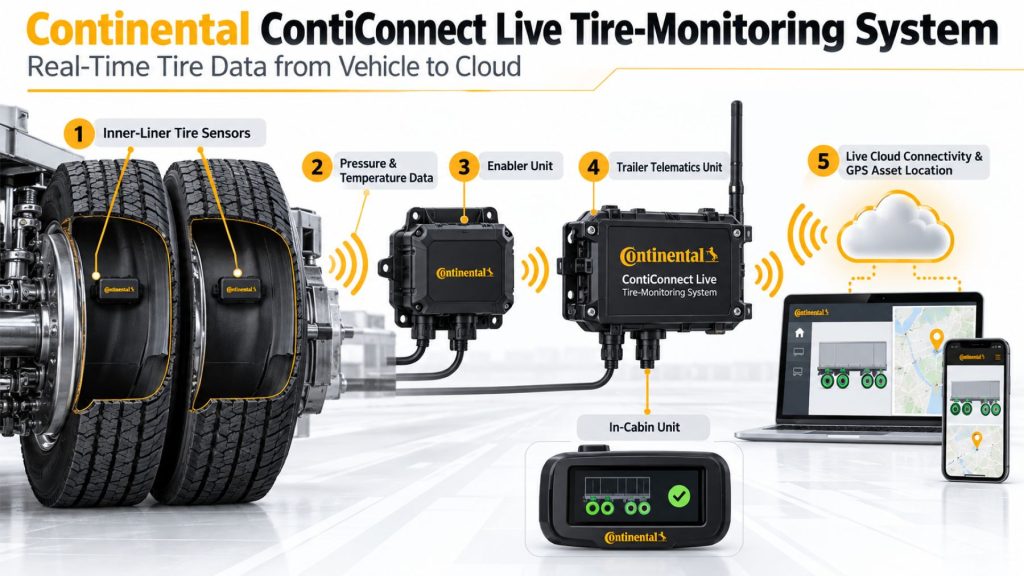
Sensors assigned to individual wheel positions measure tire conditions such as inflation pressure and internal temperature. Sensor transmissions are received by compatible vehicle hardware, which associates the information with the correct vehicle and tire position.
The communication unit sends the collected information to the ContiConnect platform. Fleet personnel can then review current tire status, vehicle information, alerts, and historical trends through supported web, mobile, or telematics interfaces.
If a reading crosses a configured threshold, the system can generate a notification so the fleet can inspect the vehicle. The system identifies a condition requiring attention but does not determine the physical cause or perform the repair.
Position and Function Within the Vehicle
The sensors are associated with individual tire positions on the tractor, truck, trailer, bus, or other equipped vehicle. Communication hardware is installed in a protected vehicle location with suitable power, wiring, reception, and wireless connectivity.
Its primary function is to turn individual tire readings into usable fleet information. This helps connect drivers, maintenance departments, dispatchers, and fleet managers with the condition of tires operating away from the terminal.
Common Specifications
- System Type: Connected commercial-vehicle TPMS and tire-management platform
- Measured Conditions: Tire pressure and temperature; other data depends on sensor and service configuration
- Sensor Options: Compatible tire-mounted or valve-cap sensors
- Vehicle Communication: Application-specific receiver, antenna, and connected communication hardware
- User Interfaces: Supported web portal, mobile application, alerts, and compatible telematics displays
- Vehicle Configurations: Tractor, straight truck, trailer, bus, and specialty commercial-vehicle applications
- Tire Compatibility: Determined by sensor type, tire construction, valve equipment, wheel configuration, and approved application
- Power Supply: Vehicle electrical power for applicable communication hardware
- Inflation Function: None; corrective inflation requires manual service or a separate tire-inflation system
- Installation: New-vehicle integration or compatible fleet retrofit, depending on the selected configuration
Monitoring Specifications and Performance
Monitoring performance depends on correct sensor installation, tire-position assignment, communication coverage, hardware condition, alert settings, and platform configuration. Each sensor must be matched to the correct vehicle and wheel position for the displayed information to be useful.
Pressure and temperature thresholds should reflect the fleet’s approved tire-inflation program, tire specifications, axle loading, operating environment, and Continental’s instructions. A warning threshold should never be treated as the recommended cold inflation pressure.
Pressure and Temperature Monitoring
Underinflation increases tire deflection, heat generation, rolling resistance, and casing stress. Elevated temperature may indicate underinflation, overloading, brake heat, bearing problems, tire damage, or severe operating conditions.
ContiConnect Live helps identify these changes, but the reading must be interpreted in context. Technicians should inspect the tire, valve, wheel, brake, and wheel end rather than assuming every temperature or pressure alert has the same cause.
Sensor Programming and Tire-Position Assignment
Each sensor must be registered and assigned to the correct vehicle and tire position. Accurate assignment allows the platform to show maintenance personnel exactly which tire requires inspection.
Sensor records should be updated whenever tires, wheels, sensors, tractors, or trailers are exchanged. Failure to update those records can produce missing readings, duplicate assignments, or alerts attributed to the wrong wheel position.
Alerts, Connectivity, and Telematics Integration
ContiConnect Live can provide configurable notifications based on tire conditions and the selected service configuration. Alerts may be delivered through supported portal, mobile, email, or integrated telematics functions.
Connectivity can be affected by cellular availability, antenna placement, damaged wiring, electrical faults, platform settings, and communication-hardware status. A temporary loss of remote data does not necessarily mean the tire sensor has failed.
Installation and System Setup
Installation begins by selecting the correct sensor and communication package for the vehicle. Tire-mounted sensors generally require tire removal and proper attachment inside the casing, while approved valve-cap sensors can simplify certain retrofit installations.
Vehicle hardware must be mounted securely, connected to the correct power source, and protected from road debris, water, heat, and mechanical damage. After installation, the vehicle, sensor identifiers, axle arrangement, and individual tire positions must be entered accurately in the platform.
Tire, Wheel, and Valve Compatibility
Compatibility depends on the selected sensor, tire construction, valve design, wheel type, wheel position, axle arrangement, and intended operating environment. Fleets should confirm approval before installing a sensor on a different tire, wheel, or valve configuration.
Tire-mounted sensors must be positioned correctly inside the casing and protected during mounting, demounting, retreading, and repair. Valve-cap sensors require serviceable valve stems and enough clearance from wheel openings, hubs, brake components, and neighboring dual tires.
Common Applications
- Long-haul tractor-trailer fleets
- Regional-haul fleets
- Private and dedicated fleets
- Truckload and less-than-truckload operations
- Distribution and delivery fleets
- Commercial bus and motorcoach fleets
- Trailer fleets operating away from a central terminal
- Mixed tractor and trailer operations
- Vocational fleets with compatible equipment
- Fleets seeking remote tire-condition visibility
Vehicle and Fleet-System Compatibility
ContiConnect Live must be configured for the fleet’s vehicles, trailers, tire positions, sensor types, and communication requirements. Compatibility also depends on available electrical power, mounting space, cellular or telematics connectivity, and the fleet’s digital-system architecture.
Mixed fleets should confirm how tractors and trailers are identified when equipment is exchanged. The system configuration must preserve the relationship between each sensor, wheel position, vehicle, and trailer.
Advantages
- Provides tire-pressure and temperature visibility while vehicles are operating
- Allows remote monitoring across multiple vehicles
- Can warn fleets before some tire conditions become roadside failures
- Supports preventive maintenance planning
- May help preserve tire casings and retread potential
- Can reduce manual pressure-checking workload
- Identifies the affected vehicle and wheel position
- Supports tractors, trailers, buses, and mixed fleets
- Creates historical tire-condition information
- Can integrate tire information into broader fleet-management workflows
Limitations or Considerations
- Does not automatically inflate an underinflated tire
- Requires compatible sensors and communication hardware
- Remote reporting depends on power and data connectivity
- Incorrect tire-position assignments can misidentify alerts
- Sensors require inspection and eventual replacement
- Tire service personnel must avoid damaging internal sensors
- Alerts still require physical inspection and corrective service
- System availability and features can vary by region and service package
- Additional subscription, data, or platform costs may apply
- The system does not replace required pre-trip and maintenance inspections
Driver and Operator Experience
Drivers may receive tire-condition information through an approved in-cab display, mobile interface, dispatch communication, or fleet maintenance notification, depending on the installation. Alerts should clearly identify the vehicle and tire position whenever possible.
A critical pressure-loss or temperature warning should be handled according to the fleet’s safety procedure. The driver should not continue operating solely because the tire still appears inflated or the vehicle remains controllable.
Inspection and Sensor Service
- Confirm that each sensor reports from the correct wheel position
- Inspect valve-cap sensors for damage, looseness, corrosion, and leakage
- Protect tire-mounted sensors during tire service
- Check receiver, antenna, harness, and power connections
- Review the platform for missing or stale readings
- Update sensor assignments after tire or wheel changes
- Investigate repeated alerts instead of repeatedly clearing them
- Verify system operation after repairs or component replacement
Maintenance and Ownership Notes
ContiConnect Live works best when it is incorporated into the fleet’s existing tire-maintenance program. Fleet personnel should establish responsibility for reviewing alerts, contacting drivers, opening maintenance work orders, correcting pressure, and documenting completed repairs.
Sensor status and wheel-position records should be checked during tire changes, rotations, retreading, wheel replacement, tractor reassignment, and trailer interchange. Platform users, notification recipients, and alert thresholds should also be reviewed periodically.
Common Tire-Monitoring System Problems
- Missing sensor reading: Sensor damage, depleted sensor power, incorrect assignment, receiver problems, communication loss, or excessive distance may interrupt reporting.
- Incorrect wheel-position alert: A sensor may not have been reassigned after a tire rotation, wheel replacement, or vehicle change.
- Repeated low-pressure warning: A puncture, leaking valve, damaged wheel, bead leak, improper inflation target, or temperature change may be responsible.
- High-temperature warning: Underinflation, overloading, brake drag, bearing trouble, casing damage, or severe service may create excess heat.
- No remote data: Loss of vehicle power, damaged wiring, antenna trouble, cellular coverage, account configuration, or platform communication may be involved.
- Valve leakage after sensor installation: A damaged valve core, loose component, contaminated seal, incompatible valve, or incorrectly installed valve-cap sensor may cause leakage.
- False or inconsistent readings: Incorrect programming, damaged sensors, improper installation, or mismatched system components should be investigated.
Safety and Service Precautions
A tire-pressure monitoring alert is not a complete diagnosis. Drivers and technicians should follow approved procedures for stopping, securing, deflating, inflating, removing, and servicing commercial tire and wheel assemblies.
Never attempt to correct an overheated, damaged, or severely underinflated commercial tire without evaluating its condition. Tires operated significantly underinflated may have internal casing damage that cannot be identified from the exterior.
Only trained personnel should service commercial tire and wheel assemblies. Tire sensors, valves, communication hardware, and electrical connections should be installed according to Continental’s current instructions.
Identification Information
System identification may appear on the tire sensor, valve-cap sensor, receiver, communication unit, wiring harness, installation records, ContiConnect account, or vehicle-equipment documentation.
Record the vehicle identification number, fleet unit number, trailer number, sensor type, sensor identification numbers, receiver and communication-unit numbers, axle configuration, tire positions, software or platform information, and active service package before ordering replacement components or requesting technical support.
Buying Considerations
- Determine whether live over-the-road monitoring is required
- Confirm the number and types of vehicles and trailers to be equipped
- Select approved tire-mounted or valve-cap sensors
- Verify compatibility with the fleet’s tires, wheels, and valves
- Confirm vehicle power and communication requirements
- Review cellular and operating-area coverage
- Determine whether in-cab display functions are needed
- Review web, mobile, email, and telematics notification options
- Confirm subscription and data-service requirements
- Plan sensor assignment and tire-service procedures
- Establish who will monitor and respond to alerts
- Confirm replacement-sensor and technical-support availability
Variants and Configurations
- Truck configurations
- Trailer configurations
- Bus and motorcoach configurations
- Tire-mounted sensor installations
- Valve-cap sensor installations
- In-cab monitoring configurations
- Remote fleet-portal monitoring
- Mobile application access
- Telematics-integrated configurations
- ContiConnect Live and newer ContiConnect Pro Live service arrangements
Comparison to Similar Equipment
Compared with Continental ContiPressureCheck TPMS, ContiConnect Live places greater emphasis on remotely transmitting tire information to a fleet-management platform. ContiPressureCheck is centered on continuous vehicle-level monitoring and driver information.
Compared with Bendix SmarTire Trailer-Link TPMS, ContiConnect Live belongs to Continental’s connected tire-management ecosystem and supports remote fleet visibility through the ContiConnect platform.
Compared with the Hendrickson TIREMAAX PRO-LB Tire Inflation System or Meritor Tire Inflation System by P.S.I., ContiConnect Live monitors and reports tire conditions but does not automatically supply air to an underinflated tire.
Best Fit For
- Fleets requiring tire visibility while vehicles are away from the terminal
- Long-haul tractor-trailer operations
- Regional and distribution fleets
- Fleets with high tire and roadside-service costs
- Operations seeking centralized tire-condition alerts
- Trailer fleets requiring remote tire monitoring
- Bus and motorcoach fleets
- Mixed fleets using compatible Continental sensor technology
- Maintenance departments using preventive tire-service programs
- Fleets integrating tire information with telematics workflows
Related Vehicle and Trailer Types
- Semi Trucks
- Dry Van Trailers
- Refrigerated Trailers
- Flatbed Trailers
- Tanker Trailers
- Lowboy Trailers
- Dump Trailers
- Intermodal Container Chassis
Related Truck and Trailer Models
- Freightliner Cascadia
- Kenworth T680
- Peterbilt 579
- Volvo VNL
- International LT Series
- Mack Anthem
- Western Star 57X
- Great Dane Champion SE
- Utility 4000D-X Composite
- Wabash DuraPlate Dry Van
Related Tire and Monitoring System Types
- Tire Pressure Monitoring & Inflation Systems
- Steer & All-Position Truck Tires
- Drive Tires
- Trailer Tires
- Vocational & Severe-Service Tires
- Commercial Truck Wheels
Related Tire-Monitoring Products
- Continental ContiPressureCheck TPMS
- Bendix SmarTire Trailer-Link TPMS
- Hendrickson TIREMAAX PRO-LB Tire Inflation System
- Hendrickson TIREMAAX PRO Tire Inflation System
- Hendrickson TIREMAAX CP Tire Inflation System
- Meritor Tire Inflation System by P.S.I.
- STEMCO Aeris Tire Inflation System
- Aperia HALO Tire Inflator
- P.S.I. TireView LIVE
- P.S.I. ThermALERT Wheel-End Heat Warning System
Related Equipment Systems
- Tires & Wheels
- Telematics & ELD Systems
- Electrical Systems
- Safety Systems
- Trailer Suspension Systems
- Axles & Differentials
- Brake Systems
Related Guides
- Tire & Wheel Guides
- How Tire Pressure Monitoring and Inflation Systems Work
- How to Read Commercial Truck Tire Sizes and Ratings
- How to Inspect and Maintain Commercial Truck Tires
- Commercial Truck Tire Types Explained
- Steer vs Drive vs Trailer Tires
- How Commercial Truck Telematics Systems Work
Regulatory and Compliance Notes
ContiConnect Live does not replace required driver inspections, fleet maintenance procedures, tire-pressure checks, or applicable commercial-vehicle inspection requirements. The driver and motor carrier remain responsible for ensuring that every tire is properly inflated, serviceable, and suitable for the vehicle’s load.
Sensor and communication equipment must not interfere with tire, wheel, brake, axle, valve, or vehicle operation. Installation and service should follow Continental instructions, wheel and tire industry practices, fleet policies, and applicable regulations.
Real World Operating Notes
The value of live monitoring depends on how quickly the fleet responds. An alert that remains unreviewed provides little protection against tire damage or roadside failure.
Pressure normally changes with tire temperature, weather, elevation, and operating conditions. Maintenance personnel should compare readings with the approved cold inflation target and investigate the trend rather than reacting to every small change as a defect.
Temperature alerts should prompt inspection beyond the tire itself. Dragging brakes, wheel-end problems, overloading, and restricted tire clearance can also create abnormal heat.
Frequently Asked Questions
What is Continental ContiConnect Live?
It is a connected commercial-vehicle tire-monitoring solution that sends tire-condition information to Continental’s digital fleet-management platform.
What tire conditions does the system monitor?
Compatible sensors primarily monitor tire pressure and temperature. Additional information may be available depending on the sensor, vehicle hardware, and ContiConnect service configuration.
Does ContiConnect Live automatically inflate tires?
No. It monitors and reports tire conditions. Inflation requires manual service or a separate automatic tire-inflation system.
Can it monitor trailers?
Yes. Compatible ContiConnect Live configurations can monitor truck and trailer tire positions.
Can valve-cap sensors be used?
Continental offers compatible valve-cap sensor technology for supported digital tire-monitoring configurations. Exact compatibility should be confirmed for the selected system and vehicle.
Why is the system showing the wrong tire position?
The sensor assignment may not have been updated after a tire rotation, wheel replacement, sensor change, or vehicle reassignment.
Does the system replace manual tire inspections?
No. Drivers and technicians must continue performing required visual, pressure, tread, valve, wheel, and tire-condition inspections.
What should a fleet do after receiving a high-temperature alert?
The vehicle should be handled according to fleet safety procedures, and the tire, inflation pressure, load, brake, bearing, and wheel end should be inspected before continued operation.
Can ContiConnect Live connect with fleet telematics?
Compatible integrations may be available depending on the fleet platform, region, hardware, and ContiConnect service package.
How are replacement components identified?
Use the sensor identification, communication-unit number, vehicle configuration, account information, installed hardware, and current Continental application data.
Availability and Where to Find
Continental ContiConnect digital tire-monitoring systems, sensors, communication hardware, service packages, and technical support may be available through Continental commercial-tire dealers, authorized service providers, fleet-solution representatives, truck and trailer equipment specialists, and participating telematics providers.
System names, packages, hardware, supported integrations, and availability can vary by market and may change as Continental develops its ContiConnect platform. Buyers should confirm whether the required application is offered as ContiConnect Live, ContiConnect Pro Live, or another current ContiConnect configuration.
Current product and service information is available through the Continental Digital Tire Monitoring website.
Support Trucking Families
Truck Equipment Atlas supports the mission of Grey Cross, a nonprofit dedicated to helping families of truck drivers who lose their lives while on the road. As the site grows, part of its mission is to bring awareness and support to these families.
Podcast or Video Section
Learn More Through Audio and Video
Truck Equipment Atlas will continue expanding with podcast episodes, interviews, and equipment breakdowns to help drivers and fleets better understand trucks and equipment.
Follow the Growth of Truck Equipment Atlas
Truck Equipment Atlas continues to expand with new truck profiles, trailer coverage, diesel engine pages, equipment system resources, manufacturer information, and educational guides.
Visit our Site Updates page to explore recent additions, project milestones, and upcoming resources as we continue building one of the industry’s growing commercial trucking equipment reference libraries.
View the Latest Site Updates: Truck Equipment Atlas Site Updates