
Quick Facts
- Manufacturer: JOST International
- Product Series: JSK3CN
- Primary Model: JSK3CNWL
- Product Type: Ultralight commercial-truck fifth wheel
- Top-Plate Construction: Fusion-welded steel with an integrated carbon-fiber beam
- Lubrication Configuration: Low-lube design convertible to a standard lubricated configuration
- Mounting Options: Stationary, sliding outboard, and sliding inboard configurations
- Maximum Vertical Load: 55,000 pounds, subject to the complete mounting and vehicle configuration
- Maximum Drawbar Pull: 150,000 pounds, subject to application approval and the lowest-rated component
- Kingpin Compatibility: Standard SAE 2-inch semitrailer kingpins
- Primary Applications: Standard-duty on-highway tractors and weight-sensitive fleets
- Production Status: Current product; specifications and mounting availability should be confirmed with JOST
Overview
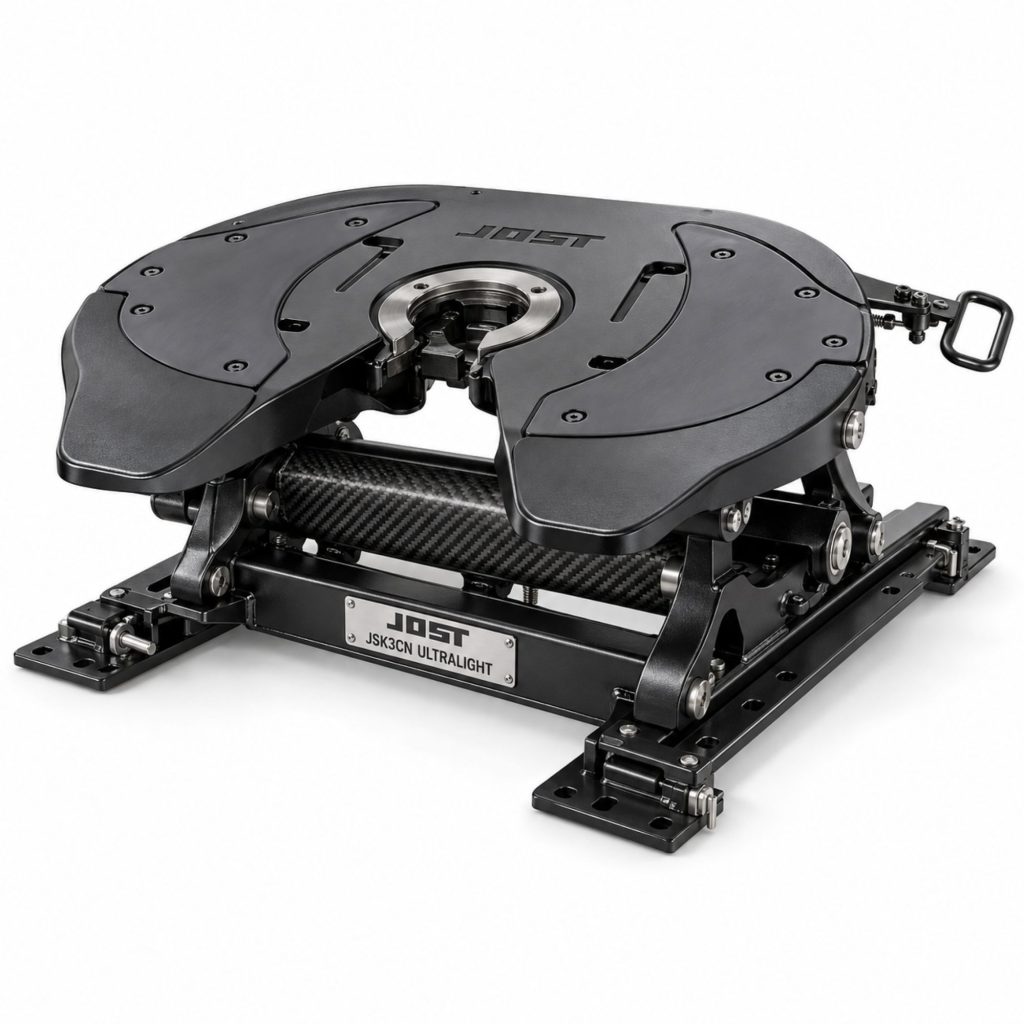
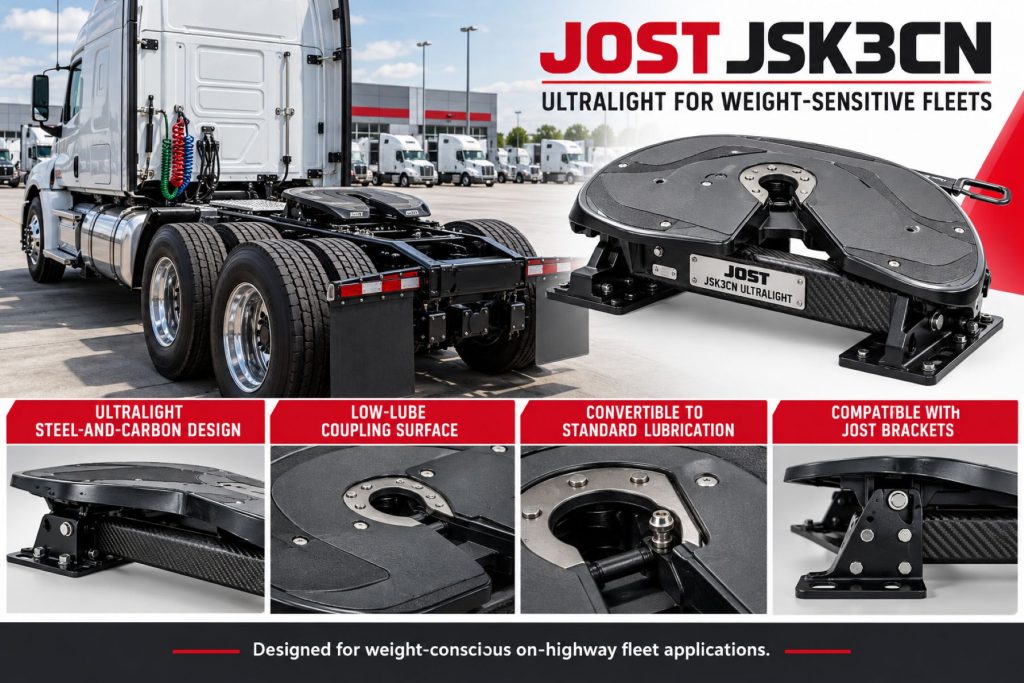
The JOST JSK3CN is an ultralight fifth wheel developed for on-highway tractors where reducing tractor weight can increase usable payload or improve vehicle efficiency. The primary JSK3CNWL version combines a fusion-welded steel top plate with a carbon-fiber structural beam.
This construction provides a lightweight alternative to conventional cast-steel fifth wheels without requiring an aluminum top plate. The fifth wheel retains JOST’s established locking mechanism, replaceable steel wear ring, and compatibility with JOST mounting brackets.
The JSK3CNWL uses low-lube wear plates across the top surface to reduce routine greasing between the fifth wheel and trailer upper coupler. It can also be converted to a standard lubricated configuration when operating requirements change.
Key Characteristics
- Ultralight fifth wheel for standard-duty highway applications
- Fusion-welded steel top plate
- Integrated carbon-fiber structural beam
- Low-lube top-plate surface
- Convertible to a conventional lubricated fifth wheel
- Replaceable steel wear ring
- JOST locking mechanism with a limited number of moving components
- Full-size coupling surface comparable to the JOST JSK37UW
- Compatible with JOST stationary and sliding mounting systems
- Designed for standard SAE 2-inch kingpins
- Supports weight-sensitive tractor specifications
- Intended primarily for maintained-road operation
Major Components
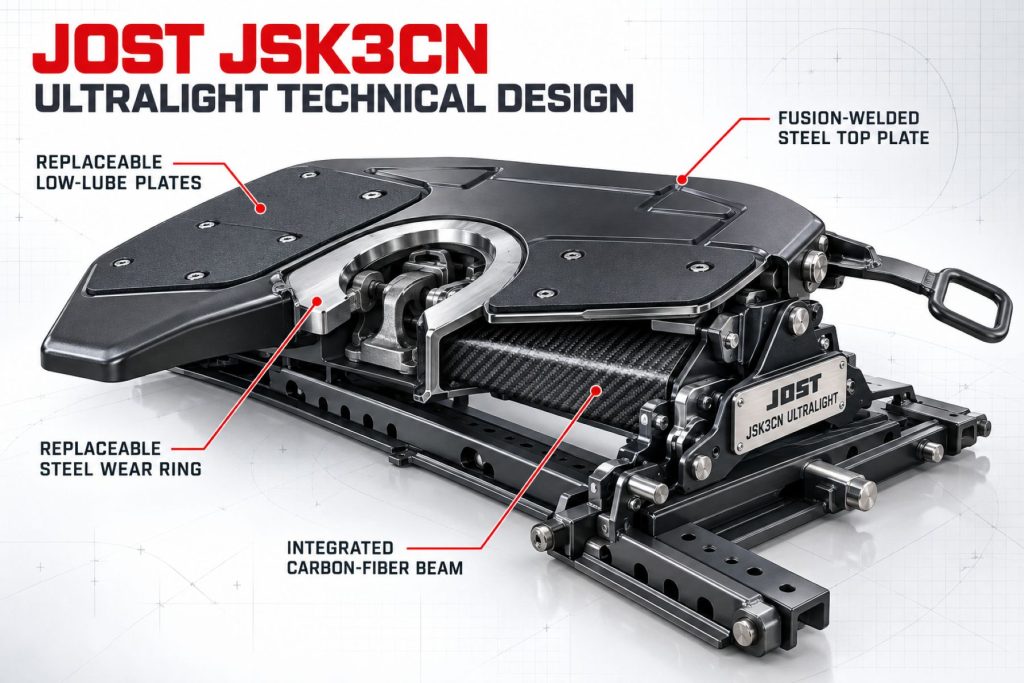
- Fusion-welded steel top plate
- Carbon-fiber structural beam
- Replaceable low-lube wear plates
- Fifth-wheel throat
- Locking jaw
- Locking bar and operating mechanism
- Replaceable steel wear ring
- Release handle
- Safety-lock components
- Pivot pins and bushings
- Mounting brackets
- Stationary or sliding mounting assembly
- Slider rails and locking plungers when equipped
- Air-release actuator when specified
- Mounting fasteners
Coupling Type and Design
The JSK3CN is a semitrailer fifth wheel with a rear-entry throat that guides the trailer kingpin into the locking mechanism. Its top plate pivots on mounting brackets so the tractor and trailer can move relative to one another while traveling over normal road transitions.
The JSK3CNWL combines a steel coupling surface with a carbon-fiber beam to reduce weight. Replaceable low-lube plates cover the primary trailer-contact areas, while a steel wear ring protects the high-load region around the kingpin throat.
How the Coupling System Works
During coupling, the tractor backs beneath the trailer with the fifth-wheel ramps tilted downward. The trailer upper coupler slides across the top plate and directs the kingpin into the fifth-wheel throat.
As the kingpin reaches the locking mechanism, the jaw closes around it and the locking components move into their secured position. The driver must visually inspect the lock, verify that the trailer upper coupler is seated against the fifth wheel, and conduct a controlled tug test before moving the vehicle.
Position and Function Within the Vehicle
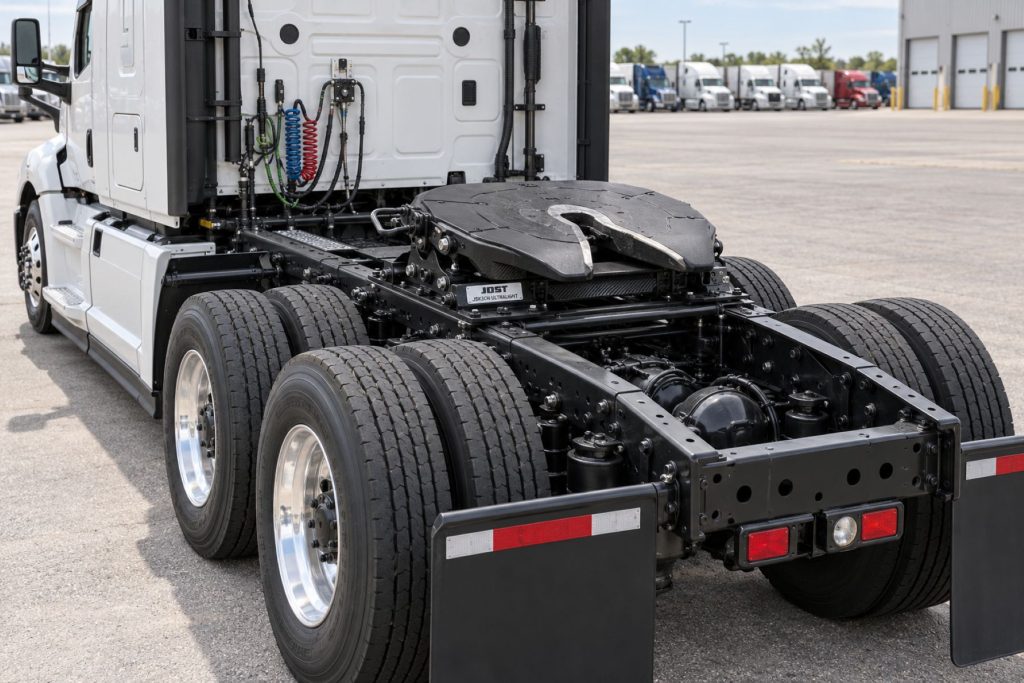
The fifth wheel is mounted above the tractor’s rear axle or tandem-axle group. It connects the tractor to the semitrailer, supports the trailer’s imposed vertical load, and transfers acceleration, braking, and cornering forces between the two vehicles.
When installed on a slider, the fifth wheel can be repositioned to help adjust weight distribution among the steer axle, drive axles, and trailer axles. Its final position must remain within vehicle, suspension, frame, driveline, and regulatory limits.
Common Specifications
- Fifth-Wheel Type: Ultralight standard-duty highway fifth wheel
- Top-Plate Material: Fusion-welded steel
- Structural Beam: Carbon fiber
- Lubrication Type: Replaceable low-lube plates with conversion capability
- Kingpin Size: Standard SAE 2-inch kingpin
- Maximum Vertical Load: 55,000 pounds
- Maximum Drawbar Pull: 150,000 pounds
- Mounting Styles: Stationary, sliding outboard, or sliding inboard
- Release Configuration: Application-specific manual release; available equipment should be confirmed by part number
- Primary Duty Classification: Standard-duty on-highway operation
- Typical Trailer Compatibility: Van, refrigerated, tank, bulk, and flatbed semitrailers within approved ratings
Load Ratings and Operating Capacity
JOST’s application information lists the JSK3CN top plate with a maximum vertical load of 55,000 pounds and maximum drawbar pull of 150,000 pounds. These values are maximum component ratings rather than automatic vehicle or combination ratings.
The usable capacity is limited by the lowest-rated part of the complete installation, including the fifth wheel, brackets, slider, mounting plate, tractor frame, fasteners, axles, suspension, tires, wheels, kingpin, upper coupler, and completed vehicle ratings.
Articulation and Oscillation
The JSK3CN top plate provides normal fore-and-aft articulation for highway operation. This movement allows the tractor and semitrailer to pass over grades, loading-dock approaches, and ordinary road transitions without placing excessive stress on the coupling.
The JSK3CN is not a fully oscillating severe-duty fifth wheel. Applications requiring extensive side-to-side oscillation, frequent off-road travel, or extreme frame articulation should use a coupling specifically approved for those operating conditions.
Sliding and Adjustment System
The JSK3CN can be installed on compatible stationary or sliding JOST mounting systems. A sliding installation allows the fifth wheel to move forward or rearward along its rails when the locking plungers are released.
Moving the fifth wheel changes tractor axle loading and tractor-to-trailer clearance. After adjustment, all slider plungers must fully engage, and the driver must confirm that the tractor retains adequate cab, frame, landing-gear, tire, and trailer clearance.
Release and Locking Mechanism
The JOST locking system captures the kingpin as it enters the throat. The release handle allows the driver to open the mechanism during uncoupling after the trailer is secured and coupling forces have been relieved.
A closed handle does not by itself prove that the kingpin is correctly locked. The driver must inspect the jaw and locking components from behind the fifth wheel, confirm full upper-coupler contact, and perform a tug test.
Air and Electronic Controls
The standard JSK3CN configuration is mechanically operated and does not require electronic controls. Air-operated slider release may be included with an appropriate mounting system, depending on the tractor specification.
Control equipment, warning devices, and release options vary by installation. Any cab-mounted control must be protected against accidental operation and installed according to the component manufacturer’s instructions.
Mounting and Installation
The fifth wheel must be installed using approved brackets, fasteners, frame procedures, and mounting dimensions. JOST instructs installers to position the center of the fifth-wheel locks on or ahead of the tractor rear-suspension centerline.
Installation should be performed by qualified technicians. The top plate must not be welded, and the factory-adjusted locking mechanism should not be altered outside authorized service procedures.
Vehicle Frame and Mounting Compatibility
Compatibility depends on the tractor frame, rear suspension, axle spacing, mounting height, frame width, tire clearance, driveline layout, and required load distribution. The selected bracket or slider must be approved for both the fifth wheel and tractor application.
Although the JSK3CN is compatible with JOST brackets, this does not mean every bracket or slider is suitable for every tractor. The complete model and part numbers should be confirmed before installation.
Mating Component and Trailer Compatibility
The JSK3CN is intended for semitrailers equipped with a standard SAE 2-inch kingpin and a structurally sound upper-coupler plate. The kingpin, bolster plate, and surrounding trailer structure must remain within applicable wear and damage limits.
JOST’s application information associates the JSK3CN with approved standard-duty van, refrigerated, tank, bulk, flatbed, and certain framed end-dump applications. It should not be assumed suitable for lowboys, bottom dumps, frameless dumps, converter dollies, or severe off-road service without written application approval.
Common Applications
- Weight-sensitive highway tractors
- Long-haul tractors
- Regional-haul tractors
- Dry-van operations
- Refrigerated freight operations
- Tank and bulk transportation
- Flatbed transportation
- Payload-sensitive fleet applications
- Tractors using stationary fifth-wheel mounts
- Tractors using inboard or outboard sliders
Advantages
- Reduces fifth-wheel weight compared with many conventional steel designs
- Avoids the higher material cost commonly associated with aluminum fifth wheels
- Combines steel coupling surfaces with a carbon-fiber structural beam
- Low-lube plates reduce routine top-surface greasing
- Can be converted to a standard lubricated configuration
- Uses JOST’s established locking mechanism
- Replaceable wear components support serviceability
- Compatible with JOST mounting brackets
- Full-size top surface supports normal trailer contact
- Available for stationary and sliding installations
Limitations or Considerations
- Primarily intended for standard-duty maintained-road operation
- Not designed as a fully oscillating severe-duty fifth wheel
- Low-lube plates still require inspection and eventual replacement
- Kingpin and locking components continue to require approved lubrication
- Carbon-fiber and welded structural components require correct inspection procedures
- Component ratings do not increase tractor or trailer certified ratings
- Not every JOST bracket is automatically approved for every tractor
- Applications involving substantial off-road use require a different product or manufacturer approval
- Incorrect trailer height can damage low-lube plates and cause an unsafe coupling
- Replacement parts must match the exact model and production configuration
Driver and Operator Experience
The JSK3CN operates similarly to a conventional commercial fifth wheel, so properly trained drivers should encounter a familiar coupling and uncoupling process. Its lower weight is primarily a vehicle-specification benefit rather than a major change in normal driver controls.
The low-lube surface can reduce grease accumulation on the fifth-wheel top plate. Drivers must still inspect the coupling before every trip and must not treat the low-lube design as maintenance-free.
Coupling and Uncoupling Procedure
Before coupling, the driver should inspect the fifth wheel, confirm that the locks are open, verify that the low-lube plates are present and undamaged, secure the trailer, and adjust its height so the upper coupler contacts the fifth wheel near the pivot area.
After backing beneath the trailer, the driver must verify full contact between the upper coupler and fifth wheel, visually inspect the closed locking mechanism, perform a tug test, connect all lines, raise the landing gear, and complete the required pre-trip inspection.
During uncoupling, the trailer should be positioned on firm, level ground whenever possible. The driver must secure the trailer, lower the landing gear, disconnect the lines, relieve pressure on the locking mechanism, release the fifth wheel, and pull the tractor away carefully.
Inspection and Wear Points
- Locking jaw and locking bar
- Kingpin contact area
- Replaceable steel wear ring
- Low-lube wear plates
- Top-plate surface and throat
- Carbon-fiber beam condition
- Fusion-welded joints
- Release handle and safety components
- Pivot pins and bushings
- Mounting brackets
- Slider rails and plungers when equipped
- Mounting fasteners and frame attachment points
Lubrication Requirements
The low-lube plates reduce or eliminate the need to spread grease across the primary top-plate contact surface. They do not eliminate lubrication requirements for the locking mechanism, kingpin-contact components, pivot points, or other specified service locations.
Only manufacturer-approved lubricant and procedures should be used. Excessive grease, incompatible products, contamination, or failure to lubricate required points can interfere with operation and accelerate wear.
Maintenance and Ownership Notes
The fifth wheel should be cleaned and inspected at the intervals specified by JOST and the fleet’s maintenance program. Wear plates, the steel wear ring, locking components, pivots, brackets, slider parts, and fasteners require particular attention.
Maintenance records should include inspection dates, measured wear, replaced components, lubrication service, slider repairs, and any coupling complaints. Structural repairs or replacement decisions should follow JOST instructions rather than general welding or fabrication practices.
Common Coupling Problems
- High coupling: The trailer is too high, allowing the kingpin to pass over or incorrectly enter the locking mechanism.
- False coupling: The handle may appear closed even though the kingpin is not correctly captured.
- Difficult release: Tractor-to-trailer tension, contamination, damaged parts, inadequate lubrication, or worn locking components may prevent normal release.
- Excessive kingpin movement: A worn kingpin, wear ring, jaw, or locking component may allow excessive play.
- Damaged low-lube plates: Incorrect coupling height, impact damage, missing fasteners, heat exposure, or normal wear can damage the plates.
- Slider will not lock: Misaligned plungers, contamination, damaged teeth, air-system faults, or worn components may prevent engagement.
- Excessive articulation play: Worn pivot pins, bushings, brackets, or mounting components may allow unwanted movement.
Safety and Service Precautions
A driver should never rely only on the release-handle position to confirm coupling. Visual inspection of the locking mechanism, confirmation of full upper-coupler contact, and a controlled tug test are essential before road operation.
Do not exceed the ratings of the fifth wheel or any connected component. Do not weld on the top plate, alter the carbon-fiber beam, or readjust the factory-set locking mechanism without an authorized procedure.
Identification Information
Identification information should be recorded from the product label, top plate, mounting assembly, slider, and vehicle records.
- JOST model number
- Complete assembly or part number
- Serial number
- Production date or series
- Vertical-load rating
- Drawbar-pull rating
- Mounting style
- Mounting height
- Slider travel and release type
- Low-lube plate configuration
- Bracket and slider part numbers
- Replacement-component numbers
Buying Considerations
- Confirm that the application is standard-duty and primarily on-highway
- Verify the required vertical-load and drawbar-pull ratings
- Compare weight savings with the current fifth-wheel assembly
- Select stationary, sliding inboard, or sliding outboard mounting
- Confirm the required mounting height
- Verify tractor-frame and rear-suspension compatibility
- Check kingpin and trailer upper-coupler condition
- Confirm slider travel and axle-weight requirements
- Review low-lube plate inspection and replacement costs
- Verify parts and service availability
- Use the complete model and part numbers when ordering
- Obtain application approval when operating conditions fall outside standard highway service
Variants and Configurations
- JSK3CNWL low-lube top plate
- Stationary mounting configuration
- Sliding outboard mounting configuration
- Sliding inboard mounting configuration
- Different mounting heights
- Application-specific bracket arrangements
- Manual-release configurations
- Low-lube configuration
- Conversion to standard lubrication
- Replacement wear-plate and wear-ring arrangements
Comparison to Similar Equipment
Compared with the JOST JSK36N Lightweight Fifth Wheel, the JSK3CN uses a fusion-welded steel top plate with a carbon-fiber beam and carries a higher published maximum vertical-load rating.
Compared with the JOST JSK37U Fifth Wheel, the JSK3CN prioritizes lower assembly weight and standard-duty highway use. The JSK37U supports a broader range of moderate- and heavy-duty applications.
Compared with the Holland FWAL Aluminum Fifth Wheel, the JSK3CN achieves weight reduction through a welded-steel and carbon-fiber design rather than an aluminum top plate.
Compared with the Holland FW33 Low-Lube Fifth Wheel, both products reduce routine top-plate lubrication, but they use different construction, locking, mounting, and wear-component designs.
Best Fit For
- Weight-sensitive on-highway tractors
- Fleets seeking greater usable payload
- Dry-van and refrigerated operations
- Tank, bulk, and flatbed fleets within approved ratings
- Standard-duty maintained-road applications
- Fleets wanting a lightweight alternative to aluminum
- Operators seeking a low-lube top surface
- Tractors using compatible JOST mounting equipment
- Applications requiring stationary or sliding fifth-wheel installations
Related Vehicle and Trailer Types
- Complete Guide to Semi Truck Types
- Dry Van Trailers
- Refrigerated Trailers
- Flatbed Trailers
- Tanker Trailers
- Bulk Trailers
Related Truck and Trailer Models
- Freightliner Cascadia
- Kenworth T680
- Peterbilt 579
- Volvo VNL
- International LT Series
- Mack Anthem
- Western Star 57X
Related Coupling Types
- Commercial Truck Fifth Wheels
- Fifth Wheel Sliders & Mounting Systems
- Heavy-Haul & Severe-Duty Fifth Wheels
- Terminal Tractor & Yard Coupling Systems
- Trailer Kingpins & Upper Couplers
- Pintle Hooks & Drawbar Couplings
Related Coupling Products
- JOST JSK36N Lightweight Fifth Wheel
- JOST JSK37U Fifth Wheel
- JOST JSK37Y Terminal Tractor Fifth Wheel
- Holland FW35 Fifth Wheel
- Holland FW33 Low-Lube Fifth Wheel
- Holland FW17 Lightweight Fifth Wheel
- Holland FWAL Aluminum Fifth Wheel
- Fontaine No-Slack 6000 Fifth Wheel
- Fontaine No-Slack 7000 Fifth Wheel
- Fontaine No-Slack 7000CC Clean Connect Fifth Wheel
Related Equipment Systems
- Fifth Wheels & Coupling Equipment
- Suspension Systems
- Axles & Differentials
- Brake Systems
- Tires & Wheels
- Electrical Systems
Related Guides
- Fifth Wheel System Explained
- Fixed vs Sliding Fifth Wheels
- How to Couple and Uncouple a Semi-Trailer Safely
- How to Inspect and Maintain a Fifth Wheel and Kingpin
- How to Choose a Commercial Truck Fifth Wheel
Regulatory and Compliance Notes
The fifth wheel, kingpin, upper coupler, mounting system, tractor frame, and related components must comply with applicable vehicle-safety standards and commercial-vehicle regulations. Installation does not increase the tractor’s certified gross axle or gross vehicle weight ratings.
Drivers and carriers remain responsible for legal axle weights, vehicle condition, coupling inspections, cargo securement, and compliance with federal, state, provincial, and local requirements.
Real World Operating Notes
The JSK3CN’s weight savings are most valuable when the complete tractor specification is managed for payload efficiency. Actual savings should be calculated by comparing complete fifth-wheel and mounting assemblies rather than top plates alone.
Low-lube plates can reduce grease use and help keep the tractor frame cleaner, but they must not be exposed to incorrect coupling height or treated as permanent components. Slight temperature-related movement at plate edges may occur, while missing, cracked, severely distorted, or loose plates require service.
Frequently Asked Questions
What is the JOST JSK3CN?
It is an ultralight commercial fifth wheel that combines a fusion-welded steel top plate with a carbon-fiber structural beam.
What is the JSK3CNWL?
The JSK3CNWL is the low-lube version of the JSK3CN series.
What are its maximum ratings?
JOST’s application guide lists a maximum vertical load of 55,000 pounds and maximum drawbar pull of 150,000 pounds, subject to the complete installation and application.
Does it require grease on the top plate?
The low-lube plates reduce the need for grease across the main top surface. Required locking, kingpin-contact, and pivot lubrication must still be performed.
Can it be converted to a standard lubricated fifth wheel?
Yes. JOST identifies the JSK3CNWL as convertible to a standard lubricated configuration using the correct approved components and procedure.
Can it be installed on a slider?
Yes. Approved stationary, sliding outboard, and sliding inboard configurations are available.
Is it suitable for heavy-haul or off-road service?
It is primarily intended for standard-duty on-highway service. Heavy-haul, severe-duty, and substantial off-road applications require a differently rated fifth wheel or specific manufacturer approval.
Does low-lube mean maintenance-free?
No. The wear plates, locking mechanism, steel wear ring, pivots, brackets, slider, and mounting fasteners still require scheduled inspection and service.
How can the correct replacement parts be identified?
Use the complete model, assembly number, serial number, mounting configuration, and individual component numbers. Do not select parts by appearance alone.
Availability and Where to Find
The JOST JSK3CN and its replacement components may be available through JOST distributors, truck dealerships, original equipment manufacturers, heavy-duty parts suppliers, fifth-wheel specialists, and commercial-truck repair facilities.
Availability depends on the mounting style, mounting height, slider configuration, release system, and tractor application. Buyers should confirm that an assembly includes the required top plate, brackets or slider, fasteners, controls, and installation information.
Current specifications, manuals, replacement parts, warranty information, and distributor support are available through the JOST International website.
Support Trucking Families
Truck Equipment Atlas supports the mission of Grey Cross, a nonprofit dedicated to helping families of truck drivers who lose their lives while on the road. As the site grows, part of its mission is to bring awareness and support to these families.
Podcast or Video Section
Learn More Through Audio and Video
Truck Equipment Atlas will continue expanding with podcast episodes, interviews, and equipment breakdowns to help drivers and fleets better understand trucks and equipment.
Follow the Growth of Truck Equipment Atlas
Truck Equipment Atlas continues to expand with new truck profiles, trailer coverage, diesel engine pages, equipment system resources, manufacturer information, and educational guides.
Visit our Site Updates page to explore recent additions, project milestones, and upcoming resources as we continue building one of the industry’s growing commercial trucking equipment reference libraries.
View the Latest Site Updates: Truck Equipment Atlas Site Updates