
Quick Facts
- Manufacturer: JOST International
- Product Series: JSK37Y
- Product Type: Terminal-tractor and yard-spotter fifth wheel
- Coupling Type: Air-release fifth wheel for SAE 2-inch semitrailer kingpins
- Top-Plate Construction: Cast top plate with replaceable steel contact and throat components
- Mounting Type: Application-specific stationary bracket mounting
- Maximum Vertical Capacity: 50,000 pounds
- Maximum Horizontal Capacity: 150,000 pounds
- Release Type: Air release, with manual safety-lockout configurations available
- Lubrication Options: Standard-lube or automatic-lubrication-compatible configurations
- Primary Applications: Terminal tractors, yard spotters, distribution centers, ports, intermodal terminals, and industrial yards
- Production Status: Current product; specifications and configurations should be confirmed with JOST
Overview
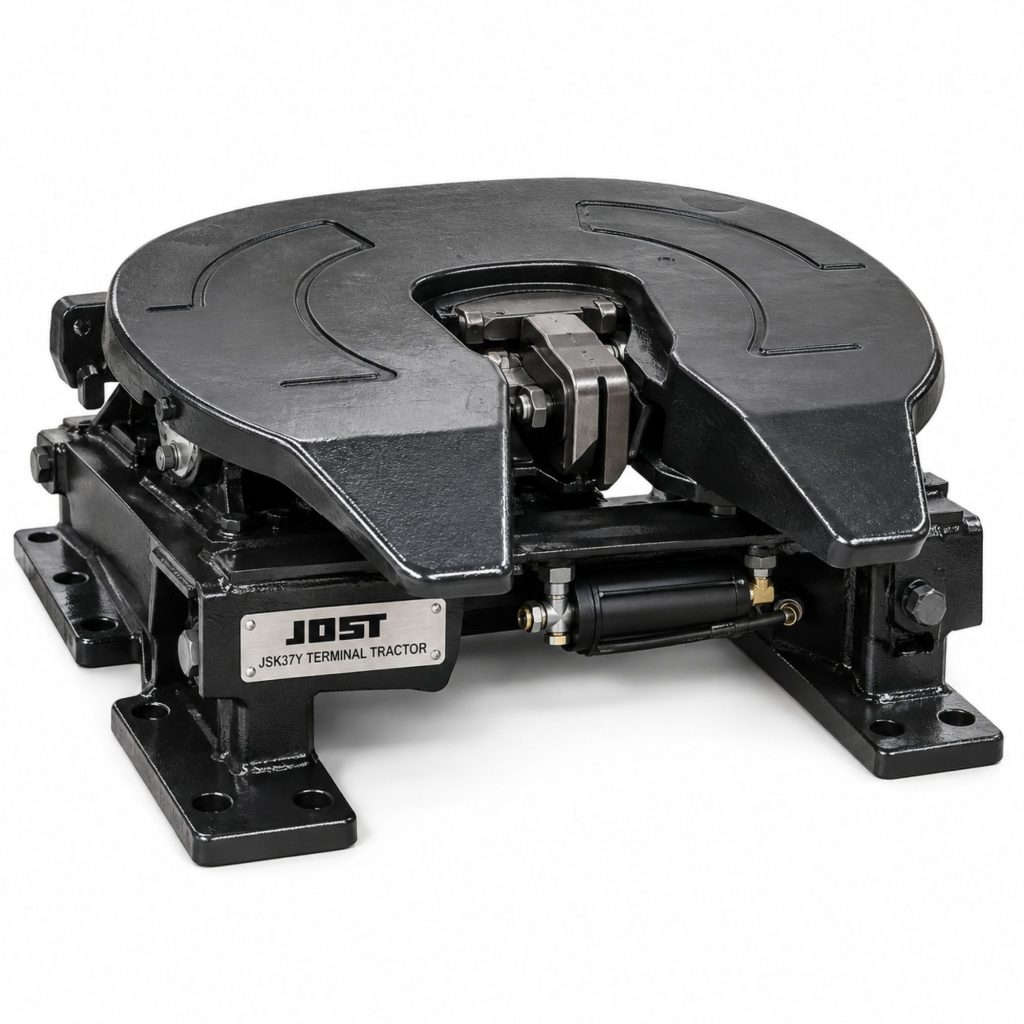
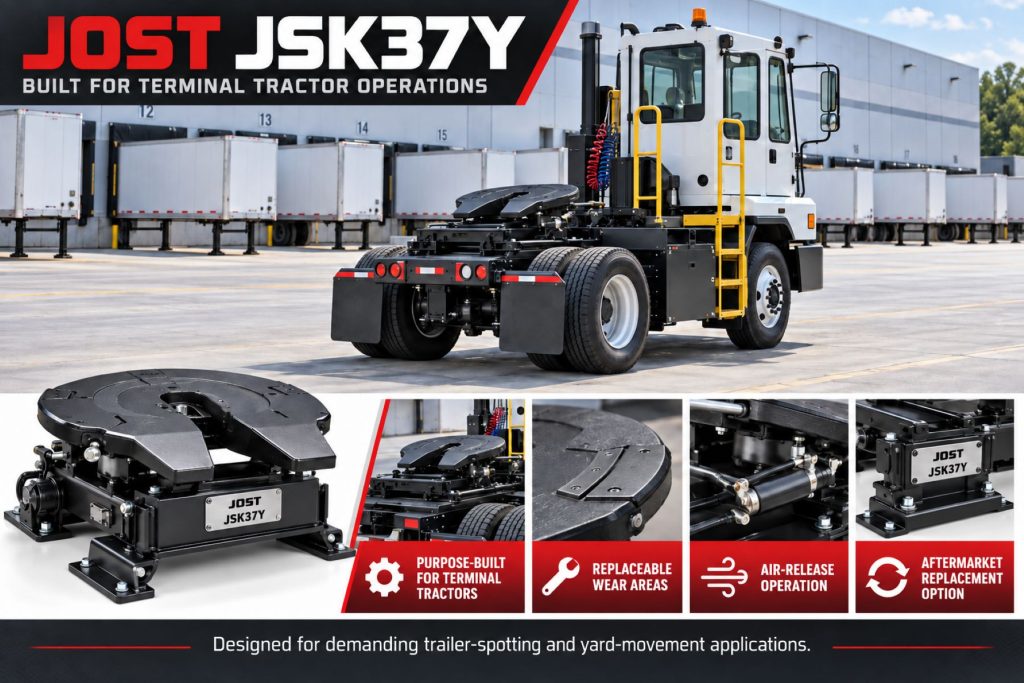
The JOST JSK37Y is a specialized fifth wheel developed for terminal tractors and yard spotters that repeatedly couple and uncouple semitrailers. These vehicles commonly operate inside distribution centers, freight terminals, warehouses, ports, manufacturing plants, and intermodal yards.
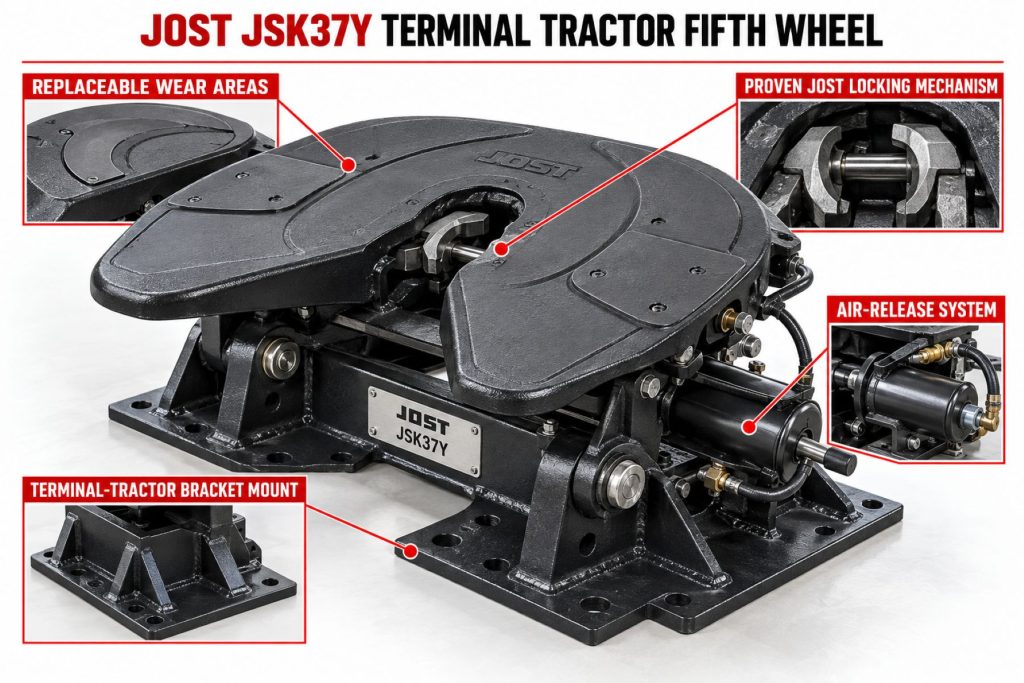
Frequent trailer moves can create substantially more coupling cycles and concentrated wear than normal highway service. JOST designed the JSK37Y with replaceable steel liner plates, a replaceable steel wear ring, and replaceable throat guides so high-wear areas can be renewed without automatically replacing the complete fifth wheel.
The JSK37Y also includes air release for efficient trailer switching, protected locking components, anti-high-coupling lugs, and application-specific mounting options. These features are intended to increase service life, reduce downtime, and support the rapid operating cycle of a terminal tractor.
Key Characteristics
- Designed specifically for terminal tractors and yard spotters
- Air-operated release mechanism
- Replaceable steel top-plate liners
- Replaceable hardened-steel wear ring
- Replaceable hardened-steel throat guides
- Anti-high-coupling lugs
- Protected handle and adjustment components
- Manual safety-lockout configurations available
- Standard-lube and automatic-lubrication-compatible versions
- Application-specific mounting heights
- Replacement configurations for certain competitive mounting systems
- Designed for frequent coupling and uncoupling cycles
- Serviceable wear areas help reduce total ownership cost
Major Components
- Cast fifth-wheel top plate
- Replaceable steel liner plates
- Replaceable hardened-steel wear ring
- Replaceable hardened-steel throat guides
- Fifth-wheel throat
- Locking jaw
- Locking bar and adjustment components
- Anti-high-coupling lugs
- Air-release cylinder
- Release handle
- Manual safety lockout when equipped
- Pivot pins and bushings
- Mounting brackets
- Lubrication points
- Automatic-lubrication connections when equipped
- Structural fasteners
Coupling Type and Design
The JSK37Y is a rear-entry fifth wheel designed to capture a standard SAE 2-inch semitrailer kingpin. Its throat guides direct the kingpin toward the locking mechanism as the terminal tractor backs beneath the trailer.
The fifth wheel is designed around the high number of coupling cycles encountered in yard operations. Its major trailer-contact and throat-wear surfaces are replaceable, allowing technicians to renew worn areas while retaining a serviceable core casting.
How the Coupling System Works
During coupling, the terminal tractor backs under the trailer while its hydraulic lifting fifth wheel is positioned at the correct height. The trailer upper coupler moves across the fifth-wheel surface and guides the kingpin into the throat.
When the kingpin reaches the locking mechanism, the jaw closes around it and the locking components move into their secured position. The anti-high-coupling lugs help guide a correctly positioned kingpin into the jaws or force an incorrectly positioned kingpin upward, giving the operator a clearer indication that proper coupling has not occurred.
During uncoupling, the air-release cylinder operates the release mechanism after the trailer has been secured and pressure has been removed from the lock. The terminal tractor can then lower or reposition its lifting fifth wheel and move away from the trailer.
Position and Function Within the Vehicle
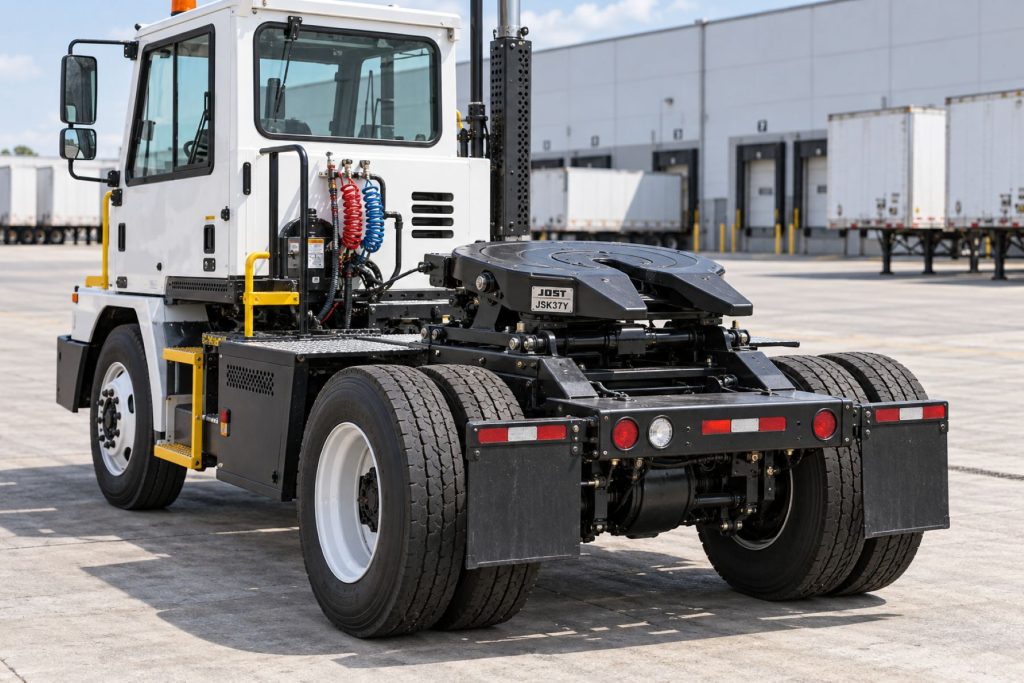
The JSK37Y is mounted on the terminal tractor’s lifting boom or fifth-wheel structure behind the cab. It supports the front of the semitrailer, captures the kingpin, and transfers vertical, pulling, braking, and cornering forces between the terminal tractor and trailer.
Unlike a normal highway-tractor fifth wheel, the terminal-tractor installation can be raised and lowered hydraulically. This allows many trailers to be moved without repeatedly operating their landing gear.
Common Specifications
- Fifth-Wheel Type: Terminal-tractor and yard-spotter fifth wheel
- Top-Plate Type: Cast top plate
- Kingpin Compatibility: Standard SAE 2-inch semitrailer kingpin
- Maximum Vertical Capacity: 50,000 pounds
- Maximum Horizontal Capacity: 150,000 pounds
- Release System: Air operated
- Safety Lockout: Manual safety-lockout configuration available
- Lubrication Surface: Standard-lube or automatic-lubrication-compatible configuration
- Published Mounting Heights: Application-specific configurations around 7.5, 8.75, and 10 inches, depending on model designation
- Mounting Style: Yard-tractor bracket mount or approved replacement configuration
- Replaceable Wear Components: Steel liner plates, steel wear ring, and hardened-steel throat guides
- Primary Operating Environment: Freight yards, ports, warehouses, distribution centers, and industrial facilities
Load Ratings and Operating Capacity
JOST lists the JSK37Y with a maximum vertical capacity of 50,000 pounds and maximum horizontal capacity of 150,000 pounds. These are maximum fifth-wheel ratings and do not automatically establish the capacity of the complete terminal tractor and trailer combination.
Actual operating capacity is limited by the lowest-rated component in the system, including the fifth wheel, brackets, lifting boom, hydraulic system, tractor frame, axles, suspension, tires, wheels, kingpin, trailer upper coupler, and complete vehicle certification.
Articulation and Oscillation
The JSK37Y pivots on its mounting brackets to provide fore-and-aft articulation as the terminal tractor and trailer travel across yard surfaces, dock approaches, ramps, and pavement transitions.
Its movement should not be confused with a fully oscillating severe-duty fifth wheel. Side-to-side movement depends on the terminal tractor’s mounting and lifting-system design. The operator must avoid conditions that force the fifth wheel beyond its approved articulation range.
Sliding and Adjustment System
A conventional highway-style slider is generally not used with the JSK37Y. The fifth wheel is normally mounted to a terminal tractor’s lifting structure in a fixed fore-and-aft position.
Vertical adjustment is provided by the terminal tractor’s hydraulic lifting system rather than by fifth-wheel slider rails. Any fore-and-aft adjustment or mounting change must follow the terminal-tractor and fifth-wheel manufacturers’ approved procedures.
Release and Locking Mechanism
The JSK37Y uses an air-release system to improve efficiency during frequent trailer moves. When the proper conditions are met, the air cylinder operates the release mechanism so the operator can uncouple without manually pulling a conventional release handle during every cycle.
Available configurations may include a manual safety lockout that provides additional protection against unintended release. The handle and adjustment bolt are positioned inside the casting to reduce their exposure to impact and mis-coupling damage.
Air and Electronic Controls
The JSK37Y requires a properly configured compressed-air supply and operator control for its air-release cylinder. The release circuit should be protected against accidental activation and should operate only under the conditions established by the terminal-tractor manufacturer.
The fifth wheel itself does not require a complex electronic control system. However, terminal tractors may integrate the release control with cab switches, warning indicators, interlocks, hydraulic lift controls, or fleet safety systems.
Mounting and Installation
The JSK37Y must be installed on an approved terminal-tractor mounting structure using the correct brackets, pivot pins, bushings, fasteners, air connections, and mounting dimensions. The selected height must match the tractor’s lifting geometry and intended trailer range.
Installation should be performed by qualified technicians familiar with terminal tractors, lifting fifth wheels, pneumatic release systems, and commercial coupling equipment. Welding, machining, drilling, or structural modification should not be performed unless specifically authorized.
Vehicle Frame and Mounting Compatibility
Compatibility depends on the terminal-tractor manufacturer, model, production year, mounting-bracket design, lifting-boom dimensions, pivot-pin arrangement, air-system configuration, and required fifth-wheel height.
JOST offers application-specific bracket-mounted assemblies and replacement configurations designed for certain existing mounting arrangements. A replacement top plate may include bracket pins without including new mounting brackets or bushings, so package contents must be verified before ordering.
Mating Component and Trailer Compatibility
The JSK37Y is intended for semitrailers equipped with a standard SAE 2-inch kingpin and a compatible upper-coupler plate. The kingpin, bolster plate, surrounding structure, and trailer contact surface must remain within applicable wear and damage limits.
Because terminal tractors may move many different trailers during a shift, operators must account for variations in trailer height, kingpin condition, upper-coupler shape, landing-gear position, and trailer loading.
Common Applications
- Terminal tractors
- Yard spotters
- Yard trucks
- Distribution centers
- Warehouse complexes
- Freight terminals
- Intermodal terminals
- Container ports
- Manufacturing plants
- Rail yards
- Parcel and less-than-truckload terminals
- Private industrial facilities
Advantages
- Designed specifically for high-cycle yard operations
- Air release supports faster trailer switching
- Replaceable steel liner plates extend serviceability
- Replaceable throat guides protect high-wear areas
- Replaceable steel wear ring reduces core-casting wear
- Anti-high-coupling lugs help prevent improper coupling
- Protected handle and adjustment components resist impact damage
- Manual safety-lockout configurations are available
- Automatic-lubrication compatibility may reduce manual service demands
- Replacement configurations may simplify competitive fifth-wheel replacement
- Serviceable wear areas can reduce total ownership cost
- Multiple mounting heights support different terminal-tractor applications
Limitations or Considerations
- Designed primarily for terminal-tractor and yard-spotter use
- Not intended as a normal sliding highway-tractor fifth wheel
- Requires a dependable compressed-air supply
- Air-release controls and interlocks require periodic testing
- High-cycle service increases inspection frequency
- Replaceable wear components must still be monitored and serviced
- Mounting height must match the terminal tractor
- Replacement assemblies may not include brackets or bushings
- Maximum ratings do not increase the vehicle’s certified capacity
- Incorrect hydraulic-lift operation can cause high coupling or equipment damage
- Parts must be matched using the complete model number
- It is not a fully oscillating severe-duty fifth wheel
Driver and Operator Experience
The JSK37Y is designed to support rapid trailer moves while reducing the physical effort associated with repeated manual releases. The operator can normally release the fifth wheel using the terminal tractor’s pneumatic control after securing the trailer and unloading the lock.
The hydraulic lifting system allows the operator to raise or lower the front of the trailer without operating the landing gear during every yard move. Operators must still confirm correct coupling, adequate trailer clearance, proper airline connections when required, and safe landing-gear condition.
Coupling and Uncoupling Procedure
Before coupling, the operator should inspect the fifth wheel, verify that the lock is open, check the replaceable liner plates and throat components, and position the lifting system at the correct height.
The tractor should be backed squarely beneath the trailer so the upper coupler contacts the fifth-wheel surface and the kingpin enters the throat at the proper height. After the lock closes, the operator must verify coupling according to JOST, fleet, and terminal-tractor procedures.
Before uncoupling, the trailer must be positioned safely and supported as required. The operator should remove pulling pressure from the lock, activate the air release, confirm that the mechanism has opened, and move the tractor away carefully.
Inspection and Wear Points
- Replaceable steel liner plates
- Hardened-steel wear ring
- Hardened-steel throat guides
- Locking jaw and locking bar
- Anti-high-coupling lugs
- Kingpin contact area
- Top-plate casting
- Air-release cylinder
- Air lines and fittings
- Release handle and safety lockout
- Internal adjustment components
- Pivot pins and bushings
- Mounting brackets
- Structural fasteners
- Lubrication-system lines and fittings when equipped
Lubrication Requirements
Standard-lube JSK37Y configurations require the approved lubricant on the trailer-contact surface, locking mechanism, throat area, pivot points, and other specified service locations. Yard contamination and repeated trailer moves may require more frequent cleaning and lubrication than normal highway operation.
Automatic-lubrication-compatible configurations may distribute lubricant to selected points, but they do not eliminate inspection. Reservoir level, lines, fittings, metering devices, and lubricant delivery should be checked regularly.
Maintenance and Ownership Notes
The JSK37Y should be maintained according to JOST procedures and the terminal tractor’s duty cycle. High-volume yards may require inspections based on operating hours or trailer moves rather than highway mileage.
Replaceable liner plates, throat guides, and the wear ring should be renewed before wear damages the core casting. Maintenance records should document measured wear, air-release operation, lubrication, replaced components, mounting repairs, and repeated coupling complaints.
Common Coupling Problems
- High coupling: Incorrect fifth-wheel height can allow the kingpin to pass above the locking mechanism instead of entering the jaws correctly.
- False coupling: The mechanism may appear closed even though the kingpin is not properly captured.
- Failure to release: Tractor-to-trailer tension, insufficient air pressure, a damaged air cylinder, contamination, or worn components may prevent release.
- Air leakage: Damaged hoses, fittings, seals, valves, or actuator components can prevent reliable air-release operation.
- Excessive kingpin play: A worn kingpin, locking jaw, wear ring, or adjustment component may allow excessive movement.
- Rapid liner wear: Poor lubrication, contaminated yard conditions, damaged upper couplers, excessive loading, or misalignment can accelerate wear.
- Damaged throat guides: Repeated off-center coupling or incorrect trailer height can damage the replaceable guides.
- Difficult articulation: Worn or seized pivot pins, damaged bushings, contamination, or inadequate lubrication can restrict movement.
Safety and Service Precautions
Air release does not remove the operator’s responsibility to verify that the trailer is safely supported and that pressure has been removed from the locking mechanism before uncoupling. Controls must be protected against accidental activation.
A closed mechanism or control indication should not be treated as proof of correct coupling. Operators must complete the visual, physical, and functional checks required by JOST, the terminal-tractor manufacturer, and facility procedures.
Never exceed the rated capacity, weld on the top plate, alter the locking mechanism, bypass a safety lockout, or substitute unapproved wear components.
Identification Information
Identification information should be recorded from the fifth-wheel label, mounting assembly, terminal-tractor data plate, and maintenance records.
- JOST model number
- Complete assembly part number
- Serial number
- Production date or series
- Standard-lube or automatic-lubrication configuration
- Air-release configuration
- Safety-lockout configuration
- Bracket or replacement mounting style
- Installed fifth-wheel height
- Terminal-tractor manufacturer and model
- Pivot-pin and bushing dimensions
- Liner-plate kit number
- Wear-ring and throat-guide part numbers
- Air-cylinder part number
Buying Considerations
- Confirm that the application is a terminal tractor or yard spotter
- Verify maximum vertical and horizontal load requirements
- Record the complete existing fifth-wheel model number
- Confirm the required mounting height
- Match the pivot-pin and bracket arrangement
- Determine whether new brackets and bushings are included
- Select standard or automatic lubrication
- Confirm the air-release control configuration
- Determine whether a manual safety lockout is required
- Review replacement compatibility with the existing mounting system
- Confirm access to liner, wear-ring, and throat-guide kits
- Compare repair cost with complete assembly replacement
- Use an installer familiar with terminal-tractor coupling systems
Variants and Configurations
- Standard-lube top plate
- Automatic-lubrication-compatible top plate
- Air release
- Air release with manual safety lockout
- Yard-tractor bracket mounting
- Approved competitive replacement mounting
- Approximately 7.5-inch mounting-height configuration
- Approximately 8.75-inch mounting-height configuration
- Approximately 10-inch mounting-height configuration
- Application-specific replacement assemblies
- Automatic-lubrication retrofit equipment where approved
Comparison to Similar Equipment
Compared with the JOST JSK37U Fifth Wheel, the JSK37Y is specialized for terminal tractors and repeated yard coupling. The JSK37U is primarily intended for highway and vocational tractors.
Compared with the JOST JSK36N Lightweight Fifth Wheel, the JSK37Y prioritizes replaceable wear components and high-cycle yard durability instead of reducing tractor weight.
Compared with the JOST JSK3CN Ultralight Fifth Wheel, the JSK37Y uses a rugged cast top plate and replaceable steel liners rather than a lightweight steel-and-carbon-fiber structure.
Compared with a conventional manually released highway fifth wheel, the JSK37Y’s air release and terminal-tractor mounting support faster trailer switching and repeated yard operation.
Best Fit For
- Terminal tractors
- Yard spotters
- High-volume distribution centers
- Freight terminals with frequent trailer moves
- Ports and intermodal yards
- Manufacturing facilities
- Warehouse campuses
- Fleets seeking replaceable fifth-wheel wear surfaces
- Operations requiring air release
- Facilities focused on reducing coupling downtime
- Approved replacement of compatible competitive assemblies
Related Vehicle and Trailer Types
- Terminal Tractor & Yard Coupling Systems
- Complete Guide to Semi Truck Types
- Dry Van Trailers
- Refrigerated Trailers
- Intermodal Container Chassis
- Flatbed Trailers
Related Truck and Trailer Models
Related Coupling Types
- Terminal Tractor & Yard Coupling Systems
- Commercial Truck Fifth Wheels
- Fifth Wheel Sliders & Mounting Systems
- Heavy-Haul & Severe-Duty Fifth Wheels
- Trailer Kingpins & Upper Couplers
- Pintle Hooks & Drawbar Couplings
Related Coupling Products
- JOST JSK37U Fifth Wheel
- JOST JSK36N Lightweight Fifth Wheel
- JOST JSK3CN Ultralight Fifth Wheel
- Holland FW35 Fifth Wheel
- Fontaine No-Slack 6000 Fifth Wheel
Related Equipment Systems
- Fifth Wheels & Coupling Equipment
- Suspension Systems
- Axles & Differentials
- Brake Systems
- Tires & Wheels
- Electrical Systems
Related Guides
- Fifth Wheel System Explained
- Fixed vs Sliding Fifth Wheels
- How to Couple and Uncouple a Semi-Trailer Safely
- How to Inspect and Maintain a Fifth Wheel and Kingpin
- How to Choose a Commercial Truck Fifth Wheel
- Terminal Tractor & Yard Coupling Systems
Regulatory and Compliance Notes
The fifth wheel, mounting structure, kingpin, trailer upper coupler, hydraulic lifting system, air-release controls, and connected vehicle components must comply with applicable safety standards and workplace requirements.
Terminal tractors operating only on private property may be subject to different requirements from road-legal vehicles. However, private-yard operation does not remove the employer’s responsibility to maintain safe equipment, train operators, control workplace traffic, and follow occupational-safety requirements.
Real World Operating Notes
Terminal-tractor fifth wheels can complete far more coupling cycles than highway fifth wheels. Inspection frequency should therefore reflect trailer moves, operating hours, yard conditions, and reported problems rather than relying only on mileage.
Replaceable wear components provide the greatest benefit when they are changed before wear reaches the core casting. Waiting too long can turn a planned wear-component replacement into a more expensive fifth-wheel repair or complete replacement.
Yard debris, sand, road salt, damaged trailer plates, and inconsistent trailer heights can accelerate wear. Clean operating surfaces and properly adjusted lifting procedures can materially improve fifth-wheel life.
Frequently Asked Questions
What is the JOST JSK37Y?
It is a specialized air-release fifth wheel designed for terminal tractors, yard spotters, and other high-cycle trailer-moving applications.
What is its maximum capacity?
JOST lists a maximum vertical capacity of 50,000 pounds and maximum horizontal capacity of 150,000 pounds.
Does the JSK37Y use air release?
Yes. The series uses an air-operated release system, and configurations with a manual safety lockout are available.
Which wear components are replaceable?
The steel liner plates, hardened-steel wear ring, and hardened-steel throat guides are replaceable.
What do the anti-high-coupling lugs do?
They help guide a correctly positioned kingpin toward the jaws or force an incorrectly positioned kingpin upward to provide a clearer indication of improper coupling.
Does the fifth wheel slide forward and backward?
Not like a conventional highway-tractor slider. It is normally mounted in a fixed fore-and-aft position on the terminal tractor’s hydraulic lifting structure.
Is automatic lubrication available?
Automatic-lubrication-compatible configurations and approved retrofit equipment may be available. The exact model and installation requirements should be confirmed with JOST.
Can it replace another manufacturer’s fifth wheel?
JOST offers application-specific replacement configurations for certain competitive mounting systems. Compatibility must be verified using the complete existing assembly and mounting information.
How can the correct replacement parts be identified?
Use the complete JOST model number, serial number, mounting height, bracket style, lubrication type, release configuration, and individual component numbers.
Availability and Where to Find
The JOST JSK37Y and its replacement components may be available through JOST distributors, terminal-tractor dealerships, original equipment manufacturers, heavy-duty parts suppliers, coupling specialists, and commercial-equipment repair facilities.
Availability depends on the required mounting height, bracket arrangement, lubrication configuration, air-release system, safety lockout, and terminal-tractor model. Buyers should verify whether the package includes the top plate, brackets, pivot pins, bushings, controls, air components, fasteners, and installation instructions.
Current specifications, manuals, replacement parts, warranty information, and distributor resources are available through the JOST JSK37Y product page.
Support Trucking Families
Truck Equipment Atlas supports the mission of Grey Cross, a nonprofit dedicated to helping families of truck drivers who lose their lives while on the road. As the site grows, part of its mission is to bring awareness and support to these families.
Podcast or Video Section
Learn More Through Audio and Video
Truck Equipment Atlas will continue expanding with podcast episodes, interviews, and equipment breakdowns to help drivers and fleets better understand trucks and equipment.
Follow the Growth of Truck Equipment Atlas
Truck Equipment Atlas continues to expand with new truck profiles, trailer coverage, diesel engine pages, equipment system resources, manufacturer information, and educational guides.
Visit our Site Updates page to explore recent additions, project milestones, and upcoming resources as we continue building one of the industry’s growing commercial trucking equipment reference libraries.
View the Latest Site Updates: Truck Equipment Atlas Site Updates