
Quick Facts
- Manufacturer: Fontaine Fifth Wheel
- Product Series: No-Slack 7000
- Product Type: Cast-steel commercial-truck fifth wheel
- Duty Classification: Standard to heavy-duty service
- Mounting Options: Sliding and stationary mounting systems
- Maximum Vertical Load: 55,000 pounds
- Maximum Drawbar Pull: 150,000 pounds
- Recommended Maximum GCW: Less than 140,000 pounds
- Kingpin Compatibility: Standard 2-inch SAE kingpin
- Locking System: Self-adjusting Fontaine No-Slack mechanism
- Release Options: Manual or air actuated
- Primary Applications: Highway tractors, vocational tractors, tankers, regional fleets, and approved heavy-duty operations
- Production Status: Current product with multiple mounting configurations
Overview
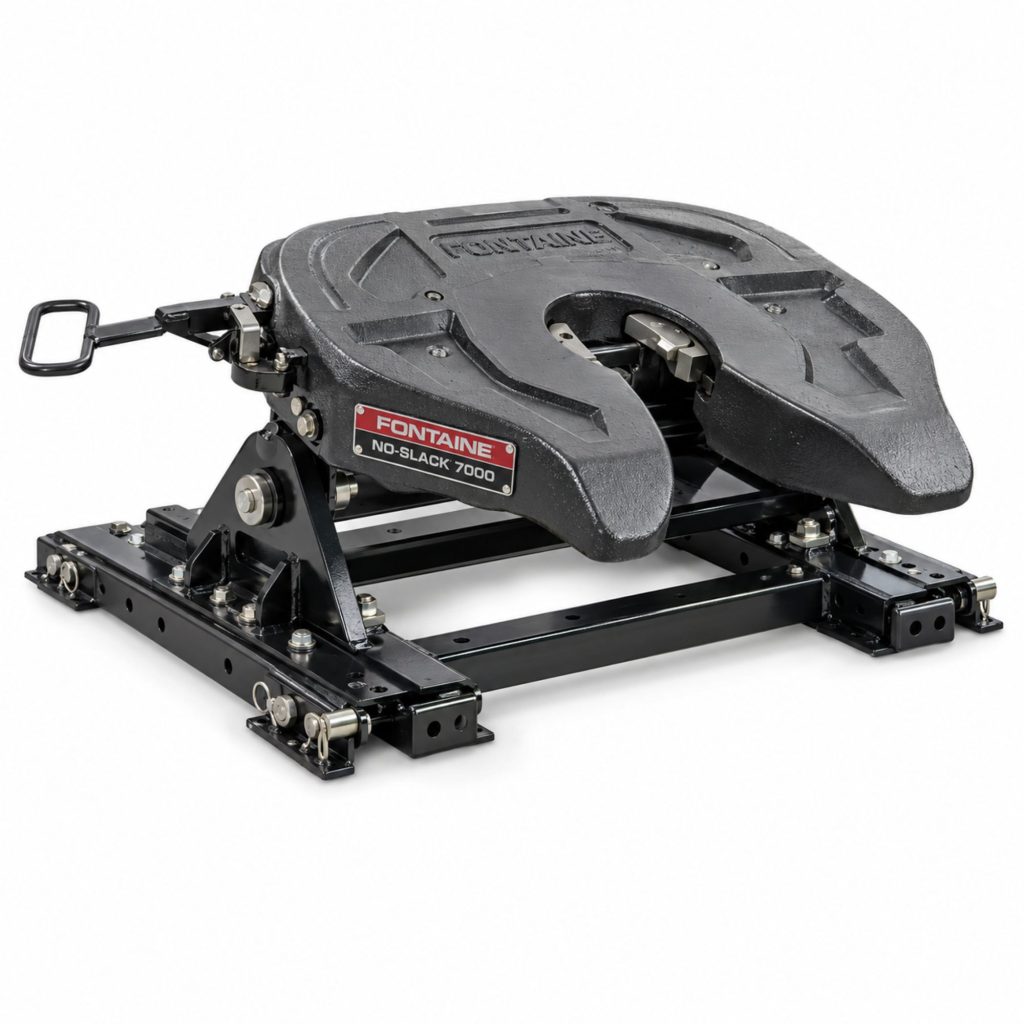
The Fontaine No-Slack 7000 is a cast-steel fifth wheel designed for standard through heavy-duty commercial-truck applications. It provides greater vertical-load capacity and a broader application range than the lighter stamped-steel Fontaine No-Slack 6000.
The 7000 uses Fontaine’s self-adjusting No-Slack locking mechanism. The lock automatically adjusts around the trailer kingpin as normal wear occurs, helping reduce movement, impact loading, and noise between the tractor and trailer.
The fifth wheel can be combined with compatible sliding or stationary Fontaine mounting systems. Manual-release, air-actuated, and application-specific configurations allow fleets to match the fifth wheel to the tractor, trailer, operating duty, and weight-distribution requirements.
Key Characteristics
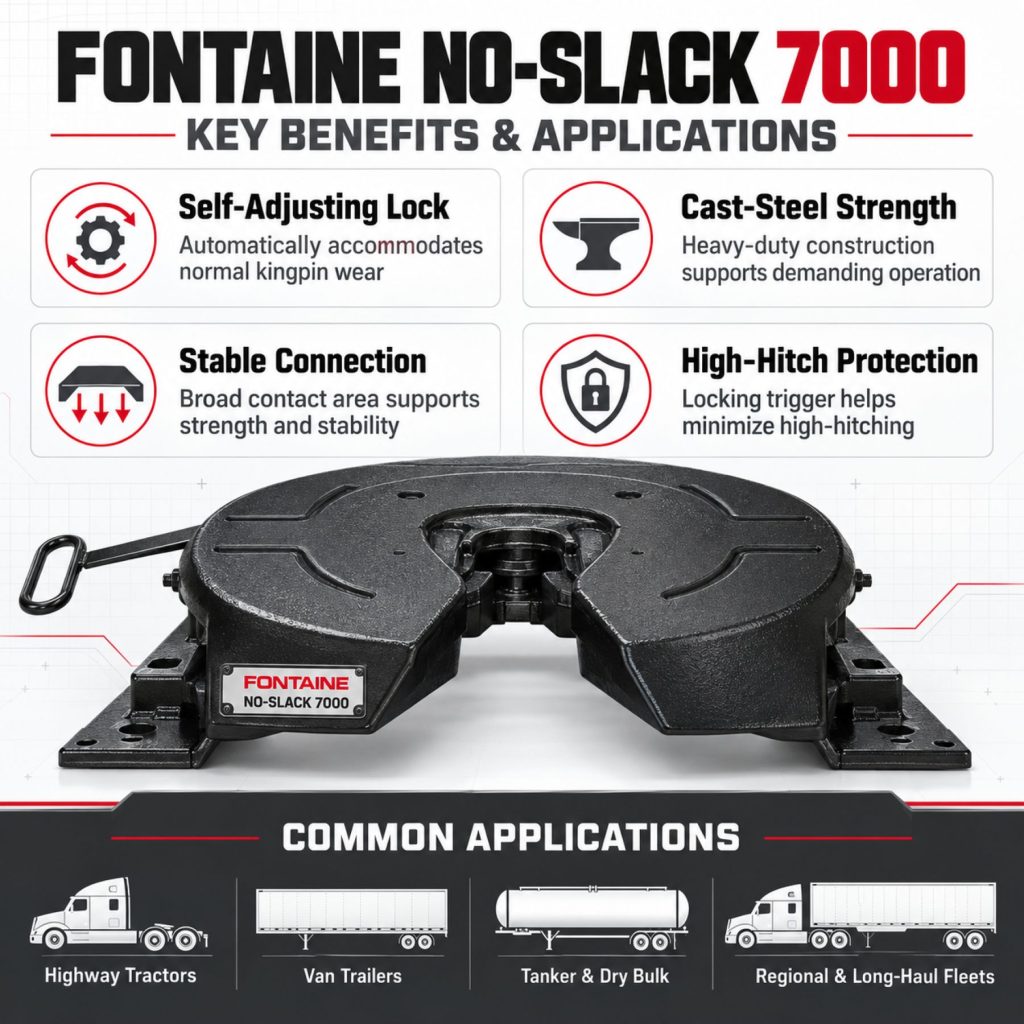
- Durable cast-steel top plate
- Patented self-adjusting No-Slack locking mechanism
- Positive secondary lock
- Locking trigger designed to reduce high coupling
- 55,000-pound maximum vertical-load rating
- 150,000-pound maximum drawbar-pull rating
- Standard 2-inch kingpin compatibility
- Manual and air-actuated release options
- Sliding and stationary mounting options
- Designed for standard through heavy-duty applications
- Suitable for approved on-highway and vocational service
- Replaceable locking and operating components
Major Components
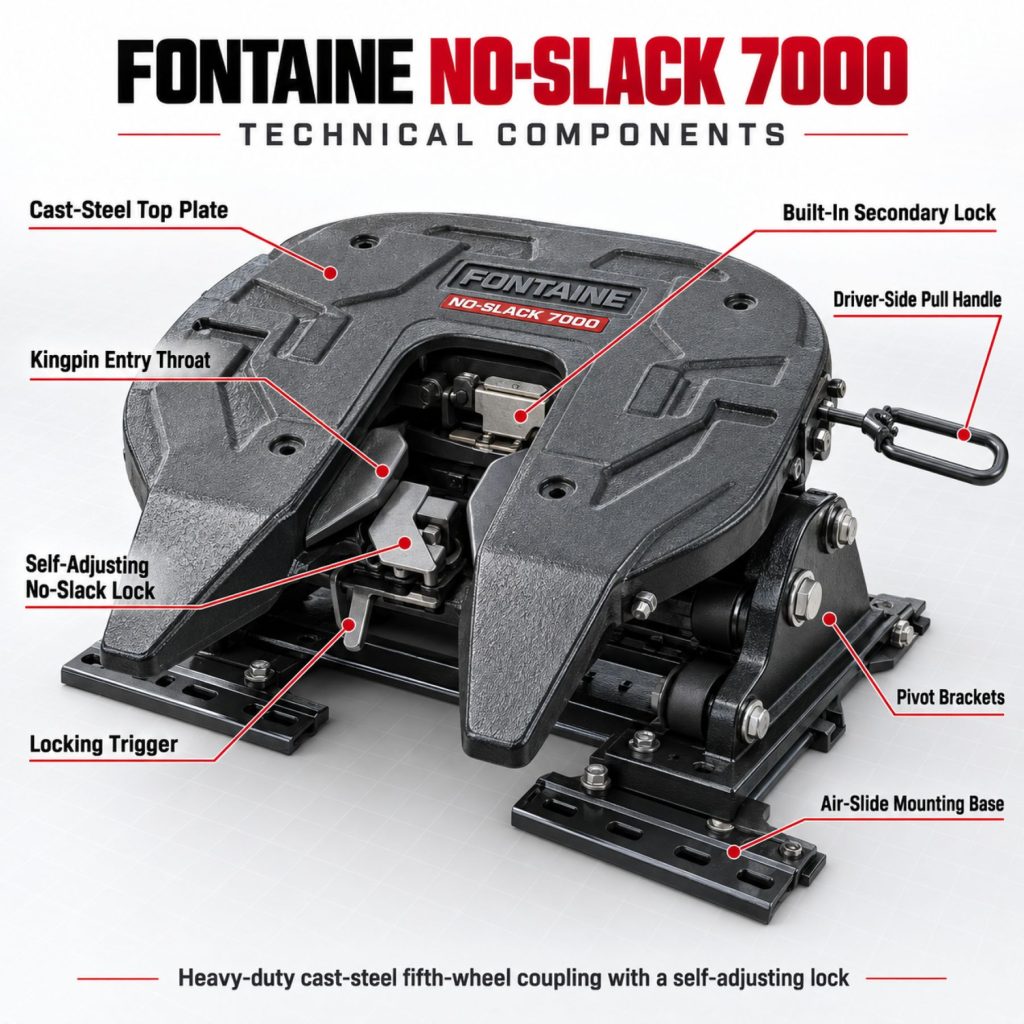
- Cast-steel top plate
- Fifth-wheel throat
- Self-adjusting lock
- Wedge and wedge-stop rod
- Locking trigger
- Positive secondary lock
- Operating handle
- Pull handle and linkage
- Pivot pins and bushings
- Mounting brackets
- Slider rails and locking components when equipped
- Optional air-release actuator and controls
- Lubrication points
Coupling Type and Design
The No-Slack 7000 is a conventional semi-oscillating fifth wheel with a cast-steel top plate. It permits front-to-rear articulation between the tractor and trailer while supporting the trailer’s imposed vertical load.
The locking system is designed around a standard 2-inch SAE trailer kingpin. Its self-adjusting mechanism maintains close contact with the kingpin as normal wear occurs within the approved service limits.
The 7000 is intended for a broader range of service than the lightweight No-Slack 6000. However, it is not a fully oscillating severe-duty fifth wheel and should only be used in applications approved by Fontaine.
How the Coupling System Works
As the tractor backs beneath the trailer, the kingpin enters the fifth-wheel throat and contacts the locking trigger. The primary lock closes around the kingpin, and the positive secondary lock helps prevent unintended release.
The No-Slack mechanism automatically adjusts to compensate for normal wear between the lock and kingpin. This helps control free movement that could otherwise cause:
- Tractor-trailer chucking
- Impact loading
- Coupling noise
- Accelerated component wear
- Reduced ride quality
The self-adjusting design does not compensate for components that have exceeded their approved wear limits. The lock and kingpin still require scheduled inspection and measurement.
Position and Function Within the Vehicle
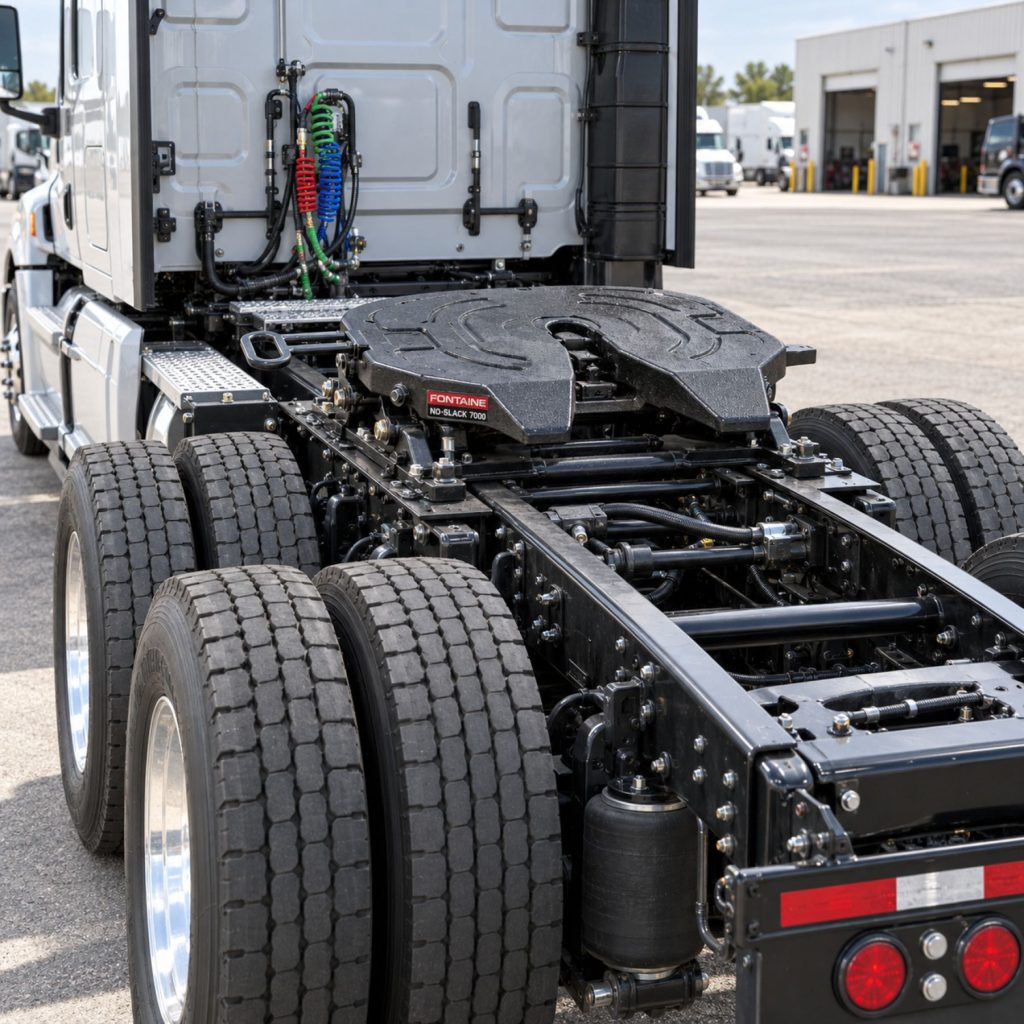
The No-Slack 7000 mounts above the tractor frame and rear-axle group. It forms the primary structural connection between the tractor and a compatible semitrailer.
Its primary functions are to:
- Support the front of the semitrailer
- Capture and retain the trailer kingpin
- Transfer pulling and braking forces
- Permit tractor-trailer articulation
- Help control movement between the tractor and trailer
- Distribute trailer weight through the tractor frame and axles
Common Specifications
- Top-Plate Construction: Cast steel
- Maximum Vertical Load: 55,000 pounds
- Maximum Drawbar Pull: 150,000 pounds
- Recommended Maximum GCW: Less than 140,000 pounds
- Kingpin Size: Standard 2-inch SAE kingpin
- Locking System: Self-adjusting Fontaine No-Slack lock
- Secondary Lock: Positive mechanical secondary lock
- Release: Manual or optional air actuation
- Mounting: Compatible sliding or stationary Fontaine mounting system
- Application Range: Standard through heavy-duty service
Mounting height, slider travel, assembly weight, bracket design, and complete part number depend on the selected mounting system and release configuration.
Load Ratings and Operating Capacity
The No-Slack 7000 is rated for a maximum vertical load of 55,000 pounds and a maximum drawbar pull of 150,000 pounds. Fontaine identifies the series for standard through heavy-duty applications with a gross combination weight below 140,000 pounds.
The fifth wheel’s rating does not independently establish the capacity of the complete tractor-trailer combination. Actual capacity remains limited by the lowest-rated component, including:
- Tractor frame and mounting structure
- Fifth-wheel mounting system
- Axles and suspension
- Tires and wheels
- Trailer kingpin
- Trailer upper coupler
- Trailer structure
- Certified axle and vehicle ratings
Articulation and Oscillation
The No-Slack 7000 permits front-to-rear top-plate articulation to accommodate normal road grades, ramps, loading-dock approaches, and tractor-trailer movement.
It does not provide the side-to-side movement of a fully oscillating fifth wheel. Severe cross-axle terrain, specialized lowboy work, and certain off-highway applications may require a different Fontaine fifth wheel or mounting arrangement.
Sliding and Adjustment System
The No-Slack 7000 can be installed on compatible Fontaine air-slide mounting systems. A slider allows the fifth wheel to move forward or rearward along the tractor frame.
Moving the fifth wheel can change:
- Steering-axle loading
- Drive-axle loading
- Tractor-to-trailer clearance
- Trailer swing clearance
- Landing-gear clearance
- Overall weight distribution
Available adjustment increments and slide travel depend on the selected mounting system. Every slider lock must be completely engaged and visually inspected before road operation.
Release and Locking Mechanism
The No-Slack mechanism automatically adjusts around the trailer kingpin to reduce free movement. A locking trigger activates the mechanism during coupling, while a positive secondary lock helps prevent accidental release.
Manual configurations use an external operating handle. Air-actuated models use a pneumatic actuator to operate the release linkage from a compatible control system.
The operator must never rely on handle position alone. Correct coupling must be confirmed through a controlled pull test and direct visual inspection of the lock around the kingpin.
Air and Electronic Controls
Standard manual-release configurations do not require air or electronic controls. Air-actuated versions require:
- A compatible tractor air supply
- Protected air lines and fittings
- A release-control valve
- A pneumatic actuator
- Appropriate operating interlocks when specified
Air-slide mounting systems also use compressed air to disengage their locking mechanism. Pneumatic operation does not replace visual inspection, a pull test, or approved coupling and slider procedures.
Mounting and Installation
The No-Slack 7000 must be installed with a Fontaine-approved mounting system and procedures appropriate for the tractor frame, vehicle ratings, and intended application.
Installation must provide:
- Adequate frame and mounting strength
- Correct fifth-wheel height
- Secure mounting fasteners
- Sufficient trailer swing clearance
- Landing-gear and tire clearance
- Access to the release mechanism
- Correct air-line routing when equipped
- Proper slider travel and stop locations
Vehicle Frame and Mounting Compatibility
Compatibility depends on:
- Tractor manufacturer and model
- Frame width and rail construction
- Rear-axle arrangement
- Suspension configuration
- Required fifth-wheel height
- Available mounting length
- Required slider travel
- Trailer swing and landing-gear clearance
- Completed vehicle weight distribution
- Intended operating duty
A fifth wheel should not be selected solely by vertical-load rating. The complete tractor, mounting system, trailer, and operating application must be evaluated together.
Mating Component and Trailer Compatibility
The No-Slack 7000 must be paired with an approved standard 2-inch SAE kingpin and compatible trailer upper-coupler plate.
The following mating components must be inspected and matched to the fifth wheel:
- Trailer kingpin size and profile
- Kingpin wear and damage
- Upper-coupler flatness
- Upper-coupler structural condition
- Trailer load rating
- Trailer swing clearance
- Landing-gear clearance
- Electrical and air-line clearance
Common Applications
- Over-the-road tractors
- Regional-haul tractors
- Dry-van operations
- Refrigerated-freight operations
- Tanker tractors
- Flatbed operations
- Approved vocational tractors
- Standard through heavy-duty highway service
- Fleets requiring adjustable fifth-wheel positioning
Advantages
- Durable cast-steel construction
- Self-adjusting kingpin lock
- Reduced tractor-trailer slack
- Positive secondary lock
- Locking trigger helps reduce high coupling
- Greater capacity than the No-Slack 6000
- Sliding and stationary mounting choices
- Manual and air-release options
- Broad highway and vocational application range
- Established replacement-parts support
Limitations or Considerations
- Not intended for every severe-duty or off-highway application
- Recommended GCW must remain below 140,000 pounds
- Top plate requires regular lubrication
- Lock and wedge-stop adjustment require inspection
- Slider systems add maintenance points
- Does not provide full side-to-side oscillation
- Cast construction is heavier than the stamped-steel 6000
- Does not increase the tractor’s certified ratings
- Requires a compatible 2-inch kingpin and upper coupler
Driver and Operator Experience
The self-adjusting lock helps reduce chucking, noise, and impact between the tractor and trailer. A properly maintained 7000 should provide a secure coupling and predictable articulation during highway operation.
On sliding installations, the driver can reposition the fifth wheel to adjust axle loading and tractor-to-trailer clearance. Drivers must confirm slider-lock engagement after every adjustment and verify legal axle weights on a certified scale.
Coupling and Uncoupling Procedure
Before coupling:
- Inspect the top plate and locking mechanism
- Confirm the lock is open
- Check the trailer kingpin and upper coupler
- Verify correct trailer height
- Inspect fifth-wheel lubrication
- Confirm the mounting system is secure
After coupling:
- Perform a controlled pull test
- Visually confirm the lock is closed around the kingpin
- Confirm the secondary lock is engaged
- Verify there is no gap between the mating plates
- Connect and inspect the trailer air and electrical lines
- Raise and secure the landing gear
Before uncoupling, secure the tractor and trailer, place the landing gear on suitable ground, relieve binding from the lock, and follow Fontaine and fleet procedures. This overview does not replace the manufacturer’s operating instructions.
Inspection and Wear Points
- Lock and kingpin contact surfaces
- Wedge and wedge-stop rod
- Locking trigger
- Positive secondary lock
- Operating and pull handles
- Top-plate surface and throat
- Pivot pins and bushings
- Mounting brackets and fasteners
- Slider rails, wedges, stops, and locking points
- Air lines and actuators when equipped
- Trailer kingpin
- Trailer upper-coupler plate
Lubrication Requirements
The No-Slack 7000 requires lubrication of the top-plate surface, locking mechanism, pivot points, and applicable slider components according to Fontaine’s service instructions.
During cold-weather or contaminated service:
- Remove hardened or contaminated grease
- Clean the locking mechanism
- Inspect the operating components
- Apply the manufacturer-approved lubricant
- Confirm free lock and release operation
Poor lubrication can increase steering resistance, accelerate wear, interfere with coupling or release, and place additional stress on the tractor and trailer.
Maintenance and Ownership Notes
Routine maintenance should include:
- Cleaning and lubricating the top plate
- Inspecting the lock and secondary lock
- Checking wedge-stop rod adjustment
- Measuring kingpin wear
- Inspecting pivot pins and bushings
- Checking mounting fasteners and brackets
- Inspecting slider rails and locks
- Testing air-release or air-slide controls
- Checking for cracks, distortion, and corrosion
The complete model and assembly numbers should be used when ordering rebuild kits, mounting components, or replacement parts.
Common Coupling Problems
- High coupling: Incorrect trailer height allows the kingpin to pass above the locking mechanism instead of entering through the throat.
- Failure to lock: Dirt, damage, binding, poor lubrication, incorrect trailer height, or worn components may prevent full engagement.
- Difficult release: Pressure against the lock, dry components, damaged linkage, corrosion, or improper adjustment may restrict the operating handle.
- Excessive kingpin movement: A worn kingpin, lock, wedge, or incorrectly adjusted wedge-stop rod may create excessive slack.
- Slider will not move: Low air pressure, damaged air lines, corroded rails, binding, or a failed actuator may prevent adjustment.
- Slider locks will not engage: Misalignment, damaged wedges, contamination, worn components, or incorrect tractor positioning may prevent engagement.
- Air-release failure: Low pressure, damaged lines, valve problems, linkage binding, or actuator failure may prevent release.
- Accelerated top-plate wear: Poor lubrication, a damaged trailer upper coupler, contamination, or overloading may damage the bearing surfaces.
Safety and Service Precautions
Never rely on release-handle position alone to confirm coupling. Before moving the vehicle:
- Perform a controlled pull test
- Inspect the lock around the kingpin
- Confirm the secondary lock is engaged
- Check for a gap between the mating plates
- Verify slider locks are engaged when equipped
Never place any part of the body between unsecured vehicles or beneath an unsupported trailer. Do not weld, heat, grind, drill, straighten, or modify structural components unless specifically permitted by Fontaine’s service instructions.
Identification Information
Record the following information before ordering parts or a replacement assembly:
- Fontaine model and assembly number
- Top-plate part number
- Serial or production information
- Manual or air-release configuration
- Sliding or stationary mounting type
- Mounting height
- Slider travel and adjustment increments
- Bracket and rail design
- Vehicle identification number
- Kingpin size and condition
Do not identify replacement components solely by appearance. Similar Fontaine assemblies may use different brackets, mounting heights, release systems, and slider components.
Buying Considerations
- Confirm vertical-load and drawbar-pull requirements
- Verify that GCW remains within the approved application range
- Choose between sliding and stationary mounting
- Confirm mounting height and required slider travel
- Select manual or air-actuated release
- Verify tractor-frame compatibility
- Check trailer swing and landing-gear clearance
- Confirm kingpin and upper-coupler compatibility
- Review assembly weight and payload requirements
- Confirm genuine replacement-parts availability
- Use the Fontaine application guide before ordering
Variants and Configurations
Common No-Slack 7000 configurations may include:
- Manual-release top plate
- Air-actuated release top plate
- Fontaine sliding mounting systems
- Fontaine stationary mounting systems
- Different mounting heights
- Different slider travels
- Application-specific bracket and rail designs
- Lock-sensor configurations where offered
The related No-Slack 7000 Clean Connect uses replaceable low-friction top-plate inserts and should be treated as a separate product configuration. Complete part numbers must be verified before ordering.
Comparison to Similar Equipment
Compared with the Fontaine No-Slack 6000 Fifth Wheel, the 7000 uses a cast top plate, carries a higher vertical-load rating, and supports a broader duty range.
Compared with the Fontaine No-Slack 7000 Clean Connect Fifth Wheel, the standard 7000 requires conventional lubrication between the fifth wheel and trailer upper coupler.
Compared with the Fontaine No-Slack H7 Fifth Wheel, the 7000 has lower maximum capacity and is not intended for the same extra-heavy or severe-duty applications.
Compared with the Holland FW35 Fifth Wheel, the No-Slack 7000 uses Fontaine’s self-adjusting lock and Fontaine-specific mounting-system options.
Best Fit For
- Standard through heavy-duty highway tractors
- Combinations below Fontaine’s stated GCW limit
- Regional and long-haul fleets
- Dry-van and refrigerated operations
- Tanker and flatbed operations
- Approved vocational applications
- Fleets wanting a self-adjusting kingpin lock
- Applications requiring sliding or stationary mounting choices
Related Vehicle and Trailer Types
- Complete Guide to Semi Truck Types
- Day Cab Trucks
- Sleeper Trucks
- Dry Van Trailers
- Refrigerated Trailers
- Tank Trailers
- Flatbed Trailers
Related Truck and Trailer Models
- Freightliner Cascadia
- Kenworth T680
- Peterbilt 579
- Volvo VNL
- International LT Series
- Mack Anthem
- Western Star 57X
Related Coupling Types
- Commercial Truck Fifth Wheels
- Fifth Wheel Sliders & Mounting Systems
- Heavy-Haul & Severe-Duty Fifth Wheels
- Trailer Kingpins & Upper Couplers
- Terminal Tractor & Yard Coupling Systems
Related Coupling Products
- Fontaine No-Slack 6000 Fifth Wheel
- Fontaine No-Slack 7000 Clean Connect Fifth Wheel
- Fontaine No-Slack H7 Fifth Wheel
- Holland FW35 Fifth Wheel
- JOST JSK37U Fifth Wheel
Related Equipment Systems
- Fifth Wheels & Coupling Equipment
- Suspension Systems
- Axles & Differentials
- Brake Systems
- Tires & Wheels
- Equipment Systems
Related Guides
- Fifth Wheel System Explained
- Fixed vs Sliding Fifth Wheels
- How to Couple and Uncouple a Semi-Trailer Safely
- How to Inspect and Maintain a Fifth Wheel and Kingpin
- How to Choose a Commercial Truck Fifth Wheel
Regulatory and Compliance Notes
The fifth wheel, mounting system, kingpin, upper coupler, tractor, and trailer must comply with applicable commercial-vehicle construction and operating requirements.
The 7000’s mechanical capacity does not override:
- Gross axle weight ratings
- Gross vehicle weight ratings
- Gross combination weight ratings
- Frame and suspension ratings
- Tire and wheel ratings
- Kingpin and upper-coupler ratings
- Federal, state, provincial, or local weight limits
Real World Operating Notes
The self-adjusting No-Slack mechanism can reduce tractor-trailer chucking, but it cannot compensate for a kingpin or locking component that has exceeded its wear limit. Regular inspection and measurement remain necessary.
When a slider is fitted, the fifth wheel should be repositioned on level ground with the tractor and trailer aligned. After adjustment, the driver should inspect the locks and verify axle weights on a certified scale.
Cold weather, road salt, dirt, and old grease can interfere with locking and release. Cleaning and lubrication should be increased when operating conditions are severe.
Frequently Asked Questions
What is the Fontaine No-Slack 7000?
It is a cast-steel fifth wheel designed for standard through heavy-duty commercial-truck applications.
What are the No-Slack 7000 load ratings?
Fontaine rates the 7000 for a maximum vertical load of 55,000 pounds and maximum drawbar pull of 150,000 pounds.
What does No-Slack mean?
The locking mechanism automatically adjusts around the trailer kingpin to control free movement as normal wear occurs.
What kingpin does the 7000 use?
It is designed for a standard 2-inch SAE semitrailer kingpin.
Can the No-Slack 7000 be installed on a slider?
Yes. It can be combined with compatible Fontaine sliding or stationary mounting systems.
Is an air release available?
Yes. Manual and air-actuated configurations are available for approved applications.
Is the 7000 the same as the 7000 Clean Connect?
No. The standard 7000 uses conventional top-plate lubrication. The 7000 Clean Connect uses replaceable low-friction inserts on the top-plate surface.
Can the No-Slack 7000 be used for severe-duty heavy haul?
Not automatically. Extra-heavy, severe-duty, or combinations exceeding the 7000’s application limits may require the Fontaine No-Slack H7 or another approved fifth wheel.
Does the self-adjusting lock eliminate maintenance?
No. The lock, wedge-stop rod, kingpin, top plate, pivots, mounting system, and slider components still require inspection, adjustment, and lubrication.
How are the correct replacement parts identified?
Use the complete Fontaine assembly number, top-plate number, mounting type, release configuration, installed height, and slider travel.
Availability and Where to Find
Fontaine No-Slack 7000 assemblies, top plates, mounting systems, rebuild kits, release components, and replacement parts may be available through Fontaine distributors, commercial-truck dealers, fleet-parts suppliers, fifth-wheel specialists, and heavy-duty repair facilities.
Availability depends on the required mounting height, slider travel, release configuration, bracket design, and complete assembly number.
Current specifications, literature, parts information, instructional material, and distributor resources are available through the Fontaine No-Slack 7000 product page and the Fontaine Fifth Wheel literature library.
Support Trucking Families
Truck Equipment Atlas supports the mission of Grey Cross, a nonprofit dedicated to helping families of truck drivers who lose their lives while on the road. As the site grows, part of its mission is to bring awareness and support to these families.
Podcast or Video Section
Learn More Through Audio and Video
Truck Equipment Atlas will continue expanding with podcast episodes, interviews, and equipment breakdowns to help drivers and fleets better understand trucks and equipment.
Follow the Growth of Truck Equipment Atlas
Truck Equipment Atlas continues to expand with new truck profiles, trailer coverage, diesel engine pages, equipment system resources, manufacturer information, and educational guides.
Visit our Site Updates page to explore recent additions, project milestones, and upcoming resources as we continue building one of the industry’s growing commercial trucking equipment reference libraries.
View the Latest Site Updates: Truck Equipment Atlas Site Updates