
Quick Facts
- Manufacturer: Fontaine Fifth Wheel
- Product Series: H7
- Product Type: Extra-heavy and severe-duty fifth wheel
- Top-Plate Construction: Steel-reinforced cast housing
- Duty Classification: Extra-heavy to severe-duty on- and off-highway service
- AWB Maximum Vertical Load: 62,500 pounds
- AWB Maximum Drawbar Pull: 150,000 pounds
- AWX and PS5 Maximum Vertical Load: 70,000 pounds
- AWX and PS5 Maximum Drawbar Pull: 200,000 pounds
- Kingpin Compatibility: Standard 2-inch SAE kingpin
- Locking System: Enhanced self-adjusting Fontaine No-Slack mechanism
- Mounting Options: Sliding, stationary, convertible tilt/no-tilt, and blocked no-tilt configurations
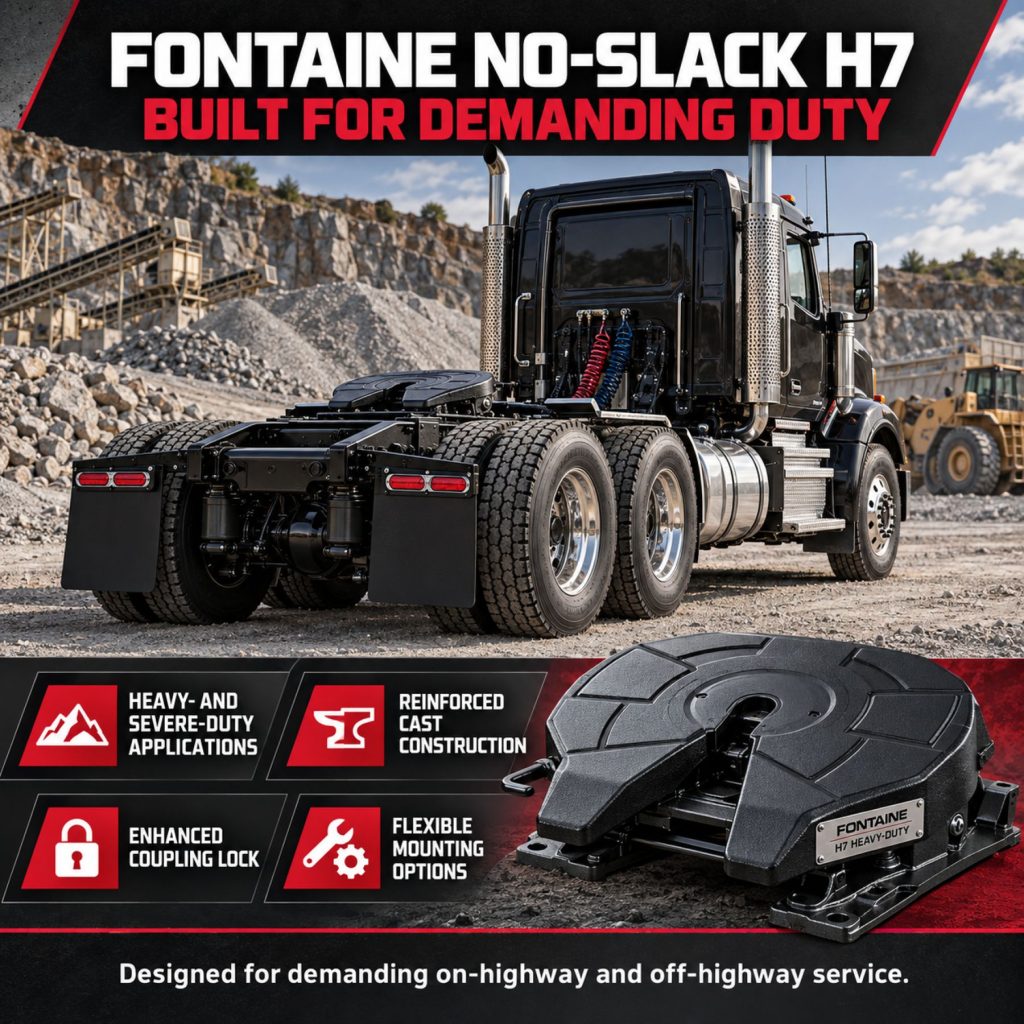
- Primary Applications: Heavy haul, construction, mining, logging, frameless dumps, vocational trucks, and severe off-highway operations
- Production Status: Current heavy- and severe-duty Fontaine product
Overview
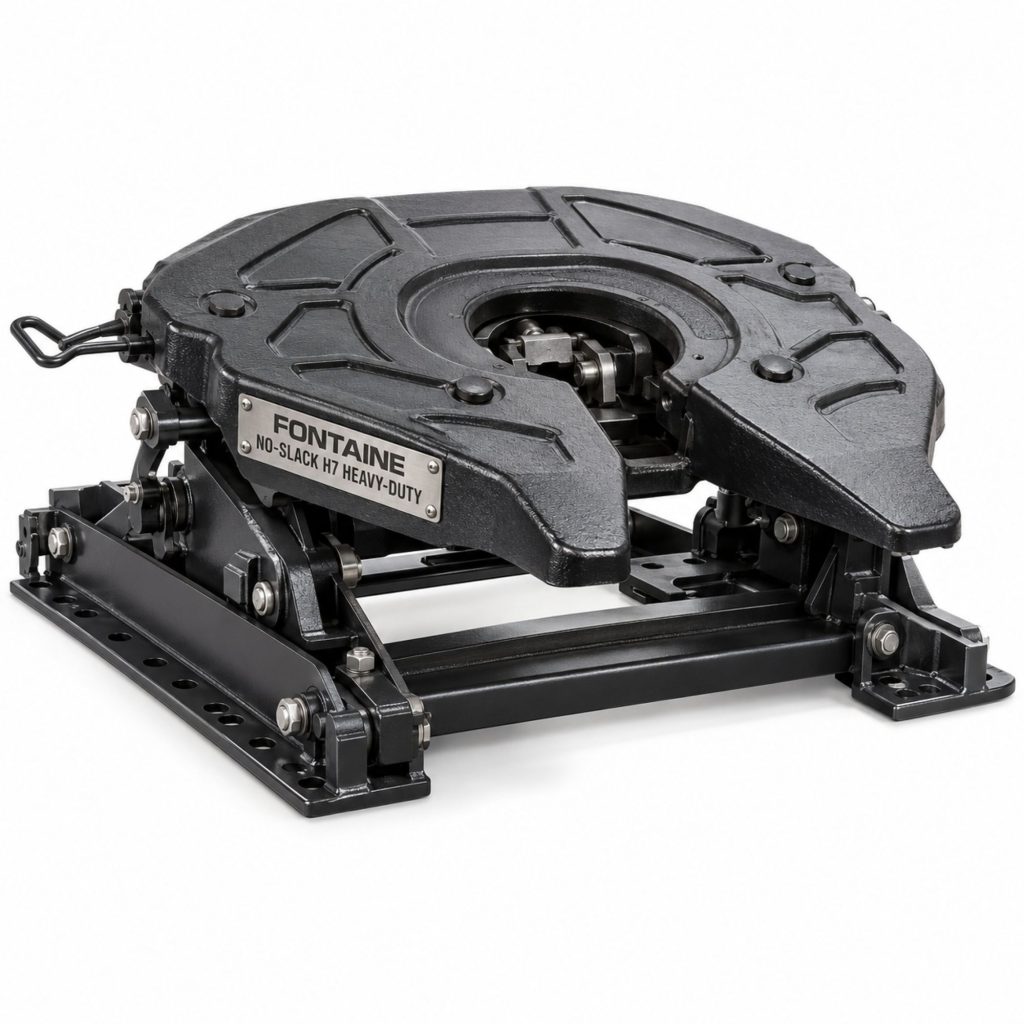
The Fontaine H7 Heavy-Duty Fifth Wheel is an extra-heavy and severe-duty coupling system designed for demanding on-highway, vocational, and off-highway tractor-trailer applications. It combines Fontaine’s self-adjusting No-Slack locking technology with a reinforced cast top-plate housing.
The H7 is available with multiple mounting systems that affect its capacity and function. AWB air-slide assemblies support applications requiring fifth-wheel repositioning, while higher-capacity AWX and PS5 configurations are available for demanding heavy-haul service.
Blocked and convertible no-tilt configurations can support frameless dump applications that require the fifth wheel to remain rigid rather than pivoting normally. Because capacity and permitted operation depend on the selected mounting system, the complete H7 assembly must be identified before installation, operation, or parts ordering.
Key Characteristics
- Steel-reinforced cast top-plate housing
- Extra-heavy and severe-duty construction
- Self-adjusting No-Slack locking mechanism
- Positive secondary lock
- Standard 2-inch kingpin compatibility
- Mount-dependent load ratings
- Sliding and stationary mounting options
- Approved on- and off-highway applications
- Blocked no-tilt configurations
- Convertible tilt/no-tilt mounting systems
- Compatible with frameless dump applications when correctly configured
- Shared service components with other Fontaine No-Slack models
Major Components
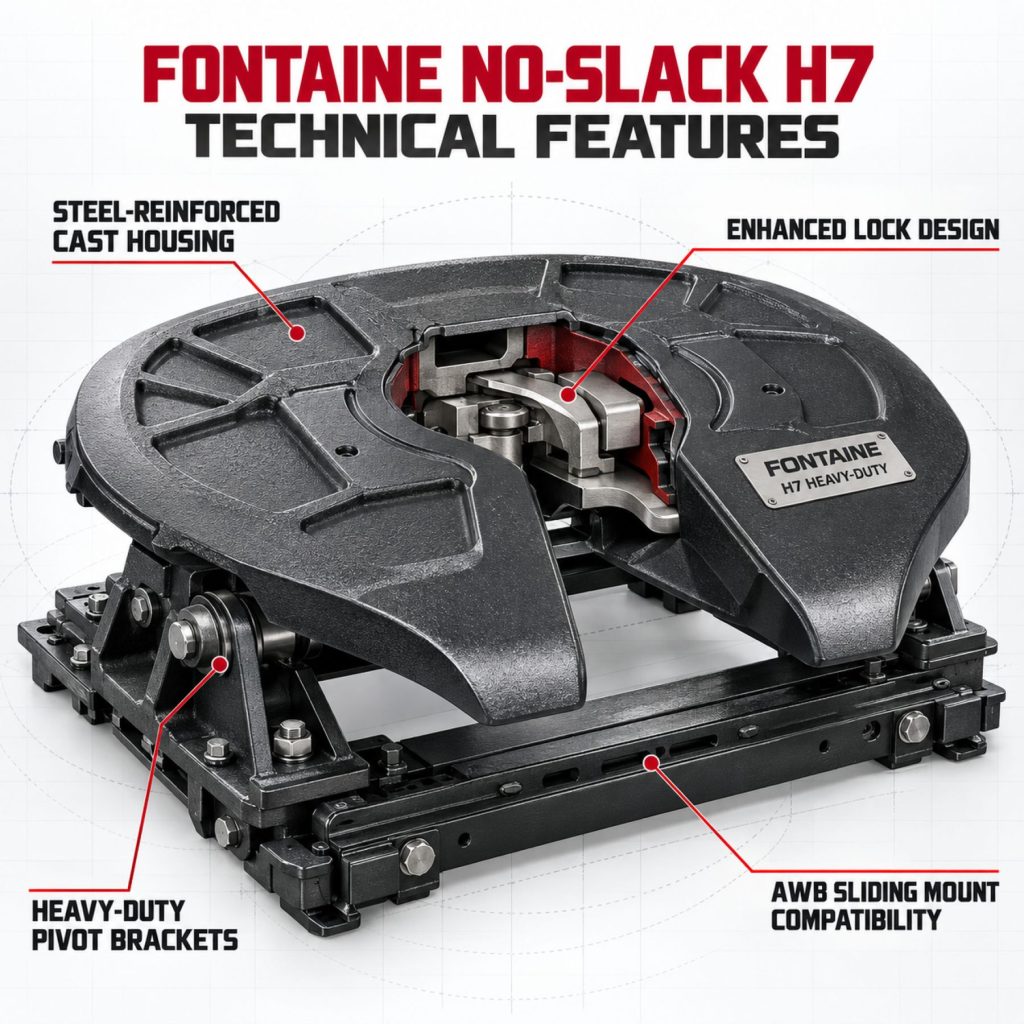
- Steel-reinforced cast top plate
- Fifth-wheel throat
- Enhanced self-adjusting lock
- Wedge and wedge-stop rod
- Locking trigger
- Positive secondary lock
- H7 operating handle and pull handle
- Release linkage
- Pivot pins and bushings
- Mounting brackets
- Slider rails and locking wedges when equipped
- No-tilt blocks or conversion components when equipped
- Mounting plate and structural reinforcement
- Lubrication points
Coupling Type and Design
The H7 is a heavy-duty fifth-wheel coupling designed for a standard 2-inch SAE kingpin. In its normal tilting configuration, the top plate pivots forward and rearward to accommodate tractor-trailer articulation.
The reinforced cast housing provides additional capacity for heavy and severe-duty service. Fontaine’s No-Slack mechanism automatically adjusts around the kingpin as normal wear occurs, helping reduce movement and impact between the tractor and trailer.
When paired with an approved blocked or no-tilt mounting system, the fifth wheel can be prevented from pivoting for specific frameless dump-trailer applications. No-tilt operation must not be used with a conventional trailer that requires normal fifth-wheel articulation.
How the Coupling System Works
As the tractor backs beneath the trailer, the kingpin enters the fifth-wheel throat and activates the locking trigger. The primary lock closes around the kingpin, while the positive secondary lock helps prevent unintended release.
The No-Slack mechanism automatically compensates for normal wear within its approved service range. This helps reduce:
- Tractor-trailer chucking
- Coupling noise
- Impact loading
- Kingpin-to-lock movement
- Accelerated component wear
The fifth wheel transfers the trailer’s vertical load and pulling forces into the mounting system and tractor frame. Mounting-system selection determines how much load the complete assembly can safely carry.
Position and Function Within the Vehicle
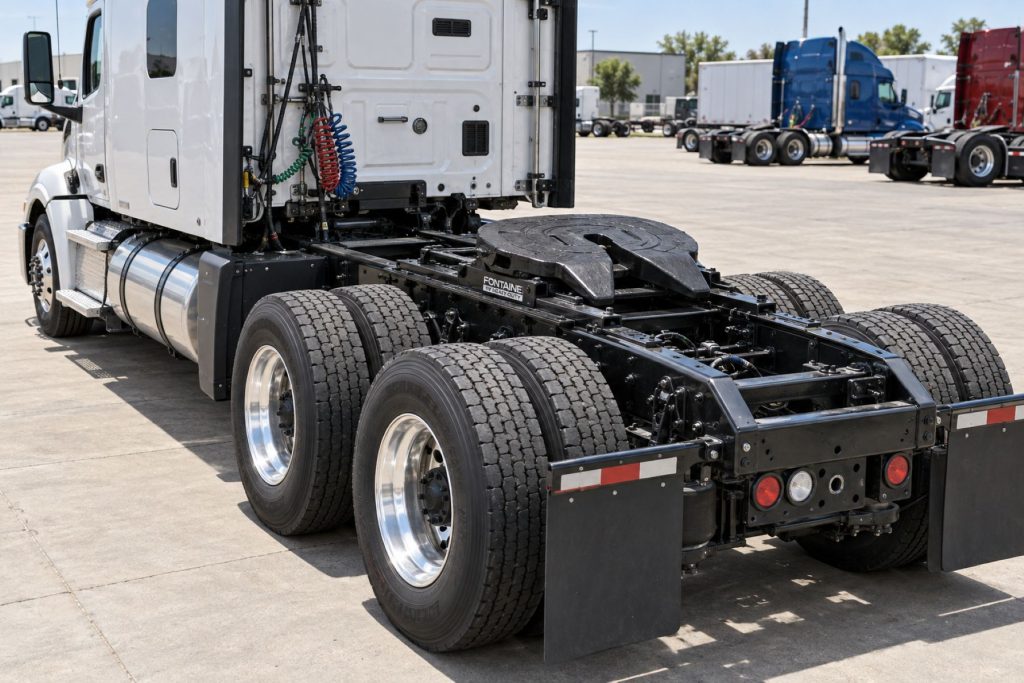
The H7 mounts above the tractor’s rear frame and axle group. It forms the primary structural connection between the tractor and a compatible semitrailer.
Its primary functions are to:
- Support the front of the semitrailer
- Capture and retain the trailer kingpin
- Transfer pulling and braking forces
- Permit articulation when used in tilting mode
- Provide rigid support in approved no-tilt applications
- Distribute trailer weight through the tractor frame and axles
- Control movement between the tractor and trailer
Common Specifications
- Top-Plate Construction: Steel-reinforced cast housing
- AWB Maximum Vertical Load: 62,500 pounds
- AWB Maximum Drawbar Pull: 150,000 pounds
- AWX Maximum Vertical Load: 70,000 pounds
- AWX Maximum Drawbar Pull: 200,000 pounds
- PS5 Maximum Vertical Load: 70,000 pounds
- PS5 Maximum Drawbar Pull: 200,000 pounds
- Kingpin Size: Standard 2-inch SAE kingpin
- Locking System: Enhanced self-adjusting Fontaine No-Slack lock
- Secondary Lock: Positive mechanical secondary lock
- Mounting Options: AWB, blocked AWB, AWX, PS5, blocked PS5, PMH, PMX, HDS, and HDI configurations where approved
- Articulation: Standard tilting or approved no-tilt configuration
- Application Range: Extra-heavy and severe-duty on- and off-highway service
Capacity, gross combination weight, mounting height, slide travel, assembly weight, and permitted application depend on the complete H7 mounting configuration. Confirm all specifications using the full assembly number and current Fontaine application guide.
Load Ratings and Operating Capacity
The H7’s ratings depend directly on its mounting system. Fontaine rates AWB configurations for 62,500 pounds of maximum vertical load and 150,000 pounds of maximum drawbar pull.
Approved AWX and PS5 configurations increase capacity to 70,000 pounds of maximum vertical load and 200,000 pounds of maximum drawbar pull.
The highest top-plate rating cannot be applied to a lower-rated mounting system. Actual vehicle capacity remains limited by the lowest-rated component, including:
- Fifth-wheel mounting system
- Tractor frame
- Axles and suspension
- Tires and wheels
- Trailer kingpin
- Trailer upper coupler
- Trailer structure
- Certified vehicle ratings
Articulation and Oscillation
In a standard tilting configuration, the H7 pivots forward and rearward to accommodate normal tractor-trailer movement over road grades, ramps, and uneven surfaces.
The H7 is not a fully oscillating fifth wheel and does not provide unrestricted side-to-side articulation. Operations requiring full lateral oscillation may need a different coupling design.
In an approved no-tilt configuration, the top plate is prevented from pivoting. This arrangement supports frameless dump trailers that articulate through their rear connection during unloading.
Sliding and Adjustment System
AWB, AWX, HDS, and HDI sliding configurations allow the fifth wheel to move forward or rearward along the tractor frame. Repositioning the fifth wheel can change:
- Steering-axle loading
- Drive-axle loading
- Tractor-to-trailer clearance
- Trailer swing clearance
- Landing-gear clearance
- Overall vehicle weight distribution
Slide travel, adjustment increments, frame attachment, and capacity depend on the selected mounting system. Every slider lock must be fully engaged and inspected before road operation.
Release and Locking Mechanism
The enhanced No-Slack lock automatically adjusts around the trailer kingpin to reduce free movement. A locking trigger initiates coupling, while the secondary lock helps prevent accidental release.
The H7 uses model-specific operating-handle and pull-handle components. Although it shares many service kits with Fontaine 6000 and 7000 fifth wheels, H7 handle components should not be assumed interchangeable.
Correct coupling must always be confirmed through a controlled pull test and direct visual inspection of the lock around the kingpin.
Air and Electronic Controls
Standard side-release H7 configurations use a mechanical operating handle and do not require electronic controls.
Air-slide configurations require:
- A compatible tractor air supply
- Protected air lines and fittings
- A slide-control valve
- A pneumatic cylinder
- Mechanical linkage to the slide-locking wedges
Control availability differs among H7 assemblies. The full model number must be checked before assuming that an air-release or electronic option is available.
Mounting and Installation
The H7 must be installed using a Fontaine-approved mounting system and procedures appropriate for its capacity, tractor frame, and operating application.
Installation must provide:
- Adequate tractor-frame strength
- Correct mounting-plate reinforcement
- Approved mounting fasteners
- Correct fifth-wheel height
- Required trailer swing clearance
- Landing-gear and tire clearance
- Correct slide travel and stop locations
- Protected air-line routing when equipped
- Correct tilt or no-tilt configuration
No-tilt installations require particular attention because incorrect use can transfer damaging forces into a conventional trailer or tractor frame.
Vehicle Frame and Mounting Compatibility
Compatibility depends on:
- Tractor manufacturer and model
- Frame width and rail construction
- Frame reinforcement
- Rear-axle arrangement
- Suspension configuration
- Required fifth-wheel height
- Available mounting length
- Required slider travel
- Trailer swing and landing-gear clearance
- Intended on- or off-highway duty
- Required tilt or no-tilt operation
The complete mounting system—not the top plate alone—determines the assembly’s approved capacity and application range.
Mating Component and Trailer Compatibility
The H7 must be paired with an approved 2-inch SAE kingpin and compatible trailer upper-coupler structure.
Compatibility checks should include:
- Kingpin size, profile, and wear
- Upper-coupler flatness and structural condition
- Trailer load rating
- Trailer center of gravity
- Trailer swing clearance
- Landing-gear clearance
- Required articulation
- Suitability for no-tilt operation when applicable
A conventional semitrailer that depends on fifth-wheel articulation must not be coupled to an H7 locked in no-tilt mode.
Common Applications
- Heavy-haul tractors
- Construction tractors
- Mining and quarry vehicles
- Logging tractors
- Oilfield-service vehicles
- Frameless dump trailers with approved no-tilt assemblies
- Heavy vocational tractors
- On- and off-highway severe-duty operations
- Specialized industrial transport
Advantages
- Up to 70,000 pounds of vertical capacity with approved mounts
- Up to 200,000 pounds of drawbar-pull capacity with approved mounts
- Steel-reinforced cast housing
- Self-adjusting No-Slack lock
- Reduced kingpin-to-lock movement
- Sliding and stationary mounting choices
- Approved severe-duty on- and off-highway applications
- Convertible and blocked no-tilt options
- Support for approved frameless dump applications
- Established parts and rebuild support
Limitations or Considerations
- Capacity varies by mounting system
- Higher-capacity top-plate ratings cannot be applied to lower-rated mounts
- Heavy construction adds tractor weight
- Requires regular lubrication and inspection
- Sliding systems add maintenance points
- No-tilt operation is only appropriate for specific trailers
- Does not provide full side-to-side oscillation
- Off-highway service may require shorter maintenance intervals
- Does not increase the tractor’s certified ratings
- Some configurations may only be available as first-fit equipment
Driver and Operator Experience
The self-adjusting lock helps reduce chucking and impact between the tractor and trailer. Sliding configurations allow drivers to reposition the fifth wheel for axle-weight and clearance adjustments.
Drivers using a no-tilt H7 must understand that the coupling will not pivot like a conventional fifth wheel. The tractor and trailer must be correctly aligned, and the configuration must only be used with an approved trailer.
Coupling and Uncoupling Procedure
Before coupling:
- Inspect and lubricate the top plate
- Confirm the locking mechanism is open
- Inspect the trailer kingpin and upper coupler
- Verify the correct trailer height
- Confirm the mounting system is secure
- Verify the correct tilt or no-tilt configuration
After coupling:
- Perform a controlled pull test
- Visually inspect the lock around the kingpin
- Confirm the secondary lock is engaged
- Verify there is no gap between the mating plates
- Confirm slider locks are engaged when equipped
- Connect and inspect air and electrical lines
- Raise and secure the trailer landing gear
These steps provide a general overview and do not replace Fontaine instructions or fleet safety procedures.
Inspection and Wear Points
- Lock and kingpin contact surfaces
- Wedge and wedge-stop rod
- Locking trigger
- Positive secondary lock
- H7 operating and pull handles
- Top-plate surface and throat
- Pivot pins and bushings
- Mounting brackets and reinforcement
- Slider rails, wedges, stops, and locks
- No-tilt blocks and conversion components
- Air lines and slide actuator
- Trailer kingpin and upper coupler
- Tractor frame and mounting fasteners
Lubrication Requirements
The top-plate surface, locking mechanism, wedge, pivot points, bracket contact areas, and applicable slider components require the manufacturer-specified lubricant and service intervals.
Severe-duty conditions that may require more frequent cleaning and lubrication include:
- Mud and abrasive dust
- Mining and quarry service
- Logging operations
- Water and road-salt exposure
- Cold-weather operation
- Frequent coupling and uncoupling
- Heavy off-highway loads
Maintenance and Ownership Notes
Routine H7 maintenance should include:
- Cleaning and lubricating the top plate
- Inspecting the primary and secondary locks
- Checking wedge-stop rod adjustment
- Measuring kingpin wear
- Inspecting H7-specific handle components
- Checking pivot pins and bushings
- Inspecting mounting brackets and fasteners
- Checking slider rails and locking wedges
- Inspecting no-tilt components when equipped
- Testing pneumatic slide controls
- Checking for cracks, distortion, and corrosion
Off-highway and severe-duty vehicles should be inspected more frequently than vehicles operating primarily on paved highways.
Common Coupling Problems
- High coupling: Incorrect trailer height allows the kingpin to pass above the lock instead of entering through the throat.
- Failure to lock: Dirt, damage, binding, poor lubrication, incorrect trailer height, or worn components may prevent engagement.
- Difficult release: Pressure against the lock, damaged linkage, corrosion, contamination, or incorrect adjustment may restrict the handle.
- Excessive kingpin movement: A worn kingpin, lock, wedge, or incorrectly adjusted wedge-stop rod may create excessive slack.
- Slider will not move: Low air pressure, damaged lines, corrosion, contaminated rails, or tractor-trailer binding may prevent adjustment.
- Slider locks will not engage: Misalignment, worn wedges, contamination, or damaged linkage may prevent full engagement.
- Incorrect no-tilt operation: Missing, damaged, or improperly installed blocking components may allow unwanted movement or transmit improper loads.
- Structural cracking: Overloading, loose mounting hardware, severe impacts, frame flex, or improper installation can damage the mount or tractor frame.
Safety and Service Precautions
Never rely on handle position alone to confirm coupling. Before moving the vehicle:
- Perform a controlled pull test
- Inspect the lock around the kingpin
- Confirm the secondary lock is engaged
- Verify there is no gap between the mating plates
- Confirm all slider locks are engaged
- Verify correct tilt or no-tilt operation
Never use no-tilt mode with a trailer that requires normal fifth-wheel articulation. Never weld, heat, grind, drill, straighten, or modify structural parts unless specifically permitted by Fontaine.
Identification Information
Record the following information before ordering parts or a replacement assembly:
- Fontaine H7 model designation
- Complete assembly number
- Top-plate part number
- Nine-digit serial number
- Mounting-system model
- Mounting height
- Slider travel
- Side-release or other release configuration
- Tilt, convertible, or blocked no-tilt configuration
- Vehicle identification number
- Kingpin size and condition
Fontaine identifies the installed height within the complete model number. The serial number is typically engraved on the right side of the fifth-wheel skirt.
Buying Considerations
- Determine the required vertical-load capacity
- Confirm the required drawbar-pull rating
- Verify gross combination weight requirements
- Select the correct mounting system
- Choose sliding or stationary mounting
- Determine whether no-tilt capability is required
- Confirm mounting height and slider travel
- Verify tractor-frame strength
- Check trailer swing and landing-gear clearance
- Confirm kingpin and upper-coupler compatibility
- Review replacement-parts availability
- Use the current Fontaine application guide
Variants and Configurations
H7 configurations may include:
- AWB air-slide assembly
- Blocked AWB no-tilt air-slide assembly
- AWX heavy-duty sliding assembly
- PS5 reinforced stationary plate mount
- Blocked PS5 no-tilt stationary mount
- PMH convertible tilt/no-tilt stationary mount
- PMX convertible tilt/no-tilt stationary mount
- HDS outboard sliding mount
- HDI inboard sliding mount
- Different mounting heights and slide travels
Availability and capacity vary. Certain HDI and NHDI configurations may be limited to original-equipment or first-fit installations.
Comparison to Similar Equipment
Compared with the Fontaine No-Slack 7000 Fifth Wheel, the H7 supports higher-capacity and more severe-duty applications.
Compared with the Fontaine No-Slack 7000CC Clean Connect Fifth Wheel, the H7 emphasizes severe-duty strength rather than a grease-free top-plate surface.
Compared with the Holland FW70 Heavy-Duty Fifth Wheel, the H7 uses Fontaine’s self-adjusting No-Slack lock and Fontaine-specific mounting systems.
Compared with the Holland FW2080 Fully Oscillating Fifth Wheel, the H7 does not provide full side-to-side oscillation.
Best Fit For
- Extra-heavy and severe-duty tractor applications
- Heavy-haul fleets
- Construction and mining operations
- Logging and oilfield service
- Approved off-highway applications
- Frameless dump operations requiring no-tilt capability
- Applications requiring up to 70,000 pounds of vertical capacity
- Fleets wanting Fontaine No-Slack technology in a reinforced housing
Related Vehicle and Trailer Types
- Heavy Haul Freight Guide
- Complete Guide to Semi Truck Types
- Heavy-Haul Tractors
- Lowboy Trailers
- Dump Trailers
- Logging Trucks
- Construction Trucks
Related Truck and Trailer Models
- Kenworth T880
- Kenworth C500
- Peterbilt 567
- Western Star 49X
- Mack Granite
- International HX Series
- Volvo VHD
Related Coupling Types
- Commercial Truck Fifth Wheels
- Heavy-Haul & Severe-Duty Fifth Wheels
- Fifth Wheel Sliders & Mounting Systems
- Trailer Kingpins & Upper Couplers
- Terminal Tractor & Yard Coupling Systems
Related Coupling Products
- Fontaine No-Slack 6000 Fifth Wheel
- Fontaine No-Slack 7000 Fifth Wheel
- Fontaine No-Slack 7000CC Clean Connect Fifth Wheel
- Holland FW70 Heavy-Duty Fifth Wheel
- Holland FW2080 Fully Oscillating Fifth Wheel
Related Equipment Systems
- Fifth Wheels & Coupling Equipment
- Suspension Systems
- Axles & Differentials
- Brake Systems
- Tires & Wheels
- Equipment Systems
Related Guides
- Fifth Wheel System Explained
- Fixed vs Sliding Fifth Wheels
- How to Couple and Uncouple a Semi-Trailer Safely
- How to Inspect and Maintain a Fifth Wheel and Kingpin
- How to Choose a Commercial Truck Fifth Wheel
Regulatory and Compliance Notes
The fifth wheel, mounting system, kingpin, upper coupler, tractor, and trailer must comply with applicable commercial-vehicle requirements.
The H7’s mechanical ratings do not override:
- Gross axle weight ratings
- Gross vehicle weight ratings
- Gross combination weight ratings
- Frame and suspension ratings
- Tire and wheel ratings
- Kingpin and upper-coupler ratings
- Permit and road-weight restrictions
Blocked no-tilt configurations must only be used in approved applications and installed according to Fontaine and vehicle-manufacturer requirements.
Real World Operating Notes
The H7’s final capacity is determined by its mount. An H7 top plate installed on an AWB mount does not receive the higher AWX or PS5 rating.
Vehicles operating in mud, dust, mining sites, logging roads, or construction areas should receive more frequent cleaning and inspection. Abrasive contamination can accelerate wear in the lock, pivots, and slider system.
When a slider is repositioned, drivers should verify lock engagement and confirm axle weights on a certified scale. No-tilt users must confirm the configuration is correct before every trailer connection.
Frequently Asked Questions
What is the Fontaine H7?
It is a steel-reinforced cast fifth wheel designed for extra-heavy and severe-duty on- and off-highway applications.
What is the H7’s maximum vertical-load rating?
AWB configurations are rated for 62,500 pounds. Approved AWX and PS5 configurations are rated for up to 70,000 pounds.
What is its maximum drawbar-pull rating?
AWB configurations are rated for 150,000 pounds. Approved AWX and PS5 configurations are rated for up to 200,000 pounds.
Can the H7 be installed on a slider?
Yes. Fontaine offers approved sliding and stationary mounting configurations.
Can the H7 be used with a frameless dump trailer?
Yes, when installed in an approved blocked or no-tilt configuration designed for that application.
Can no-tilt mode be used with a conventional semitrailer?
No. A trailer that depends on normal fifth-wheel articulation must not be operated with the fifth wheel rigidly blocked.
Does the H7 use No-Slack technology?
Yes. Its lock automatically adjusts around the kingpin as normal wear occurs within approved service limits.
Are all Fontaine No-Slack parts interchangeable?
No. The H7 shares many service components with other No-Slack models, but it uses H7-specific operating-handle and pull-handle parts.
How are the correct replacement parts identified?
Use the complete assembly number, H7 top-plate number, serial number, mounting system, installed height, slide travel, and tilt or no-tilt configuration.
Availability and Where to Find
Fontaine H7 complete assemblies, replacement top plates, mounts, rebuild kits, locks, handles, pins, bushings, and no-tilt components may be available through Fontaine distributors, commercial-truck dealers, heavy-haul equipment installers, and heavy-duty parts suppliers.
Availability depends on required capacity, mounting height, slide travel, frame attachment, tilt or no-tilt operation, and complete assembly number.
Current product information is available through the official Fontaine H7 product page. Technical documents and service information are available through the Fontaine Fifth Wheel literature library.
Support Trucking Families
Truck Equipment Atlas supports the mission of Grey Cross, a nonprofit dedicated to helping families of truck drivers who lose their lives while on the road. As the site grows, part of its mission is to bring awareness and support to these families.
Podcast or Video Section
Learn More Through Audio and Video
Truck Equipment Atlas will continue expanding with podcast episodes, interviews, and equipment breakdowns to help drivers and fleets better understand trucks and equipment.
Follow the Growth of Truck Equipment Atlas
Truck Equipment Atlas continues to expand with new truck profiles, trailer coverage, diesel engine pages, equipment system resources, manufacturer information, and educational guides.
Visit our Site Updates page to explore recent additions, project milestones, and upcoming resources as we continue building one of the industry’s growing commercial trucking equipment reference libraries.
View the Latest Site Updates: Truck Equipment Atlas Site Updates