
Haldex Gold Seal Spring Brake
Quick Facts
- Manufacturer: Haldex
- Original Brand: Anchorlok
- Current Product Name: GoldSeal+ Combination Spring Brake
- Common Name: Gold Seal Spring Brake
- Product Type: Double-diaphragm combination spring brake actuator
- Primary Functions: Service braking, parking braking, and emergency braking
- Primary Foundation Brake: S-cam drum brake
- Common Chamber Sizes: Type 24/24, 24/30, 30/30, 30/36, and 36/36, depending on application
- Common Type 30/30 Stroke: 2.5-inch standard or 3-inch long stroke, depending on model
- Center-Seal Design: Double O-ring center seal
- Spring Protection: Corrosion- and fatigue-resistant power spring
- Housing Protection: Zinc plating and advanced powder coating, depending on component and model
- Installation Options: Standard pushrod, threaded clevis, welded clevis, and piggyback configurations
- Primary Applications: Trucks, tractors, trailers, buses, and vocational vehicles
- Current Related Premium Product: Haldex LifeSeal+ sealed spring brake
- Primary Benefit: Broad application coverage with durable power-spring, center-seal, and corrosion-protection features
Overview
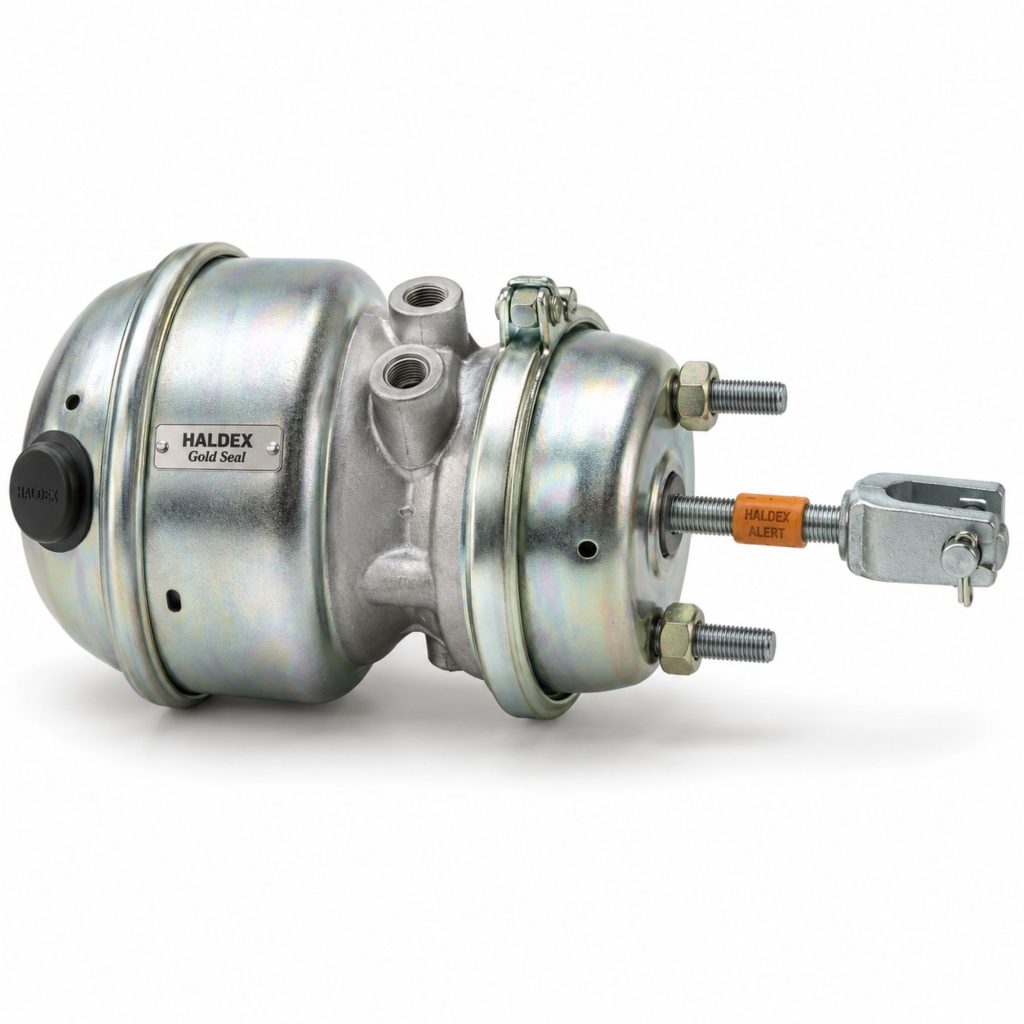
The Haldex Gold Seal is a double-diaphragm combination spring brake actuator used on commercial trucks, tractors, trailers, buses, and vocational vehicles. The current product family is marketed as the GoldSeal+ Combination Spring Brake.
Gold Seal combines a pneumatic service-brake chamber with a mechanical parking and emergency-brake section. During normal braking, compressed air moves the service diaphragm and pushrod. During parking or certain air-pressure failures, a powerful mechanical spring applies the foundation brake.
The product traces its history to Anchorlok, an early spring-brake manufacturer acquired by Haldex in 2001. Gold Seal became a widely used original-equipment and replacement actuator across North American truck and trailer applications.
Current GoldSeal+ features include Haldex power-spring technology, an advanced protective coating process, a double O-ring center seal, durable rubber compounds, and application-specific pushrod and clevis arrangements.
Gold Seal should not be confused with Haldex LifeSeal+. GoldSeal+ is a durable vented combination spring brake, while LifeSeal+ is Haldex’s fully sealed premium design for applications seeking additional protection from moisture and contamination.
The exact chamber size, stroke, pushrod length, clevis, mounting dimensions, and port orientation must be confirmed before replacement. Haldex GoldSeal+ product information
Key Characteristics
- Double-diaphragm combination spring brake
- Service-brake chamber section
- Parking and emergency spring section
- Superior power-spring technology
- Resistance to corrosion and fatigue
- Advanced powder-coated components
- Zinc-plated spring housing on applicable models
- Double O-ring center seal
- Heat- and cold-resistant rubber compounds
- Standard- and long-stroke configurations
- Multiple chamber sizes
- Standard pushrod options
- Threaded-clevis options
- Welded-clevis options
- Piggyback replacement units
- Truck and trailer application coverage
- Heavy-duty vocational configurations
- Original-equipment and aftermarket availability
Major Components
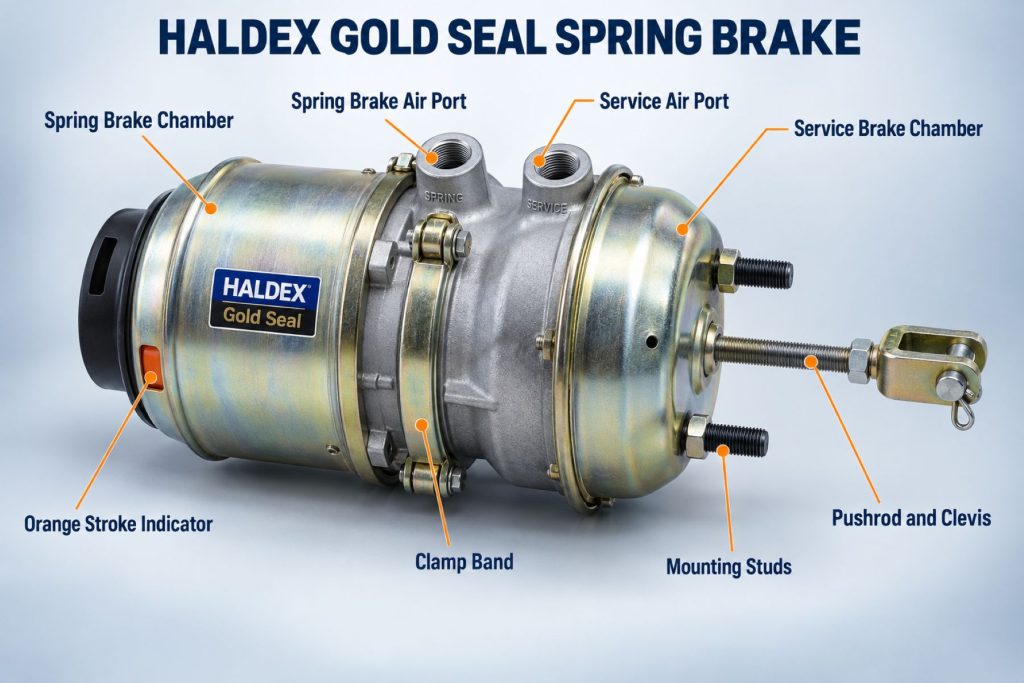
- Service chamber housing
- Service diaphragm
- Service return spring
- Service pushrod
- Pushrod plate
- Clamp band
- Mounting studs
- Service air port
- Parking and emergency housing
- Mechanical power spring
- Spring-brake diaphragm
- Pressure plate
- Center-seal assembly
- Double O-rings
- Center-section housing
- Spring-brake pushrod
- Release or caging bolt
- Caging-bolt storage point
- Breather or vent holes
- Dust plug
- Threaded clevis when equipped
- Welded clevis when equipped
- Clevis pin
- Cotter pin
- Jam nut
- Mounting hardware
- Product-identification label
- Stroke and chamber-size markings
How the Brake Component or System Works
During a service-brake application, compressed air enters the service section of the Gold Seal chamber. Air pressure acts against the service diaphragm and moves the pushrod outward.
The pushrod rotates the slack adjuster and camshaft. The S-cam spreads the brake shoes outward until the friction linings contact the rotating brake drum.
When the service brake is released, air leaves the chamber. The service return spring retracts the diaphragm and pushrod.
The parking and emergency section contains a powerful mechanical spring. During normal vehicle operation, compressed air holds this spring in its released position.
When the driver applies the parking brake, air is exhausted from the spring section. The power spring expands, moves the pushrod, and mechanically applies the foundation brake.
If spring-brake supply pressure falls because of a pneumatic-system failure, the power spring can also apply the brake automatically. The exact response depends on the vehicle’s valves and system configuration.
Position and Function Within the Brake System
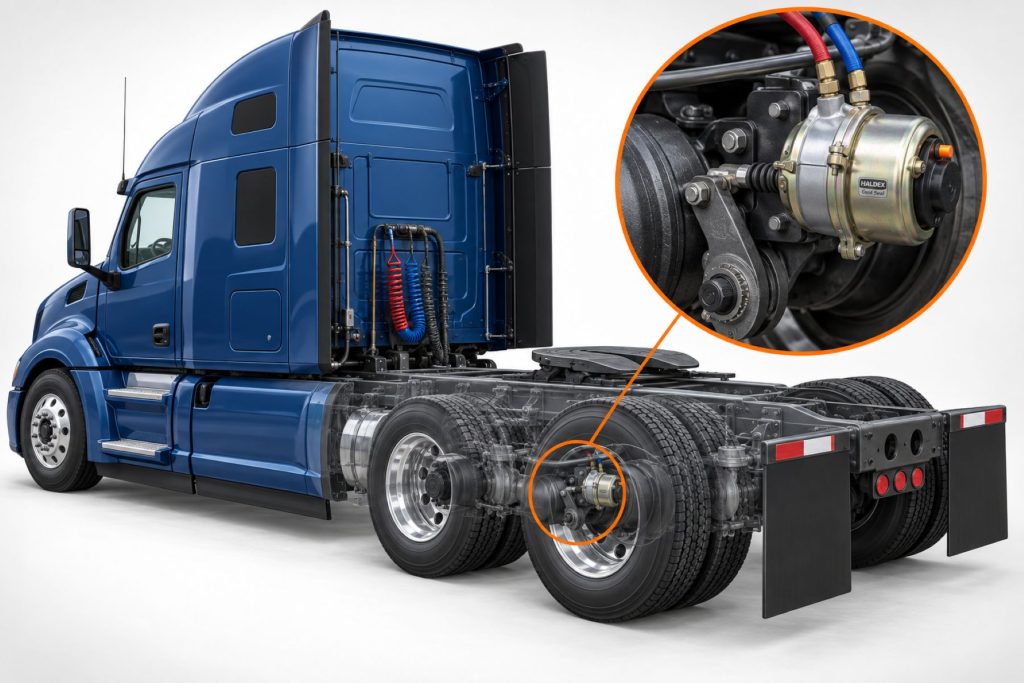
The Gold Seal mounts to a brake chamber bracket near the foundation brake. It converts air pressure or stored spring force into linear pushrod movement.
It performs three principal functions:
- Applies the service brake when air enters the service section
- Applies the parking brake when air is released from the spring section
- Provides emergency braking when spring-brake supply pressure falls
In a typical S-cam drum-brake system, the force path includes:
- Driver brake valve
- Relay or ABS-modulator valve
- Gold Seal service chamber
- Pushrod and clevis
- Automatic slack adjuster
- Camshaft
- S-cam
- Brake shoes
- Brake drum
The chamber does not control brake timing by itself. Relay valves, spring-brake valves, ABS modulators, and other pneumatic controls determine when air enters or leaves the actuator.
Common Specifications
- Product Type: Double-diaphragm combination spring brake
- Current Product Family: Haldex GoldSeal+
- Primary Foundation Brake: S-cam drum brake
- Common Chamber Sizes: Type 24/24, 24/30, 30/30, 30/36, and 36/36
- Common Type 30/30 Standard Stroke: 2.5 inches
- Common Type 30/30 Long Stroke: 3 inches
- Air-Port Threads: Application-specific; 3/8-18 NPTF is common on many configurations
- Maximum Air Pressure: Application-specific; 150 psi is listed for common Gold Seal models
- Center Seal: Double O-ring design
- Housing Protection: Zinc plating and powder coating, depending on model
- Clevis Options: Threaded or welded
- Replacement Options: Complete chamber or application-specific piggyback unit
- Mounting: Application-specific stud and bracket arrangement
- Warranty: Current GoldSeal literature lists standard four-year coverage; terms vary by product, vocation, mileage, and installation
- Applications: Trucks, tractors, trailers, buses, and vocational vehicles
Exact specifications must be verified using the complete Haldex part number. A Type 30/30 description alone does not identify stroke, pushrod length, clevis, port angle, mounting, or application.
Operating Specifications and Performance
The Gold Seal is designed to provide service-brake output and reliable mechanical parking force across a broad range of commercial-vehicle applications.
Haldex subjects its actuator designs to performance and durability testing. Published Haldex actuator information describes:
- SAE J1469 testing
- High-temperature testing above 158 degrees Fahrenheit
- Cold-temperature testing to minus 40 degrees Fahrenheit
- High-pressure testing
- Vibration testing
- Production leak testing
- Date coding for traceability
Actual output depends on:
- Service-chamber size
- Spring-section size
- Rated stroke
- Applied air pressure
- Power-spring condition
- Pushrod length
- Clevis setting
- Slack-adjuster length
- Foundation-brake geometry
- Brake adjustment
The chamber’s mechanical size must match the brake application. Installing a chamber with a different output or stroke can change braking torque, parking performance, and brake balance.
Braking Performance and System Integration
Gold Seal operates as one part of the complete foundation-brake system. Its output must be coordinated with the slack adjuster, camshaft, brake shoes, friction material, and drum.
Brake performance can be affected by:
- Incorrect chamber size
- Mismatched stroke
- Improper clevis adjustment
- Wrong slack-adjuster length
- Pushrod misalignment
- Excessive drum diameter
- Worn friction material
- Air-pressure differences
- Damaged valves
- Foundation-brake binding
Chambers installed on the same axle should normally match in size, stroke, and output characteristics. Mismatched chambers can create side-to-side brake imbalance.
Long-stroke chambers must be replaced with compatible long-stroke chambers. Using a standard-stroke unit in a long-stroke application can reduce reserve stroke and violate the approved braking configuration.
Air Supply, Controls, and Electronic Integration
The Gold Seal requires compressed air for service-brake operation and for holding the mechanical power spring in its released position.
It can operate with:
- Service brake valves
- Relay valves
- Quick-release valves
- Spring-brake relay valves
- Spring-brake modulating valves
- Tractor-protection valves
- Trailer emergency systems
- Antilock braking systems
- Automatic traction control
- Electronic stability control
- Trailer roll-stability systems
The service and spring ports must be connected correctly. Reversing the lines can produce improper or unsafe brake operation.
ABS controls service-brake air pressure during a wheel-lock event. It does not normally release the mechanical parking spring.
Spring-brake control and modulating valves manage air entering and leaving the parking side. A failure elsewhere in the air system can therefore produce symptoms that appear to originate at the chamber.
Installation, Adjustment, and Brake Balance
The replacement Gold Seal must match the original actuator’s chamber size, stroke, pushrod, clevis, mounting, and port arrangement.
Important installation checks include:
- Confirming the complete Haldex part number
- Verifying chamber size
- Identifying standard or long stroke
- Matching the pushrod length
- Confirming threaded or welded clevis
- Checking mounting-stud spacing
- Matching the port orientation
- Confirming chamber-bracket angle
- Inspecting mounting hardware
- Verifying slack-adjuster length
- Setting the clevis correctly
- Checking pushrod alignment
- Inspecting air-hose routing
- Verifying suspension clearance
- Measuring applied pushrod stroke
- Testing service-brake operation
- Testing parking-brake operation
- Checking for air leakage
The pushrod should operate in line with the slack adjuster. Angular misalignment can cause binding, center-seal wear, clevis damage, and uneven brake application.
Welded-clevis chambers can reduce setup time, but the clevis position must match the exact vehicle application.
Foundation Brake, Axle, and Wheel-End Compatibility
Gold Seal is primarily designed for compatible S-cam drum-brake systems. The selected chamber must match the foundation brake and its mechanical geometry.
Compatibility depends on:
- Foundation-brake manufacturer
- Brake size
- Axle manufacturer
- Axle model
- Axle position
- Chamber mounting bracket
- Service-section size
- Spring-section size
- Rated stroke
- Pushrod length
- Clevis design
- Slack-adjuster length
- Port orientation
- Available clearance
- Vehicle brake certification
Common applications include Type 30/30 chambers on drive and trailer axles. Other applications use Type 24/24, 24/30, 30/36, or 36/36 configurations.
A chamber should not be substituted because it appears physically similar. Changes in size, stroke, pushrod position, or slack-adjuster geometry can alter braking performance.
Common Applications
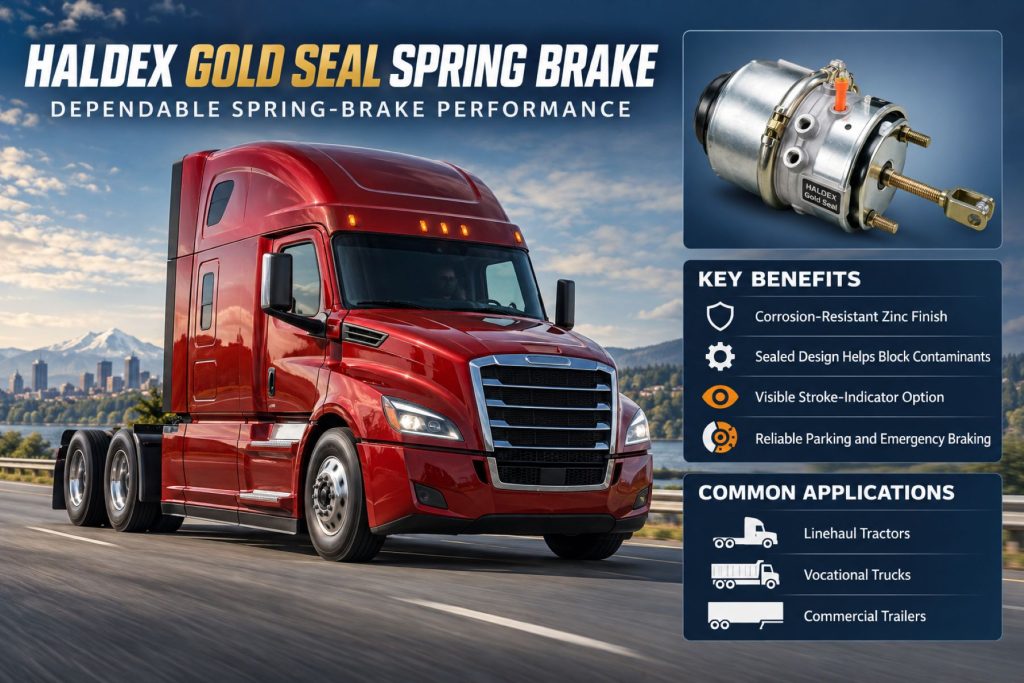
- Line-haul tractors
- Regional-haul tractors
- Heavy-duty straight trucks
- Delivery trucks
- Dump trucks
- Concrete mixers
- Refuse trucks
- Logging trucks
- Construction vehicles
- Tank trucks
- Municipal vehicles
- School buses
- Transit buses
- Motorcoaches
- Fire apparatus
- Yard tractors
- Dry van trailers
- Refrigerated trailers
- Flatbed trailers
- Tank trailers
- Dump trailers
- Hopper trailers
- Container chassis
- Specialty commercial vehicles
Vehicle and Brake-System Compatibility
Gold Seal chambers are available across a broad range of truck and trailer applications. The correct part must be identified for each vehicle and axle.
Compatibility should be verified using:
- Vehicle identification number
- Truck or trailer manufacturer
- Vehicle model and model year
- Axle manufacturer
- Axle model
- Foundation-brake type
- Original Haldex part number
- Chamber type
- Rated stroke
- Pushrod length
- Clevis type
- Mounting-stud spacing
- Port orientation
- Chamber bracket
- Slack-adjuster length
- ABS configuration
- Vehicle vocation
A parts catalog or approved Haldex cross-reference should be used when the original actuator has been replaced or its identification label is damaged.
Advantages
- Service, parking, and emergency braking in one assembly
- Broad original-equipment application coverage
- Broad aftermarket replacement coverage
- Multiple chamber sizes
- Standard- and long-stroke options
- Corrosion-resistant power spring
- Fatigue-resistant spring design
- Advanced powder coating
- Zinc-plated spring housing on applicable models
- Double O-ring center seal
- Heat- and cold-resistant diaphragms
- Threaded-clevis options
- Welded-clevis options
- Piggyback replacement availability
- Production leak testing
- Established Haldex service support
Limitations or Considerations
- Vented design is not fully sealed like LifeSeal+
- Moisture can enter through vent openings
- Drain and breather openings can become obstructed
- Correct chamber size must be identified
- Standard- and long-stroke chambers are not interchangeable
- Pushrod length must match the application
- Clevis position affects brake geometry
- Port orientation varies
- Spring housing contains dangerous stored energy
- Parking-side housing must never be disassembled
- Corrosion can develop after coating damage
- Air leaks can affect brake release or application
- Incorrect installation can cause brake imbalance
- Warranty terms vary by model and vocation
- Replacement must preserve brake-system certification
Driver and Operator Experience
A properly operating Gold Seal should provide normal service-brake response and secure parking-brake operation. The parking brakes should release when adequate air pressure reaches the spring chambers.
Drivers should report:
- Parking brakes that release slowly
- Parking brakes that do not release
- Parking brakes that fail to hold
- Air leaking near a chamber
- Low-air warnings
- ABS warning lamps
- Vehicle pulling during braking
- Increased stopping distance
- Brake dragging
- Burning odors
- Wheel-end smoke
- Unexpected spring-brake application
- Unusual brake noises
A vehicle should not be operated if a spring brake remains partially applied, leaks severely, or cannot hold the parked vehicle.
Maintenance and Ownership Notes
- Inspect the chamber housing
- Check for corrosion
- Inspect protective coatings
- Check mounting studs
- Inspect mounting nuts
- Check clamp bands
- Inspect air ports
- Check hoses and fittings
- Inspect vent and breather openings
- Keep drain openings clear
- Inspect pushrod alignment
- Check the clevis
- Inspect the clevis pin
- Check cotter pins
- Verify slack-adjuster alignment
- Measure applied pushrod stroke
- Test service-brake operation
- Test parking-brake application
- Test parking-brake release
- Listen for air leakage
- Inspect the caging bolt
- Install dust plugs when required
- Check suspension clearance
- Verify chamber identification
- Never open the power-spring housing
Common Brake-System Problems
- Spring brake will not release: Low system pressure, restricted air lines, a faulty parking-brake valve, frozen moisture, a damaged diaphragm, center-seal leakage, or a broken power spring may prevent release.
- Spring brake releases slowly: Restricted hoses, low air delivery, contaminated valves, obstructed ports, air leakage, or internal chamber damage may delay release.
- Parking brake will not hold: A weak or broken power spring, excessive brake clearance, worn linings, oversized drums, incorrect adjustment, or the wrong chamber may reduce holding force.
- Service-side air leak: A damaged diaphragm, loose clamp band, corroded housing, cracked hose, loose fitting, or damaged port may cause leakage.
- Air transfer between chamber sections: Worn center-seal O-rings, pushrod damage, contamination, or misalignment can allow air to move between the service and spring sides.
- Chamber corrosion: Road salt, water, clogged drains, damaged coating, missing plugs, or physical damage can corrode the housing or power spring.
- Blocked breather holes: Dirt, paint, corrosion, ice, or debris can interfere with normal venting and moisture drainage.
- Excessive pushrod stroke: Worn friction material, oversized drums, incorrect slack-adjuster setup, worn foundation-brake components, or the wrong chamber geometry may increase stroke.
- Brake dragging: Pushrod misalignment, incorrect clevis position, restricted exhaust, foundation-brake binding, or incomplete spring compression may keep the brake applied.
- Uneven braking: Mismatched chambers, different strokes, unequal slack adjusters, air-pressure differences, or foundation-brake problems can cause side-to-side imbalance.
Safety and Service Precautions
The Gold Seal contains a powerful compressed spring capable of causing severe injury or death. The parking and emergency housing must never be opened, drilled, cut, welded, or disassembled.
Before servicing the chamber:
- Park on a firm and level surface
- Chock the wheels
- Follow the approved caging procedure
- Drain or isolate air pressure
- Support raised equipment with approved stands
- Wear eye and hand protection
- Confirm the brake is fully released
- Use the correct caging bolt
- Inspect the caging bolt before use
- Keep hands clear of the pushrod
- Follow Haldex service procedures
- Replace damaged hardware
- Test the brakes before road operation
Caging mechanically compresses the power spring so the parking brake can be released for approved service or towing. It does not make the chamber safe to disassemble.
A severely corroded, damaged, or distorted chamber should be handled cautiously and replaced according to Haldex procedures.
Identification Information
Gold Seal identification may be found on the label, chamber housing, stroke markings, clevis, or vehicle build records.
Record the following information:
- Vehicle manufacturer
- Vehicle identification number
- Vehicle model and model year
- Axle manufacturer
- Axle position
- Foundation-brake type
- Haldex part number
- Gold Seal or GoldSeal+ marking
- Chamber type
- Service-section size
- Spring-section size
- Rated stroke
- Standard- or long-stroke designation
- Pushrod length
- Threaded or welded clevis
- Mounting-stud spacing
- Port orientation
- Brake chamber bracket
- Slack-adjuster length
- Complete or piggyback configuration
A Type 30/30 designation alone is insufficient. The correct replacement must also match stroke, pushrod length, clevis, mounting, and port orientation.
Buying Considerations
- Confirm the complete Haldex part number
- Verify Gold Seal or GoldSeal+ identification
- Determine complete or piggyback replacement
- Confirm chamber size
- Identify standard or long stroke
- Match the pushrod length
- Confirm threaded or welded clevis
- Check mounting-stud spacing
- Verify port orientation
- Match the chamber bracket
- Confirm slack-adjuster length
- Inspect hose routing
- Check suspension clearance
- Review the vehicle vocation
- Determine whether LifeSeal+ is preferable
- Check current warranty terms
- Use an approved Haldex cross-reference
- Replace axle pairs when appropriate
- Purchase from an authorized supplier
Variants and Configurations
- Type 24/24 chamber
- Type 24/30 chamber
- Type 30/30 chamber
- Type 30/36 chamber
- Type 36/36 chamber
- Standard-stroke chamber
- Long-stroke chamber
- Standard pushrod
- Threaded clevis
- Welded clevis
- Different pushrod lengths
- Complete combination chamber
- Piggyback replacement chamber
- Truck configuration
- Tractor configuration
- Trailer configuration
- Bus configuration
- Vocational configuration
- Heavy-duty service housing
- Dust-boot configuration
- Application-specific port angles
Comparison to Similar Equipment
Compared with the Bendix EverSure Spring Brake, Gold Seal uses Haldex’s own power-spring, coating, center-seal, and actuator construction. EverSure uses Bendix No Touch power-spring technology.
Compared with the Bendix EnduraSure-Pro Spring Brake, GoldSeal+ is a conventional vented spring brake. EnduraSure-Pro uses a sealed parking section and a one-way check valve to limit contamination.
Compared with Haldex LifeSeal+, GoldSeal+ relies on venting and drain openings. LifeSeal+ permanently seals the spring chamber for greater protection from moisture and contaminants.
Compared with a service-only chamber, Gold Seal combines service braking with mechanical parking and emergency-brake functions.
Compared with the Bendix SR-7 Spring Brake Modulating Valve, Gold Seal produces the mechanical force that applies the foundation brake. The SR-7 controls pneumatic pressure within the spring-brake circuit.
Compared with the Meritor Q Plus Cam Brake, Gold Seal is the brake actuator. The Q Plus is the S-cam foundation-brake assembly that receives the chamber’s pushrod force.
Best Fit For
- Vehicles originally equipped with Gold Seal chambers
- Current GoldSeal+ applications
- Line-haul tractors
- Commercial trailers
- Heavy-duty straight trucks
- Vocational vehicles
- Dump trucks
- Concrete mixers
- Refuse vehicles
- Commercial buses
- Vehicles using Type 30/30 chambers
- Standard-stroke applications
- Long-stroke applications
- Fleets needing broad replacement coverage
- Operations using welded-clevis chambers
- Maintenance programs familiar with Haldex actuators
Related Vehicle and Trailer Types
- Complete Guide to Semi Truck Types
- Complete Guide to Semi-Trailer Types
- Class 7 trucks
- Class 8 trucks
- Sleeper tractors
- Day cab tractors
- Vocational trucks
- Dump trucks
- Concrete mixers
- Refuse trucks
- Heavy-haul vehicles
- School buses
- Transit buses
- Motorcoaches
- Dry van trailers
- Refrigerated trailers
- Flatbed trailers
- Tank trailers
- Dump trailers
- Hopper trailers
- Container chassis
Related Truck and Trailer Models
- Freightliner Cascadia
- Freightliner 114SD
- Kenworth T680
- Kenworth T880
- Peterbilt 579
- Peterbilt 567
- Mack Anthem
- Mack Granite
- Volvo VNL
- International LT Series
- International HX Series
- Great Dane Champion Dry Van Trailer
- Great Dane Everest Refrigerated Trailer
- Utility 3000D Dry Van Trailer
- Utility 3000R Refrigerated Trailer
- Wabash DuraPlate Dry Van Trailer
Related Brake System Types
- Brake Systems
- Air Brake Systems
- Brake Chambers & Actuators
- Drum Brake Systems
- Trailer Brake Systems
- ABS & Electronic Braking Systems
- Service-brake systems
- Parking-brake systems
- Emergency-brake systems
- Spring-brake control systems
Related Brake Products
- Bendix EverSure Spring Brake
- Bendix EnduraSure-Pro Spring Brake
- Bendix SR-7 Spring Brake Modulating Valve
- Meritor Q Plus Cam Brake
- Meritor Q Plus LX500 Cam Brake
- Gunite 3600A Brake Drum
- Webb Vortex Unlimited Brake Drum
- ConMet TruTurn Brake Drum
- Automatic slack adjusters
- Service brake chambers
- Spring-brake relay valves
- Air brake hoses
- Commercial brake drums
Related Equipment Systems
- Equipment Systems
- Axles & Differentials
- Suspension Systems
- Tires & Wheels
- Compressed-air systems
- Drive axles
- Trailer axles
- Foundation brakes
- Parking-brake controls
- Vehicle stability systems
Related Guides
- Brake System Guides
- Air Brake Systems Explained
- Air Disc Brakes vs Drum Brakes
- How to Inspect and Maintain Commercial Truck Brakes
- Tractor vs Trailer Brake Systems
- How Truck ABS and Electronic Stability Control Work
- Commercial Truck Brake Components Explained
Regulatory and Compliance Notes
The chamber must match the vehicle’s approved braking-system configuration. Chamber size, stroke, pushrod length, mounting, slack-adjuster length, and foundation-brake geometry affect braking force and reserve stroke.
Inspectors may evaluate:
- Chamber condition
- Mounting security
- Air leakage
- Pushrod stroke
- Chamber-size matching
- Standard- or long-stroke identification
- Parking-brake operation
- Spring-brake release
- Hose and fitting condition
- Clevis and pin condition
- Foundation-brake adjustment
- Missing or damaged components
Long-stroke chambers must be replaced with compatible long-stroke chambers. A standard-stroke replacement can reduce reserve stroke and change the approved brake configuration.
A chamber that leaks, is severely corroded, is improperly mounted, or cannot apply and release correctly may place the vehicle out of service.
Real World Operating Notes
Gold Seal and GoldSeal+ are commonly used as interchangeable names, but the current product should be identified using its complete Haldex part number.
The chamber’s vent and drain openings should remain clear. Paint, undercoating, mud, corrosion, or ice can obstruct normal airflow and drainage.
A welded-clevis replacement can save installation time, but only if the clevis position and pushrod geometry match the application.
Repeated manual adjustment of an automatic slack adjuster does not repair a chamber or foundation-brake problem. Excessive pushrod stroke requires a complete brake inspection.
A caged spring brake does not provide parking or emergency application at that wheel end. The vehicle must be secured through other approved means.
For vehicles exposed to road salt, frequent washing, bulk materials, refuse, or long periods of storage, Haldex LifeSeal+ may offer greater contamination protection than a conventional Gold Seal chamber.
Frequently Asked Questions
What is the Haldex Gold Seal Spring Brake?
It is a double-diaphragm combination actuator that provides service, parking, and emergency braking on commercial vehicles.
Is Gold Seal still available?
Yes. Haldex currently markets the updated family as GoldSeal+ Combination Spring Brakes.
What is a Type 30/30 chamber?
It combines a Type 30 service chamber with a Type 30 mechanical spring section. Stroke, pushrod, mounting, and clevis must still be confirmed.
Does Gold Seal come in long-stroke versions?
Yes. Application-specific long-stroke models are available, including Type 30/30 configurations.
What is the double O-ring center seal?
It uses two O-rings around the center section to help prevent air leakage between the service and spring-brake sections.
Is Gold Seal fully sealed?
No. GoldSeal+ is a vented spring brake. Haldex LifeSeal+ is the company’s fully sealed premium design.
What happens when air pressure is lost?
As spring-brake supply pressure falls, the mechanical power spring can apply the brake according to the vehicle’s pneumatic-system design.
Can the power-spring housing be opened?
No. The housing contains dangerous stored energy and must never be opened, drilled, cut, or welded.
What does caging the chamber do?
Caging mechanically compresses the power spring to release the parking brake for approved service or towing procedures.
Can a standard-stroke chamber replace a long-stroke chamber?
No. The replacement must preserve the original chamber’s rated stroke and approved brake geometry.
Can a Gold Seal be replaced with a LifeSeal+?
An approved LifeSeal+ cross-reference may be available. Size, stroke, pushrod, clevis, mounting, and port orientation must match.
How can the correct replacement be identified?
Use the complete Haldex part number, chamber type, stroke, pushrod length, clevis, mounting dimensions, port orientation, axle, and vehicle information.
Availability and Where to Find
Haldex GoldSeal+ chambers, Gold Seal replacement components, and piggyback assemblies are available through Haldex distributors, commercial-truck dealers, trailer dealers, heavy-duty parts suppliers, fleet-maintenance providers, and brake specialists.
Availability depends on chamber size, stroke, pushrod length, clevis, mounting-stud spacing, port orientation, brake bracket, and vehicle application.
Gold Seal and LifeSeal replacement components are also supported through Haldex’s service-component catalog. Parts should be identified using the complete actuator number rather than appearance alone.
Current product information, technical documentation, parts availability, and customer support are available through the Haldex GoldSeal+ product page and Gold Seal replacement-parts section.
Support Trucking Families
Truck Equipment Atlas supports the mission of Grey Cross, a nonprofit dedicated to helping families of truck drivers who lose their lives while on the road. As the site grows, part of its mission is to bring awareness and support to these families.
Podcast or Video Section
Learn More Through Audio and Video
Truck Equipment Atlas will continue expanding with podcast episodes, interviews, and equipment breakdowns to help drivers and fleets better understand trucks and equipment.
Follow the Growth of Truck Equipment Atlas
Truck Equipment Atlas continues to expand with new truck profiles, trailer coverage, diesel engine pages, equipment system resources, manufacturer information, and educational guides.
Visit our Site Updates page to explore recent additions, project milestones, and upcoming resources as we continue building one of the industry’s growing commercial trucking equipment reference libraries.
View the Latest Site Updates: Truck Equipment Atlas Site Updates