
Bendix EverSure Spring Brake
Quick Facts
- Manufacturer: Bendix Commercial Vehicle Systems
- Original Manufacturer Organization: Bendix Spicer Foundation Brake
- Product Family: EverSure
- Product Type: Double-diaphragm combination spring brake chamber
- Primary Functions: Service braking, parking braking, and emergency braking
- Foundation-Brake Compatibility: Drum and air disc brakes, depending on model
- Common Drum-Brake Size: Type 30/30
- Other Available Sizes: Application-specific drum- and air-disc-brake configurations
- Common Rated Stroke: 2.5 or 3.0 inches on Type 30/30 models
- Power-Spring Technology: Bendix No Touch design
- Corrosion Protection: Epoxy-coated power spring with reduced coil contact
- Installation Options: Standard pushrod, threaded clevis, welded clevis, and piggyback configurations
- Common Positions: Drive, trailer, auxiliary, and other parking-brake-equipped axles
- Primary Applications: Trucks, tractors, trailers, buses, and vocational vehicles
- Original Warranty Positioning: Four-year coverage under qualifying applications and terms
- Current Product Status: Legacy product replaced in Bendix’s current lineup by the EnduraSure Spring Brake Series
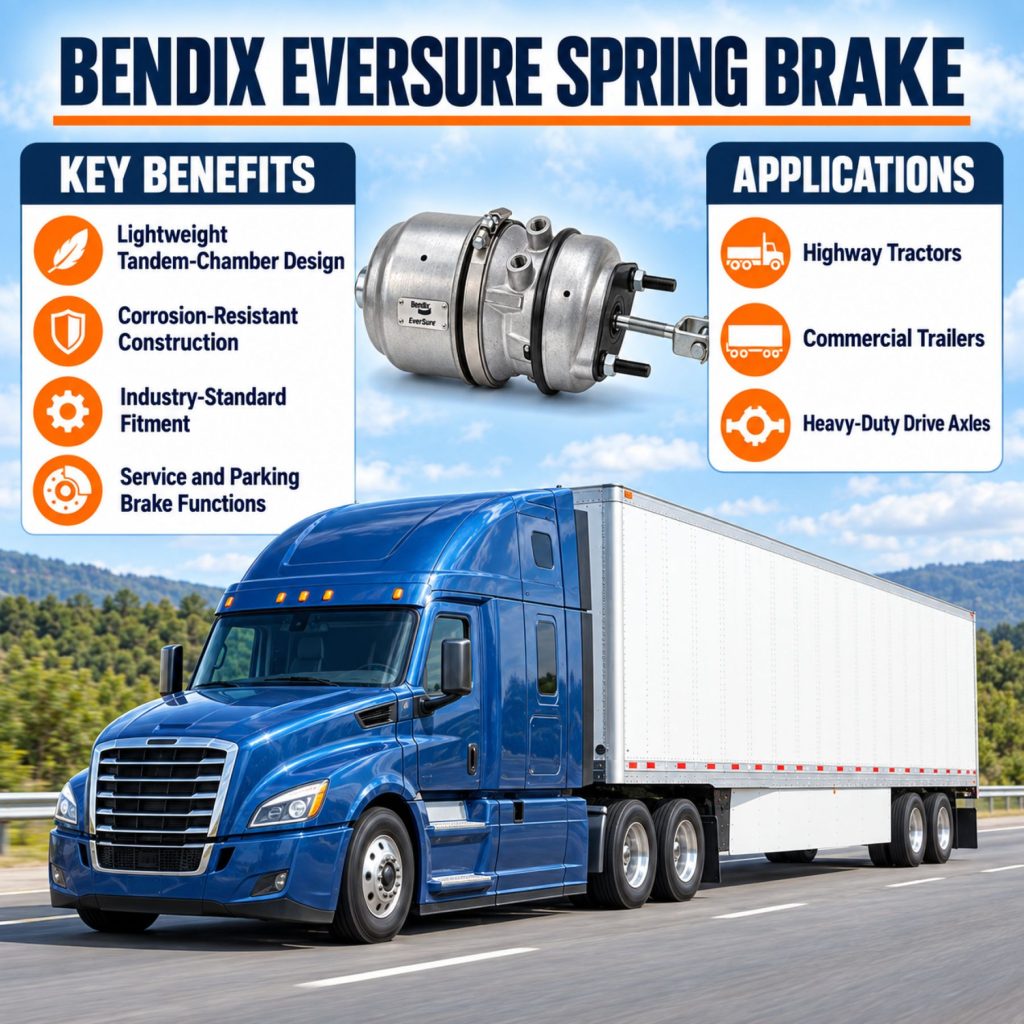
- Primary Benefit: Lightweight actuation with improved power-spring durability and corrosion resistance
Overview
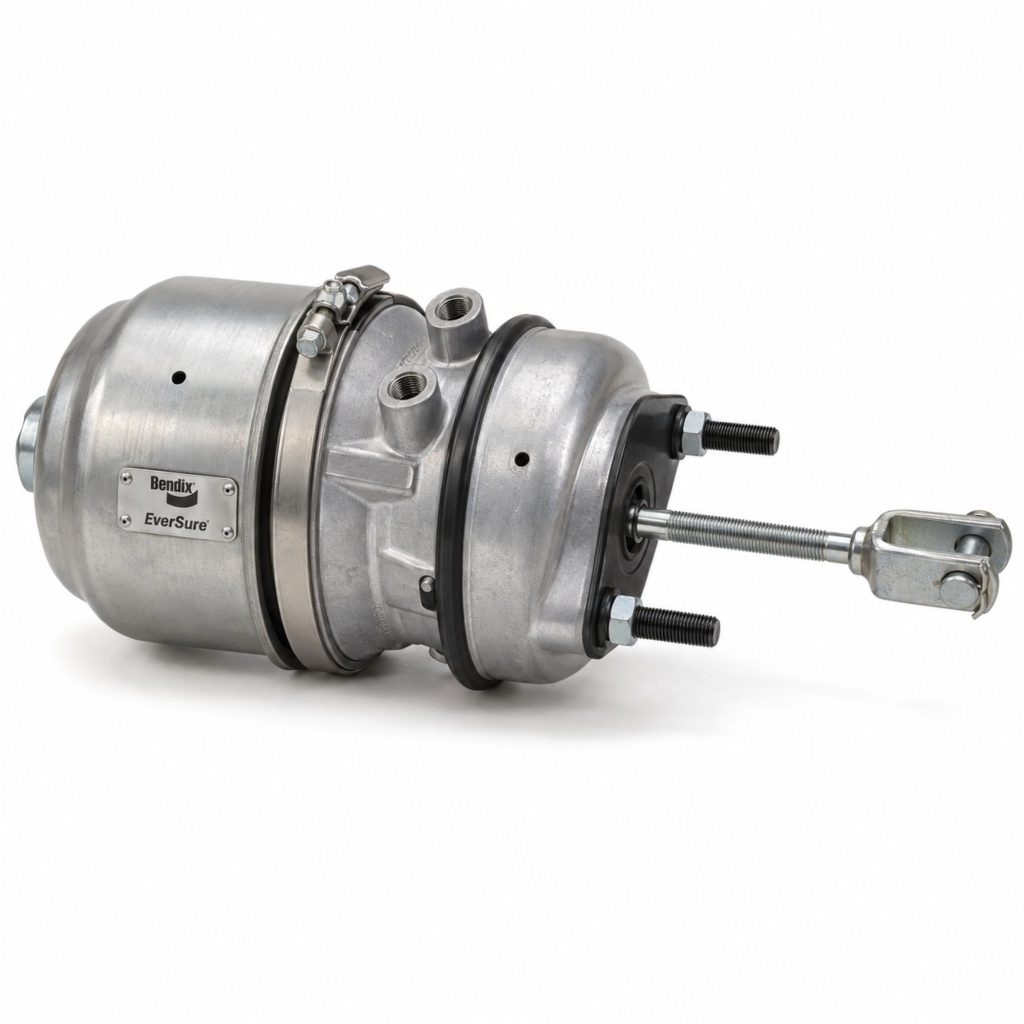
The Bendix EverSure is a double-diaphragm spring brake chamber designed to provide service, parking, and emergency braking on commercial vehicles. It was offered for both S-cam drum brakes and air disc brake applications in several chamber sizes, strokes, pushrod lengths, and mounting configurations.
The EverSure’s best-known feature is Bendix’s No Touch power spring. The spring was engineered with additional active coils and greater space between the coils to reduce contact while the spring was compressed.
Reducing coil contact helps preserve the spring’s protective epoxy coating. This addresses corrosion caused when repeated coil contact damages the coating and exposes the underlying metal.
The EverSure combines a conventional service chamber with a mechanically powered parking and emergency section. During normal driving, compressed air holds the power spring in its released position. When the parking brakes are applied—or supply pressure is lost—the power spring extends and mechanically applies the foundation brake.
EverSure was also designed to reduce weight. Bendix described its Type 30/30 design as more than two pounds lighter than several competing spring chambers available during its original introduction.
EverSure is now a legacy Bendix product. The current Bendix actuator lineup states that the EnduraSure Spring Brake Series builds on and replaces EverSure. Existing EverSure-equipped vehicles can still require EverSure identification, service information, or approved replacement cross-references.
Key Characteristics
- Double-diaphragm combination spring brake
- Service-brake chamber section
- Parking and emergency spring section
- No Touch power-spring technology
- Increased spacing between spring coils
- Reduced power-spring coil contact
- Epoxy-coated power spring
- Improved corrosion resistance
- Slotted center-seal design
- Lightweight chamber construction
- Standard and long-stroke configurations
- Drum-brake configurations
- Air-disc-brake configurations
- Standard pushrod options
- Threaded-clevis options
- Welded-clevis options
- Piggyback replacement assemblies
- Industry-standard mounting dimensions
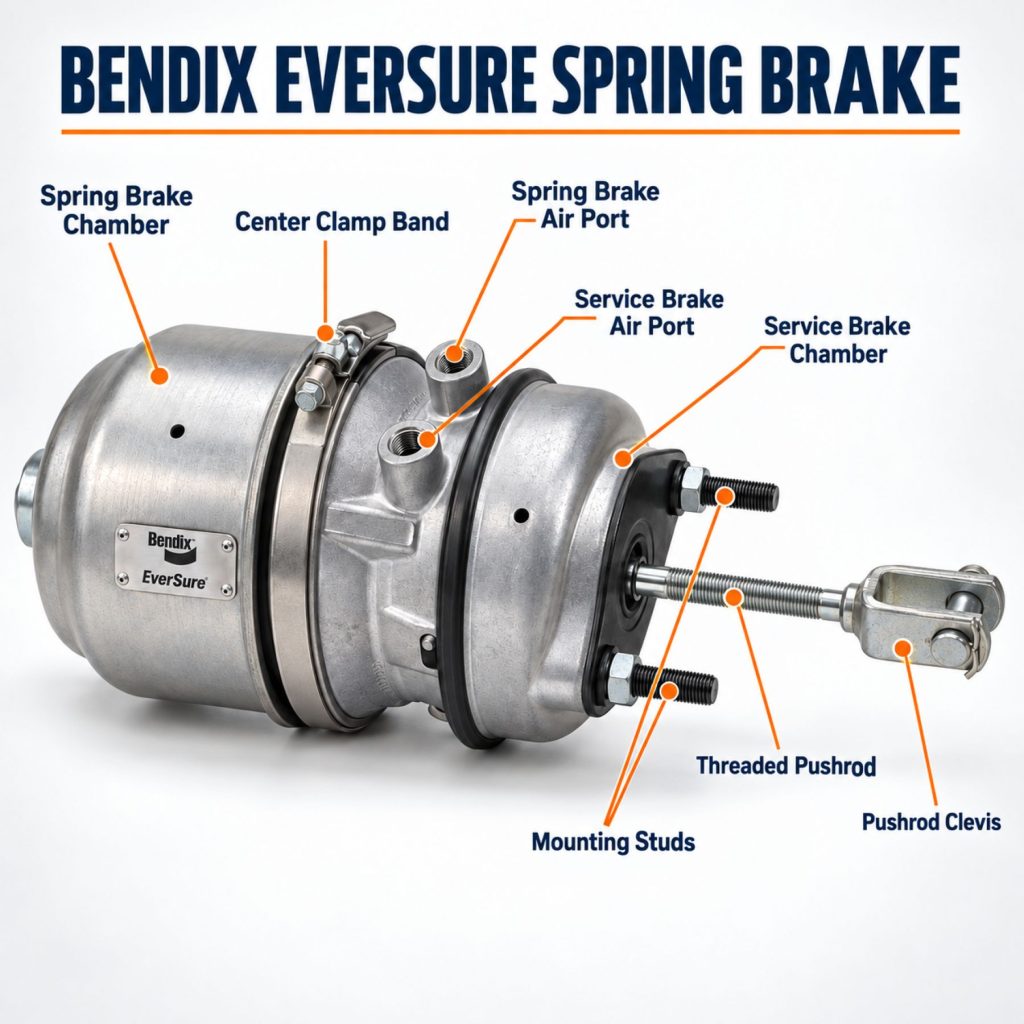
Major Components
- Service chamber housing
- Service diaphragm
- Service return spring
- Service pushrod
- Pushrod plate
- Clamp band
- Mounting studs
- Air inlet port
- Parking and emergency chamber housing
- Power spring
- Spring diaphragm
- Center seal
- Spring-brake pushrod
- Release bolt
- Release-bolt storage pocket
- Dust plug
- Breather or venting components
- Threaded clevis when equipped
- Welded clevis when equipped
- Clevis pin
- Jam nut
- Mounting hardware
- Product identification label
- Stroke and chamber-size markings
How the Brake Component or System Works
During a normal service-brake application, compressed air enters the service side of the EverSure. The air acts against the service diaphragm, moving the pushrod outward.
On an S-cam brake, the pushrod moves the slack adjuster, which rotates the camshaft and applies the brake shoes against the drum. On an air disc brake, the chamber applies the caliper’s operating mechanism.
When the service brake is released, air leaves the service chamber. The service return spring retracts the diaphragm and pushrod.
The parking and emergency section operates differently. A powerful mechanical spring is held compressed by air pressure while the vehicle is operating.
When the driver applies the parking brake, air is exhausted from the spring section. The power spring expands and mechanically moves the brake pushrod.
If system pressure is lost, the power spring can also apply the brakes automatically. The exact emergency application depends on the vehicle’s spring-brake valves and pneumatic system.
Position and Function Within the Brake System
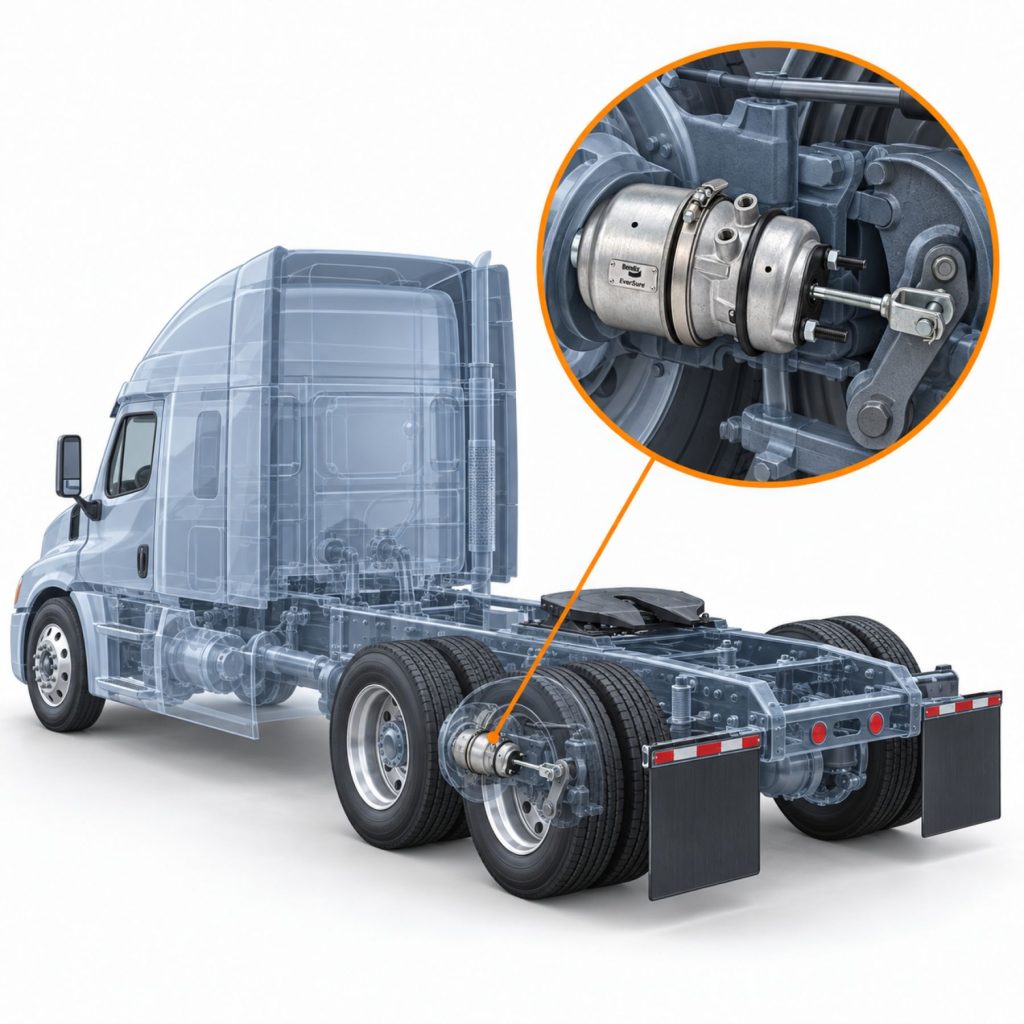
The EverSure mounts near the foundation brake and converts pneumatic pressure or stored spring force into linear pushrod movement.
It performs three primary functions:
- Applies the service brake when air enters the service chamber
- Applies the parking brake when air is released from the spring chamber
- Provides emergency braking when spring-brake supply pressure falls
On a typical S-cam installation, the force path includes:
- Brake-control valve
- Relay or ABS-modulator valve
- EverSure service chamber
- Pushrod and clevis
- Automatic slack adjuster
- Camshaft
- S-cam
- Brake shoes
- Brake drum
During a parking or emergency application, the power spring supplies the mechanical force rather than normal service air pressure.
Common Specifications
- Product Type: Double-diaphragm combination spring brake
- Common Drum-Brake Size: Type 30/30
- Common Standard Stroke: 2.5 inches
- Common Long Stroke: 3.0 inches
- Common Drum-Brake Pushrod Lengths: Application-specific, including documented 5.62-, 7.8-, 8.0-, and 12.0-inch configurations
- Clevis Options: Standard pushrod, threaded clevis, or welded clevis
- Piggyback Option: Replacement spring section available for approved configurations
- Power Spring: No Touch epoxy-coated spring
- Center Seal: Slotted design
- Actuation: Pneumatic service braking and mechanical spring parking braking
- Mounting: Industry-standard application-specific bracket and stud arrangement
- Foundation Brakes: S-cam drum brake or compatible air disc brake, depending on part number
- Air Disc Brake Sizes: Documented configurations include Type 16/24, 18/24, 20/24, 22/24, and 24/24
- Original Normal-Duty Warranty: Four years with unlimited mileage and hours under applicable warranty terms
- Original Severe-Duty Warranty: Two years or the applicable mileage and hour limits stated in Bendix warranty documentation
- Current Replacement Family: Bendix EnduraSure
The chamber type, stroke, pushrod length, clevis, mounting angle, port orientation, bracket, and foundation-brake application must be confirmed before replacement.
Operating Specifications and Performance
The EverSure was designed to provide sufficient pushrod force and reserve stroke across normal service, parking, and emergency operating conditions.
Bendix documented several performance features:
- Increased power-spring life
- Reduced power-spring coil contact
- Improved corrosion resistance
- Increased braking reserve
- Reduced chamber weight
- Industry-standard mounting dimensions
- Service replacement coverage for common applications
Bendix reported that the No Touch design increased the height between the power-spring coils by approximately 33 percent compared with a typical Type 30/30 spring brake. The company also reported up to three times the power-spring life of competing and earlier Bendix designs under applicable testing.
The EverSure’s actual output depends on:
- Chamber size
- Chamber stroke
- Applied air pressure
- Power-spring condition
- Pushrod length
- Clevis setting
- Slack-adjuster length
- Foundation-brake geometry
- Brake adjustment
- Vehicle application
A larger chamber number does not automatically make a chamber suitable for a particular brake. The complete actuation and foundation-brake system must be matched.
Braking Performance and System Integration
The EverSure must work with the correct slack adjuster, camshaft, brake chamber bracket, foundation brake, and pneumatic controls.
On an S-cam brake, the chamber’s pushrod force is multiplied through the slack adjuster. Changing chamber size or slack-adjuster length alters brake torque.
Incorrect components can cause:
- Insufficient braking force
- Excessive braking force
- Brake imbalance
- Excessive pushrod stroke
- Brake drag
- Premature wheel lockup
- ABS intervention
- Component interference
- Reduced parking-brake holding ability
Chamber size, stroke, and slack-adjuster length should normally match across an axle unless the vehicle manufacturer specifies otherwise.
Long-stroke chambers must be identified and replaced with compatible long-stroke units. Installing a standard-stroke chamber in a long-stroke application can reduce available reserve stroke and violate the vehicle’s approved brake configuration.
Air Supply, Controls, and Electronic Integration
The EverSure depends on the vehicle’s compressed-air system for normal service braking and spring-brake release.
It can operate with:
- Service brake valves
- Relay valves
- Quick-release valves
- Spring-brake relay valves
- Spring-brake modulating valves
- Tractor-protection systems
- Trailer emergency systems
- Antilock braking systems
- Automatic traction control
- Electronic stability control
- Trailer roll-stability systems
The service and spring ports must be connected correctly. Reversing air lines can cause improper or unsafe brake operation.
ABS modulator valves control pressure delivered to the service chamber. They do not normally control the mechanical force stored in the parking-brake power spring.
Systems using a spring-brake modulating valve, such as the Bendix SR-7 Spring Brake Modulating Valve, can use service-system air to modulate spring-brake application during certain failure conditions.
Installation, Adjustment, and Brake Balance
The replacement EverSure or approved successor must match the original chamber’s dimensions and operating characteristics.
Important installation checks include:
- Confirming chamber type
- Verifying service and spring-chamber sizes
- Confirming standard or long stroke
- Matching pushrod length
- Checking threaded or welded clevis
- Confirming mounting-stud spacing
- Matching port orientation
- Checking bracket angle
- Inspecting mounting hardware
- Verifying slack-adjuster length
- Setting the clevis correctly
- Confirming the correct installed angle
- Checking pushrod alignment
- Inspecting air-hose routing
- Verifying suspension and axle clearance
- Measuring applied pushrod stroke
- Testing service-brake operation
- Testing parking-brake operation
- Checking for air leakage
The pushrod should travel in line with the slack adjuster. Misalignment can cause side loading, premature seal wear, binding, or damaged brackets.
A welded-clevis chamber can reduce setup time because the clevis position is established for a specific application. The correct vehicle-specific chamber must still be selected.
Foundation Brake, Axle, and Wheel-End Compatibility
EverSure configurations were offered for S-cam drum and air disc brakes. The selected chamber must match the brake’s actuation requirements.
Compatibility depends on:
- Foundation-brake type
- Brake manufacturer and model
- Axle manufacturer
- Axle position
- Chamber mounting bracket
- Chamber type
- Service-section size
- Spring-section size
- Rated stroke
- Pushrod length
- Clevis design
- Slack-adjuster length
- Port orientation
- Available clearance
- Vehicle brake certification
Common drum-brake applications used Type 30/30 chambers. Other applications could use Type 24/30 or specialized arrangements.
Documented air-disc-brake EverSure configurations included Type 16/24, 18/24, 20/24, 22/24, and 24/24 chambers with application-specific strokes.
A drum-brake chamber should not be substituted for an air-disc-brake chamber solely because its mounting studs appear compatible.
Common Applications
- Line-haul tractors
- Regional-haul tractors
- Heavy-duty straight trucks
- Delivery trucks
- Dump trucks
- Concrete mixers
- Refuse trucks
- Logging trucks
- Construction vehicles
- Tank trucks
- Municipal vehicles
- School buses
- Transit buses
- Motorcoaches
- Fire apparatus
- Motorhomes
- Dry van trailers
- Refrigerated trailers
- Flatbed trailers
- Tank trailers
- Dump trailers
- Hopper trailers
- Container chassis
- Specialty commercial vehicles
Vehicle and Brake-System Compatibility
EverSure was designed around common industry dimensions, but the correct chamber must be identified for each vehicle and axle.
Compatibility should be verified using:
- Vehicle identification number
- Truck or trailer manufacturer
- Vehicle model and model year
- Axle manufacturer
- Axle model
- Foundation-brake type
- Original chamber part number
- Chamber type
- Rated stroke
- Pushrod length
- Clevis type
- Mounting-stud dimensions
- Port orientation
- Slack-adjuster information
- Brake chamber bracket
- ABS configuration
- Vehicle vocation
An approved Bendix cross-reference should be used when replacing EverSure with an EnduraSure model. The new chamber must preserve the original size, stroke, mounting, pushrod, and actuation requirements.
Advantages
- Service, parking, and emergency braking in one assembly
- No Touch power-spring design
- Reduced spring-coil contact
- Improved power-spring coating protection
- Enhanced corrosion resistance
- Epoxy-coated power spring
- Additional active spring coils
- Increased reserve stroke
- Lightweight chamber construction
- Industry-standard mounting dimensions
- Standard and long-stroke configurations
- Drum- and air-disc-brake options
- Threaded-clevis availability
- Welded-clevis availability
- Piggyback replacement options
- Established Bendix support network
Limitations or Considerations
- EverSure has been replaced by EnduraSure
- Legacy part numbers may be superseded
- Spring section contains dangerous stored energy
- Spring housing must never be disassembled
- Correct chamber size must be identified
- Standard- and long-stroke chambers are not interchangeable
- Pushrod length must match the application
- Clevis position affects brake geometry
- Port orientation may vary
- Drum- and disc-brake chambers differ
- Corrosion can still occur after physical damage
- Air leaks can affect service or parking operation
- Incorrect installation can cause brake imbalance
- Power spring adds weight to the wheel-end system
- Replacement must preserve the vehicle’s brake certification
Driver and Operator Experience
A properly operating EverSure should provide normal service-brake response and secure parking-brake application. Drivers should notice the parking brakes releasing when sufficient air pressure reaches the spring chamber.
The driver should report:
- Parking brakes that release slowly
- Parking brakes that do not release
- Parking brakes that fail to hold
- Air leaking near a chamber
- Vehicle pulling during braking
- Increased stopping distance
- Low-air warnings
- ABS warning lamps
- Brake dragging
- Burning odors
- Wheel-end smoke
- Unusual brake noises
- Unexpected spring-brake application
A vehicle should not be driven if a spring brake cannot fully release, if a chamber is physically damaged, or if severe air leakage is present.
Maintenance and Ownership Notes
- Inspect the chamber housing
- Check for corrosion
- Inspect mounting studs
- Check mounting nuts
- Inspect the clamp band
- Check air ports
- Inspect hoses and fittings
- Check pushrod alignment
- Inspect the clevis
- Check the clevis pin
- Inspect retaining clips
- Verify slack-adjuster alignment
- Measure applied pushrod stroke
- Check service-brake operation
- Test parking-brake application
- Test parking-brake release
- Listen for air leakage
- Inspect the release bolt
- Keep the release-bolt opening sealed
- Check suspension clearance
- Inspect for impact damage
- Confirm chamber identification
- Use an approved Bendix replacement
- Never open the spring housing
Common Brake-System Problems
- Spring brake will not release: Low system pressure, restricted air lines, a faulty parking-brake valve, leaking diaphragm, damaged center seal, frozen components, or a broken power spring may prevent release.
- Spring brake releases slowly: Restricted hoses, a contaminated valve, low air delivery, internal chamber damage, or incorrect plumbing may delay release.
- Parking brake will not hold: A weak or broken power spring, excessive foundation-brake clearance, incorrect adjustment, worn linings, oversized drums, caliper problems, or the wrong chamber may reduce holding force.
- Service-brake air leak: A damaged diaphragm, loose clamp, corroded housing, cracked hose, damaged fitting, or leaking port may cause pressure loss.
- Leak between chamber sections: A damaged center seal can allow air to transfer between the service and spring sections.
- Excessive pushrod stroke: Worn friction material, an oversized drum, incorrect slack-adjuster setup, damaged foundation-brake components, or the wrong chamber geometry may increase stroke.
- Brake dragging: Misaligned pushrod, incorrect clevis setting, restricted exhaust, foundation-brake binding, damaged chamber components, or a power spring that does not fully compress may cause drag.
- Chamber corrosion: Road salt, moisture, damaged coating, missing plugs, or physical damage can corrode the chamber or power spring.
- Broken power spring: Corrosion, damaged protective coating, spring fatigue, impact damage, or contamination may lead to failure.
- Uneven braking: Different chamber sizes, unequal strokes, mismatched slack adjusters, air-pressure differences, or foundation-brake problems may cause imbalance.
Safety and Service Precautions
Safety and Service Precautions
The EverSure contains a powerful compressed spring capable of causing severe injury or death. The sealed parking-brake housing must never be opened, cut, welded, drilled, or disassembled.
Before servicing the chamber:
- Park on a firm and level surface
- Chock the wheels
- Follow the approved spring-brake caging procedure
- Drain or isolate air pressure
- Support raised equipment with approved stands
- Wear eye and hand protection
- Confirm the brake is fully released
- Use the correct release bolt
- Inspect the release bolt before use
- Keep hands clear of moving pushrods
- Follow Bendix service instructions
- Replace damaged hardware
- Test the brake before road service
Caging the power spring mechanically releases the parking brake for servicing or towing. It does not repair the chamber or make a damaged unit safe to disassemble.
A spring-brake chamber with severe corrosion, impact damage, an unsecured clamp, or a damaged housing should be replaced using approved procedures.
Identification Information
EverSure identification may be found on the chamber label, housing, clamp, pushrod configuration, or vehicle build records.
Record the following information:
- Vehicle manufacturer
- Vehicle identification number
- Vehicle model and model year
- Axle manufacturer
- Axle position
- Foundation-brake type
- Bendix part number
- EverSure product marking
- Chamber type
- Service-section size
- Spring-section size
- Rated stroke
- Standard- or long-stroke designation
- Pushrod length
- Threaded or welded clevis
- Mounting-stud spacing
- Port orientation
- Brake chamber bracket
- Slack-adjuster length
- Drum- or air-disc-brake application
A Type 30/30 description alone is insufficient. Stroke, pushrod, clevis, mounting, and port details must also match.
Buying Considerations
- Confirm the original Bendix part number
- Determine whether EverSure has been superseded
- Use the approved EnduraSure cross-reference
- Identify drum- or air-disc-brake use
- Confirm chamber type
- Verify rated stroke
- Identify standard or long stroke
- Measure pushrod length correctly
- Confirm clevis type
- Check mounting-stud spacing
- Verify port orientation
- Confirm brake bracket compatibility
- Match the slack-adjuster length
- Inspect air-hose routing
- Check available clearance
- Confirm vehicle vocation
- Replace chambers in axle pairs when appropriate
- Purchase through an authorized supplier
- Follow the current Bendix service information
Variants and Configurations
- Type 24/30 drum-brake configuration
- Type 30/30 drum-brake configuration
- Standard-stroke chamber
- Long-stroke chamber
- 2.5-inch-stroke Type 30/30
- 3.0-inch-stroke Type 30/30
- Standard pushrod
- Threaded clevis
- Welded clevis
- Different pushrod lengths
- Complete combination chamber
- Piggyback replacement chamber
- Type 16/24 air-disc-brake chamber
- Type 18/24 air-disc-brake chamber
- Type 20/24 air-disc-brake chamber
- Type 22/24 air-disc-brake chamber
- Type 24/24 air-disc-brake chamber
- Truck configuration
- Trailer configuration
- Bus configuration
- Vocational configuration
Comparison to Similar Equipment
Compared with the Bendix EnduraSure Spring Brake, EverSure is the earlier product generation. EnduraSure builds on the No Touch power-spring concept with additional durability and performance improvements.
Compared with Bendix EnduraSure-Pro, EverSure does not use the newer fully sealed design and integrated check-valve protection offered on applicable EnduraSure-Pro air-disc-brake chambers.
Compared with a service-only brake chamber, EverSure contains both a service section and a power-spring section. A service chamber cannot provide mechanical parking or emergency-brake application by itself.
Compared with a conventional combination chamber, EverSure uses Bendix’s No Touch power spring to reduce coil contact and protect the spring coating.
Compared with the Bendix SR-7 Spring Brake Modulating Valve, EverSure converts air pressure and stored spring energy into mechanical braking force. The SR-7 controls air delivery and modulation within the spring-brake system.
Compared with the Bendix ADB22X Air Disc Brake, EverSure is an actuator rather than a complete foundation brake. An approved spring chamber supplies mechanical input to the ADB22X caliper.
Best Fit For
- Vehicles originally equipped with EverSure chambers
- Approved EverSure service replacements
- Approved EnduraSure conversions
- Heavy-duty tractors
- Commercial trailers
- Straight trucks
- Vocational vehicles
- Buses and motorcoaches
- Vehicles using Type 30/30 chambers
- Standard-stroke applications
- Long-stroke applications
- Fleets prioritizing corrosion resistance
- Applications using welded clevises
- Vehicles requiring parking and emergency braking
- Maintenance programs familiar with spring-brake safety
Related Vehicle and Trailer Types
- Complete Guide to Semi Truck Types
- Complete Guide to Semi-Trailer Types
- Class 7 trucks
- Class 8 trucks
- Sleeper tractors
- Day cab tractors
- Vocational trucks
- Dump trucks
- Concrete mixers
- Refuse trucks
- Heavy-haul vehicles
- School buses
- Transit buses
- Motorcoaches
- Dry van trailers
- Refrigerated trailers
- Flatbed trailers
- Tank trailers
- Dump trailers
- Container chassis
Related Truck and Trailer Models
- Freightliner Cascadia
- Freightliner 114SD
- Kenworth T680
- Kenworth T880
- Peterbilt 579
- Peterbilt 567
- Mack Anthem
- Mack Granite
- Volvo VNL
- International LT Series
- International HX Series
- Great Dane Champion Dry Van Trailer
- Utility 3000D Dry Van Trailer
- Wabash DuraPlate Dry Van Trailer
Related Brake System Types
- Brake Systems
- Air Brake Systems
- Brake Chambers & Actuators
- Drum Brake Systems
- Air Disc Brake Systems
- Trailer Brake Systems
- ABS & Electronic Braking Systems
- Service-brake systems
- Parking-brake systems
- Emergency-brake systems
- Spring-brake control systems
Related Brake Products
- Bendix SR-7 Spring Brake Modulating Valve
- Bendix ADB22X Air Disc Brake
- Bendix ADB22X-LT Air Disc Brake
- Meritor Q Plus Cam Brake
- Meritor Q Plus LX500 Cam Brake
- Gunite 3600A Brake Drum
- Webb Vortex Unlimited Brake Drum
- ConMet TruTurn Brake Drum
- Automatic slack adjusters
- Service brake chambers
- Spring-brake relay valves
- Air brake hoses
- Air disc brake calipers
Related Equipment Systems
- Equipment Systems
- Axles & Differentials
- Suspension Systems
- Tires & Wheels
- Compressed-air systems
- Drive axles
- Trailer axles
- Foundation brakes
- Vehicle stability systems
- Parking-brake controls
Related Guides
- Brake System Guides
- Air Brake Systems Explained
- Air Disc Brakes vs Drum Brakes
- How to Inspect and Maintain Commercial Truck Brakes
- Tractor vs Trailer Brake Systems
- How Truck ABS and Electronic Stability Control Work
- Commercial Truck Brake Components Explained
Regulatory and Compliance Notes
Spring brake chambers must match the vehicle’s approved braking-system configuration. Chamber type, stroke, pushrod length, mounting, slack-adjuster length, and foundation-brake geometry affect braking force and reserve stroke.
Inspectors may evaluate:
- Chamber condition
- Mounting security
- Air leakage
- Pushrod stroke
- Chamber-size matching
- Standard- or long-stroke identification
- Parking-brake operation
- Spring-brake release
- Hoses and fittings
- Clevis and pin condition
- Foundation-brake adjustment
- Missing or damaged components
Long-stroke chambers normally use required identification markings. They should not be replaced with standard-stroke chambers.
A chamber that is leaking, severely corroded, improperly mounted, mismatched, or unable to apply or release the brake correctly can place the vehicle out of service.
Real World Operating Notes
EverSure identification is important because the chambers may resemble later EnduraSure products or competing Type 30/30 chambers.
When replacing an older EverSure, use the current Bendix cross-reference. Do not select a chamber based only on the 30/30 designation.
A welded-clevis replacement can reduce installation time, but only when the pushrod length and clevis position match the vehicle application.
Repeated manual adjustment of the automatic slack adjuster is not a spring-chamber repair. Excessive stroke requires inspection of the complete foundation brake.
Spring brakes may apply when system pressure becomes too low. Drivers and technicians should never assume that loss of air pressure leaves the brake released.
A caged spring brake does not provide parking or emergency application at that wheel end. The vehicle must be properly secured while the chamber is caged.
Frequently Asked Questions
What is the Bendix EverSure Spring Brake?
EverSure is a double-diaphragm combination chamber that provides service, parking, and emergency braking for commercial vehicles.
Is EverSure still Bendix’s current spring brake?
No. Bendix states that its current EnduraSure Spring Brake Series builds on and replaces EverSure.
What is No Touch technology?
It is a power-spring design with greater space between the coils, helping reduce coil contact and damage to the protective coating.
Why is reducing coil contact important?
Repeated contact can damage the coating, expose the spring metal, and lead to corrosion and spring failure.
What is a Type 30/30 spring brake?
It combines a Type 30 service chamber with a Type 30 spring-brake section. Stroke and other dimensions must still be confirmed.
Does EverSure come in long-stroke configurations?
Yes. Documented Type 30/30 configurations include both 2.5-inch standard-stroke and 3.0-inch long-stroke versions.
Can EverSure be used with air disc brakes?
Yes. Bendix offered application-specific EverSure chambers for compatible air disc brakes in several sizes.
What happens when air pressure is lost?
As spring-brake supply pressure falls, the power spring can mechanically apply the brake according to the vehicle’s pneumatic system design.
Can the spring-brake housing be opened?
No. The sealed power-spring housing contains dangerous stored energy and must never be opened, drilled, cut, or welded.
What does caging the spring brake do?
Caging mechanically compresses the power spring so the parking brake can be released for approved service or towing procedures.
Can a standard-stroke chamber replace a long-stroke chamber?
No. The replacement must preserve the approved stroke and actuation geometry.
How can the correct replacement be identified?
Use the Bendix part number, chamber type, stroke, pushrod length, clevis, mounting dimensions, port orientation, foundation-brake type, and vehicle information.
Availability and Where to Find
EverSure is a legacy Bendix product that has been replaced by the EnduraSure Spring Brake Series. Original EverSure chambers, piggyback assemblies, diaphragms, dust plugs, and service components may still be available through existing inventory and heavy-duty parts suppliers.
For current replacement service, buyers should use Bendix’s actuator cross-reference to identify the correct EnduraSure equivalent.
Replacement chambers may be available through Bendix distributors, commercial-truck dealers, trailer dealers, fleet-parts suppliers, brake specialists, and authorized repair facilities.
Current actuator information, product literature, replacement resources, and technical support are available through the Bendix actuator product page.
Support Trucking Families
Truck Equipment Atlas supports the mission of Grey Cross, a nonprofit dedicated to helping families of truck drivers who lose their lives while on the road. As the site grows, part of its mission is to bring awareness and support to these families.
Podcast or Video Section
Learn More Through Audio and Video
Truck Equipment Atlas will continue expanding with podcast episodes, interviews, and equipment breakdowns to help drivers and fleets better understand trucks and equipment.
Follow the Growth of Truck Equipment Atlas
Truck Equipment Atlas continues to expand with new truck profiles, trailer coverage, diesel engine pages, equipment system resources, manufacturer information, and educational guides.
Visit our Site Updates page to explore recent additions, project milestones, and upcoming resources as we continue building one of the industry’s growing commercial trucking equipment reference libraries.
View the Latest Site Updates: Truck Equipment Atlas Site Updates