
Trailer Suspension Systems
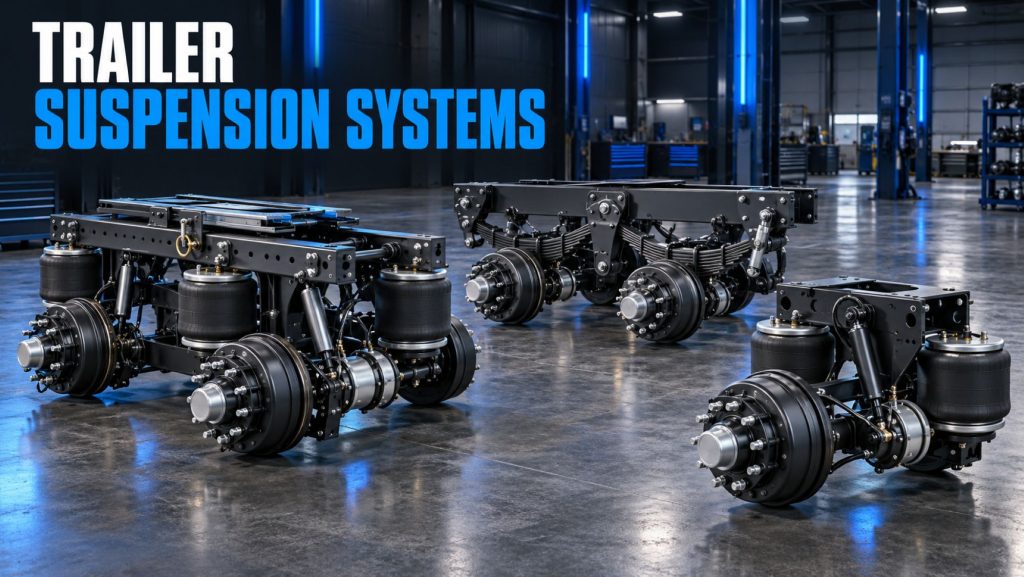
Trailer suspension systems support the trailer frame, connect it to the axle group, and help control ride quality, cargo movement, axle alignment, tire wear, and weight distribution.
This Truck Equipment Atlas sub-hub organizes trailer suspension coverage by suspension type, axle arrangement, application, and manufacturer. Use this page to explore individual trailer suspension systems, compare major configurations, and access related suspension guides.
Explore Trailer Suspension Systems
Trailer Air Suspensions
Trailer air suspensions use air springs to support the trailer and isolate the frame and cargo from road shock. These systems are widely used on dry vans, refrigerated trailers, flatbeds, tank trailers, and other commercial equipment.
Air suspensions may be installed in fixed, sliding-tandem, spread-axle, or integrated axle-and-suspension configurations.
Mechanical Trailer Suspensions
Mechanical trailer suspensions use steel springs, equalizers, hangers, and related components to support the trailer and distribute weight across the axles.
These systems are commonly found on vocational trailers, container chassis, dump trailers, lowboys, logging trailers, and other equipment operating under demanding conditions.
Fixed Trailer Suspensions
A fixed trailer suspension remains mounted in one position beneath the trailer. Fixed configurations are common on flatbeds, tank trailers, dump trailers, lowboys, and other trailers built around a predetermined axle location.
Sliding-Tandem Suspensions
A sliding-tandem suspension allows the axle group to move forward or rearward beneath the trailer. This helps drivers adjust weight distribution between the tractor drive axles and the trailer axles.
Sliding tandems are especially common on dry van and refrigerated trailers.
Integrated Axle and Suspension Systems
Integrated systems combine the trailer axle, suspension beams, brakes, wheel ends, and related mounting components into a coordinated assembly.
These systems may reduce equipment weight, simplify installation, and improve compatibility among the axle, suspension, brake, and wheel-end components.
Spread-Axle and Multi-Axle Suspensions
Spread-axle, tridem, and other multi-axle suspensions are used when trailer capacity, axle spacing, freight requirements, or regional weight regulations call for a configuration beyond a conventional tandem.
These arrangements are frequently found on flatbeds, refrigerated trailers, tank trailers, heavy-haul trailers, and specialty equipment.
Hendrickson Trailer Suspension Systems
An integrated trailer air-suspension and axle system offered for a wide range of commercial trailer applications.
An integrated sliding-tandem air-suspension system commonly used beneath dry van and refrigerated trailers.
A lightweight integrated trailer air-suspension system developed for applications where reducing tare weight is an important consideration.
A sliding-tandem configuration combining the ULTRAA-K suspension with a movable trailer subframe.
SAF-Holland Trailer Suspension Systems
A tandem-axle trailer air suspension designed for common North American commercial trailer applications.
A lightweight trailer air-suspension system intended for applications requiring reduced equipment weight and efficient packaging.
An AeroBeam trailer suspension configuration developed for applications requiring additional capacity and operating flexibility.
Browse by Trailer Type
Trailer suspension selection varies according to the trailer, freight, operating environment, and required axle arrangement.
Dry Van and Refrigerated Trailers
Dry vans and refrigerated trailers commonly use sliding-tandem air suspensions. These systems help protect cargo while allowing axle-position adjustments for legal weight distribution.
Flatbed and Step-Deck Trailers
Flatbed and step-deck trailers may use fixed tandems, sliding tandems, spread axles, or multi-axle suspension arrangements depending on freight requirements.
Tank Trailers
Tank trailers require stable suspension systems capable of supporting concentrated loads and managing the handling effects created by moving liquid cargo.
Dump and Vocational Trailers
Dump, logging, refuse, and other vocational trailers may use mechanical or severe-duty air suspensions designed for rough terrain, frequent loading cycles, and high structural stress.
Lowboy and Heavy-Haul Trailers
Lowboy, removable gooseneck, and heavy-haul trailers may use specialized multi-axle suspensions selected around capacity, deck height, axle spacing, steering requirements, and permit regulations.
Container Chassis
Container chassis commonly use mechanical spring or air-suspension systems designed around container weight, chassis height, axle placement, and intermodal operating conditions.
Compare Trailer Suspension Configurations
Air vs Mechanical Trailer Suspensions
Air suspensions generally provide improved ride isolation and cargo protection. Mechanical suspensions offer simpler construction and may be better suited to rugged vocational service.
Fixed vs Sliding Suspensions
Fixed suspensions provide a permanent axle location and straightforward structure. Sliding suspensions allow axle-weight adjustments but require slider rails, locking pins, release mechanisms, and additional maintenance.
Tandem vs Spread-Axle Suspensions
A conventional tandem places two axles relatively close together. A spread-axle configuration increases the distance between the axles and can affect legal weight allowances, maneuverability, tire scrub, and trailer operation.
Conventional vs Integrated Systems
A conventional trailer suspension may combine separately selected suspension and axle components. An integrated system is designed as a coordinated axle-and-suspension assembly.
Choosing a Trailer Suspension System
Important selection considerations include:
- Trailer type
- Cargo and freight requirements
- Required axle capacity
- Air or mechanical suspension design
- Fixed or sliding configuration
- Tandem, tridem, or spread-axle arrangement
- Ride quality and cargo protection
- Suspension weight
- Axle and brake compatibility
- Required ride height
- Operating terrain
- Maintenance requirements
- Replacement-parts availability
- Manufacturer and service support
- Applicable axle-weight and spacing regulations
Trailer Suspension Maintenance Resources
Routine inspection and maintenance help preserve trailer alignment, tire life, ride quality, and structural integrity.
Important inspection areas include:
- Air springs and air lines
- Leaf springs and equalizers
- Suspension beams
- Pivot bushings
- Shock absorbers
- Height-control valves
- Hangers and mounting brackets
- Axle connections
- Slider rails and locking pins
- Brake hoses and ABS wiring
- Axle alignment
- Tire-wear patterns
Use the identification and troubleshooting guides below for additional information about inspecting and maintaining commercial suspension systems.
Suspension System Guides
- How Commercial Truck Suspension Systems Work
- Air Suspension vs Leaf Spring Suspension
- How to Choose a Commercial Truck Suspension
Related Trailer Guides
- Complete Guide to Trailer Types
- Choosing the Right Trailer for Your Freight
- Air Brake Systems Explained
- Lift Axles Explained
- Complete Guide to Freight Types
Explore Other Suspension Categories
- Air Suspension Systems
- Mechanical & Leaf Spring Suspensions
- Vocational & Severe-Duty Suspensions
- Auxiliary & Lift Axle Suspensions
- Steer Axle & Front Suspensions
Related Equipment Systems
Using the Trailer Suspension Systems Library
Truck Equipment Atlas is building this library to help drivers, fleets, technicians, equipment buyers, and industry professionals compare commercial trailer suspension systems in one organized location.
Each product page will provide model-specific information covering:
- Suspension design
- Available configurations
- Common capacities
- Ride-height options
- Axle and brake compatibility
- Common applications
- Maintenance considerations
- Identification information
- Advantages and limitations
- Buying considerations
- Related suspension systems
Future Trailer Suspension Coverage
The Trailer Suspension Systems library will continue expanding with additional air, mechanical, slider, spread-axle, lift-axle, and specialized trailer suspension systems.
Future coverage may include additional products from Hendrickson, SAF-Holland, Ridewell, Hutchens, Reyco Granning, Watson & Chalin, Dexter, and other commercial trailer equipment manufacturers.
Follow the Growth of Truck Equipment Atlas
Truck Equipment Atlas continues to expand with new truck profiles, trailer coverage, diesel engine pages, equipment-system resources, manufacturer information, and educational guides.
Visit our Site Updates page to explore recent additions, project milestones, and upcoming resources as we continue building one of the industry’s growing commercial trucking equipment reference libraries.
View the Latest Site Updates: Truck Equipment Atlas Site Updates