
Lift Axles Explained: How Lift Axles Work on Commercial Trucks
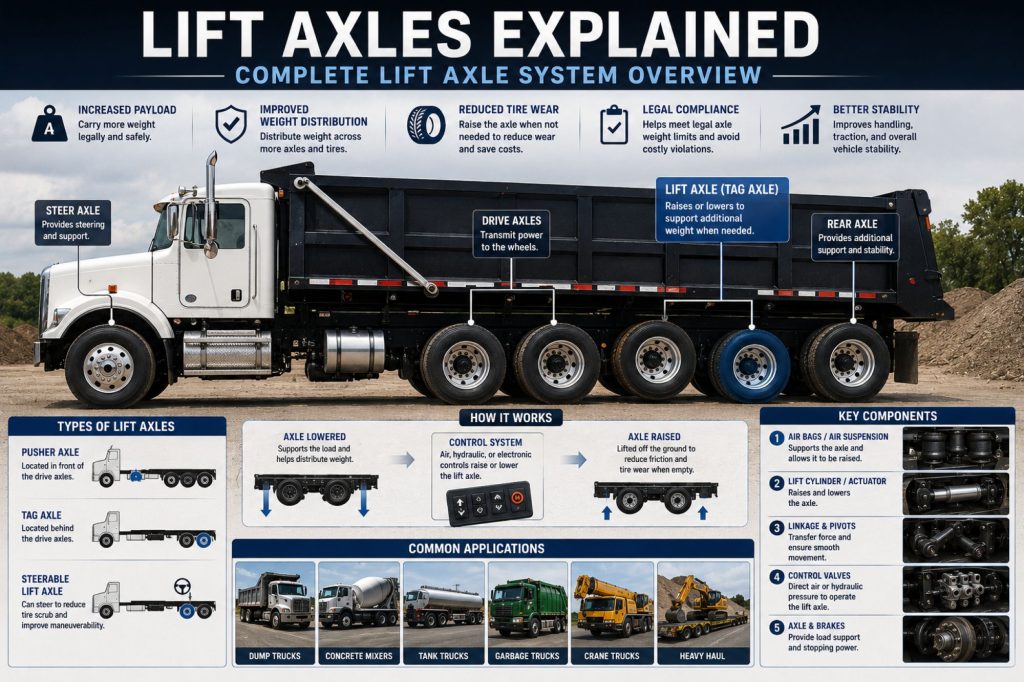
Lift axles are commonly found on vocational trucks and heavy-duty commercial vehicles that occasionally carry loads exceeding the capacity of their primary axles.
These auxiliary axles can be raised or lowered depending on vehicle weight and operating conditions, helping improve weight distribution, reduce tire wear, and comply with axle weight regulations.
Although lift axles are widely used throughout the trucking industry, many drivers and new operators are unfamiliar with how they work and when they should be used.
This guide explains the different types of lift axles, how they function, their advantages and disadvantages, and common maintenance practices.
What Is a Lift Axle?
A lift axle is an additional axle that can be lowered to support extra weight or raised when the additional capacity is not needed.
Lift axles are often called:
- Pusher axles
- Tag axles
- Auxiliary axles
- Drop axles
Their primary purpose is to distribute vehicle weight across additional tires and axles.
Why Trucks Use Lift Axles
Lift axles provide several benefits:
- Increased legal payload capacity
- Improved axle weight distribution
- Reduced risk of overweight violations
- Better vehicle stability
- Reduced tire wear when unloaded
- Lower operating costs
Many vocational trucks would be unable to legally haul their loads without lift axles.
Types of Lift Axles
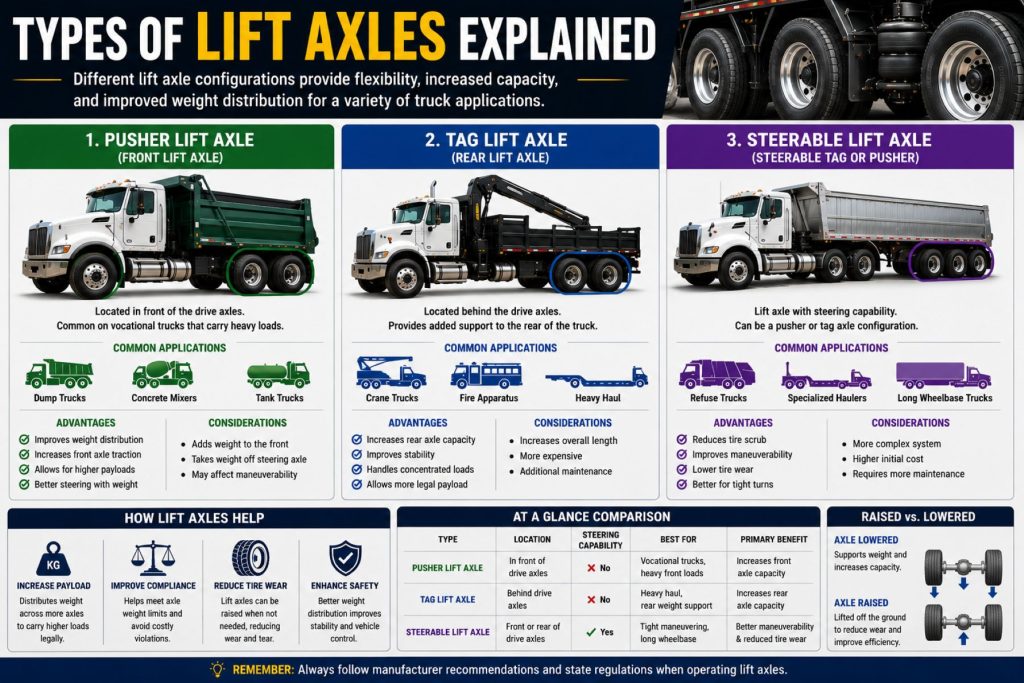
Pusher Axles
Located in front of the drive axles.
Common on:
- Dump trucks
- Concrete mixers
- Tank trucks
Advantages:
- Improves weight distribution
- Increases payload capacity
Tag Axles
Located behind the drive axles.
Common on:
- Heavy haul trucks
- Crane trucks
- Fire apparatus
- Specialized equipment
Advantages:
- Excellent rear weight support
- Improved stability
Steerable Lift Axles
Some lift axles are equipped with steering systems.
Benefits:
- Reduced tire scrub
- Improved maneuverability
- Lower tire wear
How Lift Axles Operate
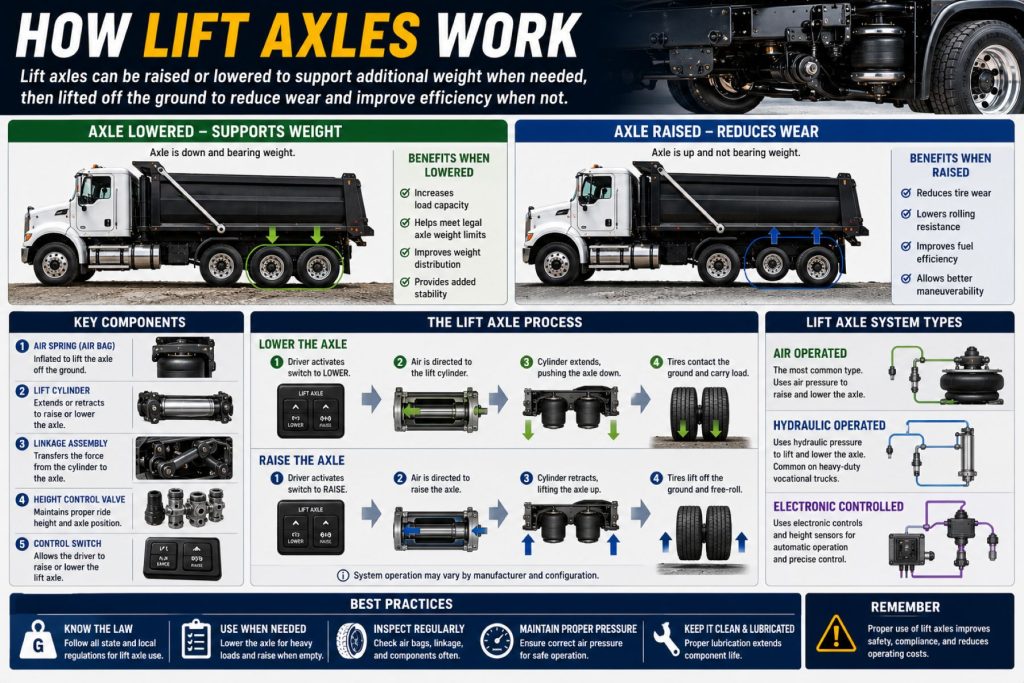
Most lift axles use:
- Air suspension
- Hydraulic systems
- Electronic controls
- Pneumatic controls
The driver can:
- Raise the axle
- Lower the axle
- Adjust pressure in some systems
When lowered, the lift axle supports part of the vehicle’s weight.
When raised, the axle is lifted off the ground to reduce rolling resistance and tire wear.
When Should Lift Axles Be Lowered?
Lift axles are typically lowered:
- When carrying heavy loads
- To meet legal axle weight requirements
- During loading operations
- When required by state regulations
When Should Lift Axles Be Raised?
Lift axles are commonly raised:
- When empty
- During tight maneuvering
- To reduce tire wear
- To improve traction in certain situations
State laws vary regarding lift axle operation.
Drivers should always follow local regulations.
Common Applications
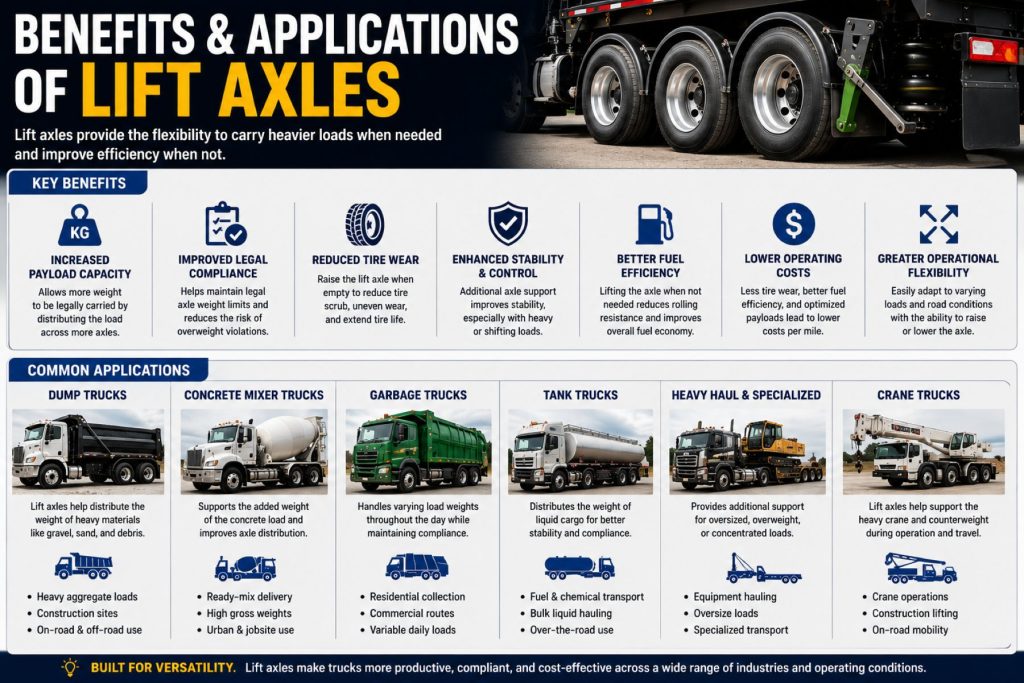
Lift axles are commonly found on:
Dump Trucks
To support heavy aggregate loads.
Concrete Mixer Trucks
To distribute the weight of concrete.
Garbage Trucks
To handle varying load weights.
Tank Trucks
To support liquid cargo.
Heavy Haul Equipment
To increase legal gross vehicle weight.
Crane Trucks
To support concentrated loads.
Advantages of Lift Axles
Increased Payload Capacity
Additional axles allow more legal weight.
Reduced Overweight Violations
Better axle distribution improves compliance.
Reduced Tire Wear
Lift axles can be raised when empty.
Improved Stability
Additional support helps vehicle handling.
Greater Operational Flexibility
Allows trucks to handle a wider range of loads.
Disadvantages of Lift Axles
Higher Purchase Cost
Lift axle systems increase vehicle cost.
Increased Maintenance
Additional tires, brakes, and suspension components require maintenance.
Added Weight
Lift axle systems add weight to the vehicle.
More Complex Operation
Drivers must understand proper lift axle usage.
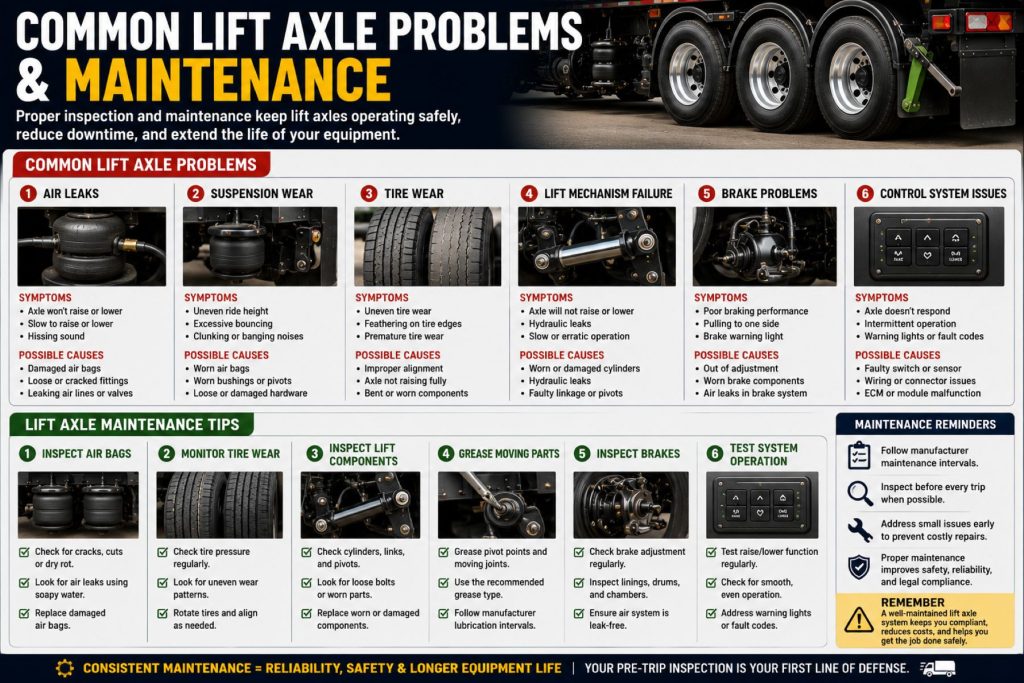
Common Lift Axle Problems
Air Leaks
Can prevent proper operation.
Suspension Wear
Air bags and bushings eventually wear.
Tire Wear
Improper alignment can accelerate wear.
Lift Mechanism Failure
Hydraulic or pneumatic components may fail.
Brake Problems
Additional brake systems require maintenance.
Lift Axle Maintenance Tips
Inspect Air Bags
Check for leaks and damage.
Monitor Tire Wear
Uneven wear often indicates alignment issues.
Inspect Lift Components
Check cylinders, pivots, and hardware.
Grease Moving Parts
Proper lubrication extends component life.
Inspect Brakes
Additional brake systems must be maintained.
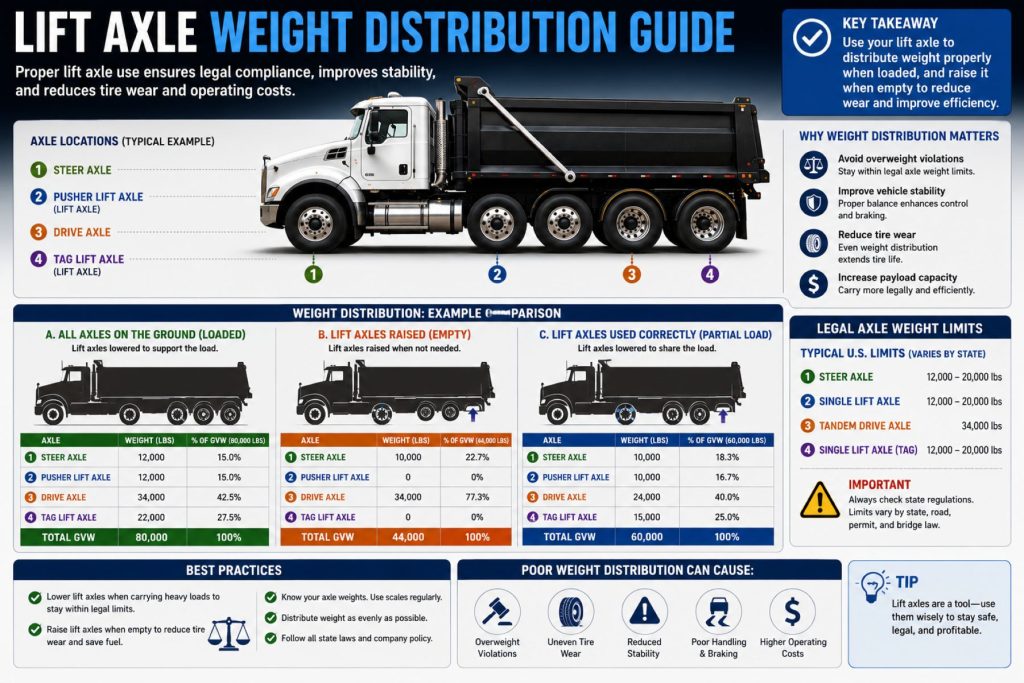
Weight Distribution Considerations
Proper lift axle operation affects:
- Steering axle weight
- Drive axle weight
- Legal compliance
- Tire wear
- Vehicle handling
Improper use can result in:
- Overweight violations
- Poor handling
- Premature tire wear
- Increased operating costs
Frequently Asked Questions
What is a lift axle?
An auxiliary axle that can be raised or lowered to support additional weight.
What is the difference between a pusher axle and a tag axle?
A pusher axle is located in front of the drive axles, while a tag axle is located behind them.
Why do dump trucks have lift axles?
To increase legal payload capacity and improve weight distribution.
Can you drive with a lift axle raised?
Yes, when operating conditions and state regulations allow.
Do lift axles have brakes?
Most lift axles are equipped with brakes.
Are lift axles steerable?
Some are steerable, while others are fixed.
Related Truck Types
- Dump Trucks
- Heavy Haul Trucks
- Concrete Mixer Trucks
- Garbage Trucks
Related Equipment Systems
- Suspension Systems
- Air Brake Systems
- Fifth Wheel Systems
- Steering Systems
Related Guides
Final Thoughts
Lift axles play an important role in modern commercial trucking by allowing trucks to legally carry heavier loads while improving weight distribution and reducing operating costs.
Understanding how lift axles work, when they should be used, and how to properly maintain them can improve safety, compliance, and equipment longevity for drivers and fleet operators alike.