
Steer Axle & Front Suspensions
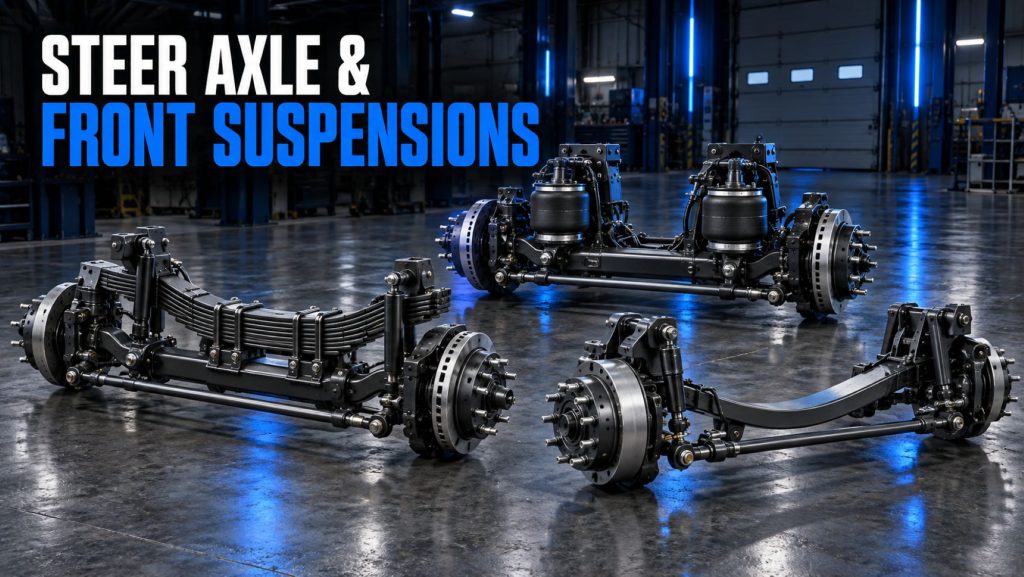
Commercial truck steer axles and front suspension systems support the front of the vehicle, allow the wheels to respond to steering input, absorb road shock, maintain tire contact, and help control directional stability.
The steer axle and front suspension work together but perform different functions. The axle carries the wheel ends, steering knuckles, brakes, and steering linkage, while the suspension connects that axle to the vehicle frame and permits controlled movement over the road.
Truck Equipment Atlas covers front leaf-spring suspensions, integrated front air suspensions, lightweight mechanical systems, steer axles, steering geometry, capacity ratings, brake and wheel-end compatibility, maintenance considerations, and individual suspension products used throughout commercial trucking.
Steer Axle and Front Suspensions on Truck Equipment Atlas
Explore the steer-axle and front-suspension products being added to Truck Equipment Atlas:
Hendrickson
Additional front air suspensions, leaf-spring systems, lightweight mechanical suspensions, integrated steer-axle packages, and high-capacity vocational front suspensions will be added as the Truck Equipment Atlas Suspension Systems Library continues to expand.
Related Steer Axles on Truck Equipment Atlas
The front suspension must be correctly matched to the steer axle, wheel ends, brakes, tires, steering gear, and chassis.
Explore related steer-axle profiles:
- Hendrickson STEERTEK NXT Steer Axle
- Meritor MFS Front Steer Axle
- Dana Spicer E-Series Steer Axle
- Dana Spicer D-Series Steer Axle
- Detroit Front Steer Axle
- PACCAR FX-20 and FX-22 Front Axle
How Front Suspension Systems Work
The front suspension connects the steer axle to the truck’s frame while allowing the axle and wheels to move vertically as the vehicle travels over uneven surfaces.
Springs carry the front of the vehicle and absorb part of the road force. Shock absorbers control repeated suspension movement, while hangers, shackles, control arms, torque rods, bushings, and related components keep the axle properly positioned.
The steering system turns the steering knuckles around the kingpins. The suspension must allow this steering movement while maintaining the designed axle position, ride height, caster, camber, toe, and tire clearance.
A correctly operating front suspension helps the truck track straight, return toward center after a turn, maintain tire contact, and respond predictably to steering input.
Major Front Suspension Components
Steer-axle and front-suspension systems can include:
- Steer axle
- Leaf springs
- Tapered leaf springs
- Air springs
- Control arms
- Torque rods
- Radius rods
- Shock absorbers
- Spring hangers
- Spring shackles
- Spring pins
- Pivot bushings
- U-bolts
- Axle seats
- Kingpins
- Steering knuckles
- Tie rod
- Tie-rod ends
- Steering arms
- Drag link
- Wheel hubs
- Wheel bearings
- Brake assemblies
- Steering stabilizers
- Bump stops
- Height-control valves
- Air lines and fittings
The exact components depend on whether the vehicle uses a mechanical leaf-spring suspension, an integrated air suspension, or another application-specific front design.
Front Leaf Spring Suspensions
Front leaf springs are widely used on medium-duty and heavy-duty commercial trucks.
The spring packs support the front of the chassis while allowing vertical axle movement. The axle is commonly secured to the springs with U-bolts and axle seats.
Front leaf-spring systems can provide:
- Proven construction
- Broad service familiarity
- High load capacity
- Straightforward maintenance
- Strong vocational durability
- Wide replacement-parts availability
Potential considerations include spring-pack weight, interleaf wear, broken leaves, corrosion, bushing wear, and a firmer ride than some front air-suspension designs.
Products associated with front mechanical and leaf-spring suspension include:
Learn more in Mechanical & Leaf Spring Suspensions.
Front Air Suspension Systems
Front air suspensions use pressurized air springs to support part or all of the front chassis load.
Depending on the design, the air springs may work with control arms, mechanical springs, shocks, torque rods, or an integrated steer axle. A height-control system regulates air pressure to maintain the designed ride height.
Potential benefits can include:
- Improved front-axle ride quality
- Reduced road shock
- Improved driver comfort
- Reduced cab vibration
- Consistent designed ride height
- Controlled axle movement
- Lightweight integrated construction
Front air-suspension products include:
Learn more in Air Suspension Systems.
Integrated Steer Axle and Suspension Systems
An integrated system is engineered so the steer axle and front suspension function as a coordinated assembly.
This approach can help optimize:
- Suspension weight
- Axle capacity
- Ride quality
- Steering geometry
- Wheel cut
- Frame packaging
- Brake compatibility
- Tire clearance
- Component durability
An integrated design does not mean every component is interchangeable across all trucks. Axle rating, track width, spring spacing, ride height, brakes, wheel ends, steering arms, and chassis mounting points must match the specific vehicle.
Steer Axle Function
The steer axle supports the front of the truck and provides mounting points for the steering knuckles, kingpins, wheel ends, brakes, and steering linkage.
Unlike a conventional drive axle, a front steer axle normally does not transmit engine torque to the wheels. Its primary functions are load support, steering, braking, alignment, and maintaining front-tire contact.
Specialized all-wheel-drive and powered front-axle vehicles use different designs and are not represented by a conventional non-driven steer axle.
Front Suspension Capacity
Front suspension capacity must be matched to the steer axle and complete vehicle.
Important ratings include:
- Front suspension capacity
- Gross axle weight rating
- Front tire capacity
- Wheel capacity
- Hub and bearing capacity
- Brake capacity
- Steering-system capacity
- Frame rating
- Vehicle gross weight rating
The lowest-rated component can limit the usable front-axle capacity.
Installing a higher-capacity suspension or steer axle does not automatically increase the truck’s certified gross axle weight rating or gross vehicle weight rating.
Steering Geometry
Steering geometry determines how the front wheels align and move during straight-line travel and turns.
Important measurements include:
- Caster
- Camber
- Toe
- Kingpin inclination
- Turning angle
- Axle setback
- Thrust angle
- Ride height
- Track width
These measurements are affected by the axle, suspension, steering linkage, frame, tires, wheels, and vehicle loading.
Incorrect geometry can cause pulling, wandering, poor steering return, excessive steering effort, shimmy, uneven tire wear, or reduced stability.
Caster
Caster describes the forward or rearward tilt of the steering axis when viewed from the side of the vehicle.
Correct caster helps the front wheels return toward center and improves directional stability. Too little caster can contribute to wandering or poor steering return, while excessive caster may increase steering effort or sensitivity.
Caster can be affected by:
- Suspension ride height
- Spring condition
- Axle position
- Frame angle
- Vehicle loading
- Worn bushings
- Incorrect alignment shims
- Bent components
Caster should be measured using proper commercial-vehicle alignment equipment.
Camber
Camber describes the inward or outward tilt of the wheel when viewed from the front of the vehicle.
Camber is often established by the steer-axle and spindle geometry. Excessive or unequal camber can cause uneven tire wear and pulling.
Incorrect camber may indicate:
- A bent steer axle
- Damaged steering knuckles
- Worn kingpins
- Wheel-bearing looseness
- Overloading
- Impact damage
- Incorrect components
A camber problem should not automatically be corrected by bending or modifying the axle without following the manufacturer’s approved procedures.
Toe
Toe describes the relationship between the front edges and rear edges of the steer tires.
Incorrect toe is one of the most common causes of rapid steer-tire wear. Toe can change because of worn tie-rod ends, loose steering components, impact damage, bent linkage, or incorrect adjustment.
Toe should be inspected whenever:
- Steer tires show feathered wear
- Tie-rod components are replaced
- The axle or suspension is repaired
- The vehicle strikes a curb or obstacle
- Steering behavior changes
Alignment should be performed at the vehicle’s normal operating condition and ride height.
Kingpins and Steering Knuckles
Kingpins connect the steering knuckles to the steer axle and allow the wheel ends to pivot.
Kingpin and bushing wear can cause:
- Loose steering
- Wheel movement
- Shimmy
- Poor alignment
- Irregular tire wear
- Reduced steering precision
- Brake and wheel-end movement
Kingpins require inspection and lubrication according to the axle manufacturer’s procedures. Some designs use different bushing materials, sealing systems, or lubrication arrangements.
Track Width and Wheel Cut
Track width describes the distance across the axle between corresponding wheel or tire reference points.
Wheel cut describes how far the steer wheels can turn. Greater wheel cut can reduce turning radius, but sufficient clearance must remain between the tires and the frame, suspension, steering gear, brake chambers, body, and other chassis components.
Wheel cut can be affected by:
- Axle design
- Steering stops
- Tire size
- Wheel offset
- Frame width
- Suspension geometry
- Steering linkage
- Brake configuration
- Chassis-mounted equipment
Steering stops should not be changed without confirming component clearance and manufacturer requirements.
Ride Height
Front suspension ride height affects steering geometry, axle position, suspension travel, shock-absorber movement, and vehicle handling.
On an air suspension, height-control valves maintain the designed distance between the axle or suspension and the frame.
On a mechanical suspension, ride height can change because of worn, damaged, incorrectly specified, or sagging springs.
An uneven front ride height can cause:
- Vehicle leaning
- Unequal caster
- Steering pull
- Reduced suspension travel
- Tire clearance problems
- Incorrect headlight aim
- Uneven weight distribution
Ride height should be checked before completing an alignment.
Brake and Wheel-End Compatibility
Front suspension and steer-axle selection must account for the complete wheel-end and braking system.
Available equipment can include:
- Air-disc brakes
- S-cam drum brakes
- Different brake sizes
- Unitized hubs
- Serviceable hubs
- Oil-lubricated wheel bearings
- Grease-lubricated wheel bearings
- ABS wheel-speed sensors
- Different spindle configurations
- Single steer tires
- Wide-base steer tires
Brake chambers, steering arms, tie rods, wheels, tires, and suspension parts must have adequate operating clearance throughout the full steering and suspension range.
Tire Wear and Alignment
The steer tires provide important information about front suspension and steering condition.
Common wear patterns can indicate:
- Incorrect toe
- Unequal caster
- Camber problems
- Loose wheel bearings
- Worn kingpins
- Worn tie-rod ends
- Damaged shocks
- Tire imbalance
- Incorrect tire pressure
- Bent suspension parts
- Mismatched tires
Irregular tire wear should be diagnosed before installing new tires. Replacing the tires without correcting the underlying problem can cause the same wear pattern to return.
Highway Applications
Highway tractors require front suspensions that provide directional stability, predictable steering, driver comfort, and controlled tire wear during extended operation.
Important highway considerations can include:
- Front suspension weight
- Ride quality
- Steering precision
- Alignment retention
- Tire wear
- Wheel cut
- Brake compatibility
- Driver comfort
- Replacement-parts availability
- Maintenance intervals
Front air suspensions may be selected for improved comfort and reduced vibration, while lightweight leaf-spring systems remain common because of their simplicity and durability.
Medium-Duty Applications
Medium-duty trucks operate in delivery, utility, municipal, towing, beverage, emergency, and vocational services.
These vehicles may experience:
- Frequent starts and stops
- Tight urban turns
- Curb contact
- Potholes
- Uneven loading
- Repeated low-speed maneuvering
Front suspension selection must account for the truck body, front-axle loading, engine placement, equipment mounted ahead of the cab, and expected operating environment.
Vocational and Severe-Duty Applications
Vocational trucks may require higher-capacity steer axles and front suspensions than conventional highway tractors.
Common applications include:
- Dump trucks
- Concrete mixers
- Refuse trucks
- Construction trucks
- Logging trucks
- Heavy-haul tractors
- Utility trucks
- Snowplows
- Municipal vehicles
- Oilfield trucks
- Mining vehicles
- Fire and emergency equipment
These applications may require increased capacity, stronger springs, greater ground clearance, reinforced components, larger brakes, wider tires, and resistance to repeated impact loading.
Learn more in Vocational & Severe-Duty Suspensions.
Snowplow and Front-Mounted Equipment Applications
Snowplows, cranes, winches, pumps, utility equipment, and other front-mounted components can add substantial weight to the steer axle.
This equipment can affect:
- Front suspension capacity
- Steer-axle loading
- Ride height
- Steering effort
- Tire capacity
- Brake requirements
- Frame loading
- Vehicle balance
Front-axle weight should be verified with the equipment installed and the vehicle prepared for normal operation.
Advantages of Modern Front Suspension Systems
Depending on their design and application, modern front suspensions can provide:
- High load-bearing capacity
- Predictable steering response
- Improved tire contact
- Reduced road shock
- Improved driver comfort
- Lightweight construction
- Air and mechanical options
- Highway and vocational configurations
- Improved wheel cut
- Integrated axle and suspension designs
- Compatibility with modern air-disc brakes
- Application-specific ride characteristics
The actual benefits depend on the suspension, steer axle, chassis, steering system, tires, wheels, alignment, and vehicle application.
Front Suspension Limitations and Considerations
No single front suspension is appropriate for every commercial truck.
Important considerations include:
- Suspension capacity
- Steer-axle capacity
- Suspension weight
- Ride quality
- Ride height
- Wheel cut
- Track width
- Tire clearance
- Brake compatibility
- Steering geometry
- Frame compatibility
- Maintenance requirements
- Replacement-parts availability
- Highway or vocational use
- Front-mounted equipment
- Operating environment
Incorrectly matched components can affect steering, stability, braking, tire life, and vehicle certification.
Driver and Operator Considerations
Drivers should monitor how the vehicle steers, tracks, returns to center, and responds to road irregularities.
Warning signs can include:
- Steering pull
- Wandering
- Shimmy
- Excessive steering effort
- Poor steering return
- Uneven steering response
- Front suspension noise
- Vehicle leaning
- Harsh impacts
- Excessive bouncing
- Irregular steer-tire wear
- Steering-wheel vibration
- Changes in turning radius
A sudden change in steering or front suspension behavior should be inspected before continued operation.
Maintenance and Ownership
Steer axles and front suspensions require regular inspection because they directly affect vehicle control and tire wear.
Important maintenance areas can include:
- Leaf springs
- Air springs
- Height-control valves
- Shock absorbers
- Spring hangers
- Spring pins and shackles
- Pivot bushings
- Control arms
- Torque rods
- U-bolts
- Axle seats
- Kingpins and bushings
- Steering knuckles
- Tie rod and tie-rod ends
- Drag link
- Steering arms
- Wheel bearings
- Hub seals
- Brake components
- ABS sensors and wiring
- Ride height
- Axle alignment
- Tire pressure and wear
Maintenance procedures, lubrication intervals, alignment specifications, and torque values must match the exact axle, suspension, truck, and application.
Common Steer Axle and Front Suspension Problems
Common problems can include:
- Broken or sagging leaf springs
- Leaking front air springs
- Incorrect ride height
- Worn suspension bushings
- Failed shock absorbers
- Loose U-bolts
- Damaged spring hangers
- Worn kingpins
- Loose tie-rod ends
- Wheel-bearing looseness
- Steering pull
- Wandering
- Shimmy
- Poor steering return
- Unequal caster
- Incorrect toe
- Camber problems
- Bent steer axle
- Irregular tire wear
- Brake pull
- Wheel-end leaks
- Tire or component interference
- Cracked frame or suspension brackets
A steering or front-suspension problem can affect vehicle control and should not be treated as a tire-wear issue alone.
Choosing a Steer Axle and Front Suspension
The correct front suspension depends on the complete truck and its intended application.
Selection considerations can include:
- Required front-axle capacity
- Vehicle class
- Highway or vocational use
- Front-mounted equipment
- Air or mechanical suspension
- Ride-quality requirements
- Suspension weight
- Steer-axle rating
- Track width
- Wheel cut
- Tire size and capacity
- Wheel rating
- Brake configuration
- Frame compatibility
- Ride height
- Steering-system compatibility
- Replacement-parts availability
- Maintenance support
- Initial purchase cost
- Long-term ownership cost
The front suspension and steer axle should be selected as a coordinated system rather than as unrelated components.
Major Steer Axle and Front Suspension Manufacturers
Truck Equipment Atlas covers front suspensions and steer axles from manufacturers and OEM brands serving the commercial truck industry.
Current suspension product coverage includes:
- Hendrickson
Related steer-axle coverage includes:
- Cummins-Meritor
- Dana Spicer
- Detroit
- PACCAR
- Hendrickson
Future suspension coverage may include proprietary and supplier-built systems used by Freightliner, Western Star, Mack, Volvo, Kenworth, Peterbilt, International, and other commercial vehicle manufacturers.
Related Suspension Categories
- Suspension Systems
- Air Suspension Systems
- Mechanical & Leaf Spring Suspensions
- Vocational & Severe-Duty Suspensions
- Auxiliary & Lift Axle Suspensions
- Trailer Suspension Systems
Related Truck Equipment Resources
- Axles and Differentials
- Commercial Truck Steer Axles
- Brake Systems
- Tires and Wheels
- Steering Systems
- Safety Systems
Related Suspension and Axle Guides
- How Commercial Truck Suspension Systems Work
- Air Suspension vs Leaf Spring Suspension
- How to Choose a Commercial Truck Suspension
- How Commercial Truck Axles and Differentials Work
How to Use the Steer Axle and Front Suspension Library
Individual Truck Equipment Atlas profiles provide deeper information about specific front suspensions and steer-axle products.
Depending on the equipment, these pages may include:
- System overview
- Manufacturer information
- Suspension type
- Steer-axle design
- Capacity ratings
- Ride-height information
- Track width
- Wheel cut
- Steering geometry
- Brake and wheel-end options
- Truck compatibility
- Highway and vocational applications
- Driver considerations
- Maintenance information
- Common problems
- Identification information
- Buying considerations
- Availability and replacement information
Readers can explore the individual profiles above or use the related suspension, axle, and guide pages to compare front suspension and steer-axle systems.
Steer Axle and Front Suspension Library Expansion
The Truck Equipment Atlas Steer Axle and Front Suspension Library will continue to grow with additional leaf-spring, air-suspension, lightweight, integrated, medium-duty, heavy-duty, vocational, and severe-service profiles.
Future development will also expand the connections between front suspensions and the trucks, steer axles, brakes, tires, steering systems, manufacturers, and applications in which they are used.
The goal is to build an organized front-suspension reference that helps drivers, owner-operators, fleets, technicians, students, equipment buyers, and industry professionals understand how these systems work and where different front suspension and steer-axle platforms fit within commercial trucking.
Follow the Growth of Truck Equipment Atlas
Truck Equipment Atlas continues to expand with new trucks, trailers, diesel engines, transmissions, axles, differentials, suspension systems, equipment resources, manufacturer information, freight resources, and educational guides.