
Mechanical & Leaf Spring Suspensions
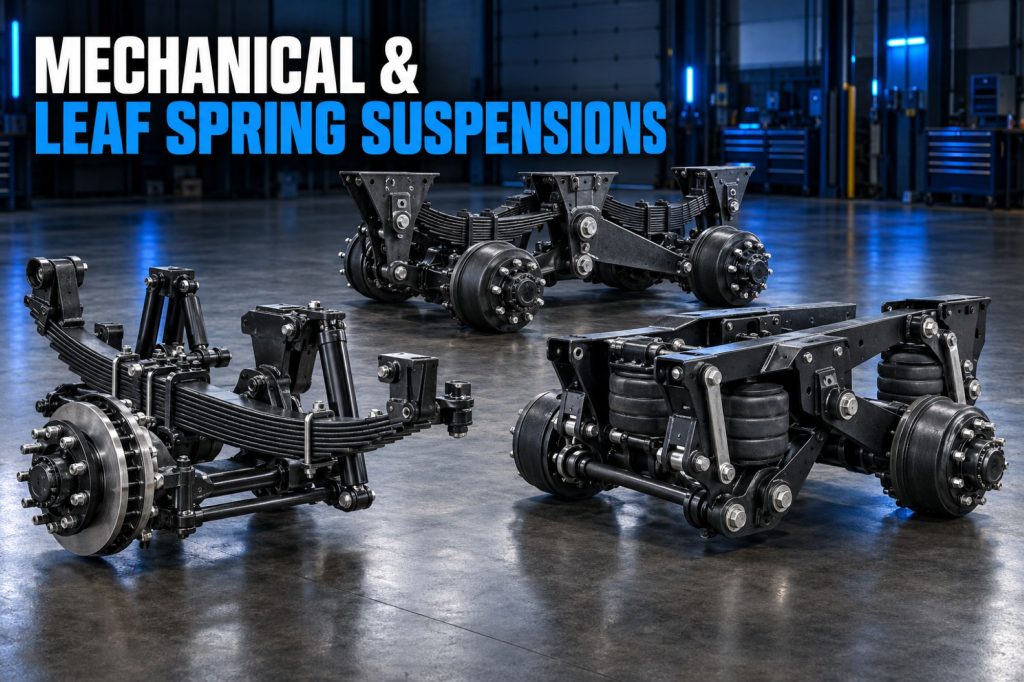
Commercial truck and trailer mechanical suspension systems use steel springs, rubber springs, walking beams, equalizers, torque rods, and related structural components to support vehicle weight and control axle movement.
Unlike air suspension, a conventional mechanical suspension does not rely primarily on compressed air to carry the vehicle’s load. Its springs flex, compress, or rotate as the wheels move across bumps, holes, uneven terrain, and changing road surfaces.
Truck Equipment Atlas covers front and rear leaf-spring suspensions, walking-beam systems, rubber-spring suspensions, vocational mechanical systems, trailer suspensions, suspension components, maintenance considerations, and individual products used throughout commercial trucking.
Mechanical and Leaf Spring Suspensions on Truck Equipment Atlas
Explore the mechanical, rubber-spring, walking-beam, and leaf-spring suspension products being added to Truck Equipment Atlas:
Hendrickson
- Hendrickson HAULMAAX EX
- Hendrickson SOFTEK
- Hendrickson STEERTEK NXT Suspension System
- Hendrickson HN Vocational Suspension
- Hendrickson RT/RTE Mechanical Suspension
- Hendrickson RS Series Suspension
Additional front, rear, tandem, walking-beam, rubber-spring, leaf-spring, trailer, and severe-service mechanical suspension systems will be added as the Truck Equipment Atlas Suspension Systems Library continues to expand.
How Mechanical Suspension Systems Work
Mechanical suspensions use physical spring components to support the truck or trailer and allow controlled movement between the axles and frame.
When a wheel moves over a bump, the spring bends, compresses, twists, or rotates to absorb part of the road force. The spring then returns toward its normal position as the vehicle moves beyond the disturbance.
Shock absorbers may be used to control repeated movement and prevent the vehicle from continuing to bounce. Torque rods, control arms, beams, equalizers, hangers, bushings, U-bolts, and other mounting components keep the axles positioned beneath the vehicle.
The suspension must allow enough movement for the tires to maintain road contact while preventing excessive axle movement, frame contact, body roll, driveline misalignment, or instability.
Major Mechanical Suspension Components
Mechanical suspension systems can include:
- Leaf springs
- Tapered leaf springs
- Multi-leaf spring packs
- Parabolic springs
- Rubber springs
- Walking beams
- Equalizer beams
- Spring hangers
- Spring pins
- Shackles
- Torque rods
- Radius rods
- Shock absorbers
- Rebound straps
- Pivot bushings
- U-bolts
- Axle seats
- Frame brackets
- Crossmembers
- Bump stops
- Load cushions
The exact components depend on whether the system supports a front steer axle, single rear axle, tandem rear axles, auxiliary axle, or trailer axle group.
Leaf Spring Suspensions
Leaf springs are curved steel suspension members that support vehicle weight by flexing as the axle moves.
A traditional leaf spring consists of several steel leaves stacked together to form a spring pack. The longest leaf normally includes mounting eyes that connect the spring to the chassis through pins, bushings, hangers, and shackles.
The axle is commonly secured to the spring with U-bolts and an axle seat. As the axle moves vertically, the spring changes shape and absorbs part of the road force.
Leaf-spring suspensions are widely used because they can support the vehicle while also helping locate the axle. They remain common on steer axles, medium-duty trucks, vocational vehicles, pickup-based commercial trucks, and certain trailers.
Multi-Leaf Spring Suspensions
A multi-leaf suspension uses several steel leaves of different lengths assembled into a spring pack.
The leaves work together to support the vehicle and resist bending forces. Friction between the leaves can provide some natural damping, although shock absorbers may still be used.
Multi-leaf suspensions can provide:
- High load capacity
- Straightforward construction
- Broad service familiarity
- Strong resistance to demanding road conditions
- Wide replacement-parts availability
- Application flexibility
Potential considerations include spring-pack weight, interleaf wear, corrosion, noise, broken leaves, and a firmer unloaded ride.
Tapered and Parabolic Leaf Springs
Tapered leaf springs use one or more leaves whose thickness changes along their length. Parabolic designs distribute stress through a carefully shaped spring profile.
These designs can reduce weight and interleaf friction compared with a conventional multi-leaf pack. They may also provide improved ride quality and more responsive spring movement.
Because tapered and parabolic springs depend on their designed shape and stress distribution, damaged leaves should be replaced with the correct parts. Adding unapproved leaves or substituting a different spring pack can change ride height, capacity, alignment, and handling.
Walking-Beam Suspensions
A walking-beam suspension connects two tandem axles through beams that pivot around a central support.
When one axle moves upward over an obstacle, the beam rotates and allows the other axle to move in relation to it. This provides axle articulation and helps maintain tire contact on uneven terrain.
Walking-beam systems are commonly used on:
- Dump trucks
- Concrete mixers
- Logging trucks
- Refuse vehicles
- Construction trucks
- Mining vehicles
- Oilfield equipment
- Severe-service trucks
- Heavy-haul vehicles
The beams, center bushings, torque rods, frame brackets, and axle connections must withstand substantial braking, driving, cornering, and suspension forces.
Rubber-Spring Suspensions
Rubber-spring suspensions use engineered rubber components to support weight, absorb road shock, and control suspension movement.
The rubber elements compress and deform under load. Their resistance can change as compression increases, allowing the suspension to provide load support without conventional air springs.
Rubber-spring systems can provide:
- Progressive load support
- Good roll stability
- Reduced dependence on air-system components
- Resistance to certain harsh operating conditions
- Vocational durability
- Lower maintenance in selected applications
Rubber springs remain subject to cracking, tearing, contamination, heat, age, overloading, and incorrect installation. The correct replacement component must match the suspension model and capacity.
Front Leaf Spring Suspensions
Front leaf springs connect the steer axle to the chassis while supporting the front of the truck.
They affect:
- Steering geometry
- Front-axle ride quality
- Vehicle ride height
- Caster
- Wheel alignment
- Tire wear
- Brake response
- Driver comfort
- Axle movement
Front leaf springs are used on medium-duty trucks, highway tractors, vocational trucks, severe-service vehicles, buses, and specialty equipment.
Front-suspension capacity must match the steer axle, tires, wheels, brakes, frame, steering system, and expected vehicle load.
Products associated with front mechanical and leaf-spring suspension include:
Learn more in Front Suspension Systems.
Rear Mechanical Suspension Systems
Rear mechanical suspensions support single or tandem rear axles and manage driving, braking, cornering, and load forces.
Single rear suspensions may use leaf springs mounted above or below the axle. Tandem systems may use walking beams, equalizers, rubber springs, multi-leaf springs, or combinations of these components.
Rear suspension design affects:
- Load distribution
- Axle articulation
- Drive-axle traction
- Roll stability
- Frame height
- Driveline angles
- Ground clearance
- Tire contact
- Ride quality
- Loaded and unloaded handling
Rear mechanical-suspension products include:
- Hendrickson HAULMAAX EX
- Hendrickson HN Vocational Suspension
- Hendrickson RT/RTE Mechanical Suspension
- Hendrickson RS Series Suspension
Learn more in Rear Suspension Systems.
Single and Tandem Mechanical Suspensions
A single-axle mechanical suspension supports one rear axle. These configurations are widely used on medium-duty delivery trucks, utility vehicles, tow trucks, buses, municipal equipment, and vocational trucks.
A tandem mechanical suspension connects and supports two rear axle positions. Depending on the design, equalizers or walking beams help distribute weight and allow the axles to move over uneven terrain.
Tandem mechanical suspensions are commonly used where durability, articulation, stability, and resistance to severe operating conditions are more important than the softest possible ride.
Mechanical Trailer Suspensions
Mechanical trailer suspensions support trailer axles using leaf springs, equalizers, walking beams, or other non-air spring components.
These systems are used on:
- Construction trailers
- Dump trailers
- Agricultural trailers
- Logging trailers
- Container chassis
- Equipment trailers
- Lowboy trailers
- Heavy-haul trailers
- Specialty trailers
Mechanical trailer suspensions may be selected for simplicity, durability, reduced dependence on air controls, or resistance to demanding operating environments.
Spring capacity, axle spacing, equalizer geometry, hanger position, tire clearance, frame strength, brakes, and wheel-end ratings must be evaluated as a complete system.
Load Equalization
Tandem mechanical suspensions often use equalizers or walking beams to distribute weight between two axles.
As one axle moves over an obstacle, the equalizing component shifts or rotates to allow movement between the axle positions. This helps both axles maintain contact with the road or ground.
Load equalization is affected by:
- Suspension geometry
- Spring condition
- Vehicle ride height
- Axle spacing
- Pivot condition
- Bushing wear
- Vehicle loading
- Terrain
- Brake and drive forces
A suspension may not distribute weight evenly if its springs, equalizers, beams, bushings, or mounting components are damaged or worn.
Axle Articulation
Axle articulation describes the ability of the suspension to allow one wheel or axle to move vertically in relation to another.
Greater articulation can help vocational trucks maintain tire contact on uneven jobsites, logging roads, construction areas, mines, and off-highway terrain.
The amount of useful articulation depends on suspension design, shock travel, torque-rod movement, driveline clearance, frame clearance, tire clearance, and vehicle stability.
Maximum articulation is not always the best choice for every application. Highway vehicles may place greater priority on precise axle control, low weight, ride quality, and reduced suspension movement.
Ride Quality and Vehicle Stability
Mechanical suspensions can provide predictable axle control and strong roll stability, but their ride characteristics vary significantly.
A suspension designed to support high loads may feel firm when the vehicle is empty. As payload is added, the springs move closer to their intended operating range and ride quality may change.
Vehicle stability depends on more than spring stiffness. Center of gravity, track width, axle spacing, tires, frame design, suspension geometry, shocks, torque rods, and loading all affect how the vehicle responds to turns and uneven surfaces.
A stiff suspension does not automatically make a truck safer, and a softer suspension does not automatically make it unstable. The complete vehicle must be engineered for its intended application.
Highway Mechanical Suspension Applications
Mechanical suspension remains common on front steer axles and selected medium-duty, local, and specialty vehicles.
Important highway considerations can include:
- Suspension weight
- Ride quality
- Driver comfort
- Axle alignment
- Tire wear
- Parts availability
- Service familiarity
- Loaded and unloaded operation
- Corrosion resistance
- Maintenance requirements
While rear air suspension dominates many highway tractor applications, leaf springs remain widely used on steer axles and medium-duty commercial vehicles.
Vocational Mechanical Suspension Applications
Vocational trucks can place substantial loads and shock forces on suspension components.
Common applications include:
- Dump trucks
- Concrete mixers
- Refuse trucks
- Logging trucks
- Construction trucks
- Utility trucks
- Tow and recovery trucks
- Municipal vehicles
- Snowplows
- Oilfield trucks
- Mining vehicles
- Fire and emergency vehicles
- Severe-service equipment
These applications may require higher suspension capacity, increased roll stiffness, greater axle articulation, reinforced mounting structures, improved ground clearance, and resistance to impact or contamination.
Heavy-Haul and Severe-Service Applications
Heavy-haul and severe-service trucks operate at high weights and may encounter steep grades, uneven terrain, loose surfaces, and repeated low-speed maneuvering.
Important suspension considerations can include:
- Suspension capacity
- Axle capacity
- Vehicle center of gravity
- Roll stability
- Axle articulation
- Frame strength
- Axle spacing
- Ground clearance
- Suspension weight
- Torque-rod design
- Walking-beam construction
- Bushing durability
- Brake capacity
- Tire and wheel capacity
- Expected shock loading
A heavy-duty suspension does not automatically make a vehicle legal or suitable for a particular load. Every chassis and running-gear component must remain within its approved rating.
Advantages of Mechanical and Leaf Spring Suspensions
Depending on their design and application, mechanical suspension systems can provide:
- Simple and proven construction
- High load-bearing capacity
- Strong vocational durability
- Good axle articulation
- Predictable axle control
- Strong roll stability
- Reduced dependence on compressed air
- Broad service familiarity
- Wide replacement-parts availability
- Front and rear applications
- Truck and trailer configurations
- Severe-service capability
- Resistance to demanding operating conditions
The actual benefits depend on the suspension model and how well it is matched to the vehicle, load, terrain, and duty cycle.
Mechanical Suspension Limitations and Considerations
No single mechanical suspension is appropriate for every commercial vehicle.
Important considerations include:
- Suspension capacity
- Suspension weight
- Loaded ride quality
- Unloaded ride quality
- Vehicle stability
- Axle articulation
- Ground clearance
- Frame height
- Axle compatibility
- Brake compatibility
- Tire and wheel capacity
- Spring replacement cost
- Bushing maintenance
- Alignment requirements
- Corrosion exposure
- Replacement-parts availability
- Vehicle application
- Road and terrain conditions
Some mechanical suspensions provide a firmer ride than comparable air systems. Heavy steel components may also add vehicle weight and reduce available payload.
Driver and Operator Considerations
Drivers should understand that mechanical suspension behavior can change as vehicle weight changes.
An empty vocational truck may ride more firmly and bounce differently than the same truck under load. Drivers should adjust speed for road conditions, uneven jobsites, railroad crossings, potholes, and other surface changes.
Operators should monitor for:
- Vehicle leaning
- Uneven ride height
- Suspension clunking
- Squeaking or grinding
- Harsh impacts
- Excessive bouncing
- Steering changes
- Axle movement
- Irregular tire wear
- Broken or displaced spring leaves
- Loose suspension components
- Changes in driveline vibration
A sudden change in handling or vehicle height should be inspected before continued operation.
Maintenance and Ownership
Mechanical and leaf-spring suspensions require regular inspection even though they do not rely on air springs or height-control valves.
Important maintenance areas can include:
- Leaf-spring condition
- Broken or cracked spring leaves
- Spring-eye bushings
- Spring pins
- Shackles
- Walking beams
- Equalizers
- Rubber springs
- Center bushings
- Torque rods
- Shock absorbers
- U-bolts
- Axle seats
- Hangers and brackets
- Frame connections
- Crossmembers
- Bump stops
- Mounting fasteners
- Axle alignment
- Tire-wear patterns
Suspension components should be inspected more frequently in construction, logging, mining, refuse, agricultural, and off-highway applications.
Replacement parts must match the suspension model, capacity, spring rate, axle configuration, ride height, and vehicle application.
Common Mechanical Suspension Problems
Common mechanical and leaf-spring suspension problems can include:
- Broken spring leaves
- Cracked leaf springs
- Sagging springs
- Uneven vehicle height
- Worn spring-eye bushings
- Worn spring pins
- Damaged shackles
- Loose or stretched U-bolts
- Shifted axle position
- Worn walking-beam bushings
- Damaged equalizers
- Cracked or torn rubber springs
- Worn torque-rod bushings
- Failed shock absorbers
- Loose mounting hardware
- Cracked hangers or brackets
- Frame-mounting damage
- Axle misalignment
- Irregular tire wear
- Suspension noise
- Harsh ride
- Excessive bouncing
- Reduced roll stability
- Driveline vibration caused by axle movement
A broken spring or loose axle connection can affect vehicle control and should not be ignored.
Choosing a Mechanical Suspension System
The correct mechanical suspension depends on the truck, trailer, axles, frame, operating weight, and intended application.
Selection considerations can include:
- Front or rear position
- Truck or trailer application
- Single or tandem configuration
- Suspension capacity
- Axle rating
- Frame specifications
- Expected operating weight
- Highway or vocational duty cycle
- Road and terrain conditions
- Required axle articulation
- Vehicle center of gravity
- Roll-stability requirements
- Loaded ride quality
- Unloaded ride quality
- Ground clearance
- Suspension weight
- Maintenance support
- Replacement-parts availability
- Initial purchase cost
- Long-term ownership cost
A higher-capacity or heavier suspension is not automatically the best choice. The suspension must be matched to the vehicle’s axles, frame, tires, wheels, brakes, expected loads, and operating environment.
Major Mechanical Suspension Manufacturers
Truck Equipment Atlas covers mechanical, rubber-spring, walking-beam, and leaf-spring systems from manufacturers serving the commercial truck and trailer industries.
Current Phase 1 product coverage includes:
- Hendrickson
- Future coverage may include systems from:
- Chalmers
- Mack
- Volvo
- Freightliner and Detroit
- PACCAR, Kenworth, and Peterbilt
- Reyco Granning
- Ridewell
- Watson & Chalin
- Trailer manufacturers
- Specialty vehicle builders
Related Suspension Categories
- Suspension Systems
- Air Suspension Systems
- Front Suspension Systems
- Auxiliary and Lift Axle Suspensions
- Trailer Suspension Systems
Related Truck Equipment Resources
- Commercial Trucks
- Commercial Trailers
- Axles and Differentials
- Brake Systems
- Tires and Wheels
- Steering Systems
- Safety Systems
Related Suspension Guides
- How Commercial Truck Suspension Systems Work
- Air Suspension vs Leaf Spring Suspension
- How to Choose a Commercial Truck Suspension
How to Use the Mechanical and Leaf Spring Suspension Library
Individual Truck Equipment Atlas suspension profiles provide deeper information about specific mechanical and leaf-spring models and product families.
Depending on the equipment, these pages may include:
System overview
- Manufacturer information
- Suspension type
- Axle position
- Capacity ratings
- Spring design
- Available configurations
- Truck or trailer compatibility
- Axle compatibility
- Brake and wheel-end considerations
- Highway and vocational applications
- Driver considerations
- Maintenance information
- Common suspension problems
- Identification information
- Buying considerations
- Availability and replacement considerations
Readers can explore individual suspension profiles above or use the related suspension categories and guides to compare mechanical systems with commercial air suspensions.
Mechanical and Leaf Spring Suspension Library Expansion
The Truck Equipment Atlas Mechanical and Leaf Spring Suspension Library will continue to grow with additional front leaf-spring, rear leaf leaf-spring, walking-beam, equalizer, rubber-spring, tandem, trailer, vocational, and severe-service suspension profiles.
Future development will also expand the connections between mechanical suspensions and the trucks, trailers, axles, brakes, tires, steering systems, manufacturers, and applications in which they are used.
The goal is to build an organized commercial mechanical suspension reference that helps drivers, owner-operators, fleets, technicians, students, equipment buyers, and industry professionals understand how these systems work and where different suspension platforms fit within the trucking industry.
Follow the Growth of Truck Equipment Atlas
Truck Equipment Atlas continues to expand with new trucks, trailers, diesel engines, transmissions, axles, differentials, suspension systems, equipment resources, manufacturer information, freight resources, and educational guides.