
Air Suspension Systems
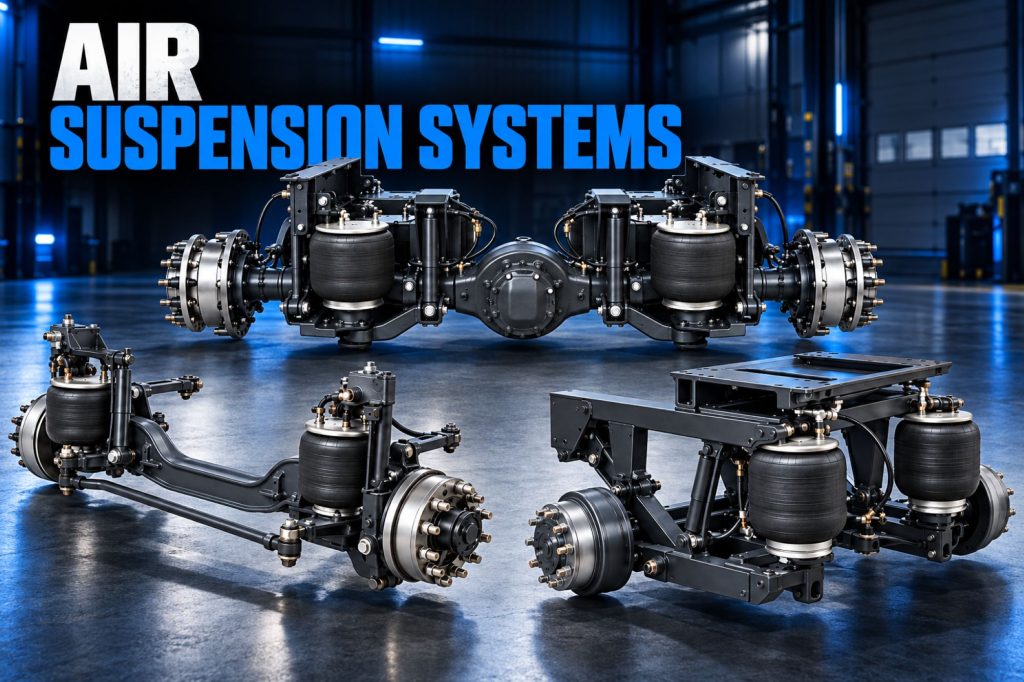
Commercial truck and trailer air suspension systems use pressurized air springs to support vehicle weight, maintain ride height, absorb road shock, and help control axle movement. They are widely used on highway tractors, vocational trucks, buses, commercial trailers, auxiliary axles, and cab suspension systems.
Air suspensions can improve ride quality, driver comfort, cargo protection, axle articulation, and load distribution. Depending on the design, they may also allow the suspension to be raised, lowered, dumped, or adjusted for specific loading and operating conditions.
Truck Equipment Atlas covers front and rear truck air suspensions, single and tandem systems, vocational air suspensions, trailer suspensions, lift-axle systems, cab suspensions, suspension components, maintenance considerations, and individual products from major commercial suspension manufacturers.
Air Suspension Systems on Truck Equipment Atlas
Explore the commercial truck, trailer, auxiliary, and cab air-suspension products being added to Truck Equipment Atlas:
Hendrickson
- Hendrickson PRIMAAX EX
- Hendrickson PRIMAAX
- Hendrickson HAS Air Suspension
- Hendrickson AIRTEK
- Hendrickson COMFORT AIR
- Hendrickson HTB Rear Air Suspension
- Hendrickson INTRAAX
- Hendrickson VANTRAAX
- Hendrickson ULTRAA-K
- Hendrickson ULTRAA-K Slider System
SAF-Holland
- SAF-Holland NEWAY ADZ
- SAF-Holland NEWAY ADL
- SAF-Holland NEWAY AD Series
- SAF-Holland CBX40
- SAF-Holland CBX23 AeroBeam
- SAF-Holland CBX25 AeroBeam
Link Manufacturing
Reyco Granning
- Reyco Granning 79KB Air Suspension
- Reyco Granning 102AR Air Suspension
- Reyco Granning 240AR Air Suspension
Additional truck, trailer, cab, auxiliary, highway, and vocational air-suspension systems will be added as the Truck Equipment Atlas Suspension Systems Library continues to expand.
How Commercial Air Suspension Systems Work
An air suspension uses flexible air springs positioned between the axle-supporting suspension structure and the vehicle frame, trailer frame, or cab.
Compressed air from the vehicle’s air system enters the air springs through control valves and air lines. As vehicle weight changes, a height-control valve adds or releases air to maintain the suspension’s designed ride height.
The air springs support the load, but they do not normally locate and control the axle by themselves. Trailing arms, control arms, torque rods, beams, hangers, bushings, and related components control longitudinal, lateral, and rotational axle movement.
Shock absorbers damp repeated suspension movement. Without effective shock control, an air-suspended vehicle may continue bouncing after encountering a bump or road disturbance.
A properly operating system balances air-spring pressure, suspension geometry, axle alignment, ride height, and shock damping to keep the vehicle stable and the tires in contact with the road.
Major Air Suspension Components
Commercial air suspensions can include:
- Air springs
- Height-control valves
- Air lines and fittings
- Pressure regulators
- Dump valves
- Protection valves
- Trailing arms
- Control arms
- Torque rods
- Suspension beams
- Shock absorbers
- Pivot bushings
- Axle seats
- Hangers and frame brackets
- Crossmembers
- Axle-lift mechanisms
- Electronic height sensors
- Suspension control modules
The exact components vary according to whether the suspension supports a front axle, rear axle, trailer axle, auxiliary axle, or cab.
Air Springs
Air springs are flexible reinforced-rubber chambers that carry part or all of the suspension load using compressed air.
Common designs include rolling-lobe air springs, convoluted air springs, and application-specific bellows. Their size, shape, mounting arrangement, pressure range, and load capability depend on the suspension.
Air springs can isolate the frame from road shock more effectively than many rigid mechanical spring arrangements. However, they remain vulnerable to age, abrasion, punctures, contamination, incorrect ride height, overextension, heat, and contact with surrounding components.
An air spring should never be selected by appearance alone. The replacement must match the suspension model, mounting pattern, ride height, load rating, and manufacturer specifications.
Height-Control Valves and Ride Height
A height-control valve monitors the distance between the axle or suspension structure and the vehicle frame.
When the vehicle is loaded and the frame moves downward, the valve allows additional air into the air springs. When weight is removed and the frame rises, the valve releases air until the designed ride height is restored.
Correct ride height is essential because it can affect:
- Suspension travel
- Driveshaft angles
- Universal-joint operation
- Axle alignment
- Steering geometry
- Shock-absorber travel
- Air-spring position
- Frame clearance
- Tire clearance
- Vehicle handling
- Trailer dock height
- Fifth-wheel height
Ride height should be measured and adjusted according to the suspension manufacturer’s procedures. Visual estimates are not sufficiently accurate.
Front Air Suspension Systems
Front air suspensions support the steer axle while helping isolate the cab and chassis from road shock.
These systems may use air springs alone or combine air springs with mechanical springs, control arms, shocks, and an integrated steer axle.
Potential benefits include improved steering-axle ride quality, reduced vibration, better driver comfort, and more controlled front-axle movement.
Front air suspensions must maintain precise steering geometry. Worn bushings, incorrect ride height, loose components, or improper alignment can affect steering response and front-tire wear.
Products associated with front air suspension include:
Rear Truck Air Suspension Systems
Rear air suspensions support single or tandem rear axles and are used extensively on highway tractors, vocational trucks, buses, motorhomes, and specialty vehicles.
Trailing arms or suspension beams connect the axles to the frame while air springs carry the load. Torque rods or other locating components may control lateral movement, driveline forces, and axle alignment.
Rear air-suspension design affects:
- Ride quality
- Vehicle stability
- Axle articulation
- Drive-axle traction
- Driveline angles
- Suspension weight
- Frame height
- Tire wear
- Loaded and unloaded operation
Rear truck air-suspension products include:
- Hendrickson PRIMAAX EX
- Hendrickson PRIMAAX
- Hendrickson HAS Air Suspension
- Hendrickson HTB Rear Air Suspension
- SAF-Holland NEWAY ADZ
- SAF-Holland NEWAY ADL
- SAF-Holland NEWAY AD Series
- Link UltraRide Suspension
- Reyco Granning 79KB Air Suspension
- Reyco Granning 102AR Air Suspension
- Reyco Granning 240AR Air Suspension
Single and Tandem Air Suspensions
A single-axle air suspension supports one rear axle. It is commonly used on medium-duty trucks, buses, motorhomes, specialty vehicles, and certain tractor configurations.
A tandem air suspension supports two rear axle positions. Tandem systems are widely used on Class 8 highway tractors and heavy vocational trucks.
Tandem suspensions must distribute weight between both axles while controlling axle alignment, articulation, roll movement, braking forces, and drive torque.
The suspension rating must be matched to the ratings of both axles, tires, wheels, brakes, frame, and complete vehicle.
Vocational Air Suspensions
Vocational air suspensions are engineered for trucks operating in construction sites, refuse routes, logging operations, oilfields, mines, transfer stations, and other demanding environments.
Compared with a highway-focused air suspension, a vocational system may provide:
- Greater roll stiffness
- Higher capacity
- Improved axle articulation
- Stronger suspension beams
- Reinforced mounting components
- Greater resistance to shock loading
- Improved ground clearance
- Application-specific stability characteristics
Vocational air suspension must be selected for the actual terrain, vehicle body, center of gravity, axle configuration, load, and operating cycle.
A highway air suspension should not be assumed suitable for severe vocational use simply because its nominal capacity appears adequate.
Trailer Air Suspension Systems
Trailer air suspensions connect one or more trailer axles to the frame while helping protect the trailer and cargo from road shock.
They are widely used on:
- Dry van trailers
- Refrigerated trailers
- Flatbed trailers
- Step-deck trailers
- Tank trailers
- Dump trailers
- Container chassis
- Car-hauler trailers
- Lowboy trailers
- Specialized heavy-haul trailers
A trailer air suspension may be fixed directly to the frame or installed as part of a sliding tandem assembly. Integrated systems may combine the suspension beams, axle, brakes, and wheel-end provisions into a coordinated assembly.
Trailer air-suspension products include:
- Hendrickson INTRAAX
- Hendrickson VANTRAAX
- Hendrickson ULTRAA-K
- Hendrickson ULTRAA-K Slider System
- SAF-Holland CBX40
- SAF-Holland CBX23 AeroBeam
- SAF-Holland CBX25 AeroBeam
Auxiliary and Lift-Axle Air Suspensions
Auxiliary air suspensions support pusher, tag, and liftable axle systems.
Air pressure lowers the axle and determines how much vehicle weight is transferred onto it. When additional axle support is unnecessary, the suspension may raise the axle and remove its tires from the road.
Improper auxiliary-axle pressure can overload the lift axle or remove too much weight from the steer or drive axles. This can affect traction, braking, steering, stability, and legal axle weights.
Auxiliary air-suspension products include:
Learn more in Auxiliary and Lift Axle Suspensions.
Cab Air Suspension Systems
Cab air suspensions isolate the driver compartment from chassis vibration and movement.
A cab suspension may use air springs, shocks, pivot bushings, leveling valves, linkages, and cab-mounting components. It does not support the truck’s axles, but it can substantially affect driver comfort and fatigue.
Worn cab-suspension components can cause excessive cab movement, harsh ride, leaning, clunking, or vibration.
Cab air-suspension products include:
Suspension Dump and Height Adjustment
Many air suspensions include a dump function that releases air from the air springs.
Suspension dump may be used to:
- Lower the chassis temporarily
- Assist trailer coupling or uncoupling
- Reduce trailer movement during loading
- Improve stability during certain stationary operations
- Provide clearance beneath equipment
- Transfer weight under approved operating conditions
A suspension should not normally be driven with its air springs dumped unless the vehicle or suspension manufacturer specifically permits that operation.
Some specialized systems use electronic controls to provide multiple programmed heights. These systems must remain within the suspension’s approved operating range.
Load Distribution and Axle Weight
Air pressure inside an air spring changes according to the amount of load it supports. This allows air-suspension pressure to provide a useful indication of axle loading when the system is correctly calibrated.
Air pressure alone does not replace certified scale measurements. Suspension geometry, ride height, valve arrangement, air-spring size, friction, vehicle position, and uneven ground can affect the relationship between pressure and actual axle weight.
Operators should verify axle weights on a suitable scale and confirm that the suspension, axles, tires, wheels, brakes, and frame remain within their approved ratings.
Highway Air Suspension Applications
Long-haul and regional trucks commonly use air suspension because of its ride quality, cargo protection, and ability to maintain a consistent frame height.
Important highway considerations can include:
- Vehicle weight
- Fuel efficiency
- Driver comfort
- Cargo protection
- Highway stability
- Tire wear
- Alignment retention
- Ride-height accuracy
- Driveline angles
- Maintenance intervals
- Replacement-parts availability
Air suspensions are especially common on sleeper tractors, day cabs, dry van trailers, refrigerated trailers, tank trailers, and flatbed equipment.
Vocational Air Suspension Applications
Vocational trucks can place significantly different demands on an air suspension than highway tractors.
Common applications include:
- Dump trucks
- Refuse trucks
- Concrete mixers
- Construction trucks
- Utility trucks
- Tow and recovery trucks
- Logging trucks
- Heavy-haul tractors
- Municipal vehicles
- Oilfield trucks
- Fire and emergency vehicles
- Severe-service equipment
These applications may require increased suspension capacity, roll stiffness, axle articulation, ground clearance, reinforced structural components, and resistance to contamination or impact damage.
Advantages of Commercial Air Suspension Systems
Depending on their design and application, air suspensions can provide:
- Improved ride quality
- Reduced road shock
- Better driver comfort
- Improved cargo protection
- Consistent designed ride height
- Adjustable vehicle height
- Suspension-dump capability
- Improved tire contact
- Controlled axle articulation
- Single and tandem configurations
- Truck and trailer applications
- Auxiliary lift-axle capability
- Cab-isolation options
- Integrated axle-and-suspension systems
The actual benefits depend on the suspension model and how well it is matched to the vehicle, load, road conditions, and duty cycle.
Air Suspension Limitations and Considerations
No single air suspension is appropriate for every commercial truck or trailer.
Important considerations include:
- Suspension capacity
- Suspension weight
- Ride height
- Axle compatibility
- Frame compatibility
- Brake compatibility
- Tire and wheel capacity
- Air-system capacity
- Air-line routing
- Air-spring clearance
- Roll stability
- Axle articulation
- Ground clearance
- Maintenance requirements
- Replacement-parts availability
- Alignment requirements
- Vehicle application
- Operating environment
Air suspensions contain more air lines, valves, fittings, and flexible components than most mechanical suspensions. Air leaks or control-system failures can affect ride height and vehicle operation.
Driver and Operator Considerations
Drivers should allow the vehicle’s air system to reach normal operating pressure before moving a truck or trailer equipped with air suspension.
The suspension should rise to its designed operating height without excessive leaning, delay, or repeated valve cycling.
Drivers should monitor for:
- Low vehicle height
- Uneven vehicle height
- Excessive leaning
- Air-system warning indications
- Continuous air-compressor cycling
- Air leaks
- Harsh ride
- Excessive bouncing
- Suspension clunking
- Steering or handling changes
- Irregular tire wear
- Tire or component interference
Operators should understand suspension-dump controls, lift-axle controls, kneeling systems, and any electronically controlled height functions installed on the vehicle.
Maintenance and Ownership
Commercial air suspensions require regular inspection and correct ride-height adjustment.
Important maintenance areas can include:
- Air-spring condition
- Air-line and fitting condition
- Air leaks
- Height-control valve operation
- Ride-height measurement
- Dump-valve operation
- Pressure-regulator operation
- Shock-absorber condition
- Trailing-arm inspection
- Torque-rod inspection
- Pivot-bushing inspection
- Hanger and bracket inspection
- Axle-seat inspection
- Mounting-fastener inspection
- Frame and crossmember inspection
- Axle alignment
- Tire-wear patterns
- Component clearance
Owners should use the suspension manufacturer’s approved ride-height measurement points, alignment procedures, torque values, and replacement parts.
Common Air Suspension Problems
Common air-suspension problems can include:
- Leaking air springs
- Cracked or deteriorated rubber bellows
- Damaged air lines
- Loose or leaking fittings
- Faulty height-control valves
- Incorrect ride height
- Slow suspension inflation
- Suspension failing to rise
- Suspension failing to dump
- Uneven vehicle height
- Repeated compressor cycling
- Worn pivot bushings
- Worn torque-rod bushings
- Failed shock absorbers
- Loose mounting hardware
- Cracked hangers or brackets
- Bent suspension components
- Axle misalignment
- Irregular tire wear
- Tire or air-spring interference
- Excessive bouncing
- Harsh ride
- Reduced roll stability
Not every loss of air pressure originates in the suspension. The vehicle’s compressor, air dryer, reservoirs, protection valves, brake system, and other pneumatic equipment may also need to be inspected.
Choosing an Air Suspension System
The correct air suspension depends on the complete truck, trailer, axle, chassis, and operating application.
Selection considerations can include:
- Front, rear, trailer, auxiliary, or cab position
- Single or tandem configuration
- Suspension capacity
- Axle rating
- Truck or trailer frame
- Designed ride height
- Available frame space
- Expected operating weight
- Highway or vocational duty cycle
- Road and terrain conditions
- Vehicle center of gravity
- Required roll stability
- Axle articulation
- Driver-comfort requirements
- Cargo sensitivity
- Suspension weight
- Maintenance support
- Replacement-parts availability
- Air-system compatibility
- Initial purchase cost
- Long-term ownership cost
A higher capacity rating does not automatically make one suspension a better choice. The system must be matched to the vehicle structure, axles, tires, wheels, brakes, expected loads, and operating conditions.
Major Commercial Air Suspension Manufacturers
Truck Equipment Atlas covers air suspensions from manufacturers that serve the commercial truck, bus, trailer, specialty-vehicle, and vocational-equipment industries.
Current Phase 1 product coverage includes:
- Hendrickson
- SAF-Holland
- Link Manufacturing
- Reyco Granning
- Future coverage may include additional proprietary and supplier-built systems used by:
- Freightliner and Detroit
- Volvo and Mack
- PACCAR, Kenworth, and Peterbilt
- Trailer manufacturers
- Bus and motorhome manufacturers
- Specialty vehicle builders
Related Suspension Categories
- Suspension Systems
- Mechanical & Leaf Spring Suspensions
- Front Suspension Systems
- Auxiliary and Lift Axle Suspensions
- Trailer Suspension Systems
Related Truck Equipment Resources
- Commercial Trucks
- Commercial Trailers
- Axles and Differentials
- Brake Systems
- Tires and Wheels
- Steering Systems
- Safety Systems
- Electrical Systems
Related Suspension Guides
- How Commercial Truck Suspension Systems Work
- Air Suspension vs Leaf Spring Suspension
- How to Choose a Commercial Truck Suspension
How to Use the Air Suspension Systems Library
Individual Truck Equipment Atlas air-suspension profiles provide deeper information about specific suspension models and product families.
Depending on the equipment, these pages may include:
- System overview
- Manufacturer information
- Suspension type
- Axle position
- Capacity ratings
- Designed ride height
- Available configurations
- Truck or trailer compatibility
- Axle compatibility
- Brake and wheel-end considerations
- Highway and vocational applications
- Driver considerations
- Maintenance information
- Common suspension problems
- Identification information
- Buying considerations
- Availability and replacement considerations
Readers can explore individual air-suspension profiles above or use the related suspension categories and guides to compare air systems with other commercial suspension designs.
Air Suspension Systems Library Expansion
The Truck Equipment Atlas Air Suspension Systems Library will continue to grow with additional front, rear, single-axle, tandem, vocational, trailer, auxiliary, lift-axle, and cab suspension profiles.
Future development will also expand the connections between air suspensions and the trucks, trailers, axles, brakes, tires, steering systems, manufacturers, and applications in which they are used.
The goal is to build an organized commercial air-suspension reference that helps drivers, owner-operators, fleets, technicians, students, equipment buyers, and industry professionals understand how these systems work and where different air-suspension platforms fit within the trucking industry.
Follow the Growth of Truck Equipment Atlas
Truck Equipment Atlas continues to expand with new trucks, trailers, diesel engines, transmissions, axles, differentials, suspension systems, equipment resources, manufacturer information, freight resources, and educational guides.