
Auxiliary & Lift Axle Suspensions
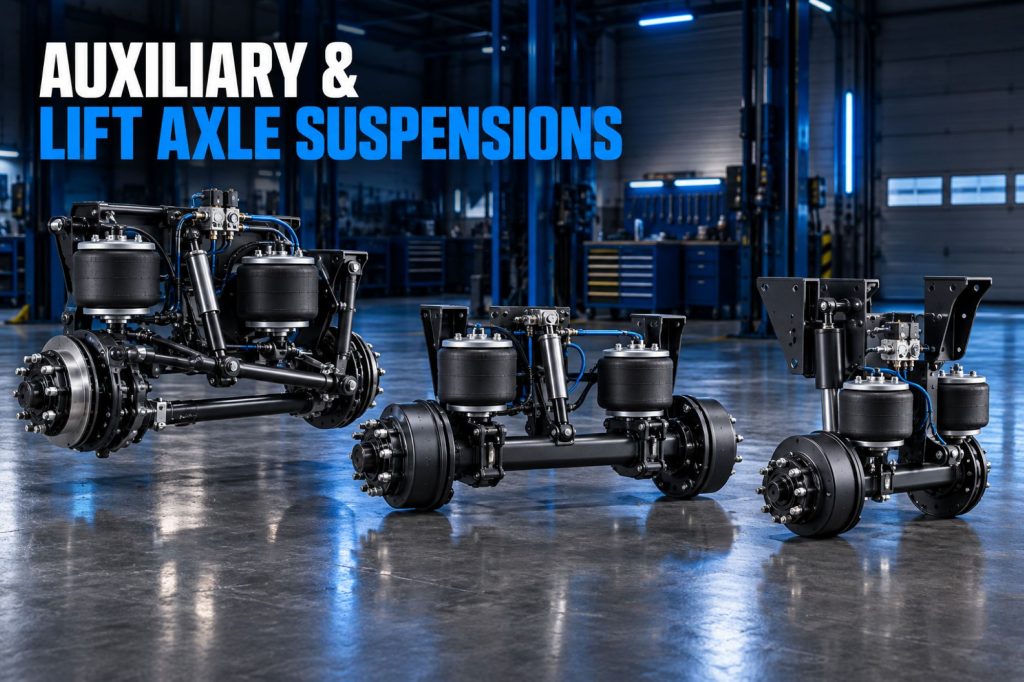
Auxiliary and lift-axle suspension systems support additional axles installed on commercial trucks, trailers, and specialized vehicles. These systems help distribute vehicle weight, support higher operating loads, and reduce the amount of weight carried by the primary steer or drive axles.
An auxiliary axle may be installed ahead of the primary rear axle group as a pusher axle or behind it as a tag axle. Depending on the design, the axle may remain fixed, steer during turns, lift away from the road when it is not needed, or use regulated air pressure to change the amount of weight it carries.
Truck Equipment Atlas covers steerable and non-steerable lift-axle suspensions, pusher and tag configurations, air-operated auxiliary systems, axle controls, weight distribution, maintenance considerations, regulations, and individual products from commercial suspension manufacturers.
Auxiliary and Lift Axle Suspensions on Truck Equipment Atlas
Explore the auxiliary and lift-axle suspension products being added to Truck Equipment Atlas:
Hendrickson
Link Manufacturing
Additional steerable, non-steerable, pusher, tag, self-steering, fixed, and liftable auxiliary suspension systems will be added as the Truck Equipment Atlas Suspension Systems Library continues to expand.
How Auxiliary Axle Suspensions Work
An auxiliary suspension connects an additional axle to the vehicle or trailer frame. The system supports part of the vehicle’s weight and transfers that load through the axle, wheels, tires, and road surface.
Many auxiliary systems use air springs to lower the axle and regulate the amount of load it carries. Increasing air pressure generally transfers more weight onto the auxiliary axle, while reducing pressure decreases the supported load.
A lift mechanism raises the axle when it is not required. Depending on the design, separate lift air springs, mechanical linkages, suspension geometry, or combinations of these components may be used.
The suspension must control vertical, longitudinal, and lateral axle movement while maintaining tire clearance, brake-line protection, alignment, and stability.
Major Auxiliary Suspension Components
Auxiliary and lift-axle suspension systems can include:
- Air springs
- Lift air springs
- Suspension beams
- Trailing arms
- Control arms
- Torque rods
- Pivot bushings
- Axle seats
- Hangers and mounting brackets
- Crossmembers
- Shock absorbers
- Air-pressure regulators
- Raise-and-lower valves
- Height-control valves
- Solenoid valves
- Air lines and fittings
- Brake chambers
- ABS sensors
- Steering linkages
- Steering stabilizers
- Reverse-locking mechanisms
- Cab-mounted or exterior controls
- Axle-position indicators
The exact components depend on the suspension manufacturer, axle position, capacity, steering design, brake configuration, and vehicle application.
Pusher Axle Suspensions
A pusher axle is normally installed ahead of the primary drive axle or tandem-drive group.
Pusher axles are used to transfer part of the vehicle’s weight away from the steer and drive axles. They are common on dump trucks, concrete mixers, refuse vehicles, roll-off trucks, heavy vocational equipment, and specialized transport vehicles.
A pusher axle may be:
- Steerable
- Non-steerable
- Liftable
- Fixed in the lowered position
- Air-pressure regulated
- Mechanically load sharing
The axle’s location affects legal axle spacing, turning behavior, frame loading, and the amount of weight it can effectively support.
Tag Axle Suspensions
A tag axle is normally installed behind the primary rear axle or tandem-drive group.
Tag axles are used on vocational trucks, heavy-haul tractors, buses, motorhomes, specialty vehicles, and certain trailer configurations.
A tag axle can provide additional load-bearing capacity and help distribute rear vehicle weight. However, its position can increase the vehicle’s overall turning footprint and change how weight is transferred between the rear axle group and front steer axle.
Tag axles may be fixed, steerable, liftable, or capable of controlled load transfer.
Steerable Lift Axle Suspensions
A steerable lift axle allows its wheels to turn as the vehicle changes direction.
Many auxiliary steer axles use passive self-steering geometry. Caster causes the wheels to follow the vehicle’s direction during forward travel without being mechanically connected to the steering wheel.
Steerable designs can reduce:
- Tire scrub
- Turning resistance
- Pavement disturbance
- Suspension stress during turns
- Resistance in tight vocational operations
Steering performance depends on axle loading, caster, toe, alignment, steering-component condition, vehicle speed, and road surface.
Some steerable axles must be raised, centered, or locked during reverse operation. Operators should follow the vehicle builder’s approved control strategy.
Non-Steerable Lift Axle Suspensions
A non-steerable auxiliary axle keeps its wheels in a fixed forward position.
These systems can be simpler than steerable configurations, but their tires may scrub during tight turns because the wheels cannot align with the vehicle’s turning path.
Tire scrub can increase:
- Tire wear
- Turning resistance
- Stress on suspension components
- Stress on frame mounting points
- Pavement disturbance
Non-steerable lift axles may be appropriate for applications with limited turning, specific axle positions, or operating requirements that do not justify a steerable system.
Fixed Auxiliary Suspensions
Not every auxiliary axle is designed to lift away from the road.
A fixed auxiliary suspension remains in the operating position and continuously supports part of the vehicle or trailer weight. Fixed systems may be used when the axle is required under nearly all loading conditions or when lifting capability would add unnecessary weight and complexity.
A fixed auxiliary axle still requires correct load distribution, alignment, tire capacity, braking capability, and frame integration.
Lift-Axle Raising and Lowering
An air-operated lift axle uses pneumatic controls to change between raised and lowered positions.
When the axle is lowered, the suspension air springs inflate and press the axle toward the road. When it is raised, the load-supporting air pressure is released and the lift mechanism pulls the axle upward.
The control system may be operated by:
- A manual cab control
- An exterior control valve
- An automatic pressure system
- An electronic suspension controller
- A vehicle-speed input
- A transmission reverse signal
- A weight or load sensor
Local regulations may restrict how lift-axle controls are designed, located, or operated. Some jurisdictions require automatic axle deployment or exterior controls to prevent improper driver adjustment.
Axle Load Regulation
Lowering an auxiliary axle does not guarantee that it is carrying the correct amount of weight.
Air pressure must be adjusted so the auxiliary axle supports its intended share without overloading itself or removing too much weight from the primary axles.
Too much auxiliary-axle pressure can:
- Reduce drive-axle traction
- Change steering-axle loading
- Increase tire wear
- Affect braking stability
- Overload the auxiliary axle
- Overload its tires and wheels
- Create handling problems
Too little pressure can leave the primary axles overloaded and prevent the auxiliary axle from providing its intended benefit.
Axle loads should be verified on a suitable scale under realistic operating conditions.
Weight Distribution
Auxiliary axles help distribute vehicle weight across additional axle positions.
The amount of weight transferred depends on:
- Axle position
- Axle spacing
- Suspension geometry
- Air pressure
- Frame stiffness
- Vehicle wheelbase
- Body configuration
- Payload position
- Steer-axle loading
- Drive-axle loading
- Overall vehicle weight
Adding an axle does not automatically increase the vehicle’s certified gross vehicle weight rating. The frame, suspension, axles, brakes, tires, wheels, steering system, and vehicle certification must all support the intended operating weight.
Axle Spacing and Bridge Requirements
Axle spacing can be as important as axle capacity.
Federal, state, provincial, and local weight laws may limit the amount of weight carried by an axle group based on the number of axles and the distance between them.
An auxiliary axle installed too close to another axle may not provide the same legal weight benefit as an axle positioned farther away.
Vehicle builders and operators must evaluate:
- Individual axle limits
- Tandem and tridem limits
- Bridge-formula requirements
- Tire-width limits
- Seasonal weight restrictions
- Route restrictions
- Permit conditions
- State or provincial regulations
- Local road limits
Legal weight requirements should be confirmed for the jurisdictions in which the vehicle will operate.
Auxiliary Axle Brakes
Many auxiliary axles include foundation brakes and must be integrated with the truck or trailer braking system.
Brake configurations may include:
- Air-disc brakes
- S-cam drum brakes
- Air brake chambers
- Automatic slack adjusters
- ABS wheel-speed sensors
- Brake-pressure controls
The braking system must be designed so the auxiliary axle contributes controlled braking without locking prematurely or creating instability.
Brake requirements vary by axle rating, vehicle type, jurisdiction, axle position, and whether the axle can be lifted.
Wheel-End and Tire Considerations
Auxiliary axles may use single or dual tires depending on the axle capacity, application, available space, and legal requirements.
Wheel-end considerations include:
- Hub type
- Wheel-bearing design
- Spindle configuration
- Brake package
- ABS provisions
- Tire size
- Tire load rating
- Wheel load rating
- Track width
- Frame clearance
- Body clearance
- Turning clearance
A tire or wheel should never be selected based only on physical fit. Its load rating must support the intended axle weight.
Common Truck Applications
Auxiliary and lift-axle suspensions are commonly used on:
- Dump trucks
- Concrete mixers
- Refuse trucks
- Roll-off trucks
- Construction trucks
- Heavy-haul tractors
- Logging trucks
- Tank trucks
- Bulk-hauling vehicles
- Municipal vehicles
- Utility trucks
- Oilfield trucks
- Mining vehicles
- Specialty transport equipment
The appropriate axle type depends on vehicle weight, body type, payload, wheelbase, axle spacing, turning requirements, and operating environment.
Dump Truck Applications
Dump trucks frequently use pusher or tag axles to distribute payload weight and support legal axle loading.
The suspension must account for:
- High payload weight
- Changing center of gravity
- Uneven jobsites
- Repeated loading
- Dump-body clearance
- Hoist clearance
- Tight turns
- Raised-body stability
- Ground clearance
- Axle deployment procedures
The vehicle should be on suitable ground before the dump body is raised. A lift axle cannot correct an unstable dumping position.
Concrete Mixer Applications
Concrete mixers carry concentrated, high-density loads in a rotating drum. Auxiliary axles can help distribute this weight across the chassis.
Mixer applications may require:
- High-capacity auxiliary axles
- Steerable pusher axles
- Strong roll stability
- Adequate tire clearance
- Protected air lines
- Jobsite durability
- Automatic or regulated axle controls
- Proper frame reinforcement
The suspension must be engineered around the mixer body, drum placement, water tanks, wheelbase, and expected operating weight.
Refuse and Roll-Off Applications
Refuse and roll-off trucks experience changing loads, frequent stops, tight turns, curb contact, and demanding urban operation.
Steerable lift axles can reduce tire scrub during repeated turning. Air-operated systems allow the auxiliary axle to be raised when the truck is empty or when its use is unnecessary.
Control-system durability, steering alignment, tire clearance, brake integration, and protection from debris are especially important in these applications.
Heavy-Haul Applications
Heavy-haul tractors and specialized transport vehicles may use multiple auxiliary axles to distribute high gross vehicle or combination weights.
Important considerations include:
- Axle capacity
- Axle spacing
- Permit requirements
- Frame strength
- Steering capability
- Tire and wheel capacity
- Brake capacity
- Suspension travel
- Low-speed maneuverability
- Load distribution
- Route restrictions
Auxiliary axles do not automatically make a heavy load legal. The complete truck, trailer, route, permits, and axle-loading plan must satisfy applicable requirements.
Trailer Auxiliary Suspensions
Auxiliary axles can also be installed on specialized trailers.
Trailer configurations may include:
- Liftable front axles
- Liftable rear axles
- Self-steering axles
- Tag axles
- Booster axles
- Flip axles
- Removable axle assemblies
- Hydraulically controlled axle groups
- Air-operated lift axles
Trailer auxiliary systems are used to improve maneuverability, distribute weight, reduce unnecessary tire wear, or configure the trailer for different loads.
Advantages of Auxiliary and Lift Axle Suspensions
Depending on their design and application, auxiliary suspensions can provide:
- Additional load-bearing support
- Improved axle-weight distribution
- Reduced loading on primary axles
- Greater vehicle-configuration flexibility
- Lift capability when additional support is unnecessary
- Reduced tire wear when the axle is raised
- Steerable options for improved turning
- Pusher and tag configurations
- Truck and trailer applications
- Additional braking capacity when properly equipped
- Support for vocational and heavy-haul applications
The actual benefits depend on axle placement, suspension design, legal requirements, vehicle vehicle configuration, and correct load adjustment.
Auxiliary Suspension Limitations and Considerations
No single auxiliary suspension is appropriate for every vehicle.
Important considerations include:
- Added vehicle weight
- Reduced available payload from equipment weight
- Installation cost
- Frame space
- Axle spacing
- Suspension capacity
- Air-system capacity
- Brake-system integration
- Tire and wheel capacity
- Steering clearance
- Ground clearance
- Reverse operation
- Control-system complexity
- Maintenance requirements
- Legal restrictions
- Replacement-parts availability
Improper axle pressure can reduce traction, change steering behavior, create tire wear, or overload vehicle components.
Driver and Operator Considerations
Drivers must understand when the auxiliary axle should be raised or lowered and how its position affects vehicle operation.
Important operating considerations include:
- Vehicle loading
- Axle weights
- Turning radius
- Tire scrub
- Drive-axle traction
- Steering response
- Braking behavior
- Reverse operation
- Ground clearance
- Jobsite obstacles
- Road and bridge restrictions
Cab indicators should clearly show whether the axle is raised or lowered. Operators should never assume an axle has moved into position without checking the indicator and vehicle response.
Steerable lift axles may need to be raised or locked before reversing, depending on the system.
Maintenance and Ownership
Auxiliary suspension systems require regular inspection because they combine structural, pneumatic, steering, braking, and wheel-end components.
Important maintenance areas can include:
- Air springs
- Lift air springs
- Air lines and fittings
- Pressure regulators
- Control valves
- Solenoids
- Suspension beams
- Pivot bushings
- Torque rods
- Steering linkages
- Steering stabilizers
- Reverse locks
- Shock absorbers
- Mounting brackets
- Frame connections
- Axle alignment
- Wheel bearings
- Hub seals
- Brake components
- ABS sensors and wiring
- Tires and wheels
- Axle-position indicators
The axle should raise, lower, steer, and center according to the manufacturer’s specifications. Scale checks should be performed when air-pressure settings or vehicle configuration changes.
Common Auxiliary Suspension Problems
Common auxiliary and lift-axle suspension problems can include:
- Air leaks
- Axle failing to lower
- Axle failing to raise
- Slow axle movement
- Incorrect axle pressure
- Uneven axle loading
- Vehicle leaning
- Worn pivot bushings
- Damaged air springs
- Faulty control valves
- Failed solenoids
- Damaged air lines
- Steering shimmy
- Wheels failing to center
- Irregular tire wear
- Excessive tire scrub
- Incorrect toe or caster
- Loose mounting hardware
- Cracked brackets
- Bent suspension components
- Wheel-bearing problems
- Brake imbalance
- ABS faults
- Tire or chassis interference
- Reduced drive-axle traction
- Unexpected steering behavior during reverse operation
A malfunctioning lift axle can affect vehicle stability, braking, steering, legal weight distribution, and tire life.
Choosing an Auxiliary or Lift Axle Suspension
The correct auxiliary suspension depends on the complete vehicle and intended operating environment.
Selection considerations can include:
- Required axle capacity
- Pusher or tag position
- Steerable or non-steerable design
- Liftable or fixed configuration
- Available frame space
- Axle spacing
- Vehicle wheelbase
- Expected payload
- Legal weight requirements
- Truck or trailer application
- Tire configuration
- Brake type
- Track width
- Ground clearance
- Body and equipment clearance
- Air-system capacity
- Control-system requirements
- Reverse-operation strategy
- Maintenance support
- Replacement-parts availability
- Initial purchase cost
- Long-term ownership cost
The suspension should be selected and installed by qualified professionals familiar with the chassis, axle, body, brake system, and applicable regulations.
Regulatory and Compliance Considerations
Auxiliary and lift-axle rules vary significantly between jurisdictions.
Requirements may address:
- Maximum axle weight
- Minimum axle spacing
- Bridge formulas
- Tire width
- Brake equipment
- Steerable axle requirements
- Automatic deployment
- Manual controls
- Exterior control placement
- Reverse operation
- Speed-based axle controls
- When an axle must remain lowered
- Seasonal weight limits
- Permit conditions
Drivers and fleets should confirm the requirements for every jurisdiction in which the vehicle operates.
Major Auxiliary Suspension Manufacturers
Truck Equipment Atlas covers auxiliary and lift-axle suspensions from manufacturers serving vocational trucks, trailers, buses, heavy-haul vehicles, and specialty equipment.
Current product coverage includes:
- Hendrickson
- Link Manufacturing
- Future coverage may include:
- Watson & Chalin
- Ridewell
- Reyco Granning
- SAF-Holland
- Silent Drive
- Truck and trailer OEM systems
- Specialty vehicle builders
Related Suspension Categories
- Suspension Systems
- Air Suspension Systems
- Mechanical & Leaf Spring Suspensions
- Vocational & Severe-Duty Suspensions
Related Axle and Differential Resources
- Axles and Differentials
- Lift Axles and Auxiliary Axles
- Commercial Truck Steer Axles
- Commercial Trailer Axles
Related Truck Equipment Resources
- Brake Systems
- Tires and Wheels
- Steering Systems
- Safety Systems
Related Suspension and Axle Guides
- How Commercial Truck Suspension Systems Work
- How to Choose a Commercial Truck Suspension
- Lift Axles Explained
How to Use the Auxiliary and Lift Axle Suspension Library
Individual Truck Equipment Atlas profiles provide deeper information about specific auxiliary suspension and lift-axle products.
Depending on the equipment, these pages may include:
- System overview
- Manufacturer information
- Axle position
- Suspension type
- Capacity ratings
- Steering design
- Lift mechanism
- Available configurations
- Truck or trailer compatibility
- Brake and wheel-end options
- Control-system information
- Driver considerations
- Maintenance information
- Common problems
- Identification information
- Buying considerations
- Regulatory considerations
- Availability and replacement information
Readers can explore the individual equipment profiles above or use the related suspension, axle, and guide pages to learn more about auxiliary vehicle systems.
Auxiliary and Lift Axle Suspension Library Expansion
The Truck Equipment Atlas Auxiliary and Lift Axle Suspension Library will continue to grow with additional steerable, non-steerable, pusher, tag, fixed, liftable, self-steering, trailer, vocational, and heavy-haul suspension profiles.
Future development will also expand the connections between auxiliary suspensions and the trucks, trailers, axles, brakes, tires, steering systems, manufacturers, regulations, and applications in which they are used.
The goal is to build an organized auxiliary suspension reference that helps drivers, owner-operators, fleets, technicians, students, equipment buyers, and industry professionals understand how these systems work and where different lift-axle configurations fit within commercial trucking.
Follow the Growth of Truck Equipment Atlas
Truck Equipment Atlas continues to expand with new trucks, trailers, diesel engines, transmissions, axles, differentials, suspension systems, equipment resources, manufacturer information, freight resources, and educational guides.