
Air Suspension vs Leaf Spring Suspension
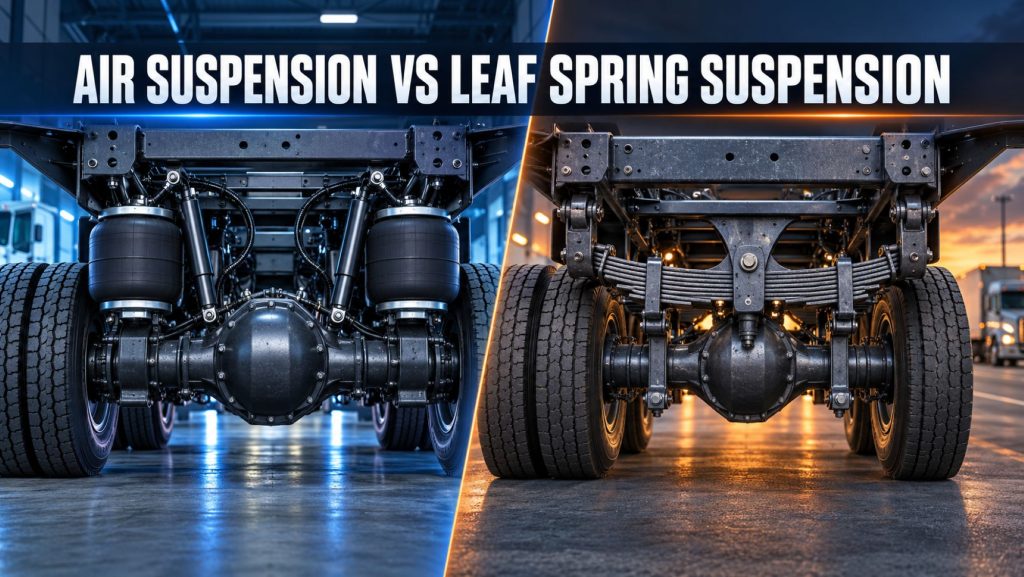
Air suspension and leaf spring suspension are two of the most common methods used to support commercial trucks and trailers.
Both systems connect the vehicle’s frame to its axles, support the vehicle and its load, control axle movement, absorb road impacts, and help keep the tires in contact with the road. However, they accomplish these tasks in different ways and provide different advantages.
Air suspensions use compressed air inside flexible air springs. Leaf spring suspensions use curved steel spring leaves that flex as the axles move.
Air suspension is frequently selected for improved ride quality, cargo protection, and automatic ride-height control. Leaf spring suspension is often chosen for mechanical simplicity, durability, and dependable performance in demanding vocational and off-highway applications.
This guide compares air suspension and leaf spring suspension, explains how each system works, and examines their differences in ride quality, stability, durability, maintenance, weight, cost, and commercial-truck applications.
Understanding Commercial Truck Suspensions
A commercial truck suspension operates between the frame and axles.
Its basic functions include:
- Supporting the vehicle and its load
- Connecting the axles to the frame
- Allowing controlled wheel and axle movement
- Absorbing road impacts
- Maintaining tire contact with the road
- Controlling body and axle movement
- Helping distribute weight between axles
- Supporting steering and braking stability
- Protecting cargo and mounted equipment
- Improving driver comfort
Air and leaf spring suspensions perform these same basic functions, but their spring materials and supporting components differ.
Learn more about the complete system in How Commercial Truck Suspension Systems Work.
How Air Suspension Works
An air suspension uses flexible, reinforced rubber air springs filled with compressed air.
The truck’s compressed-air system supplies air to the suspension. On a trailer, air is normally supplied through the tractor-trailer air connections and stored in trailer reservoirs.
A height-control valve monitors the distance between the frame and axle. When the vehicle’s load changes, the valve adds or releases air to maintain the suspension’s specified ride height.
When weight is added:
- The frame moves downward relative to the axle.
- The height-control valve detects the change.
- Compressed air enters the air springs.
- The air springs expand and support the additional weight.
- The frame returns toward its specified ride height.
When weight is removed:
- The frame rises relative to the axle.
- The height-control valve detects the change.
- Excess air is released from the air springs.
- The suspension returns toward its specified ride height.
Air springs primarily support vertical weight. Torque rods, control arms, trailing arms, bushings, shocks, brackets, and other components locate the axles and control their movement.
Explore these systems in Air Suspension Systems.
How Leaf Spring Suspension Works
A leaf spring suspension uses one or more curved steel leaves arranged into a spring assembly.
The spring bends as weight is applied or the axle moves over an uneven surface. This controlled flexing allows movement between the axle and frame while supporting the vehicle.
When a wheel encounters a bump:
- The wheel and axle move upward.
- The leaf spring bends under the changing force.
- The spring stores part of the impact energy.
- The shock absorber helps control continued movement.
- The spring returns toward its normal position.
Depending on the suspension design, leaf springs may also help locate the axle and transfer braking or acceleration forces into the frame.
Mechanical tandem suspensions may use equalizers, walking beams, torque rods, or other components to distribute weight and coordinate movement between multiple axles.
Explore leaf spring and related designs in Mechanical Suspension Systems.
The Primary Difference
The primary difference is the material used to support the vehicle.
An air suspension uses compressed air inside flexible air springs.
A leaf spring suspension uses the controlled bending of steel spring leaves.
This difference affects how each suspension responds to changing loads, road conditions, vehicle movement, and maintenance requirements.
Air pressure can be adjusted as the load changes. A steel leaf spring has a fixed mechanical spring rate determined by its design, dimensions, material, and construction.
Ride Quality
Ride quality is one of the most noticeable differences between air and leaf spring suspensions.
Air Suspension Ride Quality
Air suspension generally provides a smoother and more controlled ride, particularly when the vehicle is lightly loaded or operating across changing load conditions.
The air springs can adjust their internal pressure to support the load while maintaining ride height. Their flexible construction helps isolate the frame, cab, cargo, and trailer from road vibration.
Potential ride-quality benefits include:
- Reduced vibration
- Softer response to road impacts
- Improved driver comfort
- Better cargo protection
- Less shock transferred into the frame
- More consistent ride height as loading changes
The exact ride depends on the complete suspension design, air pressure, shock absorbers, axle configuration, tires, vehicle weight, and road conditions.
Leaf Spring Ride Quality
Leaf spring suspensions often provide a firmer ride, especially when the truck or trailer is empty or lightly loaded.
A spring pack designed to support a heavy load must remain strong enough to carry that load. When the vehicle is empty, the same spring can transmit more road shock into the frame.
Ride quality may improve when the vehicle is loaded because the springs are operating closer to their intended working range.
Leaf spring ride characteristics depend on:
- Number of spring leaves
- Spring dimensions
- Spring rate
- Axle configuration
- Vehicle weight
- Load
- Shock absorbers
- Suspension geometry
- Road conditions
A firmer ride does not automatically mean the suspension is unsuitable. Many vocational applications value durability, stability, and load support more than maximum ride comfort.
Cargo Protection
Air suspension is commonly selected when cargo protection is a major concern.
A smoother suspension can reduce the vibration and shock transferred into freight, trailer structures, truck bodies, and mounted equipment.
Air suspension can be beneficial when transporting:
- Electronics
- Furniture
- Appliances
- Packaged consumer goods
- Fragile materials
- Temperature-controlled freight
- Vehicles
- Sensitive machinery
- Livestock
- Other damage-sensitive cargo
Leaf spring suspensions can transport these types of freight, but they may transfer more vibration into the cargo under certain operating conditions.
Cargo protection also depends on load securement, packaging, tire condition, road quality, vehicle speed, trailer design, and driver behavior.
Ride-Height Control
Air suspension provides automatic ride-height control.
As weight is added or removed, height-control valves regulate air pressure so the frame remains near its designed operating height.
Consistent ride height can help maintain:
- Suspension travel
- Driveline angles
- Fifth-wheel height
- Trailer height
- Dock compatibility
- Tire clearance
- Shock-absorber position
- Air spring alignment
- Vehicle appearance
Some air suspensions can also temporarily raise or lower the vehicle for coupling, loading, unloading, or clearing an obstacle.
Leaf spring suspensions do not normally provide automatic height compensation. The springs compress farther as weight is added, causing the vehicle’s ride height to change.
Load Changes
Commercial trucks frequently operate under changing load conditions.
A tractor may pull an empty trailer on one trip and a heavily loaded trailer on the next. A delivery truck gradually becomes lighter as cargo is removed. A dump truck may alternate between empty travel and operation near its rated capacity.
Air suspension can adjust pressure to support these changing loads while maintaining ride height.
Leaf spring suspension responds mechanically. As load increases, the springs deflect farther. Some systems use multi-stage, progressive, or auxiliary springs to provide different support characteristics at different loads.
Air suspension generally provides greater adaptability across large load changes. Leaf springs provide predictable mechanical support without depending on air-pressure adjustments.
Stability and Body Roll
Suspension design influences how a truck responds during turns, lane changes, braking, and operation on slopes.
Air suspension is sometimes assumed to be less stable because air springs are flexible. However, stability depends on the complete system rather than the spring material alone.
Important factors include:
- Air spring placement
- Suspension geometry
- Spring stiffness
- Track width
- Center of gravity
- Shock absorbers
- Anti-roll components
- Axle configuration
- Cargo height
- Cargo movement
- Tire condition
- Vehicle speed
Mechanical suspensions can provide firm roll resistance and are often selected for dump trucks, concrete mixers, refuse vehicles, and other high-center-of-gravity applications.
Air suspensions designed for vocational service can also provide strong roll stability. The correct comparison must be made between specific suspension models designed for the same application.
Axle Articulation
Axle articulation is important when trucks operate on uneven ground.
Construction, logging, mining, heavy-haul, agricultural, and off-highway vehicles may need the axles to move relative to one another while keeping the tires in contact with the surface.
Mechanical suspension designs such as walking-beam systems can provide substantial articulation and load equalization.
Air suspensions can also provide useful axle movement, but their performance depends on suspension geometry, air plumbing, axle configuration, and intended application.
Neither air nor mechanical suspension automatically provides better articulation in every situation. The specific design and operating environment must be considered.
Traction
A suspension helps maintain traction by keeping the tires in contact with the road and controlling axle movement.
Air suspension may provide consistent load support and good tire contact during highway operation.
Mechanical suspensions can provide dependable traction and articulation on rough or uneven terrain.
Traction is also influenced by:
- Axle loading
- Differential configuration
- Tire tread
- Tire pressure
- Road surface
- Suspension condition
- Shock-absorber condition
- Vehicle speed
- Driver inputs
Improper load distribution, worn suspension components, or incorrect ride height can reduce the traction benefits of either suspension type.
Weight Distribution
Tandem and tridem suspensions are designed to distribute weight across multiple axles.
Air suspension uses air pressure and suspension geometry to support and share the load.
Mechanical tandem suspensions may use equalizers, walking beams, or connected spring assemblies to transfer weight between axles.
Proper weight distribution affects:
- Legal axle weights
- Tire loading
- Braking
- Steering
- Traction
- Stability
- Component life
Suspension pressure may help estimate loading on some air-suspended vehicles, but an accurate certified scale should be used to verify legal axle weights.
Durability
Leaf spring and other mechanical suspensions are widely known for durability.
Their relatively straightforward construction can perform well in demanding environments involving:
- Rough jobsites
- Mud
- Dust
- Gravel
- Debris
- Severe articulation
- Repeated loading
- Off-highway operation
- Concentrated loads
- Heavy vocational service
Air suspensions are also available for severe-duty applications, but air springs, lines, valves, and fittings introduce additional components that must be protected and maintained.
An air suspension properly designed for the application can provide long service life. Problems are more likely when a highway-oriented suspension is used in an environment beyond its intended design.
Maintenance Requirements
Both suspension types require regular inspection and maintenance.
Air Suspension Maintenance
Air suspension inspection commonly includes:
- Air springs
- Air lines
- Fittings
- Height-control valves
- Air tanks
- Suspension dump valves
- Shock absorbers
- Torque rods
- Control arms
- Bushings
- Brackets
- Mounting fasteners
- Ride height
- Axle alignment
Common air suspension problems can include:
- Air leaks
- Cracked or damaged air springs
- Faulty height-control valves
- Restricted air lines
- Incorrect ride height
- Worn bushings
- Damaged shocks
- Loose mounting hardware
Leaf Spring Suspension Maintenance
Leaf spring suspension inspection commonly includes:
- Spring leaves
- Spring eyes
- Bushings
- Shackles
- Hangers
- Equalizers
- U-bolts
- Torque rods
- Walking beams
- Wear pads
- Shock absorbers
- Brackets
- Mounting fasteners
- Axle alignment
Common mechanical suspension problems can include:
- Broken or cracked spring leaves
- Worn bushings
- Loose U-bolts
- Damaged hangers
- Worn equalizers
- Shifted spring packs
- Corrosion
- Bent components
- Loose mounting hardware
Mechanical suspensions eliminate the air components associated with an air suspension, but they are not maintenance-free.
Air Leaks and System Dependence
An air suspension depends on a reliable source of compressed air.
Leaks can develop in:
- Air springs
- Air lines
- Fittings
- Valves
- Connections
- Reservoirs
A minor leak may cause the suspension to lose height after the vehicle is parked. A more serious leak may prevent proper ride-height control or increase demand on the air compressor.
Leaf spring suspension does not depend on compressed air to support the vehicle. This can be an advantage in remote, off-highway, or severe environments where mechanical simplicity is valuable.
However, many commercial trucks with mechanical suspension still use compressed air for their brake systems and other equipment.
Failure Characteristics
Air and leaf spring suspensions can fail in different ways.
A damaged air spring or major air leak can cause the suspension to lose pressure and ride height. Continued operation may damage the air spring, shocks, driveline, tires, or other components.
A leaf spring can crack, break, shift, or lose its original shape. A broken spring may allow the axle to move, alter ride height, or place additional stress on the remaining spring leaves and suspension mounts.
Neither type should be considered fail-proof. Regular inspection is essential.
Repairability
Leaf spring systems are often valued for straightforward mechanical repair.
Many technicians are familiar with leaf springs, U-bolts, shackles, hangers, bushings, and equalizers. Mechanical parts may also be easier to diagnose in locations with limited access to specialized equipment.
Air suspension repairs may require knowledge of pneumatic controls, ride-height adjustment, air plumbing, and suspension geometry.
However, air suspensions are widely used throughout commercial trucking, and parts and service are generally available for major systems.
Repairability depends on:
- Suspension manufacturer
- Vehicle location
- Parts availability
- Technician experience
- Fleet maintenance capabilities
- Application
- Suspension age
Initial Cost
Air suspension can have a higher initial cost because it includes air springs, valves, lines, fittings, and additional controls.
Leaf spring suspension is often less expensive and mechanically simpler.
The purchase price should not be considered alone. The complete operating cost may include:
- Maintenance
- Tire wear
- Cargo damage
- Driver comfort
- Vehicle downtime
- Component life
- Resale value
- Fuel use
- Application suitability
A more expensive suspension may provide value when its benefits match the operation. A simpler suspension may be more economical when ride-height control and premium ride quality are not priorities.
Suspension Weight
Suspension weight varies by design.
Some air suspensions are engineered to reduce weight compared with certain mechanical systems. Other heavy-duty or specialized air suspensions may not provide a weight advantage.
Leaf spring systems can be relatively simple, but heavy spring packs, equalizers, beams, and mounting structures can add substantial weight.
The weight comparison should be made between specific suspension models with equivalent axle capacities and intended applications.
Driver Comfort
Air suspension generally provides better isolation from road shock and vibration.
This can reduce the movement transferred into the frame and cab, particularly during long highway trips.
Improved ride quality may help reduce driver fatigue, but total cab comfort also depends on:
- Cab suspension
- Seat suspension
- Tires
- Wheelbase
- Vehicle load
- Road conditions
- Shock absorbers
- Cab design
- Driver position
Leaf spring suspension may provide a firmer ride, especially when empty, but can still be appropriate for shorter routes, lower speeds, and vocational operations.
Highway Applications
Air suspension is widely used on long-haul and regional highway tractors and trailers.
Reasons include:
- Improved ride quality
- Better cargo protection
- Consistent ride height
- Driver comfort
- Broad availability
- Compatibility with highway operations
- Adjustable height on some systems
Leaf spring suspensions remain in use on certain trucks and trailers where simplicity, cost, or application requirements make them appropriate.
Vocational Applications
Vocational operations create different suspension demands.
Dump trucks, refuse vehicles, concrete mixers, logging trucks, cranes, service trucks, and construction vehicles may experience:
- Rough surfaces
- High centers of gravity
- Repeated loading
- Uneven terrain
- Concentrated loads
- Severe braking
- High articulation
- Mud and debris
- Off-highway travel
Mechanical suspensions are common in these environments because of their durability, stability, and straightforward construction.
Vocational air suspensions are also available and can provide improved ride quality and load control when properly selected.
Explore these applications in Vocational & Severe-Duty Suspensions.
Steer Axle Applications
Commercial truck steer axles commonly use leaf spring suspensions.
Leaf springs provide durable support while helping control axle position. Front suspension systems may also include shocks, stabilizer components, hangers, shackles, bushings, and U-bolts.
Some commercial vehicles use air-assisted or full-air front suspensions, but they are less common than rear air suspension systems.
Explore front suspension designs in Steer Axle & Front Suspensions.
Drive Axle Applications
Class 8 highway tractors commonly use tandem rear air suspensions.
These systems can provide:
- Improved ride quality
- Consistent ride height
- Cargo protection
- Controlled axle movement
- Load sharing between drive axles
Vocational trucks may use air, leaf spring, walking-beam, rubber, or other mechanical drive-axle suspensions depending on the application.
Trailer Applications
Commercial trailers use both air and mechanical suspension systems.
Air suspension is common on:
- Dry vans
- Refrigerated trailers
- Tank trailers
- Flatbeds
- Car haulers
- Specialized trailers
- Cargo-sensitive operations
Leaf spring suspension is common on:
- Vocational trailers
- Dump trailers
- Equipment trailers
- Agricultural trailers
- Certain flatbeds
- Heavy-duty and off-highway trailers
- Cost-sensitive applications
Trailer design, cargo, axle configuration, loading method, operating environment, and maintenance capabilities should all influence suspension selection.
Explore these systems in Trailer Suspension Systems.
Air Suspension Advantages
Potential advantages of air suspension include:
- Smoother ride quality
- Improved cargo protection
- Automatic ride-height control
- Better empty-vehicle ride
- Adaptability to changing loads
- Reduced vibration
- Improved driver comfort
- Adjustable height on some systems
- Broad highway availability
- Potential resale benefits
These advantages depend on selecting and maintaining the correct suspension for the application.
Air Suspension Disadvantages
Potential disadvantages of air suspension include:
- More pneumatic components
- Greater sensitivity to air leaks
- More complex troubleshooting
- Higher initial cost in some applications
- Possible air spring damage from debris or abrasion
- Dependence on correct ride-height adjustment
- Additional valves, lines, and fittings
- Increased complexity in severe environments
Leaf Spring Suspension Advantages
Potential advantages of leaf spring suspension include:
- Mechanical simplicity
- Proven durability
- Straightforward inspection
- Strong load support
- Suitability for severe-duty applications
- No suspension air system required
- Broad technician familiarity
- Good performance on rough terrain
- Potentially lower initial cost
- Fewer pneumatic components
Leaf Spring Suspension Disadvantages
Potential disadvantages of leaf spring suspension include:
- Firmer ride quality
- Harsher empty-vehicle ride
- More vibration transferred to cargo
- Ride-height changes as load changes
- No automatic leveling
- Heavy spring assemblies in some designs
- Spring wear, cracking, or breakage
- Reduced cargo protection compared with many air systems
Air Suspension or Leaf Springs: Which Is Better?
Neither suspension type is better for every commercial vehicle.
Air suspension is generally the stronger choice when the priorities include:
- Highway ride quality
- Driver comfort
- Cargo protection
- Automatic leveling
- Consistent ride height
- Frequently changing loads
Leaf spring or mechanical suspension may be the stronger choice when the priorities include:
- Mechanical simplicity
- Severe-duty durability
- Off-highway operation
- Resistance to harsh environments
- Straightforward field repair
- Lower initial cost
- Firm load control
The final decision should be based on the vehicle’s actual work rather than a general belief that one suspension technology is always superior.
Questions to Ask Before Choosing
Before choosing between air and leaf spring suspension, consider:
- What type of truck or trailer is being specified?
- Will it operate primarily on highways or jobsites?
- How much will the load change?
- Is the cargo sensitive to vibration?
- What ride quality is required?
- Does the vehicle need automatic leveling?
- Will adjustable ride height be useful?
- How important is severe-terrain articulation?
- What are the vehicle’s stability requirements?
- Are air-suspension parts and service readily available?
- What maintenance capabilities does the fleet have?
- What suspension is recommended by the truck or body manufacturer?
- What is the expected cost over the vehicle’s working life?
For a complete selection process, see How to Choose a Commercial Truck Suspension.
Suspension Condition Matters
A well-maintained suspension of either type will generally perform better than a worn or incorrectly adjusted system of the supposedly superior type.
Air suspensions require correct ride height, sound air springs, functioning valves, secure mounting points, and tight air connections.
Leaf spring suspensions require intact spring leaves, secure U-bolts, serviceable bushings, sound hangers, and properly operating equalizers or torque-control components.
Both systems depend on:
- Correct axle alignment
- Proper tire inflation
- Serviceable shock absorbers
- Secure fasteners
- Correct loading
- Regular inspection
- Application-appropriate components
Continue Learning About Commercial Truck Suspensions
Continue with the other Truck Equipment Atlas suspension guides:
- How Commercial Truck Suspension Systems Work
- How to Choose a Commercial Truck Suspension
- Truck Suspension Components Explained
- Truck vs Trailer Suspension Systems
Visit the Commercial Truck Suspension Systems Library to explore air, mechanical, vocational, auxiliary, steer axle, and trailer suspension systems.
Visit Equipment System Guides to explore additional guides covering commercial-truck suspensions, air brakes, fifth wheels, PTO systems, hydraulics, lift axles, electrical systems, and other equipment.
Final Thoughts
Air and leaf spring suspensions perform the same fundamental job: supporting the vehicle and controlling movement between the frame, axles, wheels, and road.
They accomplish that job differently.
Air suspension uses compressed air to support changing loads and maintain ride height. It generally provides smoother ride quality, improved cargo protection, and greater adaptability across changing load conditions.
Leaf spring suspension uses flexible steel spring assemblies. It provides durable, mechanically straightforward support that remains valuable in medium-duty, vocational, severe-duty, trailer, and off-highway applications.
The correct suspension depends on the truck or trailer, load, terrain, operating environment, maintenance capabilities, and performance priorities.
Understanding the differences between air and leaf spring suspension helps fleets, drivers, equipment buyers, and technicians evaluate which system is better suited to a particular commercial vehicle and operation.