
Automated Manual Transmissions
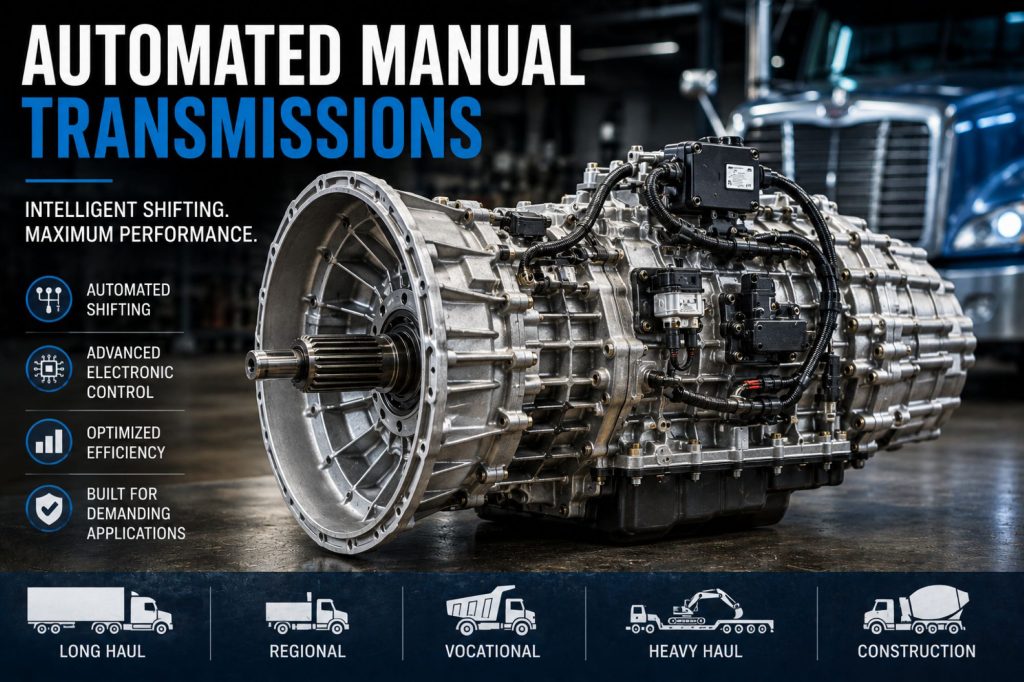
Automated manual transmissions, commonly known as AMTs, have become one of the most important transmission technologies in modern commercial trucking.
An AMT combines the internal mechanical design of a traditional manual transmission with electronically controlled shifting and automated clutch operation. Instead of requiring the driver to operate a clutch pedal and manually select every gear, electronic controls and actuators manage much of the shifting process.
Truck Equipment Atlas covers automated manual transmissions used throughout long-haul, regional, vocational, heavy-duty, and specialized commercial truck applications.
Automated Manual Transmission Models on Truck Equipment Atlas
Explore the automated manual transmissions currently covered on Truck Equipment Atlas:
Detroit
Eaton and Eaton Cummins
- Eaton AutoShift
- Eaton Cummins Endurant HD
- Eaton Cummins Endurant HD V
- Eaton Cummins Endurant XD
- Eaton Cummins Endurant XD Pro
- Eaton UltraShift
- Eaton UltraShift PLUS
International
Mack
PACCAR
Volvo
Additional automated manual transmission models and families will be added as the Truck Equipment Atlas Transmission Library continues to expand.
How Automated Manual Transmissions Work
An automated manual transmission retains many of the mechanical principles of a conventional manual gearbox while replacing much of the driver’s shifting work with electronic controls.
Depending on the transmission, the system can use electronic control modules, sensors, clutch actuators, shift actuators, and communication with the engine control system to determine when and how to change gears.
The transmission can evaluate factors such as:
- Vehicle speed
- Engine speed
- Engine load
- Throttle position
- Vehicle weight
- Road grade
- Selected operating mode
- Current gear
- Driver demand
The transmission then selects an appropriate gear and coordinates the shift with the engine.
For a step-by-step explanation of power flow and gear reduction, read How Commercial Truck Transmissions Work.
AMT vs. Traditional Manual Transmission
An AMT and a traditional manual transmission can have similar mechanical foundations, but the driver’s interaction with them is very different.
A traditional manual normally requires the driver to operate the clutch and control gear selection.
An AMT automates those functions through electronic controls and actuators.
This can provide many of the mechanical characteristics associated with a geared manual transmission while substantially reducing the amount of physical shifting required from the driver.
Readers interested in traditional transmissions can explore the Manual Transmissions section.
Compare clutch operation, launch behavior, and application tradeoffs in Manual vs Automated Manual vs Automatic Transmissions.
AMT vs. Fully Automatic Transmission
An automated manual transmission should not be confused with a conventional fully automatic transmission.
Many commercial fully automatic transmissions use a torque converter and planetary gearsets.
An AMT generally uses a mechanically geared transmission architecture with an automated clutch and electronically controlled shifting.
Both can eliminate normal manual clutch operation for the driver, but they accomplish that goal through different transmission designs.
Explore conventional commercial automatics in the Automatic Transmissions section.
Common AMT Configurations
Automated manual transmissions are available in several configurations depending on manufacturer and application.
Common configurations can include:
- 8-speed AMTs
- 10-speed AMTs
- 12-speed AMTs
- 14-speed AMTs
- 18-speed AMTs
- Direct-drive configurations
- Overdrive configurations
- Highway-oriented transmissions
- Vocational transmissions
- Heavy-haul configurations
The appropriate configuration depends on engine torque, axle ratio, vehicle weight, terrain, duty cycle, startability requirements, and intended application.
Heavy-Duty Highway Applications
Modern AMTs have become especially important in Class 8 highway tractors.
Long-haul and regional applications can benefit from automated gear selection because the transmission can coordinate shifting with the engine and other powertrain systems.
Potential advantages include:
- Reduced driver workload
- Consistent shifting
- Powertrain integration
- Fuel-efficiency optimization
- Reduced dependence on individual shifting technique
- Easier driver training
- Improved consistency across large fleets
For these reasons, AMTs have become a common transmission choice in modern fleet-operated highway tractors.
Vocational Applications
AMT technology has also expanded into vocational trucking.
Applications can include:
- Dump trucks
- Construction trucks
- Heavy-haul tractors
- Logging trucks
- Municipal equipment
- Refuse applications
- Severe-service trucks
- Specialized transport equipment
Vocational AMTs may incorporate specialized gearing, software, clutch controls, PTO capabilities, and operating modes designed for demanding low-speed or off-highway environments.
Models such as the Endurant XD and XD Pro, Mack mDRIVE HD, and PACCAR TX-18 platforms demonstrate how AMT technology has expanded beyond standard highway freight applications.
Driver Control and Operating Modes
Although an AMT performs much of the shifting automatically, many systems still provide the driver with some level of manual gear control.
Depending on the transmission and truck configuration, the driver may be able to:
- Request upshifts
- Request downshifts
- Hold a selected gear
- Select performance modes
- Select economy modes
- Use specialized vocational modes
- Control low-speed maneuvering behavior
These features allow the transmission to automate routine operation while still giving the driver additional control when conditions require it.
Powertrain Integration
One of the major advantages of modern AMTs is their ability to communicate with other vehicle systems.
The transmission can work with the engine, engine brake, cruise control, vehicle sensors, and other electronic systems to manage power delivery.
Integrated powertrains can coordinate engine speed and transmission gearing during acceleration, climbing, descending, and highway cruising.
This integration is one reason truck manufacturers increasingly pair specific engines and AMTs as complete powertrain packages.
Examples include Detroit engines with the DT12, Volvo engines with the I-Shift, Mack engines with mDRIVE, and PACCAR engines with PACCAR transmissions.
Advantages of Automated Manual Transmissions
Depending on the application, AMTs can provide several advantages:
- Reduced driver workload
- No routine clutch pedal operation
- Consistent gear selection
- Easier driver training
- Improved powertrain integration
- Reduced dependence on driver shifting technique
- Application-specific programming
- Highway fuel-efficiency potential
- Automated grade and load response
- Availability across a growing range of applications
These benefits have contributed to the widespread adoption of AMTs throughout modern commercial trucking.
Limitations and Considerations
AMTs also have characteristics that should be considered when specifying or purchasing a truck.
These can include:
- Electronic complexity
- Shift actuator maintenance
- Clutch actuator maintenance
- Software and calibration requirements
- Different low-speed behavior compared with a torque-converter automatic
- Repair costs for certain electronic components
- Driver adaptation
- Application-specific programming requirements
Performance can vary significantly between transmission generations and applications.
Maintenance and Ownership
Proper maintenance remains essential even though shifting is automated.
Important areas can include:
- Transmission lubricant
- Clutch condition
- Clutch actuator operation
- Shift actuators
- Electronic fault codes
- Wiring and electrical connections
- Software and calibration
- Transmission seals
- Driveshaft components
- Transmission mounts
Drivers and technicians should also pay attention to changes in shift quality, clutch engagement, warning messages, unusual noises, or unexpected transmission behavior.
Choosing an Automated Manual Transmission
The best AMT depends on the truck and its intended application.
Important considerations include:
- Engine torque
- Gross vehicle weight
- Gross combination weight
- Highway versus vocational use
- Terrain
- Axle gearing
- Startability
- Gradeability
- PTO requirements
- Low-speed operation
- Heavy-haul requirements
- Service availability
- Manufacturer powertrain integration
A transmission designed primarily for highway freight may not be appropriate for a severe-service or heavy-haul application.
Use How to Choose a Commercial Truck Transmission to check engine compatibility, working weight, axle gearing, tires, PTO needs, and service requirements together.
Related Transmission Categories
Explore additional commercial transmission categories:
- Manual Transmissions
- Automatic Transmissions
- Heavy-Duty Transmissions
- Medium-Duty Transmissions
- Vocational Transmissions
Explore the Complete Transmission Library
Automated manual transmissions represent an increasingly important part of the modern commercial truck drivetrain.
Visit the Truck Equipment Atlas Transmission Library to explore manual, automated manual, automatic, heavy-duty, medium-duty, and vocational transmission platforms.
Truck Equipment Atlas will continue adding AMT models, transmission families, manufacturer information, and educational resources as the Transmission Library expands.