
SAF-Holland INTEGRAL Trailer Disc Brake
Quick Facts
- Manufacturer: SAF-Holland
- Product Name: SAF INTEGRAL
- Product Type: Commercial-trailer air disc brake and wheel-end technology
- Brake Category: Trailer air disc brake
- Primary Position: Trailer axle wheel end
- Brake Actuation: Pneumatic brake chamber
- Brake Sizes: Application-specific 19.5-inch and 22.5-inch configurations
- Common Axle Application: SAF trailer axles and INTRADISC suspension systems
- Rotor Design: Two-piece composite-cast disc and adapter-ring assembly
- Primary Function: Converts pneumatic braking force into clamping force at the trailer wheels
- Primary Benefit: Allows controlled radial expansion of the brake disc to improve temperature distribution and help reduce heat-related distortion
- Typical Applications: Dry vans, refrigerated trailers, curtain-side trailers, container chassis, tank trailers, and specialized commercial trailers
- Important Distinction: INTEGRAL primarily identifies SAF-Holland’s brake-disc and wheel-end technology; the installed caliper model can vary by axle, market, and production date
Overview
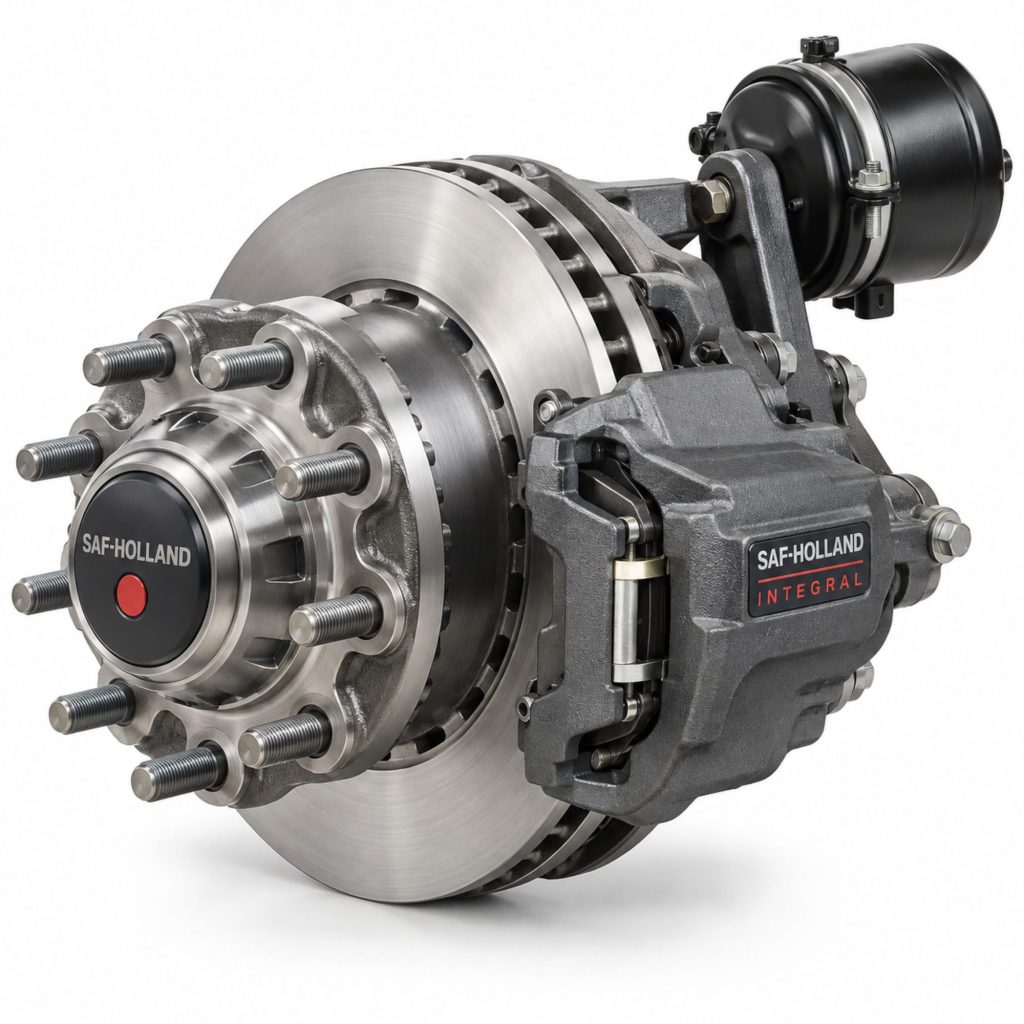
The SAF-Holland INTEGRAL Trailer Disc Brake is a commercial-trailer braking system built around SAF-Holland’s distinctive two-piece INTEGRAL brake-disc design. The technology is commonly integrated with SAF trailer axles and SAF INTRADISC suspension systems.
Unlike a conventional one-piece brake disc and hub arrangement, the INTEGRAL design uses a brake disc cast around a high-strength adapter ring. The adapter ring is then bolted to the wheel hub. This construction allows the friction ring to expand primarily in the radial direction as its temperature increases during braking.
Managing thermal expansion helps the braking surfaces remain flatter under demanding operating conditions. This can reduce the risk of uneven contact, localized hot spots, thermal stress, and premature wear of the disc and brake pads.
INTEGRAL does not necessarily identify one universal brake caliper. SAF-Holland has used the INTEGRAL disc with application-specific calipers, brake chambers, axle models, wheel sizes, and suspension configurations. The complete axle identification must therefore be verified before replacement parts are ordered.
Current and historical applications may use 19.5-inch or 22.5-inch wheel equipment. Exact brake torque, rotor dimensions, pad specifications, chamber size, and axle rating depend on the complete SAF axle and brake configuration.
Key Characteristics
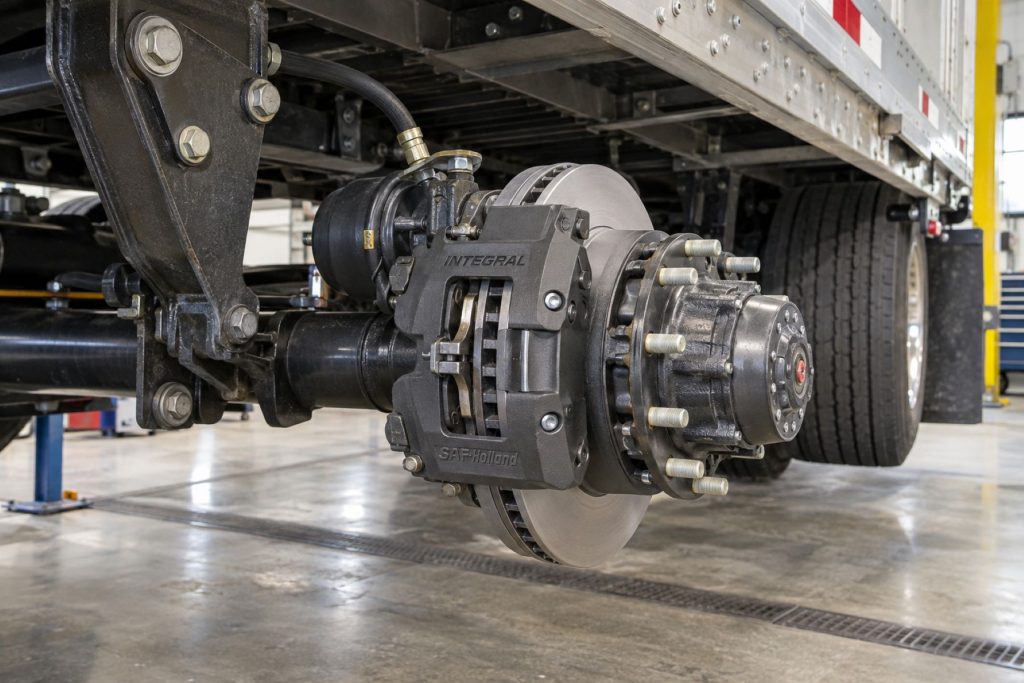
- Commercial-trailer air disc brake technology
- Two-piece brake-disc construction
- Composite-cast friction ring and adapter ring
- Designed to permit controlled radial disc expansion
- Helps maintain flatter braking surfaces under heat
- Reduces heat transfer into the wheel hub and bearing assembly
- Open wheel-flange design promotes cooling airflow
- Available in application-specific 19.5-inch and 22.5-inch configurations
- Integrated with approved SAF trailer axles
- Used with SAF INTRADISC suspension systems
- Pneumatically actuated foundation brake
- Automatic compensation for normal pad wear through the caliper mechanism
- Replaceable brake pads
- Application-specific caliper and chamber arrangements
- Designed for commercial-trailer duty cycles
- Supports integration with trailer ABS and electronic braking systems
Major Components
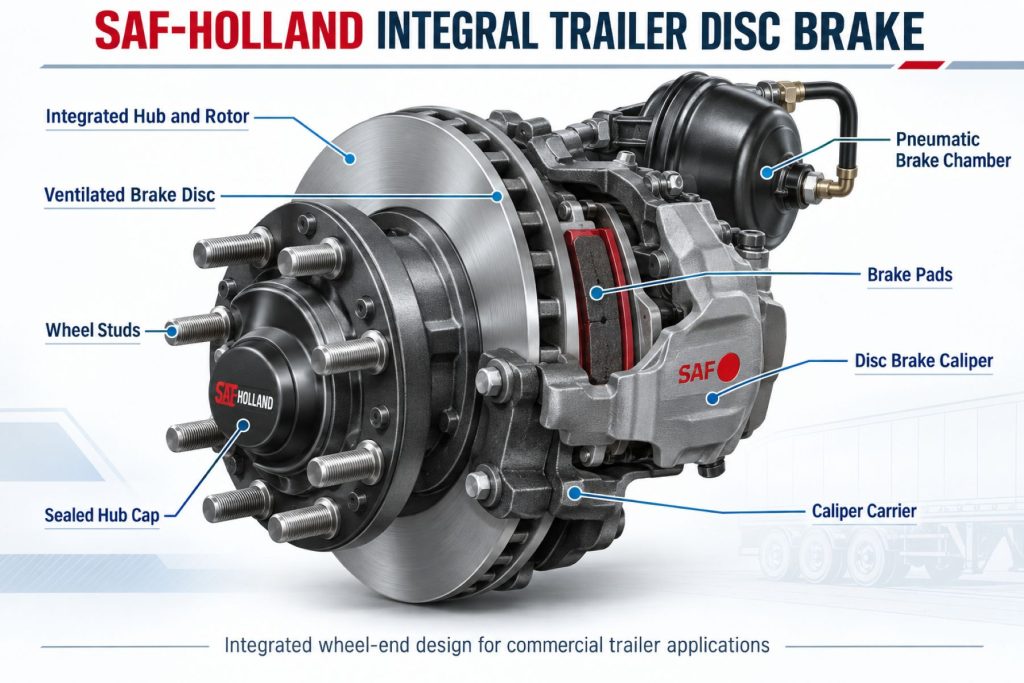
- INTEGRAL brake disc
- High-strength adapter ring
- Disc-to-hub mounting hardware
- Wheel hub
- Compact wheel-bearing unit
- Brake caliper
- Caliper carrier
- Brake pads
- Pad-retaining hardware
- Caliper guide pins
- Guide-pin bushings and seals
- Internal adjustment mechanism
- Brake chamber
- Chamber mounting bracket
- Actuating lever or interface
- Axle spindle
- Axle beam
- Hub cap
- Wheel-speed sensor
- ABS tone ring or exciter ring
- Wheel studs and wheel fasteners
- Thermal and protective shields where specified
How the Brake Component or System Works
When the driver applies the service brakes, the tractor’s pneumatic braking system sends a control signal to the trailer. The trailer relay valve or electronic braking system supplies compressed air to the brake chambers at the trailer axles.
Air pressure moves the brake-chamber diaphragm and pushrod. The pushrod operates the air disc brake’s actuating mechanism, which converts the chamber movement into mechanical clamping force.
The caliper presses the inboard and outboard brake pads against the rotating INTEGRAL disc. Friction between the pads and disc converts the trailer’s kinetic energy into heat, slowing the wheel and trailer.
As the disc heats, its friction ring expands. The connection between the disc and its adapter ring is engineered to allow controlled radial expansion. This reduces the tendency for the braking surfaces to distort into an umbrella-like shape.
When the driver releases the brake pedal, air pressure is exhausted from the chamber. The brake’s internal mechanism releases clamping force and restores the required running clearance between the pads and disc.
The caliper’s automatic adjustment mechanism compensates for normal pad wear. It does not eliminate the need to inspect pad thickness, rotor condition, chamber operation, caliper movement, and running clearance.
Position and Function Within the Brake System
The INTEGRAL brake assembly is installed at the wheel end of a compatible SAF trailer axle. It is the foundation-brake portion of the trailer’s larger pneumatic and electronic braking system.
The wheel-end brake receives force from the brake chamber and applies that force directly to the rotating disc. Other trailer components regulate when the brake applies and how much pressure reaches the chamber.
The complete braking system can include:
- Tractor brake controls
- Trailer supply and service air lines
- Gladhand connections
- Trailer reservoirs
- Relay and emergency valves
- ABS or electronic braking-system modulator
- Wheel-speed sensors
- Pneumatic brake chambers
- INTEGRAL wheel-end brakes
- Spring parking brakes
- Warning lamps and diagnostic connections
The INTEGRAL brake cannot provide normal service braking without a properly functioning air supply, control system, chamber, caliper, and wheel end.
Common Specifications
- Brake Type: Pneumatically actuated trailer disc brake
- Disc Technology: SAF INTEGRAL two-piece brake disc
- Wheel Sizes: Application-specific 19.5-inch or 22.5-inch equipment
- Typical Axle Application: SAF commercial-trailer axle
- Typical Suspension Integration: SAF INTRADISC and related SAF trailer suspension systems
- Axle Capacity: Determined by the complete axle and suspension configuration
- Rotor Attachment: Adapter ring fastened to the wheel hub
- Caliper Type: Application- and production-specific air disc brake caliper
- Brake Chamber: Application-specific service or spring-brake chamber
- Adjustment: Automatic internal wear adjustment
- Electronic Integration: Compatible with properly specified trailer ABS or electronic braking systems
- Wheel-Speed Sensing: Sensor and tone-ring equipment where required
- Parking Brake: Spring-brake chamber on designated axle positions
- Pad and Disc Limits: Determined by the exact brake model and service documentation
Exact dimensions, torque values, wear limits, chamber sizes, and component numbers must be obtained from the service information for the identified axle and brake assembly.
Operating Specifications and Performance
Braking performance depends on the installed caliper, brake-disc diameter, effective friction radius, pad material, brake-chamber size, pneumatic pressure, tire traction, axle loading, and electronic control system.
SAF INTEGRAL systems are available in different wheel and brake configurations. SAF-Holland identifies 19.5-inch and 22.5-inch equipment within its broader INTRADISC plus INTEGRAL product family.
The design’s principal performance feature is its management of thermal expansion. During repeated or prolonged braking, the friction ring becomes significantly hotter than the hub. Allowing the ring to expand radially helps limit deformation of the braking surfaces.
Maintaining a flatter disc surface can promote more consistent pad contact. It may also help control uneven pad wear and reduce damaging concentrations of heat.
Actual stopping performance remains dependent on the complete vehicle. An INTEGRAL-equipped trailer must still have correctly adjusted tractor and trailer brakes, adequate air pressure, functioning ABS equipment, properly loaded axles, and suitable tires.
Braking Performance and System Integration
The INTEGRAL brake works as part of a balanced tractor-trailer braking system. Brake timing and force must be coordinated so the tractor and trailer decelerate together without excessive wheel lock, trailer push, or instability.
Disc brakes generally respond quickly because the brake chamber acts through a relatively direct caliper mechanism. Their exposed rotor design can also dissipate heat more effectively than an enclosed drum in many operating conditions.
The INTEGRAL design further addresses thermal performance by increasing the available heat-emitting area and providing ventilation openings around the wheel flange. Reduced contact between the hot disc and hub also helps limit heat transfer into the wheel-bearing area.
Brake balance can be affected by:
- Mismatched brake-chamber sizes
- Incorrect replacement calipers
- Contaminated or mismatched pads
- Restricted air lines
- Relay-valve or modulator problems
- Incorrect ABS configuration
- Unequal tire sizes
- Improper axle loading
- Excessive pushrod travel
- A dragging or seized caliper
A trailer with mixed brake types or different brake generations requires careful compatibility review. Replacement components must preserve the vehicle’s approved braking calculation and certification.
Air Supply, Controls, and Electronic Integration
The INTEGRAL foundation brake relies on the trailer’s compressed-air system for normal operation. Air from the tractor charges the trailer reservoirs and supplies the control valves, ABS modulator, and brake chambers.
The trailer may use conventional pneumatic control, trailer ABS, or a more advanced electronic braking system. These systems monitor wheel speed and regulate brake pressure to help prevent wheel lock.
Depending on the trailer, associated electronic functions may include:
- Antilock braking
- Electronic brake-force control
- Roll-stability support
- Diagnostic fault storage
- Brake-lining wear monitoring
- Auxiliary-axle control
- Suspension integration
- Telematics reporting
- Electronic parking-brake functions
The foundation brake remains mechanically and pneumatically operated even when an electronic system controls the pressure delivered to it.
Damaged wheel-speed sensors, incorrect sensor gaps, contaminated tone rings, wiring faults, low voltage, or an incorrectly configured modulator can disable ABS functions without necessarily eliminating basic pneumatic braking.
Installation, Adjustment, and Brake Balance
Installation must follow the instructions for the exact SAF axle, hub, INTEGRAL disc, caliper, and brake chamber. Similar-looking components may have different mounting dimensions, torque requirements, offsets, or braking capacities.
The INTEGRAL disc and adapter assembly must be installed with the correct hardware and tightening sequence. Disc-to-hub fasteners should not be reused unless the applicable service procedure specifically permits reuse.
Brake balance should be verified whenever calipers, chambers, axle assemblies, or control valves are changed. The replacement must match the original vehicle’s brake calculation and approved configuration.
Before returning the trailer to service, technicians should verify:
- Correct component identification
- Proper disc and hub installation
- Caliper mounting-fastener torque
- Free caliper movement
- Correct pad installation
- Proper retaining hardware
- Acceptable disc and pad thickness
- Correct chamber mounting
- Acceptable pushrod alignment
- Proper hose routing
- No pneumatic leakage
- Correct wheel-speed-sensor operation
- Normal wheel rotation after brake release
- Balanced brake application across the axle
Automatic adjustment does not correct an incorrect installation, seized guide mechanism, damaged chamber, or excessively worn brake component.
Foundation Brake, Axle, and Wheel-End Compatibility
The INTEGRAL brake must be matched to an approved SAF axle and wheel-end configuration. Compatibility cannot be determined from wheel diameter or visual appearance alone.
Important compatibility factors include:
- Complete SAF axle model
- Axle serial number
- Axle load rating
- Brake size
- Caliper manufacturer and model
- Left- or right-hand installation
- Brake-chamber size and stroke
- Wheel offset
- Single- or dual-wheel arrangement
- Hub and bearing-unit design
- Rotor part number
- Pad shape and friction specification
- ABS sensor configuration
- Suspension model
- Trailer brake calculation
- Market-specific certification
SAF INTEGRAL wheel ends may use different calipers across production periods and markets. Parts should be identified from the axle tag, caliper markings, rotor number, and current SAF-Holland parts documentation.
Common Applications
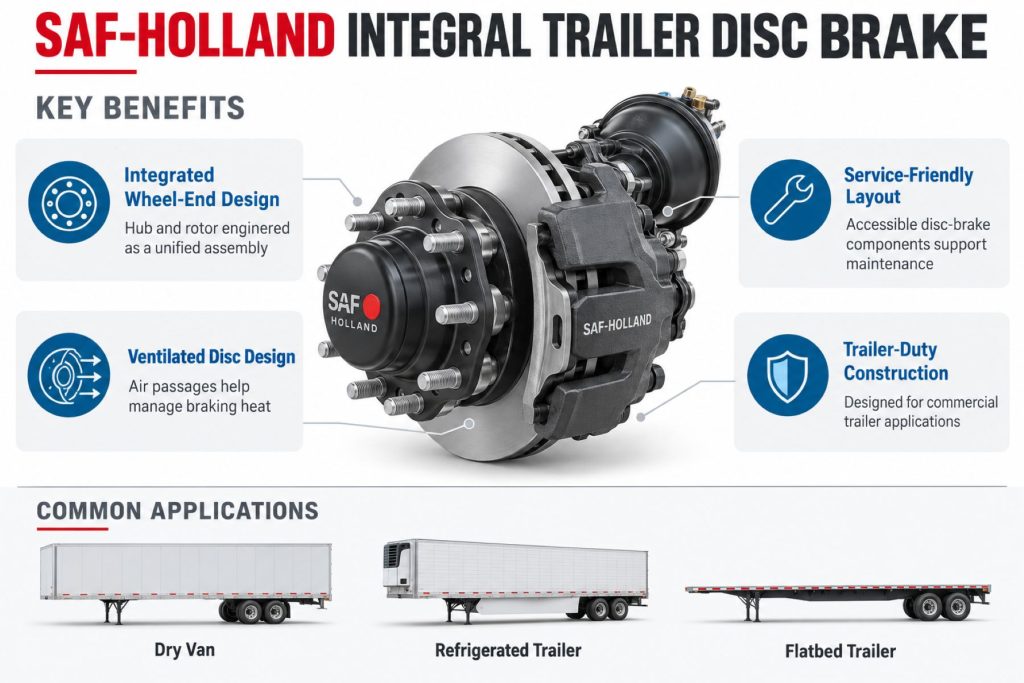
- Dry van trailers
- Refrigerated trailers
- Curtain-side trailers
- Container chassis
- Flatbed trailers
- Tank trailers
- Bulk trailers
- Tipper trailers
- Dump trailers
- Platform trailers
- Intermodal trailers
- European-style semitrailers
- Specialized commercial trailers
- High-mileage fleet trailers
- Trailers operating in stop-and-go service
- Trailers requiring 19.5-inch or 22.5-inch disc-brake equipment
Vehicle and Brake-System Compatibility
The SAF INTEGRAL brake is intended for compatible commercial-trailer axles rather than direct installation on every trailer platform. The axle, suspension, air system, electronic controls, wheel equipment, and vehicle certification must support the selected brake.
Compatibility depends on the trailer’s:
- Manufacturer and model
- Model year
- Gross axle weight rating
- Suspension and axle series
- Wheel size and offset
- Tire configuration
- Brake-chamber requirements
- Air-system layout
- ABS or electronic braking-system configuration
- Parking-brake arrangement
- Electrical supply
- Intended operating region
- Approved brake calculation
Retrofitting a drum-brake trailer or another disc-brake axle to INTEGRAL technology generally requires more than changing the rotor and caliper. A complete engineered axle or wheel-end conversion may be necessary.
Advantages
- Controlled radial expansion of the brake disc
- Reduced tendency toward heat-related disc distortion
- Improved temperature distribution across the friction surfaces
- Helps maintain consistent brake-pad contact
- Can extend brake-pad and disc service life in suitable applications
- Reduced heat transfer into the hub and bearing area
- Open wheel-flange design supports cooling airflow
- Strong braking performance for commercial-trailer applications
- Disc-brake response and inspection advantages
- Replaceable brake pads
- Automatic compensation for normal pad wear
- Integration with SAF axle and suspension systems
- Compatibility with trailer ABS and electronic braking controls
- Available in multiple wheel and brake configurations
- Designed for demanding fleet operation
Limitations or Considerations
- INTEGRAL identifies a technology family rather than one universal caliper
- Specifications vary by axle, market, and production date
- Replacement parts must match the complete axle identification
- Disc-to-hub mounting requires the correct hardware and procedure
- Air disc brake components can cost more than basic drum-brake parts
- Caliper guide mechanisms remain vulnerable to contamination and corrosion
- Road salt and moisture can affect underused trailer brakes
- Automatic adjustment does not eliminate inspection requirements
- Incorrect pads may alter braking performance and wear
- Rotor cracking or wear beyond limits requires replacement
- Brake-drag conditions can generate severe heat
- Special service tools may be required
- Wheel-end work requires trained technicians
- Conversions must preserve brake-system certification
- Parts from different INTEGRAL configurations may not interchange
Driver and Operator Experience
Drivers may notice smooth, predictable trailer-brake application when the INTEGRAL system is correctly maintained and properly balanced with the tractor.
Air disc brakes can provide consistent response during repeated brake applications. Thermal-management features are particularly valuable during heavy traffic, frequent stops, long descents, and other conditions that generate substantial brake heat.
The driver should still select the proper gear, use available engine-braking systems, and avoid continuously riding the service brakes on long grades. No foundation brake is immune to overheating.
Operators should report:
- Trailer pulling during braking
- Delayed trailer-brake application
- Brake warning lamps
- ABS warning lamps
- Burning odors
- Smoke from a wheel end
- Unusual wheel-end heat
- Grinding or scraping sounds
- Reduced braking response
- Parking brakes that do not hold
- Trailer brakes that fail to release
- Visible damage to brake hoses or chambers
A severely overheated wheel end should not be touched or immediately exposed to water. The trailer should be secured and inspected using appropriate safety procedures.
Maintenance and Ownership Notes
- Inspect brake-pad thickness at scheduled intervals.
- Check the INTEGRAL disc for wear, scoring, heat damage, and cracking.
- Measure disc thickness using the approved procedure.
- Inspect caliper movement and guide-pin condition.
- Check guide-pin boots and seals for damage.
- Inspect pad-retaining hardware.
- Verify that the internal adjustment mechanism operates correctly.
- Check brake-chamber condition and mounting.
- Inspect pushrod alignment and travel.
- Test the air system for leakage.
- Inspect hoses for abrasion, cracking, and interference.
- Check the wheel-speed sensor and tone ring.
- Inspect electrical wiring and connectors.
- Monitor the hub and wheel-bearing unit for looseness or overheating.
- Use the specified mounting hardware and torque procedures.
- Replace friction components in balanced axle sets when required.
- Investigate uneven wear rather than replacing pads alone.
- Follow the identified SAF-Holland service schedule.
- Record axle, brake, and replacement-part information in fleet maintenance files.
Common Brake-System Problems
- Uneven brake-pad wear: Restricted caliper movement, damaged guide pins, worn bushings, an improperly installed pad, or a rotor condition can produce unequal wear.
- Brake drag: A seized caliper, damaged chamber, incorrect pushrod alignment, contaminated guide mechanism, internal adjuster problem, or trapped air pressure can prevent full release.
- Reduced braking force: Low air pressure, a damaged chamber, worn pads, a contaminated friction surface, incorrect components, or a control-system fault may reduce braking.
- Disc cracking: Excessive heat, operation beyond the wear limit, thermal shock, improper installation, or severe service can damage the friction ring.
- Disc scoring: Worn pads, embedded debris, damaged friction material, or prolonged metal-to-metal contact can score the braking surfaces.
- Excessive wheel-end heat: Brake drag, bearing problems, repeated heavy braking, incorrect adjustment, or inadequate release clearance may cause overheating.
- Caliper does not slide correctly: Corrosion, contamination, damaged boots, worn guide components, or improper service procedures may restrict movement.
- Premature pad wear: Brake imbalance, excessive trailer braking, dragging components, severe duty cycles, or incorrect friction material can shorten pad life.
- Trailer pulls while braking: Unequal chamber operation, air restrictions, contaminated brakes, mismatched components, tire problems, or ABS faults can create side-to-side imbalance.
- ABS warning lamp remains illuminated: A damaged sensor, incorrect sensor gap, tone-ring contamination, wiring failure, low electrical voltage, or modulator fault may be responsible.
- Parking brake will not release: Insufficient supply pressure, a damaged spring-brake chamber, a blocked hose, frozen pneumatic equipment, or a control-valve problem may prevent release.
- Repeated mounting-hardware problems: Incorrect fasteners, reused single-use hardware, contamination, improper torque, or damaged mounting surfaces can allow components to loosen.
Safety and Service Precautions
Air disc brakes and spring-brake chambers store significant mechanical and pneumatic energy. Only trained personnel using the correct service information and equipment should perform repairs.
Before beginning service:
- Park the trailer on a firm, level surface
- Chock the wheels
- Support the trailer with correctly rated equipment
- Drain or isolate air pressure as required
- Follow spring-brake chamber safety procedures
- Never disassemble a sealed spring-brake chamber
- Allow overheated components to cool naturally
- Wear eye, hand, and respiratory protection
- Control brake dust without using compressed air
- Use approved lifting tools for heavy components
Never work beneath a trailer supported only by its air suspension, landing gear, or a hydraulic jack.
Do not apply grease, oil, anti-seize compound, or cleaning chemicals to the brake-disc and pad friction surfaces. Contaminated pads normally require replacement.
Torque values should never be guessed. SAF axle and brake families use application-specific fasteners and tightening procedures, and some fasteners must be replaced after removal.
After service, the brake system should be leak-tested, function-tested, and inspected before the trailer returns to public roads.
Identification Information
Identification information may be found on the SAF axle tag, suspension label, caliper casting, brake chamber, hub, disc, or original trailer build documentation.
Record the following information:
- Trailer manufacturer
- Vehicle identification number
- Trailer model and model year
- SAF suspension model
- Complete axle model
- Axle serial number
- Axle load rating
- Brake size
- Wheel size
- Wheel offset
- INTEGRAL disc part number
- Hub or wheel-bearing-unit number
- Caliper manufacturer
- Caliper model
- Caliper side or orientation
- Brake-pad part number
- Brake-chamber type and size
- ABS or electronic braking-system model
- Wheel-speed-sensor configuration
- Original component supersessions
Do not order a replacement disc, caliper, pad set, hub, or chamber using the INTEGRAL name alone. Multiple configurations use this technology.
Buying Considerations
- Confirm the complete SAF axle model and serial number.
- Identify the installed caliper manufacturer and model.
- Verify whether the brake uses 19.5-inch or 22.5-inch equipment.
- Record the INTEGRAL disc part number.
- Confirm the wheel and hub configuration.
- Match the brake pads to the exact caliper.
- Determine whether left- and right-hand calipers differ.
- Verify brake-chamber size and stroke.
- Check whether mounting hardware must be replaced.
- Review current part-number supersessions.
- Confirm compatibility with the trailer ABS or electronic braking system.
- Compare new, remanufactured, and approved replacement-caliper options.
- Check regional parts availability.
- Confirm warranty requirements.
- Buy friction components from a reputable commercial-vehicle supplier.
- Use an installer familiar with SAF trailer axles and air disc brakes.
Variants and Configurations
- 19.5-inch brake configuration
- 22.5-inch brake configuration
- Different axle-load ratings
- Different wheel offsets
- Single-wheel configurations
- Application-specific hub assemblies
- Compact wheel-bearing units
- Different caliper models
- Different brake-pad shapes
- Different brake-chamber sizes
- Service-brake chamber configurations
- Spring-brake chamber configurations
- ABS-equipped wheel ends
- Electronic braking-system applications
- INTRADISC suspension integration
- Application-specific axle tracks
- Regional brake and certification packages
- Legacy and current component generations
- Original and superseded service parts
Comparison to Similar Equipment
Compared with the SAF-Holland P89 Plus Trailer Air Disc Brake, SAF INTEGRAL describes the specialized two-piece disc and wheel-end technology used across compatible SAF axle applications. P89 Plus identifies a more specific North American trailer air-disc-brake product configuration.
Compared with the Hendrickson MAXX22T Trailer Air Disc Brake, the INTEGRAL system uses SAF-Holland’s proprietary disc-to-adapter construction and SAF axle integration. The systems use different calipers, rotors, mounting arrangements, and service parts.
Compared with the ZF WABCO MAXXUS L2.0 Air Disc Brake, the SAF INTEGRAL name focuses heavily on the brake disc and wheel-end architecture. MAXXUS L2.0 identifies a specific caliper platform.
Compared with the Haldex ModulT Air Disc Brake, the systems use different actuation, adjustment, guide, and mounting designs. Brake pads and service components should not be assumed interchangeable.
Compared with a conventional one-piece disc, the INTEGRAL disc is designed to accommodate radial thermal expansion through its composite-cast disc and adapter ring.
Compared with a trailer drum brake, the INTEGRAL disc-brake system offers more accessible friction-component inspection and strong heat-management characteristics. Drum brakes may have lower initial component costs and a more familiar service base in some regions.
Best Fit For
- Trailers originally equipped with SAF INTEGRAL wheel ends
- SAF INTRADISC suspension systems
- High-mileage commercial trailers
- Dry van fleets
- Refrigerated fleets
- Curtain-side trailers
- Container and intermodal equipment
- Tank and bulk trailers
- Trailers operating in frequent-stop service
- Applications generating substantial brake heat
- Fleets prioritizing predictable disc and pad wear
- Operators wanting integrated SAF axle and brake components
- Trailers using compatible ABS or electronic braking systems
- Maintenance programs equipped to service commercial air disc brakes
Related Vehicle and Trailer Types
- Complete Guide to Semi Trailer Types
- Dry Van Trailers
- Refrigerated Trailers
- Flatbed Trailers
- Curtain-side trailers
- Container chassis
- Tank trailers
- Bulk trailers
- Tipper trailers
- Platform trailers
- Intermodal trailers
- Specialized commercial trailers
Related Truck and Trailer Models
- Utility dry van trailers
- Great Dane dry van and refrigerated trailers
- Wabash dry van trailers
- Hyundai Translead trailers
- Schmitz Cargobull semitrailers
- Krone semitrailers
- Kögel semitrailers
- Stoughton dry van trailers
- Manac commercial trailers
- Vanguard National trailers
Related Brake System Types
- Brake Systems
- Air Brake Systems
- Air Disc Brake Systems
- Trailer Brake Systems
- ABS & Electronic Braking Systems
- Trailer air disc brakes
- Pneumatic foundation brakes
- Electronic trailer braking systems
- Trailer parking-brake systems
- Wheel-end braking systems
Related Brake Products
- SAF-Holland P89 Plus Trailer Air Disc Brake
- Hendrickson MAXX22T Trailer Air Disc Brake
- Haldex ModulT Air Disc Brake
- ZF WABCO MAXXUS L2.0 Air Disc Brake
- Meritor EX+ LS Air Disc Brake
- Bendix ADB22X Air Disc Brake
- Bendix TABS-8 Trailer ABS
- Haldex PLC Select Trailer ABS
- Meritor WABCO Enhanced Easy-Stop Trailer ABS
Related Equipment Systems
- Equipment Systems
- Suspension Systems
- Axles & Differentials
- Tires & Wheels
- Trailer axles
- Trailer air systems
- Wheel hubs and bearings
- Air suspensions
- Tire-pressure monitoring systems
- Automatic tire-inflation systems
- Trailer electrical systems
Related Guides
- Brake System Guides
- Air Brake Systems Explained
- Air Disc Brakes vs Drum Brakes
- How to Inspect and Maintain Commercial Truck Brakes
- Tractor vs Trailer Brake Systems
- How Truck ABS and Electronic Stability Control Work
- Commercial Truck Brake Components Explained
Regulatory and Compliance Notes
The installed brake system must comply with the commercial-vehicle braking standards applicable in the trailer’s operating jurisdiction. Requirements can cover stopping performance, parking-brake capability, emergency braking, air-system timing, ABS operation, warning devices, component certification, and periodic inspection.
Brake components should not be substituted solely because they physically fit. Changes to calipers, chambers, rotors, pads, valves, axle capacity, or electronic controls can alter the trailer’s approved brake calculation.
In the United States, applicable trailers must meet relevant Federal Motor Vehicle Safety Standards, including braking and ABS requirements. Canadian, European, Australian, and other markets apply their own certification and inspection rules.
The axle’s mechanical rating does not override the trailer’s gross axle weight rating, tire capacity, wheel capacity, suspension rating, or legal road-weight limits.
Maintenance personnel should retain service records and follow the inspection requirements governing the vehicle’s location and operation.
Real World Operating Notes
INTEGRAL should not be treated as the complete identification of the installed brake. Fleets frequently encounter different calipers, pads, chambers, and hub arrangements across trailers that all use SAF INTEGRAL disc technology.
The axle tag is the most reliable starting point for identifying replacement parts. If the tag is missing or unreadable, the trailer VIN, axle dimensions, caliper markings, hub number, rotor number, and photographs may be needed.
Air disc brakes on lightly used trailers can develop corrosion when moisture remains on the friction surfaces. Periodic operation alone does not replace inspection, especially when the trailer is stored outdoors or exposed to road salt.
Uneven pad wear should trigger inspection of the caliper guides, seals, adjuster, chamber, rotor, and mounting components. Installing new pads without correcting restricted movement can result in another early failure.
After wheel-end service, technicians should check for free wheel rotation and abnormal heat during the initial road test. Comparing wheel-end temperatures can help identify a dragging brake, but temperature readings must be interpreted in relation to operating conditions and axle loading.
Original service limits and torque procedures should always be used. Values from another SAF axle or a visually similar air disc brake may not apply.
Frequently Asked Questions
What is the SAF-Holland INTEGRAL Trailer Disc Brake?
It is a commercial-trailer air disc brake and wheel-end system built around SAF-Holland’s two-piece INTEGRAL brake-disc technology.
Is INTEGRAL the name of the brake caliper?
Not necessarily. INTEGRAL primarily identifies SAF-Holland’s brake-disc and wheel-end technology. The installed caliper can vary by axle, market, and production date.
How is an INTEGRAL disc different from a conventional brake disc?
The friction ring is composite-cast around a high-strength adapter ring. This arrangement allows controlled radial expansion of the disc as it heats.
Why is radial expansion important?
It helps the braking surfaces remain flatter under high temperatures, reducing the tendency toward umbrella-shaped distortion, uneven pad contact, and concentrated thermal stress.
What wheel sizes are available?
SAF-Holland uses INTEGRAL technology in application-specific 19.5-inch and 22.5-inch brake configurations.
Does the INTEGRAL brake use compressed air?
Yes. A pneumatic brake chamber operates the air disc brake caliper.
Does the brake adjust itself?
The caliper normally includes an automatic mechanism that compensates for ordinary pad wear. Manual inspection of wear, movement, clearance, and component condition is still required.
Can any air disc brake pad be installed?
No. The pad shape, friction material, thickness, and approval must match the installed caliper and axle configuration.
Can the INTEGRAL disc be installed on a non-SAF axle?
It should only be used in an approved axle and wheel-end configuration. Installing it on an unrelated axle would require engineering validation and appropriate certification.
What causes uneven pad wear?
Common causes include restricted caliper movement, damaged guide components, a faulty adjustment mechanism, rotor problems, chamber misalignment, or improper installation.
Why is one wheel end hotter than the others?
A dragging caliper, trapped pneumatic pressure, bearing problem, incorrect adjustment, or restricted chamber return may generate excessive heat.
Should pads be replaced across the entire axle?
Friction components should be serviced according to SAF-Holland’s current instructions. Balanced replacement across an axle is commonly necessary to maintain consistent braking.
Does the INTEGRAL system include ABS?
The foundation brake can operate within an ABS- or electronically controlled trailer brake system, but the ABS modulator, sensors, wiring, and controller are separate components.
How can the correct replacement parts be identified?
Use the trailer VIN, SAF axle model, axle serial number, brake size, caliper markings, disc number, hub number, chamber specification, and current parts documentation.
Does the INTEGRAL brake increase trailer capacity?
No. Trailer capacity remains limited by the certified axle, suspension, frame, tires, wheels, brakes, and gross vehicle weight rating.
Availability and Where to Find
SAF INTEGRAL brake discs, pads, calipers, hubs, bearing units, chambers, sensors, mounting hardware, and other replacement components may be available through SAF-Holland distributors, trailer dealers, axle specialists, commercial brake suppliers, fleet-maintenance providers, and heavy-duty repair facilities.
Availability depends on the axle generation, brake size, caliper model, wheel configuration, operating market, and whether an original part number has been superseded.
Before ordering, buyers should provide the complete axle identification and confirm whether the component is supplied individually or as part of a service kit. Required mounting hardware, seals, retaining components, and installation instructions should be included in the order when applicable.
Current product information, technical literature, parts support, and distributor resources are available through the SAF-Holland website.
Support Trucking Families
Truck Equipment Atlas supports the mission of Grey Cross, a nonprofit dedicated to helping families of truck drivers who lose their lives while on the road. As the site grows, part of its mission is to bring awareness and support to these families.
Podcast or Video Section
Learn More Through Audio and Video
Truck Equipment Atlas will continue expanding with podcast episodes, interviews, and equipment breakdowns to help drivers and fleets better understand trucks and equipment.
Follow the Growth of Truck Equipment Atlas
Truck Equipment Atlas continues to expand with new truck profiles, trailer coverage, diesel engine pages, equipment system resources, manufacturer information, and educational guides.
Visit our Site Updates page to explore recent additions, project milestones, and upcoming resources as we continue building one of the industry’s growing commercial trucking equipment reference libraries.
View the Latest Site Updates: Truck Equipment Atlas Site Updates