
Meritor WABCO Enhanced Easy-Stop Trailer ABS
Quick Facts
- Original Manufacturer/Brand: Meritor WABCO
- Current Support Brand: ZF WABCO
- Product Name: Enhanced Easy-Stop Trailer ABS with PLC
- Product Type: Electronic trailer antilock braking system
- Brake-System Category: Trailer ABS and electronic braking system
- Primary Function: Helps prevent monitored trailer wheels from locking during braking
- Communication Technology: Power Line Carrier communication
- Common Configurations: 2S/1M, 2S/2M, 4S/2M, and 4S/3M
- Configuration Meaning: Number of wheel-speed sensors followed by number of modulator channels
- System Levels: Basic, Standard, and Premium, depending on configuration and part number
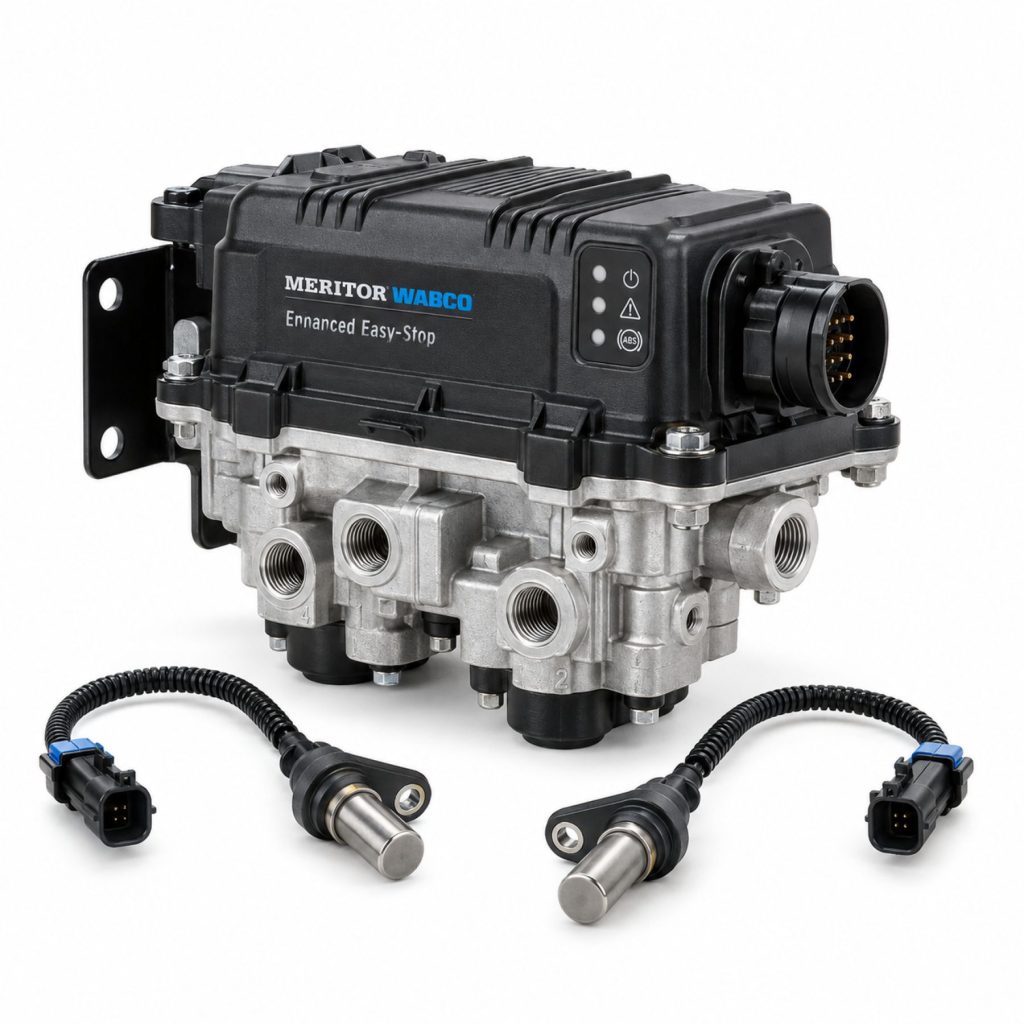
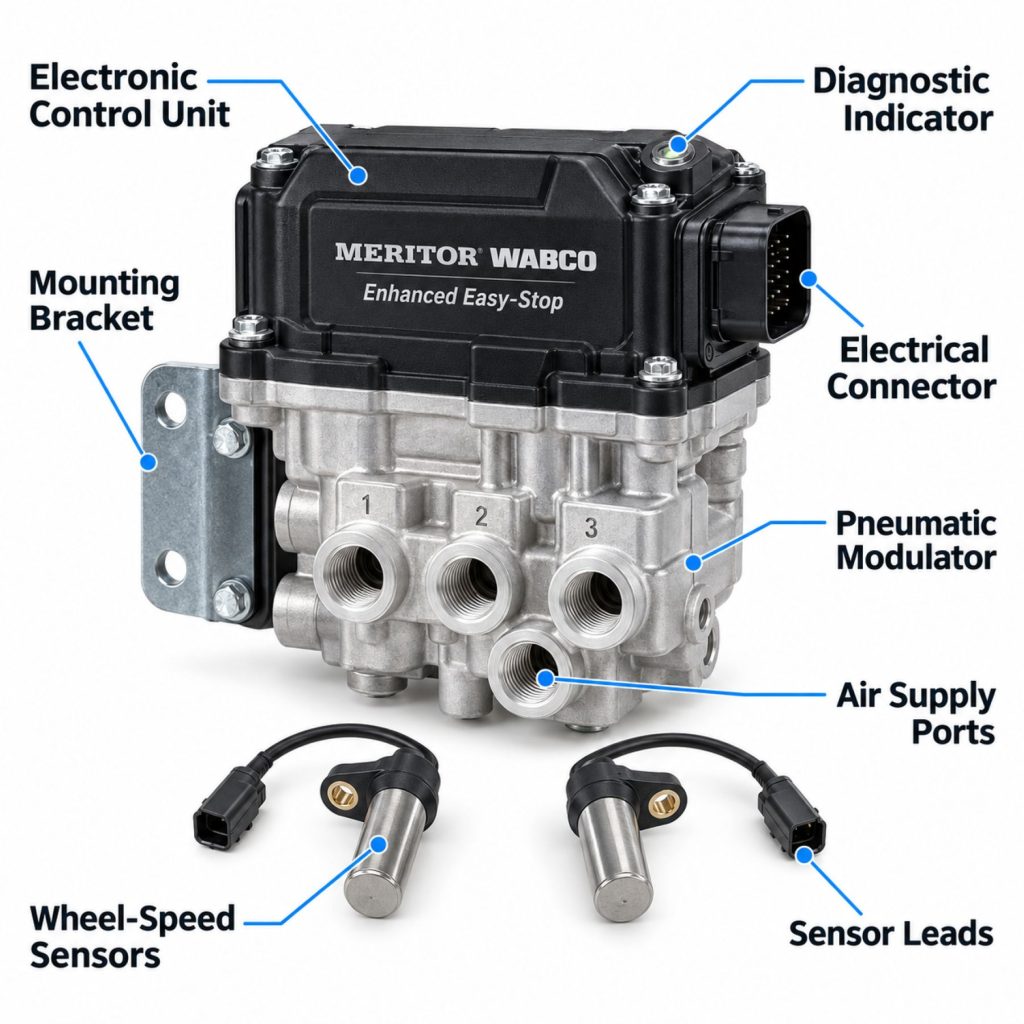
- Primary Components: Electronic control unit, modulator valves, wheel-speed sensors, tone rings, wiring, and ABS warning system
- Foundation-Brake Compatibility: Trailer air-disc and S-cam drum brakes when properly configured
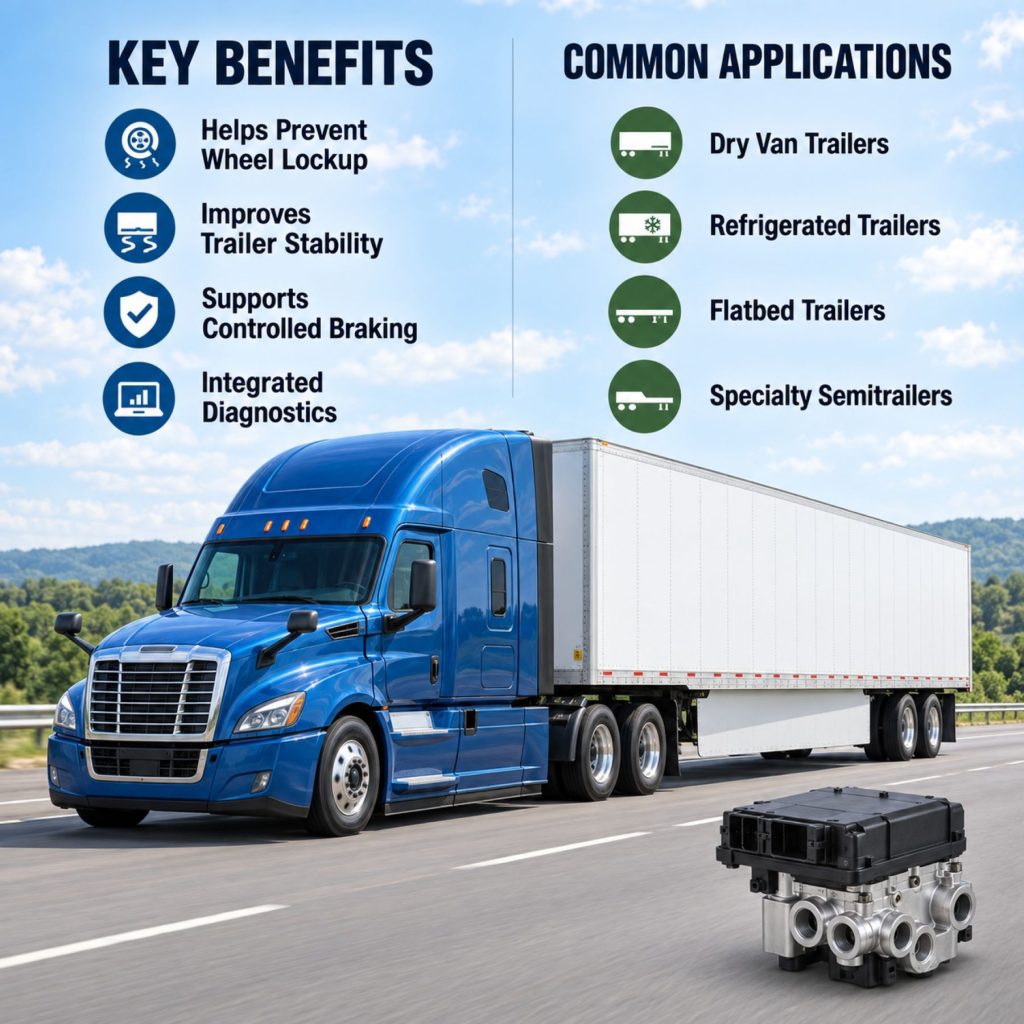
- Primary Applications: Dry vans, refrigerated trailers, flatbeds, tank trailers, dump trailers, and specialty air-braked trailers
- Regulatory Role: Supports trailer ABS and in-cab trailer warning-lamp requirements
- Primary Benefit: Helps maintain trailer stability and tire rotation during hard braking
Overview
The Meritor WABCO Enhanced Easy-Stop Trailer ABS is an electronic, self-monitoring antilock braking system developed for air-braked commercial trailers.
The system monitors wheel speed during braking. If one or more monitored wheels begin approaching lockup, the electronic control unit commands the appropriate modulator valve to adjust air pressure at the affected brakes.
By repeatedly holding, reducing, and restoring brake pressure, Enhanced Easy-Stop helps keep the monitored wheels rotating. This can improve trailer stability, reduce uncontrolled skidding, and help the driver maintain control of the tractor-trailer combination.
Enhanced Easy-Stop introduced Power Line Carrier communication, commonly abbreviated PLC. PLC transmits trailer ABS information through the trailer’s existing power circuit, allowing the trailer system to control the in-cab trailer ABS warning lamp without requiring a dedicated communication wire.
The system was originally widely identified under the Meritor WABCO name. WABCO later became part of ZF, so current replacement parts, literature, diagnostics, and technical support may carry ZF or WABCO branding.
ZF WABCO technical literature identifies Enhanced Easy-Stop configurations including 2S/1M, 2S/2M, 4S/2M, and 4S/3M arrangements. WABCO Enhanced Easy-Stop system chart
Key Characteristics
- Electronic self-monitoring trailer ABS
- Designed for standard pneumatic trailer brakes
- Power Line Carrier communication
- Supports in-cab trailer ABS warning indication
- Available in multiple sensor and modulator configurations
- Integrated ECU and modulator assemblies on many versions
- Separate external modulator valve on selected configurations
- Basic, Standard, and Premium system arrangements
- Monitors trailer wheel speed
- Controls brake pressure during impending wheel lock
- Stores active and historical diagnostic faults
- Supports blink-code diagnostics
- Supports electronic diagnostic software
- Compatible with air-disc and drum-brake applications
- Designed for air-braked commercial trailers
- Helps reduce trailer wheel lock and skidding
- Supports replacement of certain earlier Easy-Stop systems
Major Components
- Electronic control unit
- ECU and single-modulator valve assembly
- ECU and dual-modulator valve assembly
- External ABS modulator valve on selected systems
- Wheel-speed sensors
- Tone rings or tooth wheels
- Sensor extension cables
- Power cable
- Power and diagnostic cable where equipped
- Modulator-valve cables
- Trailer ABS warning lamp
- Tractor-mounted trailer ABS warning lamp
- PLC communication circuit
- SAE J560 trailer electrical connection
- Air reservoir
- Relay and emergency valves
- Trailer service-brake chambers
- Trailer spring-brake chambers
- Pneumatic hoses and fittings
- Diagnostic connector
- Blink-code activation equipment where applicable
- Identification and warning labels
How the Brake Component or System Works
Wheel-speed sensors are positioned near the trailer wheel ends. Each sensor detects the passing teeth of a tone ring as the wheel rotates and sends an electrical signal to the ABS electronic control unit.
The ECU compares the speed and deceleration of the monitored wheels. During normal braking, the trailer’s conventional pneumatic brake system controls brake application.
If the ECU determines that a monitored wheel is decelerating too quickly and may lock, it commands the appropriate modulator valve to control pressure at that brake circuit.
The modulator can perform three basic actions:
- Allow normal pressure increase
- Hold the existing brake pressure
- Release a portion of the brake pressure
Once wheel rotation recovers, the system restores braking pressure. This pressure-control cycle can occur several times during a hard stop.
If the ABS develops a fault, the affected antilock function may be disabled. Normal pneumatic braking generally remains available, but the trailer ABS warning lamp alerts the driver that service is required.
Position and Function Within the Brake System
Enhanced Easy-Stop is installed on the trailer between the normal pneumatic brake controls and the foundation brakes.
The trailer relay or emergency valve receives the service-brake command from the tractor. The ABS modulator valve then controls the air delivered to selected brake chambers when wheel-lock conditions are detected.
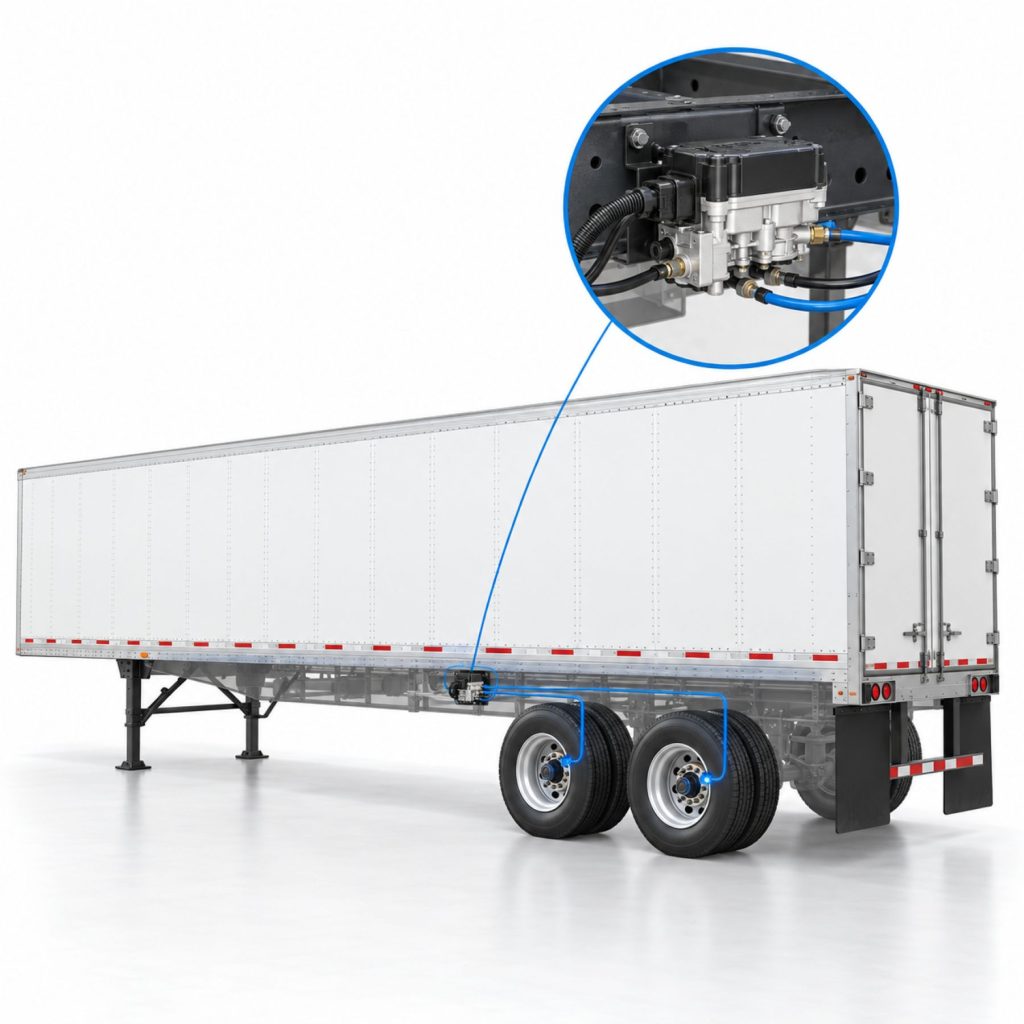
The system’s wheel-speed sensors are located at monitored wheel ends. The ECU and modulator assembly may be mounted on the trailer air reservoir or a protected frame crossmember, depending on the installation.
The trailer ABS warning lamp is normally mounted on the roadside of the trailer where it can be observed during inspection. PLC communication also transmits system status to the tractor’s in-cab trailer ABS warning lamp.
The system does not create the driver’s original brake request. It modifies air pressure only when necessary to help control wheel lock.
Common Specifications
- System Type: Electronic trailer antilock braking system
- Brake-System Medium: Compressed air
- Common Voltage: 12 volts in North American trailer applications
- Communication: Power Line Carrier through the trailer power circuit
- Common Configurations: 2S/1M, 2S/2M, 4S/2M, and 4S/3M
- Wheel-Speed Inputs: Two or four sensors, depending on configuration
- Modulator Channels: One, two, or three, depending on configuration
- Controller Arrangement: Integrated or separately serviceable ECU and valve components, depending on model
- Foundation Brakes: Approved air-disc or S-cam drum brakes
- External Warning: Trailer-mounted ABS indicator lamp
- In-Cab Warning: PLC-compatible trailer ABS lamp
- Diagnostics: Blink codes and compatible electronic diagnostic software
- Fault Memory: Active and stored diagnostic faults
- Installation Locations: Air reservoir or trailer crossmember, depending on assembly
- Primary Technical Manual: Enhanced Easy-Stop Trailer ABS with PLC Maintenance Manual MM-0180
Exact ECU, valve, sensor, connector, port, cable, and mounting specifications depend on the complete system and part numbers.
Operating Specifications and Performance
Enhanced Easy-Stop begins monitoring wheel-speed information when electrical power is supplied and the trailer moves above the applicable self-test speed.
At startup, the warning lamp may illuminate as part of its normal self-check. The exact lamp sequence depends on whether the trailer is stationary, whether a stored fault is present, and whether the system has confirmed valid wheel-speed signals.
ABS operation depends on:
- Adequate electrical power
- Correct wheel-speed sensor signals
- Proper tone-ring condition
- Functional modulator valves
- Adequate air pressure
- Correct pneumatic plumbing
- Functional foundation brakes
- Proper tire sizes
- Correct ECU configuration
- Reliable PLC communication
The system only controls the wheel positions assigned to its sensors and modulator channels. A 4S/3M Premium system provides more independent wheel-speed information and brake-pressure control than a basic 2S/1M arrangement.
Enhanced Easy-Stop does not necessarily shorten stopping distance on every surface. Its primary purpose is to help prevent wheel lock and maintain trailer stability and steerability of the overall combination.
Braking Performance and System Integration
During ordinary braking, service air flows through the trailer’s normal brake system. Enhanced Easy-Stop remains ready to intervene if monitored wheel deceleration indicates impending lockup.
System configuration affects how independently brake pressure can be controlled.
A 2S/1M system uses two wheel-speed sensors and one modulator channel. The system monitors two wheels but modulates pressure through a common channel.
A 2S/2M system uses two sensors and two modulator channels. It can provide separate pressure control for the two monitored sides or brake circuits.
A 4S/2M system uses four sensors and two modulator channels. It receives information from four wheel positions while controlling two pneumatic channels.
A 4S/3M system uses four sensors and three modulator channels. This configuration is commonly used where more independent control is required, including certain multi-axle, spread-axle, or steering-axle trailer applications.
Actual plumbing and control strategy depend on the trailer design and installation instructions.
Air Supply, Controls, and Electronic Integration
Enhanced Easy-Stop uses the trailer’s existing compressed-air brake system. It does not replace the supply, service, emergency, relay, parking, or spring-brake functions.
The system integrates with:
- Trailer air reservoirs
- Relay or emergency valves
- ABS modulator valves
- Service-brake chambers
- Spring-brake chambers
- Tractor service-control line
- Trailer supply line
- SAE J560 electrical connector
- Trailer constant-power circuit
- PLC communication
- Tractor trailer-ABS warning lamp
- Trailer-mounted warning lamp
- Diagnostic equipment
Power Line Carrier communication adds digital trailer ABS information to the existing electrical power circuit. A compatible tractor receives the PLC signal and controls the trailer ABS warning lamp in the cab.
PLC communication does not control normal service-brake application. It communicates ABS status and may support other compatible trailer information functions.
Installation, Adjustment, and Brake Balance
The ECU, valves, sensors, cables, and air lines must be installed according to the correct configuration diagram. Sensor and valve connections may change with the mounting orientation of the ECU and modulator assembly.
On certain dual-modulator assemblies, the orientation of the unit determines whether designated yellow and blue sensor connections correspond to roadside or curbside wheel positions.
Correct installation requires verification of:
- Sensor count
- Modulator count
- Trailer axle arrangement
- Roadside and curbside connections
- ECU mounting orientation
- Air inlet, control, delivery, and exhaust ports
- Cable routing
- Electrical power
- PLC operation
- Trailer warning-lamp operation
- Foundation-brake balance
The system cannot compensate for incorrect foundation-brake adjustment. Brake chamber size, slack-adjuster length, lining condition, drum or rotor condition, and air-delivery timing must remain balanced across the trailer.
An end-of-line test should be performed after installation or major repairs. This verifies sensor placement, valve operation, warning-lamp function, and system configuration.
Foundation Brake, Axle, and Wheel-End Compatibility
Enhanced Easy-Stop can be used with compatible trailer air-disc and S-cam drum brakes. The ABS system monitors wheel rotation and controls pneumatic pressure regardless of the approved foundation-brake style.
Compatibility depends on:
- Number of trailer axles
- Fixed, lift, steerable, or tag-axle design
- Sensor locations
- Tone-ring dimensions
- Hub and bearing arrangement
- Modulator-valve plumbing
- Foundation-brake type
- Brake chamber size
- Tire rolling circumference
- Suspension movement
- Trailer electrical system
- ECU configuration
Wheel-speed sensors must remain correctly positioned relative to their tone rings. Excessive wheel-bearing movement can push sensors away from the tone ring and create intermittent signals.
Different tire sizes or inflation conditions can produce wheel-speed differences. Replacement tires should follow the trailer and ABS manufacturer’s requirements.
Common Applications
- Dry-van trailers
- Refrigerated trailers
- Flatbed trailers
- Step-deck trailers
- Tank trailers
- Hopper trailers
- Dump trailers
- Container chassis
- Lowboy trailers
- Car-hauler trailers
- Livestock trailers
- Logging trailers
- Utility trailers
- Multi-axle specialty trailers
- Spread-axle trailers
- Lift-axle trailers
Vehicle and Brake-System Compatibility
Enhanced Easy-Stop was widely installed on North American air-braked commercial trailers. Compatibility is determined by the trailer’s ABS configuration rather than its manufacturer name alone.
The system may be used on:
- Single-axle trailers
- Tandem-axle trailers
- Tridem trailers
- Spread-axle trailers
- Lift-axle trailers
- Steerable-axle trailers
- Multi-axle specialty trailers
The replacement ECU or valve must match the original sensor and modulator arrangement. A component suitable for a 2S/1M system should not automatically be used in a 4S/2M or 4S/3M installation.
Some replacement kits allow an older Easy-Stop ECU and valve assembly to be replaced with an Enhanced Easy-Stop assembly. These conversions require the correct adapter cables, valve arrangement, air-line routing, and instructions.
Advantages
- Helps prevent trailer wheel lock
- Improves stability during hard braking
- Can reduce uncontrolled trailer skidding
- Uses electronic self-monitoring
- Provides trailer-mounted warning indication
- Supports in-cab trailer ABS warning through PLC
- Available in multiple configurations
- Supports simple and complex trailer axle arrangements
- Works with standard pneumatic trailer brakes
- Compatible with drum and air-disc brakes
- Stores diagnostic fault information
- Supports blink-code diagnosis
- Supports computer-based diagnostics
- Provides replacement options for some earlier Easy-Stop systems
- Widely used in North American trailer applications
- Replacement components and technical literature remain available
Limitations or Considerations
- Does not prevent every jackknife or collision
- Does not replace proper driving technique
- Does not correct defective foundation brakes
- Configurations are not universally interchangeable
- Sensor positions must match the programmed system
- Incorrect valve plumbing can create improper modulation
- Damaged wiring can disable ABS
- Low voltage can produce system faults
- Wheel-bearing movement can affect sensor signals
- Incorrect tire sizes can affect wheel-speed comparison
- PLC faults can affect the in-cab warning lamp
- Normal pneumatic braking may remain after an ABS fault, but antilock protection may be lost
- Some older components require replacement kits or adapter cables
- Diagnostic procedures vary by ECU generation
- Installation orientation can affect sensor and delivery-port assignments
Driver and Operator Experience
During most braking, the driver will not notice Enhanced Easy-Stop operating. During a hard stop on a slippery surface, the driver may feel changes in trailer braking as the system modulates pressure.
The driver should continue applying the brakes according to the situation. Pumping the brake pedal is generally unnecessary and can reduce the benefit of ABS.
The trailer ABS warning lamp should illuminate during the prescribed startup check and then turn off when the system confirms proper operation. The exact sequence depends on the system and whether the trailer moves.
Drivers should report:
- Trailer ABS warning lamp remaining on
- Trailer ABS lamp failing to illuminate during its check
- In-cab trailer ABS warning lamp
- Intermittent warning-lamp operation
- Trailer pulling during braking
- Trailer wheel lock
- Flat-spotted tires
- Damaged electrical connectors
- Air leaks
- Recent wheel-end or suspension repairs
The warning lamp indicates system status but does not replace a physical brake inspection.
Maintenance and Ownership Notes
- Inspect wheel-speed sensor cables.
- Check connectors for corrosion and water intrusion.
- Inspect tone rings for missing or damaged teeth.
- Remove excessive debris from tone rings.
- Verify correct wheel-speed sensor position.
- Check wheel bearings for looseness.
- Inspect ECU and modulator mounting.
- Check modulator-valve cables.
- Inspect power and diagnostic cables.
- Verify trailer electrical power.
- Inspect the SAE J560 connector.
- Check the trailer ABS warning lamp.
- Test PLC communication.
- Inspect pneumatic lines for leakage and abrasion.
- Verify correct air-line routing.
- Check modulator-valve exhaust ports.
- Measure brake chamber stroke.
- Inspect slack adjusters.
- Inspect brake linings, pads, drums, and rotors.
- Retrieve active and stored diagnostic faults.
- Perform an end-of-line test after major repairs.
- Use the correct maintenance manual for the identified ECU.
Common Brake-System Problems
- Trailer ABS warning lamp remains illuminated: An active sensor, valve, power, ECU, wiring, or configuration fault may be present.
- Warning lamp does not illuminate: A failed lamp, wiring problem, missing power supply, damaged ECU, connector fault, or incorrect installation may be responsible.
- Intermittent wheel-speed fault: Excessive sensor gap, wheel-bearing movement, tone-ring damage, corrosion, debris, or broken sensor wiring may interrupt the signal.
- Modulator-valve fault: An open or shorted solenoid circuit, damaged cable, contaminated valve, internal electrical failure, or pneumatic restriction can prevent modulation.
- No PLC communication: Power-circuit problems, poor connector contact, incompatible tractor equipment, damaged wiring, or ECU failure may prevent the in-cab lamp from receiving trailer status.
- Trailer wheels lock during braking: ABS may be disabled, sensors may not report valid speed, valves may not modulate, or foundation brakes may be improperly configured.
- Uneven trailer braking: Incorrect plumbing, mismatched brakes, different chamber sizes, poor adjustment, contaminated friction material, or unequal air delivery may cause imbalance.
- Fault returns after sensor replacement: Tone-ring damage, bearing looseness, cable problems, incorrect sensor placement, or ECU-connector faults may remain.
- Stored fault will not clear: An active problem may still exist, the clearing procedure may be incomplete, or the ECU may need valid wheel-speed signals before clearing the lamp.
- Replacement assembly does not operate correctly: The wrong configuration, incorrect adapter, reversed sensor connections, improper mounting orientation, or incorrect air-line routing may be responsible.
Safety and Service Precautions
Enhanced Easy-Stop combines electrical and pneumatic braking components. Service should be performed by technicians trained in trailer air brakes and ABS.
Before service:
- Park the vehicle on a level surface.
- Apply the parking brakes.
- Block the wheels.
- Support the trailer with properly rated stands.
- Drain the air reservoirs before opening pneumatic circuits.
- Disconnect electrical power when required.
- Label air lines and electrical connections.
- Record diagnostic faults before disconnecting the ECU.
- Identify the exact ABS configuration.
- Follow the correct ZF WABCO maintenance manual.
Never work beneath a trailer supported only by jacks. Never assume that spring brakes alone will prevent trailer movement.
Compressed air can cause component movement and personal injury. Air pressure must be exhausted before removing valves, hoses, or fittings.
Electronic components can be damaged by incorrect voltage, short circuits, welding current, or improper terminal probing. Disconnect or protect ABS electronics as directed before welding on the trailer.
Identification Information
Identification information is normally located on the ECU or ECU/modulator valve assembly label.
Record the following information:
- Trailer manufacturer
- Vehicle identification number
- Trailer model and year
- Meritor WABCO or WABCO part number
- ZF replacement number where applicable
- ECU serial number
- ECU production date
- ABS configuration
- Number of wheel-speed sensors
- Number of modulator channels
- Basic, Standard, or Premium system
- Integrated or external modulator arrangement
- Power-cable type
- Diagnostic-cable type
- PLC capability
- Mounting orientation
- Trailer axle configuration
- Foundation-brake type
- Wheel-speed sensor numbers
- External modulator-valve number
- Active diagnostic faults
- Stored diagnostic faults
Serial numbers are particularly important when working with older Easy-Stop and Enhanced Easy-Stop systems because diagnostic procedures and replacement requirements can vary by production generation.
Buying Considerations
- Confirm that the trailer uses Enhanced Easy-Stop.
- Record the complete ECU part number.
- Record the ECU serial number.
- Identify the sensor and modulator configuration.
- Determine whether the system is Basic, Standard, or Premium.
- Check whether the ECU and valve are integrated.
- Identify any external modulator valve.
- Verify PLC capability.
- Match the electrical connector style.
- Determine whether an adapter cable is required.
- Confirm mounting orientation.
- Compare pneumatic port arrangements.
- Identify the foundation-brake type.
- Check axle and suspension configuration.
- Retrieve diagnostic faults before ordering parts.
- Inspect wiring and sensors before replacing the ECU.
- Use the correct replacement or conversion kit.
- Confirm that the replacement supports the in-cab warning lamp.
- Perform an end-of-line test after installation.
Variants and Configurations
- 2S/1M Basic
- 2S/1M Standard
- 2S/2M configuration
- 4S/2M configuration
- 4S/3M Premium
- Integrated ECU and single-modulator valve assembly
- Integrated ECU and dual-modulator valve assembly
- Separate ECU and modulator arrangement
- External third modulator valve
- Tank-mounted assembly
- Crossmember-mounted assembly
- Power cable with industry-standard connector
- Blunt-cut power cable
- Power-only cable
- Combined power and diagnostic cable
- Drum-brake application
- Air-disc brake application
- Fixed-axle trailer
- Lift-axle trailer
- Steerable-axle trailer
- Multi-axle specialty trailer
- The exact designation must be confirmed from the controller and trailer installation. Configuration names should not be assigned solely from the number of visible sensor cables.
Comparison to Similar Equipment
Compared with earlier WABCO Easy-Stop Trailer ABS, Enhanced Easy-Stop adds Power Line Carrier communication and supports the federally required in-cab trailer ABS warning function on applicable vehicles.
Compared with a 2S/1M system, a 4S/3M Premium configuration monitors more wheel positions and provides more independently controlled modulator channels.
Compared with a tractor ABS system, Enhanced Easy-Stop is engineered for trailer braking. Its ECU, valve arrangements, wiring, warning system, and pneumatic circuits are trailer-specific.
Compared with trailer roll-stability systems, Enhanced Easy-Stop primarily controls wheel lock during braking. A roll-stability system adds lateral-acceleration monitoring and automatic braking intended to help mitigate certain trailer rollovers.
Compared with newer integrated trailer-braking platforms, Enhanced Easy-Stop uses an established ABS and PLC architecture. Newer systems may add roll stability, lift-axle control, tire monitoring, telematics, and expanded electronic functions.
Best Fit For
- Trailers originally equipped with Enhanced Easy-Stop
- Fleets maintaining legacy Meritor WABCO trailer ABS
- Dry-van trailers
- Refrigerated trailers
- Flatbed trailers
- Tank trailers
- Dump trailers
- Container chassis
- Multi-axle trailers
- Trailers requiring PLC warning-lamp communication
- Fleets needing replacement ECU and valve assemblies
- Repair facilities experienced with trailer ABS
- Operators seeking continued support for established WABCO systems
Related Vehicle and Trailer Types
- Complete Guide to Semi Trailer Types
- Dry-van trailers
- Refrigerated trailers
- Flatbed trailers
- Step-deck trailers
- Tank trailers
- Hopper trailers
- Dump trailers
- Container chassis
- Lowboy trailers
- Car-hauler trailers
- Logging trailers
- Livestock trailers
- Specialty trailers
Related Truck and Trailer Models
- Great Dane Champion Dry Van Trailer
- Utility 3000D Dry Van Trailer
- Utility 3000R Reefer Trailer
- Wabash DuraPlate Dry Van Trailer
- Wabash ArcticLite Reefer Trailer
- Polar Tank Trailer
- Heil Tank Trailer
- Timpte Super Hopper
- Wilson Pacesetter Hopper Trailer
- Fontaine Revolution Flatbed Trailer
Related Brake System Types
- Brake Systems
- Air Brake Systems
- ABS & Electronic Braking Systems
- Trailer Brake Systems
- Air Disc Brake Systems
- Drum Brake Systems
- Trailer antilock braking systems
- Power Line Carrier systems
- Trailer roll-stability systems
- Electronic trailer braking systems
Related Brake Products
- ZF WABCO mBSP Modular Braking System Platform
- Hendrickson MAXX22T Trailer Air Disc Brake
- Haldex ModulT Air Disc Brake
- Meritor EX+ LS Air Disc Brake
- Meritor Q Plus Cam Brake
- Meritor Q Plus LX500 Cam Brake
- WABCO trailer ABS ECUs
- WABCO ABS modulator valves
- WABCO wheel-speed sensors
- Trailer ABS warning lamps
- PLC diagnostic tools
Related Equipment Systems
- Equipment Systems
- Axles & Differentials
- Suspension Systems
- Tires & Wheels
- Trailer electrical systems
- Trailer air systems
- Trailer axle systems
- Wheel-end systems
- Tire-inflation systems
- Trailer telematics systems
Related Guides
- Brake System Guides
- Air Brake Systems Explained
- How Truck ABS and Electronic Stability Control Work
- How to Inspect and Maintain Commercial Truck Brakes
- Tractor vs Trailer Brake Systems
- Air Disc Brakes vs Drum Brakes
- Commercial Truck Brake Components Explained
Regulatory and Compliance Notes
Air-braked commercial trailers operating in the United States are subject to applicable Federal Motor Vehicle Safety Standards and motor-carrier inspection requirements.
Enhanced Easy-Stop supports the in-cab trailer ABS warning-lamp requirements that became applicable to newly manufactured trailers in the United States beginning March 1, 2001.
The trailer-mounted ABS warning lamp, tractor in-cab trailer ABS lamp, wiring, sensors, controller, and modulator valves should remain operational according to applicable requirements.
An illuminated ABS warning lamp generally indicates that an ABS fault has been detected. Normal pneumatic braking may remain available, but antilock control may be reduced or disabled.
ABS does not correct:
- Excessive brake chamber stroke
- Worn friction material
- Cracked drums or rotors
- Air leakage
- Damaged brake hoses
- Improperly adjusted brakes
- Defective spring brakes
- Overloaded axles
- Unsafe tires
Repair records and inspection results should be maintained according to fleet policy and applicable regulations.
Real World Operating Notes
Many Enhanced Easy-Stop systems have now been in service for years. Wiring, connectors, sensor cables, tone rings, wheel bearings, and pneumatic hoses often deserve inspection before the ECU is replaced.
Wheel-end work is a common source of sensor faults. If a sensor is not pushed into the correct position after hub or bearing service, the tone ring may not produce a reliable signal.
A warning lamp that turns off only after the trailer moves may be completing a wheel-speed self-check. A lamp that remains illuminated after the prescribed startup sequence indicates that diagnosis is required.
Road salt, water, debris, vibration, and poorly secured wiring can create intermittent problems. Harnesses should be supported without being stretched, crushed, or routed against sharp edges.
Replacement kits can differ from the original assembly in connector style, valve arrangement, and plumbing. The instructions supplied for the exact conversion kit should take priority over the visual layout of the removed component.
Frequently Asked Questions
What is Meritor WABCO Enhanced Easy-Stop Trailer ABS?
It is an electronic antilock braking system that monitors trailer wheel speed and modulates pneumatic brake pressure when monitored wheels approach lockup.
Is Meritor WABCO now ZF WABCO?
Yes. WABCO became part of ZF. Older systems commonly carry Meritor WABCO identification, while current parts and support may use ZF or WABCO branding.
What does 2S/1M mean?
It identifies a system with two wheel-speed sensors and one modulator channel.
What does 4S/3M mean?
It identifies a system with four wheel-speed sensors and three modulator channels.
What is PLC?
PLC means Power Line Carrier. It sends trailer ABS status information through the trailer’s existing power circuit to a compatible tractor.
Does Enhanced Easy-Stop operate the trailer’s normal brakes?
The standard pneumatic system provides normal brake application. Enhanced Easy-Stop modifies pressure only when it detects impending wheel lock.
Will the trailer still have brakes if ABS fails?
Normal pneumatic braking generally remains available, but the antilock function may be disabled. The warning lamp should alert the driver that service is required.
Can Enhanced Easy-Stop work with air disc brakes?
Yes, when the system and trailer are properly configured for compatible air-disc foundation brakes.
Can it work with drum brakes?
Yes. It is also used with S-cam trailer drum brakes.
Are all Enhanced Easy-Stop ECUs interchangeable?
No. Sensor count, modulator configuration, connectors, valve arrangement, programming, and replacement requirements differ.
Why does the ABS lamp stay on?
Possible causes include a wheel-speed sensor fault, damaged tone ring, incorrect sensor gap, wiring problem, modulator fault, low voltage, PLC issue, or failed ECU.
How can the correct replacement be identified?
Use the complete ECU part number, serial number, ABS configuration, sensor count, modulator count, valve arrangement, connector style, and trailer information.
Availability and Where to Find
Enhanced Easy-Stop replacement ECUs, modulator valves, sensors, cables, adapter harnesses, warning lamps, and conversion kits may be available through ZF WABCO distributors, trailer dealers, commercial-vehicle parts suppliers, fleet-parts departments, and trailer brake specialists.
Parts availability depends on the original ECU number, serial number, system configuration, valve arrangement, connector type, and trailer application.
ZF WABCO replacement literature identifies ECU and dual-modulator assembly 400 500 103 0 as a replacement used in specified 2S/2M, 4S/2M, and 4S/3M applications. It should not be assumed suitable for a 2S/1M system without the exact approved conversion instructions. ZF WABCO Enhanced Easy-Stop replacement instructions
Current product records, replacement documents, and technical literature are available through the WABCO Customer Centre and ZF Commercial Vehicle Solutions.
Support Trucking Families
Truck Equipment Atlas supports the mission of Grey Cross, a nonprofit dedicated to helping families of truck drivers who lose their lives while on the road. As the site grows, part of its mission is to bring awareness and support to these families.
Podcast or Video Section
Learn More Through Audio and Video
Truck Equipment Atlas will continue expanding with podcast episodes, interviews, and equipment breakdowns to help drivers and fleets better understand trucks and equipment.
Follow the Growth of Truck Equipment Atlas
Truck Equipment Atlas continues to expand with new truck profiles, trailer coverage, diesel engine pages, equipment system resources, manufacturer information, and educational guides.
Visit our Site Updates page to explore recent additions, project milestones, and upcoming resources as we continue building one of the industry’s growing commercial trucking equipment reference libraries.
View the Latest Site Updates: Truck Equipment Atlas Site Updates